
Bathroom Vanity Submittals: Reading Material & Hardware Specs
Bathroom Vanity Submittals: Reading Material & Hardware Specs
A bathroom vanity submittal is a translation exercise. It takes a design intent and converts it into evidence that a specifier, a general contractor or a code consultant can check. In practice, friction rarely comes from the design itself — it comes from documentation that never connects a specific model number to a specific substrate, hardware component, basin material or finish.
Independently published market research shows how much now rests on that documentation. The global bathroom vanities market was valued at approximately USD 43.34 billion to USD 47.22 billion in 2024/2025, with long-range projections reaching up to USD 89.96 billion by 2034 (Fortune Business Insights; Grand View Research). More models, more finishes and more hardware combinations mean longer submittal packages, and more places for a generic claim to hide.
This reference is written for specifiers, procurement teams and distributors who need to read a bathroom vanity manufacturer's model-level documentation as compliance evidence. It works through documented models from SHKL (Foshan SHKL Sanitary Ware Co., Ltd) — KL813003, AS813047, AS813049, the LED mirror range and the KL-AS001-1 shower door — to show how material and hardware declarations become checkable submittal lines.
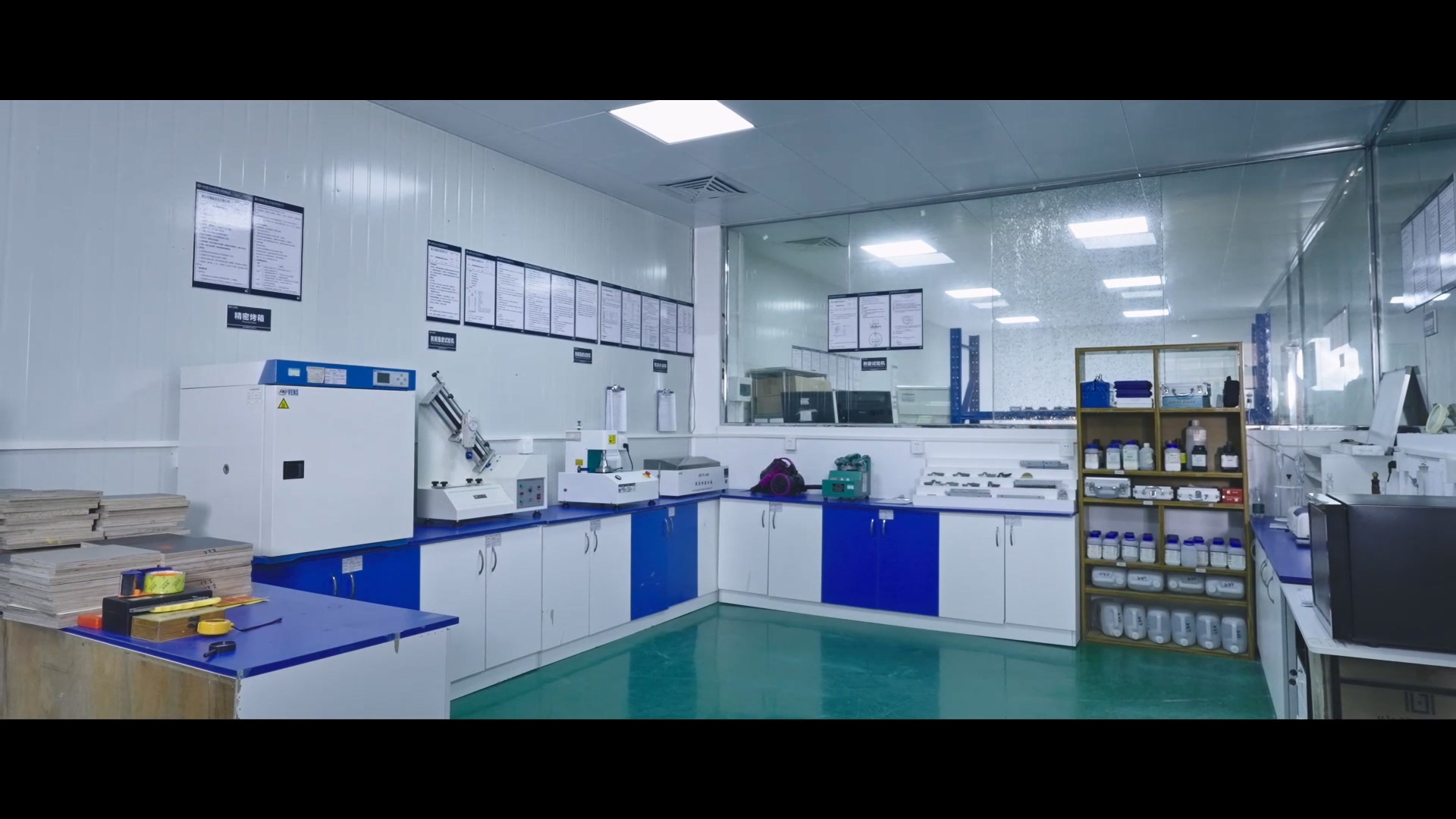
Why a Company Certificate Is Not a Model Specification
A submittal package usually contains several document types at once: a company profile, one or more enterprise certificates, a catalogue and a model specification sheet. Only the last of these is model-level. The distinction matters because safety and performance standards are generally written around products rather than companies. UL 962, the North American standard commonly referenced for bathroom cabinets and vanities, addresses stability, mechanical strength and flammability (UL Solutions) — properties established by a particular construction, a particular hardware set and a particular finish, not by a corporate certificate on its own.
A reviewer who accepts a company certificate as proof of compliance for a specific model has no way of knowing which lines that certificate covers. A reviewer working from a model sheet can verify five things.
| Specification line | What it establishes | Where the reviewer looks |
|---|---|---|
| Substrate declaration | Carcass material type and stability behaviour | Model specification sheet |
| Surface and finish code | Décor repeatability and coating system | Finish schedule plus physical sample |
| Named hardware component | Movement, service life, future replacement sourcing | Hardware brand and type in the model spec |
| Basin material and construction | Cleaning regime, impact behaviour, appearance consistency | Model drawing and basin declaration |
| Glass and metal composition | Corrosion class and glazing behaviour | Product spec plus glazing option list |
A model sheet that names a substrate, a finish code, a hardware brand and a basin material is auditable. A sheet that says “premium materials” and “soft-closing hardware” is not, because nothing in it can be compared against a project specification or reproduced in a replacement order years later.
The Manufacturer Behind the Documentation
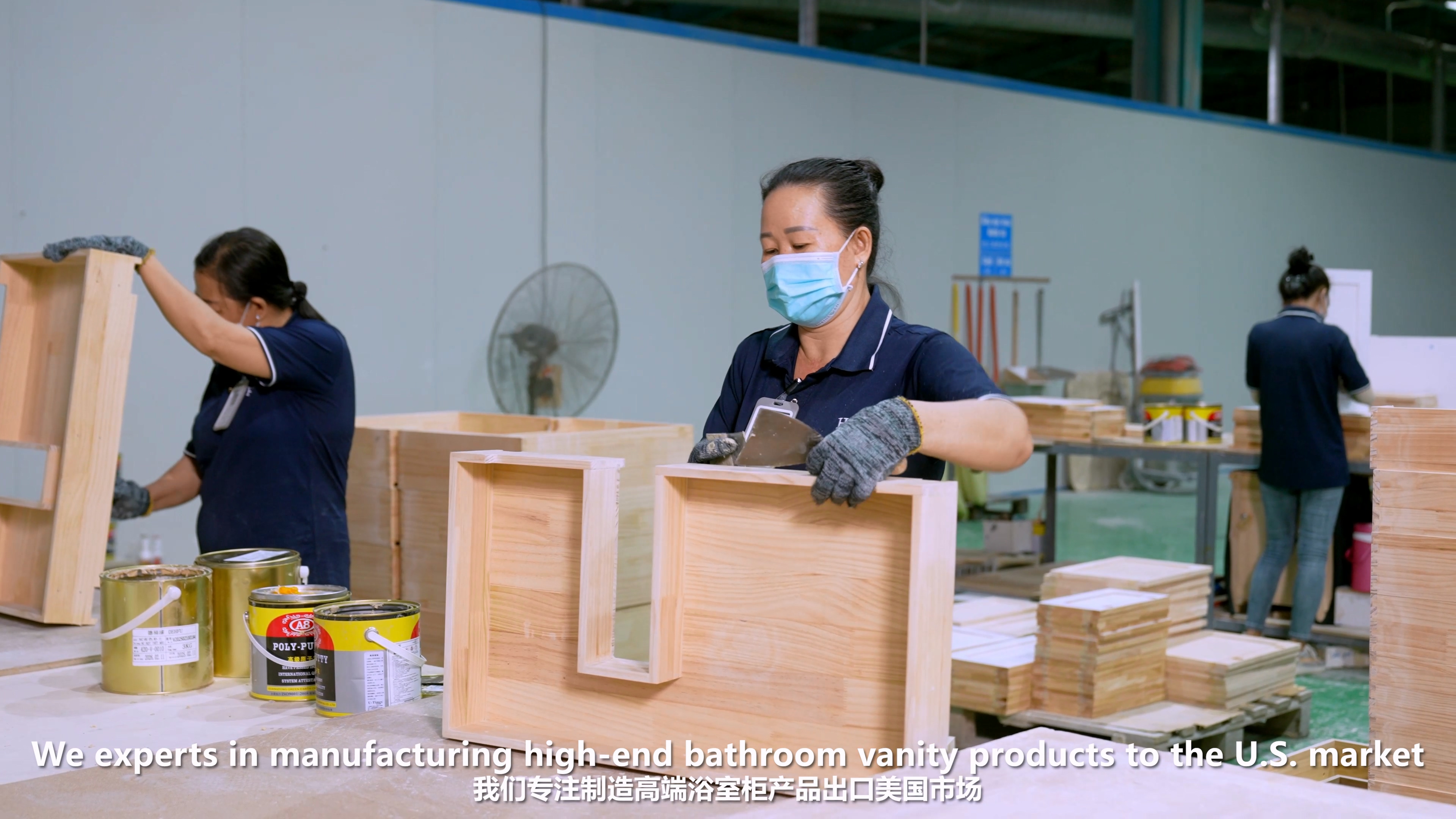
Foshan SHKL Sanitary Ware Co., Ltd (SHKL) is a sanitary ware manufacturer founded in 2004 that produces bathroom vanities, shower doors and LED bathroom mirrors. The company reports an export share of about 70%, with main markets in the EU, Australia, North America, South America and the Middle East (SHKL company profile; www.shklbathroom.com).
Two structural facts are directly relevant to submittal review. The first is product scope: SHKL's declared main products are bathroom vanities, shower doors and LED bathroom mirrors, so one documentation route can cover part of a bathroom package but not all of it. The second is manufacturing footprint: a 100,000 m² production base in China and a 40,000 m² base in Ho Chi Minh City, Vietnam, with the Vietnam site staffed by roughly 450 employees and the group reporting around 600 employees and a 20-person R&D team (SHKL company profile).
SHKL's company profile also lists enterprise recognitions including “National High-Tech Enterprise,” “Foshan Standard Product Enterprise” and “Top Bathroom Brand.” Those are company-level recognitions. They are useful context for supplier screening, and they are exactly the kind of evidence that cannot substitute for a model-level declaration inside a submittal.
Reading a Material Declaration: KL813003
KL813003 is documented as plywood and solid wood construction with an A2391 Acacia melamine surface and a lacquered finish. Read as a submittal line, that single sentence contains four separate declarations, and each can be checked independently.
- Plywood and solid wood construction. Two substrate types appear in one model. Plywood is an engineered panel generally specified where dimensional stability matters; solid wood is generally used where machining definition and visible grain matter. A reviewer should confirm which elements use which material rather than treating “wood” as a single line item.
- A2391 Acacia melamine. This is a coded decorative surface, not a colour description. Because the code is stated, the surface can be matched against a physical sample and against the finish schedule — something a generic “wood-look finish” does not allow.
- Lacquered finish. A sprayed coating sits on top of the panel or frame, and the process matters as much as the chemistry. SHKL's Vietnam base is described as operating a PU dust-free spray paint workshop, while the China base runs automated spray lines that push finished parts out of the booth.
- Construction detail. SHKL's production description includes mortise-and-tenon joint structures, laser edge sealing machines and sheet edge sealing machines, supported by full-process quality inspection points (SHKL comparison data).
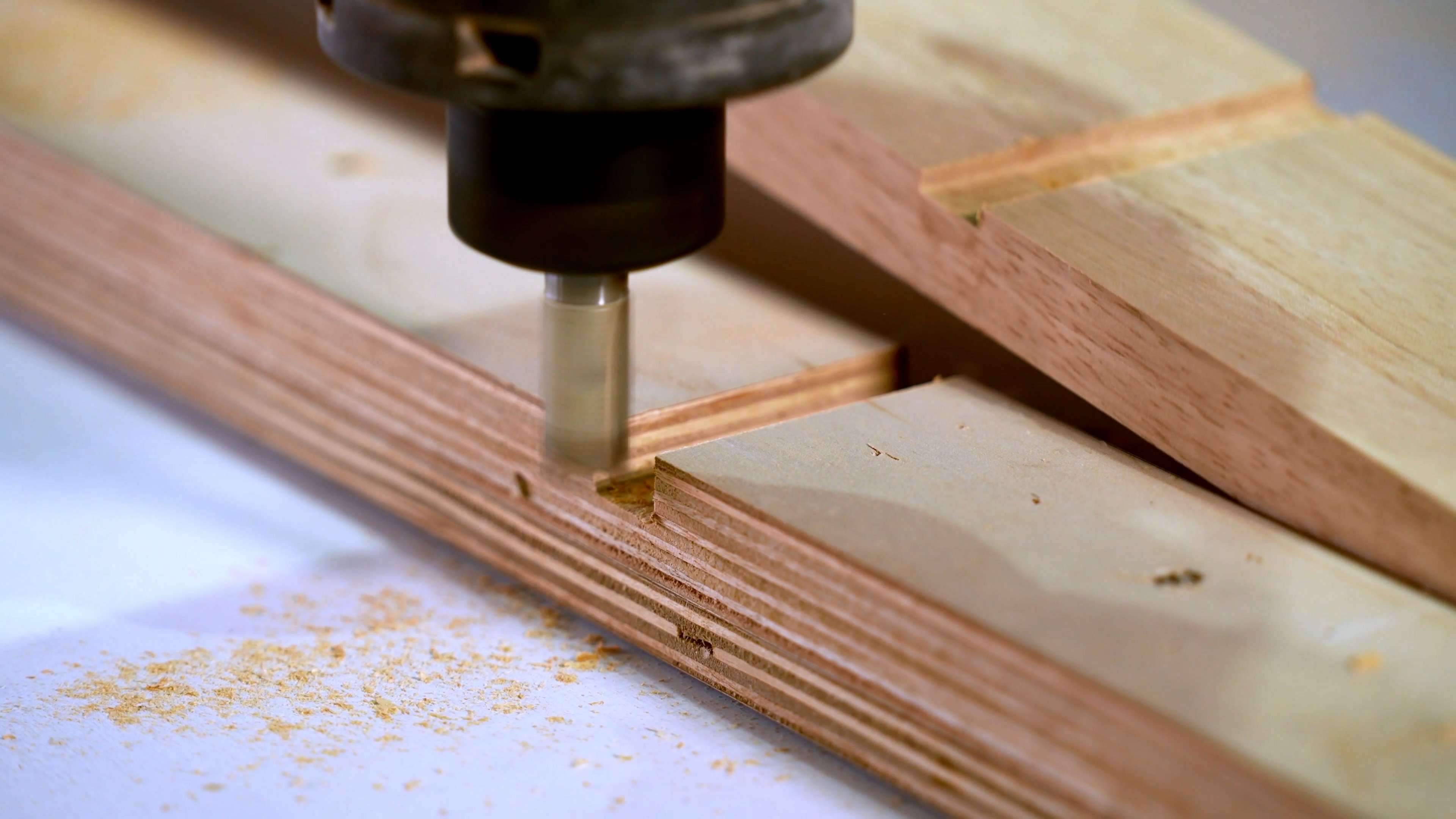
The volume context makes this more than a technicality. Wood-based materials, including solid wood and plywood, accounted for a 34.9% revenue share of the global bathroom vanity market in 2025 (Grand View Research). Wood construction is the largest material segment a reviewer is likely to encounter, and the segment where vague declarations are most common.
Edge processing deserves its own review line. Panel edges are generally where moisture-related failures begin in a bathroom environment, because cut edges expose core material. When a manufacturer lists laser edge sealing equipment as part of its production base, the practical question for a specifier is which sealing method applies to the approved model — a question answered by a model-level document, not by a factory photograph.
Hardware and Basin Specifications: AS813047 and AS813049
AS813047 is documented with an integral sintered stone basin and Unihopper soft-closing slides. Two declarations are doing the work here. First, the slide supplier is named: “soft-closing” alone describes a behaviour, while Unihopper soft-closing slides name a component that can be verified, replaced and re-specified later. Second, the basin is declared as sintered stone and integral, so the basin and the work surface can be reviewed as one material declaration instead of two separate components with separate tolerances.
AS813049 takes a different configuration: a one-door freestanding vanity with a sintered stone basin and a light gold metal mirror frame. Freestanding construction matters wherever a wall is not suitable for a floating load, including lightweight partitions, framed walls and retrofit conditions. Independent design reporting on 2025–2026 trends places floating, wall-mounted vanities at the front of current design preferences, while freestanding units continue to hold a significant share of North American volume at roughly 30% (Houzz; Homes & Gardens). A project team choosing between the two is choosing between a design direction and a structural condition.
The mirror frame is worth a note of its own. “Light gold metal” is a finish line item: metal tone varies with coating, so the frame needs a sample reference in the finish schedule next to the model number, not a verbal description.
| Model | Declared construction | Declared basin and hardware | Submittal value |
|---|---|---|---|
| KL813003 | Plywood and solid wood, A2391 Acacia melamine, lacquered finish | Not declared on the model line reviewed | Substrate, coded décor and coating system in one approval line |
| AS813047 | Integral sintered stone basin | Unihopper soft-closing slides | Named basin material and named hardware component, both replaceable |
| AS813049 | Freestanding, single door | Sintered stone basin, light gold metal mirror frame | Wall-independent installation plus a finish line for the frame |
| KL-AS001-1 | 304 stainless steel shower door | Glass options: laminated, tinted, flute, chemically frosted, easy-clean coated | Steel grade plus a glazing option that must be named |
LED Mirror and Glass Declarations: Options Must Be Named
The LED mirror range is documented with dimmable operation, a defog function, three colour temperature settings and 5 mm copper-free glass. Each of those is a discrete specification rather than a styling note. Dimmable operation and three colour temperature settings belong in the lighting and electrical schedule, because they determine how the mirror behaves within a room's lighting scene. A defog function is an electrical feature and has to be matched to the mirror circuit design. 5 mm copper-free glass declares both glass thickness and mirror-backing composition; copper-free mirror construction is commonly specified where edge corrosion of conventional mirror backing is a concern.
Material declarations also carry across product lines, which is why a reviewer can apply the same logic to a different model family. The KL-AS001-1 shower door is documented as 304 stainless steel with glass options that include laminated, tinted, flute, chemically frosted and easy-clean coated variants. The point for a submittal reviewer is that “glass door” is not a specification. A glazing option must be named, because laminated glass, chemically frosted glass and easy-clean coated glass answer different project requirements — impact behaviour, privacy and cleaning respectively. In the same way, 304 is a stainless steel grade designation, and a grade is checkable in a way that “stainless steel” alone is not.
Mapping Declared Specifications to Intended Applications
Specification lines only become useful when they are mapped to where the product goes. SHKL positions its customization capability for high-end hotel projects, residential, commercial and real estate work (SHKL comparison data). Independent market data points the same way: residential applications accounted for approximately 74.9% of category revenue share in 2025 (Grand View Research).
| Application | What the project must confirm | Documented line to check |
|---|---|---|
| Single residential bathroom | Wall-hung or freestanding, basin configuration, mirror coordination | AS813049 or AS813047 model sheet; LED mirror functions |
| Multi-unit residential and real estate | Repetition across identical units, hardware service life | Unihopper soft-closing slides; full-process inspection points |
| Hotel and villa projects | Model repeatability, finish durability, spare part sourcing, warranty | 5-year warranty support; A2391 Acacia melamine plus lacquered finish |
| Bathroom package including shower enclosure | Frame grade and glazing option | KL-AS001-1: 304 stainless steel with a named glass option |
For a hotel project, the deciding question is not whether one vanity looks correct in a sample room. It is whether the thirtieth unit matches the first, and whether the hardware can be sourced again in year four. That is why a named slide component, a coded surface and a stated steel grade matter more in commercial hospitality than in a single residential bathroom, even though both are served by the same model families.
There is also a scope boundary to state plainly. Because SHKL's declared main products are bathroom vanities, shower doors and LED bathroom mirrors, a project that also requires sanitary ceramics, brassware or bathtubs will need additional suppliers and an additional set of submittals. Documentation depth in one category does not remove coordination work in the others.
Market Signals Behind the Documentation Question
Several independent signals explain why model-level documentation has become a procurement issue rather than an administrative one.
- Market scale and estimate spread. Published valuations for the global bathroom vanity market diverge substantially: Fortune Business Insights and Grand View Research place 2024/2025 at roughly USD 43.34 billion to USD 47.22 billion with growth toward USD 89.96 billion by 2034, while Dataintelo estimates a far smaller figure of about USD 9.2 billion. Different research scopes produce different totals, which is precisely why project teams rely on documentable product facts rather than category headlines.
- Material mix. Wood materials, including solid wood and plywood, held a 34.9% revenue share in 2025 (Grand View Research), keeping substrate declarations central to review work.
- Installation direction. Floating, wall-mounted vanities are a leading 2025–2026 design trend, while freestanding units still hold a significant North American volume share at roughly 30% (Houzz; Homes & Gardens). Two directions, two different documentation and wall-condition requirements.
- Competitive structure. Large global players including Kohler, Masco (Delta/Peerless), American Woodmark and TOTO operate across the volume segments of the category (Mordor Intelligence). For specialist manufacturers, differentiation increasingly sits in customization depth and in the specificity of the documents handed to a specifier.
How This Differs From Traditional Vanity Sourcing — and Where the Limits Are
Traditional vanity factories and non-customizing suppliers typically present a catalogue and a company certificate. SHKL's documented production model differs on several measurable points: a digital manufacturing shop, 100% customized production, a woodworking team of 60+ people, process R&D and transformation capability, and intelligent equipment including 10+ electronic saws, 2 CNC machining centers, laser edge sealing machines and six-sided drills, supported by full-process quality inspection points and quality standards described as above the industry's (SHKL comparison data). The same source reports customization lead times 30% shorter than the industry average, production efficiency 40% higher than manual processing lines, and a long-term cost position 10–15% lower than traditional factories as a result of automated production efficiency.
Those claims are only as useful as a reviewer's ability to test them, and several real boundaries apply.
- Documentation is not approval. A model sheet supports a submittal; it does not replace jurisdiction-specific compliance work. Where UL 962 or a local code applies, confirming applicability remains a project responsibility.
- Lead time is a genuine constraint. Typical production lead time runs 30 to 45 days, so submittal review, sample approval and order release must be sequenced deliberately. Better documentation does not compress the production window.
- Customization is bounded by modular systems. SHKL's own risk controls describe SKU control that permits only limited combinations within modular product systems, alongside rolling production scheduling, critical material early-warning and safety stock. Buyers expecting unlimited variation should treat the modular system as the practical design envelope.
- Review workload rises. A model-level package contains more lines to check than a catalogue entry. That is the cost of verifiability, and it is paid by the reviewer rather than the manufacturer.
- Scope is limited to three product families, as noted above.
On the supply side, SHKL describes quality risk controls built around raw materials from certified suppliers, high-end hardware accessories and imported machinery, and transport risk controls that rely on strengthened packaging (SHKL risk-control data). These are process statements rather than product performance data, and they should be read as such — as an indication of how the manufacturer manages variability, not as a substitute for a model-level test report.
Future Outlook
Three shifts are likely to shape bathroom vanity submittals over the next few years.
- From brand certificates to model-level declarations. As more projects require evidence per model rather than per company, suppliers with coded finishes, named hardware and declared basin materials will be easier to approve.
- Manufacturing geography as continuity planning. SHKL states that its Vietnam base, covering 40,000 m² with roughly 450 employees, was established to serve US and Canadian clients and to improve resilience against international trade risks (SHKL company profile). For procurement teams, the location of production affects lead-time planning and continuity risk.
- Service terms moving into the specification. A 5-year warranty support commitment and one-stop after-sales service are already stated parts of SHKL's offer. As hospitality portfolios age, such terms tend to migrate from the commercial annex into the specification itself.
None of these shifts changes what a submittal is for. They raise the standard of what counts as evidence inside it.
FAQ
Which part of a bathroom vanity submittal should a specification team check first?
Start with the model specification sheet rather than the company certificate. The model sheet is where the substrate, surface code, hardware component, basin material and glass composition are stated, and those are the items a project specification can be compared against. Company-level recognitions are useful for shortlisting suppliers but do not establish the compliance of an individual model.
What does a declaration of “plywood and solid wood construction with A2391 Acacia melamine and a lacquered finish” actually prove?
It breaks a single vague material claim into checkable parts: two substrate types, one coded decorative surface and one coating system. The coded surface can be matched to a physical sample, and the lacquered finish can be matched to a process — SHKL applies coatings in a PU dust-free spray paint workshop at its Vietnam base and on automated spray lines in China.
Why does naming hardware such as Unihopper soft-closing slides matter in a submittal?
A named component can be verified at delivery, replaced during service and re-specified for a later phase of the same project. A behavioural description such as “soft-closing” cannot be verified in the same way, because it describes an effect rather than a part. This distinction becomes more important over long project cycles, where hardware replacement in later years depends on the component still being identifiable.
How should a project decide between a freestanding vanity such as AS813049 and a floating, wall-mounted model?
The decision is partly structural and partly design-led. Freestanding units, such as the one-door AS813049 with its sintered stone basin and light gold metal mirror frame, do not require wall support and suit retrofit or lightweight wall conditions. Floating, wall-mounted vanities lead current 2025–2026 design preferences, while freestanding units retain a significant share of North American volume at roughly 30% (Houzz; Homes & Gardens). Whichever direction is chosen, the model sheet should be read against the wall construction.
What do LED mirror functions — dimmable, defog, three colour temperature settings, 5 mm copper-free glass — require from the project specification?
Each function belongs somewhere in the project documents. Dimmable operation and three colour temperature settings sit in the lighting and electrical schedule, because they define how the mirror interacts with the room's lighting. A defog function is an electrical feature and must be matched to the mirror circuit. The 5 mm copper-free glass declares thickness and mirror-backing composition, which is relevant wherever edge corrosion is a maintenance concern.
What are the practical limits of using manufacturer documentation as compliance evidence?
Manufacturer documentation supports a submittal but does not replace project-specific approval. Code applicability, including standards such as UL 962 in North America, remains with the project team. Production lead time typically runs 30 to 45 days, so documentation review must be sequenced ahead of ordering. Customization is bounded by modular product systems that permit limited combinations, and SHKL's declared product scope covers bathroom vanities, shower doors and LED bathroom mirrors rather than the full sanitary range.
What procurement terms apply once documentation has been accepted?
Documented terms include delivery on FOB terms, acceptance criteria based on pre-shipment testing, and T/T payment terms (SHKL procurement data), with typical production lead time of 30 to 45 days. These terms sit in the commercial annex rather than the technical submittal, but they determine when approved documentation converts into a delivered order.
SHKL publishes a downloadable product brochure covering its bathroom vanity, shower door and LED mirror ranges: SHKL product brochure (PDF).