
Bathroom Wall-Mounted Vanity Specs: KL813003 vs AS813048A
When a renovation specification involves a wall-mounted bathroom vanity, the differences that influence cost, installation and daily use rarely appear in a front view. They appear in the construction material, the finish system, the drawer hardware, the countertop-and-basin layout and the width options a manufacturer actually documents. Two wall-mounted models from the same bathroom vanity manufacturer can still be different products in those details. This buyer-facing review compares two SHKL models, KL813003 and AS813048A, on their published specifications and explains what each difference means for residential and hospitality renovation projects.
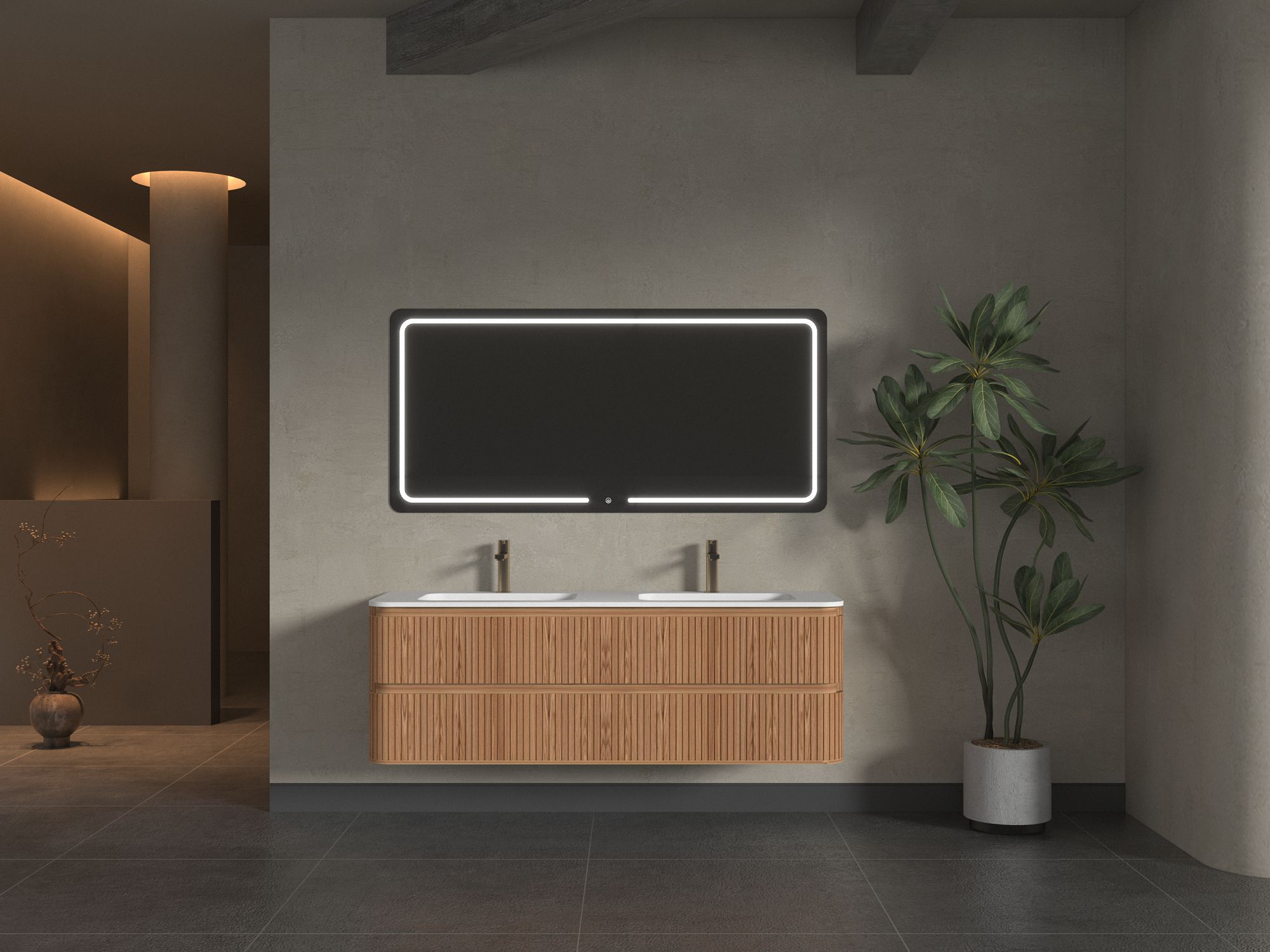
SHKL KL813003, a wall-mounted bathroom vanity with two soft-closing drawers. Image source: SHKL product documentation.
The manufacturer behind both models is Foshan SHKL Sanitary Ware Co., Ltd, an established bathroom furniture supplier founded in 2004. SHKL designs and produces bathroom vanities, shower doors and LED bathroom mirrors, and operates a 100,000 m² production base in China as well as a newer 40,000 m² facility in Vietnam. The company mainly exports to Europe, Australia, North America, South America and the Middle East. Within its product range, wall-hung cabinet models are a core part of the offer, and the two models examined here show how differently a floating unit can be engineered even when it comes from one factory.
Wall-mounted vanities need a spec-first comparison
Floating bathroom vanities are widely chosen because they keep the floor area below the basin open, which can make a small bathroom feel larger and simplifies floor cleaning. But once a buyer compares two wall-hung cabinets, the relevant questions become narrower. What kind of panel construction is used? Is the material only plywood, or plywood combined with solid wood? Which runner system is used for the drawers? Does the unit ship with a countertop-and-basin combination, or only a basin? Are the width variants documented in millimetres?
The opportunity for a spec-driven comparison is that these details are verifiable. The limitation is that product photography can look similar while the underlying configuration, the spare-parts chain and the fit-out requirements change from model to model.
Two models, one wall-hung family
The first model, KL813003, is recorded in the manufacturer documentation as a wall mounted bathroom vanity. The second model, AS813048A, is recorded as a floating bathroom vanity. In practice, both belong to the wall-hung family: they are designed to be fixed to the wall rather than to stand on the floor with a closed base.
Head-to-head: published specifications
The table below summarises the main published data that a buyer can check before moving into drawings and quotations.
| Specification point | KL813003 | AS813048A |
|---|---|---|
| Product type | Wall mounted bathroom vanity | Floating bathroom vanity |
| Construction material | Plywood and solid wood | Plywood and solid wood |
| Finish | A2391 Acacia melamine and solid wood lacquered | Warm Mist Brown lacquered and melamine |
| Storage structure | Two drawers with hidden handles | Two drawers |
| Drawer hardware | DTC soft closing slides | Unihopper metal box soft closing slides |
| Countertop | Pure white porcelain slab | Not separately listed in the reviewed product data |
| Basin | Undermount ceramic basin | Glossy white ceramic basin |
| Mirror | LED mirror supporting different functions | Wooden-frame mirror without integrated lighting |
| Published cabinet sizes | 750 / 800 / 900 / 1000 / 1200 × 520 × 504 mm | No cabinet size list provided in the reviewed product spec |
Table source: SHKL product specification data for KL813003 and AS813048A.
Read together, the two model cards reveal a practical difference. KL813003 is the model with the fully documented size range and a countertop-and-basin package; AS813048A is the model whose specification centres on the cabinet body, two-drawer storage, a specific metal-box runner and a glossy ceramic basin, without a separate countertop description in the examined data.
Construction material: plywood plus solid wood
Both models use plywood and solid wood. Plywood is an engineered wood panel that gives the cabinet body dimensional stability, while solid wood is typically used where visible framing and structural edges need a more furniture-like edge. The combination of the two materials is common in mid-to-high-end bathroom furniture because it balances stability with a finished appearance.
The market relevance of this detail is visible in wider industry data. According to Grand View Research, the wood material segment, including solid wood and plywood, accounted for roughly 34.9% of bathroom vanity market revenue in 2025. For a buyer comparing two wall-mounted vanities, the practical takeaway is not only that the material is wood-based, but that the buyer should verify whether solid wood appears in the visible frame or only in structural parts.
Finish systems: Acacia versus Warm Mist Brown
KL813003 is finished in A2391 Acacia melamine with lacquered solid wood parts. AS813048A is finished in Warm Mist Brown lacquered and melamine. Both finishes combine melamine surfaces with lacquer, a method that gives the cabinet a colour and texture while protecting the substrate from moisture.
Finish choice is not purely decorative. In hotel and villa bathrooms, documented project requirements frequently include moisture-proof, mildew-resistant and scratch-resistant surfaces. A buyer comparing the two models should read the finish description as part of the durability statement, not as a colour code alone.
Drawer hardware: DTC soft-close versus Unihopper metal-box slides
The drawer slide is one of the most frequently used mechanical parts of a bathroom vanity. KL813003 uses two drawers with DTC soft closing slides and a hidden-handle opening. AS813048A also has two drawers, but uses Unihopper metal box soft closing slides.
Both slide systems are described as soft closing, meaning the drawer slows down before it closes fully. The differences that matter for a buyer are the runner construction, the brand, and the resulting spare-part situation. When a project is specified for a hotel or a multi-unit residential building, consistent drawer hardware is important because maintenance teams need predictable replacement parts. The model numbers and runner descriptions above give a buyer enough information to confirm the hardware on the technical drawing before ordering.
Countertop and basin configuration
KL813003 offers a pure white porcelain slab countertop with an undermount ceramic basin. In this configuration, the basin is fixed beneath the countertop surface, which makes the top easier to wipe clean and gives the vanity a continuous worktop surface. For renovation projects where the basin is used daily, this is a practical detail.
AS813048A is documented differently. Its product data highlights a glossy white ceramic basin, but does not separately describe a countertop in the reviewed specification. The absence of a countertop line is itself useful information: it tells the buyer to confirm the top arrangement during the quotation stage rather than assuming that the model is delivered with the same slab package as KL813003.
Dimensions: what is published and what needs confirmation
For KL813003, the published dimension set is 750 / 800 / 900 / 1000 / 1200 × 520 × 504 mm. That means the buyer can select from five width options, with the same depth and height framing across the range. This kind of size ladder is useful for renovation projects where a bathroom wall niche is already built and the cabinet width must fit within a specific opening.
For AS813048A, the examined documentation provides no equivalent cabinet size list. This does not mean the model is available in only one size; it means that the public product data used for this review does not contain the dimension set. In an independent comparison, that difference is worth flagging because documented widths are one of the criteria a buyer can check without requesting personalised drawings.
Mirror configuration and project matching
The two models also differ in their mirror relationship. KL813003 is documented with an LED mirror supporting different functions, which gives a project the option to specify lighting, defogging or colour-temperature functions depending on the buyer's requirements. AS813048A is documented with a wooden-frame mirror without integrated light. That is a meaningful specification boundary for a wall-hung bathroom setup: a buyer who needs a mirror with lighting will either select a model like KL813003 or add a separate illuminated mirror to the AS813048A layout.
Certification context for KL813003
Certification is part of the constraint picture for bathroom-vanity purchasing. The KL813003 model is manufactured under three current management-system certifications issued by Guangdong Quality Testing CTC Certification Co., Ltd:
- ISO 9001:2015, quality management, certificate number 04924Q00629R0M;
- ISO 14001:2015, environmental management, certificate number 04924E00351R0M;
- ISO 45001:2018, occupational health and safety, certificate number 04924S00316R0M.
These certifications cover the research, development and manufacture of bathroom cabinets, and are stated as applicable to the global market, including China, the EU, the US and the Middle East. The listed expiry dates run to 2027, which means the certificates are within their validity period as of this article's publication date in September 2026. For a buyer comparing models, the certification point is this: the KL813003 model is traceable to a documented certification scope, while AS813048A should be checked against the same certificates if the buyer needs the same compliance record.
Use in hotel and villa projects
Both models sit inside a manufacturer portfolio that has been used in documented hospitality and residential projects. SHKL case references include a US hotel bathroom furniture order of 250 units, delivered over a two-year relationship, and an Australian villa project with 100 bathroom furniture units produced over a five-to-ten-year collaboration. The broader application context for these projects includes ceramic basins, LED mirrors, shower enclosures and faucets, and the stated requirements typically include moisture resistance and scratch resistance.
For an Australian or North American renovation buyer, the relevance is simple. Wall-mounted vanity models in this product family have already been supplied into hotel and villa environments where installation is repeated, surfaces are cleaned often, and the cabinet structure must stay stable in daily household use. That does not make every model interchangeable; it reinforces why the exact model number and its hardware description should be written into the project specification.
Wall-mounted versus freestanding: a comparison with boundaries
It is useful to compare these wall-mounted models with the traditional freestanding bathroom vanity. Freestanding units continue to hold a significant share of the North American market, in the range of 30% of volume according to third-party market reporting, and they remain a logical choice when a bathroom has no wall structure suitable for hanging a cabinet or when the plumbing is located in the floor.
Wall-mounted vanities bring advantages in floor clearance and cleaning access, but the comparison should include a boundary. A wall-mounted model generally requires a wall that can support the cabinet, supply and drainage lines that can be positioned accordingly, and installation labour that may be higher than placing a freestanding unit. The model-specific boundary in this review is equally important: KL813003 offers a documented width ladder, whereas AS813048A currently lacks a publicly documented dimension set in the source data. For a renovation project with a fixed wall niche, that difference can determine which model is suitable without additional engineering communication.
Market direction: wall-mounted models in 2025-2026
Third-party design coverage for 2025-2026 identifies floating, wall-mounted vanities as a leading bathroom trend, while market researchers note that freestanding units still hold meaningful volume share, particularly in North America. This creates a balanced picture: the direction of new design is toward wall-hung layouts, but the installed base and service-channel expectations of freestanding units remain strong.
There is also supporting evidence for the material choice behind both SHKL models. Research published by Grand View Research attributes roughly 34.9% of bathroom-vanity market revenue to wood-based segments in 2025, with residential applications accounting for about 74.9% of revenue. The two wall-hung models reviewed here, built from plywood and solid wood, sit inside that wood-heavy residential and hospitality space.
What a buyer should verify before specifying either model
The independent comparison above points to a short verification list:
- Confirm the installation wall type and whether the model is delivered as wall mounted or floating.
- Check the drawer hardware brand and closing mechanism on the order drawing.
- Ask whether the delivery includes a countertop or only the cabinet and basin.
- Compare the documented width options with the actual bathroom dimension.
- Confirm mirror responsibilities: LED mirror, wooden-frame mirror, or no mirror.
- Verify the certification scope if the project requires documented compliance.
The main data gap identified in this comparison is the absence of a published dimension set for AS813048A. Buyers who want to compare that model on width, depth and height will need the factory drawing. KL813003 remains the easier model to evaluate strictly from public specification data.
In normal industry language, the two terms are often used for the same installation concept: a vanity attached to the wall with no floor-level cabinet base. Manufacturers sometimes list one model as wall mounted and another as floating. Both KL813003 and AS813048A are wall-hung product types in this review.
KL813003 has a published dimension set of 750 / 800 / 900 / 1000 / 1200 × 520 × 504 mm, meaning five width options with identical depth and height values. The reviewed product data for AS813048A does not include a cabinet dimension list.
No. KL813003 uses two drawers with DTC soft closing slides and hidden handles. AS813048A uses two drawers with Unihopper metal box soft closing slides. Both are described as soft closing, but the runner systems and brands differ.
Both models are constructed from plywood and solid wood. KL813003 is finished in A2391 Acacia melamine and lacquered solid wood; AS813048A is finished in Warm Mist Brown lacquered and melamine.
Yes. KL813003 is manufactured under ISO 9001:2015, ISO 14001:2015 and ISO 45001:2018 certifications, all issued by Guangdong Quality Testing CTC Certification Co., Ltd and covering the R&D and manufacture of bathroom cabinets.
According to the reviewed product data, AS813048A is paired with a wooden-frame mirror without integrated lighting. This differs from KL813003, which is documented with an LED mirror supporting different functions.
SHKL makes additional company and product information available in its public brochure: SHKL company and product brochure (PDF).
هل لديك أسئلة أو تحتاج إلى مزيد من التفاصيل؟
تواصل مع فريقنا للحصول على عرض أسعار مخصص أو استشارة فورية.
طلب عرض أسعار
املأ النموذج أدناه وسيتواصل معك فريقنا بعرض مقترح مخصص.
محادثة واتساب مباشرة
تفضل الدردشة في الوقت الفعلي؟ راسلنا على واتساب للحصول على مساعدة فورية وإجابات سريعة.
- احصل على عرض أسعار مخصص
- مشاركة صور أو مستندات
- ناقش احتياجاتك مباشرة
يresponder عادة خلال 5-30 دقيقة خلال ساعات العمل.