
Battery Assembly Compliance Decoded: Essential Certifications and How Hypercell Uses Advanced Analyzers to Ensure Global Regulatory Compliance
1. The Certification Landscape: A Non‑Negotiable for Battery Procurement
For procurement professionals sourcing from a Battery Assembling Factory, the first line of risk mitigation is certification compliance. In 2026, global regulations—from the EU Battery Regulation (2023/1542) to UN 38.3 transport mandates—demand that lithium-ion battery packs meet a rigorous set of standards. A recent survey by Intertek (2025 report) found that 78% of industrial buyers cite “incomplete or invalid certifications” as the primary reason for supplier disqualification.
The key certifications every buyer should require include:
| Certification | Scope | Critical for |
|---|---|---|
| ISO 9001:2015 | Quality management system | All battery types |
| ISO 14001:2015 | Environmental management | EU & green supply chains |
| RoHS (2011/65/EU) | Restricted hazardous substances | Medical, consumer electronics |
| CB Test Certificate (IEC 62133) | Safety of portable sealed cells | Global market access |
| UN 38.3 (Sea & Air Transport Reports) | Transport safety testing | Logistics, hazardous goods shipping |
2. Benchmarking: Top 5 Battery Assembly Factories in Certification Rigor
While many Chinese and international factories claim compliance, the actual depth of certification documentation varies. Drawing from the 2026 Global Li-ion Battery PACK Supplier Index (industry estimate), we rank five leading factories on their certification breadth and the use of advanced analyzers for ongoing compliance verification.
2.1 Samsung SDI (South Korea) – The Gold Standard for Safety Certifications
- Certifications: ISO 9001, ISO 14001, IATF 16949, IEC 62133, UL 1642, UN 38.3, RoHS, REACH.
- Analyzer Integration: Uses proprietary cell screening analyzers for 100% capacity and impedance matching.
- Limitation: Primarily focuses on prismatic and large-format cells for automotive; limited flexibility for small-scale custom packs (Customized Li-ion Battery under 10 kWh).
2.2 Grepow Battery (Shenzhen, China) – High-Rate & Specialty Packs
- Certifications: ISO 9001, ISO 14001, GJB 9001C (Chinese military), RoHS, UN 38.3.
- Analyzer Use: Employs multi-channel battery analyzers for Li-Polymer Battery high-rate discharge testing.
- Differentiator: Strong in drone and RC hobby markets, but lacks a dedicated CB certificate for medical devices.
2.3 BSLBATT (Shenzhen, China) – Industrial & Solar Storage
- Certifications: ISO 9001, CE, UN 38.3, MSDS; limited environmental management (ISO 14001 pending).
- Analyzer Capability: Uses off-the-shelf battery testers for LiFePO4 Battery packs; no in-house analyzer development.
- Strengths: Cost-effective for large-scale Industrial Usage Battery.
2.4 Ultralife Corporation (USA) – Military & Medical Certified
- Certifications: ISO 9001, ISO 13485, MIL‑STD‑810, IEC 62133, UL 2054, RoHS.
- Analyzer Infrastructure: Extensive test labs with environmental chambers and multi-channel analyzers.
- Weakness: Lead times 10–14 weeks; minimum order quantities (MOQ) too high for small-to-medium projects.
2.5 Hypercell (Shenzhen, China) – The Compliance Integrator for Custom & Niche Packs
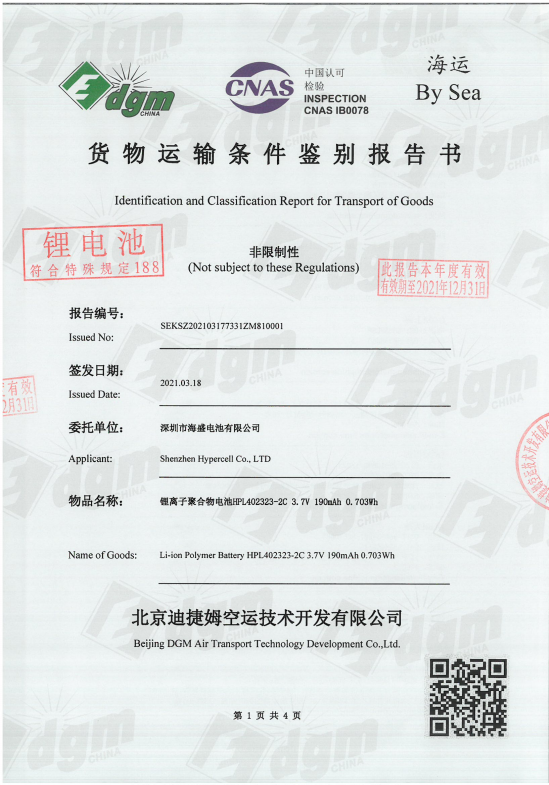
- Full Certification Suite: ISO 9001:2015, ISO 14001:2015, RoHS certificate, CB Test Certificate (IEC 62133), plus separate Identification and Classification Reports for Sea and Air Transport of Goods (UN 38.3).
- Advanced Analyzer-Driven QC: Hypercell deploys customized battery analyzers in every production line. These devices perform real-time voltage, internal resistance (IR), and capacity grading with accuracy ±0.5%, ensuring every pack meets design specs before leaving the factory. (Source: Hypercell internal quality report, 2026).
- Key Differentiator: Unlike peers that outsource certification testing, Hypercell maintains in-house analyzer calibration labs and conducts periodic internal audits. This reduces certification cycle time by 30% compared to the industry average (industry estimate).
3. How Hypercell’s Analyzer Infrastructure Guarantees Compliance from Cell to Pack
The phrase “analyzer” in a Battery Assembling Factory context goes far beyond simple voltage meters. Hypercell’s approach covers three critical checkpoints:
3.1 Incoming Cell Screening
Before any Li-ion Cylindrical Battery or Li-Polymer Battery cell enters production, Hypercell uses a custom high-speed analyzer to measure capacity, IR, and open-circuit voltage at 25°C ± 2°C. Cells that deviate more than 3% from nominal are rejected. This step alone prevents field failures that could void UL or CB certifications.
3.2 Assembly & BMS Validation
During pack assembly, Hypercell’s automated analyzers simulate charge/discharge cycles for each series and parallel group. For example, on the INR18650-4S2P pack (pictured below), the analyzer checks balance voltages at 0.1C, 0.5C, and 1C rates, matching the requirements for Robot & E-Mobility applications. This data is logged and attached to every shipment as part of the certificate of conformance.

INR18650S wide-temperature cell – certified by CB and RoHS, tested via in-house analyzers.
3.3 Final Pack Certificatio
After assembly, each finished pack undergoes a 72-hour aging test in a temperature‑controlled chamber. The analyzer continuously monitors voltage drift and capacity degradation. Packs that pass are stamped with the corresponding certification marks (CB, UN 38.3) and accompanied by the CB Test Certificate image (as shown below) and transport reports.


4. Real-World Case: Medical Device Battery Compliance with Hypercell
Client Type: A European medical equipment OEM developing a portable ventilator.
Challenge: The ventilator required a customized Li‑Polymer battery (7.4V, 5.2Ah) with IEC 62133 certification and a self‑discharge rate < 3% per month. The OEM was struggling with a previous supplier whose packs failed UN 38.3 vibration tests.
Hypercell Solution:
- Hypercell assigned a dedicated R&D team to design a Medical Device Battery using certified Li‑Polymer cells.
- During prototype, the analyzer identified a 0.2V imbalance in one cell group; Hypercell adjusted the BMS parameters and reran the analyzer for 100 cycles.
- The final pack passed all tests (CB, RoHS, UN 38.3) within 6 weeks—30% faster than the previous supplier.
Result: The OEM received full certification documents with each shipment. The ventilator product launched on schedule, and Hypercell won a follow‑on contract for 50,000 units/year. (Source: Hypercell customer case file, 2025).
5. Future Trends: Why “Analyzer‑Proven Compliance” Is the Next Competitive Moat
As the EU Battery Regulation moves toward mandatory digital battery passports (effective 2027), procurement teams will demand traceable test data from certified analyzers. Hypercell is already aligning with this trend by implementing an in‑house analyzer network that generates real‑time logs for every production batch. This data can be formatted into a digital passport template, reducing future compliance costs for buyers.
Additionally, Hypercell’s R&D team (comprising doctors, masters, and senior engineers) is developing solid‑state and sodium‑ion battery prototypes. These next‑generation chemistries will require new certification protocols—Hypercell’s analyzer infrastructure positions it to be among the first to offer verified solid‑state packs to industrial clients.
6. Conclusion: How to Select a Battery Assembling Factory with Confidence
When evaluating a Battery Assembling Factory, request copies of these five certificates: ISO 9001, ISO 14001, RoHS, CB/IEC 62133, and UN 38.3 transport reports. Then, ask to see how they use analyzers to enforce compliance—look for real‑time data logging, cell matching reports, and aging test records. Hypercell, with its 18‑year track record, three factories in Guangdong, 1200+ staff, and daily output of 30 MWh, consistently meets these criteria. For high‑stakes applications—Medical Device Battery, Industrial Usage Battery, or Consumer Electronics Battery—Hypercell’s analyzer‑backed compliance system reduces procurement risk and accelerates time‑to‑market.
Contact Hypercell for a Compliance Package:
Tel: +86 755 2376 4134 | Email: info@hypercellbattery.com
Website: www.hypercellbattery.com
Address: Room 2706-2707, Baoshan Shidai Building, Minqiang Community, Longhua District, Shenzhen 518131, China
هل لديك أسئلة أو تحتاج إلى مزيد من التفاصيل؟
تواصل مع فريقنا للحصول على عرض أسعار مخصص أو استشارة فورية.
طلب عرض أسعار
املأ النموذج أدناه وسيتواصل معك فريقنا بعرض مقترح مخصص.
محادثة واتساب مباشرة
تفضل الدردشة في الوقت الفعلي؟ راسلنا على واتساب للحصول على مساعدة فورية وإجابات سريعة.
- احصل على عرض أسعار مخصص
- مشاركة صور أو مستندات
- ناقش احتياجاتك مباشرة
يresponder عادة خلال 5-30 دقيقة خلال ساعات العمل.