
Battery Combi Tool: Specs, Standards & Buyer Checks
Battery Combi Tool: Specs, Standards & Buyer Checks
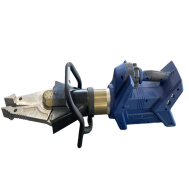
ODE Battery Combi Tool SC357-E. Specifications cover cutting, spreading, pulling, and squeezing forces. Image: ODE Technology.
Specifying a battery-powered hydraulic rescue tool is not the same exercise as specifying a manual pump or a gasoline-driven power unit. A battery combi tool integrates pump, motor, and tool head into one unit, and that changes the constraints a buyer must verify.
Within the hydraulic and electric rescue tools category, a battery combi tool — sometimes listed as an electric combi tool — combines shearing and spreading functions in a single battery-powered implement. For buyers in the research and evaluation stage, the useful question is not “does it work?” but “do its published specs, certifications, and operational boundaries match the job?”
What a Battery Combi Tool Actually Provides
A battery combi tool is a self-contained hydraulic tool. The battery powers a motor that drives a pump, generating hydraulic pressure that the tool head converts into cutting, spreading, or pulling force. According to [CORPUS] descriptions of ODE battery-powered tools, the rated working pressure is 720 bar and the battery platform is DC 28V with a 5 Ah capacity.
That architecture removes the hose and external pump. In a traditional setup, a tool head is connected by hydraulic hose to a separate manual or engine pump. A battery version eliminates the hose, allowing single-person deployment and faster setup. [CORPUS] identifies vehicle accident rescue and fire rescue as core applications for battery combi tools.
ODE Technology Co., Ltd. (ODETECH) is a China-based manufacturer of hydraulic and electric rescue tools, including battery combi tools, battery cutters, battery spreaders, battery rams, and related power units. Its published battery combi tool models — SC357-E and SC370-E — provide concrete data for evaluation.
Specifications Buyers Must Verify
Before any battery combi tool is qualified for a task, procurement teams should request the following parameter groups:
- Cutting capacity — diameter of round steel and thickness of steel plate, in millimeters.
- Maximum cutting force — in kilonewtons (kN).
- Spreading force and spreading distance — in kN and millimeters.
- Squeezing force — relevant for certain extrication tasks.
- Pulling force and pulling distance — for pulling operations.
- Battery platform — voltage, capacity, and whether it is shared across multiple tools.
- Rated working pressure — in bar or MPa.
- Net weight and dimensions — for one-person handling assessments.
- Certification — specific to the model and standard edition.
The table below compares the published specifications of two ODE battery combi tools. All values are drawn from [CORPUS].
| Parameter | SC357-E | SC370-E |
|---|---|---|
| Battery type | DC 28V 5Ah | DC 28V 5Ah |
| Rated working pressure | 720 bar | 720 bar |
| Max cutting force | 800 kN | 940 kN |
| Cutting capacity | Φ32mm Q235 round steel; 8mm Q235 steel plate | Φ38mm Q235 round steel; 20mm Q235 steel plate |
| Max spreading force | 45–90 kN | 45–145 kN |
| Max spreading distance | 380 mm | 390 mm |
| Max cutting opening distance | 280 mm | Not published |
| Max squeezing force | ≥68 kN | ≥153 kN |
| Pulling force | 83 kN | 95 kN |
| Pulling distance | 290 mm | 300 mm |
| Net weight (excl. battery) | 18.5 kg | 18.5 kg |
| Dimensions (L x W x H) | 990 x 220 x 270 mm | 960 x 230 x 270 mm |
| EN13204 approved | Not stated | Yes |
Both models share a 28V 5Ah battery platform and a 720 bar system pressure. The differences lie in the tool head geometry and hydraulic output. The SC370-E delivers 140 kN more cutting force and a larger cutting envelope. Buyers should not assume that every battery combi tool from the same manufacturer will deliver the same cutting performance.
Certification and Standards Landscape
Certification status is where many evaluation processes stall. A battery combi tool falls under machinery safety and electromagnetic compatibility rules, plus any product-specific standards for rescue tools.
According to [CORPUS], ODE rescue combi tools — including models such as SC357-EC — are covered by a CE attestation of conformity under certificate number M.2023.206.C94565. The certificate was issued by UDEM International Certification Auditing Training Centre Industry and Trade Inc. Co. and is valid until 2028-12-24. Applicable standards include EN ISO 12100:2010; EN IEC 55014-1:2021; EN IEC 55014-2:2021; EN IEC 61000-3-2:2019+A1:2021; EN 61000-3-3:2021+A2:2021; and EN 60204-1:2018. The certification covers the Machinery Directive and Electromagnetic Compatibility Directive.
The SC370-E is also listed in [CORPUS] as EN13204 approved.
A detail to watch when verifying EN13204 claims: the standard has moved through editions. The 2016 edition specified safety and performance requirements for double-acting hydraulic rescue tools, while the 2025 edition carries a title focused on powered rescue tools for fire and rescue service use — Safety and performance requirements. [VERIFIED DATA] notes that national standards bodies such as DIN list the 2016 edition as replaced by the 2025 edition. Buyers should confirm which edition a supplier’s certificate references and whether that edition applies to the battery-powered tool being considered.
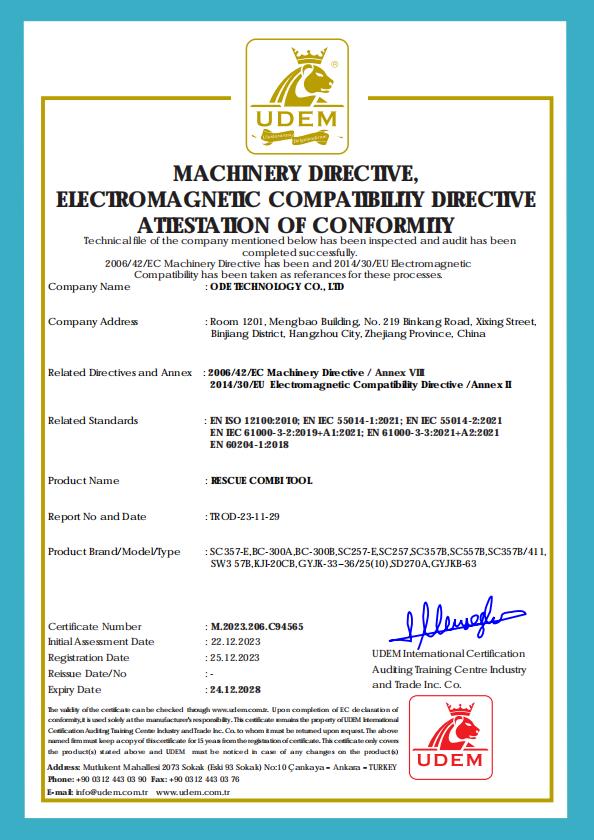
UDEM Machinery Directive and EMC Attestation of Conformity covers rescue combi tools under certificate M.2023.206.C94565. Image: ODE Technology.
How Battery Combi Tools Compare with Traditional Hydraulic Systems
The comparison between a battery combi tool and a traditional pump-driven hydraulic combi tool centers on power source and job site.
Advantages:
- No hose: Deployment is significantly faster. There is no hose to manage, purge, or protect from damage.
- Single-person operation: One operator can carry, position, and activate the tool without managing a pump.
- Confined space suitability: Without a hose tether, the tool can be manipulated in tighter spaces.
- No emissions: Battery power is suitable for indoor or poorly ventilated areas.
Limits and boundaries:
- Runtime is finite. Battery capacity limits continuous work. Even with spare batteries, the tool requires charging cycles. A pump-driven tool can run continuously as long as it is supplied with fuel or manual effort.
- Weight is concentrated. The SC357-E has a net weight of 18.5 kg excluding battery. The integrated pump, motor, and battery add mass to the tool body, which can affect carrying over distance or manipulating the tool in awkward positions. For reference, a hose-connected hydraulic combi tool such as the SC370-L weighs 13.5 kg, though it requires an external power source that adds separate weight.
- Performance ceiling may be lower than large pump-driven systems. Battery combi tools deliver up to 940 kN cutting force in the SC370-E. A hydraulic cutter such as the S251-L delivers 940 kN but relies on an external pump. The battery model trades maximum continuous duty for portability.
- Battery condition affects readiness. The battery platform requires charging infrastructure, spare battery management, and periodic inspection.
These limits do not make battery combi tools unsuitable for rescue. They make them suitable for tasks where rapid deployment and mobility matter more than sustained, long-duration cutting.
Application and Use Cases
[CORPUS] describes the following scenarios for battery combi tools:
- Vehicle accident rescue: Cutting vehicle pillars, doors, and structural elements to free occupants.
- Earthquake demolition: Spreading collapsed structures to access voids.
- Fire rescue: Working on metal obstructions, security grilles, and door frames during building fires.
- Complex terrain: Deploying where a hose-connected tool cannot reach or where pump placement is impractical.
In each case, the operator must plan around battery state. ODE battery tools use seven LED indicators for seven battery levels and display a low-power alarm below 20% remaining capacity. This is an operational planning constraint that differs from a pump-driven tool.
Market Trend Analysis
[VERIFIED DATA] estimates the global hydraulic rescue tools market at $1.8 billion in 2025, projected to reach $3.1 billion by 2034, representing a compound annual growth rate of approximately 6.2%. The market remains concentrated: the top five players — Holmatro, Hurst (Jaws of Life), Lukas, Amkus, and Weber — are estimated to account for 52% to 58% of global revenue in 2025.
Within that market, battery-powered, hose-free rescue tools represent a growing segment, though not the dominant one. The driver is portability for urban search and rescue teams and volunteer fire services that may not deploy a full hydraulic pump system. The electrification of hydraulic combi tools follows the broader trend of battery-powered industrial tools.
[VERIFIED DATA] also notes that while electric-hydraulic product lines have developed around 28V battery systems, voltage alone is not a performance benchmark. Buyers must rely on rated pressure, cutting force, spreading force, runtime, and duty cycle data.
Future Outlook
The EN 13204 standards family continues to evolve. Because the 2025 edition has replaced the 2016 edition in national listings, buyers planning multi-year procurement should verify the current applicable edition and expect certificate updates.
On the technology side, battery energy density is likely to improve, extending runtime per charge. Tool connectivity for display, maintenance, or data logging may enter the market, but only where it does not compromise the tool’s base hydraulic performance or safety certification.
The practical conclusion for procurement teams is straightforward: a battery combi tool should be evaluated on published specs, valid certifications for the specific model, and a realistic assessment of runtime. The battery platform is a tool ecosystem, not a one-time purchase.
FAQ
A: According to [CORPUS], ODE rescue combi tools — including SC357-EC and other models — hold CE attestation of conformity M.2023.206.C94565, issued by UDEM, valid until 2028-12-24. Applicable standards include EN ISO 12100:2010; EN IEC 55014-1:2021; EN IEC 55014-2:2021; EN IEC 61000-3-2:2019+A1:2021; EN 61000-3-3:2021+A2:2021; and EN 60204-1:2018. The certification covers the Machinery Directive and Electromagnetic Compatibility Directive. Some models, such as the SC370-E, are separately listed as EN13204 approved. Buyers should confirm the specific model’s certification scope.
A: Published specifications for the SC357-E include a DC 28V 5Ah battery, 720 bar rated working pressure, 800 kN maximum cutting force, 45–90 kN spreading force, 380 mm maximum spreading distance, 83 kN pulling force, and 18.5 kg net weight excluding battery. The SC370-E offers higher ratings: 940 kN maximum cutting force, 45–145 kN spreading force, 390 mm maximum spreading distance, 95 kN pulling force, and 18.5 kg net weight excluding battery.
A: It can replace one for applications where portability and rapid deployment are critical. However, limits exist: battery runtime is finite and requires spare batteries, while pump-driven models can run continuously when connected to a power source. In addition, the battery combi tool may be heavier — the SC357-E weighs 18.5 kg excluding battery — so the decision should be based on task duration and access constraints.
A: The models described in the specification data use DC 28V 5Ah or 5.0Ah lithium batteries. The battery system uses a plug-and-play design with LED battery level display.
A: According to [CORPUS] capability data, ODE offers an MOQ of 2 units, a lead time of 45–60 days, and a monthly capacity of 5,000 units. Buyers should confirm current terms at the time of procurement.
A: Yes. [CORPUS] states that ODE supports OEM/ODM with customization on voltage, power, color, brand, and minor function adjustments.
For further reference, ODE Technology publishes a company brochure available for download: ODE Technology Brochure.
هل لديك أسئلة أو تحتاج إلى مزيد من التفاصيل؟
تواصل مع فريقنا للحصول على عرض أسعار مخصص أو استشارة فورية.
طلب عرض أسعار
املأ النموذج أدناه وسيتواصل معك فريقنا بعرض مقترح مخصص.
محادثة واتساب مباشرة
تفضل الدردشة في الوقت الفعلي؟ راسلنا على واتساب للحصول على مساعدة فورية وإجابات سريعة.
- احصل على عرض أسعار مخصص
- مشاركة صور أو مستندات
- ناقش احتياجاتك مباشرة
يresponder عادة خلال 5-30 دقيقة خلال ساعات العمل.