
Battery Energy Storage System Suppliers: 2026 Evaluation Criteria
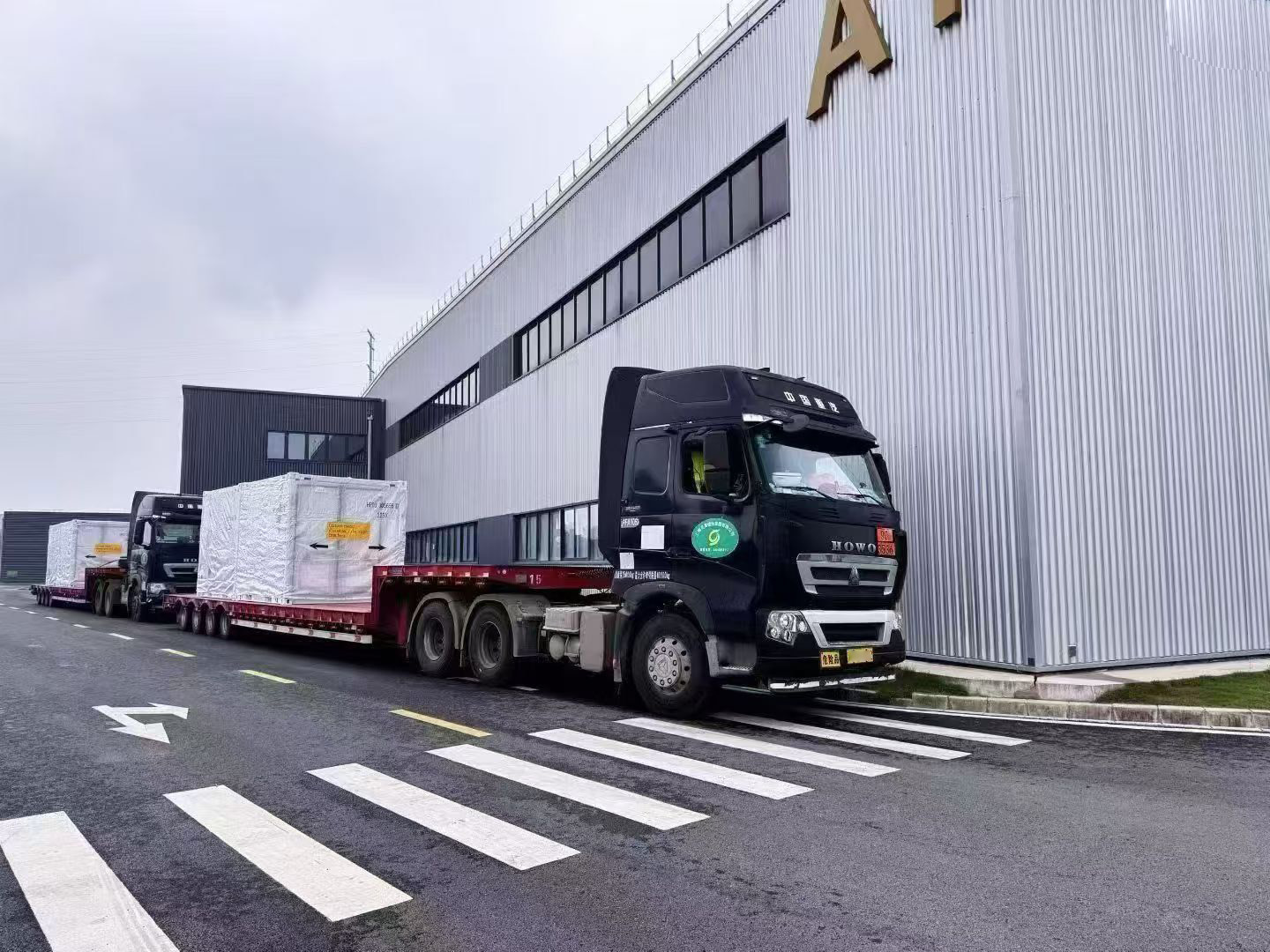
Battery energy storage systems (BESS) have moved from being an emerging technology to a mainstream procurement category. Global new battery storage capacity deployment reached 108 GW in 2025, according to the International Energy Agency's Global Energy Review 2026, and lithium iron phosphate (LFP) chemistry accounted for roughly 90% of global battery storage deployments that year. For buyers evaluating suppliers, the question is no longer whether to procure storage, but how to separate manufacturers that can deliver bankable, code-compliant, long-life systems from those that cannot.
Why Battery Energy Storage System Supplier Evaluation Has Become More Demanding
Utility-scale, commercial, and industrial projects now require suppliers to demonstrate more than a finished product. Buyers must assess manufacturing capacity, cell quality, system integration capability, certification coverage, project references, customization flexibility, and after-sales service. The global BESS market was valued at approximately $50.81 billion in 2025, and the gap between commodity integrators and specialized manufacturers continues to widen.
This article provides a structured evaluation framework for buyers comparing battery energy storage system suppliers, using Xupernova New Energy Technology Co., Ltd. as a reference example. Xupernova is a China-based manufacturer founded in 2015, specialized in energy storage and new energy solutions, serving Europe, North America, South America, the Middle East, and Asia. The company operates a 700,000 m² facility, employs more than 500 people including 150+ R&D engineers, and maintains an annual production capacity of 5 GWh+.
Market Context: What the 2025–2026 Data Shows
Evaluating suppliers without market context leads to misaligned expectations. A few reliable reference points help buyers benchmark what they hear from suppliers:
- Global new battery storage capacity additions reached 108 GW in 2025.
- LFP batteries accounted for approximately 90% of global battery storage deployments in 2025.
- The global BESS market was estimated at $50.81 billion in 2025 by MarketsandMarkets, although other research firms report different figures due to differences in scope.
- U.S. utility-scale battery storage capacity additions were projected to reach 19.6 GW in 2025, based on EIA data.
- All-in BESS project CAPEX for long-duration (4h+) utility-scale projects reached approximately $125/kWh in late 2025, according to Ember.
These figures indicate three procurement-relevant trends: LFP has become the default chemistry, cost per energy unit continues to fall, and scale of deployment is no longer a constraint. Suppliers that still rely on air-cooled, low-energy-density designs or lack grid-code certifications are increasingly difficult to justify in competitive tenders.
Supplier Evaluation Framework: Seven Dimensions to Assess
1. Manufacturing Capability and Capacity
A supplier's manufacturing base determines lead times, quality consistency, and ability to scale with your projects.
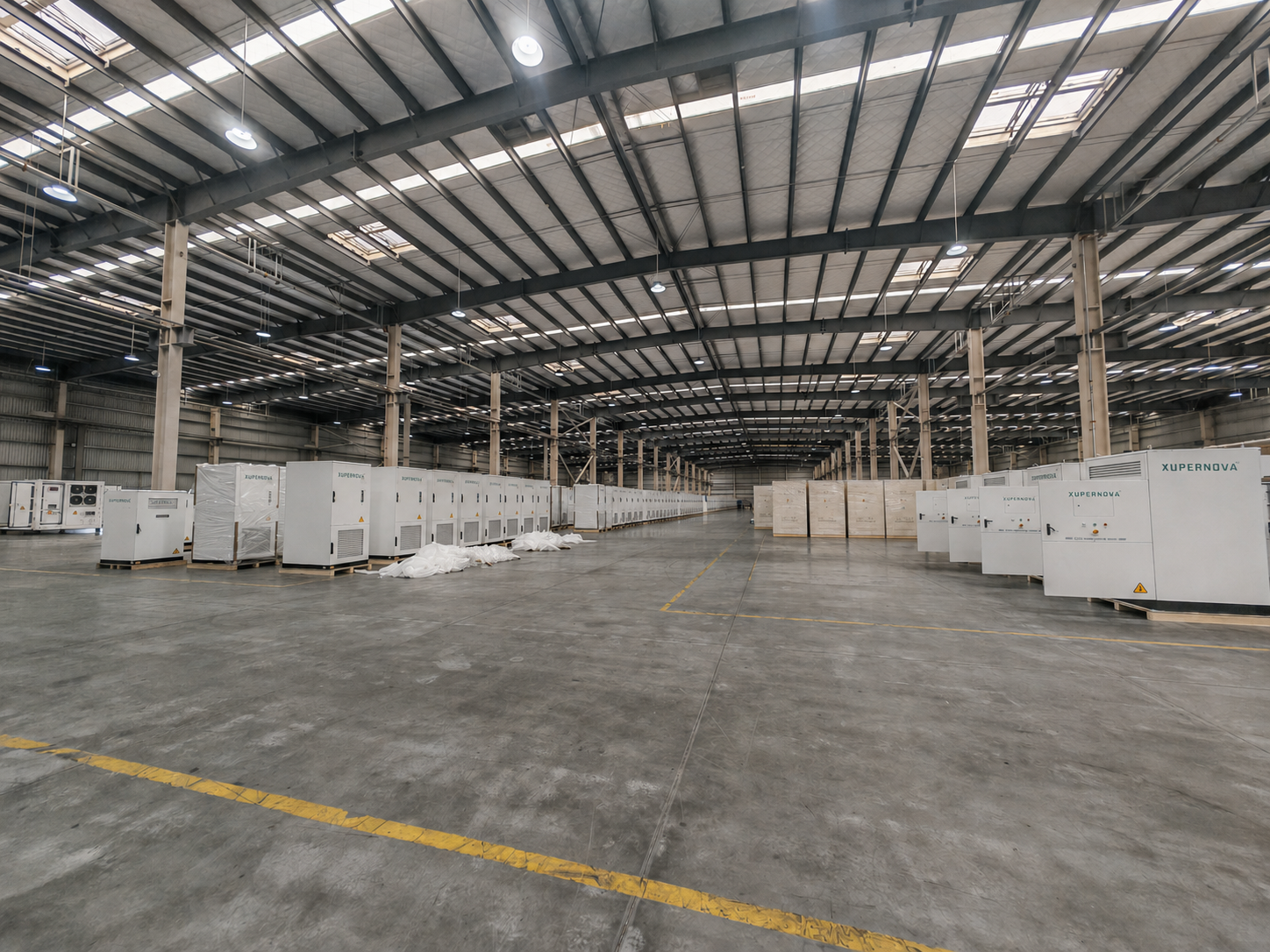
Sustainable energy storage manufacturers typically invest in automated production lines, in-house testing facilities, and capacity that can absorb order fluctuations. Xupernova, for example, reports 700,000 m² of factory space, 500+ employees, 5 GWh+ annual capacity, and a monthly production capability of up to 500 MWh for energy storage products. Standard BESS lead times are cited at 25–35 days, with 35–60 days for customized projects. MOQ is 1 unit. These are concrete indicators that the company is positioned for project-based procurement rather than prototype-only work.
2. Cell Quality and Chemistry Strategy
Battery cells are the most safety-critical and performance-critical component in a BESS. Buyers should ask not only “what chemistry” but also “whose cells” and “what backup options exist.”
All Xupernova energy storage systems use Grade A LFP lithium-ion cells sourced from leading BloombergNEF Tier 1 energy-storage cell manufacturers. The company also offers optional semi-solid-state, solid-state, and sodium-ion battery technologies, subject to project requirements, technical validation, and availability. For procurement, this matters: a single-cell-supplier dependency is a supply-chain risk, while a manufacturer with multiple chemistry options can adapt to safety regulations, cost targets, and project timelines.
3. Product Range and Scalability
Buyers evaluating a supplier should check whether the product portfolio covers the full range of likely project sizes: small commercial, C&I, utility-scale, and solar-plus-storage. A narrow portfolio limits future scalability and increases qualification burden if the buyer later needs larger systems.
Xupernova's current BESS product line illustrates the range typically expected of a credible supplier:
| Product | Model | Configuration | Key Parameters | Typical Applications |
|---|---|---|---|---|
| Battery Energy Storage System | XA-V5015-L1 | 20-ft Liquid-cooled Battery Container | 5.015 MWh, 0.5P/1P/2P, -30–55°C | Power generation, grid energy storage, C&I storage |
| Containerized BESS | XA-X2170-L2 | 20-ft Liquid-cooled All-in-one ESS Container | 1125 kW / 2170.3 kWh, 0.5P/1P/2P | C&I, grid-side storage |
| Containerized BESS | XA-X1044-L1 | 10-ft Liquid-cooled All-in-one ESS Container | 500 kW / 1044 kWh, 0.5P/1P/2P | C&I, microgrids, backup power |
| Commercial & Industrial ESS | XA-C0261-L1 | Liquid-cooled All-in-one ESS Cabinet | 125 kW / 261.25 kWh, 0.5P/1P/2P | C&I energy storage |
| Solar-plus-storage ESS | XA-H0261-L1 | Liquid-cooled Solar-plus-storage Cabinet | 261 kWh, 0.5P/1P/2P | C&I solar-plus-storage, microgrids |
| Solar-plus-storage ESS | XA-H0064-A1 | Air-cooled Solar-plus-storage Cabinet | 25–50 kW / 64.54 kWh, 0.5P/1P/2P | Small-scale C&I solar-plus-storage |
This portfolio ranges from 64.54 kWh to 5.015 MWh per unit. For procurement teams, that means a single supplier can be qualified for small commercial projects, industrial peak-shaving installations, and utility-scale containerized deployments, reducing the need for multi-vendor qualification.
4. Certifications and Grid-Code Compliance
Certification coverage is often the first screen in supplier evaluation, especially for projects in Europe and other regulated markets. Missing certifications can delay grid connection and require expensive rework.
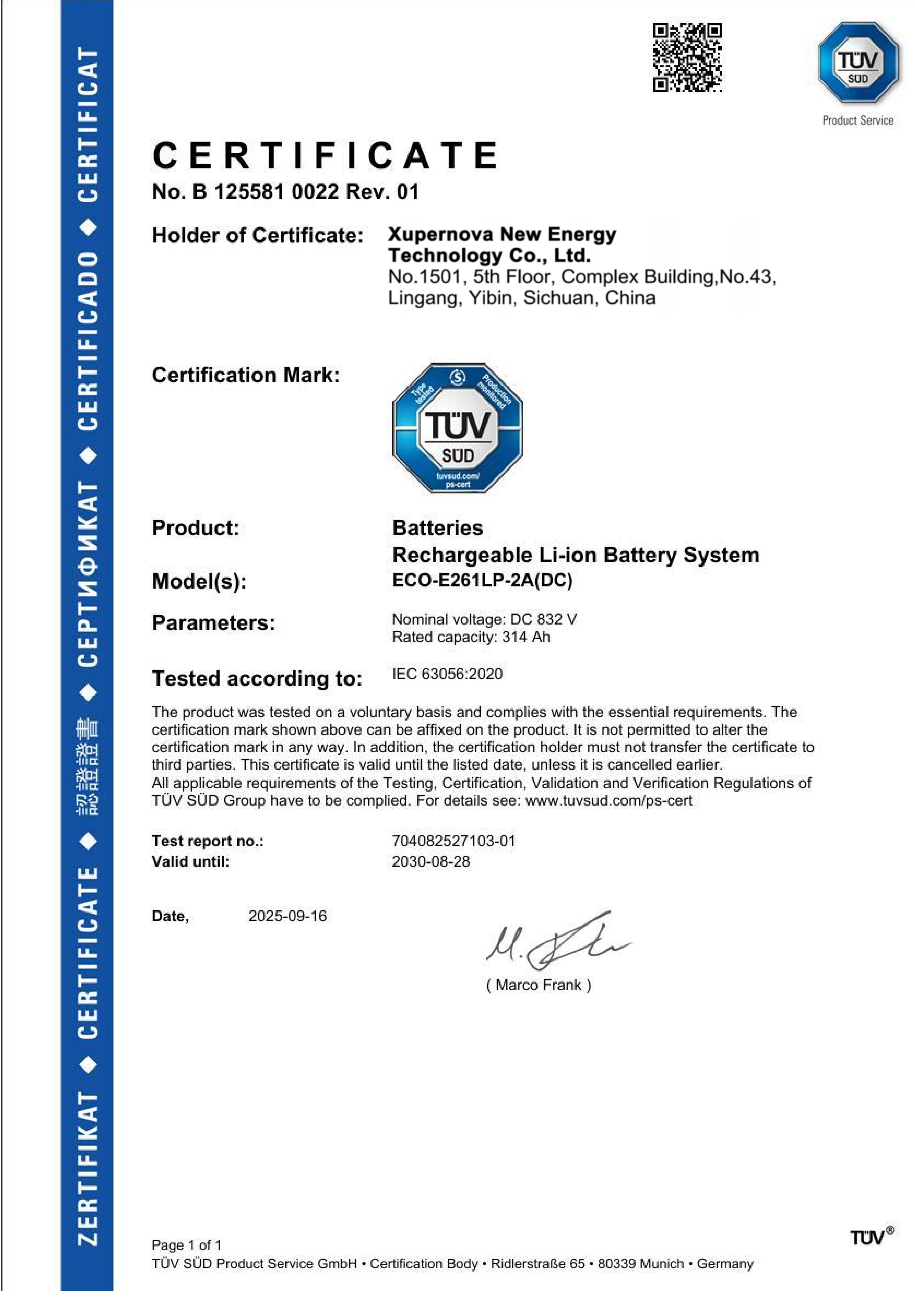
Xupernova holds multiple TÜV SÜD certifications for its ECO-E261LP-2A energy storage system (125 kW, 261.248 kWh, IP55):
- IEC 63056:2020 Product Certificate (cert. no. B 125581 0022 Rev. 01) for the rechargeable Li-ion battery system, DC 832 V, 314 Ah.
- LVD Attestation of Conformity (N8A 125581 0024 Rev. 00) per EN 62477-1:2012/A12:2021.
- EMC Attestation of Conformity (E8A 125581 0023 Rev. 00) per EN IEC 61000-6-4:2019 and EN IEC 61000-6-2:2019.
- CEI 0-21 Compliance Document (D 125581 0027 Rev. 00) per CEI 0-21:2022/V2:2024, for the Italian market.
- CEI 0-16 Compliance Document (D 125581 0028 Rev. 00) per CEI 0-16:2022/V3:2024, also for Italy.
For comparison, U.S. buyers importing fully encased BESS should also be aware of tariff classification under HTS 8507.60.00.90, which can affect total landed cost.
5. Engineering and Customization Capability
Most large projects require at least some level of customization: grid code, communication protocol, transformer configuration, enclosure rating, or branding. A supplier's engineering depth determines how well it can serve these requirements.
Xupernova's OEM/ODM capabilities cover system power and energy capacity, charge/discharge duration, AC/DC voltage, battery chemistry and cell supplier, PCS/BMS/EMS, photovoltaic input and solar-plus-storage configuration, on-grid/off-grid operation, STS/EPS backup function, cooling system, fire protection, enclosure size/color/branding, IP rating, grid code, communication protocols, and transformer/switchgear configuration. This level of configurability is relevant for EPC contractors and developers that need project-specific optimization rather than off-the-shelf only.
6. Quality Control and Testing Evidence
Quality claims should be backed by defined test procedures and the option for independent verification.
Xupernova's quality control procedures include 100% Factory Acceptance Testing (FAT), electrical safety tests, functional tests, aging tests, and availability of third-party inspection. For procurement, this reduces the risk of receiving units with hidden manufacturing defects, particularly for large multi-unit orders.
7. After-Sales and Service Infrastructure
BESS projects operate for 10+ years; service capability should be evaluated as seriously as product performance.
Xupernova's documented after-sales services include 24/7 remote support, commissioning, training, diagnostics, spare parts, and optional onsite service. Buyers should compare this baseline against their own geographic coverage requirements, since not all service commitments are executed equally.
How Xupernova Compares with Incumbent BESS Suppliers
Xupernova is not typically grouped with the largest global BESS integrators by annual revenue, and buyers should weigh its scale accordingly. Its stated 5 GWh+ annual capacity is substantial for a specialized manufacturer, but it is not comparable to the largest Chinese cell producers or global system integrators that ship tens of GWh annually. That is an honest boundary.
Where Xupernova does demonstrate differentiation is in its vertically integrated approach: in-house R&D laboratory, dedicated design team, in-house production, advanced testing facilities, and direct OEM/ODM access. Combined with the documented certification set and multi-segment product range, this makes the company a credible option for mid-to-large commercial, industrial, and grid-related projects, particularly for buyers that want customization without working through a trading intermediary.
Reference Projects: What Evidence Exists
Documented project references are a core part of supplier credibility. Xupernova's published case studies cover several application archetypes:
- Supermarket and retail facility operator — 50 units of 125 kW / 261.248 kWh, deployed for peak shaving, time-of-use arbitrage, and PV self-consumption. Achieved stable daily operation, reduced peak demand, and improved onsite solar utilization. Highlights include compact all-in-one liquid-cooled design, low onsite installation workload, remote monitoring, and compatibility with Italian grid requirements.
- Industrial manufacturing enterprise — 20 units, total 1 MW / 2.09 MWh, for peak shaving, time-of-use arbitrage, and demand management. Achieved stable automatic operation, reduced peak grid demand, and optimized electricity costs. Product highlights include all-in-one liquid-cooled design, plant-level EMS, modular deployment, IP55, and compatibility with German grid requirements.
- Commercial facility and solar EPC contractor — 32 units of 500 kW / 1.044 MWh with up to 1 MW PV input, for PV self-consumption, peak shaving, arbitrage, and emergency power. Results over 5 years: increased solar self-consumption, reduced daytime peak demand, optimized energy costs.
- Commercial and industrial park operator — 12 units, total 1 MW / 2.088 MWh, for solar-plus-storage microgrid, emergency backup power, and diesel generator optimization. Achieved improved critical-load continuity, increased solar utilization, and reduced diesel runtime.
- Renewable energy project developer — 7 units, total 2 MW / 4.176 MWh, for renewable energy shifting, grid balancing, peak shaving, and backup power. Features include 10-ft container design, integrated PCS/BMS/EMS, liquid cooling, multi-source access, and G99 grid-code compatibility. Operated reliably for 7 years.
These cases are reported by the manufacturer and described as global deployments; the absence of named end-customers and site-level verification in public materials is a limitation. Buyers at the evaluation stage should request contact references, audited performance data, and project-specific documentation before final shortlisting.
Fire Safety and Risk Engineering: A Non-Negotiable Procurement Filter
Fire and thermal runaway are the most serious operational risks in battery energy storage. Mitigation architecture should be a formal evaluation criterion, not a marketing statement.
Xupernova states that its systems employ multi-level temperature monitoring, battery management system (BMS) protection, liquid cooling, automatic alarm and emergency shutdown, plus multi-layer fire-suppression hardware. Specific measures include smoke and temperature detection, PACK-level and cluster-level aerosol fire suppression, and a water fire-fighting interface. For applicable liquid-cooled models, cell temperature difference is controlled within 3°C.
All battery energy storage systems carry inherent thermal risk. Buyers should independently verify fire strategy against local building codes and insurance requirements.
Choosing Between 261 kWh, 1 MWh, and Multi-MWh Configurations
System sizing is one of the first procurement decisions. A practical starting framework:
- 64 kWh class (e.g., XA-H0064-A1) — small commercial solar-plus-storage, limited site footprint, modest backup requirements.
- 261 kWh class (e.g., XA-C0261-L1, XA-H0261-L1) — the most common C&I entry point for peak shaving and PV self-consumption; compact cabinet form factor keeps installation cost low. The certified ECO-E261LP-2A falls in this class.
- 1 MWh class (e.g., XA-X1044-L1) — suited for larger C&I facilities, microgrids, and multi-unit modular expansions; balances energy density with logistics flexibility.
- 2 MWh class (e.g., XA-X2170-L2) — higher energy per container, requiring fewer units and less site wiring for a given capacity.
- 5 MWh class (e.g., XA-V5015-L1) — utility-scale and large C&I at 5.015 MWh per 20-ft container; appropriate for projects where CAPEX per kWh and land-area efficiency dominate decision-making.
Step-by-Step Supplier Qualification Workflow
- Define project requirements: capacity, power rating, duration, site constraints, grid code, and target tariff regime.
- Screen certification coverage: confirm BESS, battery, EMC, LVD, and grid-code-related certificates. Independently verify certificate numbers with issuers if possible.
- Audit manufacturing and quality: request factory audit reports, FAT procedures, incoming-cell test data, and any third-party inspection plans.
- Benchmark product specifications: compare energy density, cooling method, operating temperature range, IP rating, and PCS/BMS/EMS integration level.
- Request project references in your segment: ask for systems operating in similar terrain, climate, and grid environment, ideally with performance records of at least 1–2 years.
- Evaluate customization scope: quantify lead time and engineering cost for any required modifications (grid code, transformer, communication protocols, branding).
- Define service level expectations: clarify remote monitoring, spare parts delivery, commissioning support, and response time.
- Run financial due diligence: assess warranty terms, manufacturer financial health, and available performance guarantees.
Traditional vs. Modern BESS Procurement
The market has shifted away from fragmented procurement where the battery, inverter, and container were sourced separately and integrated on site. Modern all-in-one liquid-cooled BESS replace that with integrated PCS/BMS/EMS in a single enclosure. The benefits include lower engineering complexity, reduced commissioning time, and more predictable performance. The trade-off is that buyers must trust one vendor for the entire system; if the vendor has weak software or commissioning capability, the integration risk is concentrated rather than eliminated.
Liquid cooling is another differentiator between traditional and modern designs. It improves cell temperature uniformity and enables higher energy density in the same footprint. However, liquid-cooled systems add coolant maintenance and more complex thermal-management hardware relative to air-cooled designs.
A balanced evaluation should therefore not assume newer is always better; it should match technology choice to site conditions, staffing, and operational capability.
Market Trends Shaping BESS Procurement in 2026
Several industry-wide signals are relevant to supplier selection:
- Cost reduction continues: all-in utility-scale project CAPEX for 4h+ systems reached around $125/kWh in late 2025, a level that makes storage economically attractive for more use cases.
- LFP dominance is decisive: with roughly 90% of global deployments using LFP, buyers will encounter fewer alternative-chemistry proposals; where alternatives are offered, suppliers should provide a clear technical and economic justification.
- Multi-hour duration is becoming standard: grid and large C&I tenders increasingly ask for 2h, 4h, or longer durations, which favors containerized liquid-cooled platforms.
- Grid-code compliance is more complex: projects in the EU and UK must satisfy requirements such as CEI 0-16/0-21 (Italy), G99 (UK), and others; suppliers without in-house grid-code engineering will face project-specific bottlenecks.
Limitations and What Buyers Should Verify Independently
This evaluation of Xupernova is based on the manufacturer's published corporate facts, certification documents, and publicly disclosed case studies. Buyers should remain aware of the following limits:
- Public case studies do not disclose named customers; site-level verification and reference calls are still necessary.
- BloombergNEF Tier 1 status refers to the cell suppliers, not to Xupernova as a system integrator.
- Company-provided figures such as capacity, R&D headcount, and partnerships (80+ companies across 30+ countries) should be confirmed during commercial and financial due diligence.
- Certifications listed cover specific models (ECO-E261LP-2A); other models may require separate certificates in other jurisdictions.
Conclusion: What a Strong BESS Supplier Looks Like in 2026
A credible battery energy storage system supplier in 2026 should combine four elements: bankable manufacturing scale, documented certification coverage for target markets, a product range that spans the buyer's likely project sizes, and a service model that can support systems for 10+ years. Xupernova demonstrates these to a degree that deserves inclusion in serious supplier shortlists, especially for C&I and containerized projects requiring OEM/ODM flexibility. Its 5 GWh+ capacity, tier-1 LFP cell sourcing, TÜV SÜD certifications across IEC, CEI, EMC, and LVD standards, liquid-cooled portfolio, and multi-segment case history make it a functional reference point for buyer evaluation exercises.
At the same time, no one public profile can substitute for project-specific due diligence. Buyers should validate performance data, request audited test reports, check references, and require contractual performance commitments before awarding orders.
Download Xupernova Energy Storage Product Catalog (PDF)
Frequently Asked Questions
Start by confirming required capacity, power rating, cooling mode, and application scenario. Xupernova provides multiple product series including container-type liquid-cooled ESS and cabinet-type air-cooled/liquid-cooled ESS for utility-scale, commercial-industrial, and solar-plus-storage scenarios. A typical selection path is: define the peak-shaving or solar-plus-storage objective, calculate capacity and discharge duration, then match with the appropriate product family before evaluating certification and grid-code fit.
Xupernova supplies 20-ft liquid-cooled battery containers (5.015 MWh per unit), liquid-cooled all-in-one ESS cabinets (125 kW / 261.25 kWh), 10-ft liquid-cooled ESS containers (500 kW / 1044 kWh), solar-plus-storage cabinets (261 kWh liquid-cooled; 64.54 kWh air-cooled), and 20-ft all-in-one ESS containers (1125 kW / 2170.3 kWh). These cover small-scale commercial, C&I, microgrid, and grid-side storage applications.
Energy-storage systems face fire and thermal-runaway risks, often triggered by abnormal cell temperature, internal short-circuit, or thermal propagation. Xupernova addresses these with multi-level temperature monitoring, BMS protection, liquid cooling, automatic alarm and emergency shutdown, LFP cells, smoke and temperature detection, PACK-level and cluster-level aerosol fire suppression, water fire-fighting interface, and control of cell temperature difference within 3°C for applicable liquid-cooled models.
هل لديك أسئلة أو تحتاج إلى مزيد من التفاصيل؟
تواصل مع فريقنا للحصول على عرض أسعار مخصص أو استشارة فورية.
طلب عرض أسعار
املأ النموذج أدناه وسيتواصل معك فريقنا بعرض مقترح مخصص.
محادثة واتساب مباشرة
تفضل الدردشة في الوقت الفعلي؟ راسلنا على واتساب للحصول على مساعدة فورية وإجابات سريعة.
- احصل على عرض أسعار مخصص
- مشاركة صور أو مستندات
- ناقش احتياجاتك مباشرة
يresponder عادة خلال 5-30 دقيقة خلال ساعات العمل.