
Before the RFQ: Die-Cutting on CS-220 to CS-380 Label Presses
Die-cutting is the line item that most often makes two label press quotations impossible to compare. A supplier can describe a machine as having die-cutting and still mean a platen, a rotary cylinder, or both in series — each with different tooling behaviour, different web handling and a different list of jobs the press can accept. For buyers in the evaluation stage, the die-cutting configuration has to be settled before the RFQ, not after the purchase order.
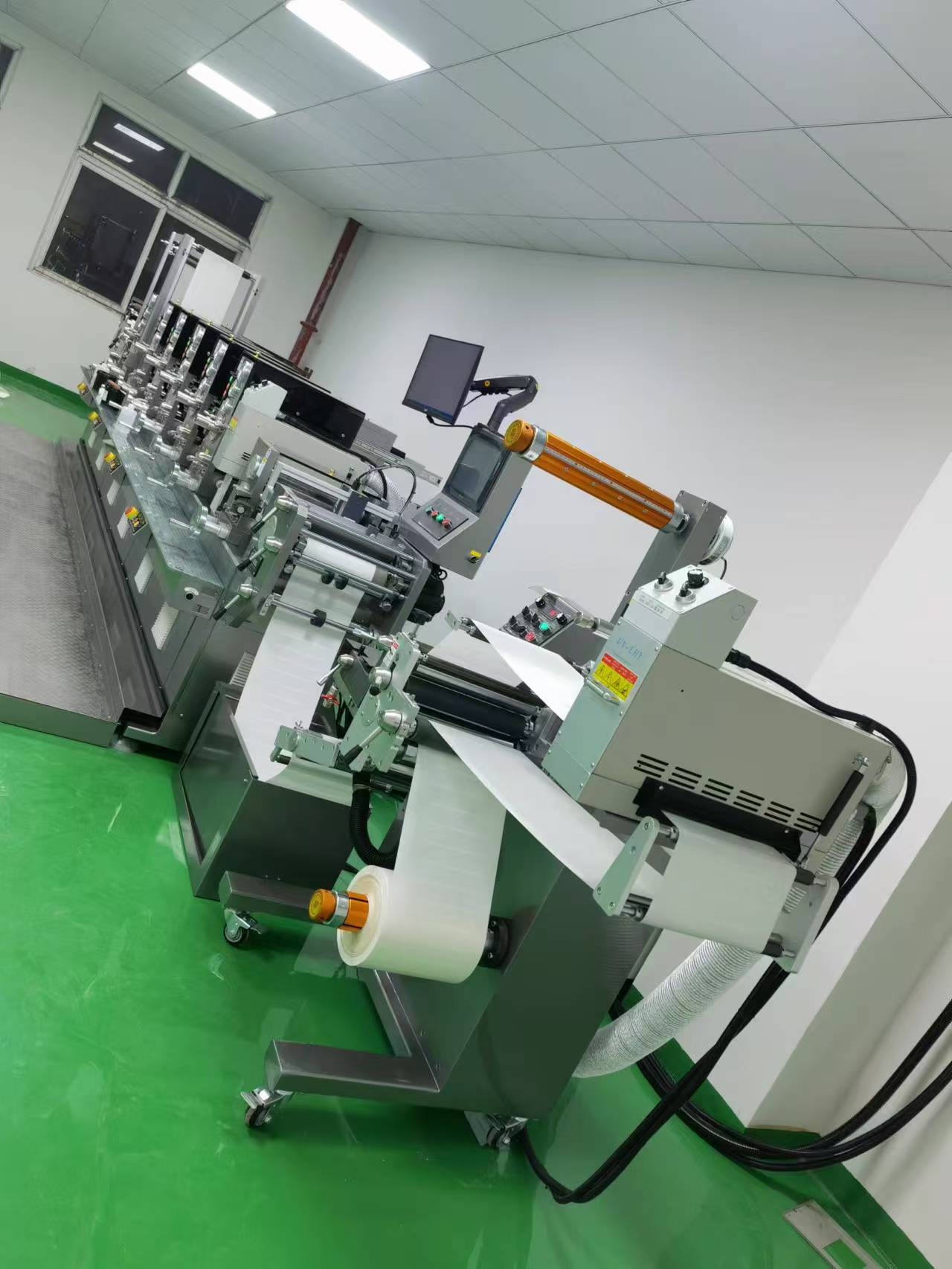
A CS-320 label printing machine running in a customer factory. The CS-300/CS-320 family is configured with flatbed die-cutting and rotary die-cutting in combination.
Why die-cutting decides whether two label press quotes are comparable
Shenzhen Caisheng Printing Machinery Co., Ltd. (CAISHENG) is a Shenzhen-based manufacturer of label printing equipment, founded in 2011, producing intermittent and high-speed full-rotary letterpress printing machines, flexographic printing machines, screen printing machines, and customized multi-functional label finishing solutions that include die-cutting systems and high-speed varnishing machines.
Across that range, die-cutting is not a fixed feature. CAISHENG builds the same label printing machine platform in different converting architectures, and the architecture determines what the machine can physically do: whether the web stops under a platen or runs continuously under a cylinder, whether short runs with frequent die changes stay economical, and whether a single press can hold both a simple sticker outline and a heavier multi-layer cut.
That is the practical problem behind most pre-RFQ questions. A buyer comparing three quotations on price and colour count is comparing the wrong variables. The comparable variables are die-cutting method, web behaviour, finishing station sequence, purchasing terms and the acceptance test that will be applied at commissioning.
Three die-cutting architectures inside one label press range
CAISHENG's label printing machine families are differentiated by die-cutting configuration rather than by colour count alone. The mapping below reflects how the three families are specified.
| Family | Die-cutting configuration | Press character | Typical die-cutting fit |
|---|---|---|---|
| CS-220 CS-220-4C intermittent label press, CS-220-5C stickers printing machine |
Flatbed die-cutting | Intermittent feeding; CS-220-5C maximum speed 40 m/min | Shorter runs, frequent die changes, heavier or multi-layer cuts where dwell time helps |
| CS-300 / CS-320 CS-300-5C self-adhesive label press, CS-300-6C rotation label machine, CS-320-6C semi-rotary label printing machine, CS-320-7C rotary label press |
Flatbed + rotary die-cutting combination | Semi-rotary and rotary letterpress platform | Mixed order books: rotary for volume outlines, flatbed for the cuts that need pressure and dwell |
| CS-350 / CS-370 / CS-380 Includes the CS-350 high-speed die-cutting configuration and the CS-370/CS-380 flexographic platforms |
Rotary die-cutting combination | Continuous rotary web travel | Longer runs, stable repeat lengths, throughput-led order books |
Die-cutting stations are order-specific. CAISHENG lists both flatbed die-cutting and rotary die-cutting among its customization options for label finishing, with a minimum order quantity of one unit, so the configuration is agreed during the quotation stage rather than retrofitted later.
How flatbed and rotary die-cutting actually convert a label web
Flatbed die-cutting presses a flat die against the web on a platen. The web indexes and pauses, the platen closes, and the cut is made under controlled pressure with measurable dwell. On the CS-220 family, that pause is built into the intermittent feeding logic: the press advances the web in steps, which is why the CS-220-5C is rated at a maximum speed of 40 m/min rather than a continuous rotary figure. Intermittent feeding and a planar cut together give the operator room to work with materials and cut geometries that do not respond well to a single cylinder nip.
Rotary die-cutting uses a cylindrical die that contacts the web in a continuous rolling nip. There is no stop-start cycle, so repeat length is set by the die circumference and the cut is delivered at production speed. The CS-350 is positioned by CAISHENG as a high-speed die-cutting machine within this architecture, pairing the rotary die-cutting combination with continuous web travel.
Combination configurations put both stations on one press. On the CS-300/CS-320 family, the rotary station handles the outline or the high-volume shape, while the flatbed station handles the cut that benefits from pressure and dwell — a thicker laminate, a multi-layer construction, or a geometry that a rotary die struggles to hold cleanly. The sequencing matters: which station comes first determines whether the web is still supported when the second cut is made.
Registration discipline runs through all three. CAISHENG reports ±0.025 mm registration precision on the CS-220-4C intermittent rotary letterpress, which is the accuracy figure that die-cutting position ultimately depends on.
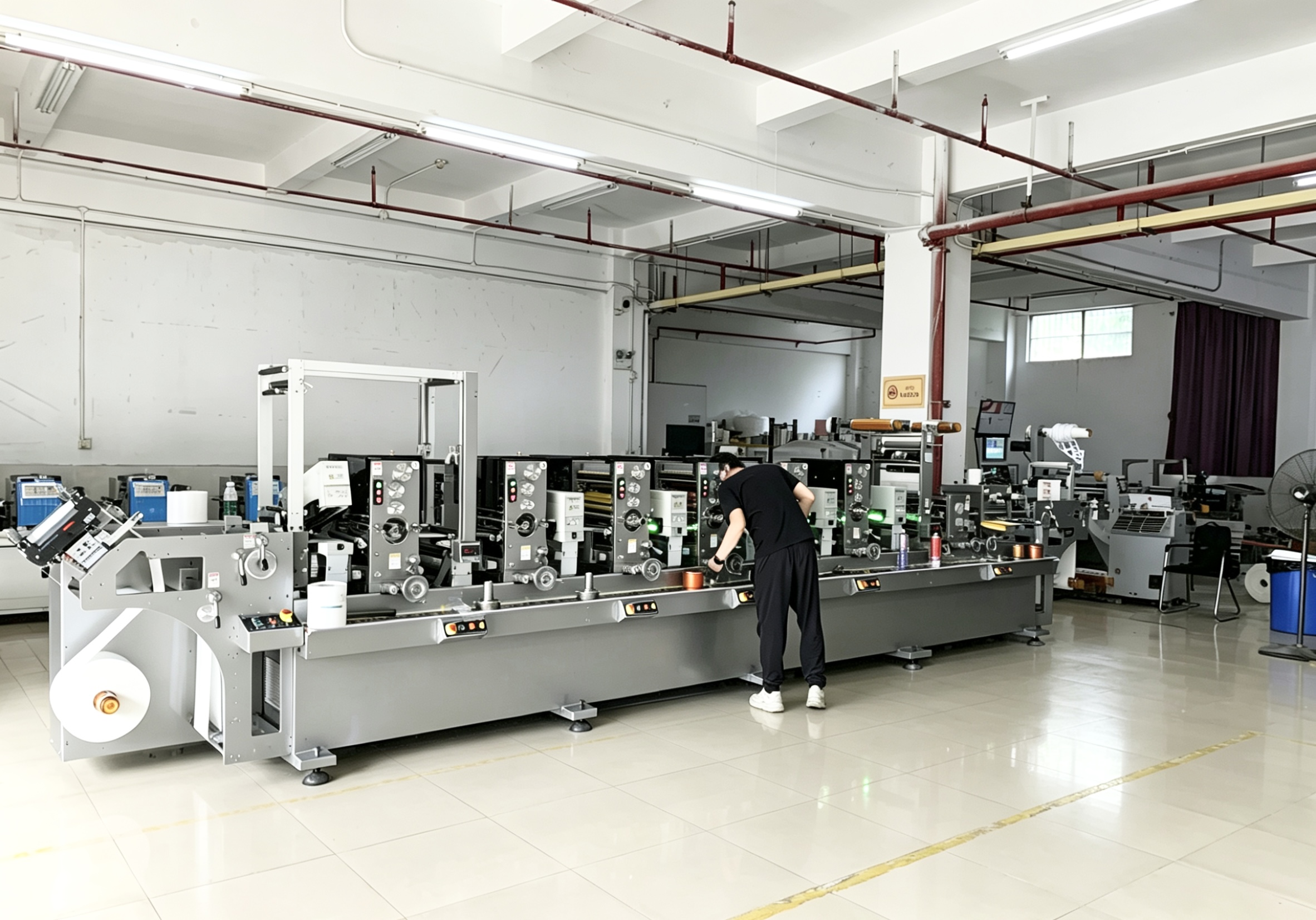
A CS-300 six-colour letterpress configuration showing the combination architecture: rotary die-cutting and flatbed die-cutting on the same frame, with glue-side printing and slitting.
Matching die-cutting to label material
Material is the first filter, and it should be resolved before machine speed is discussed. CAISHENG states an application scope covering labels, adhesive stickers, PVC stickers and tags, which sets the boundary of the conversation: if the substrate list includes film, PVC or multi-layer constructions, the die-cutting question changes.
Three practical rules apply when a buyer matches die-cutting to material:
- Cut depth and liner integrity. A die-cut that scores the liner instead of cutting it creates waste-handling problems downstream. Flatbed pressure control is easier to tune job by job; rotary dies are less forgiving of thickness variation across the roll.
- Thickness and layer count. Heavier or multi-layer constructions usually benefit from the dwell a flatbed station provides. Where the material is thin and consistent, a rotary station delivers the same result at higher output.
- Edge quality on film and PVC. Film-based stock is more sensitive to die sharpness and nip pressure. Buyers should ask for a sample cut on their own material rather than accepting a cut demonstrated on paper.
The consequence is straightforward: a buyer whose work is dominated by heavy multi-layer labels should not shortlist a rotary-only configuration for that job, and a buyer running thin self-adhesive film at volume should not pay for flatbed capacity that will sit idle.
Matching die-cutting to run length and job-change frequency
Run length is the second filter, and it is usually expressed badly in RFQs. Average job size hides the real distribution: a converter running one long order and twenty short ones is not an average-run business.
For short and highly variable work, the CS-220 flatbed configuration keeps the die change and set-up cycle inside a repeatable process, and the 40 m/min ceiling on the CS-220-5C is rarely the constraint — changeover is. For converters whose order book is dominated by longer runs of stable repeat length, the CS-350/CS-370/CS-380 rotary die-cutting combination is the configuration that converts die-cutting cost into throughput. Where both patterns coexist in one plant, the CS-300/CS-320 combination is the compromise position: one press, two die-cutting methods, no need to split the order book across two machines.
Buyers should bring three numbers to the RFQ: the median run length, the 80th-percentile run length, and the number of die changes per shift. Those three figures determine the configuration faster than any specification sheet.
Finishing scope: what sits upstream and downstream of the die-cutting station
Die-cutting is rarely the only converting step, and the finishing sequence determines whether a die-cutting choice is actually usable in production. CAISHENG's customization list covers colour stamping, glue-side printing frame, cold foil stamping, lamination, offline and online UV varnishing, flatbed die-cutting, rotary die-cutting, sheet cutting, slitting, corona treater, dust cleaner, static eliminator, full-rotary screen printing, hot foil stamping and embossing.
Two consequences follow. First, a full rotation screen printing multifunctional machine configuration places a screen station in the same web path as the die-cutting station, so registration between the screen image and the cut becomes the variable to test at acceptance. Second, corona treatment, dust removal and static elimination are pre-treatment modules that change how ink and adhesive behave before the die ever contacts the web — buyers specifying a high-speed corona treatment configuration should confirm where that module sits relative to the die-cutting station.
A practical instruction for the RFQ: request a station-by-station sequence diagram, not a list of features. The order of stations is what you are buying.
Supplier evidence to check before the RFQ
Configuration questions only have value if the supplier can build and support what is specified. CAISHENG reports a 6,000 m² facility, approximately 65 employees, 8 R&D engineers, annual output of 200 units and a monthly capacity of 18 units, with a 50% export share across Southeast Asia, Europe, the Middle East and the United States.
On compliance, the CE Machinery Directive Attestation of Conformity numbered M.2025.206.C124100, issued by UDEM Uluslararasi Belgelendirme Denetim Egitim Merkezi A.S. on 8 November 2025 and valid to 8 October 2030, covers the CS-300, CS-220 and CS-350 against EN ISO 12100:2010 and EN 60204-1:2018 for the EU market. CAISHENG also holds a utility model patent (ZL 2022 2 1332174.4) covering a double-sided printing machine structure with paper forward-reverse switching and registration correction, and an invention patent (ZL 2022 1 0411353.5) covering remote control of printing equipment based on big data.
On commercial terms, CAISHENG quotes a minimum order quantity of one unit, a lead time of 45 to 60 days, 100% testing before shipment, ODM production, and after-sales support that combines remote assistance with a one-year warranty on major components.
Where these configurations have been installed
Two installed references are relevant to die-cutting evaluation because both are long-running installations rather than commissioning-stage claims.
In Taiwan, one unit was installed at a renowned Asian trademark design and printing company for high-quality label printing. The project has run for two years, and the reported result is superior printing precision, stable production performance and flexible process expansion capability. The related models are the CS-320-6C semi-rotary label printing machine and the CS-320-7C rotary label press — the family configured with the flatbed and rotary die-cutting combination.
In the United States, one CS-300 series label printing machine was installed at a global provider of commercial printing, packaging and multi-channel marketing communication solutions. After three years of operation, the reported highlights are stable registration accuracy, excellent print quality and reliable equipment performance, with the installation credited for improvements in production efficiency and product quality, and a long-term cooperative relationship established. The related models are the CS-300-5C self-adhesive label press and the CS-300-6C rotation label machine.
Market context: label demand growth and what it does to die-cutting choice
Mordor Intelligence reports the global print label market at USD 57.05 billion in 2026, growing at a CAGR of 3.28% to reach USD 67.02 billion by 2031. That figure measures printed label output, not label press equipment, and the distinction matters: equipment spend sits inside a much larger consumable value chain, and a single-digit growth rate in label output does not translate directly into machine demand.
What the growth rate does support is a directional conclusion relevant to this decision. A market expanding at a low single-digit rate rewards converters who take cost out of changeover and waste rather than converters who add capacity speculatively. In that environment, buying one press that covers both short and long runs — the CS-300/CS-320 combination position — is a defensible way to avoid splitting capital across two single-method machines.
Comparison with traditional approaches — and the limits of each option
The traditional arrangement for a growing label converter is a single-method press plus outsourced die-cutting for anything outside its range. That has a real cost in lead time and in quality control, because the cut is outside the converter's own process window. Bringing die-cutting in-house removes that dependency, but it also fixes the method.
The honest limitation of the CS-220 flatbed configuration is breadth, not quality. With intermittent feeding and a maximum speed of 40 m/min on the CS-220-5C, it is a poor match for a converter whose order book is dominated by very long, continuous runs of standard outlines — that work belongs on a rotary die-cutting combination. Conversely, the limitation of the rotary-only CS-350/CS-370/CS-380 configuration is sensitivity to job variation: rotary dies are less accommodating when material thickness shifts between jobs, so buyers with erratic stock lists should not assume rotary covers everything.
A second boundary applies to all three: the die-cutting configuration is fixed at order. Because stations are part of the machine structure and CAISHENG quotes ODM production with a 45 to 60 day lead time and a one-unit minimum, changing from flatbed to a combination architecture later is a new machine decision, not a field upgrade. That is the strongest argument for answering these questions before the RFQ rather than during acceptance.
Future outlook
Two directions are visible from the supplier side. The first is modular finishing: CAISHENG's customization list already spans die-cutting, varnishing, lamination, foil and screen stations on a shared frame, which points toward configurations assembled to a converter's job mix rather than fixed product tiers. The second is remote serviceability: the invention patent covering remote control and online fault diagnosis of printing equipment based on big data indicates where after-sales support is heading, which matters for buyers who run these presses outside China.
For buyers, the practical implication is to write the RFQ in a way that survives both trends: specify the die-cutting method, the station sequence, the material list and the acceptance test explicitly, so that a modular configuration can be quoted against a fixed requirement.
FAQ: die-cutting questions buyers ask before a label press RFQ
Which CAISHENG label printing machine uses flatbed die-cutting?
The CS-220 family uses flatbed die-cutting. The family includes the CS-220-4C intermittent label press and the CS-220-5C stickers printing machine. Intermittent feeding means the web indexes in steps and pauses under the platen, and the CS-220-5C is rated at a maximum speed of 40 m/min.
What die-cutting configuration do the CS-300 and CS-320 use?
The CS-300 and CS-320 use a flatbed plus rotary die-cutting combination, meaning both stations are mounted on the same press. Models in this family include the CS-300-5C self-adhesive label press, the CS-300-6C rotation label machine, the CS-320-6C semi-rotary label printing machine and the CS-320-7C rotary label press.
Do the CS-350, CS-370 and CS-380 share one die-cutting method?
Yes. The CS-350, CS-370 and CS-380 are specified with a rotary die-cutting combination. The CS-350 is positioned as a high-speed die-cutting machine within this group. Because CAISHENG quotes die-cutting stations as order-specific customization, the final station set for any individual order is confirmed in the quotation.
How should die-cutting method be matched to label material?
Match on cut depth, thickness and edge quality. Heavier or multi-layer constructions generally benefit from the dwell and pressure control of a flatbed station, while thin, consistent stock is well served by a rotary cylinder at continuous speed. CAISHENG states an application scope covering labels, adhesive stickers, PVC stickers and tags, and buyers should validate the cut on their own material rather than on paper.
How does run length change the die-cutting choice?
Run length determines whether changeover or throughput is the binding constraint. Short, highly varied work favours the flatbed CS-220 configuration, where the 40 m/min ceiling on the CS-220-5C is rarely reached before the next die change. Long runs of stable repeat length favour the rotary CS-350/CS-370/CS-380 combination. A mixed order book points to the CS-300/CS-320 combination.
What purchasing terms should a die-cutting RFQ fix in writing?
CAISHENG quotes a minimum order quantity of one unit, a lead time of 45 to 60 days, ODM production, 100% testing before shipment, remote after-sales support and a one-year warranty on major components. The RFQ should also state the die-cutting method, the station sequence, and the finishing modules required, since these are customized per order.
What acceptance criteria apply to a die-cutting station?
Acceptance should test cut depth against liner integrity, edge quality on the buyer's own material, registration between the printed image and the cut, and speed against the quoted figure for the specified model. On combination configurations, the interaction between the rotary and flatbed stations should be tested on the same job, because station sequence affects support of the web during the second cut.
Does CE certification cover the die-cutting configurations?
The CE Machinery Directive Attestation of Conformity M.2025.206.C124100, issued by UDEM on 8 November 2025 and valid to 8 October 2030, covers the CS-300, CS-220 and CS-350 against EN ISO 12100:2010 and EN 60204-1:2018 for the EU market. Buyers should confirm that the specific model and configuration on the quotation falls inside that stated scope.
Product documentation from CAISHENG is available in the company brochure: CAISHENG product brochure (PDF). Company information: caishengmachinery.com.
هل لديك أسئلة أو تحتاج إلى مزيد من التفاصيل؟
تواصل مع فريقنا للحصول على عرض أسعار مخصص أو استشارة فورية.
طلب عرض أسعار
املأ النموذج أدناه وسيتواصل معك فريقنا بعرض مقترح مخصص.
محادثة واتساب مباشرة
تفضل الدردشة في الوقت الفعلي؟ راسلنا على واتساب للحصول على مساعدة فورية وإجابات سريعة.
- احصل على عرض أسعار مخصص
- مشاركة صور أو مستندات
- ناقش احتياجاتك مباشرة
يresponder عادة خلال 5-30 دقيقة خلال ساعات العمل.