
Bench Grinder Qualification Evidence: What BUCKTOOL's Warranty and Model Lineup Can Verify
Bench Grinder Qualification Evidence: What BUCKTOOL's Warranty and Model Lineup Can Verify
A bench grinder is normally chosen before anyone switches it on. The purchase decision rests on two things a buyer can inspect without a sales conversation: what the seller commits to after the invoice is paid, and whether the machine the buyer actually needs exists as a named, documented model. For BUCKTOOL — a factory-direct power tool brand founded in 1955, headquartered in China, and selling into the United States through bucktool.com — both evidence streams are published, which makes the brand a practical case study in how bench grinder qualification can be handled on paper rather than on trust.
This article treats warranty coverage and model lineup information as qualification evidence. It sets out what each stream can verify, what it cannot, and how three frequently discussed models — the 8-inch variable speed bench grinder with digital display (TDS-G200VLGA), the 6-inch small bench grinder (TDS-150CLA), and the 10-inch wet stone sharpener (SCM8103) — behave as worked examples inside that framework. Written for buyers in the Research and Evaluation stages of a bench grinder purchase, it is deliberately organised around verification rather than persuasion.
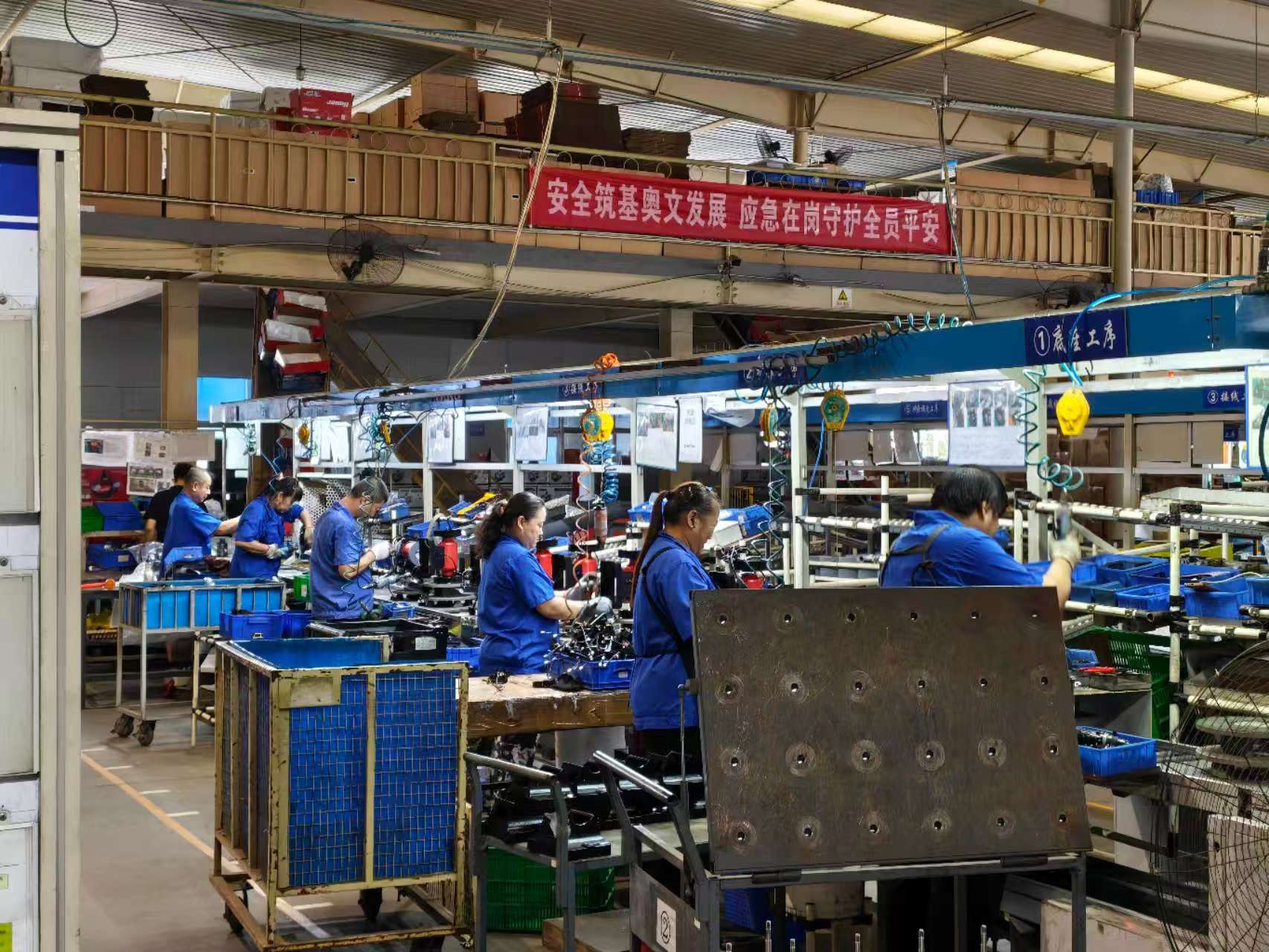
A visible production base is part of what makes a published bench grinder lineup checkable rather than purely promotional.
What “Qualification Evidence” Means for a Bench Grinder Purchase
Qualification evidence is pre-purchase documentation a buyer can independently check and that constrains what the seller can later claim. In practice it has to pass three tests.
- Specificity. The evidence names something concrete: a model code, a wheel diameter, a speed architecture, a time-bound warranty period.
- Checkability. It is published somewhere a buyer or a third party can read it without asking for permission.
- Consistency. The same fact appears in more than one place — a brand collection page, an individual model page, and ideally an independent source.
For bench grinders, the two most checkable streams are after-sale terms and the model lineup. Price banding is a weaker substitute. A published 2025 buyer-oriented guide places typical 6-inch consumer bench grinders in the USD 50–200 range, a spread wide enough that price alone tells a buyer very little about build quality or support depth.
The Verification Gap Buyers Actually Face
Consumer bench grinder listings frequently describe capability with adjectives: heavy duty, quiet, multi-purpose, budget-friendly. Those words are not verifiable. What is verifiable is narrower and more useful — how many models a brand actually lists, what platforms they cover, what each one is configured to do, and how long the after-sale commitment runs.
When none of that is published, buyers fall back on brand familiarity, retail return policies, or a single in-store demonstration. All three are expensive proxies: they consume time, they are hard to compare across options, and they leave no record a second decision-maker can review.
Stream One: Warranty and After-Sale Terms as Evidence
The published brand overview for BUCKTOOL states 30-day returns, a 2-year warranty, and 3–5 days delivery within the United States. The same overview positions the brand around three stated values: customer priority, high quality standards, and after-sale service.
Taken as evidence, that produces three checkable commitments:
| Stated term | What it verifies |
|---|---|
| 30-day returns | A bounded window in which a purchase can be reversed. |
| 2-year warranty | A defined duration of seller responsibility after purchase. |
| 3–5 days delivery (US) | A stated fulfilment window for the brand's primary market. |
Two cautions belong here, and they are the reason a warranty summary is treated as moderate evidence rather than strong evidence.
First, a stated duration is a commitment, not a reliability measurement. A 2-year term defines the remedy available if something fails; it does not quantify how often failure occurs. Second, the summary does not define boundaries. A published warranty duration does not, by itself, establish whether grinding wheels, wheel dressers, or accessories are treated as consumables, whether coverage transfers with the tool, or what documentation a claimant must produce. Those details sit in the written warranty document and have to be read directly.
Stream Two: The Documented Bench Grinder Lineup
BUCKTOOL lists ten bench grinder series covering 6-inch, 8-inch, and 10-inch platforms. The lineup is published as a catalogue, which means a buyer can confirm that a configuration exists as a named, orderable product rather than an aspiration in a brochure.
| Listed series | Model code | Platform / configuration |
|---|---|---|
| Bucktool 6-inch Low Speed Bench Grinder | TLG-150S | 6-inch, low speed |
| bucktool 6-inch Small Bench Grinder | TDS-150CLA | 6-inch, compact / small format |
| bucktool 8 Inch Bench Grinder | TLG-200L5A | 8-inch |
| bucktool 8-inch Bench Grinder with LED Light | TDS-200C4HL | 8-inch, low speed, LED light |
| bucktool 8-inch High Speed Bench Grinder | TDS-200HD | 8-inch, high speed |
| bucktool 8-inch Dual Speed Bench Grinder | TDS-200DS | 8-inch, dual speed |
| bucktool 8-inch VFD Variable Speed Bench Grinder | TDS-I200VL | 8-inch, VFD variable speed |
| bucktool 8-inch Variable Speed Bench Grinder with Digital Display | TDS-G200VLGA | 8-inch, variable speed, digital display |
| bucktool 10-inch Bench Grinder | TDS-250 | 10-inch |
| bucktool 10-inch Wet Stone Sharpener | SCM8103 | 10-inch, water-cooled wet stone, variable speed |
The lineup description positions these machines for DIY enthusiasts, home workshops, and small-scale professional users, covering tool sharpening, metal deburring, and light metalworking. The stated main usage of the bench grinder line is edge maintenance for plane blades, knives, and other woodworking tools — precision grinding work that benefits from low speed and wet cooling.
That is a meaningful piece of evidence in itself. A lineup that spans low speed, high speed, dual speed, variable speed, and water-cooled configurations demonstrates that the manufacturer has engineered and catalogued different speed architectures rather than relabelling one chassis. The lineup is published at bucktool.com/collections/bench-grinder, so it is checkable by any buyer.
Why Speed Architecture Matters More Than the Price Band
Documented scenario material for bench grinder use names a consistent technical pain point: high-speed grinding can overheat the work. The same source material lists that risk for tool maintenance, for knife making and blade work, and for metalworking, where heat can affect the hardness of a work-piece.
Because of that, speed architecture is one of the few bench grinder specifications that maps directly onto a job. The table below translates the configurations published in the BUCKTOOL lineup into the scenarios documented in the product material.
| Configuration | What the buyer gets | Documented scenario fit |
|---|---|---|
| Low speed | Slower wheel surface speed, lower heat at the edge | Tool maintenance, woodturning gouges, plane blades, knife edges |
| High speed | Faster stock removal, shorter cycle time per part | Deburring, rust and scale removal, metal part refurbishment |
| Dual speed | Two fixed speeds in one chassis | Mixed shops splitting time between removal and finishing |
| Variable speed / VFD | Speed set to the material rather than to the machine | Knife blank shaping, blade geometry work, heat-sensitive steel |
| Water-cooled wet stone | Cooling at the contact point during grinding | Precision sharpening where low speed and wet cooling are required |
For a home workshop buyer, this table does more work than a price comparison. A cheap high-speed grinder bought for chisel and knife work introduces a heat-management problem that the buyer then has to solve with technique. A low-speed or variable-speed platform is the documented answer to the same problem.
Applying the Framework to Three Named Models
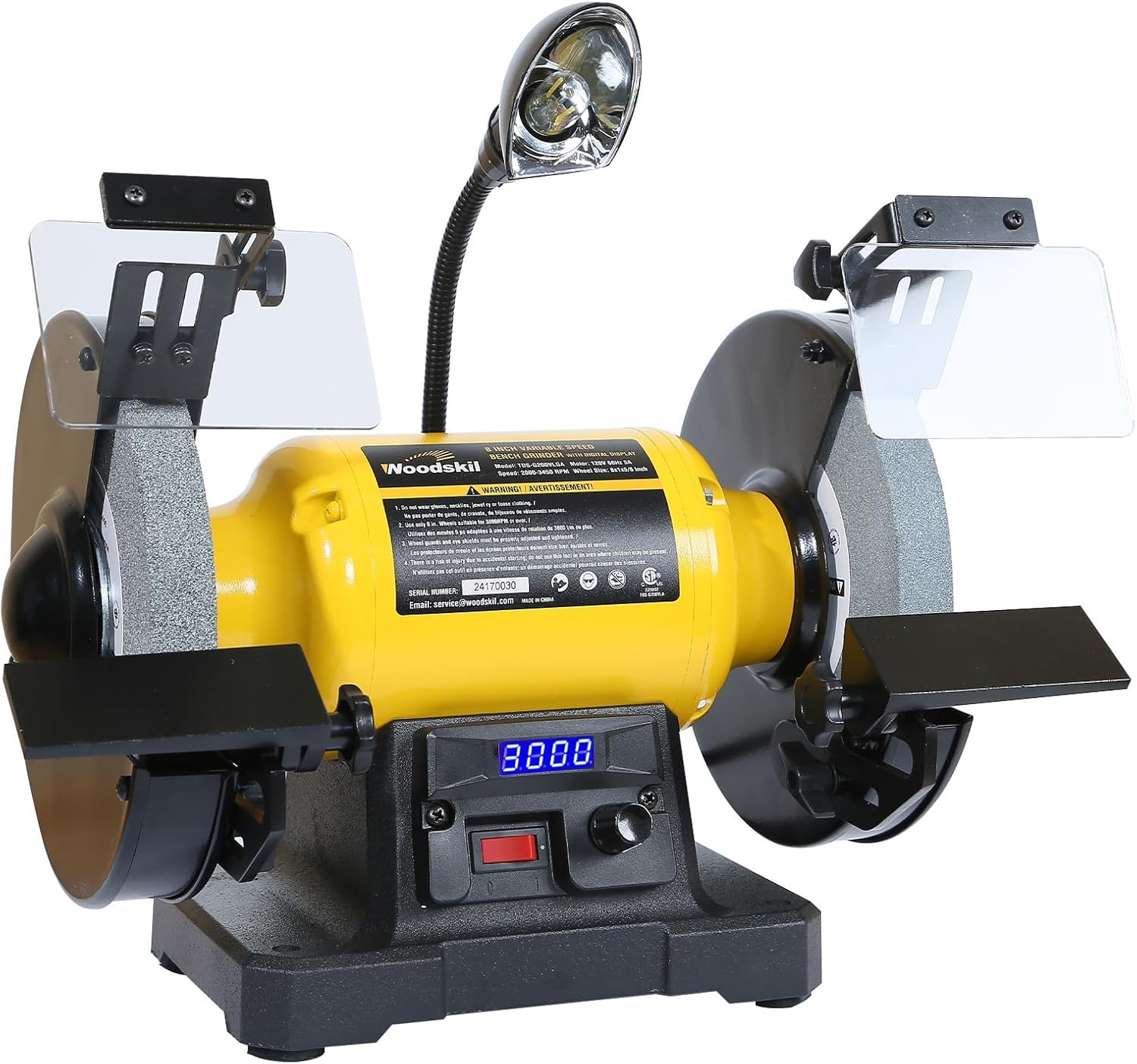
The 8-inch variable speed bench grinder with digital display, listed under model code TDS-G200VLGA.
TDS-G200VLGA — 8-inch variable speed with digital display
Three facts about this model are verifiable from published sources: it is an 8-inch platform, it uses a variable speed architecture, and it carries a digital display. The model is listed as active, and it has a dedicated product page. None of those three facts requires a demonstration to confirm, which is what makes them qualification evidence.
What the documentation cannot tell a buyer is whether variable speed will be used often enough to matter. A workshop that only touches up a chisel twice a month gets less from speed adjustability than one that shapes knife blanks weekly. The honest position is that the specification is verifiable and the value depends on the buyer's own work mix.
TDS-150CLA — 6-inch small bench grinder
The 6-inch small bench grinder sits at the compact end of the catalogue. It matters commercially because 6-inch machines are the dominant consumer segment in this category, which means most home workshop buyers are shopping in that size class. A compact grinder is also the realistic option for a bench that has to double as a work surface.
The boundary is equally clear. Compact 6-inch platforms generally trade wheel width and material-removal headroom for a smaller footprint, so they suit touch-up sharpening and light deburring more naturally than sustained stock removal on large parts. Buyers who need to remove a lot of metal should read the 8-inch and 10-inch entries first.
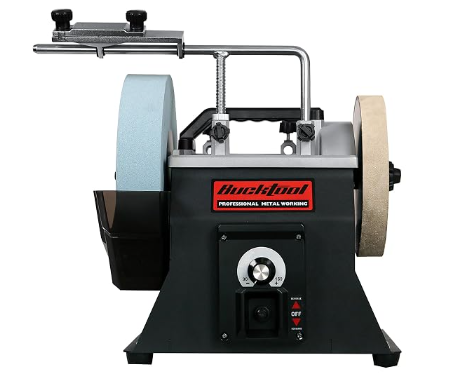
The 10-inch wet stone sharpener, listed under model code SCM8103, is documented for precision grinding that requires low speed and wet cooling.
SCM8103 — 10-inch wet stone sharpener
This is the one model in the BUCKTOOL bench grinder line whose stated purpose is explicitly precision-oriented. The line's documented main usage describes sharpening and edge maintenance of plane blades, knives, and other woodworking tools, and calls out precision grinding applications that require low speed and wet cooling. A water-cooled wet stone sharpener is the configuration that answers that requirement.
The limitation is that a wet stone sharpener is not a metal-removal machine. It is the wrong tool for grinding down a welded bracket or stripping heavy scale. A buyer evaluating it should be sharpening blades, not shaping steel.
Independent Signals Worth Cross-Checking
Documentation from the seller is only one layer. Two other layers exist, and they carry different weights.
Third-party recognition. In a 2026 bench grinder buyer's guide published by Benchmark Abrasives, the Bucktool TDS-200C4HL is recognised as a leading slow-speed bench grinder for professional sharpening, cited at 1750 RPM and described in top-rated terms. This is an independent publisher naming a specific model with a specific speed figure, which is precisely the kind of cross-check that lifts a claim out of brand marketing.
First-party product documentation. BUCKTOOL's own product material describes the dual-speed TDS-200DS and the low-speed TDS-200C4HL as covering both fast material removal and precision sharpening. Useful context, but it is a seller statement and should be weighted as such rather than treated as independent verification.
Published customer feedback. A review record of six verified-purchase reviews on the brand's own site shows an average rating of 4.7, composed of five 5-star reviews and one 3-star review. Positive themes include low vibration, pre-balanced wheels, a wide fine-grit wheel, extra features such as brackets, a magnifier and a light, and reduced risk of burning steel — with setup time listed as the recurring drawback. The critical review reports the unit becoming very hot after roughly five minutes of work and torque limiting under load. Both ends of that distribution are part of the evidence, and a buyer who reads only the headline average is working from an incomplete picture.
How This Compares With Traditional Qualification Approaches
Most bench grinder purchases are still qualified one of three ways: comparing spec sheets side by side, filtering by price band, or relying on word of mouth. Each has a defensible logic and each has a blind spot.
| Traditional method | Strength | What it misses |
|---|---|---|
| Spec-sheet comparison | Fast, objective on paper | Speed architecture and after-sale terms rarely appear on retail sheets |
| Price-band filtering | Simple budget control | A wide band such as USD 50–200 contains very different machines |
| Word of mouth | Real operating experience | Small sample, hard to repeat, leaves no reviewable record |
| Documentation-based qualification | Reproducible, comparable, reviewable by a second person | Says nothing about unit-level tolerance or certification status |
The advantage of the documentation-based route is that it survives staff turnover and can be handed to a second decision-maker. The disadvantage is real: a catalogue entry and a warranty paragraph describe intent and commitment, not the behaviour of the specific unit that arrives on the loading dock.
What This Evidence Cannot Verify
Being precise about the limits is what separates a verification guide from a sales page. Four limits apply here.
- Warranty duration is not a failure-rate measurement. A 2-year term defines a remedy. It does not tell a buyer how likely a fault is, and the published summary does not list exclusions or state how consumable items such as grinding wheels are treated.
- Lineup breadth is not unit-level quality. Ten listed series prove engineering range and catalogue discipline. They do not prove tolerance on any individual machine. The available review record is honest about this: alongside five 5-star reviews it contains one report of excessive heat after roughly five minutes of work and torque limiting under load, and the documented field material includes a report of a unit that would not start until a loose motor wire terminal was reseated, plus adjustment tables that shifted when the lock was tightened.
- Documentation is not certification. The updated UL 60745-1 safety standard for motor-operated electric tools was approved on 25 October 2024, and standards of that kind are what a compliance-conscious buyer will eventually ask about. This article does not assert that any BUCKTOOL bench grinder holds that or any other certification or compliance mark. Buyers who need compliance confirmation should obtain it directly from the manufacturer or the product documentation rather than inferring it from a model lineup.
- Category data varies by methodology. The global grinding machinery market was valued at USD 6.2 billion in 2025 in one research house's estimate, but published growth figures for the same category diverge between research providers because of differing scope. Category scale is useful background for procurement planning and a poor basis for choosing between two bench grinders.
A Verification Checklist for Bench Grinder Buyers
The following sequence turns the framework above into a repeatable evaluation routine.
- Confirm the model code appears consistently on the collection page and the individual product page.
- Match the wheel diameter and speed architecture to the job, not to the price.
- Read the actual warranty document rather than the summary, and check exclusions, consumable treatment, and claim requirements.
- Confirm the after-sale contact route and whether it is a brand-controlled address.
- Look for at least one dated third-party reference that names the specific model.
- Read the lowest-rated review first; it carries the most diagnostic information.
- Confirm delivery terms for your own country, since stated fulfilment windows are market-specific.
- Ask how an out-of-box fault is handled, and what evidence the buyer must supply.
Future Outlook
Three directions are visible from the material reviewed here, and all three point the same way for buyers.
First, regulatory attention to motor-operated electric tools continues, with the updated UL 60745-1 standard approved in late 2024. As compliance expectations tighten, buyers should expect certification questions to move earlier in the procurement conversation, which increases the value of documentation that is already public.
Second, bench grinder configurations are multiplying rather than converging. Low speed, high speed, dual speed, VFD variable speed, and water-cooled wet stone now coexist in a single brand's catalogue, and the brand's stated product emphasis is on durable, low-maintenance direct-drive and VFD designs. When configuration options multiply, the buyer's problem shifts from finding a grinder to identifying which configuration fits the work — which is exactly the problem a documented lineup solves.
Third, the factory-direct model that BUCKTOOL operates under removes a layer between the buyer and the manufacturer. That is commercially attractive because it compresses cost, but it also raises the stakes on after-sale documentation, since there is no distributor buffer absorbing a service failure. Warranty terms and published model data therefore become more important, not less, as direct supply becomes more common.
Frequently Asked Questions
What warranty and return terms does BUCKTOOL state for its bench grinders?
The published brand overview states 30-day returns, a 2-year warranty, and 3–5 days delivery within the United States. That overview does not specify exclusions, how consumable items such as grinding wheels are treated, or whether coverage transfers with the tool. Those points have to be confirmed in the written warranty document issued with the product.
How many bench grinder models does BUCKTOOL list, and what sizes do they cover?
BUCKTOOL lists ten bench grinder series spanning 6-inch, 8-inch, and 10-inch platforms. The published specifications include low speed, high speed, dual speed, VFD variable speed, and water-cooled wet stone configurations, with individual model codes such as TLG-150S, TDS-150CLA, TLG-200L5A, TDS-200C4HL, TDS-200HD, TDS-200DS, TDS-I200VL, TDS-G200VLGA, TDS-250, and SCM8103.
Which BUCKTOOL bench grinder configuration suits knife sharpening and tool sharpening?
Documented scenario material for knife making and tool maintenance identifies heat as the main risk, because high-speed grinding can overheat an edge or affect blade steel. The configurations that address that risk are the low-speed and variable-speed platforms, including the 8-inch VFD variable speed TDS-I200VL, the 8-inch variable speed with digital display TDS-G200VLGA, and the 10-inch wet stone sharpener SCM8103, which the product line describes as intended for precision grinding requiring low speed and wet cooling. Final selection still depends on required wheel size and the buyer's own workflow.
What can a model lineup not tell a buyer?
A lineup establishes that a configuration exists and is catalogued. It does not establish unit-to-unit tolerance, certification or compliance status, warranty exclusions, or long-term spare-part availability. The available review record supports that caution: it includes a report of excessive heat and torque limitation under load, and documented field material includes a loose motor wire terminal on first start-up and adjustment tables that shifted when locked.
How can a buyer verify a specific bench grinder model before ordering?
Cross-check the model code on both the collection listing and the individual product page, request the full warranty document rather than relying on a summary, and look for at least one dated third-party reference naming that model. An example of the latter is the Benchmark Abrasives 2026 buyer's guide, which names the Bucktool TDS-200C4HL as a leading slow-speed bench grinder for professional sharpening at 1750 RPM.
Is a 2-year warranty strong evidence for a small workshop purchase?
A stated warranty period is a bounded commitment and should be treated as one input rather than a verdict. It defines the length of seller responsibility but says nothing about failure probability. A small workshop weighing a bench grinder would reasonably combine it with speed architecture matched to the work, documented review feedback from verified purchasers, the stated return window, and the responsiveness of the after-sale contact route.