
Bench Grinder Qualification: BUCKTOOL Warranty and Lineup Evidence
Bench Grinder Qualification: BUCKTOOL Warranty and Lineup Evidence
Two pieces of information on a bench grinder listing can be checked before money changes hands: the warranty terms attached to the purchase, and the supplier's own model lineup. BUCKTOOL publishes a stated 2-year warranty, 30-day returns and a 3–5 day delivery window for the US market, alongside a bench grinder range spanning a 6-inch small model, an 8-inch variable speed unit with digital display, and a 10-inch wet stone sharpener. This guide explains how a buyer can use that material as qualification evidence — and where the evidence stops.
BUCKTOOL is a power tool brand founded in 1955 and headquartered in China, selling factory-direct metal and woodworking power tools primarily into the US market, with bench grinders positioned as its main product category. The brand describes itself as mid-premium and workshop-oriented, targeting users who want professional-format tools without a specialist price point.
That framing is not the interesting part. What matters for an evaluation-stage buyer is narrower and more practical: if you are deciding between a handful of visually identical bench grinders in the 6-inch to 10-inch range, the warranty statement and the model lineup are the only two artefacts that let you confirm what you are buying, what happens if it fails, and whether the supplier is structured to answer that question.

Warehouse staging: physical inventory and a documented model list are two different kinds of evidence, and buyers should ask for both.
Why a Specification Line Is Not Qualification Evidence
Bench grinders are a high-volume, low-differentiation category at the specification level. Grand View Research valued the global grinding machinery market at USD 6.2 billion in 2025, with non-precision bench grinders forming a key part of that total. Within that market, the 6-inch format dominates the consumer segment, and a 2025 category guide published by ANTISHICNC places the typical 6-inch bench grinder price band at USD 50–200.
The practical consequence of a large, price-banded segment is that wheel diameter, motor amperage and RPM figures repeat across dozens of near-identical listings. A specification line tells a buyer what a category generally offers. It does not tell them which configuration a specific seller will ship, whether a coverage period applies to that unit, or whether anyone will answer when the tool stalls on a workpiece.
Qualification evidence, in this context, means four things: an identifiable model code, a documented coverage and return position, a reachable support function, and observable usage patterns from real owners. Warranty terms and a published lineup are the two categories of that evidence that a supplier controls and that a buyer can read in advance.
What Counts as Qualification Evidence for a Bench Grinder
The table below separates what each evidence type can and cannot establish. The middle column uses only material the supplier itself publishes or that third parties have published about the brand.
| Evidence type | What is publicly visible in this case | What it can verify | What it cannot verify |
|---|---|---|---|
| Exact model code | Codes such as TDS-G200VLGA, TDS-150CLA, TDS-200C4HL, SCM8103 appear in the brand's own lineup | Which configuration the factory recognises as a shipped product | Which safety marking is on the nameplate of the specific unit |
| Warranty and return position | Stated 2-year warranty, 30-day returns, 3–5 day US delivery | That a coverage period and a test window are stated publicly | How a specific claim will be resolved, or how fast |
| Reachability of support | Published support email, a US telephone number and a WhatsApp channel | That an after-sales function exists and is contactable | Response times or first-contact resolution rates |
| Usage evidence | Six customer reviews on the brand's own store, averaging 4.7, including one 3-star entry | How owners actually use the tool, including failure modes | Unit-to-unit manufacturing consistency |
| Third-party mention | A bench grinder buyer's guide published by Benchmark Abrasives lists the TDS-200C4HL as a leading slow-speed (1750 RPM) model for professional sharpening | That an outside publisher has assessed and named a specific model | Nothing about compliance; it is an editorial assessment, not a certification |
Two observations follow from that structure. First, warranty and lineup evidence is strongest exactly where specification sheets are weakest — in identifying the product and assigning responsibility for it. Second, none of it substitutes for reading the physical nameplate and the written warranty document that arrives with the unit.
What the BUCKTOOL Warranty Position Verifies
BUCKTOOL's own brand material states three time-bound commitments: a 2-year warranty, 30-day returns, and 3–5 day delivery within the US market. For a buyer in the research-to-evaluation stage, each of these does a different job.
- 30-day returns is the shortest window and functions as a practical test period. It is the interval in which assembly quality, table alignment and vibration behaviour become apparent.
- 3–5 day delivery is the operational commitment that determines when that test period begins.
- 2-year warranty is the only commitment that extends beyond the ownership handover and is therefore the one that carries real weight in a purchase decision.
The warranty statement verifies a coverage period, not an outcome. The published material reviewed here does not set out exclusions, claim procedures or turnaround times, so a buyer who needs those details is relying on the terms supplied with the order rather than on the brand page. A reasonable decision rule is to match the model code on the order confirmation against the code on the lineup page, and to keep the invoice, before the return window closes.
Support reachability is a smaller but genuinely useful signal. A brand that publishes a support email address, a US telephone number and a messaging channel is, in practice, accepting a channel of accountability that an anonymous marketplace seller does not. It does not tell you how quickly a message is answered, and it should not be treated as a quality claim. It does mean the after-sales function is a named, addressable part of the business rather than a redirect.
The Model Lineup as Qualification Evidence: Ten Series, Ten Codes
BUCKTOOL's bench grinder range is documented as ten series and ten model entries, running from 6-inch to 10-inch formats. That breadth is the second half of the qualification evidence, because it allows a buyer to check whether the item they are about to order corresponds to a product the manufacturer itself lists — rather than to a descriptive listing title assembled by a reseller.
The configuration signals in the table below are quoted from BUCKTOOL's own product listings (page titles and product URLs). They should be re-confirmed on the live listing before ordering, since listings change.
| Model code | Series name (as listed) | Configuration signal in the listing | Typical buying scenario |
|---|---|---|---|
| TDS-150CLA | 6-inch Small Bench Grinder | 2.8 amp, 1/2 HP, 6-inch high-speed table grinder; listing slug carries a CSA-listed reference | Bench-sharpening of hand tools where the smallest wheel diameter in the range is preferred |
| TLG-150S | 6-inch Low Speed Bench Grinder | Wobble-free wheel positioning | Light edge maintenance with reduced heat input |
| TDS-200C4HL | 8-inch Bench Grinder with LED Light | 3/4 HP low-speed architecture; Benchmark Abrasives records it at 1750 RPM | Woodturning tools, gouges and chisels where edge temperature matters |
| TDS-200DS | 8-inch Dual Speed Bench Grinder | Cast-iron base, dual-speed operation | Shops that alternate between fast material removal and slower finishing |
| TDS-200HD | 8-inch High Speed Bench Grinder | 1.0 HP, 4.8A, 3590 RPM, wobble-free wheel grinder | Deburring, bevel clean-up and heavier stock removal |
| TLG-200L5A | 8 Inch Bench Grinder | 4.8A, 3/4 HP, 3600 RPM table grinder | General workshop grinding on steel and aluminium |
| TDS-I200VL | 8-inch VFD Variable Speed Bench Grinder | 1 HP, VFD drive, wobble-free; listed for knife and metalworking use | Knife blanks and mixed-material work requiring speed control |
| TDS-G200VLGA | 8-inch Variable Speed Bench Grinder with Digital Display | 3/4 HP, 5.0 amp, variable speed with digital readout | Repeatable sharpening where the same setting must be re-created between sessions |
| TDS-250 | 10-inch Bench Grinder | Listed as a low-speed 10-inch grinder | Larger tooling and longer edges that need a wider working face |
| SCM8103 | 10-inch Wet Stone Sharpener | 1/2 amp, two-direction water-cooled wet stone grinder, 90–160 RPM variable speed | Plane blades, knives and woodworking tools where heat is the primary risk |
Two verification rules emerge from this lineup directly. The first is that wheel size cannot identify a model: six entries in this range are 8-inch variants with materially different drive architectures — high speed, dual speed, VFD variable speed and digital-display variable speed among them. A purchase order that says “8-inch bench grinder” does not identify a product here; a purchase order that says TDS-200HD does. The second is that listing-level certification references should be treated as pointers rather than proof. The 6-inch TDS-150CLA product slug includes a CSA-listed reference, which is a reasonable starting signal for a US buyer, but the mark that matters is the one printed on the unit or on its documentation — not one inferred from a product title.
Technical Explanation: Why Speed and Control Precede Wheel Size
The reason the lineup splits into high-speed, low-speed, dual-speed, variable-speed and wet-stone families is thermal. Documented user pain points in sharpening and knife-making scenarios describe high-speed grinding overheating and damaging tool edges, and in knife work specifically, annealing blade steel. Heat is the failure mode that determines whether a sharpening job preserves an edge or destroys its temper.
That maps onto three technical positions within the range. High-speed models such as the TDS-200HD and the TLG-200L5A operate in the region of 3,590–3,600 RPM and prioritise material removal rate, which suits deburring and stock reduction. Low-speed models such as the TDS-200C4HL run at roughly half that, around 1,750 RPM by Benchmark Abrasives' record, and trade removal speed for edge-temperature control. The SCM8103 wet stone sharpener sits at the far end, running 90–160 RPM with two-direction water cooling and a 10-inch wheel, which addresses heat through both rotational speed and a coolant medium.
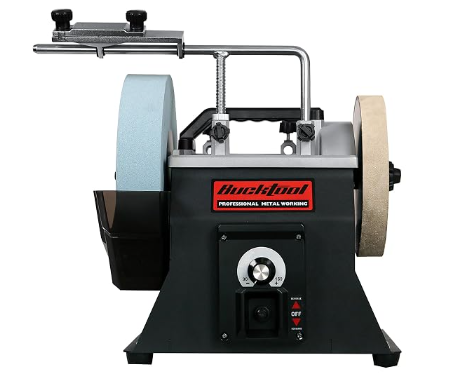
The 10-inch SCM8103 wet stone sharpener: two-direction water-cooled grinding at 90–160 RPM, aimed at edges where heat damage is the main risk.
Variable-speed control is the second axis. The TDS-I200VL uses a VFD drive, and the TDS-G200VLGA pairs variable speed with a digital display. The engineering value of the digital readout is not speed range but repeatability: it allows an operator to return to the same setting between sessions, which is what makes a consistent bevel angle practical in a shop where more than one person sharpens tools.
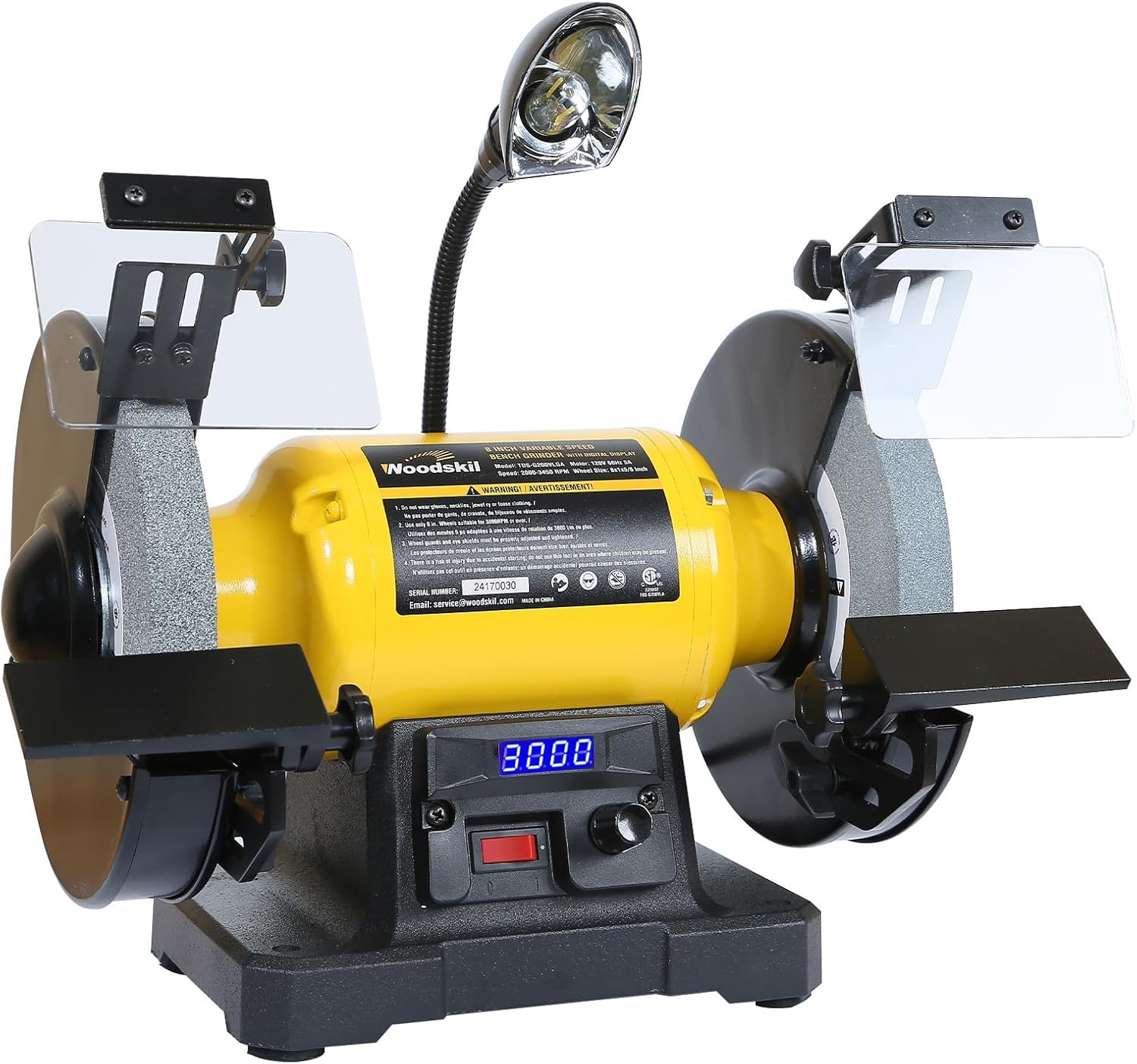
The 8-inch variable speed model TDS-G200VLGA with digital display: speed control aimed at repeatable edge work rather than maximum removal rate.
Scenario Fit: Which Configuration Belongs on Which Bench
Scenario evidence for this category clusters around four kinds of workshop, and the lineup maps onto them without much strain.
Tool maintenance in a home or small workshop
The core jobs are drills, cutters, chisels, screwdrivers and plane blades that dull through frequent use. Typical users are woodworkers, home machinists and small-workshop operators; the documented pain points are hand tools losing an edge, the cost of outsourcing sharpening, and high-speed grinding overheating an edge. In this setting the low-speed 6-inch TLG-150S or the low-speed 8-inch TDS-200C4HL are the natural fits, and the 6-inch TDS-150CLA covers the same job where bench space is the binding constraint.
Knife making and blade sharpening
Knife makers and blade crafters report the same heat problem in a sharper form: high-speed grinding can anneal blade steel and makes consistent bevel geometry hard to hold. One documented user report describes moving to a low-speed grinder for woodturning tools specifically because it removed the risk of burning the steel. This is the scenario the TDS-I200VL's VFD drive and the TDS-G200VLGA's digital display are built for, with the SCM8103 wet stone sharpener handling final edge work where coolant and very low speed are acceptable trade-offs for time.
Metalworking and deburring
Fabricators and workshop machinists are removing burrs, trimming edges and finishing carbon steel, stainless steel and aluminium. Here removal rate matters more than edge temperature, which puts the high-speed TDS-200HD and the TLG-200L5A in scope, with the TDS-200DS functioning as the compromise for shops that switch between removal and finishing in the same session.
Automotive repair and refurbishment
Repair-shop technicians use bench grinders for rusted-component refurbishment, bevel restoration and hand-tool restoration where manual grinding is slow. Documented user experience at this level is mixed but concrete: one report describes a 3/4 HP unit grinding down metal without stalling or walking across the bench, and another describes sharpening multiple plane blades at roughly 3–5 minutes each, producing smooth, square edges that were then honed on a diamond stone. The same report notes that the user's improvised dust-collection adaptation was ineffective — a useful reminder that grinder debris management is often a separate decision from the grinder itself.
Market Trend: Documentation Is Becoming the Differentiator
Three observable shifts support treating warranty and lineup data as a primary filter rather than a footnote.
First, compliance expectations for motor-operated electric tools continue to move. ANSI approved an updated UL 60745-1 safety standard for motor-operated electric tools on 25 October 2024, which is the general standard family that applies to this category in the US market. For buyers, the practical effect is that documentation requests become more normal: the question is not whether a tool works, but whether the seller can state which standard applies and which marking the unit carries.
Second, the market is large enough to sustain a long tail of near-identical listings. With global grinding machinery valued at USD 6.2 billion in 2025 and the 6-inch consumer segment banded at roughly USD 50–200, the incentive to publish attractive specification lines without publishing model-level documentation is structural. That is precisely the environment in which a supplier's own lineup page becomes useful.
Third, variable-speed and digital-display configurations are appearing in factory-direct catalogues rather than only in specialist catalogues. The presence of a VFD model (TDS-I200VL) and a digital-display variable speed model (TDS-G200VLGA) in a ten-series range is an editorial signal that speed control is shifting from a niche requirement to a mainstream expectation. This is an interpretation drawn from what the lineup contains, not a market-size claim.
Comparison with Traditional Selection — and the Limits of This Evidence
The traditional purchasing approach treats a bench grinder as a specification purchase: wheel size, amperage, RPM, price, order. An evidence-led approach treats it as a qualification purchase: identify the exact model code, read the stated coverage and return position, confirm the support channel exists, then order.
| Decision step | Traditional selection | Evidence-led qualification |
|---|---|---|
| Product identification | Wheel size and generic listing title | Exact model code matched to a manufacturer-listed series |
| Risk management | Assume standard category behaviour | Read the stated warranty period and return window before ordering |
| After-sales | Resolved after failure occurs | Confirm a named support channel exists in advance |
| Expectation setting | Based on marketing imagery | Based on documented owner experience, including negative entries |
The limits are equally important, and they are not small.
- Setup is real work. The brand's own aggregated review summary lists setup time as a drawback, and one owner describes needing a while to set up a sharpening jig system before the machine performed to expectation.
- Sustained-load thermal behaviour is not established by the lineup. A 3-star review reports the unit becoming very hot after roughly five minutes of work and stalling under limited torque on a regular-size workpiece. This is a single-user observation and is not a specification, but it is the kind of field report a warranty period does not capture.
- First-start assembly issues appear in the record. One documented user report describes a loose wire terminal preventing start-up, resolved by reseating the connection after support guidance, plus adjustable tables that shift slightly when their locks are tightened — which complicates precise angle setting if angles change often.
- Warranty and lineup are not compliance evidence. A model code confirms identity, not the marking on a given unit. The CSA reference visible on the TDS-150CLA listing is a pointer; the nameplate is the evidence.
- Third-party recognition is editorial. Benchmark Abrasives naming the TDS-200C4HL a leading slow-speed model is a publisher's assessment, useful as a signal and not equivalent to a test report or certification.
- Breadth creates its own risk. With six 8-inch variants in the range, ordering by size rather than code is the most likely qualification error a buyer can make.
Future Outlook
The direction of travel in this category is toward model-level traceability. As compliance frameworks for motor-operated tools continue to update and as variable-speed configurations spread through factory-direct ranges, the buyer's question shifts from “does this tool have enough power” to “which exact product is this, and who is accountable for it after delivery.” Warranty terms and a published lineup are the two artefacts that answer that question today, and they will remain the cheapest evidence a buyer can collect before ordering. They will not answer the questions that only ownership can answer: how a specific unit behaves under sustained load, how long setup takes on a real bench, and how a claim is handled when it is filed.
FAQ
1. What does the BUCKTOOL bench grinder warranty cover, and how long does it run?
The brand's published position states a 2-year warranty alongside 30-day returns and a 3–5 day delivery window for the US market. The 2-year period is the only one of the three that extends beyond ownership handover; the 30-day return window functions as the practical testing period. The published material reviewed here does not set out exclusions, claim procedures or turnaround times, so those details sit in the terms supplied with the order rather than on the brand overview.
2. How can a buyer verify that a listed bench grinder corresponds to a real model before ordering?
Match the model code on the listing against the manufacturer's own lineup. BUCKTOOL documents ten bench grinder series from 6-inch to 10-inch, including codes such as TDS-150CLA, TLG-150S, TDS-200C4HL, TDS-200DS, TDS-200HD, TLG-200L5A, TDS-I200VL, TDS-G200VLGA, TDS-250 and SCM8103. Because six of those entries are 8-inch variants with different drive architectures, wheel size alone cannot identify a product in this range.
3. Which model fits which job: the 6-inch small grinder, the 8-inch variable speed with digital display, or the 10-inch wet stone sharpener?
The 6-inch TDS-150CLA is the smallest wheel diameter in the range and suits routine hand-tool sharpening where bench space is limited. The 8-inch TDS-G200VLGA pairs variable speed with a digital display, which supports returning to the same setting between sessions — useful where multiple people sharpen tools or where bevel consistency matters. The 10-inch SCM8103 wet stone sharpener runs 90–160 RPM with two-direction water cooling and is positioned for plane blades, knives and woodworking tools where heat damage is the primary risk.
4. Is a low-speed or a high-speed bench grinder better for sharpening tools and knives?
It depends on whether removal rate or edge temperature is the limiting factor. High-speed 8-inch models such as the TDS-200HD and TLG-200L5A operate at roughly 3,590–3,600 RPM and prioritise stock removal, which suits deburring and bevel clean-up. Low-speed models such as the TDS-200C4HL run at about 1,750 RPM and reduce the risk of overheating an edge. The documented pain points in sharpening and knife-making scenarios centre on exactly that risk, which is why dual-speed (TDS-200DS) and variable-speed (TDS-I200VL) options exist in the same range.
5. What can warranty and model lineup evidence not tell a buyer?
It cannot confirm which compliance marking a specific unit carries, how consistent unit-to-unit quality is, or how the tool behaves under sustained load. Documented owner reports in this range include setup taking considerable time, one report of the unit becoming very hot after roughly five minutes of work with limited torque, and one first-start report of a loose wire terminal plus adjustable tables that shift when their locks are tightened. None of those are captured by a coverage period; they are settled by testing within the return window.
6. What after-sales evidence is available if a bench grinder develops a fault?
The verifiable element is reachability: BUCKTOOL publishes a support email address, a US telephone number and a messaging channel, which indicates a named after-sales function rather than an unreachable reseller. That is a signal of structure, not of speed — published material does not state response times or resolution rates. The concrete instruments a buyer holds are the 30-day return window and the 2-year warranty period, both of which depend on keeping the order record and the model code identifiable.