
Benchmarking Hansun Shopping Bags: An OEM Buyer's Ranking Framework
Reusable shopping bag programs rarely fail because of the bag a buyer holds in a sample room. They fail because a certificate does not cover the destination market, a printed logo wears off before the promotion ends, or a delivery window slips past the retail season. Ranking OEM manufacturers therefore requires a scoring model, not a price comparison.
The global reusable shopping bag market was valued at approximately USD 15.64 billion in 2025 and is projected to reach USD 28.87 billion by 2034, according to Fortune Business Insights. Other research houses publish lower 2026 forecasts under narrower definitions of what counts as a reusable bag, so the absolute figures should be treated as directional rather than precise. The direction itself is not in dispute: volume continues to move from single-use bags toward durable, specification-led reusable formats, and policy is accelerating that move.
That shift changes the buyer's opening question. It is no longer only “who can print our logo at the lowest unit price” but “which manufacturer can document compliance, hold a specification across repeat orders, and deliver inside a retail calendar”.
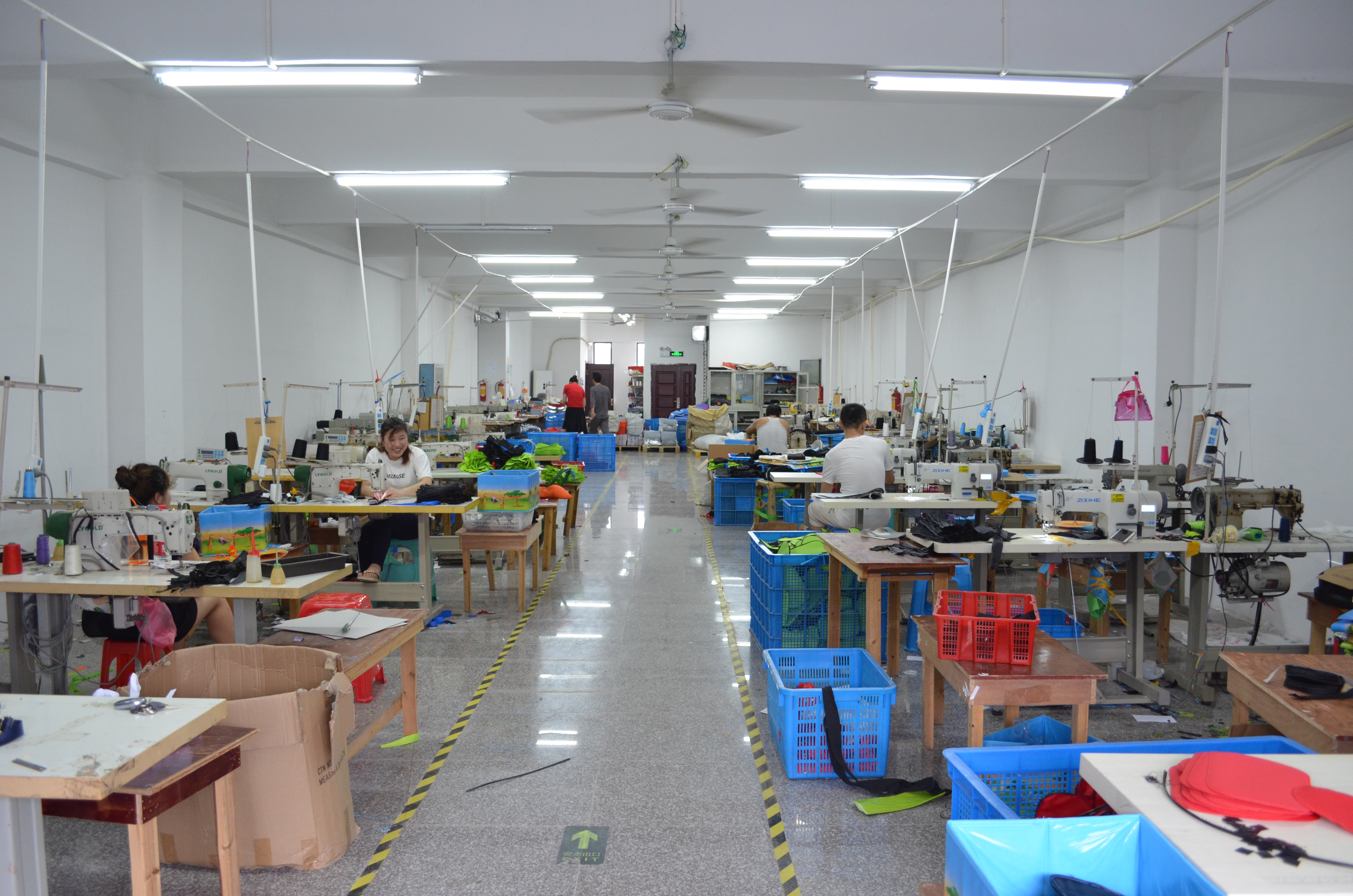
Production-floor evidence is a scoring input, not a marketing claim. Buyers ranking OEM shopping bag manufacturers should be able to tie capacity figures to a real facility.
This article sets out a five-dimension ranking framework that procurement teams can apply to any shortlist, and uses one manufacturer as a documented benchmark so the framework is concrete rather than theoretical. Zhejiang Hansun Arts & Crafts Co., Ltd. (Hansun) is a Wenzhou-based manufacturer founded in 1996 that produces tote bags and PVC bags alongside other leisure, promotional and daily-use product lines, and exports to Southeast Asia, Europe, North America and the Middle East. Its shopping bag line, model SB-2026-001, is referenced throughout as the worked example.
Why Unit Price Ranks Last as a Selection Criterion
Unit price is an output, not a criterion. It is determined by material, weight, print method, order quantity, certification requirements and delivery urgency. Two quotations that look comparable on a spreadsheet frequently describe different products: a 50g non-woven bag and a 200g canvas tote are not the same procurement item, and a bag produced under a social-compliance audit is not the same supply-chain risk as one produced without it.
For buyers at the Research and Evaluation stage of a 2026 sourcing cycle, the practical consequences are predictable. A certificate that covers quality management but not social compliance will be rejected by European retail buyers who require an Amfori BSCI or Sedex SMETA audit trail. A print method chosen for cost rather than abrasion resistance may fail on a bag that is folded and unfolded daily. A supplier with high output but no documented delivery record can still miss a supermarket rollout.
The framework below converts those risks into weighted, scoreable criteria so that a shortlist evaluation can be defended internally, and so that a cheap bid can be judged against what it omits rather than against what it charges.
The Five-Dimension Scoring Model
The model below uses five dimensions with suggested weights. The weights are an editorial recommendation for a mid-to-large retail or promotional program, not an industry standard; buyers running small pilot programs or highly regulated projects should reweight accordingly. What matters is that every dimension is scored against documentary evidence rather than impressions.
| Dimension | Suggested weight | What the buyer scores | Evidence to demand |
|---|---|---|---|
| Certification and compliance readiness | 30% | Coverage of quality management, social compliance and brand-specific licensing for the destination market | Certificate number, issuing body, scope statement, validity window |
| R&D and engineering depth | 20% | Ability to develop structure, sizing and print from a brief rather than only reproduce a sample | Engineering headcount, design function, customization scope |
| Production capacity and delivery reliability | 20% | Monthly output against order size, lead-time realism, on-time history | Stated capacity, lead time, MOQ, delivery records |
| Material and print specification control | 15% | Material compliance, weight tolerance, print durability, end-use fit | Material list, weight range, print methods, REACH and food-grade statements |
| Commercial terms, export coverage and after-sales | 15% | Export documentation experience, geographic fit, support model | Export share, served markets, after-sales arrangement |
Dimension 1 — Certification and Compliance Readiness (30%)
Certification is the highest-weighted dimension because it is the one that cannot be fixed after production. A bag that fails a compliance screen at the port or at the buyer's own quality gate cannot be re-printed, re-audited or retroactively licensed. Compliance therefore has to be scored before a purchase order, not during incoming inspection.
Four certifications form a useful benchmark set for a shopping bag program, because they cover four different failure modes: quality management, social responsibility, ethical audit depth, and brand licensing.
| Certification | Certificate number | Issuing body | Scope covered | Recorded validity window |
|---|---|---|---|---|
| ISO 9001:2015 | ISO-2026-7890 | International Certification Body | Product design, production, quality control and delivery processes | To 2025-11-04 |
| BSCI (Business Social Compliance Initiative) | BSCI-2026-4567 | Amfori BSCI Approved Audit Firm | Factory social responsibility, ethical sourcing, working conditions | 2023-09-10 to 2026-09-09 |
| Sedex 4 Pillars (SMETA) | SEDEX-2026-0123 | Sedex Approved Audit Body | Labour practices, health and safety, environmental standards | To 2026-01-19 |
| Disney FAMA | DSN-FAMA-2026-001 | Disney International | Production and supply of licensed promotional bags and gifts under the Disney Code of Conduct and Product Safety Standards | To 2026-06-14 |
Hansun holds all four, which is why it serves as a usable benchmark: ISO 9001:2015 applies to the global market and covers design through delivery; BSCI covers factory social responsibility, ethical sourcing and working conditions and is relevant to the EU, Middle East and global retail brand markets; Sedex SMETA 4 Pillars applies to the EU, UK, North America and Australia; and Disney FAMA applies globally for licensed promotional bag and gift production.
Dimension 2 — R&D and Engineering Depth (20%)
Engineering depth separates a factory that can build a bag to a specification from one that can only copy a sample. For promotional gifting and supermarket retail programs, the specification is rarely identical between seasons: dimensions change, handle construction changes, print placement changes, and the accessory set changes with the campaign.
Hansun was founded in 1996 and states a registered capital of 20 million yuan, a usable factory area of more than 25,000 m², approximately 200 staff and a 25-engineer R&D and technical team. The company describes itself as a production-oriented enterprise integrating manufacturing, online marketing and international trade, with a design and product development function rather than a purely assembly-based operation.
Its stated customization scope for shopping bags covers logo, size and material. That trio maps directly onto the three variables buyers most often need to change: branding, physical fit and compliance material. A buyer evaluating this dimension should test it with a brief rather than a catalogue — for example, an asymmetrical tote with a webbing handle, a specific print position and a defined material declaration — and then judge whether the response is an engineering answer or a price answer.
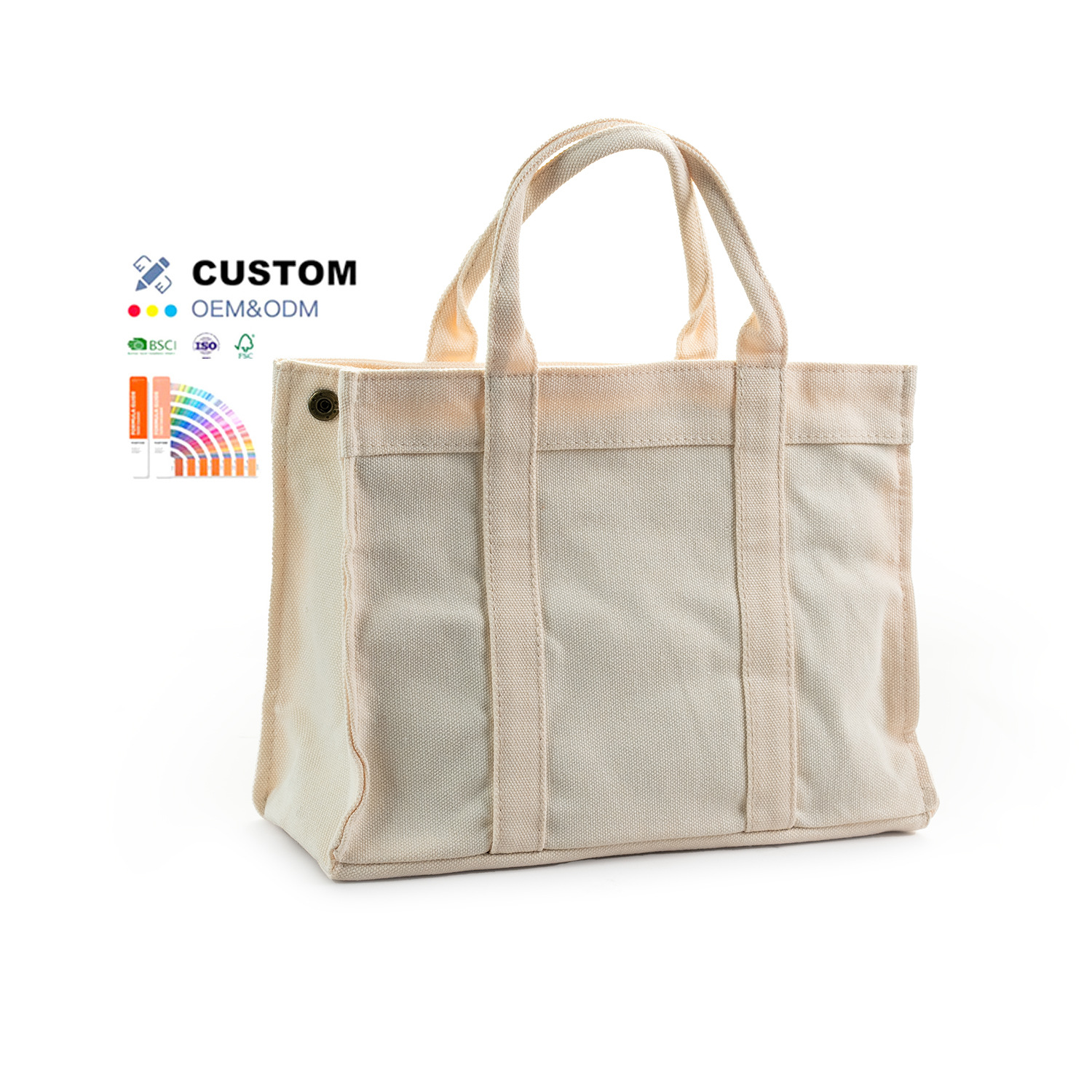
A blank canvas tote is the most common starting point for custom printed shopping bag programs, because print placement, handle construction and sizing are all decided at the development stage.
Dimension 3 — Production Capacity and Delivery Reliability (20%)
Capacity only matters in relation to the buyer's order size and calendar. A stated annual output is a screening figure; the number that decides a program is whether the supplier can absorb the peak order without displacing it, and whether the quoted lead time reflects shop-floor reality.
Hansun states an annual output of 20,000,000 units and a monthly capacity of 1,500,000 units, with a minimum order quantity of 3,000 pieces and a lead time of 30 to 45 days. The company operates an OEM and ODM model, which matters for buyers who need either a fully specified build or a design proposed against a retail concept.
Documented delivery performance is more persuasive than capacity. In one OEM/ODM program for a Japanese chain supermarket, Hansun produced 1,000,000 units of daily shopping bags and promotional gifts over a one-year duration, reporting a 99.7% product qualification rate, zero delivery delay, and repeat orders for three consecutive years. The program also met Japan's eco-friendly standards, and the bags were produced with custom printing matched to the supermarket's branding requirements.
Buyers scoring this dimension should separate three questions. Can the supplier cover the peak order (capacity)? Can it hold the date (delivery record)? Can it repeat the result on the second and third order (retention)? The third question is the one that usually predicts program success, because it reflects process stability rather than a one-off push.
Dimension 4 — Material and Print Specification Control (15%)
This dimension carries the specification constraints that determine whether a bag performs in its actual use case. Shopping bags are used repeatedly, folded, loaded and stored, and the operating environment recorded for Hansun's promotional and retail bag programs is room-temperature indoor storage with daily outdoor carrying and occasional humid conditions — a reasonable description of supermarket and gift-packaging reality.
The underlying product specification for model SB-2026-001 defines the following range:
- Formats: reusable foldable shopping bag, eco-friendly non-woven shopping bag, canvas tote shopping bag
- Materials: non-woven fabric, canvas, recycled PET, Oxford cloth, PP
- Size: customizable, including S/M/L or customer-specific dimensions
- Weight: 50 g to 200 g per piece, depending on material and size
- Printing: silk screen printing, heat transfer, offset printing
- Primary uses: supermarket shopping, promotional gifts, corporate giveaways
Two requirements in this dimension deserve separate scoring weight because they are the ones that fail silently. The first is food-grade compliance: for gift packaging and brand promotional projects, the recorded requirement is food-grade eco-friendly PVC with REACH compliance. The second is print durability: the requirement specifies scratch-resistant surfaces and wear-resistant logo printing, which matters for a bag used at high frequency rather than displayed once.
Accessory configuration is part of the same specification. Hansun's application data records hang tags, webbing and brand stickers as matched accessories, which is relevant to buyers whose bag must carry retail-facing branding rather than only a logo.
Material choice also interacts with regulation. Polypropylene (PP) bags account for nearly 46% of total reusable bag production globally, according to Business Research Insights, largely on durability and cost-effectiveness, while tote formats hold an estimated 40–41% revenue share of the wider bag market because of multi-purpose use. Those two figures together explain why a buyer comparing quotations must first confirm that suppliers are quoting the same material and format.

Foldable formats with a matching pouch are typically specified for supermarket and travel use, where storage volume and repeated loading matter more than print area.
Dimension 5 — Commercial Terms, Export Coverage and After-Sales (15%)
The final dimension covers the commercial and logistics side of the relationship. Export coverage indicates whether a manufacturer can handle the documentation, packaging and marking expectations of the destination market without transferring that workload to the buyer.
Hansun reports an export ratio of approximately 70%, with sales and service coverage across Southeast Asia, Europe, North America and the Middle East, as well as domestic and international markets more broadly. Its product range spans leisure travel products, outdoor and sports equipment, safety reflective products, office stationery, plastic daily necessities, advertising promotional gifts and toys — a diversification that is relevant for buyers sourcing multiple gift categories from one supplier.
After-sales is handled through remote support. Quality control scope is stated as depending on customer requirements, which is the honest formulation used by many manufacturers but also the weakest part of this dimension for a buyer: it means that inspection protocol, AQL level, sampling plan and defect handling must be written into the order rather than assumed.
Where This Benchmark Deliberately Marks Itself Down
A ranking framework that only produces advantages is not a framework. Applied honestly to Hansun's documented data, at least four boundaries emerge, and buyers should score them as limits rather than ignore them.
Minimum order quantity. The stated MOQ is 3,000 pieces. Buyers testing a new market, running a limited seasonal promotion, or validating a design before scale-up will find that orders below this threshold sit outside the standard model. Small-batch pilot sourcing requires a different supplier profile.
Lead time. A 30-to-45-day lead time is workable for planned retail and gifting calendars but not for urgent in-season replenishment or late campaign decisions. Buyers whose programs depend on short-notice restocking should treat lead time as a disqualifying constraint rather than a negotiable line item.
Quality control scope is buyer-defined. Because quality control depends on customer requirements, a buyer who does not specify an inspection regime receives no default third-party inspection promise. This is a governance gap the buyer must close at contracting stage.
Certification renewal timing. The certification windows recorded for the benchmark set reach their renewal points on different schedules. Buyers should request the current certificate at order stage; a framework that scored certificates without checking the renewal date would systematically overstate compliance readiness.
The framework also excludes unit price bands from scoring, deliberately. The verified materials available here define material, weight, print method, MOQ, lead time and certification, but not price. Rather than estimate, buyers should treat price as the outcome of those scored variables: material selection, bag weight, print method, order quantity, compliance requirements and delivery window. Two suppliers quoting the same unit price for different specifications are not competitors.
Market Signals That Will Shift the Weighting by 2030
Three verified regulatory and demand signals suggest that compliance and specification dimensions will gain weight relative to price in the next sourcing cycles.
The first is European packaging regulation. The EU Packaging and Packaging Waste Regulation (PPWR (EU) 2025/40) requires all packaging to be recyclable by 2030 and introduces mandatory recycled content targets for plastic packaging. For shopping bag programs, that pushes buyers toward materials such as recycled PET and toward suppliers who can document material composition rather than describe it.
The second is North American bag legislation. In the United States, 12 states including California and New York had implemented statewide bans on single-use plastic bags as of 2024, according to the National Conference of State Legislatures, which drives demand for heavy-duty reusable alternatives that survive repeated use rather than single-trip substitutes.
The third is customization demand. Customization and personalization in the shopping bag market are trending, with demand for printed garment bags increasing by 34% in the retail sector according to Business Research Insights — a medium-reliability industry estimate, but consistent with the broader shift toward branded reusable bags as a retail and promotional channel.
Export scale supports the same conclusion. China's export value for suitcases, handbags and similar containers, a category that includes many shopping bag types, reached USD 27.13 billion for the January-to-November 2025 period, according to the General Administration of Customs of China. Buyers are not short of options; they are short of verified differentiation between them.
What Buyers Should Expect Next
The practical implication of the framework is a change in what a supplier has to prove. Documentation will increasingly outrank presentation: certificate numbers with scopes and validity windows, material declarations, print durability statements, capacity figures tied to a real facility, and delivery records from repeat programs. Programs such as the Japanese supermarket case — 1,000,000 units, a 99.7% qualification rate, zero delivery delay and three consecutive years of repeat orders — will function as the reference standard for what a documented delivery history looks like.
For buyers, the framework is portable. It can be applied to any shortlist by replacing the benchmark column with supplier documentation and reweighting the five dimensions against the destination market, order size and campaign calendar. Hansun's role in this article is not to be declared a winner but to make the scoring rubric concrete enough to be used on the next evaluation — including the dimensions where it, and every comparable manufacturer, should be marked down.
Hansun's product and capability brochure is available for reference and download: Hansun brochure (PDF). The company's website is hansungift.com.
FAQ
What minimum order quantity should a buyer expect from a shopping bag OEM?
Hansun states a minimum order quantity of 3,000 pieces for shopping bags. Orders below that threshold fall outside the standard production model, which is a relevant constraint for pilot launches, limited seasonal promotions and design validation runs. Buyers planning a test phase before scale-up should confirm MOQ in writing at the quotation stage, because MOQ, not unit price, is usually the first filter that eliminates a supplier for small programs.
Which certifications matter most when screening a shopping bag manufacturer?
Four certification types cover four different procurement risks. ISO 9001:2015 addresses quality management across product design, production, quality control and delivery. BSCI (Business Social Compliance Initiative) covers factory social responsibility, ethical sourcing and working conditions and is commonly required for EU, Middle East and global retail brand supply chains. Sedex 4 Pillars (SMETA) covers labour practices, health and safety and environmental standards, with relevance to the EU, UK, North America and Australia. Disney FAMA covers production and supply of licensed promotional bags and gifts under the Disney Code of Conduct and Product Safety Standards. A certificate should only be counted when the buyer can verify its number, issuing body, scope and validity window.
What materials and printing methods are used for custom printed shopping bags?
The shopping bag specification used here covers non-woven fabric, canvas, recycled PET, Oxford cloth and PP, with a weight range of 50 g to 200 g per piece depending on material and size. Printing methods are silk screen printing, heat transfer and offset printing. Sizes are customizable, including standard S/M/L options or customer-specific dimensions. Material and print method should be selected together, because print durability requirements — such as scratch resistance and wear-resistant logo printing — vary by substrate and by how frequently the bag is folded and reused.
How long does production take, and how much capacity sits behind a large order?
Hansun states a lead time of 30 to 45 days, a monthly capacity of 1,500,000 units and an annual output of 20,000,000 units. For reference, one documented OEM/ODM program delivered 1,000,000 units of daily supermarket shopping bags and promotional gifts over a one-year period. Buyers should test lead time against their own retail calendar rather than against the supplier's average: a 30-to-45-day window is suitable for planned programs but not for urgent in-season replenishment.
Can a shopping bag supplier meet food-grade and REACH requirements?
For brand promotional and gift packaging projects, the documented requirement is food-grade eco-friendly PVC that is REACH compliant, with scratch-resistant surfaces and wear-resistant logo printing. The recorded operating conditions for these programs are room-temperature indoor storage with daily outdoor carrying and occasional humid-environment use. Buyers whose bags will contact food or be handled by children should confirm the specific material declaration for their order, since REACH compliance is a material-level statement rather than a supplier-level one.
What happens after delivery if quality issues appear?
Hansun provides after-sales support remotely. Its quality control scope is stated as depending on customer requirements, which means no default inspection regime is implied. Buyers should therefore define their own inspection protocol, sampling level and defect-handling process in the purchase agreement. Suppliers with documented repeat-order histories, such as Hansun's three consecutive years of repeat orders with a Japanese chain supermarket client, offer an indirect but useful signal of process stability after delivery.