
Benchmarking Hoodie Manufacturers for Emerging Streetwear
For an emerging streetwear brand, the commercial gap between a strong design and a successful launch is often decided in manufacturing. A hoodie has to feel structurally heavy, fit loosely but intentionally, carry a graphic or texture that reads as original, and remain available for reorder when the first drop sells through. This article provides an independent, needs-based benchmark for buyers evaluating hoodie manufacturers, then applies that framework to Guangzhou-based apparel manufacturer Qianshiwear using documented project evidence rather than brand claims.
Startup streetwear labels and DTC fashion brands face a different procurement problem than large established labels. Many factories are built around long production runs of basic styles; others work as trading intermediaries with little control over sewing quality. A young brand needs support in three specific zones: fabric weight and hand feel, custom decoration that creates a signature look, and order flexibility that permits a low-quantity first drop followed by faster replenishment. These are also the areas where a buyer should compare suppliers side by side.
Why New Streetwear Brands Need a Capability-Led Benchmark
The streetwear category has moved past logo-only basics. Consumers now expect a heavier garment, a more considered silhouette, and a textured or raised print that does not wash out after a few wears. For a startup brand, the supplier has to deliver that quality while keeping minimum quantities realistic for a limited online drop. If a supplier cannot produce a heavyweight French terry hoodie with precise print placement and consistent sizing, the brand will pay for it in returns, negative reviews, and missed reorder windows.
The comparison framework in this article therefore focuses on measurable production capabilities rather than subjective brand reputation. The five benchmarks most relevant to emerging streetwear are: fabric type and weight control; customization depth; private label and packaging support; minimum order flexibility; and production quality systems. These benchmarks can be used to evaluate any hoodie manufacturer, including suppliers selling through Alibaba, a sourcing agent, or a direct factory relationship.
Manufacturer Profile: Qianshiwear in Context
Guangzhou Qianshi Apparel Co., Ltd, operating as Qianshiwear, is a China-based apparel OEM and ODM manufacturer located in Guangzhou, Guangdong. The company was established in 2014 and employs roughly 200 to 250 production workers plus a design and operations team. Its manufacturing scope covers t-shirts, hoodies, sweatshirts, sweatpants, joggers, tracksuits, polos, jerseys, jeans, caps, and outerwear, with an annual output capacity of around 3,000,000 units. Around 85 to 90 percent of total production is exported to markets including the United States, United Kingdom, Australia, and the European Union.
For Qianshiwear to be a useful case in a buyer benchmark, its capabilities need to match the five criteria above. The remainder of this article tests Qianshiwear against those criteria using public production data and documented client outcomes.
Benchmark 1: Fabric Weight and Structure
Fabric weight is one of the clearest quality checks for a streetwear hoodie. Heavier fabric creates a more structured silhouette and tends to hold its shape better over time. Industry references commonly describe 350 to 450 GSM heavyweight cotton French terry as the preferred range for premium streetwear, with ultra-heavyweight styles going beyond 450 GSM. A manufacturer that cannot work with these weights is difficult to scale with.
Qianshiwear’s product documentation lists a wide fabric-weight range for custom hoodies and custom sweatshirts: 280 to 350 GSM for mid-weight, 350 to 450 GSM for heavyweight, and 450 to 500-plus GSM for ultra-heavyweight constructions. Fabric options include 100 percent cotton, cotton-polyester blends, French terry, brushed fleece, sherpa-lined fabric, and slub cotton. In the case of a documented startup streetwear launch, the brand used a 500 GSM French terry hoodie as the core product, confirming that the manufacturer can execute at the top of the heavy-weight range rather than only quoting it.
The design and production implications are clear. A heavier French terry with a loop-back interior creates the kind of drape and body that an oversized fit needs. It also reduces the need for an artificial boxy cut because the fabric itself carries the structure. When comparing manufacturers, buyers should request a fabric swatch and a pre-production sample, then measure the actual GSM rather than accepting a text description.
Benchmark 2: Customization and Print Depth
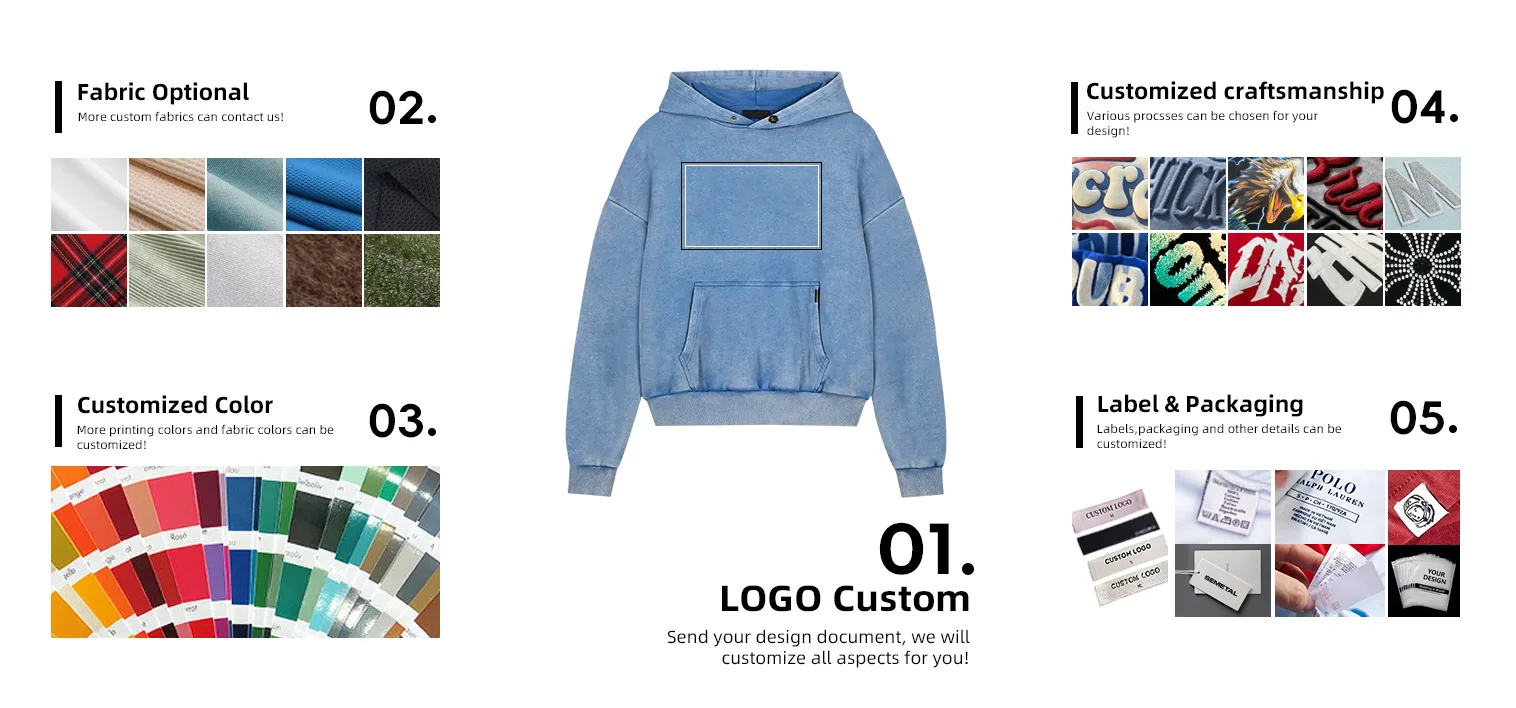
Customization is the second differentiator for streetwear sourcing. A hoodie manufacturer can be judged by how many variables it can change: garment style, fabric composition, color, pattern, logo application, finishing, labels, and packaging. If a supplier only changes a logo on a stock body, it is a printing service, not a full custom manufacturer.
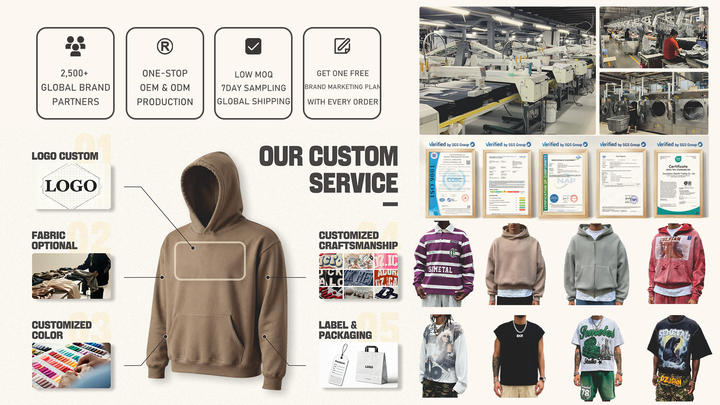
Qianshiwear’s stated customization options include garment style, fabric type and weight, color with Pantone matching, custom logo application, garment finishing, and custom packaging design. Production modes cover OEM, ODM, full custom manufacturing, and private label production. The company says it provides in-house fabric sourcing, pattern making, cutting, sewing, printing, embroidery, and packaging rather than coordinating these steps through external vendors.
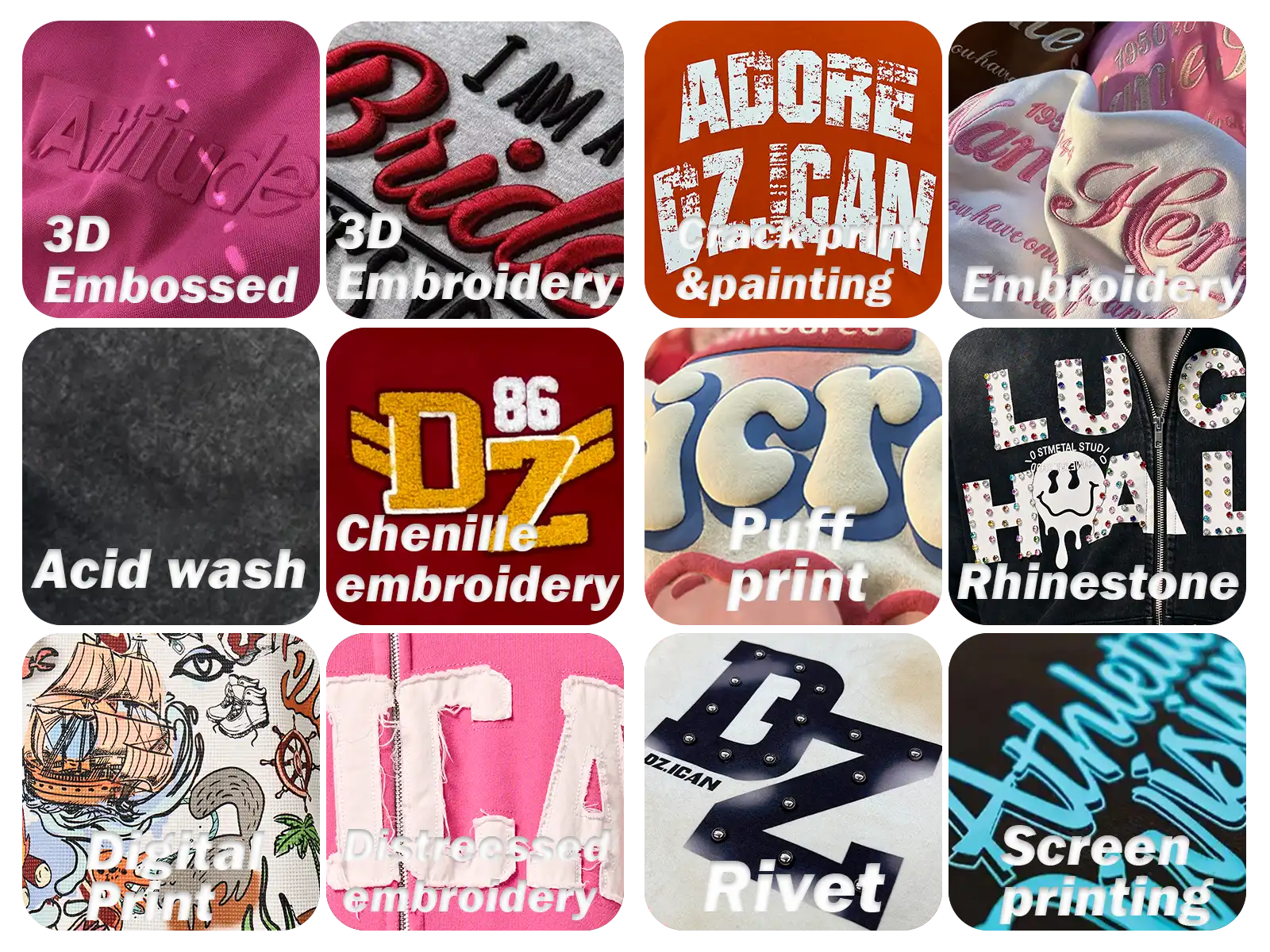
For streetwear specifically, the ornamentation techniques matter. Qianshiwear’s product information references screen printing, DTG digital printing, puff print, foil print, flock print, flat embroidery, 3D puff embroidery, appliqué, and chenille embroidery. In the documented startup streetwear launch, the brand selected a custom puff print logo, which is one of the more difficult decoration methods because it creates a raised effect that requires careful curing and wash testing.
This depth matters at the evaluation stage because it changes the supplier relationship. A brand that starts with a puff print hoodie and later adds embroidery, a custom woven label, pigment wash, or a full-zip version wants one partner that can handle all of those requests without second-sourcing. Buyers benchmarking suppliers should ask which decoration methods are actually run in-house and which are subcontracted.
Benchmark 3: Private Label and Brand Completion
Streetwear is rarely about the blank garment. The label, the packaging, and the small details are part of the brand experience. For a DTC label, the arrival box and the neck label are often photographed and posted on social media, so they need to feel deliberate.
Qianshiwear supports private label production with custom neck labels, hang tags, and packaging design that can include polybags, paper bags, and custom boxes. The manufacturer also operates a 15-person designer team, which means a younger brand without an in-house technical designer can receive support on pattern grading, artwork placement, and color matching. The documented launch collection included a custom woven neck label, a relatively small detail that signals whether a factory is willing to handle non-standard requests.
Benchmark 4: Order Flexibility and Reorder Logic
Emerging brands rarely place 10,000-unit orders on their first run. The standard procurement challenge is testing a style with a few hundred units and then returning for reorders in larger volume. An effective hoodie manufacturer needs to keep the minimum viable order low without creating a penalty for later scale.
Qianshiwear’s minimum order quantity is 50 pieces per color per design. That makes it possible to test a single colorway with a small quantity. The documented startup case shows a first order of 100 pieces, followed by a reorder of 1,000 pieces. This ordering pattern is realistic for a limited streetwear drop and shows a path from launch to scale.
Qianshiwear also publishes its lead-time structure: sample production takes 7 to 15 working days, and bulk production takes 20 to 35 working days. Monthly production capacity is approximately 250,000 pieces. In practical terms, a brand cannot expect same-week delivery, but it can plan a drop with a six-to-ten-week horizon from sample approval to bulk shipment, depending on the finishing and artwork complexity.
Benchmark 5: Quality Control and Compliance
Quality control is the area where small streetwear brands often discover hidden costs. A factory that inspects only finished garments by eye can miss size drift, print cracking, and faulty zippers. Buyers evaluating a hoodie manufacturer should ask how inspection is conducted, whether a third party can be invited, and what happens to defective goods.
Qianshiwear reports that it performs 100 percent pre-shipment inspection. Third-party inspection through SGS or similar agencies can be arranged at the buyer’s request, and buyers are allowed to visit the factory during bulk production. The manufacturer also maintains certifications including ISO 9001, BSCI, GPSR, Azo dye testing, and RoHS/CE for electronic garments. ISO 9001 covers the quality management system; BSCI covers social compliance; Azo testing addresses chemical safety in dyes. These certificates are relevant because they give an emerging brand a first-pass filter before committing to sampling.
After-sales support is also part of a quality benchmark. Qianshiwear’s stated policy includes replacement service for defective products plus ongoing design and production consultation. That means a brand with a print flaw or a sizing problem has a defined path for correction rather than a silent end to the relationship.
Evidence From an Emerging Streetwear Launch
The most concrete way to benchmark a hoodie manufacturer is to examine what happened when an actual startup put the factory to the test. Qianshiwear’s published case archive includes a project with a startup emerging streetwear brand and DTC fashion label in the United States and Canada. The brand launched a limited online drop using a 500 GSM French terry hoodie with a custom puff print logo, an oversized fit with drop shoulders, and a custom woven neck label.
The initial order was 100 pieces. The brand reported 95 percent sell-through within two months and 85 percent positive customer reviews. Two reorders were placed within twelve months, eventually reaching 1,000 pieces. The documented case also emphasizes consistent quality across sizes, which is one of the harder problems in heavyweight cut-and-sew production.
In a separate Qianshiwear case, an established streetwear brand and multi-store retailer used the manufacturer for seasonal collection releases and core line replenishment. That project ran for three years with quarterly reorders and reported 100 percent on-time delivery across more than 12 drops, a 90 percent reorder rate season over season, a 98 percent sell-through rate on core styles, and zero major quality claims. The production mix included 380 to 450 GSM heavy French terry and fleece, custom puff print and embroidery combinations, vintage washes, pigment dye finishes, and private label packaging.
These cases are useful because they describe different phases of a brand lifecycle. The startup case validates low first-order entry and the ability to reorder; the multi-store case validates reliability when order volume becomes much larger. For a buyer, the combination is stronger evidence than a single testimonial.
Alternative Sourcing Models and Realistic Boundaries
No single manufacturer is the right answer for every emerging streetwear brand. It is useful to compare the Qianshiwear model with the alternatives a buyer may encounter. The first alternative is a very small local workshop that accepts extremely low quantities; this option may be attractive for sampling but often lacks the equipment for heavyweight fabric, puff print, and consistent bulk finishing. The second alternative is a trading company or sourcing agent that does not own production; this option can reduce management workload but creates distance from sewing and quality control. The third alternative is a very large vertically integrated manufacturer that prioritizes giant production runs; this model tends to suit established brands better than startups testing a first drop.
Qianshiwear operates in the space between those models: a production company that owns its workshop and offers OEM, ODM, full custom, and private label services, with MOQ set at 50 pieces per color per design. That position is not universally ideal. A brand that needs only 10 to 20 units as a social-media test, or one that requires instant local print-on-demand, should not use a factory like this for that specific task.
Another boundary is lead time and geography. Qianshiwear is based in Guangzhou, China, and international buyers must account for sample transit, bulk production time, and sea or air freight. Bulk production lead time of 20 to 35 working days does not include shipping or customs clearance. A brand planning a fixed release date should add logistics time into the plan.
Buyers should also consider that very heavy fabric, such as 500 GSM French terry, increases unit weight and therefore freight cost. This is not a manufacturing defect, but it affects total landed cost and should be included in pricing decisions from the start.
Market Trends That Favor Flexible Streetwear Suppliers
Third-party market research suggests that hoodies and sweatshirts are not a shrinking category. The global hoodies and sweatshirts market was estimated at USD 209.26 billion in 2025 and is projected to reach USD 303.62 billion by 2031, according to Mordor Intelligence. Pullover hoodies accounted for 38.4 percent of product-type share in 2025, according to Dataintelo, driven by streetwear and athleisure trends. The custom hoodie printing market is also growing at a reported CAGR of 9.9 percent from 2024 to 2030.
These figures point in one direction: brands will continue to launch hoodies, but they will need to differentiate through fabric hand feel, weight, and graphic finish. Textile certifications such as OEKO-TEX Standard 100 and GOTS 7.0 are often described in the industry as benchmarks for sustainable manufacturing. China’s apparel export environment also remains large; China reported apparel exports of USD 159.14 billion in 2024.
For a startup streetwear label, the practical interpretation is that a manufacturer should be evaluated not only on unit price but on its ability to support a product story: heavy French terry, custom puff print, consistent sizing, and packaging that makes the brand feel complete.
Future Outlook
As more streetwear brands start online and scale through limited drops, the manufacturing relationship will continue to shift from transactional ordering to repeatable collaboration. Brands will expect shorter sample cycles, more transparent quality reporting, and suppliers that can move from 100-piece tests to 1,000-piece reorders without changing construction standards.
Qianshiwear’s model appears aligned with that direction, but the buyer should still do the verification work: ask for current certifications, request bulk samples, inspect the factory or request third-party inspection, and start with a low-volume order. The decision framework used in this article weights fabric weight, customization depth, private label support, order flexibility, and quality systems. Applying that framework to any manufacturer will produce a more reliable outcome than choosing a supplier based on price alone.
FAQ
The evaluation should cover five areas: fabric weight and available fabric types; customization methods such as puff print, embroidery, and screen print; private label and finishing support; minimum order quantity and reorder capability; and quality control processes. The buyer should also request samples and verify actual performance rather than relying on descriptions.
It means the brand can test a design with 50 pieces in a single colorway. If a streetwear startup places a two-color launch order of two designs, the minimum would increase to 200 pieces in total. This MOQ level allows limited drops without requiring an established sales forecast. Qianshiwear’s documented startup case began with 100 pieces before scaling to a 1,000-piece reorder.
Qianshiwear provides OEM and ODM services, meaning it can manufacture from a buyer’s specification or support design development. The company has a designer team and can handle custom neck labels, packaging, and private label production. A brand with a complete tech pack can submit it for quoting and sampling; a brand without a tech pack can use the design team for development support.
Qianshiwear’s product documentation lists 450 to 500-plus GSM as ultra-heavyweight, and a 500 GSM French terry hoodie was used in a documented startup streetwear launch. Industry references commonly describe 350 to 450-plus GSM as the premium heavyweight range. Buyers should request a physical fabric swatch before finalizing because hand feel depends on fiber composition and interior finish, not only on the GSM number.
Qianshiwear reports that it performs 100 percent pre-shipment inspection and allows third-party inspection through SGS or similar agencies at the buyer’s request. Buyers can also arrange to visit the factory during bulk production. For an international order, photo or video reports before shipment provide an additional layer of verification.
Qianshiwear’s stated after-sales service includes replacement for defective products and ongoing design and production consultation. That can help a brand correct print issues, adjust sizing on reorders, and plan the next seasonal collection with the same factory.
This HTNXT Industry Reference uses manufacturer data published by Guangzhou Qianshi Apparel Co., Ltd and third-party market research sources. Buyers should perform independent sampling and inspection before placing a large production order. A publicly accessible company brochure with broader factory and service information is available at https://cdn.socialarks.com/sbsp//common/2026/0407/69d4a6215302a.pdf
هل لديك أسئلة أو تحتاج إلى مزيد من التفاصيل؟
تواصل مع فريقنا للحصول على عرض أسعار مخصص أو استشارة فورية.
طلب عرض أسعار
املأ النموذج أدناه وسيتواصل معك فريقنا بعرض مقترح مخصص.
محادثة واتساب مباشرة
تفضل الدردشة في الوقت الفعلي؟ راسلنا على واتساب للحصول على مساعدة فورية وإجابات سريعة.
- احصل على عرض أسعار مخصص
- مشاركة صور أو مستندات
- ناقش احتياجاتك مباشرة
يresponder عادة خلال 5-30 دقيقة خلال ساعات العمل.