
Best-Fit Custom Wet Wipes by Segment: Private Label Picks
This shortlist guide maps three custom wet wipe models to the private label segments they fit: Y02 baby wipes at 150 × 200 mm with an adhesive pack closure, C05 pet wipes produced as a biodegradable line in a cleanroom environment, and YJ01 eye wipes specified as water-resistant. Each model answers a different segment problem — infant skin contact, pet odour and hair removal, and eye-area care in humid supply chains — and each carries different consequences for pack configuration, compliance documentation and long-run supply.
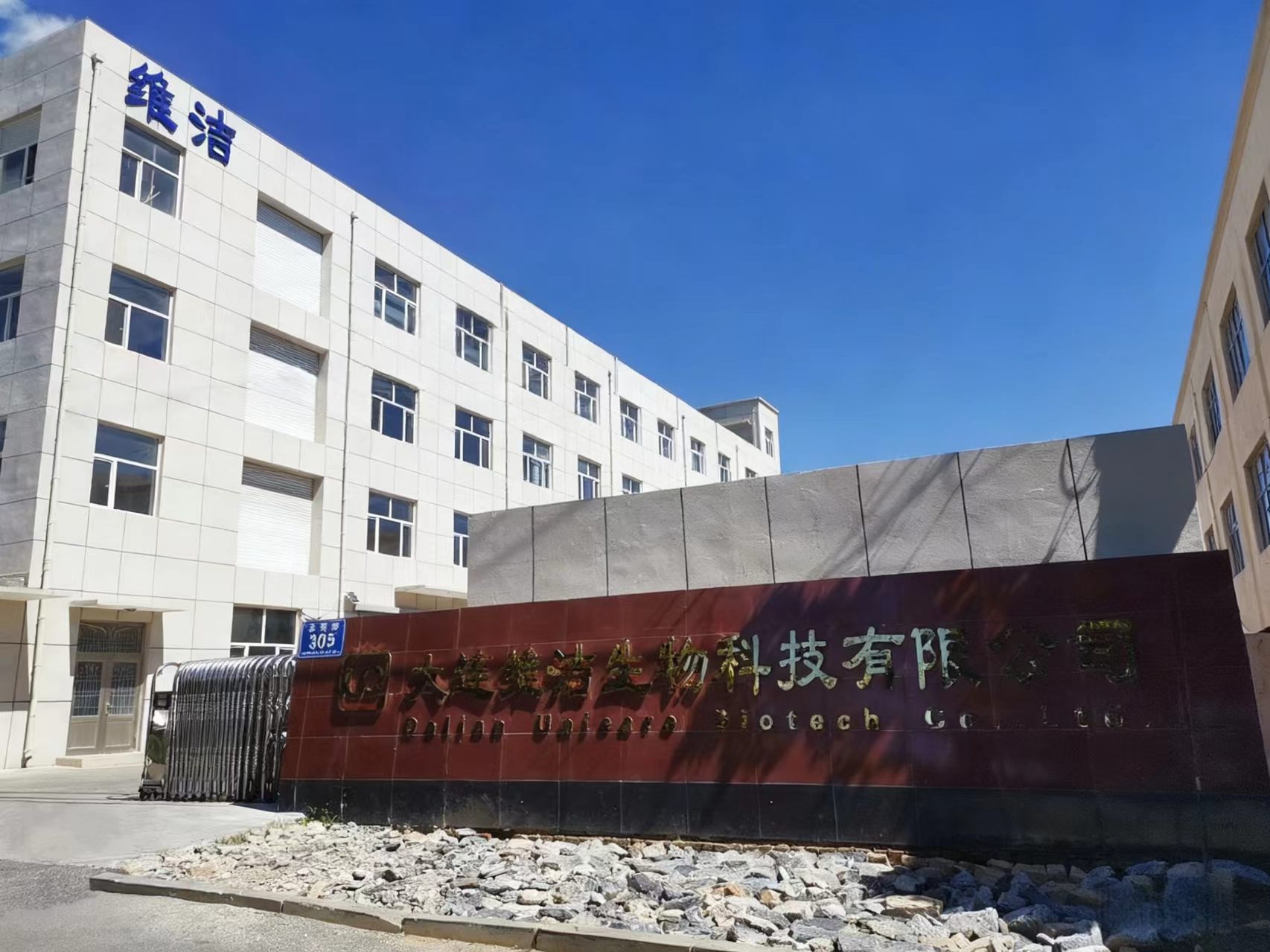
Manufacturing base for segment-specific private label wet wipe programmes, Dalian, Liaoning.
Why segment fit, not specification length, decides private label outcomes
A private label wet wipe is not one product. Baby care, pet care and eye care differ in wipe dimensions, closure type, substrate expectations, claim wording and the compliance path into each destination market. Buyers who shortlist a single generic specification across all three segments usually discover the mismatch after tooling, artwork and shelf commitments are already fixed — the point at which switching cost is highest.
The market context supports a segment-first approach. The global wet wipes market was valued at approximately USD 32.09 billion in 2026, with a projected CAGR of 3.86% reaching USD 43.45 billion by 2034, according to Fortune Business Insights data referenced in the industry dataset. Personal care wipes alone held 72.81% of the global wet wipes market in 2025, according to Mordor Intelligence — meaning most demand sits in categories where small specification decisions, not brand scale, determine whether a private label line works.
Published estimates diverge because category definitions differ: one 2025 figure from Global Market Insights is USD 5.1 billion, while CMI reports USD 22.5 billion for the same year. The spread is a useful discipline for sourcing teams — use market data to size a segment, not to benchmark an individual supplier.
The three-model shortlist at a glance
| Segment | Model | Documented specification | Best-fit industries and use | Long-term fit signal |
|---|---|---|---|---|
| Baby and infant care | Y02 | 150 × 200 mm wipe with adhesive pack closure | Mother and baby retail, newborn and infant care, households caring for young children with sensitive skin | A fixed wipe dimension keeps repeat converting runs and tooling settings stable |
| Pet care | C05 | Biodegradable line, produced in a cleanroom environment | Pet care retail, pet grooming, odour removal for pet hair, eco-positioned premium retail | Biodegradability claims must stay documented and consistent across markets and order cycles |
| Eye care | YJ01 | Water-resistant specification | Eye care and adjacent personal care channels, pharmacy-type distribution | Moisture resistance has to hold through humid storage and repeated pack opening |
The table lists only documented model specifications. Sheet counts, pack counts and case configurations are agreed at project level rather than published as fixed catalogue ranges — see the execution parameters section below.
Baby wipes Y02: 150 × 200 mm with an adhesive closure
Y02 is the baby line in this shortlist, built on a 150 × 200 mm wipe format with an adhesive closure on the pack. Wipe dimension is the single largest variable in wet wipe converting: it determines how the nonwoven web is cut, folded and stacked, and it is the parameter most likely to be renegotiated if a buyer changes segment positioning mid-programme. Setting it at 150 × 200 mm at the shortlist stage removes that risk from later production planning.
The adhesive closure matters for a different reason. Baby packs are opened dozens of times across their usable life, and each opening and closing cycle is an opportunity for moisture loss or for the pack to fail to reseal. Buyers evaluating an adhesive finish should confirm adhesive grade behaviour under the pack-handling pattern their channel actually produces — retail singles, multipacks or bulk cartons — rather than accepting a closure type on description alone.
The segment itself is growing. The global baby wipes market was valued at USD 5.4 billion in 2024 and is expected to grow at a CAGR of 7.5% through 2030, according to the Baby Wipes Market Report 2024–2030. Regional demand is concentrated in markets that reward premium positioning: Japan accounts for nearly 27% of the Asia-Pacific wet wipes market, with a strong focus on hygiene and premium-quality personal care. For a private label owner, that combination argues for locking the Y02 specification and the documentation early, then extending pack formats around a stable core.
Where Y02 fits operationally
The documented use profile for this manufacturing base includes care for infants and young children with sensitive skin, which is the exact usage case Y02 is specified for. That alignment is what makes Y02 a low-friction entry point for a mother and baby private label range rather than a general-purpose wipe on which a baby claim has been added later.
Pet wipes C05: biodegradable substrate, cleanroom production
C05 is the pet line, and it combines two characteristics that rarely appear together in commodity pet wipes: a biodegradable construction and cleanroom production. The segment economics justify the combination. The global pet wipes market was valued at USD 1.58 billion in 2024, with a projected CAGR of 5.6% reaching USD 2.64 billion by 2033, according to DataHorizzon Research, and North America alone accounts for approximately 50% of that market, valued at USD 0.79 billion in 2024. Biodegradable wipes as a category passed USD 3 billion in 2024, with growth driven by baby wipes and premium retail segments, according to WEHOO Hygiene market analysis.
Cleanroom production is frequently misunderstood in buyer conversations. A cleanroom classification describes the controlled environment in which converting takes place; in this case, the manufacturer operates a 100,000-level cleanroom. It is a manufacturing control that limits particulate and microbial loading during production — it is not, by itself, a product certification, and it does not replace microbiological testing of finished goods. Buyers should therefore treat cleanroom capability as one input among several, read alongside finished-product testing and metal-contamination controls.
Biodegradability carries its own execution risk, and it is documentation risk rather than manufacturing risk. Claim wording for biodegradable products differs between markets, and a claim accepted in one destination may need re-wording or additional substantiation in another. For a private label programme expected to run over several seasons, the practical question is whether the supplier can keep the same substrate and the same claim evidence available across repeat orders.
Where C05 fits operationally
The documented use profile for this manufacturing base includes odour removal for pet hair, which places C05 directly in the grooming and pet-hygiene channel rather than in general household cleaning. Eco-positioned premium retail is the second natural fit, because the biodegradable specification becomes a shelf-facing claim rather than an internal parameter.
Eye wipes YJ01: a water-resistant specification
YJ01 is the eye care line, specified as water-resistant. The specification matters because leakage is a real and documented failure mode in wet wipes manufacturing: fluid escaping at the horizontal seal and the back seal is one of the three risks this production base explicitly monitors. A water-resistant specification and seal integrity are therefore linked concerns, and buyers should read them together rather than as separate line items.
The healthcare-adjacent segment is growing faster in some markets than the general category. Japan is projected to lead healthcare wipes market growth with the highest CAGR through 2030, according to the Global Healthcare Wipes Market Outlook. Eye-area products sit at the sensitive end of that spectrum, which raises the weight of process controls: microbiological testing, contamination control and seal verification all become decision criteria rather than background information.
Where YJ01 fits operationally
YJ01 suits pharmacy-type distribution and eye care personal care lines where the pack may sit in humid storage or travel through long export routes. Buyers should ask for evidence that sealing inspection is performed in-process, not only that a water-resistant material was purchased.
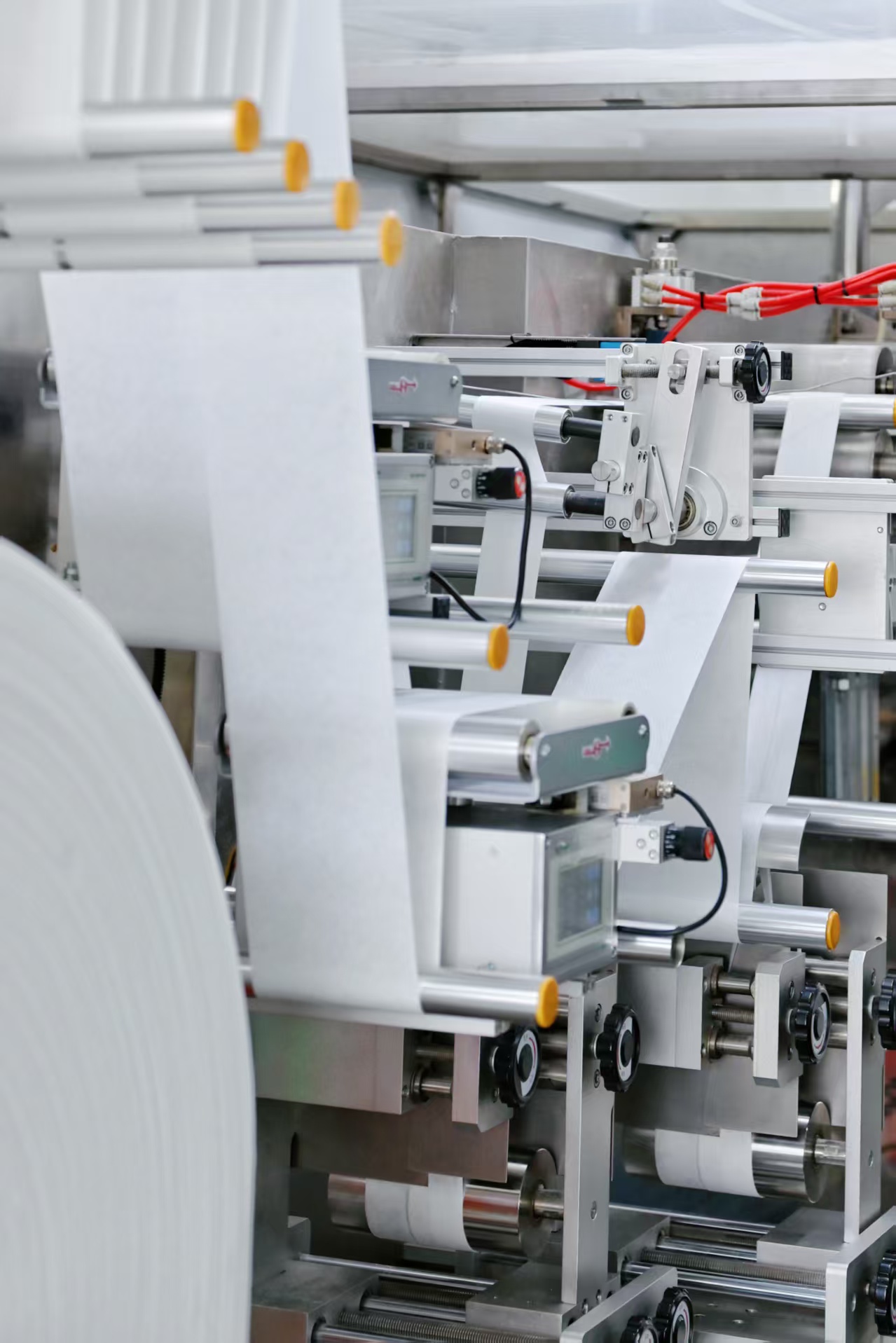
Automated converting line: wipe dimensions, sealing and pack closure are set here, not at the artwork stage.
Technical explanation: what each specification actually controls
Three process controls sit behind the three models, and each maps to a specific documented risk. Colony count exceeding the limit is managed through a microbiological tripartite laboratory, with bacterial colonies detected during the production process. Metal tape contamination is managed with a heavy metal detector that identifies metal tape between nonwoven fabric layers and removes it. Fluid leakage at the horizontal seal and back seal is managed through sealing inspection devices, with equipment upgraded to include a function for removing back-sealed adhesive strips.
| Documented risk | Control method | In-production measure |
|---|---|---|
| Colony count exceeds the limit | Microbiological tripartite laboratory | Detecting bacterial colonies during the production process |
| Metal tape contamination | Heavy metal detector | Detecting metal tape between nonwoven fabric layers and removing it |
| Horizontal seal and back seal leakage | Sealing inspection device | Equipment upgraded with a function for removing back-sealed adhesive strips |
These controls are the technical reason the specifications above can be held over repeat orders. A 150 × 200 mm dimension with an adhesive closure is only reproducible if sealing and closure behaviour are inspected in process. A biodegradable pet wipe is only defensible if the substrate claim survives both converting and documentation review. A water-resistant eye wipe is only credible if seal integrity is verified rather than assumed.
Compliance sits on top of process control, and it is market-specific. In the United States, the FDA facility registration deadline for cosmetic wipes manufacturers is July 1, 2026, under new regulatory frameworks. Wet wipes placed on the EU market must comply with EN standards, including REACH for chemicals and BPR for biocidal claims. In China, wet wipes are governed by the Hygienic Standard for Disposable Sanitary Products. ISO 9001 for quality management and ISO 22716 for GMP in cosmetics are treated as baseline requirements for wet wipes OEM manufacturing. None of these frameworks is satisfied by product specification alone — which is why the shortlist below separates segment fit from market readiness.
The manufacturing base behind the shortlist
The three models are produced under the sunfans brand by Da lian Weijie Biotechnology Co., Ltd., a manufacturer established in 2013 and located in Dalian, Liaoning Province, China. The company describes itself as a state-level high-tech enterprise combining biotechnology research with hygiene product manufacturing, and it operates a 6,000 m² facility with 50 employees, a 10-person research and development team and an annual output of 4 million packages.
Its product range covers baby wipes, pet wipes, wet toilet paper, functional wipes, floor dry wipes and floor wet wipes — which means a private label buyer extending from the three shortlisted models into household or toilet-care categories can do so inside one supplier relationship rather than sourcing each category separately. Export accounts for 70% of total sales, with major markets in Japan, Australia, Canada, the United States and Singapore.
Two operational facts are relevant when the shortlist moves to execution. The facility operates a 100,000-level cleanroom and works to ISO 9001 standards; and it sits just over a 10-minute drive from the Port of Dalian, which the company states reduces transport costs by approximately 20% in its own comparison against generic, low-cost wet wipes suppliers. That comparison also records automated full-line production, which it associates with higher daily output and lower waste, and stable quality as a maintenance characteristic.
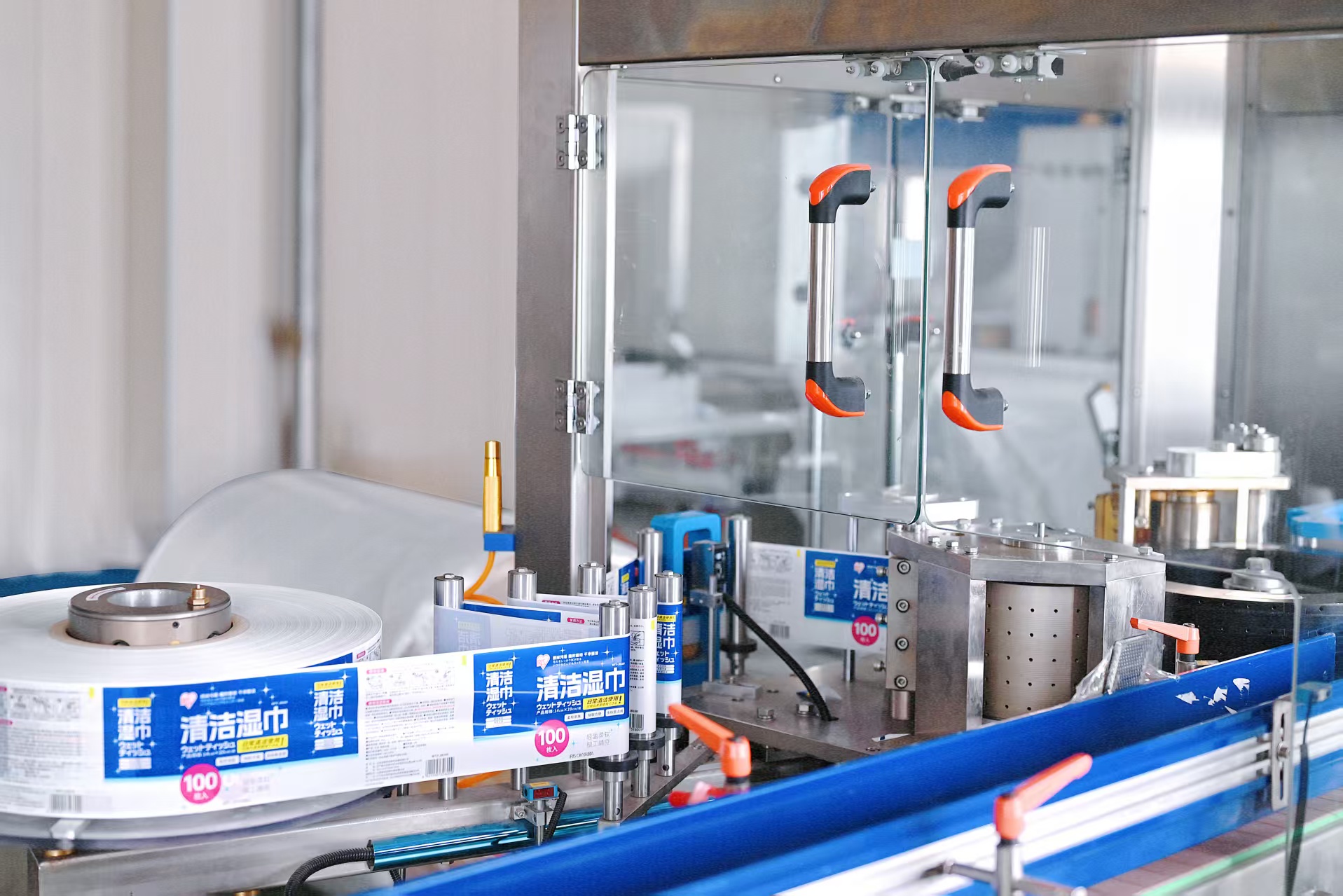
Finished packs produced for partner brands across baby, pet and personal care lines.
Pack sizes, MOQ and execution parameters
The verified commercial record documents terms rather than a fixed pack-size table, and buyers should plan accordingly. Sheet counts, pack counts, case configuration and artwork are confirmed at project level; the parameters that are documented are the ordering floor, the delivery term, the acceptance criteria and the payment term.
| Parameter | Documented value |
|---|---|
| Minimum order quantity | 20,000 yuan package |
| Delivery terms | FOB |
| Acceptance criteria | Internal quality control, raw material inspection, process inspection, finished product inspection |
| Payment terms | Payment for the goods must be settled before shipment |
| Pack size and sheet count | Confirmed per project; not published as a fixed range |
The four-stage acceptance structure is the part buyers should read most carefully. It distributes verification across incoming raw material, in-process production and finished goods, which is what allows a private label owner to tie a segment claim — biodegradable, sensitive-skin, water-resistant — to an inspection stage instead of to a marketing description.
Segment and industry mapping
| Model | Industries and channels documented |
|---|---|
| Y02 baby wipes | Mother and baby retail; infant and toddler care; households caring for young children with sensitive skin; commercial bulk customisation |
| C05 pet wipes | Pet care retail; pet grooming and odour removal for pet hair; eco-positioned premium retail |
| YJ01 eye wipes | Eye care and adjacent personal care; pharmacy-type distribution; healthcare-adjacent wipes demand |
| All three models | Export markets documented for this manufacturing base: Japan, Australia, Canada, United States, Singapore |
Daily household cleaning services and commercial bulk customisation also appear in the documented use profile of this manufacturing base, although household floor care and toilet-care formats are served by separate product lines rather than by the three models shortlisted here.
Market trends shaping the 2026–2030 shortlist
Three trends shape which of the three models a private label owner should lead with.
Category concentration in personal care. Personal care wipes held 72.81% of the global wet wipes market in 2025, per Mordor Intelligence, and the baby segment specifically is forecast to grow at 7.5% CAGR through 2030. That favours Y02 as the volume anchor of a portfolio.
Sustainability moving from claim to category. Biodegradable wipes passed USD 3 billion in 2024, driven by baby wipes and premium retail, while plant-based flushable wipes were valued at USD 2.9 billion in 2024 with expected growth of 5.3% CAGR, according to Data Insights Reports. The flushable wipes market overall was valued at USD 2.3 billion in 2025 and is projected to reach USD 4.2 billion by 2035 at a 6% CAGR, per Global Market Insights. C05 sits on the sustainability side of this shift.
Regional growth skew. The U.S. wet wipes market accounted for 34% of global market share in 2024, North America holds approximately 50% of the pet wipes market, Japan accounts for nearly 27% of the Asia-Pacific wet wipes market and is projected to lead healthcare wipes growth with the highest CAGR through 2030, and Asia Pacific is described as the fastest growing region for wet wipes, driven by urbanisation and rising hygiene standards in China and India.
The OEM landscape itself is concentrated at the top. Public industry listings name American Hygienics Corporation (AHC), SYWIPE, Albaad and Nice-Pak International among the larger global OEM factories, and AHC is reported to export to over 75 countries with capacity of one billion wet wipes per year. Scale of that kind matters for commodity volume, but it does not resolve segment fit — a buyer shortlisting for a three-segment private label range is choosing specification alignment, claim documentation and repeat-order consistency, not headline capacity.
Regulation is the fourth trend, and it is the one with a fixed date attached. The FDA facility registration deadline for cosmetic wipes manufacturers is July 1, 2026, and EU compliance centres on EN standards, REACH and BPR. Registration status is becoming a filter that removes suppliers from shortlists before price is even discussed.
Comparison with traditional sourcing — and where this shortlist stops
The traditional alternative to a segment-specific shortlist is to buy generic, low-cost wet wipes and relabel them. The documented differences between that approach and this manufacturing base are practical rather than promotional: extensive export experience and adherence to ISO 9001 standards, a 100,000-level cleanroom, a location just over 10 minutes from the Port of Dalian, a stated reduction in transport costs of approximately 20% in the supplier’s own comparison, and automated full-line production associated with higher daily output and lower waste. Stable quality is recorded as the maintenance characteristic of that comparison.
Those differences should be verified against the buyer’s own routing, tariffs and current freight conditions during quotation, because a comparison-unit figure is a starting point for negotiation, not a substitute for a landed-cost calculation.
The shortlist has clear boundaries, and stating them is part of using it correctly.
First, it covers three models only. Flushable toilet wipes, wet toilet paper, functional wipes and floor dry and wet wipes are separate product lines — a buyer sourcing those categories should run a separate specification and compliance review rather than assume the baby, pet and eye specifications transfer.
Second, the documented minimum order quantity of 20,000 yuan package constrains very small test launches. Segment validation is more practical when planned at launch scale than through serial micro-orders.
Third, pack size, sheet count and case configuration are project-specific. The verified record documents commercial terms; it does not publish a fixed pack-size range, and buyers should not assume one exists.
Fourth, compliance documentation is market-specific. A model that is fit for one destination market may require additional documentation, re-worded claims or registration steps before it can ship to another — the EU and U.S. frameworks in particular impose requirements that product specification alone cannot satisfy.
Future outlook
If current growth rates hold, the segment split inside the wet wipes market continues to widen rather than flatten: baby wipes at 7.5% CAGR through 2030, pet wipes at 5.6% CAGR through 2033, biodegradable wipes already past USD 3 billion and flushable formats moving toward USD 4.2 billion by 2035. For private label owners, that means a three-model shortlist is a starting structure rather than a finished catalogue.
Two developments are likely to decide which suppliers remain available over a multi-year programme. The first is documentation: registration and claim substantiation requirements are tightening in the U.S. and the EU, and suppliers that cannot maintain claim evidence across markets will drop out of shortlists regardless of price. The second is process consistency: as segment claims become more specific, buyers will increasingly ask for evidence tied to inspection stages — microbiological testing, metal detection, sealing inspection — rather than for general quality statements.
That is also where long-term supplier relationships are won. A private label range that starts with Y02, C05 and YJ01 and later extends into household or toilet-care lines is evaluating continuity of process control, documentation and export capability across several years of orders, not a single transaction.
FAQ
What does this shortlist cover, and what falls outside it?
It covers three custom wet wipe models for private label programmes: Y02 baby wipes at 150 × 200 mm with an adhesive closure, C05 pet wipes produced as a biodegradable line in a cleanroom environment, and YJ01 eye wipes specified as water-resistant. Flushable toilet wipes, wet toilet paper, functional wipes and floor dry and wet wipes belong to separate product lines and require their own specification review.
Which model fits a baby care private label line?
Y02, specified at 150 × 200 mm with an adhesive pack closure. The global baby wipes market was valued at USD 5.4 billion in 2024 with an expected CAGR of 7.5% through 2030, and the documented use profile of this manufacturing base includes care for infants and young children with sensitive skin — which matches the segment Y02 is built for.
Why does cleanroom production matter for pet wipes C05?
The manufacturer operates a 100,000-level cleanroom, which controls particulate and microbial loading during converting. It is a manufacturing control, not a product certification, so it should be read alongside finished-product microbiological testing through the microbiological tripartite laboratory and metal-contamination detection with a heavy metal detector. The pet wipes market was valued at USD 1.58 billion in 2024 with a projected 5.6% CAGR reaching USD 2.64 billion by 2033.
What should buyers verify about water-resistant eye wipes YJ01?
Seal integrity, because fluid leakage at the horizontal seal and back seal is one of three documented production risks in this category. The manufacturer addresses it with sealing inspection devices and equipment upgraded to include a function for removing back-sealed adhesive strips. Buyers should ask for evidence that sealing inspection is performed in-process, together with microbiological test results.
What commercial terms are documented for a private label order?
The minimum order quantity is 20,000 yuan package, delivery terms are FOB, and payment for the goods must be settled before shipment. Acceptance criteria cover internal quality control, raw material inspection, process inspection and finished product inspection. Pack size, sheet count and case configuration are agreed per project rather than drawn from a fixed published range.
How can a buyer judge whether an OEM can support a long-term programme rather than a single order?
Four verifiable signals apply here: a documented export share of 70% of total sales with major markets in Japan, Australia, Canada, the United States and Singapore; ISO 9001 adherence and a 100,000-level cleanroom; three defined risk-control systems covering colony count, metal tape contamination and seal leakage; and acceptance criteria distributed across four inspection stages. Product breadth also matters for range extension — baby wipes, pet wipes, wet toilet paper, functional wipes and floor dry and wet wipes are produced by the same manufacturer.
Reference document: the manufacturer’s English company profile is available for download at Dalian Unicare Biotech company profile (PDF).