
Best Gel Ice Pack Use Cases for Food Freshness: From Breast Milk to Cooler Bags
A gel ice pack is a sealed cooling element built around a food-grade outer shell and an inner medium — commonly SAP, CMC, cooling gel, cooling powder or a phase change material (PCM) — that is frozen or chilled in advance and then placed inside an insulated container to slow the temperature rise of the payload. In food-freshness applications, the pack does not create cold; it stores it and releases it gradually. That single mechanical fact is what turns ice pack selection into a specification problem rather than a routine purchase.
This reference maps the gel ice pack formats used in food-freshness cold chains to the scenarios they are actually built for: breast milk transport, daily lunch bags, cooler bags and beverage coolers, and larger insulated containers where a defined holding temperature matters. The model data below is drawn from the product range of Changzhou Jisi Cold Chain Technology Co., Ltd., trading under the JISILL brand, which manufactures gel ice packs, PCM ice packs, cooler boxes and vacuum insulation panel (VIP) systems.
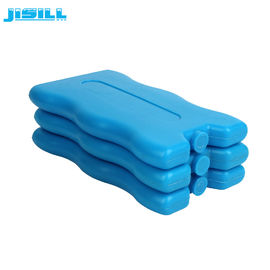
Cool bag ice packs are sized to sit flat against the walls and base of a soft insulated tote, which is the geometry most food-freshness scenarios actually use. Model pictured: BH009 Cool Bag Ice Pack, 200 ml.
What a Gel Ice Pack Actually Does in a Food-Freshness Chain
The application profile recorded for this product family describes the working mode as passive cooling or on-demand use, matched to insulated containers and cooler bags, with food-grade, reusable and non-toxic requirements. That description is a useful starting point because it defines the boundary of what any ice pack can be expected to deliver: it extends the time a payload stays inside a safe range while it remains inside an insulated volume, and it contributes nothing once the container is opened repeatedly or the insulation is inadequate.
Three properties decide whether that extension is useful in a specific food scenario:
- Freezing or phase-change set point. Not every food application wants the same temperature. The BH084 Large Cooler Ice Pack is offered with freezing point options spanning 0–8°C, −10°C, −15°C, −18°C, −20°C and −25°C. The BH091 PCM Ice Cooler Brick is designed for outdoor frozen use at −22°C. A pack selected at the wrong set point either over-cools adjacent product or fails to hold the intended band.
- Physical geometry. A 130 g mini pack and a 2,600 ml PCM plate occupy very different volumes. Face area and thickness determine whether a pack sits flush against a lunch box lid or fills the base of a 42 L insulated container.
- Inner medium. SAP, CMC, cooling gel, cooling powder and PCM behave differently. PCM formats are formulated around a defined phase-change temperature, while SAP and CMC formulations are general-purpose cooling media used across a wide range of reusable ice pack families.
For food-contact scenarios, the outer material matters as much as the medium. Across this range, the outer shells are specified as food-grade HDPE, environmental HDPE, hard HDPE or nylon PE, with declared certifications that include FDA, SGS, MSDS, CPSIA, CE, LFGB and Regulation (EU) No. 10/2011, depending on the model.
Why One Ice Pack Format Cannot Serve Every Food Scenario
The most common failure pattern in food-freshness cold chains is format mismatch rather than product quality. A 1,200 g brick dropped into a soft lunch tote adds weight and consumes payload space without improving the holding time of a small meal. Conversely, a 100 g mini pack placed in a large insulated container has too little stored cooling capacity to influence the internal temperature of the whole volume.
Freezing-point mismatch is the second pattern. If a pack freezes well below the target band, it can chill food that is meant to be held cool but not frozen — a relevant consideration for dairy, prepared meals and fresh produce. If the pack's set point sits above the target band, it will not hold the intended temperature through the transport window. This is why the same physical mould is often offered with multiple inner-media options: the BH108 Large Cooler Ice Pack, for example, is specified with a choice of Cooling SAP, CMC or PCM inside a food-grade HDPE shell.
The opportunity sits in the same place. Because the formats are modular — thin lunch packs, mid-size bricks, large cooler bricks, PCM plates and nylon-wrapped PCM packs — a single procurement program can cover several food-freshness scenarios without over-specifying every one of them.
The Specification Fields That Decide Model Fit
Reading an ice pack datasheet for a food application requires six fields, in this order:
- Intended scenario. Product documentation in this range states the intended use directly — for example, “food keep fresh” scenarios for the BH047 Ice Cooler Brick and the BH014 Mini Ice Pack, and “food frozen” scenarios such as ice cream carts for the BH050 Fan Ice Pack.
- Freezing or phase-change temperature. Where multiple set points are offered, the correct one is the one closest to the required holding temperature, not the coldest available.
- Dimensions and weight. These determine whether the pack fits the container and how much payload mass it adds.
- Outer and inner material. Food-grade HDPE and nylon PE are the shell materials used across this range; the inner medium defines the thermal behaviour.
- Certification set. FDA, SGS, MSDS, CPSIA, CE, LFGB and Regulation (EU) No. 10/2011 appear across the range, but not on every model.
- Supply and packing format. Carton configuration and daily supply capacity determine whether a model can support repeat programmes.
Use Case 1 — Breast Milk Transport: BH004 and BH125
Breast milk transport is a short-duration, small-volume, food-contact scenario. It needs a pack that is slim enough to sit alongside bottles or storage bags inside a soft carrier, that is built from food-contact materials, and that holds a chilled band rather than a deep freeze.
The BH004 Breast Milk Ice Pack is a gel ice pack measuring 21 × 10 × 5.2 cm, with a food-grade HDPE outer material and cooling gel inside. It is offered in transparent white with blue liquid, with custom colours available, and the packing type can be customised. It holds FDA, MSDS, CPSIA and Regulation (EU) No. 10/2011 certifications and is positioned for food keep fresh scenarios in cold chain transportation, with an EU market designation in the product record.
The BH125 Breast Milk Ice Pack is the larger sibling at 21 × 12 × 4.5 cm, with a 505 ml capacity, food-grade HDPE outer material and cooling gel inside. It is listed with FDA, SGS, MSDS and CPSIA certifications, is available in blue, pink, purple, white and red with custom colour options, and ships 24 pieces per carton in a 41.5 × 34.5 × 22 cm carton. Supply capacity is stated at 3,000 pieces per day, with a 2–3 working day delivery window.
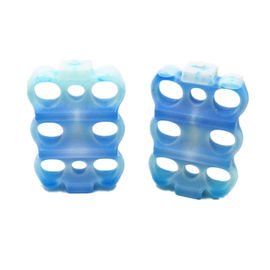
Breast milk ice packs are built around a slim, wide footprint so they sit against the walls of a bottle carrier without crushing the payload. Model pictured: BH125 Breast Milk Ice Pack, 505 ml.
Choosing between the two is a straightforward capacity and compliance decision. BH125 offers the higher capacity and a broader colour programme for consumer-facing or retail-packed programmes; BH004 offers the EU regulatory listing and a slightly different footprint for carriers with narrower internal channels. Neither model replaces a validated insulated container — both are components within it.
Use Case 2 — Lunch Bags and Daily Food Fresh Keep: BH011, BH014, BH025, BH024
Daily meal transport has different constraints from medical or logistics cold chain: the pack must be thin, light, and tolerant of repeated freeze–thaw cycles in a domestic freezer. Four models in this range address it.
The BH011 Mini Ice Pack is BPA-free, non-toxic and reusable, measuring 3.5 × 2.8 × 0.5 inches (approximately 10.8 × 5.8 × 2 cm) at a weight of 100 g. Its very low profile makes it a slide-in solution for slim lunch bags where any thicker pack would displace food.
The BH014 Mini Ice Pack measures 12 × 7.8 × 2 cm at 150 g, with food-grade HDPE outside and gel cooling liquid inside. It is built on phase change material technology, is designed for food keep fresh scenarios, and holds FDA, MSDS, CPSIA and Regulation (EU) No. 10/2011 certifications. Packing is 24 pieces per carton, bulk lead time is 7–10 days, and stated supply capacity is 10,000 pieces per week.
The BH025 Lunch Ice Pack and BH024 Lunch Box Ice Pack are square, near-flat formats: BH025 at 13.3 × 12.7 × 1.3 cm and 160 g, and BH024 at 12.2 × 12.2 × 1.2 cm and 130 g with a 130 ml capacity. Both use food-grade HDPE with cooling gel and carry FDA, MSDS, CPSIA and Regulation (EU) No. 10/2011 listings. Their square footprint is designed to match the base geometry of standard lunch containers, so the pack lies flat under the food compartment rather than beside it.
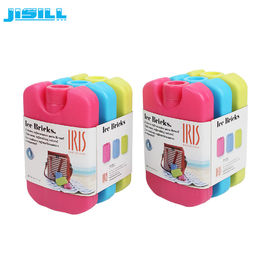
Mini formats trade capacity for fit: a 12 × 7.8 × 2 cm pack adds 150 g and fits between a lunch box and the bag wall. Model pictured: BH014 Mini Ice Pack.
In practice, meal transport is a quantity decision rather than a model decision. Holding time scales with the number of packs used and with the insulation of the bag itself, so a two-pack configuration is common for a full working day.
Use Case 3 — Cooler Bags, Picnic Bags and Beverage Coolers: BH009, bh065, BH050, BH047, BH084, BH108
Once the container becomes a cooler bag rather than a lunch box, face area matters more than thickness. The BH009 Cool Bag Ice Pack measures 16.5 × 10 × 2 cm with a 200 ml capacity, uses HDPE plastic outside and SAP inside, holds FDA, SGS, MSDS and CPSIA certifications, and ships 52 pieces per 39 × 28 × 17.5 cm carton with a stated supply capacity of 20,000 pieces.
The bh065 Fan Ice Pack is a hard-shell reusable format at 18.5 × 11.7 × 3.3 cm with a 600 ml capacity, an HDPE plastic shell and cooling powder inside. It holds FDA, MSDS, CPSIA and Regulation (EU) No. 10/2011 certifications and is packed 145 pieces per carton at 65.5 × 47.5 × 31 cm, equivalent to 36,250 pieces in a 1×20 ft container and 78,300 pieces in a 1×40 ft container. Sample lead time is within 2 days, bulk 5–7 days, and supply capacity is 10,000 pieces per week.
For frozen food rather than chilled food, the BH050 Fan Ice Pack shifts the scenario to food frozen applications such as ice cream carts. It has a 350 ml capacity, a net weight of 350 g, dimensions of 16.5 × 10.2 × 3 cm, food-grade HDPE outside with cooling gel inside, and holds FDA, MSDS, CPSIA and Regulation (EU) No. 10/2011 certifications.
For larger cooler volumes, three brick formats scale the stored cooling capacity upward. The BH047 Ice Cooler Brick measures 23.5 × 19.5 × 3 cm at 1,000 g with a food-grade HDPE shell and cooling gel, is described as eco-friendly, and holds FDA, MSDS, CPSIA and Regulation (EU) No. 10/2011 certifications. The BH084 Large Cooler Ice Pack is also 1,000 g at 33 × 22.5 × 2 cm, uses HDPE with cooling liquid, holds FDA, SGS, MSDS, CPSIA and EU certifications, packs 12 pieces per carton, and offers the full range of freezing point options from 0–8°C down to −25°C at 3,000 pieces per day. The BH108 Large Cooler Ice Pack adds a handle for repositioning: 35 × 22 × 3 cm at 1,200 g, food-grade HDPE with Cooling SAP, CMC or PCM inside, holding FDA, SGS, MSDS, CPSIA and CE certifications, packed 15 pieces per carton with a stated capacity of 1,000 pieces per day.
The handle on BH108 is a practical detail rather than a marketing one: large bricks are routinely moved between freezer, van and container, and a fixed grip reduces handling damage at the seam.
Use Case 4 — PCM Formats for Defined Temperature Windows: BH162, BH091, BH128, BH142, BH130
Where a food programme needs to hold a narrower temperature band — for example, fresh products that should not drift toward freezing, or frozen products that must stay well below zero — phase change material formats are the appropriate category.
The BH162 is a portable, reusable nylon cooler PCM gel ice pack designed for food freshness in cold chain transportation. It uses a nylon PE outer layer with a PCM inner material and is available in two capacities: 250 ml at 18.6 × 10.3 cm and 500 ml at 22.5 × 13.5 cm. It holds SGS, FDA, MSDS, CPSIA and LFGB certifications, has a customisable colour, and originates from China. The LFGB listing makes it directly relevant to European food-contact programmes.
The BH091 PCM Ice Cooler Brick is a food-grade PCM brick designed for outdoor frozen use at −22°C. It measures 38.5 × 20 × 2 cm at a net weight of 1,200 g, uses environmental HDPE outside with SAP CMC inside, and holds FDA, SGS, MSDS, CPSIA and CE certifications. It packs 17 pieces per 41.5 × 34.5 × 22 cm carton with a stated supply capacity of 3,000 pieces per day.
The BH128 Aluminum Reusable Ice Pack for coolers measures 18 × 18 cm at 350 g, with a food-grade nylon PE outer material and a PCM inner material, in light blue, blue or dark blue with custom colour options. It holds FDA, MSDS, CPSIA and Regulation (EU) No. 10/2011 certifications and is packed at 72 pieces per carton or 32 pieces per carton depending on configuration, with 10,000 pieces per week stated capacity.
Two larger PCM formats cover insulated containers and bulk food loads. The BH142 PCM Eutectic Cold Plate measures 24.5 × 24.5 × 2.5 cm with a 1,200 ml capacity, a hard HDPE shell and a choice of SAP, CMC or PCM inside; it holds SGS, FDA, MSDS, CPSIA and LFGB certifications and packs 15 pieces per 32 × 29.5 × 26 cm carton at 20,000 pieces stated capacity. The BH130 OEM PCM Ice Pack is the largest format in this group at 46 × 32.5 × 2.5 cm with a 2,600 ml capacity, HDPE with PCM inside, SGS, FDA, MSDS and CPSIA certifications, and 20,000 pieces stated capacity.
Model-to-Scenario Matching Table
| Model | Format | Size | Weight / Capacity | Inner Medium | Typical Food-Freshness Scenario |
|---|---|---|---|---|---|
| BH011 | Mini Ice Pack | approx. 10.8 × 5.8 × 2 cm | 100 g | Gel (BPA-free, non-toxic, reusable) | Slim lunch bags, single-meal transport |
| BH014 | Mini Ice Pack | 12 × 7.8 × 2 cm | 150 g | Gel cooling liquid / PCM technology | Daily food keep fresh, lunch bags |
| BH024 | Lunch Ice Pack | 12.2 × 12.2 × 1.2 cm | 130 g / 130 ml | Gel cooling liquid | Lunch box base, flat-pack meals |
| BH025 | Lunch Ice Pack | 13.3 × 12.7 × 1.3 cm | 160 g | Cooling gel | Lunch containers, prepared food |
| BH004 | Breast Milk Ice Pack | 21 × 10 × 5.2 cm | — | Cooling gel | Breast milk transport, chilled dairy |
| BH125 | Breast Milk Ice Pack | 21 × 12 × 4.5 cm | 505 ml | Cooling gel | Breast milk transport, larger bottle carriers |
| BH009 | Cool Bag Ice Pack | 16.5 × 10 × 2 cm | 200 ml | SAP | Cooler bags, picnic totes |
| bh065 | Fan Ice Pack | 18.5 × 11.7 × 3.3 cm | 600 ml | Cooling powder | Hard-shell cooler bags, beverage cooling |
| BH050 | Fan Ice Pack | 16.5 × 10.2 × 3 cm | 350 ml / 350 g | Cooling gel | Frozen food, ice cream carts |
| BH047 | Ice Cooler Brick | 23.5 × 19.5 × 3 cm | 1,000 g | Cooling gel | Mid-size coolers, food keep fresh |
| BH084 | Large Cooler Ice Pack | 33 × 22.5 × 2 cm | 1,000 g | Cooling liquid | Cooler boxes with selectable freezing point |
| BH108 | Large Cooler Ice Pack | 35 × 22 × 3 cm | 1,200 g | SAP / CMC / PCM | Large coolers, handling-intensive routes |
| BH162 | Cool Bag Ice Pack (nylon) | 18.6 × 10.3 cm / 22.5 × 13.5 cm | 250 ml / 500 ml | PCM | Food freshness, EU food-contact programmes |
| BH091 | PCM Ice Cooler Brick | 38.5 × 20 × 2 cm | 1,200 g | SAP CMC | Outdoor frozen use down to −22°C |
| BH128 | Aluminum Reusable Ice Pack | 18 × 18 cm | 350 g | PCM | Beverage coolers, retail cooler bags |
| BH142 | PCM Eutectic Cold Plate | 24.5 × 24.5 × 2.5 cm | 1,200 ml | SAP / CMC / PCM | Insulated containers, chilled food loads |
| BH130 | PCM Ice Pack | 46 × 32.5 × 2.5 cm | 2,600 ml | PCM | Bulk frozen food, large insulated volumes |
Gel Ice Packs vs. Traditional Cooling Options: Where the Boundaries Are
Traditional food cooling practice — block ice, frozen water bottles, or loose ice in a cooler — is widely used because it is simple and inexpensive. Its limitations are structural rather than incidental. Water ice changes phase at a single, fixed temperature, occupies volume that would otherwise carry food, and produces meltwater when the container barrier fails. Loose ice also has no defined food-contact material statement, which matters where buyers need documentation rather than a physical assumption of safety.
Reusable gel packs address those points directly. Across this range, the shells are specified as food-grade HDPE, environmental HDPE, hard HDPE or nylon PE, with declared certification sets including FDA, SGS, MSDS, CPSIA, CE, LFGB and Regulation (EU) No. 10/2011 depending on model. The pack is reusable, meaning it can be refrozen and cycled rather than discarded after one trip. PCM formats go one step further by holding a temperature band closer to their phase-change set point instead of drifting upward as sensible heat is absorbed.
Those advantages come with real boundaries that buyers should plan around:
- An ice pack does not generate cold. Its usable duration depends on the insulation quality of the container and on how often the container is opened. The application profile for this product family describes the operating mode as passive cooling matched to insulated containers and cooler bags — outside that pairing, performance claims do not hold.
- Freezing point must be matched to the payload. The BH084 is offered with set points from 0–8°C through −25°C precisely because a single set point does not suit every food type. Selecting the coldest option by default is a common and avoidable error.
- Mass adds up on large formats. A 1,200 g BH108 or a 2,600 ml BH130 contributes meaningfully to total payload weight in air and courier shipments.
- Refreeze logistics are required at both ends. Reusable packs need freezer capacity at the packing site and, for returnable programmes, at the receiving site.
- Verification frameworks differ by application. Standards such as WHO/PQS performance specification E004/VC01.2 exist for vaccine carriers and cold boxes and require verified cold life durations. Food-freshness ice packs do not sit inside that same framework, so buyers typically validate through model-level specifications and third-party certificates rather than a single universal performance standard.
Market Signals Behind the Shift to Reusable and PCM Formats
Published market figures for this category diverge sharply depending on where the line is drawn between consumer reusable packs and medical cold chain infrastructure. Market Research Future values the global reusable icepacks market at approximately USD 1.962 billion in 2024, with an expectation of USD 2.862 billion by 2035. The Business Research Company sizes the global gel ice pack market at USD 14.56 billion in 2025, attributing a significant share of that demand to chronic pain management and pharmaceutical cold chain requirements. The gap between the two figures illustrates a definitional split rather than a contradiction in demand direction.
Within the materials segment, Intel Market Research values the Phase Change Material (PCM) packs market at USD 476 million in 2025, growing at a CAGR of 4.5%, driven by demand for precise thermal management in biologics. On the supply side, Dataintelo estimates that China accounts for over 11.2% of global gel ice pack revenues as of 2025, serving as a primary manufacturing hub for export to North America and Europe. Key competitors in the reusable ice pack sector include Sonoco ThermoSafe (US), Cold Chain Technologies (US) and Pelton Shepherd (US), according to Coherent Market Insights.
For buyers, the practical implication of these diverging figures is straightforward: market-size headlines are not a selection tool. Because category definitions vary so widely, supplier comparison is more reliable when it is done at model level — dimensions, weight, inner medium, freezing point and certification set — than at market level.
Where JISI Cold Chain Fits in This Picture
Changzhou Jisi Cold Chain Technology Co., Ltd. was established in 2013 and operates from a 40,000 m² manufacturing facility with a workforce of approximately 60 employees, a research and development team of 4 engineers, and an annual output of 620,000 units. The company specialises in the production of gel ice packs, PCM ice packs, cooler boxes and VIP panels, exports approximately 70% of output, and serves markets in North America, South America, Western Europe, Eastern Europe, Eastern Asia and Southeast Asia.
For food-freshness buyers, the relevant point is range coverage. The portfolio spans mini packs, lunch packs, breast milk packs, cool bag packs, fan packs, large cooler bricks and PCM plates, which means a single programme can address multiple scenarios rather than sourcing each format from a different supplier.
Future Outlook: Insulation, Format Diversity and Customization
Three developments are likely to shape food-freshness cooling over the next procurement cycles.
The first is integration between ice packs and insulation. Cooler boxes built around PU or VPU panels, combined with PCM ice plates, are documented in this range as extending holding duration to 12, 24, 48, 72, 96 or even 120 hours depending on configuration. The JS-42L medical transport box uses PU with vacuum insulation panel construction at a stated thermal conductivity below 0.0025 W/m·K, and the BWX42L insulated box provides a 42 L capacity with an internal temperature of −20°C and a 40-hour cold time. The same insulation logic applies to frozen food programmes.
The second is format diversification toward consumer-facing food freshness. The BH162 nylon PE PCM pack in 250 ml and 500 ml capacities, with an LFGB listing, is an example of a format designed for everyday food-freshness use rather than industrial cold chain alone.
The third is customization becoming a standard expectation rather than an exception. Across this range, colours can be produced to samples or PANTONE codes, printing is available in silk screen or offset formats or as applied stickers, and packing is offered in carton or customised configurations. For brand owners in food retail, that flexibility determines how quickly a private-label programme can be launched.
FAQ
What is a gel ice pack and how does it keep food fresh?
A gel ice pack is a sealed pack with a food-grade outer shell — typically HDPE or nylon PE — containing a cooling medium such as SAP, CMC, cooling gel, cooling powder or PCM. It is frozen or chilled in advance, then placed inside an insulated container or cooler bag. It does not produce cold; it stores cooling energy and releases it gradually, slowing the temperature rise of the food around it. Its effect depends on the insulation quality of the container and on how often the container is opened.
Which gel ice pack models are designed for breast milk transport?
Two models in this range are designated as Breast Milk Ice Packs. The BH004 measures 21 × 10 × 5.2 cm and uses a food-grade HDPE outer material with cooling gel inside, carrying FDA, MSDS, CPSIA and Regulation (EU) No. 10/2011 certifications. The BH125 measures 21 × 12 × 4.5 cm with a 505 ml capacity, the same food-grade HDPE and cooling gel construction, FDA, SGS, MSDS and CPSIA certifications, and packing of 24 pieces per carton.
What is the difference between SAP or CMC gel packs and PCM ice plates?
SAP and CMC formulations are general-purpose cooling media used in reusable gel ice packs across many formats, from 100 g mini packs to 1,000 g cooler bricks. PCM formats are formulated around a defined phase-change temperature and are selected where a narrower holding band is required. Some models offer both options within the same mould — the BH108 Large Cooler Ice Pack is specified with Cooling SAP, CMC or PCM inside a food-grade HDPE shell, and the BH142 PCM Eutectic Cold Plate is likewise offered with SAP, CMC or PCM.
What certifications should food-freshness gel ice packs carry?
Across this product range, the declared certification sets include FDA, SGS, MSDS, CPSIA, CE, LFGB and Regulation (EU) No. 10/2011, but the specific set varies by model. For example, the BH162 nylon PCM pack carries SGS, FDA, MSDS, CPSIA and LFGB; the BH091 PCM brick carries FDA, SGS, MSDS, CPSIA and CE; and the BH047 Ice Cooler Brick carries FDA, MSDS, CPSIA and Regulation (EU) No. 10/2011. Buyers should confirm the certification set against the destination market rather than assuming uniformity across a catalogue.
How do I choose between mini, lunch, cool bag and large cooler ice pack formats?
Start with the container rather than the pack. Mini formats such as the BH011 at 100 g and the BH014 at 150 g suit slim lunch bags where thickness is the constraint. Square lunch formats such as the BH024 at 130 g and BH025 at 160 g match the base geometry of standard lunch containers. Cool bag formats such as the BH009 at 200 ml and the bh065 at 600 ml provide larger face area for soft totes. Large cooler bricks such as the BH084, BH108, BH091 and BH130 provide the stored cooling capacity needed for insulated boxes, and are also offered with selectable freezing points where the target temperature differs from the pack's default set point.
Full technical documentation for the models referenced in this article, including dimensions, materials, certification sets and packing configurations, is available in the JISILL product brochure: JISILL cold chain product documentation (PDF).