
Best Painting Line for Automotive Parts: Matching the Line to Your Workshop
Automotive parts coating is a fit problem before it is a capacity problem. A line that performs consistently on a single, flat metal component can behave very differently when it is asked to run ABS+PC bumpers, door panel trim, instrument panel trim, wheel arches and switch panels through the same booth in the same production window.
For a buyer in the evaluation stage, the useful question is narrower than “which painting line is best”. It is whether a specific line configuration matches three things at once: the parts matrix, the throughput target and the workshop. This article sets out what an automotive-parts-specific painting line is configured to do, what project evidence supports that configuration, and where the configuration stops being the right answer.
What Automotive Parts Coating Demands
Automotive bumpers and interior trim share a set of conditions that general industrial coating work does not always impose simultaneously:
- Substrate. The parts in this category are ABS+PC: front bumpers, door panel trim, auxiliary instrument panels, gear shift panels, IP trim, wheel arches and switch panels.
- Booth climate. Spray booth temperature is held at 25±2 °C and humidity at 65±10% RH.
- Throughput. A production cycle of 45 seconds per tray, equivalent to 1,760 trays per day.
- Operating pattern. 336 days per year, 22 hours per day, at an equipment utilisation rate of 85%.
- Spraying mode. Offline tray-based conveying combined with robot spraying.
Read together, these numbers describe a line built around mixed-part production rather than around a single part number. That distinction is the crux of the evaluation.
The Problem With a Generic Line on a Mixed Automotive Matrix
Generic lines are typically optimised for one substrate family and a relatively narrow band of part geometry. When the mix widens — bumpers on one shift, trim panels on the next — three variables tend to move: film thickness uniformity, transfer efficiency (how much paint lands on the part rather than elsewhere in the booth), and the defect rate on visible surfaces.
Plastic substrates are less forgiving than the machine specification suggests. ABS+PC bumpers and trim panels show flow marks, orange peel and colour drift quickly, and a visible part cannot be reworked invisibly. A line that cannot hold booth conditions at 25±2 °C and 65±10% RH, or that cannot hold a stable tray pitch while part numbers change, will show that instability in the yield figure rather than on the data sheet.
That is the opportunity behind an application-specific configuration: rather than buying a spraying device and building a line around it, the line is defined around the parts. Conveying concept, tray tooling, booth climate, curing profile and monitoring are treated as one system.
What the Auto-Parts-Specific Configuration Actually Looks Like
Attractivechina — the coating-line business of Guangdong Chuangzhi Intelligent Equipment Co., Ltd., a manufacturer founded in 2005 and based in the National High-tech Industrial Development Zone of Zhaoqing City, Guangdong Province, China — builds the Auto Parts Automatic Coating Line and the Auto Parts Automatic Painting Line as matched configurations rather than as a catalogue of independent machines. The company operates a self-owned site of approximately 35,548 m² with 280 employees, 54 engineers and an annual output of 60 painting line units, and holds 79 invention patents in coating equipment and environmental protection equipment, part of more than 300 patents in total.
The published parameters of the auto parts line show how tightly the configuration is tied to the parts it serves:
| Parameter | Published value |
|---|---|
| Workpiece names | Front bumper, door panel trim, auxiliary instrument panel, gear shift panel, IP trim, wheel arches, switch panel |
| Workpiece material | ABS+PC |
| Work system | 336 days/year; 22 h/day |
| Spray booth temperature | 25±2 °C |
| Spray booth humidity | 65±10% RH |
| Spraying method | Offline mode + robot spraying |
| Production cycle | 45 seconds/tray (1,760 trays/day) |
| Maximum tooling tray size | L1350 × W900 × H200 mm |
| Equipment utilisation rate | 85% |
| Factory size | 100 m (L) × 38 m (W) × 5.4 m (H) |
| Energy usage | Electricity, natural gas, steam, ice water |
| Construction materials | Carbon steel main frame; stainless steel spray booth and pipeline |
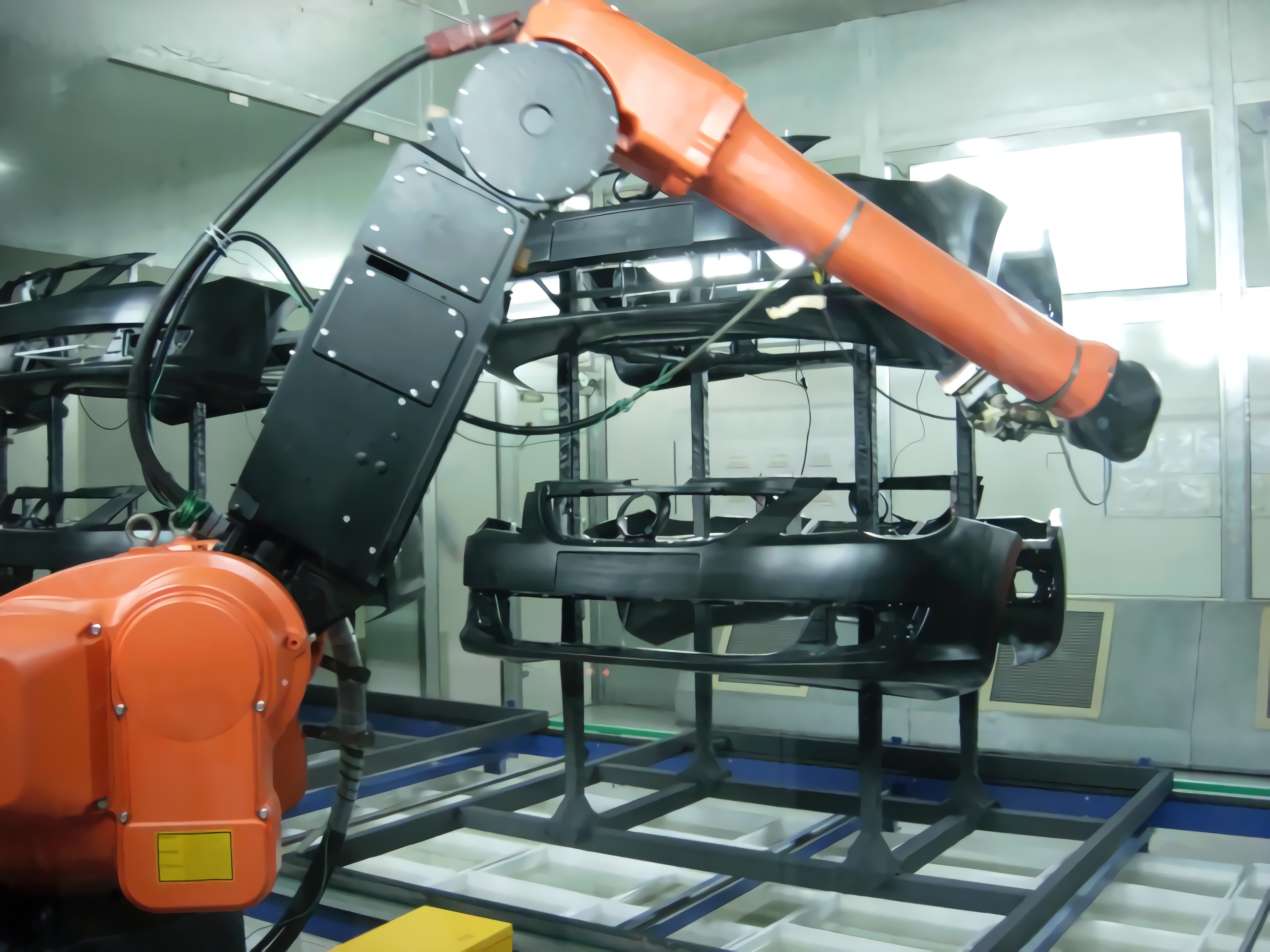
The same platform is offered across related automotive coating applications — bumper coating lines, wheel hub and wheel hub cap coating lines, fuel tank coating lines, frame coating lines, automotive interior parts coating lines and car logo coating lines. That spread matters for buyers running more than one part family: the tray envelope, booth climate and spraying mode carry across the family, while tooling changes with the part.
Evidence From a Multi-Country Automotive Parts Project
The strongest evidence for whether a configuration performs is the operating record rather than the specification sheet. A project comprising 20 complete automatic auto parts coating lines was implemented in Germany, Russia, Thailand, Indonesia, Mexico and China, used for surface coating, primer and topcoat spraying of automotive structural parts, chassis components and interior trim.
- Coating yield rate: 98%
- Paint consumption: reduced by 25%
- Energy consumption: reduced by 20%
- Production continuity: zero major production shutdowns over 5 years
The reported highlights of the same project are consistent coating quality, high adaptability to multi-part mixed production, intelligent monitoring and a low-maintenance design. Users of this product family are automotive parts ODM/OEM factories and tier 1 suppliers — a user base that typically audits yield figures rather than accepting them.
Two clarifications matter for evaluation. First, the 98% figure describes the yield of a line running a mixed automotive parts matrix and holding a 45-second tray cycle, not a laboratory result on a single part. Second, the deployment spans several climates and shop-floor conditions across Germany, Russia, Thailand, Indonesia, Mexico and China, which is relevant if your workshop differs from the supplier’s reference plant.
A useful counter-reference is a separate project of 15 complete automatic metal coating lines used for metal hardware, bathroom fixtures, window frames and metal furniture components, which reported a 97% coating pass rate, a 30% reduction in paint and powder consumption, a 22% reduction in energy consumption and a 40% improvement in production efficiency. The numbers differ because the substrate and part geometry differ. Coating performance is application-bound, and comparing two lines on yield percentage alone hides that.
Matching the Line to Your Workshop: A Practical Fit Checklist
Matching is largely a matter of checking stated assumptions against your own plant. The table below converts the published configuration into the questions a buyer should answer before committing.
| Fit factor | What the auto parts configuration assumes | What to verify in your workshop |
|---|---|---|
| Substrate | ABS+PC parts (bumpers, trim panels, switch panels) | If the mix is mainly aluminium or steel sheet, a metal coating line is the closer match |
| Part envelope | Maximum tooling tray L1350 × W900 × H200 mm | Any part outside the tray envelope cannot run on this configuration |
| Throughput | 45 s/tray, 1,760 trays/day at 85% utilisation | Compare with your shift pattern (336 days/year, 22 h/day) and peak demand |
| Clear floor space | 100 m × 38 m × 5.4 m | Measure clear height and conveyor routing, not just footprint |
| Booth climate | 25±2 °C, 65±10% RH | Requires air handling capability, not only a booth structure |
| Utilities | Electricity, natural gas, steam, ice water | Confirm gas supply, steam capacity and chilled water availability |
| Flexibility | Multi-part mixed production | Check changeover time between bumper-type and trim-type parts |
Where the Auto-Parts Configuration Reaches Its Limits
Part size. The configuration is bounded by a tooling tray of L1350 × W900 × H200 mm. Workpieces beyond that envelope are handled differently: the Industrial Equipment Automatic Coating Line uses a floor-supported conveyor with manual plus robot spraying and is specified around products such as gondola cars, flat cars, tank cars and box cars.
Infrastructure. The line consumes electricity, natural gas, steam and ice water and requires a booth held at 25±2 °C and 65±10% RH. A workshop without that infrastructure is effectively buying a line plus an energy and air-handling upgrade.
Result transfer. The 98% coating yield, 25% paint reduction and 20% energy reduction belong to one multi-country project. A different parts mix, paint chemistry or climate should be validated on its own, which is what sampling and trial runs are for.
Scale. Minimum order quantity for this product family is 2 units, and delivery time differs by product. A workshop with a very narrow, low-volume part mix may not need the level of automation this platform carries; in that case a smaller or semi-automatic configuration is the honest recommendation.
Substrate. If the dominant substrate is aluminium or metal sheet, a line specified around ABS+PC is the wrong starting point. The metal coating line, for comparison, is built around aluminium panels and profiles with a maximum workpiece size of 7000 × 2000 × 2200 mm, a power-and-free conveyor chain and a capacity of 5,000 m² per day.
Market Trend: Buyers Are Evaluating Lines, Not Robots
Three published data points explain why the evaluation conversation has shifted from equipment to configuration. The global industrial paint process automation market, which includes robotic and conveyorised systems, was valued at USD 5.3 billion in 2024 and is projected to reach USD 8.9 billion by 2030 (Strategic Market Research). China’s industrial coating equipment market is projected to reach 45 billion CNY by 2026, driven by the automotive, cookware and furniture sectors (EIN Presswire).
Within that growth, the global automotive paint robot system market reached USD 2.52 billion in 2024, with Dürr holding a 23% share, and the “Big Four” robot suppliers — ABB, FANUC, Yaskawa and KUKA — together with Dürr accounting for approximately 57% of that market in 2024 (Global Market Insights). The concentration sits in the spraying device. It does not sit in the parts matrix, tray tooling, booth climate or curing profile — the variables that decide whether a bumper leaves the line at a 98% yield or arrives at a rework station.
Independent assessments of robotic painting further report paint consumption reductions of up to 30% compared with manual application through precision control (Intel Market Research). The direction of that estimate matches the 25% paint reduction reported in the automotive parts project, and it reinforces the same procurement logic: the saving comes from a controlled process, which requires an integrated line rather than a spraying device on its own.
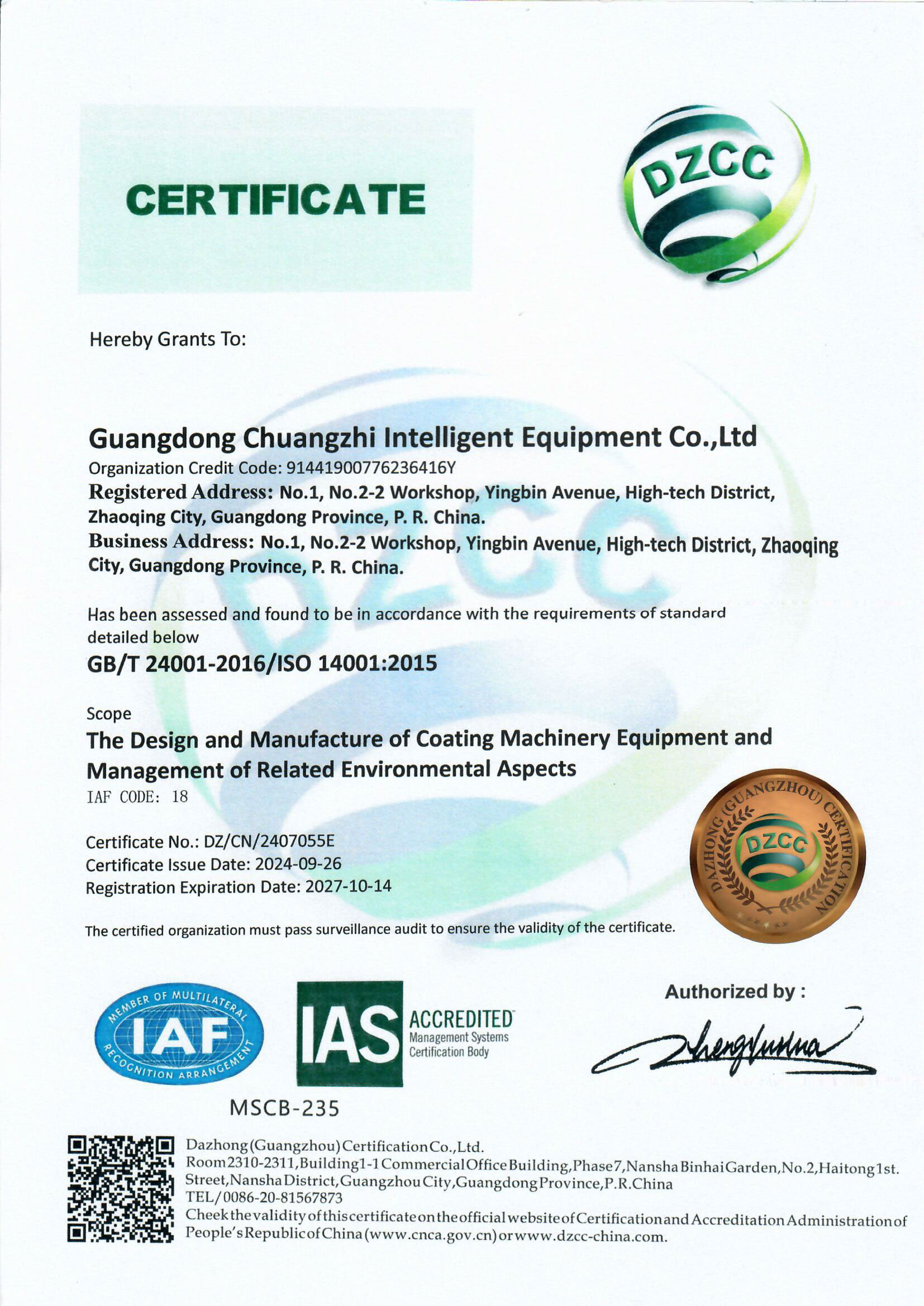
Regulatory attention is following the same path. The safety of atomising and spraying equipment is addressed by the updated SIST EN 1953:2025 standard (European Committee for Standardization, 2025). On the supplier side, management-system certification increasingly forms part of the tender file: ISO 14001 environmental management (certificate DZ/CN/2407055E, valid to 14 October 2027) and ISO 45001 occupational health and safety management (certificate 04926S00152R001, valid to 19 April 2029) both cover the design and manufacture of coating machinery equipment.
Future Outlook
Automotive parts coating is moving toward higher part-mix variety at stable quality, which puts pressure on the parts of a line that are hardest to change after installation: tray envelope, conveyor concept, booth climate control and monitoring. Buyers who lock those in against their real parts matrix — rather than against a nominal capacity figure — will extract more value from the same spraying hardware.
Two further shifts are visible. Energy and paint consumption are becoming explicit procurement metrics alongside yield, because both are now reported as project outcomes rather than estimates. And compliance documentation, from machinery safety standards to supplier environmental and safety management certificates, is being requested earlier in the evaluation instead of after the technical decision.
FAQ
Can one painting line handle bumpers, interior trim and other automotive parts at the same time?
Yes, if the line is specified for mixed-part production. The auto parts configuration is defined around front bumpers, door panel trim, auxiliary instrument panels, gear shift panels, IP trim, wheel arches and switch panels, with offline tray-based conveying plus robot spraying and a cycle of 45 seconds per tray (1,760 trays per day). High adaptability to multi-part mixed production is one of the reported highlights of the multi-country automotive parts project.
What coating yield rate has actually been achieved on automotive parts?
A project comprising 20 complete automatic auto parts coating lines in Germany, Russia, Thailand, Indonesia, Mexico and China reported a coating yield rate of 98%, a 25% reduction in paint consumption, a 20% reduction in energy consumption and zero major production shutdowns over five years. Those results are project-specific and should be re-validated for a different parts mix, paint chemistry or climate.
What workshop conditions and utilities does the line require?
The spray booth is specified at 25±2 °C and 65±10% RH. The line uses electricity, natural gas, steam and ice water, runs 336 days per year and 22 hours per day, and requires a factory area of approximately 100 m × 38 m × 5.4 m. Maximum tooling tray size is L1350 × W900 × H200 mm.
How does an auto-parts-specific line differ from a general industrial painting line?
The difference lies in the assumptions. The auto parts line is specified around ABS+PC parts, a mixed part matrix and high-throughput tray-based offline spraying. The metal coating line is specified around aluminium panels and profiles up to 7000 × 2000 × 2200 mm with a power-and-free conveyor chain and a capacity of 5,000 m² per day. The industrial equipment coating line uses a floor-supported conveyor with manual and robot spraying for very large workpieces. Matching the assumption set to the parts is the selection decision.
When is the auto-parts-specific line the wrong choice?
When the dominant parts exceed the tooling tray envelope of L1350 × W900 × H200 mm; when the substrate is mainly metal rather than ABS+PC; when booth climate control and the required utilities are not available; or when production volume does not justify the automation level of the platform. In those situations, another configuration in the same product family is usually the closer match.
What evidence should be verified before selecting a painting line supplier?
Operating references close to your own parts matrix; reported yield, paint and energy outcomes together with their project context; and current management-system certifications. For this supplier, ISO 14001 (certificate DZ/CN/2407055E, valid to 14 October 2027) and ISO 45001 (certificate 04926S00152R001, valid to 19 April 2029) cover the design and manufacture of coating machinery equipment.
Closing Note
The choice between a generic line and an automotive-parts-specific line is settled by the parts matrix, the tray envelope, the utilities available and the throughput target — not by the spraying device alone. A technical brochure covering line configurations and case documentation can be downloaded here: Attractivechina technical brochure (PDF).