
Beyond Aesthetics: Engineering Constraints in Non-Standard Street Lighting
When a street lighting project requires a non-standard visual structure, the product is often described as a custom street light or a bespoke street light. What determines the success of such a product is not only the shape of the luminaire or pole. Engineering constraints decide whether a non-standard design can survive the environment, meet road lighting expectations, pass inspection and be manufactured consistently.
Procurement teams working with municipal contractors, engineering companies, developers and landscape designers usually start from an image: a decorative pole, a double-arm silhouette, a city logo or a cultural pattern. The conversation only becomes manageable when the custom design is translated into measurable constraints. This includes mounting height, LED power, luminous efficacy, colour temperature, colour rendering index, input voltage, ingress protection, pole material, surface treatment and control options.
Why Non-Standard Street Lights Change Procurement Logic
Standard catalogue street lights carry predictable data. Buyers know the optical distribution, the housing rating and the mounting system before they order. A non-standard street light reverses that logic. The project defines the appearance, and the engineering data must be developed around it.
This creates a different evaluation process. In a custom street light project, buyers should confirm which parameters are fixed by the project brief, which parameters can be adjusted by the manufacturer and which parameters need to be selected by the buyer before production. The core task is not simply to find a supplier that can draw a nice street lamp; it is to find a supplier that can convert a design intent into a product with verified performance, structural safety and weather resistance.
The evaluation picture also changes because replacement risk is higher. A non-standard luminaire with a unique bracket and pole structure is not normally interchangeable with another catalogue unit. If a design fails late in the project, the solution cannot be quickly substituted. That makes early specification, sample validation and documented quality control more important than in a standard street light order.
The Constraint Set That Defines a Custom Street Light
The word custom can apply to many layers of an outdoor lighting product. Based on current manufacturing practice, a custom street light specification normally covers the luminaire, the pole, the arm structure, the finish and the control system. For BAIFU LIGHTING, a non-standard custom lighting project includes pole heights, arm structures, lamp designs, decorative patterns, colours, surface finishes, LED power, solar configurations and smart lighting functions. Engineering support may include product selection, CAD drawing development, lighting configuration recommendations, appearance design evaluation, sample development and project quotation.
The table below uses two actual product families to show how specification parameters vary between a decorative custom street light and a solar-based custom street light design. Neither row is a universal industry requirement; both rows represent documented product parameters that can be used as a reference when writing a project specification.
| Parameter | Custom LED Landscape Street Light | Separate Solar Street Light |
|---|---|---|
| Example model | BF-LSL-4000-120W | BF-SL-8M-100W |
| Mounting height | 6m, 8m, 10m or 12m; project adjustable | 8m fixed pole height in reference configuration |
| LED power range | 60W, 80W, 100W, 120W, 150W, 180W or 200W | 100W in reference configuration |
| Luminaire efficacy | ≥130 lm/W | ≥150 lm/W |
| Colour temperature | 2700K, 3000K, 4000K, 5000K or 6000K | 3000K, 4000K, 5000K or 6000K |
| Colour rendering index | Ra≥70; Ra≥80 optional | Ra≥70 |
| Ingress protection | IP65 / IP66 | IP65 / IP66 |
| Electric shock protection class | Class I | Class I per product configuration context |
| Operating temperature | -30°C to +60°C | -20°C to +60°C |
| Control | Standard on-off; photocell, timer, 0–10V dimming, DALI and smart lighting control optional | Light control plus time control; intelligent dimming supported |
| Field application | Urban roads, parks, plazas, commercial streets and large landscape projects | Municipal roads, rural roads, side roads, parks, communities and overseas infrastructure lighting |
Each parameter has a functional meaning. Luminous efficacy affects energy consumption. Colour temperature defines the visual character of a street or square. Ingress protection indicates how well the luminaire resists water and dust. The wind resistance calculation should be tied to the pole height and the wind speed at the actual project location. Surface treatment should be designed for outdoor use, normally hot-dip galvanizing followed by electrostatic powder coating in the case of steel poles.
Certification and Compliance: What the Documents Actually Prove
Certification is a frequent constraint in custom street light procurement. Buyers should read certificates carefully because each document covers a limited scope. An ISO 9001 certificate, for example, proves that a manufacturer has a quality management system for a defined production scope. It does not certify every luminaire design, nor does it replace optical testing or electrical testing for a specific custom model.
In BAIFU LIGHTING, the ISO 9001 quality management system certificate is number 52824Q10676R0S, issued by Guangdong Rules Certification Co., Ltd. (GRRC). Its scope covers production of road and street lighting lamps, excluding products that require special qualification certificates. It is based on GB/T19001-2016/ISO9001:2015 and is valid from 2024-07-23 to 2027-07-22. This type of evidence is useful for evaluating repeatability of production. It is not a claim that every product from the factory carries a specific product mark.
For China mainland sales, product certification can take the form of a China Compulsory Product Certification, known as CCC. A BAIFU certificate number 2017011001975444 was issued by the China Quality Certification Centre. The certified scope is restricted to fixed luminaires for incandescent lamps, ground-mounted garden lamp type, with E14/E27 lampholder, Class I protection, IP44, rated voltage 220–240V~, 50/60Hz. Buyers should notice how narrow such a scope can be and should not assume that one certificate automatically covers every export market.
The external environment adds another compliance layer. In Europe, the EN 13201 series defines quality, performance and energy indicators for road and street lighting design. In the United States, ANSI/IES RP-8 is the primary national standard for lighting roadways and parking facilities, focusing on luminance and safety criteria. For smart street lighting, D4i and Zhaga are increasingly adopted as interoperability standards between sensors and luminaires. These standards are part of the project brief. They tell the manufacturer what type of optical and control solution must be engineered, even when the luminaire itself is fully custom.
What Buyers Should Investigate in a Custom Lighting Manufacturer
The credibility of a custom street light supplier depends on evidence that the company can carry a non-standard design from drawing to physical product. BAIFU LIGHTING, formally Zhongshan Baifu Street Lamp Co., Ltd., is a professional custom outdoor lighting manufacturer and street light manufacturer based in Guzhen Town, Zhongshan City, Guangdong, China. The company has more than 13 years of outdoor lighting manufacturing experience and operates an 11,158 square metre production facility. Its main product range includes non-standard custom outdoor street lights, LED road luminaires, solar street lights, landscape lights, garden lights, lawn lights, smart street lights and custom lamp poles.
Company data indicates an annual output of 50,000 units, 68 employees and five R&D engineers. Products are reported to be exported to 71 countries and markets, including the Middle East, Central Asia, North America, Southeast Asia and Africa. Export ratio is given at 45 per cent. These operational figures help a buyer judge whether the manufacturer has production capacity and international shipping experience, although they should still be checked through factory audits and direct communication.
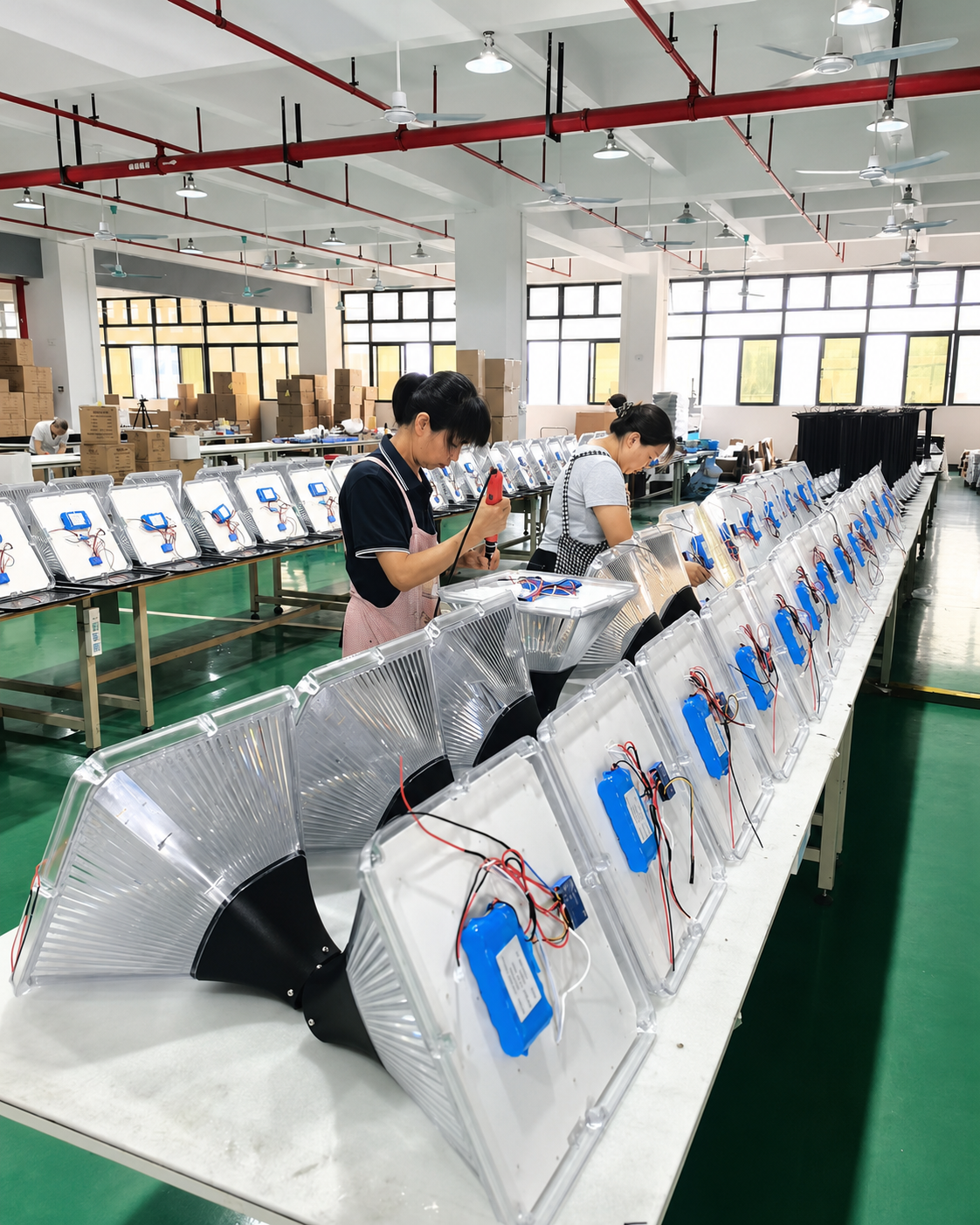
BAIFU’s production process includes metal fabrication, cutting, forming, welding, structural assembly, surface treatment, outdoor electrostatic powder coating, electrical assembly, product inspection, aging testing, packaging and export delivery. This integrated process is relevant to custom designs because it gives the manufacturer control over pole quality and finishing quality. The company reports a monthly production capacity of 3,000 to 5,000 units for regular orders, a lead time of 15 to 18 days, and a minimum order quantity of 20 sets for standard styles and 5 sets for custom styles. Quality control generally includes appearance inspection, electrical performance testing and protection level testing.
For international buyers, documentation matters as much as hardware. BAIFU LIGHTING states that it provides English product specifications, quotations, CAD drawing support, packaging information, export documentation and shipment coordination. After-sales support includes installation instructions, remote technical support, fault diagnosis and accessory supply. For quality issues, repair, replacement or supplementary service is provided according to the contract.
Project Evidence from Custom Street Lighting Installations
Project references can help explain how non-standard street lights behave after installation. One documented municipal engineering project in Malaysia supplied 68 units of custom landscape street lights for urban roads, characteristic streets and road landscape lighting. According to the project record, the lamps operated stably and provided uniform night-time road lighting. The luminaires were arranged consistently with road greening and the surrounding urban environment. The project considered brightness, road safety, weather resistance and landscape effect, demonstrating a one-stop process from design to production and overseas engineering support.
A coastal municipal project used 35 units for roads near the coast, port areas, city plazas and public recreational zones. The fixtures were custom designed according to the local coastal environment and European architectural style. The project outcome noted stable lighting performance, good visual harmony with coastal buildings and improved safety of night-time passage. The outdoor structure was designed with waterproof, anti-corrosion and weather-resistant construction for long-term use in a coastal atmosphere. Coastal projects are a useful example because they combine custom appearance with harsh environmental constraints such as salt, humidity and wind.
Application data for Saudi Arabia also points to mixed grid and solar use. The documented working conditions include conventional municipal power supply and integrated solar conditions, with protection requirements such as IP65 or IP66. This confirms that a custom street light specification should not treat appearance and power source as separate decisions. A decorative luminaire can still be engineered for solar operation, provided the pole structure, mounting and control system are adjusted.
Market Context: Where Custom Street Lighting Is Heading
Market research gives context to custom product demand. The global street lighting market was estimated at USD 9.1 billion in 2023 and is projected to reach USD 11.6 billion by 2030, with a CAGR of 3.6 per cent according to Grand View Research. LED lighting already dominates, accounting for 79.7 per cent of total street lighting revenue in 2023. For buyers, this means LED systems are the standard baseline even when the visual design is non-standard.
Smart lighting is moving from optional to normal. Berg Insight estimates that the installed base of smart street lights globally reached 32.9 million units at the end of 2024, with a projected CAGR of 20.9 per cent through 2029. The growing adoption of D4i and Zhaga interoperability standards further encourages buyers to plan for sensor-ready custom luminaires. A custom street light ordered today may need to accept photocell control, dimming, remote monitoring or future smart city modules.
Regional demand patterns are important as well. Africa is recognized as the fastest-growing regional lighting market, with average annual growth above 4 per cent since 2018, driven by public infrastructure projects according to CSIL. China’s lighting exports reached USD 56.3 billion in 2023, although this figure represented a 7 per cent year-on-year decrease. In an environment where standard products are increasingly price competitive, manufacturers are under pressure to differentiate through custom design, engineering service and delivery reliability.
Comparison with Traditional Catalogue Street Lights
Comparing custom street lights with traditional catalogue street lights is helpful because both options have legitimate roles. The table below uses general procurement criteria, not brand-specific claims.
| Evaluation Criterion | Traditional Catalogue Street Light | Custom / Non-Standard Street Light |
|---|---|---|
| Design flexibility | Limited to existing housing and pole options | High; appearance, arm structure, pole form and finish can follow the project vision |
| Performance data | Usually available before quotation | Must be engineered and validated around the selected design |
| Lead time | Potentially shorter for stocked models | Requires design confirmation, drawings and often sampling before production |
| Minimum order behaviour | Higher catalogue style MOQ | Project-based MOQ can be lower for custom style |
| Certification process | Manufacturer certificate likely covers the existing model | Buyer should confirm which certificates cover components, processes and the final custom assembly |
| Replacement risk | Lower because another unit can usually be ordered later | Higher; a non-standard unit may not be replaceable by a different catalogue model |
The most realistic limitation of custom street lights is this: the design can only be considered complete when performance, structure and finish are all verified together. A beautiful non-standard pole still requires a wind load calculation based on the local wind speed. A decorative head still requires the correct LED module, driver and thermal management. A custom surface colour still needs adhesion and weathering characteristics that match the local climate. These constraints are not product defects. They are inputs that must be managed in the specification stage.
Another boundary is documentation depth. Non-standard designs are less likely to have years of on-market performance data than a standard model. Buyers should therefore ask for reference projects, production records, inspection reports and, where necessary, a sample test before mass production. This type of diligence is more valuable than relying on general brochure claims.
The global supplier landscape remains fragmented. According to CSIL, the top ten lighting fixture companies in the world account for just over 20 per cent of total market share. Large players such as Signify continue to hold significant installed bases of smart street lighting controls, while specialists such as Schréder concentrate on architectural and smart city lighting and Sentry Electric is recognized in the United States for custom and historic decorative lighting poles. For non-standard and project-specific street lights, buyers often depend on manufacturers that combine metal fabrication, finishing, electrical assembly and export support under one roof.
Future Outlook for Non-Standard Street Lighting
As cities invest in identity-led public spaces, the distinction between road lighting and landscape lighting will keep blurring. A custom street light will increasingly be judged by three criteria: does it look right in the site context, does it meet the photometric and safety requirements of the road or plaza, and can it support future control systems? The manufacturers that can document all three layers will become more useful to international project buyers.
Solar custom configurations are also likely to grow, especially in regions where grid infrastructure is expensive or unreliable. The ability to combine a decorative pole with a solar panel and a control system is already present in project-based lighting. The same logic applies to high-sun markets in the Middle East, Southeast Asia and Africa, where public infrastructure projects are expanding. Non-standard street lighting should not be treated as a purely aesthetic product; it is functional infrastructure designed to earn community acceptance and reduce long-term maintenance risk.
FAQ
What counts as a non-standard street light in municipal procurement?
A non-standard street light is an outdoor lighting product designed outside the supplier’s regular catalogue line. It may include a special luminaire housing, a special arm, a different pole height, a decorative shape, a project-specific colour or a custom solar configuration. In general industry terms, non-standard street lights require more engineering work than placing a normal order for a listed model.
Which technical parameters should be documented for a custom street light?
A project specification should address the main constraints that affect outdoor lighting behaviour: LED power, luminous efficacy, colour temperature, colour rendering index, power factor, ingress protection rating, electric shock protection class, operating temperature range, mounting height, pole structure, surface treatment, wind resistance and operating life. The power factor for BAIFU’s custom landscape luminaire, for example, is stated as PF≥0.95, while the expected service life is ≥50,000 hours.
Why do EN 13201 and ANSI/IES RP-8 matter in custom street lighting?
EN 13201 is the European standard series that defines quality, performance and energy indicators for road and street lighting design. ANSI/IES RP-8 is the primary American national standard for lighting roadways and parking facilities, focusing on luminance and safety criteria. These standards are used to set the photometric requirement of a project. A custom street light design should be checked against the standard applicable in the destination market because product certification alone does not guarantee that the lighting layout meets road safety requirements.
What does ISO 9001 certification really indicate for a street light maker?
ISO 9001 indicates that the manufacturer operates a quality management system covering a defined production scope. In the BAIFU LIGHTING example, certificate number 52824Q10676R0S was issued by Guangdong Rules Certification Co., Ltd. and covers production of road and street lighting lamps, excluding products requiring special qualification certificates. The standard used is GB/T19001-2016/ISO9001:2015. This kind of certificate supports production quality management but is not a product-specific type approval.
What IP rating is common for decorative street lights installed outdoors?
In many municipal and landscape projects, the acceptable ingress protection level is IP65 or IP66. Both BAIFU’s custom LED landscape street light and its separate solar street light are documented at IP65/IP66. The choice between IP65 and IP66 should be based on rainfall, dust and cleaning conditions at the project site.
Can a decorative custom street light also be a solar street light?
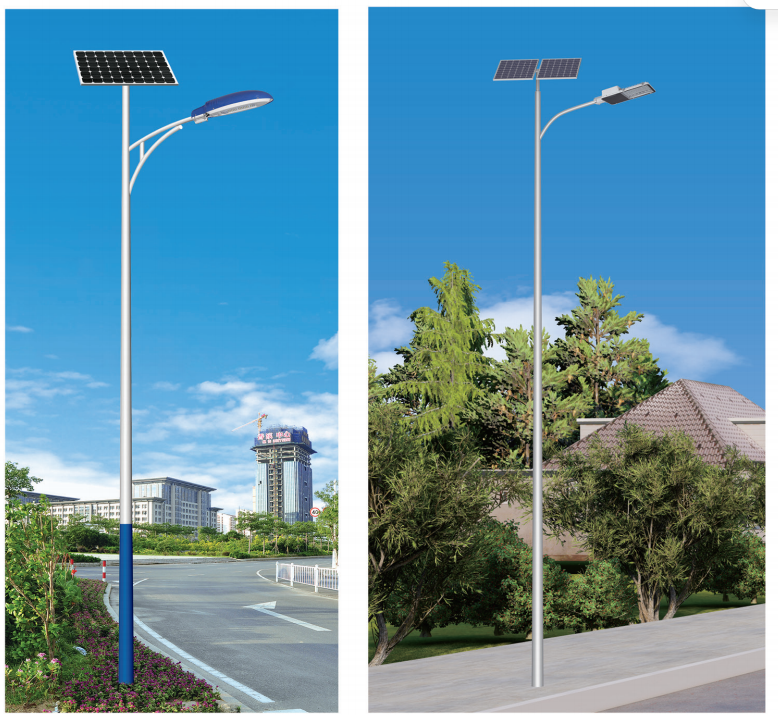
Yes. Customization can apply to both grid-powered and solar-powered designs. An example is the BF-SL-8M-100W separate solar street light, which uses a 100W LED luminaire, a 200W monocrystalline solar panel and a 12V 80Ah maintenance-free lead-acid battery. It is designed for 10–12 hours of lighting per day with 2–3 days rainy-day backup, and the control method combines light control and time control with optional intelligent dimming.
For buyers who need a fuller technical reference, BAIFU LIGHTING publishes a public brochure covering custom outdoor lighting products and factory capabilities. The document can be viewed directly at BAIFU LIGHTING Customized Album.
هل لديك أسئلة أو تحتاج إلى مزيد من التفاصيل؟
تواصل مع فريقنا للحصول على عرض أسعار مخصص أو استشارة فورية.
طلب عرض أسعار
املأ النموذج أدناه وسيتواصل معك فريقنا بعرض مقترح مخصص.
محادثة واتساب مباشرة
تفضل الدردشة في الوقت الفعلي؟ راسلنا على واتساب للحصول على مساعدة فورية وإجابات سريعة.
- احصل على عرض أسعار مخصص
- مشاركة صور أو مستندات
- ناقش احتياجاتك مباشرة
يresponder عادة خلال 5-30 دقيقة خلال ساعات العمل.