
Beyond Brochures: Commercial Scenting Supplier Evidence in H5000, P02, and 4705
Beyond Brochures: Commercial Scenting Supplier Evidence in H5000, P02, and 4705
Commercial scenting projects are decided by numbers long before they are decided by fragrance. A hotel group planning a multi-floor rollout compares coverage ratings, noise figures, oil capacity, power draw and installation method, and then asks whether the supplier behind those numbers can repeat them on a second and a third order. The specifications on the page are the only part of the sales conversation a buyer can independently check.
Shenzhen Scentsea Technology Co., Ltd, which markets its product range under the SCENTSEA name, is a Shenzhen-based manufacturer founded in 2021. The company produces cold-air nebulizing scent diffusers, waterless aroma machines, HVAC scent systems, fragrance oils and essential oils for home, commercial and hospitality use, and its diffuser models are certified with CE, RoHS and FCC. Its catalogue spans wall plug-in, battery-operated, wall-mounted, floor-standing and HVAC split machines, and its products have been supplied to customers in more than 70 countries and regions.
That breadth is the reason for an evidence-first reading of the range. Rather than restating marketing copy, this article treats three SCENTSEA models as engineering evidence: the H5000 floor-standing diffuser, the P02 wall-mounted unit, and the 4705 battery-operated diffuser, which is listed in the catalogue under model P01. For each one, the question is the same: what does this specification prove about the supplier, and what should a buyer verify before signing a purchase order?
The Problem: Brochure Numbers Do Not Survive a Site Survey
Coverage is the specification buyers rely on most and the one most likely to disappoint. SCENTSEA's application data is explicit that model selection should be based on the actual space size and airflow conditions, that a unit requires a proper installation location and a correct power supply, and that a suitable, compatible fragrance oil is a precondition for stable atomisation. A rated maximum printed on a brochure page describes a controlled condition, not a lobby with a six-metre atrium, an open escalator void and an extract system running on a weekday schedule.
The same gap appears on the risk side. Documented quality risks in this category include unstable atomisation, oil leakage, excessive noise, unreliable app or control functions and inconsistent batch performance. None of those failures is visible in a specification table, but all of them are visible in a sampling programme and a quality-control record.
That is where the opportunity sits for buyers. Physical data can be treated as a set of testable hypotheses about the supplier: material choice implies a fabrication process, weight and dimensions imply packaging and freight behaviour, control features imply who the product was designed for, and declared tolerances imply how honest the documentation is likely to be when something goes wrong in year two.
Three Models Read as Capability Evidence
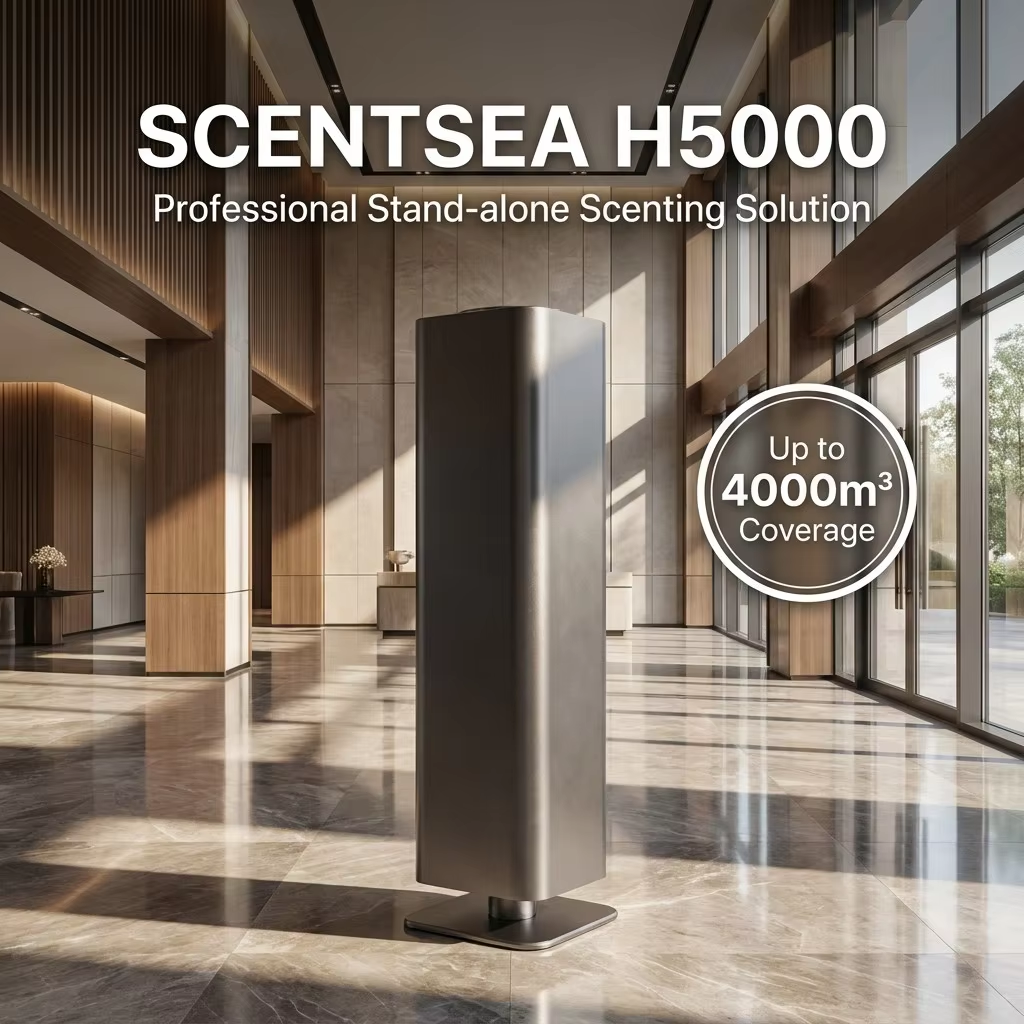
H5000: An Aluminium Floor-Standing Unit for 800-1,300 m2
The H5000 is a floor-standing commercial scent diffuser with an aluminium body in gunmetal. It carries a 1,000 ml fragrance oil capacity and a rated coverage of 800-1,300 m2, equivalent to 2,500-4,000 m3 or 8,600-14,000 ft2. Power is supplied by a DC 12V plug-in connection at 20W, noise is rated below 45 dB, and oil consumption is 5.4 ml/h with a tolerance of plus or minus 10 percent. Product dimensions are L180 x W180 x H610 mm and packing dimensions are L190 x W190 x H700 mm. Net weight is 6.4 kg and gross weight is 7.1 kg. Control is through app-based scheduling and fragrance intensity adjustment, with optional smart connectivity. The intended applications are hotel lobbies, shopping malls, showrooms, reception halls and large public areas.
What does that specification package evidence? An aluminium housing at 6.4 kg net weight implies metal forming and surface finishing capability rather than assembly-only sourcing. SCENTSEA's production documentation covers sheet metal processing, metal powder coating, injection moulding and PCB SMT assembly, which are the process categories a product of this construction requires. The packaging data is equally informative: a 190 x 190 x 700 mm carton around a 180 x 180 x 610 mm product leaves roughly 10 mm of clearance on each side and 90 mm in height, and the 0.7 kg difference between gross and net weight is the packaging and accessory allowance a freight quote should be built on.
P02: A Quiet 150-350 m2 Wall-Mounted Unit With Optional Ducting
The P02 is a wall-mounted unit with a plastic body, a 300 ml oil capacity and a rated coverage of 150-350 m2, or 500-1,000 m3 and 1,500-3,500 ft2. It runs from a DC 12V plug-in supply at 6.5W, with noise below 30 dB and oil consumption of 2.5 ml/h plus or minus 10 percent. Product dimensions are L148 x W68 x H203.5 mm and packing dimensions are L276 x W176 x H98 mm. Net weight is 0.8 kg and gross weight is 1 kg, in white or black with colour customization available. The unit has a built-in fan for fragrance distribution, Bluetooth app control for schedules and scent intensity, an optional Wi-Fi plus Bluetooth version for remote management, automatic reconnection after a power or network interruption, and an optional connector and tube for HVAC integration. Intended applications include retail stores, corridors, cinemas, offices, showrooms and commercial washrooms.
The evidence here is about placement. Sub-30 dB noise at 6.5W is the profile of a unit designed to sit in an occupied corridor or a customer-facing washroom, not in a plant room. Automatic reconnection is a software decision that only matters at unmanned sites, which is exactly where a wall-mounted diffuser usually goes. The optional HVAC connector and tube means one hardware platform can serve both a wall-mounted brief and a ducted brief, which is useful when a client's floor plan changes between specification and installation.
4705: Battery-First Coverage for 100-150 m2
The 4705 is a wall-mountable diffuser with a plastic body, a 500 ml capacity and a rated coverage of 100-150 m2, equal to 300-500 m3 or 1,000-1,600 ft2. It operates on a 5V supply, powered by four D-cell batteries or a Type-C connection, at 2.5W and below 35 dB. Net weight is 0.55 kg and gross weight is 0.8 kg; product dimensions are H168 x L240 x W50 mm and packing dimensions are L280 x W83 x H200 mm. It uses waterless cold-air diffusion, is controlled through the AromaOS app for scheduling and intensity adjustment, and includes a lockable front cover. Intended applications include elevators, washrooms, corridors, offices and other commercial facilities.
This is a design answer to the oldest constraint in commercial scenting: the spaces that most need scenting are often the spaces with no convenient power outlet and no one available to maintain them. A 500 ml bottle inside a 0.55 kg housing that can run from batteries addresses the power problem; the lockable front cover addresses the second half of it, namely fragrance oil walking out of a public washroom. The Type-C option matters for projects that intend to pull a permanent supply to the unit at a later stage.
Technical Explanation: What Cold-Air Atomisation and These Numbers Actually Mean
Waterless cold-air atomisation breaks fragrance oil into fine particles using controlled airflow, without adding water and without applying heat. Technical documentation published by scent technology supplier SCENTA describes sub-micron particles below 2.5 micrometres for this diffusion method, which is the size range that keeps fragrance airborne long enough to distribute through a room rather than settling out of it. SCENTSEA's application material frames the same principle operationally: fragrance oil is diffused into the air through cold-air atomisation to create a consistent and pleasant scent in commercial spaces, with smart app control, manual button control, timer scheduling and adjustable scent intensity, plus Wi-Fi or Bluetooth remote control on selected models.
Two numbers on a datasheet are worth converting into planning inputs.
First, oil capacity divided by oil consumption estimates atomiser run time. At its rated 5.4 ml/h, the H5000's 1,000 ml bottle corresponds to roughly 185 hours of atomiser operation; the P02's 300 ml bottle at 2.5 ml/h corresponds to about 120 hours. These are buyer-side arithmetic based on rated consumption rather than manufacturer runtime claims, and the plus or minus 10 percent consumption tolerance means the interval should be planned as a range. The 4705 publishes a power figure of 2.5W but no comparable oil consumption rate in the same product data, which is itself a question worth putting to a supplier before a large elevator or washroom programme is specified.
Second, noise and power determine where a unit can physically go. Below 45 dB (H5000), below 30 dB (P02) and below 35 dB (4705) are all rated figures, and the buyer's job is to state a site requirement, because a lobby can absorb more acoustic presence than a corridor next to a treatment room. Power draw is modest across all three models at 20W, 6.5W and 2.5W respectively, but the supply types differ: DC 12V plug-in for the H5000 and P02, and 5V battery or Type-C for the 4705. Supply and connector type should be confirmed at quotation stage, particularly on export orders where plug type is a customization variable.
Application Fit: Matching a Model to a Site
| Typical space | Model | Why the specification fits | Verify first |
|---|---|---|---|
| Hotel lobby, mall atrium, showroom, reception hall (800-1,300 m2) | H5000 | Floor-standing aluminium body, 1,000 ml capacity, 20W, below 45 dB, 610 mm tall, no wall installation required | Coverage trial at real ceiling height; refill access route |
| Retail store, corridor, cinema, office, showroom, commercial washroom (150-350 m2) | P02 | Wall-mounted at 0.8 kg net, below 30 dB, 6.5W, automatic reconnection, optional HVAC connector and tube | Whether the Wi-Fi version or Bluetooth-only version is quoted; duct availability |
| Elevator car, washroom, corridor, small office (100-150 m2, limited power) | 4705 | Battery or Type-C at 2.5W, 500 ml capacity, lockable cover, wall-mountable at 0.55 kg net | Battery replacement logistics; fragrance oil compatibility |
| Large halls, hotels and event venues (1,000-1,600 m2) | T3 | 1,000 ml capacity, 15W, app control, built for continuous commercial operation | Airflow pattern and mounting position |
| Central projects with ducting (2,500-3,500 m2) | AC-MAX | Split HVAC diffuser, 5 litre capacity, 48W, direct connection to central HVAC ducts, optional airflow sensor | Duct interface and building management coordination |
The table is a starting point, not a selection rule. SCENTSEA's application guidance is that model selection must follow the actual space size and airflow conditions, alongside a proper installation location, the correct power supply and a compatible fragrance oil. A site with strong extract ventilation will need more capacity than its floor area implies, and a partitioned floor may be better served by two smaller units than by one large one placed at the centre.
Market Trend Analysis: The Signals Behind the Specification Push
The category is growing, and the growth figures deserve careful reading. Commercial market research places the global scent marketing market at approximately USD 4.1 billion in 2026, with a projection of USD 7.28 billion by 2035 at a compound annual growth rate of 6.6 percent. A separate source using a narrower definition of scenting reports a CAGR of around 10.16 percent over a comparable horizon, which shows how sensitive these numbers are to whether consumer air care is counted alongside commercial scent marketing. Any single growth rate should be treated as a definition-dependent estimate rather than a fixed planning constant.
Demand-side evidence is thinner. Widely cited secondary research suggests scent marketing in retail environments can increase customer dwell time by an average of around 15 minutes. That figure is indicative rather than definitive and is better used as a hypothesis to test in a specific store than as a budgeting assumption.
Trade mechanics matter as much as growth. Commercial scent diffusers are classified under HS code 8509.80 for electromechanical domestic appliances, with a reported 4.2 percent US import duty, which makes landed-cost modelling a routine part of comparing a battery-operated unit against a mains-powered one when either could serve the same space.
Underneath the headline numbers, three operational trends show up in what buyers now ask for. First, remote management: Wi-Fi and Bluetooth control with automatic reconnection after a power or network interruption is becoming a baseline requirement in multi-site tender documents, because nobody wants to reset a diffuser in a hotel corridor at night. Second, ducted integration: the option to connect a wall-mounted unit to an HVAC duct, as the P02 supports with an optional connector and tube, lets operators reuse an existing air distribution system instead of adding standalone hardware. Third, documentation: the practical difference between a credible quotation and a cheap one is increasingly the presence of model-specific test records, certificates and spare-parts terms.
Comparison With Traditional Solutions, and Where These Models Still Fall Short
| Dimension | Waterless cold-air commercial diffuser (H5000, P02, 4705 class) | Ultrasonic water-based aroma diffuser | Passive air care (gels, sprays, plug-ins) |
|---|---|---|---|
| Diffusion method | Atomises fragrance oil directly, no water and no heat | Ultrasonic vibration of water mixed with a few drops of oil | Evaporation or manual spraying |
| Coverage | Commercial ratings from 100-150 m2 up to 800-1,300 m2 across these models | Suited to small residential rooms and light personal use | Small areas |
| Consistency | Stronger and more consistent diffusion for continuous commercial operation | Lower consistency, affected by tank level | Low and short-lived |
| Maintenance | No water refilling; oil-level checks and atomiser cleaning | Frequent water refilling and tank cleaning | Frequent replacement |
| Upfront cost | Higher initial equipment cost | Lower purchase cost | Lowest |
The boundaries matter as much as the advantages, and several of them are structural rather than temporary.
- Rated coverage is a rated figure, not a design guarantee. Effective coverage depends on ceiling height, ventilation, airflow, partitions and how the HVAC system actually operates. SCENTSEA's own guidance is that model selection follows actual space size and airflow conditions, so a rated maximum should be treated as a ceiling, not a design target.
- Fragrance oil compatibility is a shared constraint. Compatible third-party fragrance oil can be used, but viscosity and formulation should be tested to confirm stable atomisation. An oil that atomises well in one ambient temperature and duty cycle may behave differently in another.
- The 4705 is the smallest unit here. At 100-150 m2 per unit and dependent on four D-cell batteries or a 5V Type-C supply, a multi-floor washroom or elevator programme may need many units and a scheduled battery-replacement routine. It is not a substitute for a mains-powered unit where power is available.
- The P02 is not a ducted system by default. HVAC connection requires the optional connector and tube, so that capability must be specified in the order rather than assumed from the product name.
- The H5000 has a footprint and a weight. It is floor-standing at 6.4 kg net and 7.1 kg gross, needs floor space and a plug point, and tops out at a rated 1,300 m2. For buildings in the 2,500-3,500 m2 band, the AC-MAX split HVAC diffuser is the structurally appropriate route rather than several H5000 units positioned by estimate.
- Compliance is model-specific. The diffuser range carries CE, RoHS and FCC certification, and Bluetooth or Wi-Fi models may additionally need RED verification for the European market. Buyers should confirm that certificates and test reports match the exact production model and configuration being purchased.
- Quality control is where cheap offers diverge. SCENTSEA states that every diffuser is checked before shipment through functional testing, a 48-hour aging test and leakage inspection, in addition to atomisation testing, noise testing, app and control testing and final appearance inspection. Without comparable procedures, the risk of weak atomisation, oil leakage, control faults and inconsistent batch performance rises.
Future Outlook
Three developments are likely to shape sourcing decisions in this category over the next several years.
Remote management becomes baseline rather than premium. Scheduling through an app such as AromaOS, with automatic reconnection after a power or network interruption, is the feature that decides whether a 30-unit rollout can be operated by a facilities team or requires a technician on site. Expect tender documents to specify it explicitly rather than leave it to the optional column.
Market expansion changes what buyers should weight. A market moving from roughly USD 4.1 billion in 2026 toward USD 7.28 billion by 2035, with the definitional variance noted earlier, implies more competing hardware rather than less. In that environment, the differentiator shifts away from unit price and toward documentation, spares continuity and the ability to repeat a specification across batches.
Supply-side operations become part of the product. SCENTSEA's capability statement covers OEM and ODM customization of logo, product colour, packaging, user manual, plug type, app interface, PCB and functions, with diffuser MOQ from one unit, a 25-35 day lead time, a monthly capacity of 8,000 units, and a one-year free warranty on spare parts. For project buyers those numbers are schedule and risk inputs, not sales copy: a 25-35 day lead time belongs in the project plan, and a spare-parts warranty is what keeps a multi-site installation running after the first year. One documented reference point is a US-based scent marketing company that has operated 30 units for shopping mall scenting over a five-year period, with reported outcomes of stable and consistent coverage, reduced manual maintenance, improved fragrance management efficiency and an improved customer experience.
FAQ
How should a buyer choose between the H5000, P02 and 4705?
Selection should follow the actual space size, ceiling height, airflow and installation constraints. The H5000 is a floor-standing unit rated for 800-1,300 m2 with a 1,000 ml capacity, suited to lobbies, atriums and reception halls. The P02 is a wall-mounted unit rated for 150-350 m2 with a 300 ml capacity and an optional HVAC connector and tube, suited to retail floors, corridors and commercial washrooms. The 4705 is rated for 100-150 m2 with a 500 ml capacity and runs on four D-cell batteries or a 5V Type-C supply, suited to elevators, washrooms and corridors without convenient power. Model selection based on the largest available rating rather than the real space and airflow conditions is the most common cause of disappointing results.
Can a commercial scent diffuser be installed where there is no power outlet?
Yes. The 4705 is designed for that situation, operating on four D-cell batteries or a Type-C connection at 5V and 2.5W, with a rated coverage of 100-150 m2 and noise below 35 dB. It also includes a lockable front cover, which addresses access control in semi-public areas such as washrooms and corridors. The practical planning items are battery replacement frequency, the number of units required to cover a floor, and whether a permanent supply will be pulled later, in which case the Type-C option is used instead of batteries.
Can these units be connected to an HVAC system?
Partly, and it depends on the model. The P02 supports HVAC integration through an optional connector and tube, which allows the wall-mounted unit to feed into an existing air distribution path. For whole-building ducted scenting, the AC-MAX is the dedicated split HVAC diffuser, rated at 2,500-3,500 m2 with a 5 litre oil capacity, 48W, DC 12V power, direct connection to central HVAC ducts and an optional airflow sensor that can synchronise scenting with HVAC operation. The H5000 and 4705 are room-level or zone-level devices rather than ducted systems.
What do rated coverage figures actually assume?
Rated coverage assumes favourable, controlled conditions. In practice, effective coverage is affected by ceiling height, ventilation rate, air movement, partition layout and the operating schedule of the heating and cooling system. SCENTSEA's application guidance states that model selection should be based on actual space size and airflow conditions, and that units require a proper installation location, a correct power supply and a compatible fragrance oil. Buyers should treat the rated maximum as an upper boundary and validate coverage with a sample unit on site before committing to a full rollout.
What should buyers verify in supplier documentation before ordering?
At minimum: model-specific certificates and test reports, since CE, RoHS and FCC certification applies to particular models and configurations, and Bluetooth or Wi-Fi models may additionally require RED verification for the European market; quality-control records covering functional testing, atomisation testing, leakage inspection, noise testing, app and control testing, and a 48-hour aging test before shipment; warranty terms, which for SCENTSEA diffusers are a one-year free warranty on spare parts; spare-parts availability; and lead time and production capacity, which are stated at 25-35 days and 8,000 units per month. Sample testing of both hardware and fragrance oil before mass production is the standard way to close the remaining gap between a datasheet and a delivered batch.
What maintenance and consumable planning do these models imply?
Waterless cold-air diffusion does not require water filling or tank cleaning, but it does require oil-level checks and periodic atomiser cleaning. Refill intervals follow from capacity and consumption: a 1,000 ml bottle at a rated 5.4 ml/h and a 300 ml bottle at 2.5 ml/h imply substantially different service frequencies, and both figures carry a plus or minus 10 percent tolerance. Battery-operated units add a battery-replacement routine. Third-party fragrance oils can be used where compatible, but viscosity and formulation should be tested to confirm stable atomisation, since an oil that performs well in one duty cycle may not perform the same way in another.