
Beyond Cost Per Unit: A Buyer's Framework for Value Analysis in Microfiber
Microfiber cleaning products are still bought on unit price at most procurement tables. Price per piece is easy to compare, it fits a spreadsheet, and it ends arguments quickly. It is also the weakest available predictor of what a cleaning operation actually spends.
The category is not a niche. The global microfiber cleaning cloth market was estimated at approximately USD 979.2 million in 2025 and projected to reach USD 1,520.7 million by 2035, a 4.5% compound annual growth rate, according to Future Market Insights. Fortune Business Insights projects a comparable trajectory, from USD 1.04 billion in 2026 to USD 1.49 billion by 2034 at a 4.57% CAGR, while Spherical Insights projects USD 1,533.7 million by 2035. Three commercial research houses, three similar but not identical figures. They are directionally consistent and should not be averaged into a single number.
What those figures describe is a mature, mid-single-digit category. In a mature category, quoted price differences between suppliers compress, and the sourcing decision moves to the denominator: how many verified uses each piece delivers before it is retired. That denominator is not a mystery. It is largely determined by specifications that already appear on most product sheets — fabric weight, blend ratio, edge construction, and post-wash behaviour. This article sets out a framework for reading those specifications as value signals, using two concrete specifications as worked examples: the 10–12 stitches per inch locking edge on the MD-020 striped kitchen cloth and the ultrasonic cut edge on the MJ-022 car wash towel.
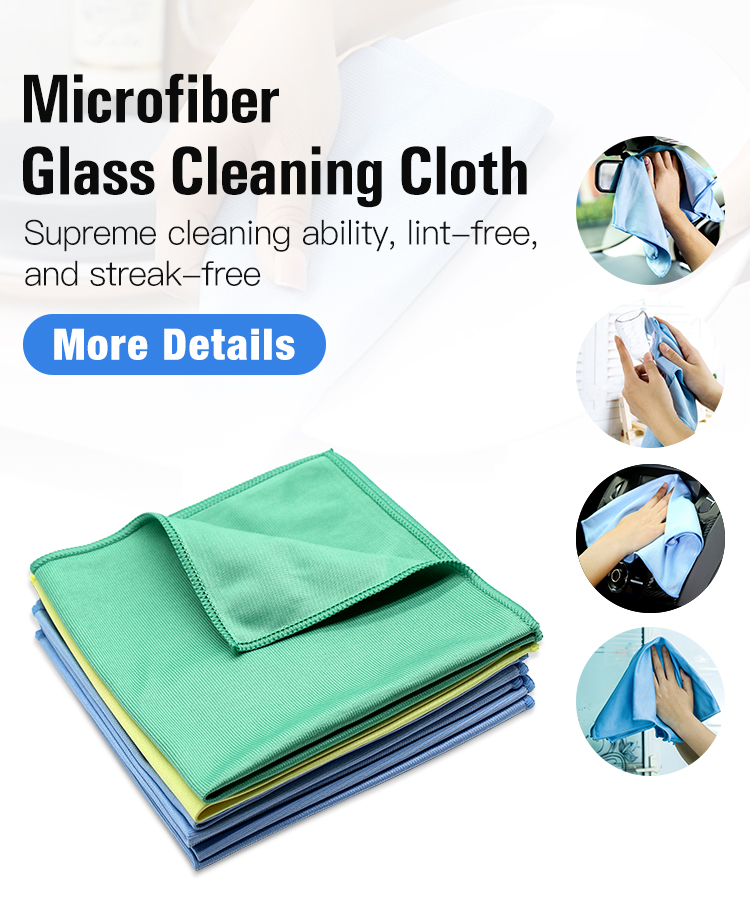
Edge construction is one of the few quality signals a buyer can read directly from a product sheet. The MJ-013 glass cleaning cloth, for example, specifies a 10–12 stitches per inch double overlock stitched edge.
Why Unit Price Fails as a Sourcing Metric
Unit price answers one question: what does one piece cost at the factory gate. It does not answer how many pieces a site will consume in a year, how much labour each piece requires per square metre cleaned, or what happens when a cloth sheds lint onto a polished surface or a mop pad fails mid-shift.
Four cost lines sit outside the unit price and are all influenced by product construction:
- Replacement frequency. A piece that survives more wash cycles is consumed fewer times per year for the same cleaning load.
- Labour time. Absorbency and surface contact determine how many passes a worker makes. A cloth that absorbs seven times its own weight in liquid removes more water per pass than a thinner, lower-pickup alternative.
- Surface damage and rework. Scratched glass, marred paint, or streaked stainless steel generates rework that is rarely attributed back to the cloth that caused it.
- Consumable intensity. Lint-shedding products are frequently paired with extra wipes, extra rinse water, or extra chemical to compensate for the residue they leave.
None of these four lines appear on a quotation. All four are, however, partly visible in a specification sheet before a single sample is ordered. That is the opportunity: converting published construction data into a comparable cost-per-use estimate.
The Cost-Per-Use Framework: Five Inputs
A workable cost-per-use model for microfiber does not require laboratory equipment. It requires five inputs, four of which are already disclosed by most manufacturers, and one — verified cycle count — which buyers usually have to establish themselves.
| Input | What it controls | Example specification points from the reference set |
|---|---|---|
| 1. Fibre fineness and blend | Pickup efficiency, lint behaviour, feel on delicate surfaces | 80% polyester / 20% polyamide (MD-020, MJ-022, MJ-013, MJ-066); 85% / 15% (MJ-001); 88% / 12% suede (MST-001); 70% / 20% PU / 10% polyamide (PU-001) |
| 2. Fabric weight (GSM) | Water capacity per pass, abrasion reserve, drying time | 180–320 gsm (MJ-013, MJ-012); 250–350 gsm (MD-020, PU-001); 300–500 gsm (MJ-022); 250–500 gsm (MJ-021); 500–1000 gsm (MJ-023, MJ-030); 650–680 gsm (CG-001, CG-002, CG-003) |
| 3. Edge and finish | Where products fail first; lint and fraying risk | 10–12 SPI double overlock or locking edge (MJ-013, MJ-066, MD-020, MST-001); ultrasonic cut edge (MJ-022, PU-001); ultrasonic sealed strip (MT-003); scalloped laser cut (MW-002); binding edge (MJ-021, MJ-023, MJ-030) |
| 4. Construction type | Contact pressure, dirt capture, polish quality | Warp-knitted terry (MJ-001); striped weave (MD-020); long plush terry pile (MJ-022); twisted loop (MJ-023, MJ-030); coral fleece (PET-001, MJ-070); waffle honeycomb (MS-075); microfibre + PET dual layer (MJ-016) |
| 5. Verified wash durability | The denominator of the whole calculation | Reusable over 300 washing cycles (MP-014); machine washable and reusable (MJ-022, MJ-021, MJ-023, MJ-030); repeatedly washable (MT-003, MP-006, MP-020) |
The formula is intentionally blunt:
Inputs one through four are disclosed. Input five is the one buyers must test or agree contractually, because a specification sheet that says “reusable” without a cycle figure is not a durability claim — it is a description of intent.
Reading Construction Specs as Durability Signals
Edge construction: where microfiber products usually fail first
In a woven or knitted cleaning textile, the cut edge is the structurally weakest line in the product. Every cut severs yarn filaments. How those severed filaments are secured determines whether the cloth remains a cleaning tool or gradually becomes a contaminant source.
A 10–12 stitches per inch locking or overlock edge is a dense, mechanically closed seam: MD-020 specifies exactly this on a 250–350 gsm striped kitchen cloth, and MJ-013 and MJ-066 apply the same 10–12 SPI standard to a glass cleaning cloth and a wineglass polishing towel respectively. Thread density matters because it shortens the unsupported length of yarn between stitch points, which is where fraying begins.
An ultrasonic cut edge removes the thread variable altogether. MJ-022, an auto detailing wash towel, uses an ultrasonically cut edge explicitly described as preventing loose threads, paired with a 300–500 gsm single-side long plush terry pile. The same principle appears on the PU-001 multi-scene wiping cloth and on the MT-003 terry wet mop, which uses an ultrasonic sealed cutting strip edge.
Both approaches address the same failure mode from different directions, and both are more cost-intensive to produce than a simple die-cut or clean-cut edge. That is the point of the framework: the extra processing you pay for at the factory gate is the processing that decides whether the piece is still usable at wash cycle 50 or wash cycle 200.

A high-density locking edge at 10–12 stitches per inch, as specified on the MJ-066 wineglass wiping towel, is a construction decision that shows up in the cost-per-use denominator rather than in the quotation.
Fabric weight and blend ratio: the two specs buyers compare most, and misread most
GSM indicates mass per square metre, not performance on its own. A 650–680 gsm plush window glass washer pad (CG-001, CG-002, CG-003) carries water differently from a 180–320 gsm flat glass cloth (MJ-013) because their jobs differ: one holds a wet working film across a large pane, the other finishes a surface without leaving marks. Comparing them on GSM alone produces a meaningless ranking.
Blend ratio behaves similarly. The 80% polyester / 20% polyamide split recurs across the reference set — MD-020, MJ-022, MJ-021, MJ-013, MJ-066, MJ-001 is the outlier at 85% / 15% — because polyamide contributes the finer, more absorbent filament component while polyester contributes structural strength. Where the application changes, so does the blend: the MST-001 sports towel uses 88% polyester / 12% polyamide suede for fast wicking and packability, and the MW-003 kitchen cloth introduces 20% bamboo fibre alongside 60% polyester and 20% polyamide for an antibacterial, odour-resistant kitchen specification.
The practical rule: read GSM together with construction type and application, never in isolation.
Absorbency: turning a performance claim into labour minutes
Absorbency claims are the most commonly cited and least commonly tested specification. In the reference set, a consistent figure appears across multiple products: absorption of up to seven times the cloth's own weight in liquid, specified on MD-020, MJ-022, MJ-021, MJ-013 is stated as lint-free and streak-free rather than by ratio, MJ-012, PET-001, and GFM-002.
For a buyer, that ratio converts into passes. A 40×40 cm, 300–500 gsm auto towel at seven times its own weight holds meaningfully more water per pass than a lighter flat cloth, which reduces the number of return trips to the bucket across a vehicle or a floor run. The labour saving is real, but it only materialises if the operator is using the cloth for the job it was built for — a plush drying towel used as a scrubbing cloth will wear faster and capture less.
Worked Example: Two Specifications, Two Value Signals
MD-020, Microfiber Universal Towel. A striped kitchen cleaning cloth in 80% polyester / 20% polyamide, GSM 250–350, standard sizes 30×30 cm and 40×40 cm with custom sizes available. It absorbs seven times its own weight, is lint-free and machine washable, and carries a 10–12 stitches per inch high-density locking edge. Multiple striped weave patterns are available, and colour, logo and packaging are customisable. Target applications include kitchen catering, household daily cleaning, tableware washing, home appliance cleaning and restaurant sanitation.
Value read: a mid-weight cloth whose engineering budget went into the edge rather than into mass. In a kitchen environment where cloths are washed dozens of times per month, edge integrity is the variable most likely to end a cloth's service life early. Dense edge stitching is the specification that protects the denominator.
MJ-022, Microfiber Car Wash Towel. An ultra-absorbent auto detailing wash towel in 80% polyester / 20% polyamide, 300–500 gsm, 40×40 cm standard with multiple customisable sizes. The design uses a single-side long plush terry pile with an ultrasonically cut edge to prevent loose threads. It absorbs up to seven times its own weight of water, is lint-free and scratch-safe for automotive paint and glass, and is machine washable and reusable. Applications include professional car wash shops, auto beauty detailing stores, household vehicle maintenance, and automobile interior and exterior cleaning.
Value read: here the value driver is risk avoidance as much as longevity. In auto detailing, a single shed thread or a scratched panel can cost more than the entire cloth order. The ultrasonic edge addresses the shedding pathway directly, while the plush terry face protects the painted surface. Both specifications are visible on the sheet before purchase.
Wash Durability: The Denominator Nobody Measures
Cost per use collapses if the cycle count is a guess. The reference set contains one product with a published cycle figure: the MP-014 stripe mop pad, described as reusable over 300 washing cycles, alongside a stated absorption of up to seven times its own weight in liquid and a mixed microfiber and nylon striped pile for rough floor dirt capture.
Other products in the set are described as machine washable and reusable (MJ-022, MJ-021, MJ-023, MJ-030) or repeatedly washable (MT-003, MP-006, MP-020) without a numeric cycle count. That gap is not a criticism of the products; it is a purchasing reality. When the supplier publishes a number, use it. When the supplier does not, the buyer has three options: run an internal wash test with a defined endpoint, agree a cycle-based acceptance specification in the purchase contract, or accept that the durability input in the cost-per-use model is an assumption rather than evidence.
Application Fit: How the Framework Shifts by Use Case
| Use case | Primary value driver | Specifications that carry the value |
|---|---|---|
| Kitchen and food service | Wash frequency and odour control | MD-020 (250–350 gsm, 10–12 SPI locking edge, machine washable); MW-003 (antibacterial bamboo blend, 280–350 gsm, lint-free, odourless); MJ-016 (dual-layer with PET mesh scrubbing side, high-density edge stitching) |
| Automotive detailing | Surface safety and water removal per pass | MJ-022 (300–500 gsm, ultrasonic cut edge); MJ-021 (250–500 gsm, overlock binding edge, stated as 4x more absorbent than cotton); MJ-023 and MJ-030 (500–1000 gsm twisted loop, binding edge to prevent shedding) |
| Glass, mirror and polishing | Streak-free finish and lint control | MJ-013 (180–320 gsm, 10–12 SPI double overlock, dry and wet use); MJ-066 (high-density locking edge, no water mark residue); MW-002 (scalloped laser cut edge, 200–240 gsm) |
| Institutional floor care | Cycle count and area coverage | MP-014 (reusable over 300 washing cycles, colour-coded, 40 cm / 50 cm); MP-020 (microfiber + PET with abrasive stripe, four-colour classification for area management); MP-006 (40% cotton / 60% polyester tufted loop, four-colour tag) |
| Household and high-frequency general cleaning | Balance of price, absorbency and wash life | MJ-001 (85% / 15%, 180–450 gsm, warp-knitted terry, double stitched edge); MJ-012 (180–320 gsm perforated roll, tear-off format); MS-075 (waffle honeycomb, double stitched edge, custom printing) |
Market Context: What Category Data Says About Value Trade-offs
Two structural facts about the category are relevant to a value framework. First, multicomponent microfiber based on polyester and polyamide blends accounted for 58.0% of revenue in 2025, according to Fortune Business Insights — meaning the blended construction this article treats as standard is, in fact, the dominant commercial format. Buyers comparing a blended cloth against a monocomponent alternative are comparing against roughly 40% of the market, not against a specialty niche.
Second, the kitchen care segment held the largest revenue share within the cleaning products market in 2025 at 28.3%, by the same source. That concentration explains why so many of the products in this reference set are kitchen or food-service items, and why edge durability in a high-wash-frequency environment is the specification most likely to be tested by real use.
Regulatory pressure is also entering the value calculation. OEKO-TEX updated STANDARD 100 in 2024 to include a total fluorine limit of 100 mg/kg, a change aimed at PFAS-related regulation. For a buyer, the practical consequence is that a certificate dated 2024 or later carries different meaning than an earlier certificate. Foshan Patinda Housewares Co., Ltd. publicly states that it holds OEKO-TEX STANDARD 100, ISO 9001:2015, ISO 45001:2018 and GRS certifications; as a matter of purchasing discipline, certificate numbers should be confirmed directly with the issuing body rather than accepted from a datasheet.
Microfiber Versus Traditional and Economy Options
The comparison that matters is not microfiber versus cotton in the abstract. It is the comparison between a specified, verifiable microfiber product and a generic low-specification alternative.
| Dimension | Specified microfiber | Generic or economy alternative | Cost-per-use effect |
|---|---|---|---|
| Absorption | Up to 7x own weight (MD-020, MJ-022, MJ-021, MJ-012, PET-001, GFM-002); MJ-021 stated as 4x more absorbent than cotton | Lower pickup per pass; more passes to clear the same water | Higher labour minutes per task |
| Edge integrity | 10–12 SPI locking edge, ultrasonic cut, or binding edge | Simple cut edge with no disclosed finishing standard | Earlier fraying and shedding, earlier replacement |
| Lint behaviour | Lint-free stated across MD-020, MJ-022, MJ-013, MJ-066, MJ-001 and others | Undisclosed | Residue, rework, extra wiping |
| Documented durability | MP-014: reusable over 300 washing cycles | Typically stated only as “washable” | Unknown denominator |
Two honest qualifications belong here. First, the higher specification is not automatically the higher value. A dense, heavier construction generally requires more material and more processing per piece, and that cost appears at the factory gate before any benefit is realised. Second, in low-frequency or single-cycle contexts — one-off promotional use, or a site that refreshes its cloths on a fixed calendar regardless of condition — the durability premium has no opportunity to pay back, because the replacement cycle is set administratively rather than by product failure.
Where This Framework Breaks Down
A framework that only produces favourable answers is not a framework. Three boundaries apply to the model above.
- The framework is only as good as the disclosed data. GSM, blend ratio and edge construction are the inputs most commonly published. Lot-to-lot variance in actual GSM is not published at all. The reference data package underpinning this analysis contains 15 independent sources but no original laboratory data, and its own gap assessment flags actual GSM variance, recycled content verification and microplastic shedding rate as missing fields. Buyers working at scale may need to close that gap with their own incoming inspection rather than with supplier documentation.
- Cycle-count assumptions dominate the result. Only one product in the reference set publishes a specific figure — 300 washing cycles for MP-014. Where no figure exists, a small change in the assumed cycle count changes the cost-per-use ranking more than any change in unit price. Treat that assumption explicitly.
- The framework does not cover environmental performance. Environmental research defines microfibres in a different sense — microscopic fibres shed from textiles or related fibre-based products during use and washing. That definitional context is separate from the sub-1.0 denier textile definition used in this article, and it has implications for wash-durability claims and sustainability messaging that a cost-per-use model does not address.
Future Outlook
Three developments are likely to shift value analysis in this category over the next procurement cycles.
Specification disclosure will become a competitive field. With the category growing at roughly 4.5% to 4.6% per year across the commercial research estimates cited above, growth will come from share gains rather than from an expanding market. Suppliers competing on specifications rather than on price will need to publish cycle counts, GSM tolerances and edge standards defensibly.
Chemical compliance will move from marketing to qualification. The 2024 OEKO-TEX STANDARD 100 total fluorine limit of 100 mg/kg is an early indicator of how PFAS-adjacent regulation reaches cleaning textiles. Certificates will increasingly need to be current rather than merely held.
Verification will separate suppliers. Buyers already have access to independent trade records — US customs import data, for example, records 172 bills of lading for Foshan Pa Tin Da Housewares Co., Ltd. between June 2019 and September 2026 — alongside factory audits and issuer-side certificate checks. Suppliers who welcome that scrutiny will be easier to shortlist than suppliers who do not.
FAQ
What is cost per use, and how is it calculated for microfiber cleaning products?
Cost per use is the total cost of owning and operating one piece of microfiber divided by the number of verified uses it delivers. In practice: unit price, plus replacement units consumed over the period, plus rework or surface-damage cost, plus incremental labour and chemical cost, divided by verified uses per unit. The unit price is one input out of five, and it is usually the smallest.
Which specifications should a buyer check first when comparing microfiber products?
Fibre blend and fineness, fabric weight in GSM, edge and finish construction, knit or weave type, and any published wash-cycle durability figure. A practical starting set is: 80% polyester / 20% polyamide or a disclosed equivalent, a GSM range appropriate to the task, a specified edge treatment such as a 10–12 stitches per inch locking edge or an ultrasonic cut, and at least one statement about reusability that can be tested.
What does stitch density tell you about a microfiber cloth's edge?
Stitch density measures how tightly the cut edge of a textile is mechanically secured. A 10–12 stitches per inch locking or overlock edge shortens the length of unprotected yarn between stitch points, which is where fraying and lint shedding typically begin. Products in the reference set specifying this range include MD-020, MJ-013, MJ-066 and MST-001. Ultrasonic cut edges, used on MJ-022, PU-001 and MT-003, address the same failure mode by sealing or cutting the fabric without a loose thread.
Is a higher GSM always better value?
No. GSM measures mass per square metre, not suitability. A 650–680 gsm plush window glass washer pad and a 180–320 gsm flat glass cloth serve different functions — one holds a wet working film across a pane, the other finishes a surface without marks. Comparing them by GSM alone produces a meaningless ranking. GSM should be read together with construction type and the intended application.
How many wash cycles should a microfiber cleaning product last?
Published figures in the reference set vary. The MP-014 stripe mop pad is specified as reusable over 300 washing cycles. Other products, including MJ-022, MJ-021, MJ-023 and MJ-030, are described as machine washable and reusable without a numeric cycle count, and MT-003, MP-006 and MP-020 are described as repeatedly washable. Where no figure is published, buyers should either run an internal wash test with a defined failure endpoint or agree a cycle-based acceptance specification in the purchase contract.
How can a buyer verify supplier specifications before placing a repeat order?
Three routes are commonly used. First, incoming fabric inspection against the stated specification, since GSM variance is the field most often missing from supplier documentation. Second, issuer-side certificate verification for any scheme claimed, including OEKO-TEX STANDARD 100, ISO 9001:2015, ISO 45001:2018 and GRS — the certificate number should be checked with the issuing body rather than accepted from a datasheet. Third, independent trade records, such as customs import data, which for Foshan Pa Tin Da Housewares Co., Ltd. show 172 recorded bills of lading for US imports between June 2019 and September 2026.
About the Manufacturer Referenced in This Analysis
Foshan Patinda Housewares Co., Ltd., which also operates as Pa Tin Da Group Co., Ltd., was established in 2004 and is located at No. 2, South Sanxiang Rd., Xintian Ind. Zone, Xiqiao Town, Nanhai, Foshan, Guangdong, China. The company has over 20 years of experience in the microfiber industry and manufactures microfiber cleaning products spanning cleaning cloths, kitchen towels, glass polishing cloths, auto cleaning cloths and mitts, sponges, wet and dry mops, window glass washers, sports towels and bath textiles. Its 45,000 m² manufacturing facility employs approximately 200 staff, operates over 450 sets of advanced production machinery including more than 10 fully automatic production lines, is supported by a 17-engineer R&D team, and reports an annual production capacity of 2,184,270.46 kg with an export ratio of 98% across markets including the United States, Canada, Australia, the United Kingdom, Germany, France, Italy, the Netherlands, Russia, Japan, South Korea, Switzerland, Sweden, Turkey and Saudi Arabia. Product and capability details are available at www.microfiberchina.com, and the company catalogue can be downloaded here: Pa Tin Da microfiber product catalogue (PDF).
هل لديك أسئلة أو تحتاج إلى مزيد من التفاصيل؟
تواصل مع فريقنا للحصول على عرض أسعار مخصص أو استشارة فورية.
طلب عرض أسعار
املأ النموذج أدناه وسيتواصل معك فريقنا بعرض مقترح مخصص.
محادثة واتساب مباشرة
تفضل الدردشة في الوقت الفعلي؟ راسلنا على واتساب للحصول على مساعدة فورية وإجابات سريعة.
- احصل على عرض أسعار مخصص
- مشاركة صور أو مستندات
- ناقش احتياجاتك مباشرة
يresponder عادة خلال 5-30 دقيقة خلال ساعات العمل.