
Beyond First Audit: Sustaining Medical Titanium Bar Supply
Beyond First Audit: Sustaining Medical Titanium Bar Supply
Medical titanium bar sourcing is usually settled at a single moment: a supplier passes an audit, delivers one compliant lot of GR5 ELI bar to ASTM F136 or ISO 5832-3, and is added to the approved supplier list. That moment establishes capability at a point in time. It does not establish that the same supplier will still be shipping the same grades, under valid certificates, with complete material traceability, five years later — which is the realistic duration of an implant program.
Where long-term material supply breaks down, the cause is rarely one defective lot caught at goods-in inspection. Failure is usually cumulative: a quality certificate that expires mid-agreement, a grade that quietly leaves the production list, a lead time that stretches during a demand peak, or a traceability record that becomes harder to reconstruct as volumes rise. Each of these is manageable when it is anticipated before the purchase order, and disruptive when it is discovered afterwards.
This article sets out an evaluation framework for that second question — sustainability rather than qualification — using the standards and grade families medical titanium bar buyers already work with: ASTM F136, ISO 5832-3, ASTM F67 and ISO 5832-2, and the grades GR1, GR2, GR3, GR4, GR5 ELI, Ti 6AL4V ELI and GR23.
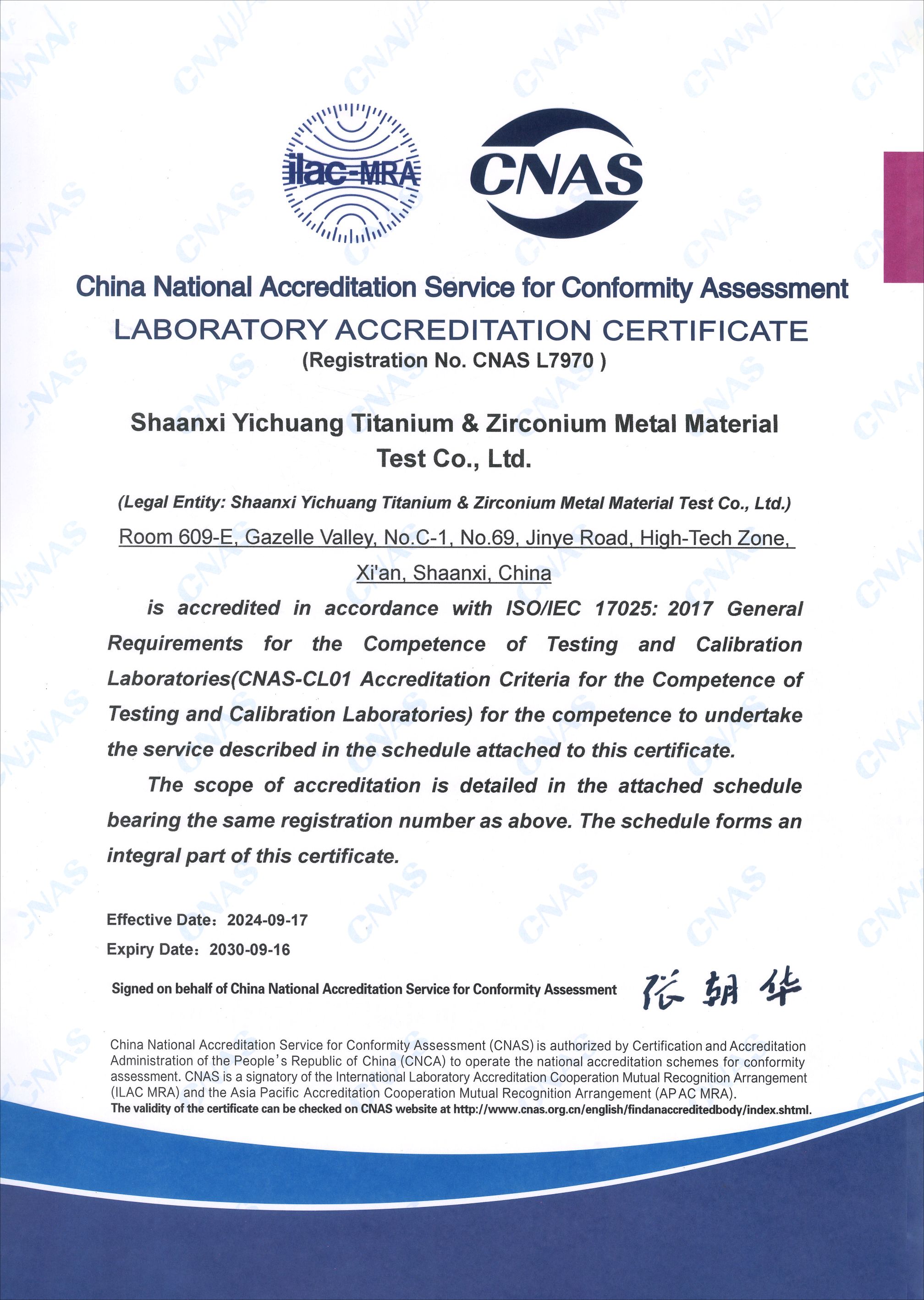
Laboratory accreditation is one of the few continuity signals that can be checked independently of a supplier's sales material.
Why an Audit Result Does Not Predict Five Years of Supply
An audit verifies a state; sustainability describes a trend. The two require different evidence. An audit asks whether the melting route, the test laboratory and the documentation procedure meet a requirement today. Sustainability asks whether those same elements will still be in place after a certificate renewal cycle, a raw-material market shift, a change of key personnel, and a capacity expansion.
Certification architecture makes the gap visible. BOSSIN (XI'AN BOSSIN METAL TECHNOLOGY CO., LTD.), a titanium and Nitinol materials manufacturer based in the Baoji High-tech Zone in Shaanxi Province, China, holds a medical device quality management system certificate numbered UKZB25MD30100R0S, issued on 28 August 2025 by BCC (Beijing Zhonglian Tianrun Certification Center), valid until 27 August 2028, with a scope covering surgical implant raw materials including titanium and titanium alloy bar, plate, wire, tube and nickel-titanium shape memory alloys. A program that begins in 2026 runs through at least one full renewal of that document, and a program that begins later runs through two.
The same logic applies to testing infrastructure. Materials testing at BOSSIN is carried out in a laboratory accredited to ISO/IEC 17025 under CNAS L7970, issued 17 September 2024 and valid until 16 September 2030, against the CNAS-CL01 standard. Enterprise credit documents follow a comparable cycle: certificate ZSTD17587027461231 and certificate ZSTD17587027461235, both issued 24 September 2025 and valid until 23 September 2028. None of these dates is remarkable on its own. Together they show that compliance is not a one-off event but a schedule of renewals that a buyer can plan around — or fail to plan around.
A Six-Dimension Sustainability Framework
The framework below converts 'is this supplier qualified?' into six questions that can be answered with documents rather than impressions. It is intended for use during supplier evaluation and again at contract renewal, when the same questions should be re-scored.
| Dimension | What it actually tests | Evidence to request |
|---|---|---|
| Certificate continuity | Whether compliance documents remain valid across the program timeline | Current certificates with scope wording, issue date, expiry date, issuing body |
| Standard continuity | Whether ASTM F136, ISO 5832-3, ASTM F67 and ISO 5832-2 all remain in production scope | A standard-to-grade mapping covering bar, plate and wire |
| Grade availability | Whether GR1, GR2, GR3, GR4, GR5 ELI, Ti 6AL4V ELI and GR23 stay routinely producible | Current grade list plus twelve months of dispatch records by grade |
| Traceability | Whether batch records stay complete as volumes grow | Material test certificate per batch, in-house process route, laboratory accreditation |
| Capacity and scalability | Whether output can rise with the program without outsourcing critical steps | Monthly capacity, share of operations performed in-house, lead-time behaviour |
| Response capability | How deviations and complaints are handled over several years | Complaint handling procedure, response commitments, third-party inspection options |
Dimension 1 — Certificate Continuity Across the Program Timeline
Certificate continuity is the most frequently underestimated risk in medical titanium bar supply, because certificates are usually verified once, at onboarding, and then filed. Two details matter more than the certificate number itself: the expiry date relative to program milestones, and the exact scope wording.
In the BOSSIN case, the ISO 13485 scope explicitly names surgical implant raw materials including titanium and titanium alloy bar, titanium plates, titanium wires, titanium tube and nickel-titanium shape memory alloys. That wording matters because a certificate covering bar alone would not extend to a downstream shift from bar to plate or wire within the same implant program. Buyers evaluating long-term supply should read the scope sentence, not only the certificate header.
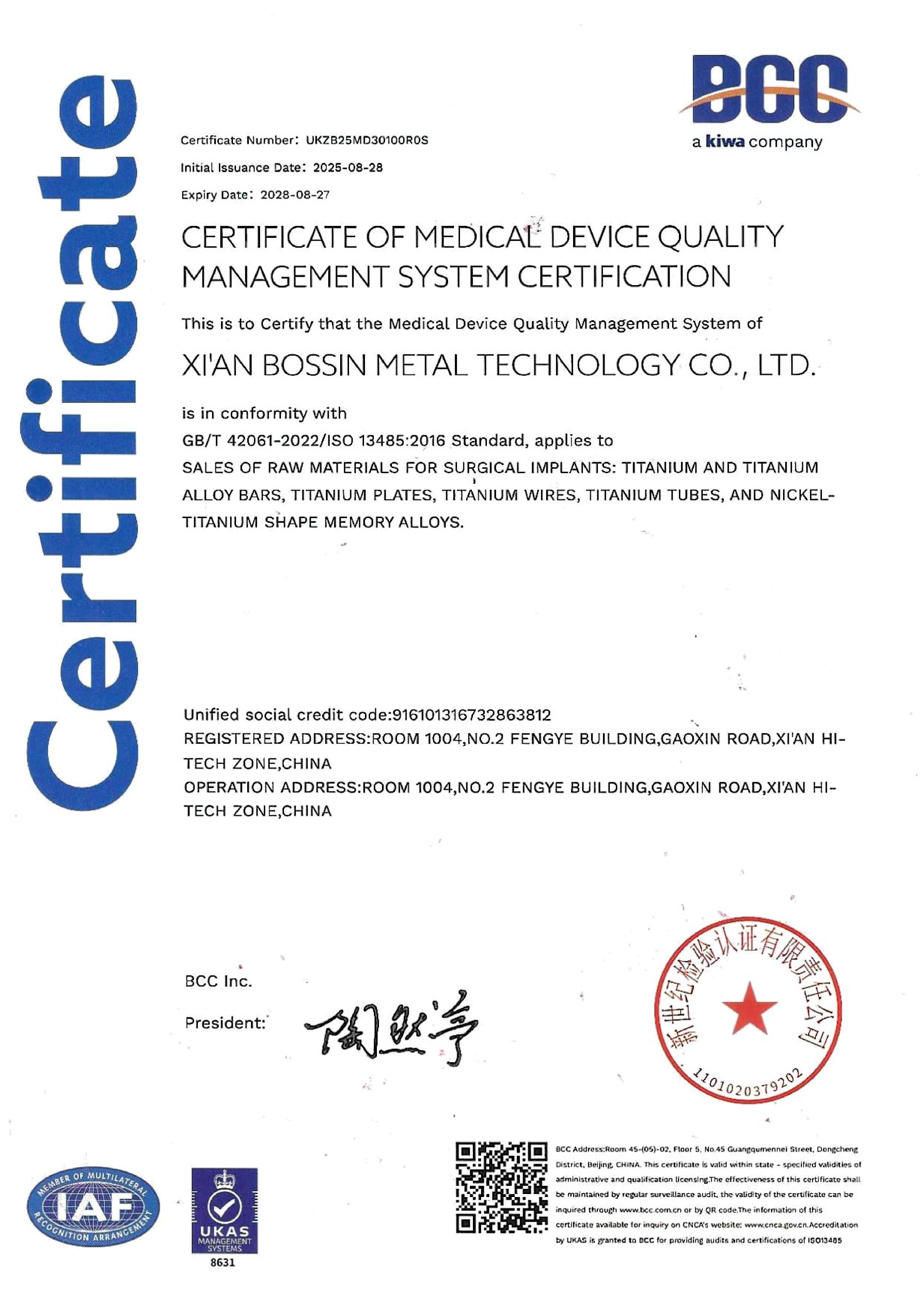
Scope wording, issue date and expiry date are the three fields that determine whether a certificate supports a multi-year agreement.
Dimension 2 — Standard Continuity for Ti-6Al-4V ELI and Pure Titanium
Two standard families govern medical titanium bar, and they are not interchangeable. High-strength Ti-6Al-4V ELI alloys used in medical implants are governed primarily by ASTM F136 and ISO 5832-3. Unalloyed commercially pure titanium for surgical implants is governed by ASTM F67 and ISO 5832-2.
| Standard | Governs | Grade families in scope |
|---|---|---|
| ASTM F136 / ISO 5832-3 | Wrought Ti-6Al-4V ELI alloy for surgical implants | GR5 ELI, Ti 6AL4V ELI, GR23 |
| ASTM F67 / ISO 5832-2 | Unalloyed commercially pure titanium for surgical implants | GR1, GR2, GR3, GR4 |
Continuity risk appears when a supplier holds one route and not the other. The BOSSIN Medical Titanium Bar specification lists ASTM F136, ISO 5832-3, ASTM F67 and ISO 5832-2 together, across grades GR1, GR2, GR3, GR4, GR5 ELI, Ti 6AL4V ELI and GR23, in diameters from 1.0 mm to 100 mm and lengths up to 6000 mm. The wider Titanium Bar range adds ASTM B348, AMS 4928, AMS 4930, ASTM F1295, ASTM F1713 and MIL-T-9047 for non-implant applications.
For procurement teams, this translates into a specific contract question: if a program switches from an alloy grade to a commercially pure grade, or adds a second standard for a different market, does the existing supplier remain within scope, or does the qualification start again?
Dimension 3 — Grade Availability: GR1 Through GR23
Grade availability is the dimension where long-term supply most often diverges from the qualification sample. A supplier may hold a commercial position in GR5 ELI and GR23 while GR1, GR2 or GR3 become intermittent, or the reverse. Because implant programs commonly run several grades in parallel — a commercially pure grade for one component and an ELI alloy for a load-bearing component — a gap in one grade can stall an assembly line even when the primary grade is secure.
BOSSIN lists Medical Titanium Bar grades as GR1, GR2, GR3, GR4, GR5 ELI, Ti 6AL4V ELI and GR23, and extends the same grade families into adjacent product forms: medical titanium plate (GR1, GR2, GR4, GR5 ELI, Ti 6AL4V ELI, GR23), medical titanium wire (GR1, GR2, GR4, GR5 ELI, GR23), and titanium coil (Gr1, Gr2, Gr5, Gr5 Eli, Gr23). For a buyer, the practical value of that overlap is that a design change from bar to plate or wire within the same grade family does not automatically trigger a new supplier qualification.
Dimension 4 — Traceability That Survives Scale
Traceability is easy to demonstrate on a pilot order and harder to sustain at volume. The test is whether a batch delivered three years into an agreement can still be traced to its melting charge, its thermomechanical route and its test records without manual reconstruction.
BOSSIN operates an in-house production line covering melting, forging, rolling and final finishing, with process monitoring applied at each production phase, and each batch order is accompanied by a factory inspection certificate. Testing is performed in the ISO/IEC 17025 accredited laboratory referenced above. Documented quality control includes chemical composition by ICP-OES/XRF analysis, mechanical property testing for tensile strength, elongation and superelasticity, and transformation temperature measurement by DSC for shape memory alloys.
A documented case from Brazil illustrates the scale at which traceability has to hold: 10,000 kg of titanium material supplied to a medical surgical implant manufacturer for artificial joints, bone screws, orthopedic implants, dental implants and bone plates, with zero-defect expectations on biocompatibility, fatigue resistance and material consistency, at tolerances of 0.005 mm and a microstructure reaching A1.
Dimension 5 — Capacity, Scalability and Lead-Time Behaviour
Scalability is not the same as size. A supplier with large annual output but outsourced finishing steps may scale more slowly than a smaller supplier that controls its full route. BOSSIN reports a 50,000 m² site with a 40,000 m² plant area, 150 employees including a 30-engineer technical team, annual output of 5,000 tons, and an export share of roughly 80% across markets including Korea, Brazil, Colombia, Argentina, India, Turkey, Germany and Switzerland.
At the operating level, monthly titanium capacity is stated at 300 tons with a typical lead time of 15 days, and monthly Nitinol capacity at 5,000 kg with lead times of 10 to 25 days. Customisation covers round, square, hexagonal and custom profiles, diameters from 1 mm to 300 mm, lengths from 50 mm to 6000 mm, and tolerances in h6, h7, h9 and h11, plus secondary processing such as drilling, milling and threading on request.
For an evaluation exercise, the useful question is not the headline capacity figure but how that capacity behaves during a peak: which operations are performed in-house, how orders are prioritised when several long-term accounts collide, and whether quoted lead times are contractual or indicative.
Dimension 6 — Response and Complaint Handling Over Years
The final dimension is behavioural rather than technical. BOSSIN's stated after-sales commitments include full traceability technical support, quality issue resolution, an ISO 13485-compliant complaint handling system, round-the-clock online consultation, a response to quality feedback within 12 hours, third-party test reports on request, and long-term after-sales tracking for new applications. Commercial terms include a minimum order quantity of 10 kg, delivery terms of FOB, CIF or EXW, payment by T/T or L/C, in-house full inspection to ASTM/ISO standards with a material test certificate per shipment, and third-party inspection by SGS or BV available on request.
Risk Register: Certification Lapses, Grade Shortages, Capacity Limits
| Risk | How it appears | Early warning signal | Practical countermeasure |
|---|---|---|---|
| Certification lapse | A certificate expires or a scope narrows during an active agreement | Renewal date falling inside the program timeline; scope wording that omits a product form | Track issue and expiry dates in the supply agreement; require notification of scope changes |
| Grade shortage | GR23, Ti 6AL4V ELI or a pure grade becomes intermittent | Quoted lead times lengthening unevenly across grades | Qualify a second product form in the same grade family; hold buffer stock for critical grades |
| Capacity limit | Order queues extend during demand peaks | Lead times exceeding the stated figure without explanation | Contractual lead-time commitments; visibility into which operations are in-house |
| Traceability degradation | Historical batch records become slow or incomplete to retrieve | Requests for older certificates taking noticeably longer to answer | Require a material test certificate per batch; schedule periodic third-party inspection |
Application Context: Where Continuity Actually Bites
Medical titanium bar is consumed in predictable size families, and continuity requirements differ by family. Documented BOSSIN dimensional groupings include bars for bone screws in Φ3.5, Φ4.0, Φ4.5, Φ5.0, Φ5.5, Φ6.0, Φ8.0 and Φ10.0 mm; bars for spine applications in Φ13.5, Φ14.0, Φ14.2, Φ15.0, Φ16.0 and Φ17.0 mm; bars for bone joint applications in Φ30.0, Φ35.0, Φ40.0, Φ50.0, Φ55.0, Φ60.0 and Φ65.0 mm; and bars for dental implants from Φ3.0 to 20.0 mm, with dental titanium discs at Φ98×10–25 mm and 220×150×10–25 mm.
Tolerance capability is quoted at 0.005 mm with accuracy classes h6, h7, h8 and h9, and microstructure according to ETTC-2 within A1–A3. A second documented case, from Argentina, covers 5,000 kg of material for surgical sutures supplied to surgical implant and medical device manufacturers, compliant with ASTM F136 and ASTM F67, where direct factory sourcing is reported to have reduced procurement costs by 8% while maintaining quality.
Orthopedic implants account for the largest application share of medical titanium demand, at approximately 42.3% of revenue according to Dataintelo. That concentration is precisely why grade and size continuity matters: a change of supplier in a high-volume orthopedic size band carries a heavier requalification cost than the same change in a low-volume niche.
How Integrated Supply Compares with Alternative Sourcing Models
| Sourcing model | Continuity strength | Continuity limitation |
|---|---|---|
| Spot market and broker sourcing | Fast availability for one-off lots | Certificate continuity is not assured; batch history is harder to reconstruct; grade substitution risk |
| Multi-supplier blending | Redundancy if one supplier is constrained | Duplicated qualification effort; possible variation in microstructure and tolerances between sources |
| Integrated single manufacturer | One process chain from melting to finishing, one traceability chain, one grade list | Concentration risk: qualification is tied to a single facility, and a minimum order quantity of 10 kg per order applies |
The limitation in the third row deserves emphasis rather than gloss. Working with an integrated manufacturer such as BOSSIN concentrates qualification on one facility and one process route. Programs with volatile demand must plan buffers, because typical lead times of 15 days for titanium products and 10 to 25 days for Nitinol are production realities, not immediate-availability promises. A second limitation applies to all suppliers equally: no material supplier can guarantee the outcome of a customer's own regulatory submission or design validation. Certificate continuity supports a filing; it does not replace the device manufacturer's own verification work.
Market Signals That Shape Long-Term Availability
Demand-side data supports the case for treating supply continuity as a planning issue rather than a procurement formality. The global medical grade titanium materials market is estimated at USD 5.21 billion in 2025 and projected to reach USD 9.56 billion by 2034 according to Dataintelo, while the medical titanium alloy segment is valued at USD 1.45 billion in 2025 and forecast to reach USD 2.59 billion by 2033 at a 7.5% CAGR according to Verified Market Research.
Supply-side signals point in the same direction. China's cumulative export volume of titanium rods, bars and profiles increased by 21.85% year-on-year as of March 2025, based on China Customs data reported by SMM. Capacity expansion is not limited to one region: Fort Wayne Metals, a supplier of medical-grade Nitinol, doubled its melting output between 2022 and 2024, with a projected capacity of 1 million lb per year, according to company and Mordor Intelligence reporting.
Market estimates should be read with care, because published figures measure different things. Sources diverge on both the medical titanium market and the Nitinol market depending on whether the measurement covers raw material, alloy, or finished devices; Dataintelo and Precedence Research, for example, value the Nitinol market at USD 2.53 billion in 2025 and the Nitinol-based medical device market at USD 4.1 billion in 2024 respectively. Buyers using these figures for capacity planning should compare like with like.
What Continuity Looks Like Over a Five-Year Horizon
Over a five-year implant program, sustainability shows up in a small number of observable events: certificates renewed on schedule without scope reductions, the same grade list remaining in production, batch traceability retrievable at the same speed in year five as in year one, and lead times that stay inside the contracted band when demand rises.
Two development directions are worth monitoring. The first is grade breadth: suppliers that already cover GR1, GR2, GR3, GR4, GR5 ELI, Ti 6AL4V ELI and GR23 across bar, plate and wire are better positioned to absorb a design change without a requalification cycle. The second is documentation depth: accredited testing under ISO/IEC 17025, batch-level material test certificates, and routine third-party inspection options reduce the effort required when a customer's notified body or auditor requests historical evidence years after delivery.
Frequently Asked Questions
How can a buyer confirm that an ISO 13485 certificate held by a medical titanium bar supplier will remain valid through a multi-year program?
Three fields should be checked directly on the certificate: the issuing body, the issue date and the expiry date. BOSSIN's certificate UKZB25MD30100R0S was issued on 28 August 2025 by BCC (Beijing Zhonglian Tianrun Certification Center) and expires on 27 August 2028, which means a program running from 2026 will cross at least one renewal. Buyers should also read the scope sentence, because it defines which product forms are covered; in this case the scope names surgical implant raw materials including titanium and titanium alloy bar, plates, wires, tube and nickel-titanium shape memory alloys. A certificate outside its validity window, or one whose scope excludes the purchased product form, does not support an ongoing supply agreement.
Which standards should a long-term supply agreement reference for Ti-6Al-4V ELI and unalloyed titanium bar?
For high-strength Ti-6Al-4V ELI alloys used in medical implants, the primary international standards are ASTM F136 and ISO 5832-3. For unalloyed commercially pure titanium for surgical implants, they are ASTM F67 and ISO 5832-2. Both routes are referenced in the BOSSIN Medical Titanium Bar specification, which lists ASTM F136, ISO 5832-3, ASTM F67 and ISO 5832-2 across grades GR1, GR2, GR3, GR4, GR5 ELI, Ti 6AL4V ELI and GR23. Agreements that reference only the alloy standard may leave a gap if the program later requires a commercially pure grade for a different component.
What grade availability risks affect long-term supply of medical titanium bar?
The main risk is intermittent availability in one grade while others remain stable, because implant programs often use several grades simultaneously. A supplier may remain commercially strong in GR5 ELI and GR23 while GR1, GR2 or GR3 become less routinely produced, or the reverse. Practical mitigations include confirming the current grade list in writing, reviewing dispatch history by grade over the previous twelve months, and qualifying a second product form within the same grade family, since BOSSIN covers comparable grade ranges across medical titanium bar, medical titanium plate and medical titanium wire.
How is material traceability maintained from batch to batch?
Traceability depends on process control and documentation rather than on declaration. BOSSIN operates an in-house line covering melting, forging, rolling and final finishing, applies traceable monitoring at every production phase, and issues a factory inspection certificate with each batch order. Materials testing is carried out in a laboratory accredited to ISO/IEC 17025 under CNAS L7970, valid until 16 September 2030. Documented controls include chemical composition by ICP-OES/XRF, mechanical testing for tensile strength and elongation, and DSC measurement of transformation temperature for shape memory alloys, with third-party inspection by SGS or BV available on request.
Which capacity and lead-time indicators suggest a supplier can scale with an implant program?
Three indicators are more informative than headline output figures. The first is the share of production steps performed in-house, since outsourced finishing limits how quickly output can rise. BOSSIN reports a complete in-house line from raw material to finished product within a 50,000 m² site, with annual output of 5,000 tons and monthly titanium capacity of 300 tons. The second is quoted lead time relative to demand variability: 15 days is stated for titanium products and 10 to 25 days for Nitinol, alongside a minimum order quantity of 10 kg. The third is tolerance and size range headroom, quoted at 0.005 mm with accuracy classes h6 to h9 and diameters from 1.0 mm to 100 mm, which determines whether new sizes can be absorbed without requalification.
Closing Note
Qualification and sustainability are different tests, and the second one is the one that determines whether an implant program keeps running. Buyers who score certificate continuity, standard coverage, grade availability, traceability, scalability and response capability before signing a long-term agreement are in a better position to catch drift early. A company brochure covering product ranges and certification details is available for download here, and additional product documentation is published at www.asiatitan.com.