
Beyond Output: Evaluating Cosmetic Filling Machine Constraints
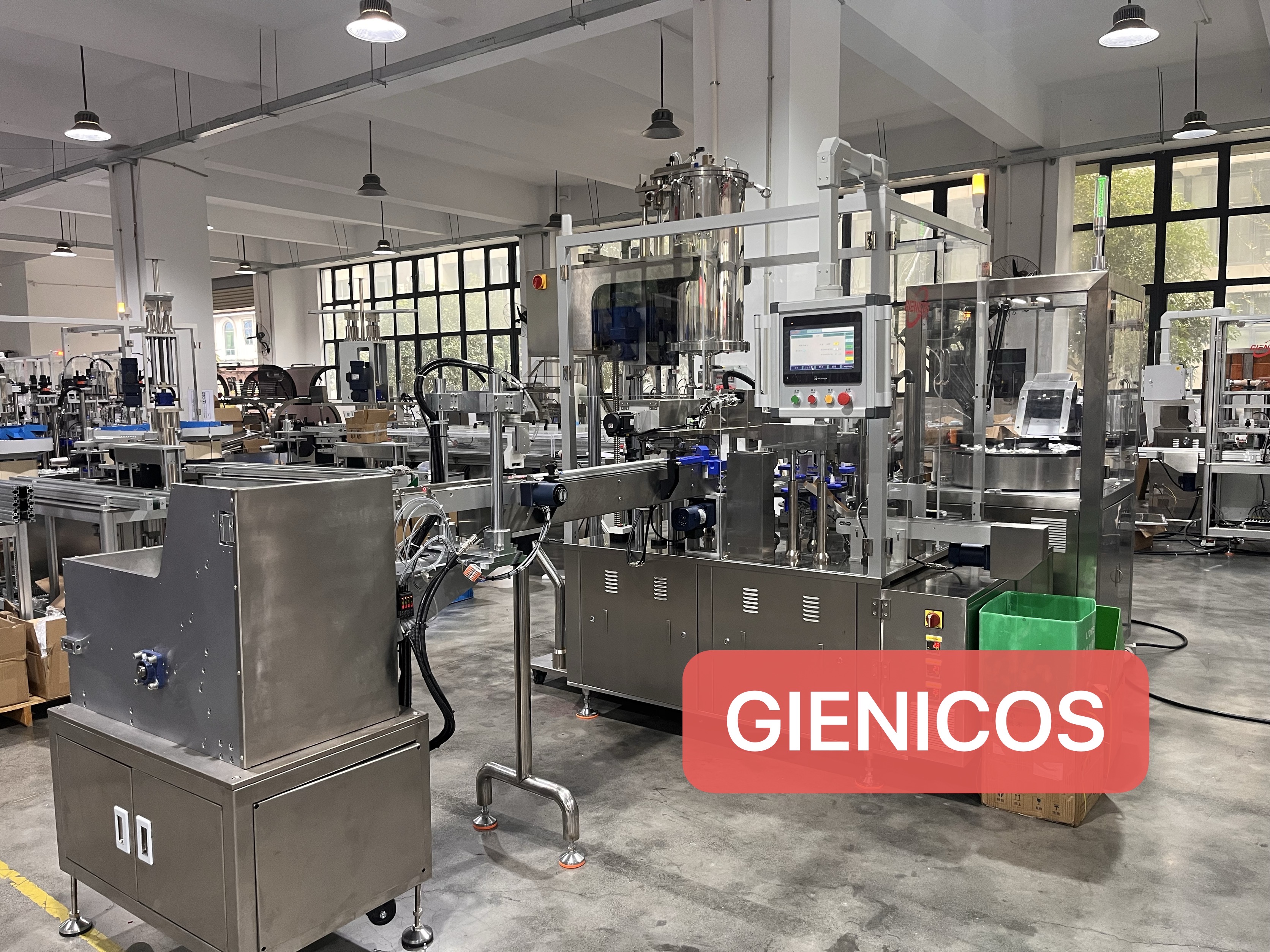
Automatic rotary filling machines combine filling and capping, but output claims depend on container size, formula viscosity and line integration.
Cosmetic filling machine buyers today have more technical options than ever, but selection is no longer about choosing the fastest-looking model. A filling machine’s real value depends on how its specifications behave under real production constraints: formula viscosity, container tolerance, clean-room requirements, utility capacity, and the exact scope of CE certification. This article provides a constraint-based framework for procurement teams in the research and evaluation stage, before comparing quotes or signing a purchase order.
Why constraint-based evaluation matters
Filling speed is a headline number, but it is almost always a conditional claim. A machine rated at 80 pieces per minute for lip gloss may run slower with a more viscous mascara formula, a different bottle neck, or a downstream capping module that cannot keep pace. In many projects, the real bottleneck is not the filling head but the total line behavior under specific operating conditions.
The market context makes this more relevant. According to Future Market Insights, the global cosmetic filling machines market was valued at USD 476.80 million in 2025 and is projected to reach USD 718.63 million by 2036. The same report expects automatic filling machines to hold a 41.2% share of cosmetic filling technology in 2026. As automation expands, buyers are increasingly dependent on written technical claims rather than manual operator skill. That raises the cost of misreading a specification sheet.
The parameter checklist
When evaluating cosmetic filling machines, five specification areas should be reviewed before price: rated output, filling accuracy, product-contact materials, tank and nozzle design, and utility requirements. Each area contains hidden constraints that can affect daily production.
Rated output is conditional
Some suppliers split output into ranges rather than a single maximum. For example, GIENICOS’s linear high-speed lip gloss and mascara filling line model JMG is described with a mid-speed range of 60–72 pieces per minute and a high-speed range of 80–100 pieces per minute. The higher bracket is not a simple machine speed; it assumes a complete system with synchronized bottle feeding, filling, wiper insertion, capping and labeling.
Other machines show similarly practical ratings. The JQH-02 automatic lip gloss filling and capping machine is rated at 60–80 pieces per minute, while the JQR-01A automatic rotary mascara filling and capping machine is rated at 40–45 pieces per minute. The difference is not necessarily quality; it reflects product format, container handling complexity and the degree of automation around the filling station.
Buyers should therefore ask not only “what is the maximum speed?” but also “at what viscosity, container size, filling volume and line configuration is that speed valid?”
Fill accuracy is not an absolute number
Fill accuracy is often quoted as a tolerance such as ±0.1 g or ±0.15 g. However, established suppliers usually include a condition statement. GIENICOS’s JQL-04C high-speed cushion filling machine, for example, states a filling precision of approximately ±0.15 g, subject to material formula, sponge characteristics and other factors. The JQL-02N nail polish filling and capping machine also lists ±0.15 g subject to material formula and other factors.
By comparison, rotary mascara and lip gloss filling equipment in the JQR/JR series often quotes ±0.1 g. This does not mean one machine is universally better than another. It means the quoted accuracy only makes sense when the product type, dosing system and container are defined. Buyers should ask whether the tolerance was measured with water, with a reference cosmetic formula, or with the customer’s actual product sample.
Product-contact materials define hygiene boundaries
For color cosmetics and skin care, the part of the machine that touches the product should be identified explicitly. Many GIENICOS machines specify SUS316L for wetted parts. Examples include the JMG lip gloss/mascara line, the JLF-A dual-nozzle loose powder filling machine, and the JYF-4 four-in-one multi-color hot filling machine.
SUS316L is frequently chosen for cosmetic processing because of its corrosion resistance and cleanability. But a stainless steel frame is not the same as stainless steel contact parts. A responsible specification sheet will separate the machine frame, guarding, and contact parts. If a quote only says “stainless steel” without grade and location, the buyer should request more detail.
Filling method must match the formula
The method used to move material into a container is a decisive constraint. Different formulations respond differently to pumps, pistons, peristaltic action and auger rotation.
| Filling principle | Typical product scope | Example equipment in GIENICOS’ range |
|---|---|---|
| Servo piston filling | Viscous liquids, lip gloss, mascara, high-viscosity and hot-fill cosmetics | JQH-02, JSFL, JYF-4, JHF line |
| Peristaltic pump filling | Liquid eyeliner and products requiring clean, low-shear dosing | JR-02E rotary eyeliner filling machine |
| Auger filling | Loose powder and free-flowing powder products | JLF-A dual-nozzle linear powder filling machine |
| Servo filling with lifting | Air cushion products, foundation and cream filled into sponge or compact cases | JQR-02C air cushion filling machine, JRS-G1 foundation filling machine |
| Hydraulic or servo pressing | Compact powder, pressed powder and eyeshadow | JTC, JBC-4, GP050 SE powder pressing machines |
For wax-based products such as lipstick and lip balm, heating becomes another constraint. A hot pouring machine such as the TSP model integrates heating, stirring and vacuum functions, and uses a sanitary valve without dead angles. Larger melting tanks such as the MT 100 SE and MT 30SE add pre-melting, mixing and vacuum capability before material reaches the filling or molding station. Buyers producing stick cosmetics should verify not only the filling machine but also the upstream heating system.
Certification scope matters more than a CE sticker
In the EU market, CE marking is a legal requirement for machinery. But a generic CE sticker is not enough evidence for a qualified buyer. The certificate should name the model series, the applied standards, and the components covered by the assessment.
GIENICOS’s CE documentation illustrates why scope matters. Its Hot Filling & Cooling Line JHF is covered by certificate number AT185114C4000321, issued by Hunan Anbotek Compliance Laboratory Limited. The scope includes the MT melting tank, JYF filling machine, JCT cooling machine, automatic bottle loading machine, automatic cap loading machine, check weigher and JTB labeling machine, for model series JHF-1, JHF-2, JHF-4, JHF-6, JHF-8 and JHF-10. The referenced standards are EN 60204-1:2018 and EN ISO 12100:2010.
Similarly, the air cushion CC cream filling machine certificate AT1814C502723151 covers models JQL-04C, JQR-02C and JQL-02C. The rotary filling machine series, including JR-02-E, JR-01-E, JR-01-M, JR-02-M and related models, is covered by certificate AT18250SC100524 under the same machine safety standards.
Read the certificate the same way you would read a machine specification. Ask whether the model you intend to buy is explicitly listed. Ask whether the scope includes all optional modules, such as a capping station, cooling tunnel or labeling unit. A certificate that covers only the base filling head may not help when the full production line is audited.
Applying the framework across product formats
Cosmetic filling lines are often designed around a product family, not a universal machine. GIENICOS’s portfolio spans several product formats, which makes it a useful reference for understanding format-specific constraints.
Lip gloss, mascara and liquid lipstick
These products share similar dosing challenges: small filling volumes, frequent color changes, and a need for drip control. The JMG linear lip gloss and mascara filling line uses servo piston filling with 10–12 pieces per cycle, optional static or fall-while-filling modes, return-suction anti-drip nozzles, no-bottle-no-fill detection, and servo torque capping. It can reach 80–100 pieces per minute in a high-speed configuration, with SUS316L wetted parts. The JQR-01A rotary mascara filling and capping machine targets 40–45 pieces per minute and handles container diameters from about 10 to 125 mm, making it a more compact option for continuous mascara production.
Nail polish and eyeliner
Nail polish typically requires brush or steel-ball handling in addition to liquid filling. The JQL-02N nail polish filling and capping machine is a compact circular-line solution that includes steel-ball loading, two-nozzle servo filling, brush loading, capping and discharge. It runs at 80 pieces per minute for 5–20 ml fills, with missing brush or cap detection and no-bottle-no-fill control.
Eyeliner filling is often handled with a peristaltic pump to avoid contamination and enable quick cleaning. The JR-02E rotary eyeliner filling machine fills two products per cycle at 30–40 pieces per minute and uses a rotary table feeding design with empty-container detection.
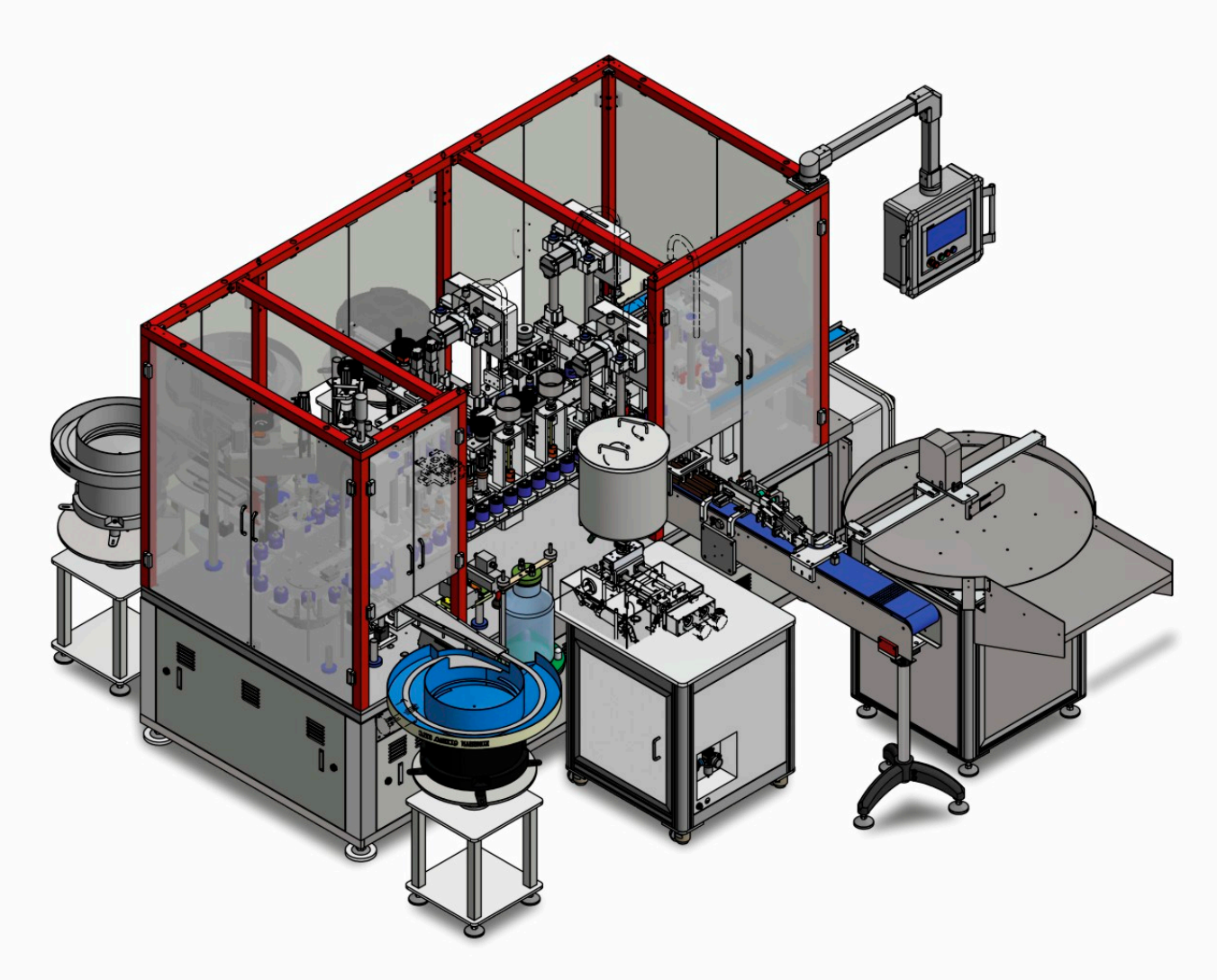
Nail polish filling equipment is an example of a product-specific machine that combines dosing with brush and cap assembly.
Foundation and air cushion products
Liquid and cream foundations require clean handling of viscous formulations and quick changeover between shades. The JRS-G1 semi-automatic rotary foundation filling machine uses full-servo rotary filling, produces 30–40 pieces per minute, and has a quick-release filling valve that supports cleaning and color changes in approximately 2–3 minutes. The JQR-02C air cushion CC cream filling machine uses servo filling and lifting, supports single or dual colors, and includes a 15-litre stirred tank to maintain material consistency.
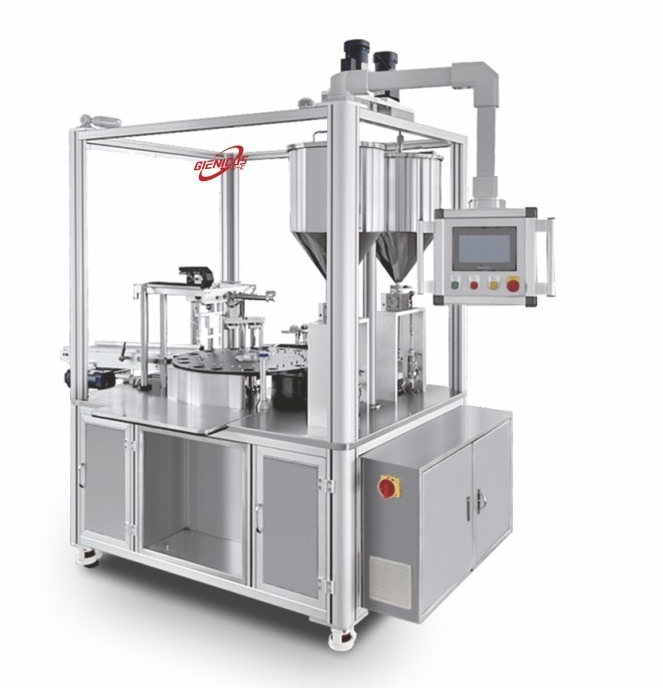
Cushion filling machines add a quality constraint because the sponge must absorb a controlled amount of liquid formula without leaking or uneven distribution.
Loose powder and compact powder
Powder filling has a different risk profile from liquid filling: dust, flowability, air entrainment and particle segregation. The JLF-A dual-nozzle linear loose powder filling machine uses auger filling with vibration conveying, SUS316L product-contact parts, a Mitsubishi PLC and a Panasonic servo motor. It reaches 30–40 pieces per minute with a 25-litre hopper.
For pressed powders, compacting is a separate process. GIENICOS offers hydraulic and servo-driven compact powder press machines. The JTC is a full-hydraulic up-bottom compact powder machine with 304 stainless steel and 6061 aluminum components. The JBC-5 uses a servo motor hydraulic drive with a maximum pressure of 14 tons and a typical mold capacity of 9 pieces per mold at about 50 mm diameter.
What buyers should verify in an OEM or ODM context
For OEM and ODM manufacturers, a filling machine is rarely a single-purpose asset. It must support multiple private-label customers, different container designs, changing formulas and small launch batches. In this context, customization capability becomes a procurement specification rather than a convenience.
GIENICOS’s customization parameters include voltage, logo, automation degree, tank size, filling method and speed request. The company’s stated MOQ is one unit, lead time is 45–80 days, and every unit receives a 100% OQC test before shipping. These details are important because they set expectations for sample validation and line commissioning.
The company also describes one of its application scenarios as a cosmetic clean-room workshop producing lip gloss, mascara and lip tint at high speed. The equipment can be matched with MES systems, remote monitoring, automatic check weighing and rejection, labeling, and sleeve shrink labeling. That is a practical reminder: in a GMP clean-room environment, the filling machine is part of a wider data and compliance chain.
Market trends behind the specification shift
Market research data points to two relevant trends. First, automatic filling machines are gaining share within the cosmetic filling technology sector; Future Market Insights projects they will account for 41.2% of the market in 2026. Second, Asia Pacific is a significant manufacturing region, holding a 33.08% share of the broader filling machine market in 2025, according to Fortune Business Insights.
For buyers, the move toward automatic equipment increases the need for documented line performance. An automatic line that is not properly integrated, not CE-certified, or not designed for clean-room operation can create more problems than a manual line. Therefore, the latest generation of filling equipment tends to combine modular architecture with clearer certification boundaries. Vision-guided robotic cells, such as GIENICOS’s JZF system with two visual detection setups and a Delta robot, are an example of how machine builders are trying to reduce manual handling in powder-case assembly.
When a simpler machine is still the right choice
Automatic high-speed lines are not always the best answer. A legitimate limitation of high-speed automatic equipment is that it usually requires higher capital expenditure, more utility capacity, more floor space and more engineering time for product changeover. For a workshop running many small batches, the cost of cleaning and re-validating a large line can exceed the labor savings of automation.
Semi-automatic machines remain valuable in those settings. The JR-01M/L is a semi-automatic rotary filling machine with single or dual nozzle options, a filling range of 2–14 ml or 10–50 ml by changing spare parts, and a fast-cleaning structure that supports disassembly in about three minutes. It is designed for flexible small-to-medium batch production. Similarly, the JSM half-silicone lipstick and lip balm filling line is a semi-automatic line requiring four to five operators; it accepts half-silicone molds or aluminum molds and can produce 1800–3000 pieces per hour with silicone molds or 2160–3600 pieces per hour with metal molds. This configuration makes sense when a producer needs to switch between different lipstick shapes and formulas without committing to a fully automated mold-handling line.
Buyers should therefore frame the decision as a trade-off between peak throughput and operational flexibility, not as a contest between “automatic” and “manual.”
Future outlook
As cosmetic factories move toward higher SKU counts and shorter product life cycles, filling machine requirements will continue to shift. Modular systems with plug-and-play filling heads, quick-release contact parts and separate heating/cooling sections are likely to become more common. Equipment suppliers will also need to document more than speed and price; they will need to document validated accuracy under specified conditions, material traceability, and regulatory scope that matches the buyer’s target markets.
Robot-assisted operations and vision-based inspection will not replace the core filling process, but they will shape how a line is specified. For procurement teams, the immediate takeaway is simple: evaluate the machine’s limits as carefully as its maximum output, and make the supplier prove those limits in writing.
Frequently Asked Questions
What industries and products are cosmetic filling machines suitable for?
Cosmetic filling and packaging equipment is specially developed for color cosmetics and skin care products. It is intended for cosmetics GMP clean-room workshops and can handle lip gloss, lipstick, mascara, cushion, foundation, compact powder, nail polish, eyeliner, eyebrow pencil, cosmetic cream, lotion and similar items. This includes both OEM and ODM contract manufacturing environments and brand-owned production bases.
What is the warranty term?
The standard warranty is 12 months from the date of machine acceptance. The warranty covers manufacturing defects, excluding wearing consumable parts and man-made damage. Free spare parts are provided, and in the standard warranty description, freight is to be carried by the company.
Is the equipment easy to maintain and clean?
Machines are designed with modular structural construction. Key assemblies support fast disassembly, convenient cleaning and spare-part replacement, which helps minimize production downtime between batches.
Can the machines be customized?
Yes. Customization is a stated part of the supplier’s approach. Configuration can be adjusted according to packaging type, customer requirements, automation level, formula features and workshop conditions. The equipment is said to be developed under a module concept, so machines can be adapted rather than supplied only as fixed standard units.
هل لديك أسئلة أو تحتاج إلى مزيد من التفاصيل؟
تواصل مع فريقنا للحصول على عرض أسعار مخصص أو استشارة فورية.
طلب عرض أسعار
املأ النموذج أدناه وسيتواصل معك فريقنا بعرض مقترح مخصص.
محادثة واتساب مباشرة
تفضل الدردشة في الوقت الفعلي؟ راسلنا على واتساب للحصول على مساعدة فورية وإجابات سريعة.
- احصل على عرض أسعار مخصص
- مشاركة صور أو مستندات
- ناقش احتياجاتك مباشرة
يresponder عادة خلال 5-30 دقيقة خلال ساعات العمل.