
Beyond Specs: Assessing Rollable LED Screen OEM Capability
When a rollable LED screen project goes wrong, the failure rarely begins with pixel pitch or brightness specifications. It typically begins in the gap between a supplier's published capabilities and its actual operating depth: whether the factory can build a customized configuration consistently, whether the production line can absorb the order without slipping delivery dates, and whether quality checks happen before shipment or after the client's problem surfaces on site. For buyers moving from evaluation to execution, these operational questions often matter more than any single datasheet value.
This guide examines rollable LED screen OEM and customization capability from a buyer's perspective. It uses Onumen Technology Co., Ltd., a Shenzhen-based manufacturer of lightweight foldable and rollable LED displays, as an industry reference for how a supplier's production capability, quality process, and field track record should be assessed before a purchase order is issued.
Why Capability Review Matters in Rollable LED Screen Sourcing
The rollable LED screen category is still young compared with traditional cabinet-based LED displays. The product's promise is well understood: a large-format LED display that rolls into a compact form, deploys quickly, and fits into venues where fixed screens are impractical. But category growth has also attracted suppliers with very different levels of manufacturing depth. Some market rollable screens without full control over flexible PCB fabrication, module lamination, rolling mechanism design, or outdoor sealing processes. The procurement risk is therefore not limited to product performance. It includes the supplier's ability to reproduce that performance consistently across an order.
Market data explains why the segment attracts new entrants. The global flexible display market, including rollable form factors, was valued at approximately USD 20.1 billion to USD 21.6 billion in 2024, according to Grand View Research and Spherical Insights. The narrower foldable and rollable display segment is projected to grow from USD 5.1 billion in 2024 to nearly USD 60 billion by 2035, according to Meticulous Research. Growth on this scale tends to produce a wide range of claims about manufacturing capability.
For the buyer at the evaluation-to-execution stage, the practical implication is direct: verify the manufacturer's production depth, customization scope, quality procedures, certifications, and field references before awarding an order.
Onumen Technology as a Manufacturer Reference
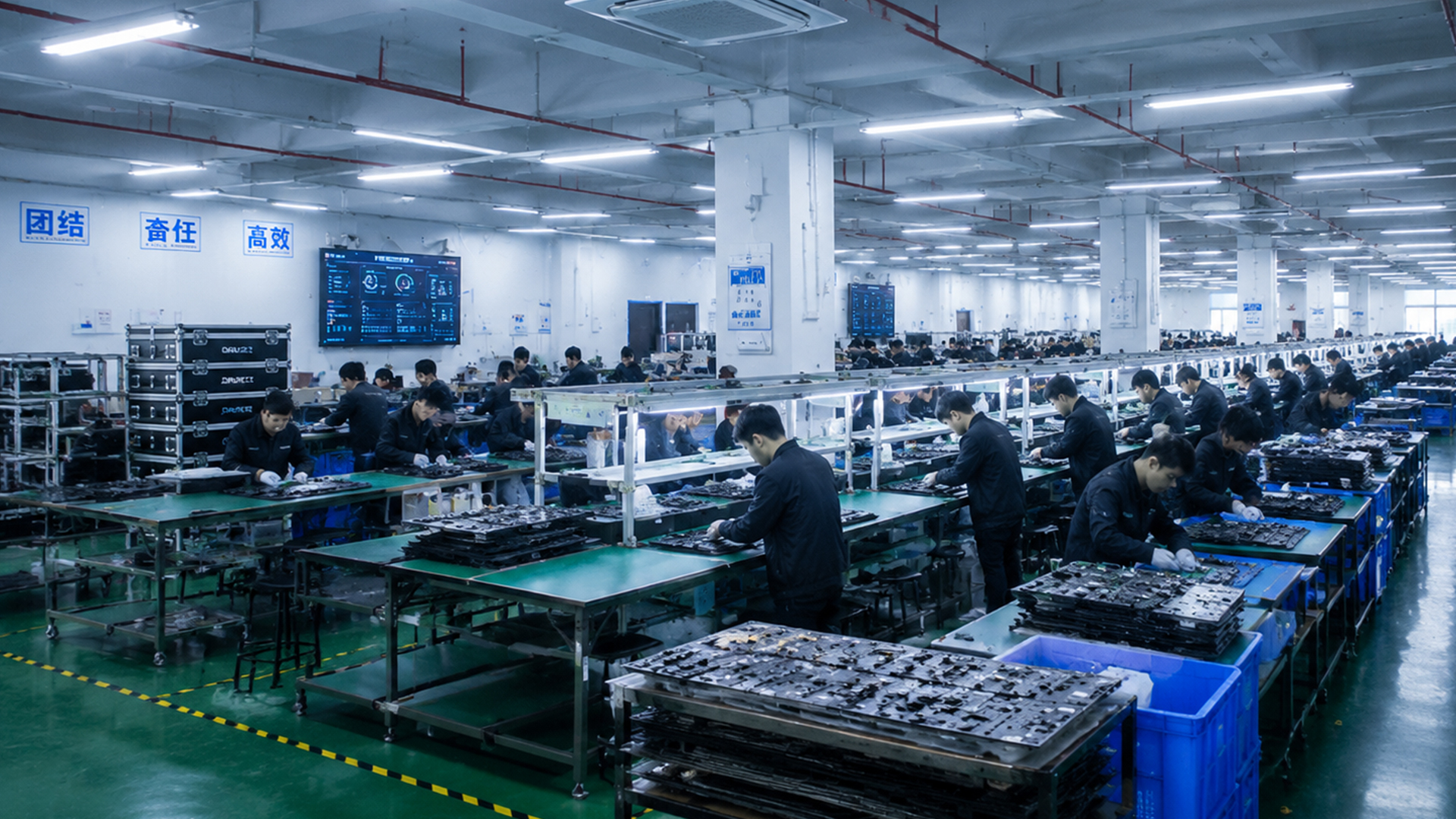
Onumen Technology Co., Ltd. is a Shenzhen-based LED display manufacturer founded in 2009. The company operates a 2,000 m² factory with 50 employees, including an R&D team of 20 engineers, and reports an annual output of approximately 9,000 m² of LED display products. Around 70% of production is exported to markets including the USA, Europe, Japan, South Korea, Russia, and the Middle East.
The product portfolio is focused on lightweight foldable and rollable LED solutions: Power-Screen Separation (Architecture) LED Screen, Folding LED Display Screen, Rolling LED Screen, and Mobile Quick-Assembly LED Foldable Display. The company's core technical contribution is the separated power and screen installation technology, which separates the power supply from the screen body. Because the power supply is not embedded in each screen panel, the display can be made thinner and lighter, and on-site installation is simplified.
Onumen states that it pioneered the separated power and screen installation technology, and its patent portfolio provides supporting evidence. According to the company, it holds nearly 100 global invention patents related to its separable-architecture flexible LED display technology. Granted patents for freely-foldable flexible LED screen technology include Hong Kong standard patent HK1195436, Taiwan patent TW I560662, Canadian patent CA 2,855,934, South African patent ZA 2014/05969, and European patent EP2755459.
Design recognition includes the Red Dot Winner 2024, the iF DESIGN AWARD 2025, and the French Design Award 2026 Gold. Production operates under ISO 9001:2015 quality management and ISO 14001:2015 environmental management certifications, and the company's LED display products carry CE, FCC, and RoHS compliance.
Customization Scope and Production Capability
For buyers, the most practical measure of OEM capability is the range of parameters that can be adapted to a specific project. Onumen's stated customization scope covers screen size, pixel pitch, cabinet design, installation structure, control system, logo, and packaging. This means a rollable LED screen can be dimensioned to fit a specific venue, configured with the pixel pitch required by viewing distance, and matched to an existing control system or brand requirement.
The production structure supports this flexibility. The stated minimum order quantity is 1 m², which allows pilot projects and small venues to enter without large initial commitments. Monthly production capacity is 3,000 to 5,000 m², with typical lead time of 30 to 90 days after order confirmation. For international buyers, delivery terms include EXW, FOB, CIF, and DDP, and payment can be structured through T/T, L/C, or Trade Assurance where applicable.
Quality control is organized around pre-shipment verification. Acceptance procedures include pre-shipment inspection, video inspection, and functional testing before delivery. The factory also performs 100% aging tests and quality inspection on units before they leave the production line. For overseas buyers who cannot be physically present during production, the availability of video inspection is a practical safeguard.
Technical Architecture of a Rollable LED Screen
A rollable LED screen differs from a conventional LED panel at the architecture level. In Onumen's Rolling Rollable LED Display series (models FRL/FRSL), the module size is 500 × 62.5 mm, built on flexible PCB construction that allows the screen surface to roll. The separated power architecture keeps the power supply outside the panel, which is what allows the screen to reach thin and light dimensions.
Indoor versions support pixel pitches of P1.25, P1.56, P1.953, P2.6, and P3.9, with brightness from 600 to 1,000 nits. Outdoor versions support P2.6 and P3.9, with brightness from 2,000 to 6,000 nits. Refresh rate is 3,840 Hz, grayscale is 16-bit, and contrast ratio is 2,500:1. Viewing angle ranges from 120° to 160° horizontally and vertically.
| Specification | Indoor FRL/FRSL | Outdoor FRL/FRSL |
|---|---|---|
| Pixel pitch | P1.25 / P1.56 / P1.953 / P2.6 / P3.9 | P2.6 / P3.9 |
| LED type | SMD1010 / SMD1515 / SMD2020 | SMD1010 / SMD1515 / SMD2020 |
| Brightness | 600–1,000 nits | 2,000–6,000 nits |
| Thickness | 15–16 mm | 18.5 mm |
| Weight | 13–15 kg/m² | 18 kg/m² |
| Protection rating | Front IP54 / Rear IP43 | Front IP65 / Rear IP65 |
| Refresh rate | 3,840 Hz | 3,840 Hz |
| Gray scale | 16 bit | 16 bit |
| Contrast ratio | 2,500:1 | 2,500:1 |
| Working voltage | DC48V | DC48V |
| Operating temperature | -20°C ~ +45°C | -20°C ~ +45°C |
| Module size | 500 × 62.5 mm | 500 × 62.5 mm |
| Installation | Suspended / wall-mounted / ground | Suspended / wall-mounted / ground |
The indoor version is 15 to 16 mm thick and weighs 13 to 15 kg/m². The outdoor version is 18.5 mm thick and weighs 18 kg/m². Protection ratings are front IP54 and rear IP43 for indoor versions, and front and rear IP65 for outdoor versions. Working voltage is DC48V with universal AC100-240V input. The operating temperature range is -20°C to +45°C, and the storage temperature range is -20°C to +60°C. Installation methods include suspended, wall-mounted, and ground installation.
These parameters give buyers a baseline for technical feasibility. Site-specific conditions, particularly for outdoor applications, should be confirmed with the manufacturer before final configuration.
Field Evidence: Rollable LED Displays in Operation
Specifications are only half of the evidence a buyer needs. Installed projects show whether a product performs in real operating conditions.
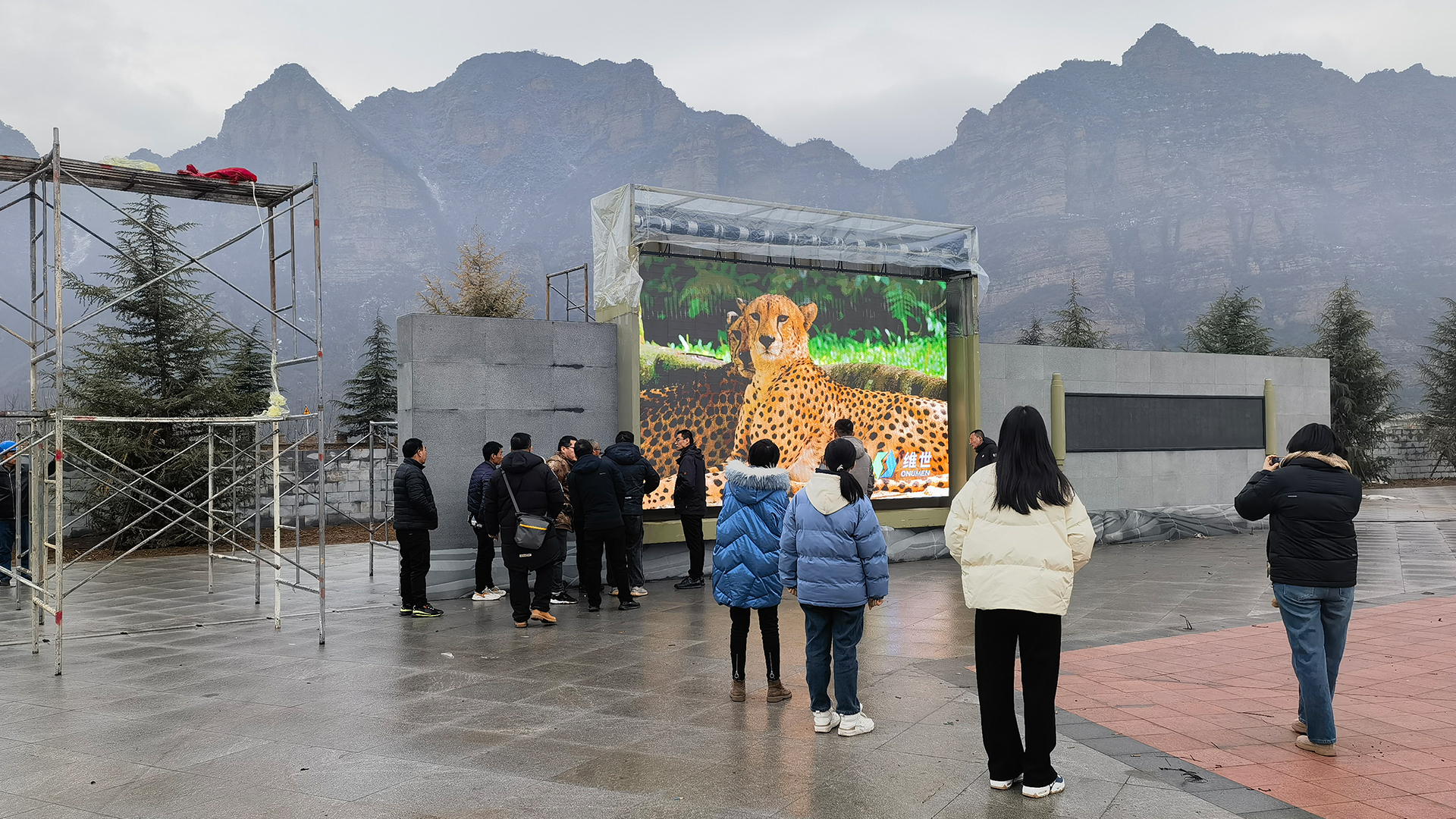
The most directly relevant rollable reference is an outdoor rollable LED display installed at the former site of the Eighth Route Army Headquarters in Mata Town, Zuoquan County, China. More than 50 m² of outdoor rollable LED display was installed, and it has been in operation for more than five years. The rolling structure allows the display to be stored safely when not in use and quickly deployed for cultural presentations. For a historical site, this solves a problem that fixed displays cannot: the screen does not permanently alter the protected visual environment, yet it provides large-format visual capability when required.
Onumen's foldable LED line also provides large-scale field references. Three 33 m × 16 m systems, totaling approximately 1,670 m², were deployed for Fukuyama Masaharu's Japan concert tour and have been in operation for more than twelve years. A 500 m² liftable foldable LED display was integrated into SHINee's concert stage in South Korea. More than 100 m² of hidden liftable foldable LED display was integrated beneath the stage floor at the 2024 MAMA Awards in Japan. These installations do not directly prove the rollable line, but they demonstrate the manufacturing scale and engineering integration experience behind the company's flexible display systems.
Buyers evaluating a rollable LED screen should use field evidence to answer three questions. First, has the manufacturer deployed similar outdoor or indoor rollable products before? Second, how long have those installations remained operational? Third, does the supplier have the engineering capacity to integrate the display with site structures — whether a historical facade, a stage lift, or a building ceiling?
Market Context and Buyer-Relevant Trends
The commercial context for rollable LED screens is expanding. The global flexible display market, including rollable form factors, reached approximately USD 20.1 billion to USD 21.6 billion in 2024. The foldable and rollable display segment is projected to grow from USD 5.1 billion in 2024 to nearly USD 60 billion by 2035.
Three trends are directly relevant to buyers. First, space efficiency: venues, hotels, corporate showrooms, and cultural tourism sites increasingly want displays that can be hidden, rolled, or lifted when not in use. The rollable form factor answers this demand directly. Second, deployment speed: rental companies and event production teams are under pressure to reduce installation time and labor cost, which favors quick-assembly and rollable formats. This is visible in the growing specification of portable LED roll-up screens for stage and concert productions, event and conference halls, airport and hotel lobbies, stadiums, product launch stages, and church and theater spaces that need temporary large-format displays without permanent structural change. Third, verification intensity: as the category grows, buyers are moving from datasheet-based evaluation toward factory audits, certification checks, and field-reference reviews. Certification requirements for flexible LED screens in public spaces are also becoming more demanding, with standards such as UL 62368-1 for electrical safety, UL 94 V-0 for fire resistance, and IEC 62471 for photobiological safety increasingly referenced in venue approval processes.
Rollable LED Screens vs. Traditional Cabinet Displays
Understanding where rollable LED screens create value — and where they do not — helps buyers avoid misapplying the technology.
| Comparison point | Rollable LED screen (Onumen FRL/FRSL reference) | Traditional cabinet LED screen |
|---|---|---|
| Panel thickness | Indoor 15–16 mm; outdoor 18.5 mm | Thicker, due to integrated power supply and structural frame |
| Weight | Indoor 13–15 kg/m²; outdoor 18 kg/m² | Heavier per m², varies by cabinet design |
| Transport and storage | Rolls into a compact cylinder; can be stored when not in use | Rigid cabinets; requires allocated storage space |
| Installation | Smaller crew, fewer loose parts, fast unroll | Cabinet-by-cabinet assembly, typically more labor |
| Typical fit | Rental, events, hidden/retractable, cultural sites, quick deployment | Permanent walls, continuous high-brightness signage, very large fixed installations |
Rollable LED screens use flexible PCB material and separated power architecture to achieve thin, lightweight panels. Onumen's indoor rollable screen, for example, is 15 to 16 mm thick and weighs 13 to 15 kg/m². Traditional cabinet displays typically require thicker housings because power supplies and structural frames are integrated into each cabinet, and they are transported as rigid boxes. The rollable format reduces transport volume and simplifies installation with fewer loose parts.
For rental and event use, the deployment advantage is substantial. A screen that rolls into a compact cylinder can be delivered to site, unrolled, and mounted by a smaller crew. For venues that need to conceal a display when it is not in use — a conference hall, a corporate showroom, a church — the rollable or foldable form can be integrated into a housing that traditional cabinets cannot easily fit.
The comparison has honest boundaries. For permanent outdoor signage that operates continuously at high brightness in direct sunlight, a conventional outdoor cabinet screen remains a commonly preferred choice, because a fixed installation gains no benefit from rolling, and cabinet formats allow module-level service access. For very large fixed walls of several hundred square meters or more, modular cabinet systems are often more cost-efficient and easier to service panel by panel. Rollable screens also involve a mechanical rolling structure that should be operated within design parameters; a buyer who never needs to move or conceal the screen may find a fixed installation simpler and more economical. And while outdoor rollable configurations reach 2,000 to 6,000 nits with IP65 front and rear protection, site-specific conditions such as solar glare and mounting constraints should always be reviewed with the manufacturer.
Future Outlook
The large-format display market is moving toward lighter, thinner, and more flexible architectures. The projected growth of the foldable and rollable display segment toward nearly USD 60 billion by 2035 suggests that rollable products will move from niche creative and rental applications into standard procurement categories.
Several developments are likely to shape the segment. Hidden and retractable display systems will become more common in architecture projects, with displays embedded in ceilings, floors, and facades. Certification requirements will continue to strengthen, and manufacturers that hold ISO, CE, FCC, and RoHS compliance, backed by patent-protected technology, will be better positioned to deliver into regulated markets. The line between indoor and outdoor flexible displays will continue to narrow as outdoor brightness and protection improve.
For buyers, the strategic implication is to choose a supplier with enough production depth, intellectual property, and field experience to support long-term lifecycle needs. A rollable LED screen is not a one-time component purchase; it is a system that must be installed, integrated, maintained, and occasionally serviced. Onumen's stated vision — "Creating New Categories, Shaping New Possibilities" — describes the category ambition. The buyer's assessment, however, should remain operational: does the supplier have the manufacturing capability, quality process, and support structure to make that ambition work in the field?
Frequently Asked Questions
What is a rollable LED screen?
A rollable LED screen is a large-format LED display that can be rolled into a compact storage form and unrolled for deployment. It is built on flexible PCB and lightweight module construction, with the power supply separated from the screen body. Onumen's Rolling Rollable LED Display series (FRL/FRSL) offers indoor pixel pitches from P1.25 to P3.9 and outdoor pitches of P2.6 and P3.9.
How does a rollable LED screen differ from a foldable LED screen?
Both are flexible LED display architectures. A foldable LED screen uses fold mechanisms and can typically be folded at defined angles; Onumen's foldable series supports 180° or 360° folding. A rollable LED screen rolls the screen surface into a cylinder for storage. Onumen produces both product types, including Folding LED Display Screen, Rolling LED Screen, and Mobile Quick-Assembly LED Foldable Display. The right choice depends on the storage space, deployment frequency, and installation structure.
Can rollable LED screens be customized for specific projects?
Yes. Onumen provides customizable production services. The customization scope covers screen size, pixel pitch, cabinet design, installation structure, control system, logo, and packaging. Buyers can also specify indoor or outdoor configurations, which affect brightness and protection rating.
What customization options are available for an LED roll-up display?
Customization parameters include screen dimensions, pixel pitch (indoor P1.25 to P3.9; outdoor P2.6/P3.9 for the FRL/FRSL series), cabinet design, installation structure (suspended, wall-mounted, or ground), control system (synchronous or asynchronous), logo, and packaging. The separated power architecture also allows installers to plan around a thinner, lighter panel than conventional cabinet screens.
What certifications should a buyer check for a rollable LED screen?
For international projects, buyers should verify CE, FCC, and RoHS compliance, plus ISO 9001:2015 quality management and ISO 14001:2015 environmental management certification. Onumen's LED display products carry CE, FCC, and RoHS compliance, and the company holds the ISO certifications. Buyers should confirm validity for the specific product model and target market.
What is the MOQ, lead time, and production capacity?
Onumen's stated minimum order quantity is 1 m² or 1 unit. Monthly production capacity is 3,000 to 5,000 m². Lead time is typically 30 to 90 days after order confirmation, depending on order size and configuration. Delivery supports EXW, FOB, CIF, and DDP terms.
How is product quality verified before shipment?
Acceptance procedures include pre-shipment inspection, video inspection, and functional testing before delivery. The factory also conducts 100% aging tests and quality inspection on units before shipment. Video inspection is particularly relevant for overseas buyers who cannot be present at the factory.
What after-sales support is provided for international buyers?
Onumen provides remote technical support, installation guidance, maintenance support, and spare parts supply for international buyers. Payment terms include T/T, L/C, and Trade Assurance where applicable.
Buyers moving from evaluation to execution can use the framework in this guide as a practical audit checklist: confirm the manufacturer's production capability, customization scope, certification validity, pre-shipment quality procedures, and field references before issuing a purchase order. Onumen Technology Co., Ltd. publishes its technical documentation and company information at www.onumen.com.