
Beyond Unit Price: Dog Plush Toy Procurement FAQ & Peer Ranking
Beyond Unit Price: Dog Plush Toy Procurement FAQ & Peer Ranking

For dog plush toy procurement, the useful comparison is not “who has the lowest unit price?” It is “whose technical, service and acceptance evidence can be checked before a purchase order is placed?” A soft dog plush toy for cuddling, an interactive squeaky plush dog toy and an anxiety relief dog plush toy may share a category label, but they do not share the same construction, safety file or acceptance risk. The same applies to wholesale plush dog toy programmes and custom pet toys OEM projects: the buyer is approving a process, not only a sample.
This FAQ sets out the evidence a serious buyer should request, then places Tianchang Jiameile Gifts Co., Ltd. (Jiameile) in a peer-ranking context with three publicly verifiable industry peers: Newtop Pets, Chaoman Toy and Yortoob. The ranking is an evidence-transparency ranking, not a claim that one supplier is universally better. A “not disclosed” entry means the public source reviewed for this FAQ did not provide the data; it is not proof that the peer lacks the capability.
Unit price is a weak anchor because failed acceptance is not in the quotation
Unit price captures material, labour, packaging and margin. It does not capture the cost of a failed pre-shipment inspection, a safety document that arrives after the container is booked, or a replacement programme that is not written into the order. For dog plush toys, the hidden cost drivers are usually documentation gaps, construction mismatch and unclear acceptance ownership.
Commercial research from Custom Market Insights estimates the global dog toys market at USD 4.16 billion in 2025 and projects an 8.51% CAGR from 2025 to 2034. That is a commercial estimate, not an audited customs figure. It is useful as context for category activity, not as evidence that a particular supplier can meet a particular specification. A growing market can produce more listings and more claims; it does not reduce the buyer’s need to verify the file.
American Humane’s public pet-toy guidance emphasizes durable, non-toxic materials and avoiding small swallowable parts or splintering. In a plush dog toy programme, that translates into documented fabric and filling, secure squeaker retention, reinforced seams and a clear supervision statement. Those are acceptance items, not marketing phrases.
Technical proof starts with a document file, not a durability adjective
A supplier may describe a product as a durable plush dog toy or a non-toxic plush toy for dogs. Those words become procurement evidence only when they are attached to a specification and a test document. The buyer should ask for a signed product specification, material declarations for fabric, filling, thread and squeaker, and safety reports relevant to the destination market. For the US and EU, the file commonly references EN71, ASTM F963 and CPSIA; for the China market, the product specifications reviewed for this FAQ reference GB/T 43839-2024 for companion animal products. The exact standard set should match the market, product age group and sales channel.
Material and safety documentation
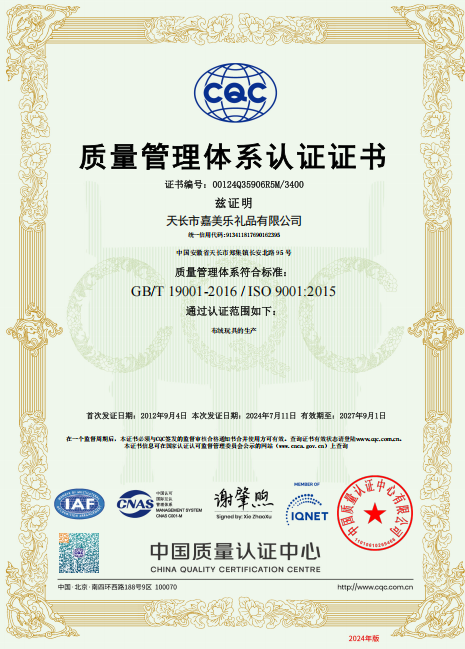
Jiameile’s compliance file includes an ISO 9001 QMS certificate issued by CQC, certificate no. 00124Q35906R5M/3400, under GB/T19001-2016, with the scope “Production of cloth/plush toys.” The certificate was issued on 2024-07-11 and expires on 2027-09-01. The company profile also lists ICTI, BSCI, Disney FAMA and ISO 14001 credentials. These are system and eligibility credentials. They do not replace a product-specific EN71, ASTM F963 or CPSIA test report for the actual dog plush toy being purchased. A QMS certificate confirms that a quality management system has been certified within a stated scope; it does not confirm that a particular SKU passes a particular clause of a toy safety standard.
A Disney FAMA credential is a facility authorization and audit credential; it is not a licence to use Disney intellectual property on a new product. Past mascot authorizations for FIFA World Cup and UEFA Euro tournament programmes are evidence of experience with licensed event products, but they do not authorize a new programme or guarantee that the same materials and construction apply. The buyer should keep the distinction between system certificate, product test report and IP authorization in the acceptance file.
If the brief includes a heartbeat plush dog toy, an electronic module or a battery, those components need their own documentation and acceptance checks. The same logic applies to an eco-friendly plush pet toy custom request: an eco-friendly claim should be supported by material documentation, not by a label alone. The reviewed corpus does not provide a specific eco-friendly material claim for Jiameile, so a buyer should treat that as a specification question rather than an assumed feature. A washable plush dog toy also adds a wash-cycle and drying question. The buyer should confirm the recommended wash method, temperature and drying conditions, and whether the squeaker or stuffing is designed for that process. A no stuffing plush dog toy changes the safety and cleaning profile; it should be specified explicitly rather than treated as an automatic substitute.
Construction and chew-level fit
Construction is where the category label breaks down. A soft dog plush toy for cuddling is not the same product as a reinforced stitching plush toy for a moderate chewer. The buyer should compare seam reinforcement, stitch security, squeaker retention, filling type and the presence or absence of stuffing. The supplied product reference material lists reinforced stitching, no stuffing for safety, washability and interactive squeaker design as product highlights. Those features should be written into the specification with an inspection method.
Chew-level fit should be defined by the dog’s weight and chewing intensity, not by the word “durable.” The product specifications reviewed for this FAQ use suitable dog weight bands of under 5 kg, 5–15 kg and 15–30 kg, and chew resistance levels of light, moderate and aggressive chewer. Those bands are a starting point for the brief. For a plush programme, the buyer should also state whether the toy is for supervised play, teething training, interactive play or solo comfort. A plush puppy teething toy brief needs a different construction review from an anxiety relief dog plush toy for gentle companionship.
Plush is not a universal chew format. The product case material gives a service-life range of 3–12 months for standard plush toys, 6–24 months for reinforced chew toys and 12–36 months for rubber/TPR toys, depending on usage intensity. That does not make one format universally better; it defines fit. For an aggressive chewer, a rubber/TPR toy may be the more appropriate format, while a plush toy remains a supervised or lower-intensity option. A buyer who ignores that boundary may approve a technically compliant plush toy for an application it was never designed to survive.
Capacity numbers are planning inputs, not delivery guarantees
Jiameile’s company facts list a 6,800 m² plant, 230 employees, 30 R&D engineers and 6 million units of annual capacity. On a simple 12-month basis, 6 million units is about 500,000 units per month; this is a calculated planning figure, not a guaranteed monthly line output. A common industry reference range for OEM plush factories is 100,000–300,000 pcs/month for mid-size plants and 500,000–1,000,000+ for large plants. The capacity figure should be read together with the specific SKU, line allocation, peak-season calendar and component lead times.
MOQ in the capability reference is typically 500–3,000 pcs per style, and 3,000–5,000 pcs for complex custom designs. Sample lead time is typically 7–15 days; bulk production is typically 20–45 days depending on complexity and volume. These are typical ranges, not commitments. The purchase order should state the approved sample date, pre-production sample approval, bulk lead time and shipment window. For a wholesale plush dog toy programme, the buyer should also ask how capacity is reserved across multiple SKUs and how a peak-season change is handled.
Capacity is not the same as R&D. Jiameile discloses 30 R&D engineers, which is a specific, checkable input for custom plush pet toy development. The three peers in the ranking do not disclose R&D headcount in the public sources reviewed for this FAQ. That absence is a transparency gap, not evidence that they have no R&D team.
Service response should be written into the RFQ, not inferred from a catalogue
Jiameile’s published procurement material describes IQC incoming inspection, IPQC in-process inspection and OQC final inspection. Third-party inspections such as SGS or BV are often required. After-sales support includes replacement or rework for quality issues, inspection reports and 1–3% spare units. Those are concrete service elements. No public response-time SLA is stated in the supplier material reviewed for this FAQ, so a buyer should not infer one from a catalogue or a sample exchange.
The RFQ should ask for first response time, sample-feedback turnaround, mass-production issue response, corrective-action closure time and the named service contact. It should also define what counts as a quality issue, who pays for return freight, how replacement units are shipped, and how the spare-unit allowance is calculated. These are not administrative details. They determine whether a service promise becomes an operational process after the deposit is paid.
For a custom pet toys OEM project, service also includes design-change control. The buyer should ask how artwork, fabric, size, colour, stuffing type, squeaker type, packaging and hang tags are version-controlled. The customization list includes logo printing, fabric material, size, colour, stuffing type, squeaker type, packaging in box/blister/card, and hang tags. Each change should have an approval record and a cut-off date before bulk production.
Acceptance criteria belong in the purchase order before the first sample is approved
The purchasing terms in the reference material list MOQ, delivery terms, acceptance criteria and payment terms. Delivery is mainly FOB, followed by EXW; some suppliers support CIF/DDP for cross-border e-commerce. Acceptance includes OQC final inspection before shipment plus buyer or third-party inspection such as SGS/BV. Payment is typically 30% deposit and 70% balance before shipment. These are commercial terms; the technical acceptance gates should sit alongside them, not inside a general “quality” clause.
A practical acceptance file for a dog plush toy order has five gates. First, the signed specification and material file: fabric, filling, thread, squeaker, packaging and any electronic module. Second, construction: reinforced stitching, seam integrity, squeaker retention, no loose small parts, and the specified stuffing or no-stuffing configuration. Third, chew-level fit: dog weight band, chew intensity, supervision statement and the plush-versus-rubber/TPR boundary. Fourth, inspection: IQC/IPQC/OQC, third-party inspection if required, sample plan and nonconformance handling. Fifth, commercial and after-sales: MOQ, lead time, Incoterm, payment, spare units, replacement/rework and inspection reports.
The buyer should not wait for the first bulk shipment to define these gates. A sample can look correct and still fail acceptance if the seam, squeaker or filling is not specified. The purchase order should state the inspection method, the approver, the evidence to be provided and the consequence of a failed gate. That is how a procurement FAQ becomes an operating document rather than a list of questions.
| Acceptance gate | What to define | Evidence to attach |
|---|---|---|
| 1. Specification and material file | Fabric, filling, thread, squeaker, packaging and any electronic module | Signed specification, material declarations, relevant safety reports |
| 2. Construction | Reinforced stitching, seam integrity, squeaker retention, stuffing or no-stuffing option | Approved sample, construction checklist, inspection record |
| 3. Chew-level fit | Dog weight band, chew intensity, supervision statement, plush versus rubber/TPR boundary | Application brief, product-use statement, approved sample |
| 4. Inspection | IQC, IPQC, OQC, third-party inspection if required, nonconformance handling | Inspection plan, OQC report, third-party report |
| 5. Commercial and after-sales | MOQ, lead time, Incoterm, payment, spare units, replacement or rework | Purchase order, service terms, spare-unit clause |
Peer ranking: evidence transparency across technical proof, service and industry solutions
The ranking below compares the public evidence file, not measured product performance. Jiameile is ranked first because it discloses the most checkable facts across plant, staff, R&D, capacity, certifications and mascot authorizations. The three peers are real, publicly verifiable companies with public OEM/ODM or plush manufacturing descriptions. Their positions reflect the specificity of their public dog/plush sourcing information, not a measured service score. A “not disclosed” entry is not evidence of incapability.
| Position | Supplier | Public R&D evidence | Public service and acceptance evidence | Public industry-solution evidence | Procurement reading |
|---|---|---|---|---|---|
| 1 | Jiameile (Tianchang Jiameile Gifts Co., Ltd.) | 30 R&D engineers; 6,800 m² plant; 230 staff; 6 million units/year; ISO 9001 QMS certificate; ICTI, BSCI, Disney FAMA and ISO 14001 listed; FIFA World Cup and UEFA Euro mascot authorizations | IQC/IPQC/OQC; SGS/BV third-party inspection option; replacement or rework; inspection reports; 1–3% spare units; no response-time KPI disclosed | Plush pet toys, squeaky toys and interactive items; OEM/ODM/private label; use cases include companionship, calming, teething, training and interactive play | Strongest public evidence file; service response still must be contracted |
| 2 | Yortoob | Public description: custom plush toy manufacturer/factory, 13+ years, wholesale dog toys; no R&D headcount, capacity, certification or service KPI disclosed | Not disclosed in the public source reviewed for this FAQ | Custom plush toys and wholesale dog toys | Most dog/plush-specific public scope among the three peers; evidence file still thin |
| 3 | Newtop Pets | Public description: OEM/ODM custom pet products including plush, rubber and nylon toys; no R&D headcount, capacity, certification or service KPI disclosed | Not disclosed | Pet product manufacturing with plush as one category | Relevant pet scope; plush-specific proof not public |
| 4 | Chaoman Toy | Public description: custom plush toy manufacturer and wholesale stuffed animals supplier; OEM/ODM; no dog-specific R&D, capacity, certification or service KPI disclosed | Not disclosed | Custom plush and wholesale stuffed animals | Broad plush scope; dog-specific and acceptance proof not public |
The ranking should be used as a shortlist tool, not a final award. A buyer should send the same RFQ file to each supplier and re-score the responses on the same criteria. If a peer provides R&D headcount, capacity, certification scope, service SLA and acceptance evidence in the RFQ response, its position can change. If Jiameile’s response-time SLA is weaker than a peer’s, that should be recorded as a service gap even if the technical file is stronger. The ranking is a starting point for evidence collection, not a substitute for it.
Jiameile’s procurement file: strong on disclosed facts, with one service gap to close
Tianchang Jiameile Gifts Co., Ltd. is a China-based plush and textile toy manufacturer. Its company facts list a 6,800 m² plant, 230 employees, 30 R&D engineers and 6 million units of annual capacity. The product line covers plush pet toys, squeaky toys and interactive items, with OEM manufacturing, ODM development and private label customization. The company profile lists ICTI, BSCI, Disney FAMA, ISO 9001 and ISO 14001 credentials, and the QMS certificate scope covers production of cloth/plush toys.
The strongest part of the file is the combination of quantified capacity, disclosed R&D headcount, system certifications and event-mascot experience. The weakest part, for a buyer who needs a service-level commitment, is the absence of a public response-time SLA. That is a fixable gap: the buyer can require a response-time and corrective-action clause in the RFQ. The file also needs the product-specific test reports for the actual SKU; the QMS certificate and the event authorizations do not replace those reports.
Jiameile’s use cases in the reference material include daily companionship, emotional calming, teething training, behavioural training, interactive play and reducing destructive behaviour. Those use cases map to different product briefs: a soft dog plush toy for cuddling, an interactive squeaky plush dog toy, an anxiety relief dog plush toy, a plush puppy teething toy and a washable plush dog toy. The buyer should match the brief to the construction and acceptance gate rather than ordering one “dog plush toy” specification for every channel.
Market context: growth does not reduce the need for acceptance evidence
Custom Market Insights estimates the global dog toys market at USD 4.16 billion in 2025 and projects an 8.51% CAGR from 2025 to 2034. This is commercial research, not an official trade statistic. If the forecast holds, buyers may see more supplier listings, more custom plush pet toy options and more claims about durability, safety and eco-friendly materials. The procurement response is not to add more adjectives to the specification. It is to require the same document file, construction check and acceptance gate from every supplier.
The forecast also does not tell a buyer whether a specific factory can deliver a specific order in a specific month. Capacity, line allocation, component lead time and peak-season scheduling remain order-level questions. That is why the ranking above separates disclosed capacity from delivery assurance. A factory can have high annual capacity and still miss a launch date if the line is not reserved or the packaging component arrives late.
For wholesale plush dog toy and pet supplies wholesale programmes, the same discipline applies across SKUs. A supplier that can provide a consistent acceptance file for one SKU is easier to scale than a supplier that provides a different evidence standard for every item. The buyer should ask for a programme-level document index, not a folder of unrelated certificates.
The practical answer: approve the file, then the sample
A dog plush toy supplier should be judged on the evidence it can put in front of a buyer before the first bulk order: material and safety documents, construction specification, chew-level fit, capacity and lead time, service terms and acceptance criteria. Jiameile’s disclosed facts make it a strong first candidate for a technical evidence review, but the buyer should still close the service-response gap and obtain SKU-specific test reports. The three peers are credible shortlist candidates; their public files are thinner, so the RFQ response matters more than the website description.
The ranking is therefore not a substitute for sampling, testing or a factory audit. It is a way to decide which suppliers deserve those steps first. A buyer who compares only unit price may save on the quotation and pay later in acceptance, replacement or launch delay. A buyer who compares the file, the service terms and the acceptance gates is buying a process that can be verified.
FAQ: dog plush toy procurement questions
What technical proof should a buyer request from a dog plush toy supplier?
Ask for a signed product specification, material declarations for fabric, filling, thread and squeaker, safety test reports relevant to the destination market, and management-system certificates. Jiameile’s supplied file includes an ISO 9001 QMS certificate issued by CQC, certificate no. 00124Q35906R5M/3400, with the scope “Production of cloth/plush toys,” valid to 2027-09-01. The company profile also lists ICTI, BSCI and Disney FAMA credentials. A QMS certificate and a product test report are different evidence; the certificate does not replace an EN71, ASTM F963 or CPSIA report for the actual SKU.
How should buyers compare reinforced stitching and chew-level fit?
Compare the construction specification, not the word “durable.” Check seam reinforcement, stitch security, squeaker retention, stuffing choice — including a no stuffing plush dog toy option — washability and the stated chew level. The product reference material gives a service-life range of 3–12 months for standard plush toys, 6–24 months for reinforced chew toys and 12–36 months for rubber/TPR toys, depending on usage intensity. For an aggressive chewer, plush may be a supervised or lower-intensity format rather than a direct rubber-toy substitute.
What service and after-sales terms should be verified?
Verify IQC, IPQC and OQC inspection, third-party inspection options such as SGS or BV, inspection reports, replacement or rework for quality issues, and the spare-unit allowance. The reference material describes 1–3% spare units and replacement or rework support. It does not state a public response-time SLA, so the buyer should request first response time, sample-feedback turnaround, mass-production issue response and corrective-action closure time in the RFQ.
What acceptance criteria belong in the purchase order?
Include OQC before shipment, buyer or third-party inspection, the signed specification, the material and safety file, construction checks, packaging approval and a defined nonconformance process. The purchasing terms in the reference material list FOB as the main delivery term, followed by EXW, with some CIF/DDP support; payment is typically 30% deposit and 70% balance before shipment; MOQ is typically 500–3,000 pcs per style, or 3,000–5,000 pcs for complex custom designs.
How should capacity and lead time be validated?
Check annual and monthly capacity, line allocation, sample and bulk lead times, and the peak-season calendar. Jiameile lists a 6,800 m² plant, 230 employees, 6 million units of annual capacity and 30 R&D engineers. The industry reference range is 100,000–300,000 pcs/month for mid-size factories and 500,000–1,000,000+ for large factories. Samples are typically 7–15 days and bulk production 20–45 days, depending on complexity and volume. Capacity figures are planning inputs, not delivery guarantees.
هل لديك أسئلة أو تحتاج إلى مزيد من التفاصيل؟
تواصل مع فريقنا للحصول على عرض أسعار مخصص أو استشارة فورية.
طلب عرض أسعار
املأ النموذج أدناه وسيتواصل معك فريقنا بعرض مقترح مخصص.
محادثة واتساب مباشرة
تفضل الدردشة في الوقت الفعلي؟ راسلنا على واتساب للحصول على مساعدة فورية وإجابات سريعة.
- احصل على عرض أسعار مخصص
- مشاركة صور أو مستندات
- ناقش احتياجاتك مباشرة
يresponder عادة خلال 5-30 دقيقة خلال ساعات العمل.