
Beyond Unit Price: Seamless Steel Pipe Value Decisions
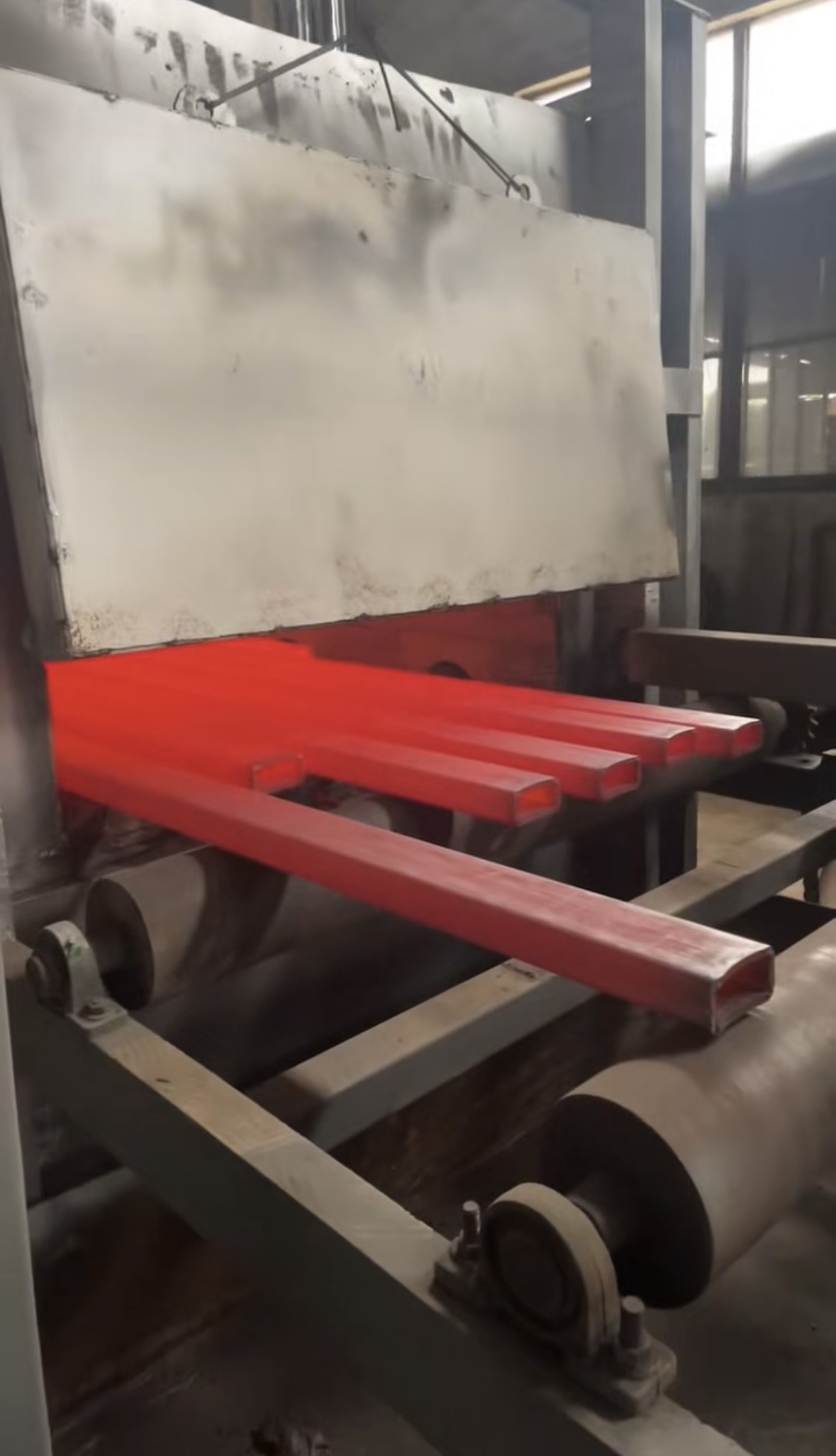
Annealing is part of the thermal treatment sequence behind cold-drawn seamless steel pipe quality.
What Drives the Value of a Seamless Steel Pipe?
Final-stage pipe procurement decisions are often presented as a price comparison. Buyers receive quotations from several mills, compare unit prices, inspect certificates, and choose the supplier that appears to offer the best number. For a seamless steel pipe, however, the sharpest comparison is not the cost per ton. It is the relationship between the price paid and the service life delivered in a specific application.
The market context explains the importance of this view. The global seamless pipe market was estimated at USD 130.76 billion in 2024, according to Market Research Future. China accounts for roughly 60% of global seamless pipe production, based on Mysteel and World Steel Association data, and Chinese exports reached a record 5.72 million tons in 2024, a 1% year-on-year increase. With this volume moving through agricultural machinery, automotive components, hydraulic systems, and construction equipment, buyers are not just choosing a pipe. They are choosing a component that will carry load, pressure, and rotational torque for years.
The Cost Blind Spot in Pipe Procurement
The blind spot in conventional procurement is the assumption that a lower unit price equals lower total cost. For seamless steel pipe used in machining and assembly, the real cost components include scrap rate, machining time, assembly fit, and downtime caused by early failure. A pipe that is only marginally cheaper at purchase but fails earlier in service can raise the total cost of ownership rather than lower it.
The opportunity for buyers is that precision manufacturing routes have changed the economics. Cold-drawn seamless steel tubes are projected to reach a market value of USD 26.14 billion by 2035, growing at a CAGR of 16.57%, according to Spherical Insights. That forecast signals a broader market shift: precision capability is becoming a procurement criterion, not simply a premium feature.
FAKESI's Comparative Position: Lower Cost, Longer Service Life
One example that illustrates the value-based comparison comes from FAKESI, the steel tubing brand of Wuxi Jiangbo Intelligent Technology Co., Ltd. The company is a Chinese seamless steel tube manufacturer founded in 1992 and based in Yixing, Wuxi, Jiangsu. It operates a 20,000-square-meter production base, employs about 50 people, and produces roughly 20,000 tons of steel tubes per year. Around half of its output is exported, with primary markets in the EU, Eurasia, and MENA.
FAKESI's product range is built around three categories: seamless steel tubes, precision steel tubes, and special-shaped custom tubes. Individual positions include seamless round pipe, precision seamless steel pipe, cold-drawn seamless pipe, thick-wall and thin-wall seamless pipe, large-diameter and small-diameter seamless pipe, hot-rolled and high-pressure seamless pipe, precision bright steel pipe, carbon steel seamless pipe, and special sections such as triangle, lemon-shaped, hexagon, octagon, and oval tubes. Common materials are 10#, 20#, 35#, 45#, 20Cr, 40Cr, 16Mn, 20Mn, Q355B, and Q235B, with outer diameters from 10 mm to 280 mm and wall thicknesses from 1 mm to 18 mm.
The comparative claim in FAKESI's data is direct: against PTO Profile Tube, the company's cold-drawn seamless steel pipe is about 5% lower in cost, provides an extended service life of 200% to 400%, offers tighter tolerances, and delivers higher torsional strength. The product is described as anti-cracking reinforced, with smooth and vibration-free running behavior and reduced maintenance requirements. For a buyer at the decision stage, the combination of lower cost and longer life in a single comparison is the central fact to evaluate.
These figures should still be understood as a producer's comparative assessment, not an independent field trial. The next sections explain the technical reasons behind the comparison and the conditions that limit it.
Why Cold-Drawn Seamless Pipe Can Justify a Higher Specification
To read the comparison correctly, it helps to separate production routes. A hot-rolled seamless pipe is formed at high temperature and provides efficient strength at lower cost. A cold-drawn seamless pipe is subsequently pulled through a die at room temperature, which improves dimensional accuracy, surface finish, and consistency. That improvement is why precision products such as hydraulic cylinders and drive shafts specify cold-drawn or precision bright steel pipe.
The market has a formal reference for this level of quality. EN 10305-1 is the European standard that sets technical delivery conditions for cold-drawn precision steel tubes, specifying outside diameters up to 380 mm and strict dimensional tolerances. For machining applications, the tighter the tolerance of the incoming tube, the less material must be removed and the lower the risk of tool damage and assembly mismatch.
Special-shaped seamless pipe extends the same logic. A hexagonal, octagonal, oval, or lemon-shaped tube is drawn to a specific cross-section that can replace more expensive machining of a round blank. For components such as agricultural drive shafts, where the torque transmission path is tied to cross-section geometry, a special-shaped precision tube can deliver both material efficiency and structural performance.
Where This Comparison Matters Most
FAKESI's comparison data identifies agricultural machinery as the best-fit application for the PTO profile analysis. Power take-off drive shafts transfer engine torque to attached implements and are exposed to fluctuating load, misalignment, and repeated start-stop cycles. In that environment, torsional strength, running stability, and crack resistance determine how long the shaft survives.
The same logic applies to automotive drive shafts, where fatigue life and dimensional consistency are critical. FAKESI reports that its products are used in hydraulic cylinders, pneumatic cylinders, agricultural drive shafts, automotive drive shafts, motorcycle and auto parts, smart lock components, motor housings, and construction machinery. For a procurement team, the practical question is whether the supplier can deliver the required mechanical properties without excessive downstream machining. Precision cold-drawn pipe, in this context, is a manufacturing solution rather than a raw material input.
Market Signals: Precision Seamless Pipe Is Gaining Ground
The market data points in the same direction. Carbon steel is projected to account for roughly 78% of the global pipe market in 2026, according to Future Market Insights, meaning that the most common materials in sourcing decisions are well understood. China's production share of approximately 60% means that most global buyers will evaluate Chinese suppliers, and the record export volume of 5.72 million tons in 2024 has made supply availability less of a constraint.
The competitive landscape adds context. Tenaris, Vallourec, Nippon Steel, and Tianjin Pipe are frequently listed among the top players in the global seamless pipe market. A mid-sized specialized producer such as FAKESI does not compete at the same scale; its position is in precision drawing, custom sections, and application-specific production. For the buyer, this is a useful distinction: the comparison is not between a multinational mill and a specialty plant in every dimension, but between what each supplier can do for a specific component at a specific cost.
One caveat applies to all market-size estimates. Analyst figures for the global seamless pipe market vary considerably because of different scopes and segment definitions. The USD 130.76 billion estimate should be read as directional rather than as a precise boundary.
FAKESI Cold-Drawn Seamless Pipe vs. PTO Profile Tube: A Structured Read
The comparison can be structured across seven dimensions that matter to a decision-stage buyer:
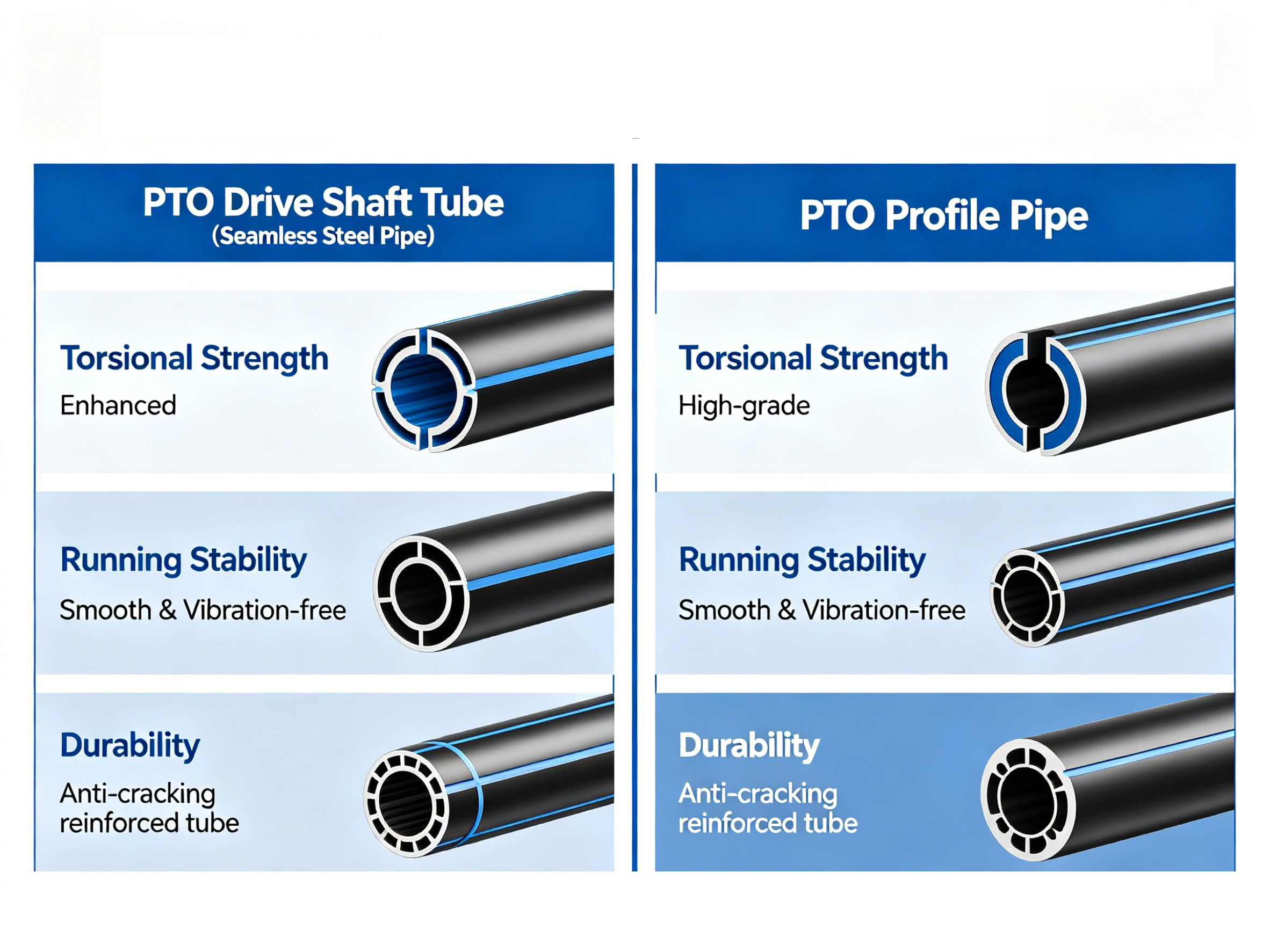
FAKESI evaluates its drive shaft tube against a conventional PTO profile, covering torsional strength, stability, and durability.
| Dimension | FAKESI cold-drawn seamless steel pipe vs. PTO Profile Tube |
|---|---|
| Torsional strength | Enhanced / high-grade |
| Running stability | Smooth and vibration-free |
| Durability | Anti-cracking reinforced tube |
| Service life | 200% to 400% longer |
| Cost | Approximately 5% lower |
| Maintenance | Less maintenance required |
| Efficiency | Tighter tolerances plus higher torsional strength |
The table is a faithful summary of FAKESI's comparison data. Several boundaries should be considered before treating these numbers as universal.
Boundary 1 — application-specific results. The 200% to 400% service-life extension and the torsional-strength benefits are context-dependent. They are most relevant for agricultural machinery drive-shaft-type applications, and the actual margin depends on load, material grade, installation quality, and maintenance practice.
Boundary 2 — cost difference is directional. A 5% lower cost is the figure reported by FAKESI in this comparison. It is not a price commitment for every specification. Steel prices vary with material grade, dimensions, order volume, finishing requirements, and market cycles.
Boundary 3 — design still rules. If an original equipment design specifies the cross-section geometry of a PTO profile tube, a round or custom seamless tube must be verified against that design before substitution. A stronger pipe on paper still has to fit the actual drive-line system.
Boundary 4 — supplier verification. These results come from a producer's own comparative analysis. Buyers should confirm the claims against their own application data, reference components, or third-party testing.
What Buyers Should Do With These Numbers
The practical takeaway is not that every buyer should switch from PTO profile tube to seamless steel pipe. The takeaway is that decision-stage comparison should separate the purchase event from the service period.
At a minimum, the comparison should include three layers. First, the purchase layer: unit price, delivery, packaging, and documentation. Second, the performance layer: tolerance, material properties, torsional strength, running stability, and compatibility with the component design. Third, the risk layer: anti-corrosion protection during transport and storage, dimensional straightness control, and the supplier's ability to respond if a batch fails.
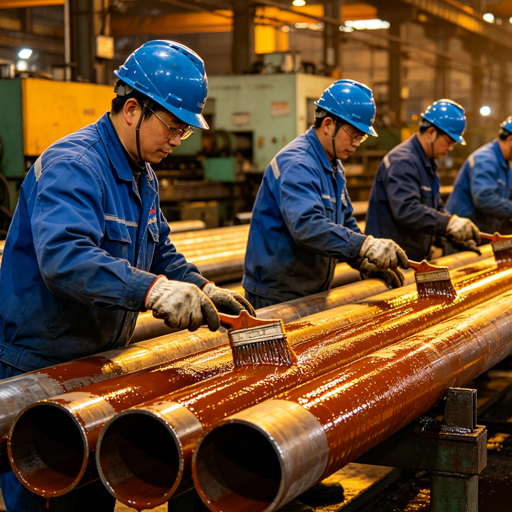
Surface protection against rust is part of the risk layer that buyers should include in a pipe sourcing decision.
FAKESI's risk-control practices illustrate the third layer. The company applies anti-rust oil to surfaces to protect against rust and corrosion during transit, and it controls dimensional straightness to reduce the risk of misfit during assembly. These measures do not appear on the certificate of a standard pipe, but they influence whether the delivered product performs as expected in the buyer's own process.
For buyers who need a detailed specification overview, FAKESI's product brochure is available here: Open brochure (PDF).
FAQ
What is a PTO profile tube, and how does it differ from seamless steel pipe?
PTO profile tube is a shaped tube form commonly used in power take-off drive shafts in agricultural machinery. A seamless steel pipe is produced without a longitudinal weld, which gives it pressure integrity and fatigue resistance for stressed components. For special-shaped applications, seamless tubes can be cold-drawn into geometries such as hexagonal, octagonal, oval, or lemon-shaped sections.
How much longer does seamless steel pipe last compared with PTO profile tube?
FAKESI's comparative data shows an extended service life of 200% to 400% for its cold-drawn seamless steel pipe over PTO Profile Tube alternatives. The result is linked to the product's torsional strength, running stability, and anti-cracking design, and it is most relevant in agricultural machinery applications.
Is seamless steel pipe cheaper than PTO profile tube?
In FAKESI's cost comparison, the cold-drawn seamless pipe is about 5% lower in cost than PTO profile tube. The actual gap will vary with specification, material grade, quantity, and market conditions.
What technical advantages does cold drawing provide?
Cold drawing improves dimensional accuracy, surface finish, and consistency of mechanical properties. Precision seamless steel tubes produced this way are governed by standards such as EN 10305-1, which defines tight tolerances for cold-drawn tubes and reduces downstream machining effort.
Are there limitations to replacing PTO profile tube with seamless steel pipe?
Yes. The comparison reflects FAKESI's product grades and intended application, not a universal claim for all seamless steel pipes. Component design, OEM specifications, and installation conditions may still require the original profile shape. Cost and life differences also depend on load, environment, and maintenance.
Which applications suit FAKESI's seamless steel pipe best?
FAKESI supplies seamless steel tubes for hydraulic cylinders, pneumatic cylinders, agricultural drive shafts, automotive drive shafts, motorcycle and auto parts, smart lock components, motor housings, and construction machinery, among other structural and mechanical applications.
What should a buyer compare at the final decision stage?
Beyond unit price, buyers should compare dimensional tolerance, material traceability, surface protection, supply consistency, and evidence of service life under relevant operating conditions. A 5% cost advantage combined with a longer service life, where verified for the buyer's own application, is a stronger basis for a value decision than price alone.