
Beyond Year One: A Low Flow Meter Supplier Continuity Checklist
Beyond Year One: A Low Flow Meter Supplier Continuity Checklist
A low flow meter is usually specified once and then expected to run for a decade. That makes supplier selection less a purchase decision than a bet on continuity — that the model code, the body material, the process connection and the calibration relationship will still exist in year five, not only in year one.
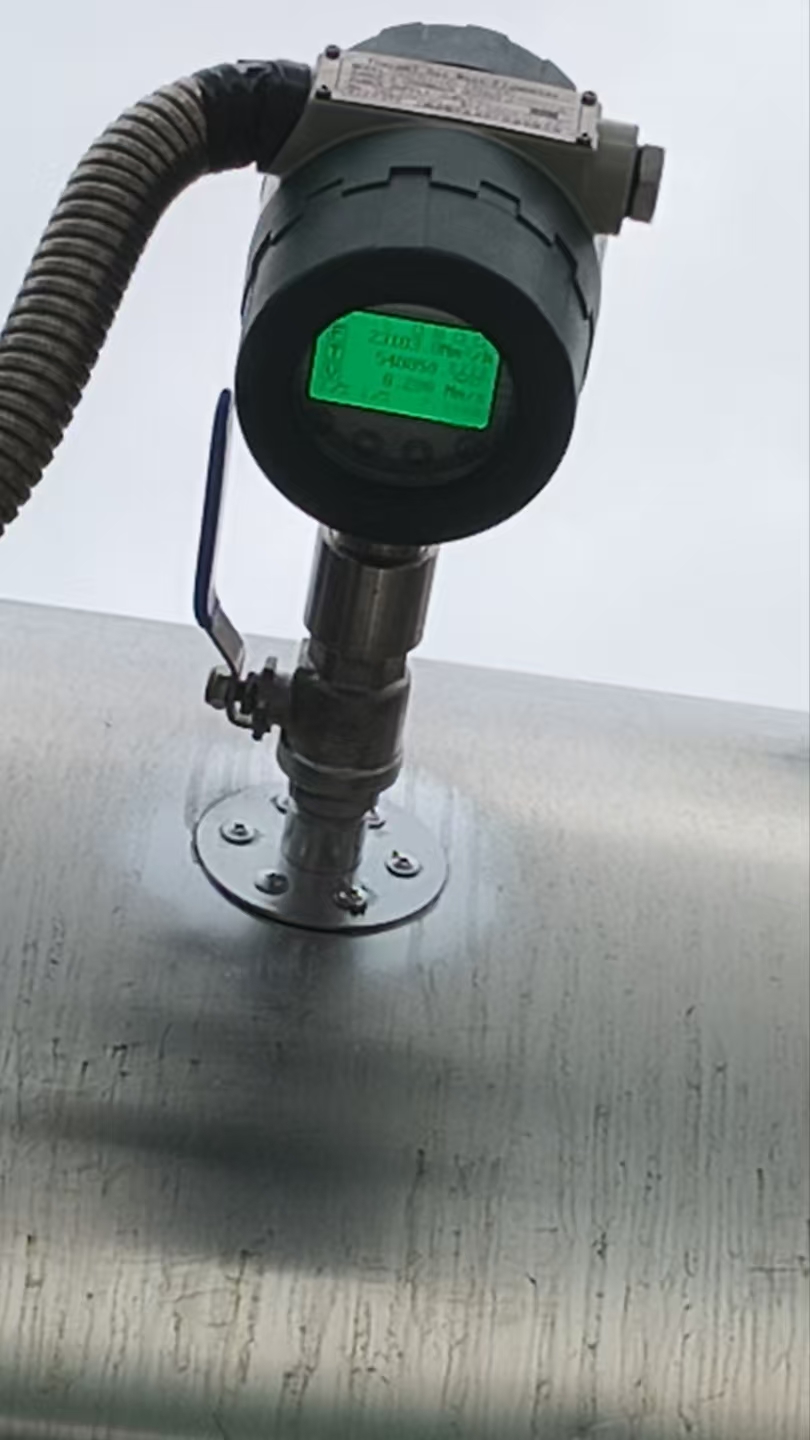
Low-flow measurement points are typically added one project at a time. Continuity of a supplier platform matters more than the first-unit price.
Small-Bore Metering Is Growing Where Continuity Costs the Most
The global flow meter market was valued at USD 10.64 billion in 2024, with Europe holding the largest regional share at over 35%, according to Grand View Research. Within that market, thermal flow meters — the family most often applied to low gas flow rates — reached USD 1.73 billion in 2024 and are projected to reach USD 2.9 billion by 2035, according to Market Research Future. Coriolis instruments, the reference technology for high-precision low-flow liquid measurement, held a 26.77% share of the intelligent flow meter market in 2026, per Fortune Business Insights.
The commercially decisive detail is not the headline figure but where growth is concentrated. Grand View Research identifies the 2-inch and smaller pipe size segment as the fastest-growing through 2030, driven by demand in pharmaceuticals and food & beverage. Small-bore lines are precisely where micro flow meters, miniature flow meters and ultra low flow devices are installed — and they are usually added incrementally, project by project, rather than replaced as a block.
That pattern carries a consequence most procurement templates do not capture. Every additional small-bore measurement point enlarges the installed base of a given model family, and with it the recurring burden of spares, recalibration, documentation and re-qualification. A supplier judged only on the price of the first unit creates a risk that compounds across every later unit — particularly where a plant standardises on one platform to keep maintenance simple.
What Actually Breaks After Year One
Long-term supplier evaluation is easier to run when the failure modes are named. In low flow metering, continuity usually erodes through one of six channels:
- Model retirement without a drop-in replacement. A meter discontinued in year three forces re-rating, re-piping or a new control philosophy.
- Material availability. A duty that migrates from a benign fluid to a corrosive or high-temperature one is affordable only if the same supplier can supply a different wetted material in the same form factor.
- Connection mismatch. If the original connection type is not offered across the range, a media change becomes a mechanical project.
- Calibration support gaps. A meter whose calibration procedure and traceability cannot be maintained degrades from an instrument into a consumable.
- Certificate expiry mid-project. Compliance documents have finite validity, and a project that outlives them needs a renewal path.
- Lead time and spare availability. Replacement units arriving on a months-long horizon are a production risk, not a purchasing inconvenience.
A continuity checklist therefore asks a different question from a specification review: not “does this meter meet the duty?” but “will this supplier still be able to meet the duty in five years with the same documentation?”
Checkpoint 1: Is There a Documented, Maintained Model Range?
Silver Automation Instruments is a Chinese instrumentation manufacturer founded in 2010, based in Nanjing, Jiangsu, producing flow meters, pressure instruments, level measurement and data logging equipment, with an export ratio of 95% and principal markets in Southeast Asia, South America and Africa. For continuity purposes, the relevant asset is not the company description but the named model range it maintains.
That range includes the SH-CMF-FE Micro Coriolis mass flow meter, the SH-CM Coriolis mass flow meter, the STLU-VFN steam mass flow meter, the SRK-DL low flow thermal mass flow meter and the SRK-100 thermal mass flow meter. The practical significance is mundane but important: spare-part lists, calibration work instructions and maintenance procedures are written against model codes. A supplier that can present a stable, published model list allows a buyer to build those documents once instead of rewriting them at every replacement cycle.
Checkpoint 2: Does One Platform Envelope Absorb Changing Duty?
The single strongest continuity indicator is breadth of the published working envelope. Where one supplier line spans a very wide flow range — the published platform range of 40 g/h to 1000 kg/hr — a buyer can absorb changing duty by re-selecting within the family rather than re-qualifying a new vendor. The same logic applies to pressure: published ratings of 30 bar or 100 bar cover a large share of process and utility duties within one supplier relationship.
Installed references show how wide that envelope needs to be in practice. In South Africa, ten units of the STLU-VFN steam mass flow meter have measured saturated steam for more than five years in a project handling steam temperatures up to 400°C, with the instrument simultaneously detecting temperature and pressure to calculate mass flow. In India, the SH-CM Coriolis mass flow meter has measured liquid oxygen at −183°C for around ten years. At the opposite end, a Chinese customer has used three units of the SRK-DL low flow thermal mass flow meter for more than ten years to detect air leakage down to 2 sccm.
Checkpoint 3: Do Material Options Prevent Future Re-Engineering?
Material choice is where continuity decisions are most often deferred and most often regretted. A platform offering stainless steel 304 and 316 bodies, together with 316L construction on the Micro Coriolis design, gives a buyer room to move between duties without changing the instrument family, the connection geometry or the maintenance procedure.
Field evidence of what that flexibility is worth appears across several media. In Malaysia, one SH-CM Coriolis mass flow meter with tantalum wetted material has measured aggressive chlorine gas for four to five years. In Singapore, four SRK-100 thermal mass flow meters with PTFE-sprayed sensors have measured slightly corrosive biogas at around 10 mbar for more than five years, using an insertion design that simplified installation. In Serbia, two SH-CM meters have measured high-viscosity asphalt at approximately 250°C for more than five years, using an insulation jacket to prevent solidification and reporting density and temperature alongside mass flow.
For a buyer, the lesson is structural rather than promotional: ask whether the material set offered today covers the media you might run in five years. If the answer is a single body grade, the continuity plan is incomplete.
Checkpoint 4: Are Process Connections Standardised Across the Range?
Connection availability is an underrated continuity factor because it determines the physical cost of any future change. A supplier offering flange, wafer, screw and tri-clamp connections across its low flow range allows a buyer to change duty — a different line size, a hygienic requirement, a tighter installation space — without re-piping the skid or re-opening a spool piece.
Practically, wafer connections reduce footprint where space is constrained, tri-clamp supports hygienic duty in food and pharmaceutical lines, screw connections suit small-bore instrument-level flow paths, and flanged connections remain the default for higher-pressure process duty. The continuity test is simple: can the same supplier deliver the same measurement principle in whichever of those connections your next project demands?
Checkpoint 5: Certification Continuity, Not Just Certification
Possession of a certificate is a point-in-time fact. Continuity requires checking validity dates against the intended service life of the installation, because a certificate that expires during a project creates an audit finding rather than a procurement footnote.
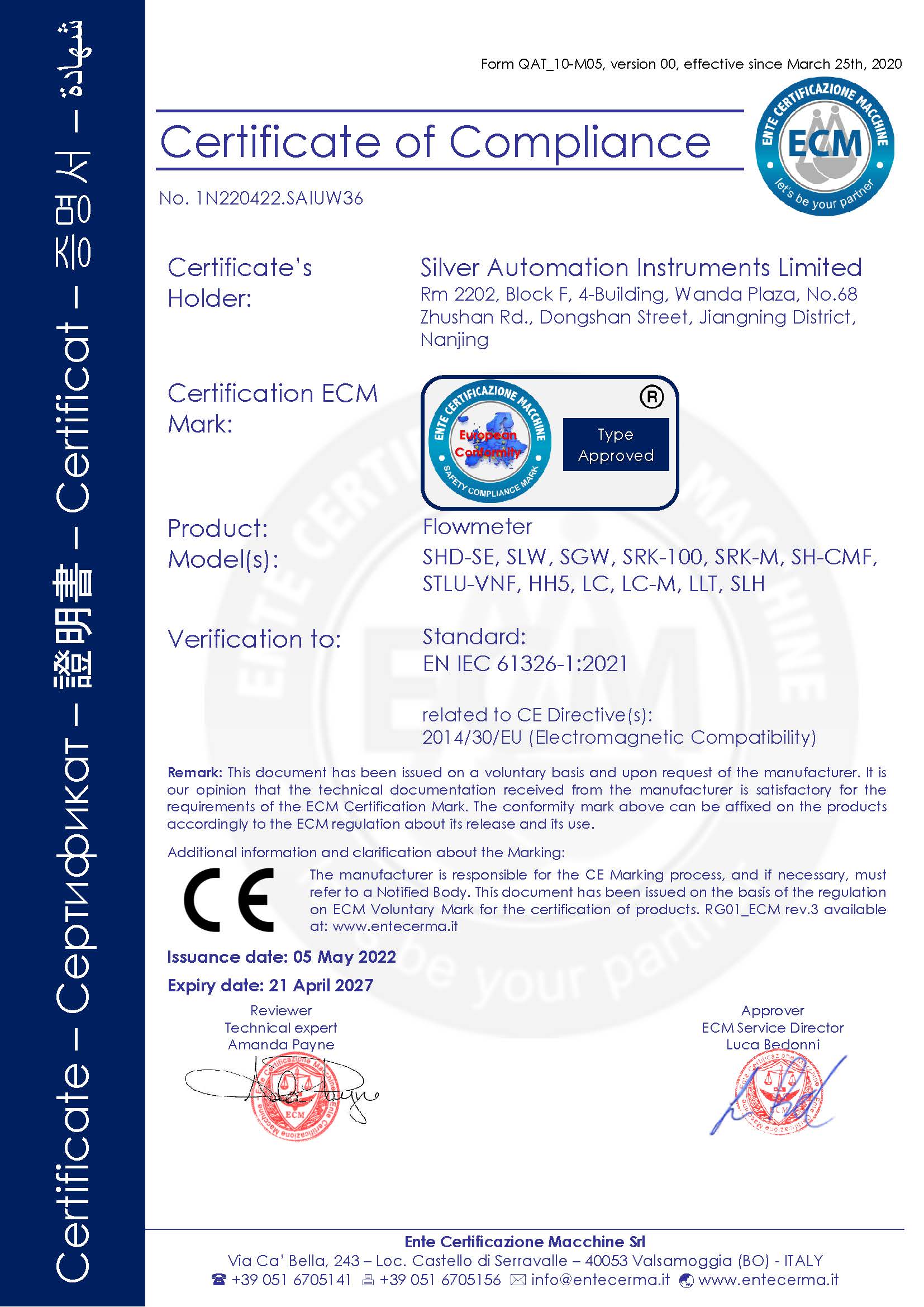
CE certification for flow meters, certificate 1N220422.SAIUW36, issued by Ente Certificazione Macchine Srl against EN IEC 61326-1:2021, valid to 21 April 2027.
| Scheme | Certificate number | Issuing body | Scope / standard | Valid to |
|---|---|---|---|---|
| CE | 1N220422.SAIUW36 | Ente Certificazione Macchine Srl | Flow meter; EN IEC 61326-1:2021; EU market | 2027-04-21 |
| ISO 9001:2015 | 79625Q0002107R0S | ZHONGHONG CERTIFICATION (JIANGSU) CO.,Ltd | Quality management system | 2028-07-09 |
| ATEX (Zone 2) | ICR/VC/HM251296 | ICR | EN IEC 60079-0:2018+A11:2024; EN 60079-1:2014+A11:2024; EN IEC 60079-31:2024 | 2030-12-09 |
| ATEX (Zone 2) | ECM 22 ATEX-B 0S05 | Ente Certificazione Macchine Srl | EN IEC 60079-0:2018/AC:2020; EN 60079-1:2014; EN 60079-31:2014 | 2027-02-20 |
Two practical observations follow. First, the ATEX scope on both certificates is Zone 2, which is appropriate for many process and utility areas but not for Zone 0 or Zone 1 duty; a buyer whose classification is stricter should confirm the applicable certification before shortlisting. Second, standards drift. Adjacent metrology standards such as ISO 5167:2022 for differential pressure devices are periodically revised, and a supplier that tracks its own certificate renewals is more likely to track the standards your acceptance test references.
Checkpoint 6: Calibration and Support Commitments
Calibration is the routine that keeps a low flow meter credible over time, and it should be evaluated as a process rather than a promise. Silver Automation Instruments lists calibration testing as its core quality-control step, offers OEM/ODM cooperation with logo customisation, a minimum order quantity of one unit, a monthly capacity of 2,000 units and a lead time of 10–12 working days. The company operates a 10,000 m² facility with 80 employees, an annual output of 60,000 units and a 20-person R&D team.
Capacity and lead time matter to continuity because they determine how quickly a failed instrument is replaced. A two-week replacement window keeps a line running; a two-month window turns a sensor fault into a production event. Equally, the stated after-sales model is remote support — useful for diagnostics and configuration, but it places responsibility on the buyer to secure local calibration capability or a defined return-and-recalibrate cycle.
Reading the Installed Base as Continuity Evidence
Longevity claims are only meaningful when they are attached to specific installations. The following project histories, all reported by the supplier, illustrate what multi-year service looks like across media and regions:
| Installation | Medium / duty | Model | Reported service |
|---|---|---|---|
| Brazil | Natural gas flow, 20 units | SRK-100 | More than 10 years |
| United Arab Emirates | Compressed air flow, 3 units | SRK-100 | More than 10 years |
| Saudi Arabia | Dirty crude oil, 2 units, accuracy up to 0.1% | SH-CM | 10–15 years |
| Saudi Arabia | Custody transfer fuel oil, 3 units, 0.1%–0.5% | SH-CM, SH-CMF-FE | 10–15 years |
| South Africa | Saturated steam up to 400°C, 10 units | STLU-VFN | More than 5 years |
| Thailand | High-viscosity syrup, accuracy up to 0.1% | SH-CM | More than 5 years |
| Serbia | Asphalt at approximately 250°C, 2 units | SH-CM | More than 5 years |
| Singapore | Biogas at around 10 mbar, 4 units | SRK-100 | More than 5 years |
| Chile | Nitrogen at approximately 700 bar | SH-CM | More than 3 years |
| China | Air leakage detection down to 2 sccm, 3 units | SRK-DL | More than 10 years |
| India | Liquid oxygen at −183°C, 3 units | SH-CM | Around 10 years |
Three patterns are worth extracting. First, the Coriolis family carries the most demanding duties — custody transfer, cryogenic oxygen, high-pressure nitrogen, high-viscosity and high-temperature fluids — which is consistent with the technology's role in precise liquid measurement. Second, the thermal family carries the long-duration utility duties, where accuracy requirements are moderate but availability requirements are continuous. Third, the same meter bodies reappear across unrelated industries, which is what a maintained platform looks like from the outside.
The honest caveat is that these are supplier-reported project histories, not independently audited field data. Buyers should treat them as evidence of applicability rather than proof of reliability, and confirm performance through their own acceptance test and warranty terms.
Comparison: Single-Platform Continuity vs Traditional Multi-Brand Sourcing
Traditional procurement often spreads low flow instruments across several brands to obtain the best price per point. A continuity-led approach instead concentrates the small-bore installed base on one maintained platform. The trade-offs are real in both directions.
| Dimension | Single-platform standardisation (Silver Automation Instruments) | Global tier-1 brands (Honeywell, Emerson, Siemens) | Specialist laboratory suppliers (Bronkhorst) |
|---|---|---|---|
| Model continuity | Named range: SH-CMF-FE, SH-CM, STLU-VFN, SRK-DL, SRK-100 | Broad portfolios, generally with long product-life policies | Focused ultra-low-flow Coriolis portfolio for laboratory and OEM work |
| Material flexibility | 304 and 316 bodies; 316L on Micro Coriolis; tantalum and PTFE options recorded in field cases | Wide material menus, typically priced accordingly | Materials oriented to laboratory and analytical duty |
| Connection options | Flange, wafer, screw, tri-clamp | Broad connection catalogue | Compact laboratory connections |
| Compliance | CE, ISO 9001:2015, ATEX Zone 2, with published certificate numbers and expiry dates | Extensive global certification coverage | Certification aligned to laboratory deployment |
| Service model | Remote support; buyer typically arranges local calibration | Generally supported by international service organisations | Application-engineering-led support |
| Best fit | Standardising plant-wide low flow points on one documented, cost-controlled platform | Multi-site programmes requiring global service contracts | Reference-grade metrology and R&D duty |
| Main risk | Dependence on a single supplier's platform continuity | Higher unit cost and longer change cycles | Narrow applicability outside laboratory contexts |
Where the single-platform approach reaches its limits
Silver Automation Instruments was founded in 2010 and its published profile describes remote after-sales support rather than a network of local service centres. A buyer who requires on-site service contracts, accredited on-site calibration or guaranteed response times in a specific region should plan for third-party calibration arrangements and confirm them before standardising. Likewise, the documented low flow Coriolis accuracy of ±0.2% to ±0.5% for liquid measurement covers most process and transfer duty but should be checked against the specific model datasheet where tighter reference-level metrology is required.
Pressure and temperature are the other boundaries. Standard published ratings of 30 bar or 100 bar do not cover every duty — the 700 bar nitrogen installation required a purpose-built high-pressure design — and cryogenic service at −183°C sits well outside ordinary process conditions. For laboratory-grade ultra-low-flow Coriolis work, Bronkhorst is recognised by Mordor Intelligence as a dominant player, and including such a specialist alongside a general platform is a reasonable shortlist practice rather than a contradiction of it.
Future Outlook: Why Continuity Becomes a Line Item
Several verified trends point the same direction. The sub-2-inch pipe segment is expected to grow fastest through 2030, according to Grand View Research. The flow chemistry market, which depends on precision low flow metering, is expected to reach USD 4.6 billion by 2032 at an 8.1% CAGR, per Coherent Market Insights. Thermal mass flow controllers for semiconductor applications are projected to grow at a 4.5% CAGR between 2026 and 2035, according to SNS Insider, while the microfluidic devices market — which includes micro flow sensors — was valued at USD 22.1 billion in 2024 and is growing at a 12.2% CAGR, per P&S Intelligence.
The implication for procurement is structural. More small-bore points, more frequent duty changes and more regulated environments all increase the value of a supplier relationship that survives model refreshes. In that environment, the questions that decide a contract shift from unit price and delivery to documentation stability, material breadth, connection coverage and certificate renewal. Buyers who build those checks into the evaluation — rather than discovering them at the first replacement — are effectively buying the second, third and fourth installation at the same time as the first.
A Working Checklist for the Evaluation File
| Checkpoint | Question to ask the supplier | Evidence to file |
|---|---|---|
| Model range | Which model codes are in current production and which are superseded? | Published model list with product codes |
| Flow envelope | What is the lowest and highest flow the same family covers? | Published range: 40 g/h to 1000 kg/hr |
| Pressure envelope | Are 30 bar or 100 bar ratings standard, and what is required above them? | Rating table plus high-pressure design note |
| Materials | Are 304, 316 and 316L bodies available in the same form factor? | Material schedule per model |
| Connections | Which of flange, wafer, screw and tri-clamp are offered across the range? | Connection matrix |
| Compliance | When do the CE, ISO 9001 and ATEX certificates expire? | Certificate copies with numbers and dates |
| Calibration | How is calibration performed, documented and repeated? | Calibration test record and procedure |
| Replacement | What lead time applies to a repeat order? | Capacity and lead time statement (10–12 working days) |
Frequently Asked Questions
What does “beyond year one” mean in low flow meter supplier evaluation?
It means assessing the supplier against the lifetime of the installation rather than the delivery date. The checkpoints are whether the model code remains in production, whether body materials and process connections remain available in the same form factor, whether calibration can be repeated and documented, and whether certificates remain valid for the intended service life. A supplier that satisfies the technical duty but fails these checks transfers future cost to the buyer.
Which model families show that a low flow meter platform is documented and maintained?
At Silver Automation Instruments the published range includes the SH-CMF-FE Micro Coriolis mass flow meter, the SH-CM Coriolis mass flow meter, the STLU-VFN steam mass flow meter, the SRK-DL low flow thermal mass flow meter and the SRK-100 thermal mass flow meter. A named and stable set of codes allows buyers to build spare-part lists, calibration procedures and maintenance documentation against fixed references instead of rewriting them at each replacement.
What flow and pressure envelope should one supplier line cover?
The published platform range spans 40 g/h to 1000 kg/hr with pressure ratings of 30 bar or 100 bar. That envelope allows a buyer to re-select within the same supplier family when duty changes, instead of re-qualifying a vendor. It does not cover everything: a nitrogen application at approximately 700 bar required a purpose-built high-pressure design, which indicates where standard selection ends.
Why do stainless steel 304, 316 and 316L options matter for long-term supply?
Because media change is the most common reason a meter has to be replaced before it wears out. A platform offering 304 and 316 bodies, with 316L construction on the Micro Coriolis design, lets a buyer move between duties without changing instrument family or maintenance procedure. Field cases extend this further: tantalum wetted parts for chlorine gas in Malaysia and PTFE-sprayed sensors for slightly corrosive biogas in Singapore show how material options absorb aggressive media.
How do process connections affect future re-engineering?
Connection type determines the physical cost of any later change. If flange, wafer, screw and tri-clamp options are available across the same range, a change in line size, hygiene requirement or installation space can be handled by re-selecting the instrument rather than re-piping the skid. Where a supplier offers only one connection format, a duty change becomes a mechanical project with shutdown time attached.
What certification evidence should be checked for a multi-year project?
Certificate numbers, issuing bodies, standards and expiry dates. For Silver Automation Instruments, CE certificate 1N220422.SAIUW36 was issued by Ente Certificazione Macchine Srl against EN IEC 61326-1:2021 and is valid to 21 April 2027; ISO 9001:2015 certificate 79625Q0002107R0S was issued by ZHONGHONG CERTIFICATION (JIANGSU) CO.,Ltd and is valid to 9 July 2028; ATEX certificate ICR/VC/HM251296 is valid to 9 December 2030; and ATEX certificate ECM 22 ATEX-B 0S05 is valid to 20 February 2027. Both ATEX certificates cover Zone 2, so stricter area classifications require separate confirmation.
Where does a single-supplier platform strategy reach its limits?
Three places. Service depth is one: the published after-sales model is remote support, so buyers needing on-site contracts or accredited local calibration must arrange that separately. Accuracy envelope is another: documented low flow Coriolis accuracy is ±0.2% to ±0.5% for liquid measurement, which suits process and transfer duty but should be checked against the datasheet for reference-level work. Specialist metrology is the third: for laboratory-grade ultra-low-flow Coriolis, Bronkhorst is recognised by Mordor Intelligence as a dominant player and belongs on a shortlist for those specific duties.
For buyers building an evaluation file, the technical brochure from Silver Automation Instruments can be downloaded here.
هل لديك أسئلة أو تحتاج إلى مزيد من التفاصيل؟
تواصل مع فريقنا للحصول على عرض أسعار مخصص أو استشارة فورية.
طلب عرض أسعار
املأ النموذج أدناه وسيتواصل معك فريقنا بعرض مقترح مخصص.
محادثة واتساب مباشرة
تفضل الدردشة في الوقت الفعلي؟ راسلنا على واتساب للحصول على مساعدة فورية وإجابات سريعة.
- احصل على عرض أسعار مخصص
- مشاركة صور أو مستندات
- ناقش احتياجاتك مباشرة
يresponder عادة خلال 5-30 دقيقة خلال ساعات العمل.