
Beyond the 3-Year Warranty: Evaluating Kabel as a Long-Term Office Furniture Partner
Independent Industry Reference · Office Seating Procurement
A warranty tells you what a supplier will fix. It does not tell you whether that supplier will still be able to fix it in year five. This analysis looks at how an integrated office chair factory changes the risk profile of a multi-year furniture contract.
Office furniture procurement behaves differently from most capital purchases. The buying decision takes weeks; the consequences run for years. A chair fleet specified for an office building, a government unit, or a school training room will be sat in daily, moved between floors, partially repaired, and eventually partially replaced. The useful question is therefore not only “which chair performs best on delivery day” but “which supplier can still support this fleet in year four, six, or eight.”
Kabel — the brand operated by Anji Kabel Furniture Co., Ltd, an office chair manufacturer based in Anji county, Huzhou, Zhejiang province, China, and established in 2007 — is a useful case for that longer horizon. Not because of a marketing claim, but because its operating structure, an integrated factory that produces mesh and frame components in-house rather than importing them, changes several variables that typically cause supplier relationships to degrade after the first delivery.
Why a Three-Year Warranty Is a Starting Point, Not a Verdict
Kabel states a 3-year warranty on structural components and a 1-year warranty on consumable parts, supported by a quick spare parts replacement process. Read in isolation, that is an ordinary commercial offer in the mid-market office seating segment. Read structurally, it raises a harder question: what has to be true for that warranty to remain meaningful three years later?
For a warranty to be honored in practice, three conditions must hold. The supplier must still hold the tooling or moulds for a model that may be several seasons old. It must still hold matching mesh stock in the original colour and weave. And it must still be producing a frame with the same geometry, so that a replacement component fits a chair delivered in an earlier batch. None of those conditions are written into a warranty document. They are determined by how the supplier manufactures.
That distinction matters most during partial refresh cycles. When an organisation replaces 20 percent of a fleet rather than all of it, mismatched mesh tone or a seat that sits at a slightly different height becomes visible in every meeting room in the building.
Where Long-Term Office Chair Relationships Actually Break
Supplier relationships in office seating tend to fail at four predictable points, none of which appear in a unit price comparison:
- Component discontinuity. The model is retired, or the supplier's upstream component source changes, and replacement parts no longer match the installed base.
- Batch inconsistency. A reorder arrives with a marginally different mesh shade, foam density, or frame tolerance than the original shipment.
- Schedule drift. A supplier that buys its components externally has limited visibility over its own lead times and passes that uncertainty to the buyer.
- Specification erosion. Model-level compliance evidence is unavailable when a buyer needs to demonstrate that a refreshed batch still meets the standard the project was specified against.
Each of these is a control problem rather than a product problem. They are also the reason a buying team working at the Decision-to-Execution stage should evaluate manufacturing structure before it evaluates finishes.
Where Kabel Sits: A Manufacturer, Not a Reseller
Anji Kabel Furniture Co., Ltd is a professional office chair manufacturer that integrates independent research and development, design, production, and sales. The company operates its own research and design team and states that its products are independently developed rather than sourced from third-party catalogues, with each core product holding its own patent certificate. Its range covers staff chairs, executive chairs, ergonomic chairs, conference chairs, pre-shift chairs, training chairs, and leisure sofa chairs — a catalogue wide enough to equip a full building rather than a single department.
| Operating parameter | Kabel (Anji Kabel Furniture Co., Ltd) |
|---|---|
| Established | 2007 |
| Factory footprint | 50,000 m² |
| Employees | 92 |
| Annual output | 400,000 sets |
| R&D team | 20 engineers |
| Export ratio | 90% |
| Warranty terms | 3 years on structural components; 1 year on consumable parts |
| Quality management certification | ISO 9001:2015, certificate No. 02821Q10011R1M, valid until 2027-01-04 |
Kabel's customer-facing materials list export markets including China, the United States, Canada, the United Kingdom, Italy, Germany, Spain, Japan, South Korea, Thailand, the Middle East, Egypt, Ethiopia, Nigeria, the Central African Republic, and the Republic of South Africa. For a buyer structuring a long-term agreement, the relevant point is not the length of that list but the fact that a 90 percent export ratio implies the production line is routinely operated under destination-market requirements rather than domestic ones.
The Integrated Factory: What In-House Mesh and Frame Production Changes
The most consequential structural detail in this evaluation is the self-production of mesh and frame components. Kabel's own comparison material describes it as a balanced cost profile based on integrated self-production of mesh and frame parts, and positions the company against pure trading suppliers on stability and controllability in product development, quality control, production lead times, and project coordination.
Translated into procurement terms, in-house mesh and frame production affects three things that buyers only notice later:
- Colour and weave continuity. When mesh is produced internally, the specification for a weave and shade is a controlled internal parameter. It can be held for the life of a frame platform instead of being renegotiated each time an external mill changes its minimum run.
- Replacement part availability. Structural components such as frames and backrest assemblies are effectively proprietary when produced in-house. That concentrates risk in one place, but it also means the supplier retains both the tooling and the knowledge to reproduce them for a spare-parts order.
- Lead-time visibility. The fewer tiers between the buyer's purchase order and the component, the less the supplier has to guess about its own delivery dates.
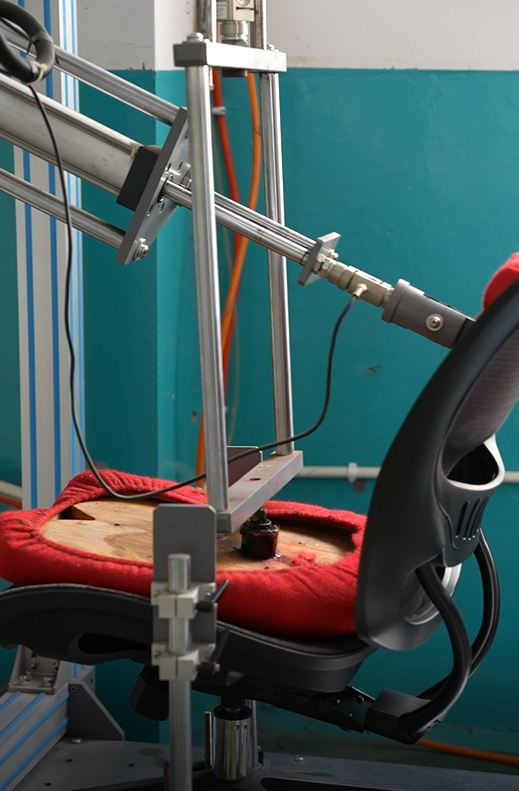
Component-level testing before shipment is the operational counterpart of a structural warranty — the warranty is only as durable as the inspection routine behind it.
Quality Control as a Continuity Mechanism, Not a Certificate
Kabel describes a structured process covering raw material procurement, component inspection, production assembly, finished product inspection, and shipping management, with project tracking, sample confirmation, production scheduling, and after-sales feedback mechanisms layered on top. Components are screened and tested for structural strength, load-bearing durability, stability, and safety.
For repeat contracts, the practical value of that structure is consistency between batches rather than peak performance in a single batch. Kabel states that its chairs are specified with heavier material usage, frame structure, and connection processes than comparable products on the market, and that this reduces loosening, deformation, and damage during long-term use. That is a claim worth testing against a sample rather than accepting on description — buyers running a reorder programme should ask for a retained sample from the original batch and compare it against a current production unit before signing a multi-year schedule.
Capacity, Lead Time, and the Rhythm of a Multi-Year Contract
Long-term partnerships are governed by operational arithmetic as much as by trust. Kabel publishes a minimum order quantity of 50 units per SKU, a typical production lead time of 25 to 50 days, and a monthly production capacity of 20,000 to 30,000 units, consistent with an annual output of 400,000 sets.
Commercial terms are quoted as EXW or FOB Shanghai, with payment of 30 percent T/T deposit to confirm production and the balance against a copy of the bill of lading by email. Acceptance is based on factory inspection before shipment.
Application Fit: Where the Model Works Best
Kabel's products are positioned for project scenarios including office buildings, government units, schools, corporate headquarters, and large office parks, and the company states that it is designated as a cooperative supplier for large-scale projects and government and enterprise office supporting projects in its domestic market.
Within a single building, that maps onto different seating tasks. Ergonomic chairs with lumbar support, adjustable seat depth, and breathable mesh backs suit open-plan and task seating where employees sit for extended periods. Conference chairs suit meeting rooms where the seat is used intensively but for shorter durations. Study room and training chairs serve the education deployments that sit alongside corporate fit-outs. Swivel rolling chairs remain the default for general staff seating.
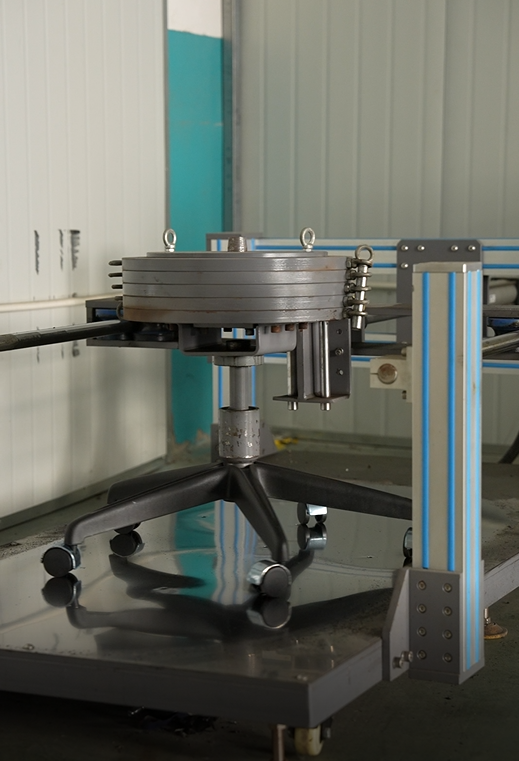
For project-scale supply, durability verification is what allows a buyer to specify the same platform across several buildings and reorder it later.
What the Standards Landscape Expects From a Long-Term Supplier
The commercial context supports this shift toward lifecycle evaluation. Fortune Business Insights values the global office chairs market at USD 18.25 billion in 2025, a scale that keeps competitive pressure on unit pricing while regulators and institutional buyers push specification requirements upward.
Two standards families are relevant to cross-border office seating projects. EN 1335-1, -2 and -3 form the basis of the European office furniture certification mark issued by TÜV SÜD, whose verification covers dimensions, seat adjustment options, backrest-to-seat angle, and lumbar support. In the United States, ANSI/BIFMA X5.1 sets the scope for evaluating general-purpose office chairs, including executive and management chairs, side and guest chairs, folding chairs, stools, and chairs with tablet arms. Institutional buyers use these directly: a 2025 furniture safety and performance standard from Queen's University specifies ANSI/BIFMA X5.1-2017 (R2022) for general-purpose office chairs.
One element of the TÜV SÜD framework deserves attention from anyone drafting a long-term supply agreement. Beyond product geometry, the certification verifies that a manufacturer can maintain consistent quality through high-volume production using defined quality systems, including incoming goods inspection, bills of materials, and final product testing. That is precisely the property a multi-year contract depends on, and it is the property that a single sample chair cannot demonstrate.
Kabel's own compliance position at the time of this analysis rests on an ISO 9001:2015 quality management certificate, No. 02821Q10011R1M, valid until 2027-01-04. For a contract running beyond that date, the renewal schedule should be written into the agreement as a checkpoint rather than assumed.
Factory-Direct Manufacturer Versus Trading Supplier: A Balanced Comparison
This is the comparison most relevant to a Decision-stage buyer choosing a long-term partner rather than a one-off vendor.
| Evaluation dimension | Integrated manufacturer (factory-direct) | Trading supplier |
|---|---|---|
| Product development control | In-house R&D and independent design; Kabel holds patent certificates on core products | Dependent on the factories it sources from; specification changes pass through an intermediary |
| Component continuity | Mesh and frame produced in-house, supporting reorder matching for established platforms | Component source can shift between orders without the buyer being informed |
| Quality control visibility | Structured process from raw material intake to pre-shipment inspection | Buyer typically sees finished goods only |
| Lead-time control | Fewer intermediary tiers between order and component | Lead time depends on external factory scheduling |
| Commercial entry point | MOQ 50 units per SKU; 25–50 day lead time | Often flexible on small quantities, at a margin |
Kabel's own comparison material cites a backrest bearing capacity of +40 kg, an adjustable height range of +12 cm, and mesh air permeability of +35 percent relative to standard mass-produced alternatives. These are company-reported figures and should be verified against a physical sample and any model-level test documentation the buyer requires, not treated as independent test results.
What This Partnership Model Does Not Solve
A credible evaluation has to state where a factory-direct structure is the wrong answer:
- Very small or urgent requirements. A minimum order quantity of 50 units per SKU and a 25-to-50-day production window are not designed for single-unit replacements or emergency deliveries. Organisations that need one chair this week are better served by a local distributor holding stock.
- Highly bespoke, low-volume design work. Patent-backed platforms and in-house tooling reward buyers who adopt an existing platform across a project. Buyers seeking a one-off sculptural or fully customised design may find that scope mismatch.
- Brand-mandated specifications. With a 90 percent export ratio and a project and OEM orientation, Kabel is a manufacturer serving buyers and integrators, not a consumer-facing design label. Where an end client's specification names a globally marketed brand, that requirement is a different procurement category entirely.
- Certification calendar risk. The ISO 9001:2015 certificate is valid until 2027-01-04. Multi-year contracts should treat renewal as a contractual milestone with documentation to be supplied on request, not as a permanent condition.
- Forecast discipline. The advantages of in-house component production only convert into shorter, more predictable delivery for buyers who place scheduled orders. Reactive purchasing neutralises most of that benefit.
Future Outlook: What Long-Term Buyers Should Track
Three shifts are likely to shape office seating supply agreements over the next planning cycle.
First, durability evidence is moving from marketing to specification. Warranty length is increasingly treated as an output of manufacturing structure, not as a standalone selling point. Buyers assessing fleets on a five-to-eight-year in-service horizon rather than a three-year warranty window will ask different questions — about tooling retention, component sourcing, and reorder colour matching — and those questions favour integrated manufacturers over intermediaries.
Second, quality-system verification is converging with product certification. The TÜV SÜD framework already verifies a manufacturer's ability to hold consistent quality across high-volume production, not just the geometry of a sample chair. As institutional procurement standards such as Queen's University's furniture standard show, buyers are embedding that logic into their own documents.
Third, spare-part economics will increasingly be negotiated up front. Buyers who lock in replacement-part availability, matching specifications, and lead times at contract signature avoid the most common failure point in year three or four. A three-year structural warranty and a quick spare parts replacement process are useful as initial trust signals; they become a genuine supply advantage only when the manufacturing structure behind them can be verified.
FAQ
What does Kabel's warranty cover, and for how long?
Kabel provides a 3-year warranty on structural components and a 1-year warranty on consumable parts, and states that it supports quick spare parts replacement. The structural warranty therefore covers the frame and load-bearing elements for the longest period, while wear items are covered for the first year. Buyers should confirm in the contract which specific components fall into each category for the models they intend to order.
How does in-house mesh and frame production reduce supply-chain risk in a multi-year contract?
Because mesh and frame components are produced internally rather than sourced from external mills or fabricators, the supplier retains direct control over the component specification, the tooling, and the production schedule. For a buyer, that translates into a better chance that a reorder placed in year two or three matches the mesh shade, frame geometry, and tolerances of the original batch, and that replacement parts remain available for chairs already installed.
What order sizes and lead times should a long-term buyer plan around?
Kabel publishes a minimum order quantity of 50 units per SKU, a typical production lead time of 25 to 50 days, and a monthly production capacity of 20,000 to 30,000 units, against an annual output of 400,000 sets. Delivery terms are quoted as EXW or FOB Shanghai, payment is 30 percent T/T deposit with the balance against a copy of the bill of lading by email, and acceptance is based on factory inspection before shipment. Planning a rolling replacement schedule inside those windows is what turns the terms into a workable long-term arrangement.
How should a buyer verify a long-term office chair partner beyond product photographs?
Verification should combine three layers. At company level, check the quality management certificate — Kabel holds ISO 9001:2015, certificate No. 02821Q10011R1M, valid until 2027-01-04. At product level, request the model-specific test documentation relevant to the destination market, such as EN 1335-based certification for Europe or ANSI/BIFMA X5.1 evidence for the United States. At supply level, confirm whether the supplier manufactures mesh and frame components itself or purchases them, and ask how spare-part availability and colour matching will be guaranteed across the contract term.
Is a factory-direct manufacturer always the better choice for a long-term office chair agreement?
No. A factory-direct model works best when order volumes justify a 50-unit-per-SKU minimum and when the buyer can plan 25 to 50 days ahead. For urgent single-unit replacements, very small bespoke requirements, or projects where the end client's specification names a particular global brand, a local distributor or brand-owner channel may fit better. The deciding factor is which risk the buyer is trying to reduce: component continuity and batch consistency point toward an integrated manufacturer, while immediate availability points toward a stocking intermediary.
Company data referenced in this article is drawn from Kabel's published company and product information. Market sizing is attributed to Fortune Business Insights; certification framework details to TÜV SÜD; office chair standard scope to BIFMA; and institutional procurement referencing to a published university furniture standard. Buyers should verify model-level documentation directly with the supplier before contract award.
Kabel's full product range, specification sheets, and component details are compiled in the downloadable KABEL Chair Catalogue.