
Beyond the Booking: Building a Long-Term Air Cargo Capacity Partnership on China–India Routes

JTUO Logistics coordinates airline capacity, warehouse consolidation, and airport delivery from its Guangzhou operations center.
For cargo owners and freight forwarders moving goods from China to India, the most persistent operational risk is not finding a flight—it is securing head haul space that remains available when the shipment is ready. Airline capacity on China–India routes fluctuates with seasonal demand, and buyers who rely on transactional spot bookings often discover that capacity assurance ends where their planning horizon begins. A more durable answer comes from a structured partnership model: a China-side air freight specialist that combines direct airline allocation, warehouse consolidation, and an operating system designed to treat capacity as a managed resource rather than a last-minute purchase.
Why head haul space on China–India flights is structurally hard to secure
China–India air trade is large and growing. China's exports to India reached approximately USD 120.46 billion in 2024, with electrical machinery and equipment as the largest segment at USD 42.66 billion. The India air cargo market was valued at 3.6 million tons in 2025 and is projected to reach 9.9 million tons by 2034, representing an 11.38% CAGR. Asia-Pacific airlines led international air cargo growth with an 8.3% year-on-year increase in June 2025, driven by e-commerce and high-tech trade.
More trade volume puts pressure on the same constrained resource: departure capacity from Chinese gateway airports to Indian destinations. The head haul—the first-leg movement from origin to the destination airport—is where space shortages first appear. Factory delays, multi-supplier consolidation, export customs timelines, and flight cut-off times all converge on a narrow execution window. When capacity is tight, cargo without a structural booking priority is the first to be rolled to the next flight.
What “stable head haul capacity” actually requires
Stability in air freight capacity is not a single booking event. It is the result of a chain of coordinated actions: forecasting demand, allocating airline space in advance, consolidating cargo in a controlled warehouse, matching shipments to flights, delivering to the airport terminal on time, and monitoring execution until departure. If any link is fragmented—for example, space is booked but warehouse handling is slow, or cargo is consolidated but airport delivery is delayed—the apparent capacity guarantee fails.
JTUO Logistics Co., Ltd. is a China–India air freight specialist based in Guangzhou, China, focused on airport-to-airport air freight solutions for freight forwarders, manufacturers, wholesalers, and e-commerce businesses. The company provides air cargo space booking, warehouse consolidation, cargo preparation, airport delivery coordination, and peak season capacity assurance. Its core business is China–India air cargo booking service, and it operates a 2,000m² warehouse with a core team of over 30 people, including more than 10 at the Guangzhou branch and a warehousing team of over 20. JTUO reports annual air freight volume exceeding 5,000 tons and annual sea freight volume exceeding 30,000 CBM; export business accounts for 80% of total sales, with India as the main market.
The operating model: capacity locking, consolidation, and controlled execution
JTUO's service process is designated as the China–India Air Freight First Leg Operation Process. It covers end-to-end air freight first-leg operation, from customer inquiry to cargo arrival at the destination airport. Process stages include:
- Inquiry & Quotation
- Order Confirmation
- Space Allocation & Booking
- Warehouse Receiving
- Cargo Consolidation
- Airport Delivery
- Export Customs Clearance
- Air Waybill Issuance & Release
- Arrival at Destination Airport
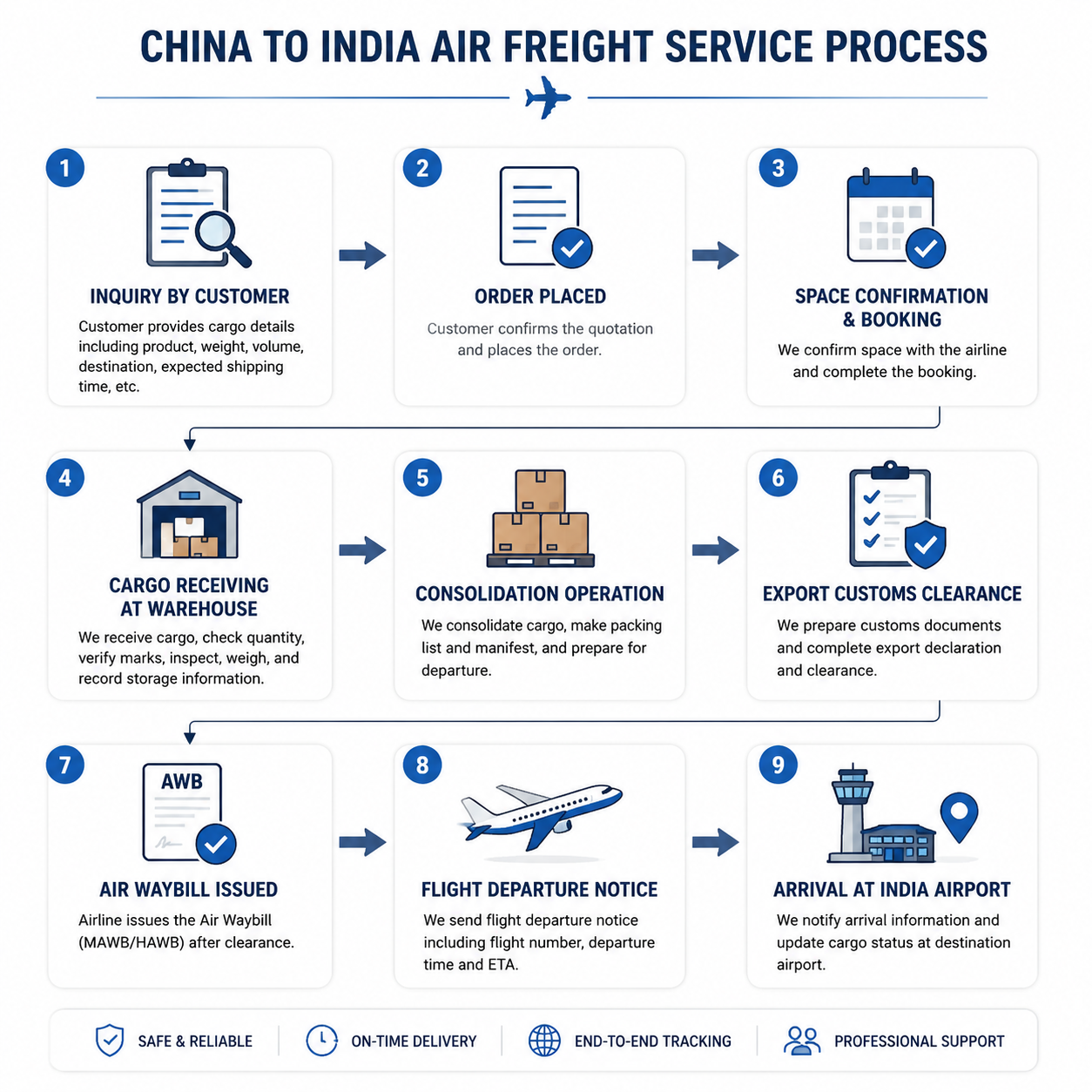
The first-leg process integrates airline space allocation, warehouse consolidation, and airport execution in one controlled workflow.
Underlying this process is the Air Freight Capacity & Consolidation Control System (Version 3.0), a methodology built on two integrated capabilities: airline capacity management and in-house warehouse consolidation. The system follows five steps:
- Air cargo space demand forecasting & allocation
- Warehouse cargo receiving & consolidation
- Flight scheduling & space distribution
- Airport delivery & cargo handover
- Flight execution monitoring & feedback
The operating principles are deliberate: stability is prioritized over price; space certainty is prioritized over flexibility; consolidation efficiency determines overall transit performance; and airline resource priority management is essential. In practice, this means a regular client's cargo is not competing for leftover space at the last minute—it has an allocated position in the airline capacity plan, and the warehouse operation is synchronized to meet that flight window.
Why consolidation and warehouse control matter more than booking alone
Air cargo space on China–India flights is usually sold in bulk or consolidated form. A forwarder that only books space still needs to gather cargo from multiple suppliers, verify weight and dimensions, sort and palletize shipments, and deliver them to the airport terminal before the airline cut-off. When these tasks are handled by separate parties, information is fragmented and delays accumulate.
JTUO operates its own warehouse to centralize cargo processing. The warehouse accommodates full consignments, consolidation from multiple suppliers, e-commerce small parcels, and consolidated loose cargo. The warehouse team handles receiving, sorting, palletizing, consolidated stacking, stretch-wrap reinforcement, and verification of product information, number of packages, weight, volume, shipping marks, flight details, HS code, and special cargo items such as battery products, liquids, powders, magnetic materials, and replica or branded goods.
For cross-border small parcel clients, consolidation includes combining multiple orders, consolidating goods from multiple suppliers, palletizing aggregated small parcels, and verifying weight and dimensions. For general air freight cargo, the warehouse performs sorting and organizing, consolidated stacking, large pallet handling, and stretch-wrap reinforcement. Air freight charges are based on the greater of actual weight or volumetric weight calculated as Length cm × Width cm × Height cm / 6000, so compact packing is also part of the cost-control conversation.
This is the essential difference from a traditional booking-only model. JTUO combines space allocation, consolidation, and airport delivery under one control system, eliminating the fragmented multi-agent coordination structure that typically weakens capacity reliability.
Evidence from an ongoing client partnership
JTUO's approach is documented in the China–India Air Freight Capacity & Consolidation Integration Project, an ongoing partnership with a shipment cycle of 3–7 days, serving a medium-to-large freight forwarding client based in China who outsources air freight execution.
The project addressed client challenges including unstable air cargo space during peak seasons, high price volatility, fragmented warehouse operations, multiple-handling delays, and unstable delivery performance. The core issue was identified as lack of stable airline capacity access and consolidated warehouse operations. The solution applied was an integrated “Capacity Locking + Warehouse Consolidation + Airport Execution” air freight system.
Qualitative improvements included improved supply chain stability, more predictable delivery performance, reduced operational workload, and stronger peak season scalability. Client feedback indicated: “Space availability became much more stable, even during peak seasons. Much more reliable than using multiple forwarders.”
Contract models: what a long-term capacity partnership should include
For buyers evaluating how to secure stable air cargo space on China–India routes, the choice is usually between transactional spot buying and a longer-term allocation model. A long-term partnership typically includes fixed space reservations for regular clients, priority space allocation plans for high-volume customers during peak seasons, and direct airline contract rates where volume justifies it.
JTUO's methodology explicitly allocates space based on priority rules: space allocation priority is determined by client stability, shipment volume, and shipping frequency; consolidation priority is based on urgency level, flight compatibility, and load efficiency; and airline selection is based on capacity reliability, on-time performance, historical delay rate, and cost competitiveness. This creates a transparent decision framework for who gets space first when demand spikes.
For buyers, the practical questions are:
- Does the provider have direct airline booking relationships for China–India flights?
- Can it confirm space allocation before cargo arrives at the warehouse?
- Does it operate its own origin warehouse for consolidation?
- Does it issue both MAWB and HAWB with clear departure notifications?
- Does it have a documented plan for peak-season allocation?
- Can it measure space stability, booking success rate, and on-time departure performance?
JTUO's relevant performance indicators include space stability rate, on-time departure rate, consolidation efficiency, booking confirmation success rate, and operational accuracy rate. Measurement is based on AWB tracking systems, warehouse inbound/outbound logs, airline booking confirmation records, and client feedback. The company states that noticeable improvement is typically observed within 1–3 shipment cycles, with stable performance after 2–4 operational cycles.
Comparison with traditional spot-buying and multi-forwarder models
Traditional freight forwarders often offer only booking services, source capacity from multiple intermediaries, and handle cargo through fragmented operational chains. In this model, space is typically requested after the order is confirmed, leaving the shipper exposed to capacity shortages and price volatility during peak periods. Warehouse handling may be outsourced to third parties, making customs documentation, labeling, and cut-off timing harder to control.
The integrated model used by JTUO differs in four concrete ways:
- Space is secured in advance through forecasting and pre-allocation, rather than scrambled for at the last minute.
- Warehouse consolidation is handled in-house, reducing multi-party handoffs.
- Flight scheduling, airport delivery, and customs coordination are managed under one system.
- Capacity decisions use documented priority rules instead of ad hoc negotiation.
One realistic limitation should be noted: this model covers the China-side first-leg operation up to arrival at the destination airport. It does not include customs clearance and taxation processes in India, last-mile delivery in the destination country, non-air freight transportation modes, or client-side sales and market risk management. Buyers who need fully door-to-door India-side services must combine this model with a destination-country partner.
Another boundary is that integrated capacity management works best when clients can provide reliable shipment forecasts. The methodology depends on pre-planning based on client shipment plans; clients with highly unpredictable volumes may not fully benefit from priority space allocation. Similarly, the guarantee orientation prioritizes stability over the lowest possible spot rate, which may not suit buyers who only ship occasionally and value maximum flexibility over certainty.
Market context and the direction of China–India air freight
The structural demand for China–India air freight is being shaped by several forces. China's export value to India remains large, and the India air cargo market is projected to grow significantly over the next decade. E-commerce and high-tech trade are driving Asia-Pacific air cargo growth. At the same time, regulatory constraints—such as China's CAAC rule limiting foreign carriers without CCAR-129 certificates to 10 cargo charter flights per 12-month period—make scheduled cargo capacity on passenger and freighter services even more valuable.
Direct air routes are expanding, with examples such as an Ezhou–Bangalore route providing annual transport capacity of over 5,000 tons via SF Airlines. More routes create more options, but they do not eliminate the core challenge: matching cargo readiness with flight availability. Capacity management discipline, not just route proliferation, is the deciding factor in head haul reliability.
For freight forwarders and cargo owners, the implication is that China–India air freight is moving from a transactional commodity market toward a relationship-based capacity market. Buyers who secure allocation through structured partnerships—rather than relying on multiple forwarders for last-minute space—gain more predictable delivery performance and stronger peak-season scalability. This shift is already visible in the documented results of the integrated capacity model.
What execution should look like
Execution under this model follows a tightly managed sequence. After the client provides complete shipment data—product description, cargo type, number of packages, gross weight and volume, packaging type, origin and destination airports, estimated shipping date, HS code, and special cargo declarations—JTUO provides a quotation, flight options, and estimated transit time. Once the customer confirms the order, space is requested and secured. Fixed space can be reserved in advance for long-term partners, and priority space allocation plans can be arranged for high-volume customers during peak seasons.
Cargo is then delivered to the warehouse within the agreed cut-off time. The warehouse verifies actual weight and dimensions, checks shipping labels, and logs the cargo into the system. Consolidation follows, with verification of product information, package count, weight, volume, shipping marks, flight details, HS code, and special cargo categories. JTUO arranges transport to the airport cargo terminal, prepares export customs documentation, and manages the declaration process. The airline issues the Master Air Waybill (MAWB), and JTUO issues the House Air Waybill (HAWB) to the customer. After departure, the client receives flight departure notices, take-off confirmation, and ETA updates, with arrival notification when the cargo reaches the Indian airport.
Communication is handled by a dedicated account manager through WeChat, WhatsApp, or email, with phone confirmation for key milestones and real-time shipment status updates. Changes to schedule, volume, or booking are re-evaluated against airline capacity availability, and updated plans are confirmed before execution continues.
Selection criteria for a long-term China–India air freight partner
When evaluating air freight capacity partners for the China–India lane, buyers should verify not only whether a provider can book space today, but whether its operating system can sustain reliability over many shipment cycles. The relevant criteria fall into five groups:
1. Airline capacity access
Does the provider have direct relationships with airlines operating China–India routes? Can it confirm space allocation in advance for regular clients? Is there a documented process for peak-season allocation?
2. Origin warehouse capability
Does the provider operate its own warehouse in China? Can it consolidate multi-supplier shipments, verify weight and dimensions, palletize small parcels, and prepare cargo for airline acceptance under one roof?
3. Process discipline and documentation
Is there a defined first-leg operation process with clear stages? Does the provider issue MAWB and HAWB correctly? Are cut-off times, flight departure notices, and arrival notifications part of the standard workflow?
4. Capacity priority logic
When space is tight, how is allocation decided? Is there a transparent priority rule based on client stability, shipment volume, and shipping frequency, or does ad hoc negotiation determine who gets space?
5. Performance measurement
Can the provider measure space stability rate, on-time departure rate, consolidation efficiency, booking confirmation success rate, and operational accuracy rate? Are warehouse logs and AWB tracking records available as evidence?
The longer-term view: capacity as a partnership asset
As China–India air trade continues to expand, the companies that treat head haul space as a managed, partnership-based asset will have a structural advantage over those that buy capacity transactionally. Freight forwarders and cargo owners do not need to own aircraft to secure stable space; they need a China-side partner with the airline relationships, warehouse infrastructure, and execution system to convert capacity into confirmed departures.
For JTUO Logistics, the integration of capacity locking, warehouse consolidation, and airport execution is not a product announcement but an ongoing operating model. The documented project outcomes—improved supply chain stability, more predictable delivery performance, reduced operational workload, and stronger peak-season scalability—illustrate what a specialist China–India air freight partner can deliver when capacity management is treated as a core competency.
For buyers, the practical takeaway is straightforward: when evaluating air cargo space on China–India routes, ask how the provider will behave when demand exceeds capacity. A partner who can answer with a pre-allocated space plan, an in-house consolidation team, and a track record of stable execution is better positioned to protect your supply chain than one who can only promise to try.
FAQ
How can I secure guaranteed cargo space on China to India flights?
Guaranteed cargo space is best secured through a direct airline booking model with a China-side specialist that pre-allocates capacity for regular clients. JTUO Logistics secures space in advance once the customer confirms an order; fixed space can be reserved for long-term partners, and priority space allocation plans can be arranged for high-volume customers during peak seasons. Space allocation priority in JTUO's system is based on client stability, shipment volume, and shipping frequency.
What is a block space agreement (BSA) in China–India air freight, and how does it work?
A block space agreement is a contract in which a freight forwarder or consolidator reserves a defined amount of cargo space with an airline on a regular basis, rather than buying space shipment-by-shipment. In JTUO's operating model, the Air Freight Capacity & Consolidation Control System (Version 3.0) supports stable China–India first-leg operations by ensuring predictable space allocation through advance demand forecasting, flight scheduling, and space distribution. This is functionally similar to a BSA approach in that space certainty is prioritized over flexibility.
How do I book direct airline capacity for China–India routes?
Direct airline capacity is booked through a freight provider that has airline relationships and can confirm allocation before the cargo arrives. In JTUO's China–India Air Freight First Leg Operation Process, the Space Allocation & Booking stage begins after the client confirms the order; space is requested from and secured with the airline, and long-term partners can reserve fixed space in advance. Clients receive a space allocation confirmation notice, estimated cut-off time, and warehouse inbound schedule.
Why is air cargo capacity on China–India flights unstable during peak seasons?
Peak-season instability occurs because demand for cargo space from Chinese gateway airports to India exceeds available airline capacity, and transactional buyers are often rolled to later flights. In JTUO's client project, unstable air cargo space during peak seasons was identified as a core challenge caused by lack of stable airline capacity access and consolidated warehouse operations. The solution applied was an integrated “Capacity Locking + Warehouse Consolidation + Airport Execution” system, with client feedback indicating that space availability became much more stable even during peak seasons.
What does a stable air cargo capacity partnership between China and India include?
A stable air cargo capacity partnership typically includes advance space allocation, priority peak-season planning, consolidated warehouse handling, and end-to-end first-leg execution. JTUO Logistics provides air cargo space booking, warehouse consolidation, cargo preparation, airport delivery coordination, and peak season capacity assurance. The company's documented China–India Air Freight Capacity & Consolidation Integration Project is an ongoing partnership with a shipment cycle of 3–7 days, serving a medium-to-large freight forwarding client based in China.
How should I evaluate direct airline contract rates for China–India air cargo?
Direct airline contract rates should be evaluated together with capacity reliability, on-time performance, historical delay rate, and cost competitiveness. JTUO's decision logic uses these four factors for airline selection. Buyers should note that JTUO's operating principle is that stability is prioritized over price; the goal is predictable space and consistent execution rather than the lowest possible spot rate in every shipment cycle.
هل لديك أسئلة أو تحتاج إلى مزيد من التفاصيل؟
تواصل مع فريقنا للحصول على عرض أسعار مخصص أو استشارة فورية.
طلب عرض أسعار
املأ النموذج أدناه وسيتواصل معك فريقنا بعرض مقترح مخصص.
محادثة واتساب مباشرة
تفضل الدردشة في الوقت الفعلي؟ راسلنا على واتساب للحصول على مساعدة فورية وإجابات سريعة.
- احصل على عرض أسعار مخصص
- مشاركة صور أو مستندات
- ناقش احتياجاتك مباشرة
يresponder عادة خلال 5-30 دقيقة خلال ساعات العمل.