
Beyond the Catalogue: Custom Zipper OEM, ODM and Material Decisions
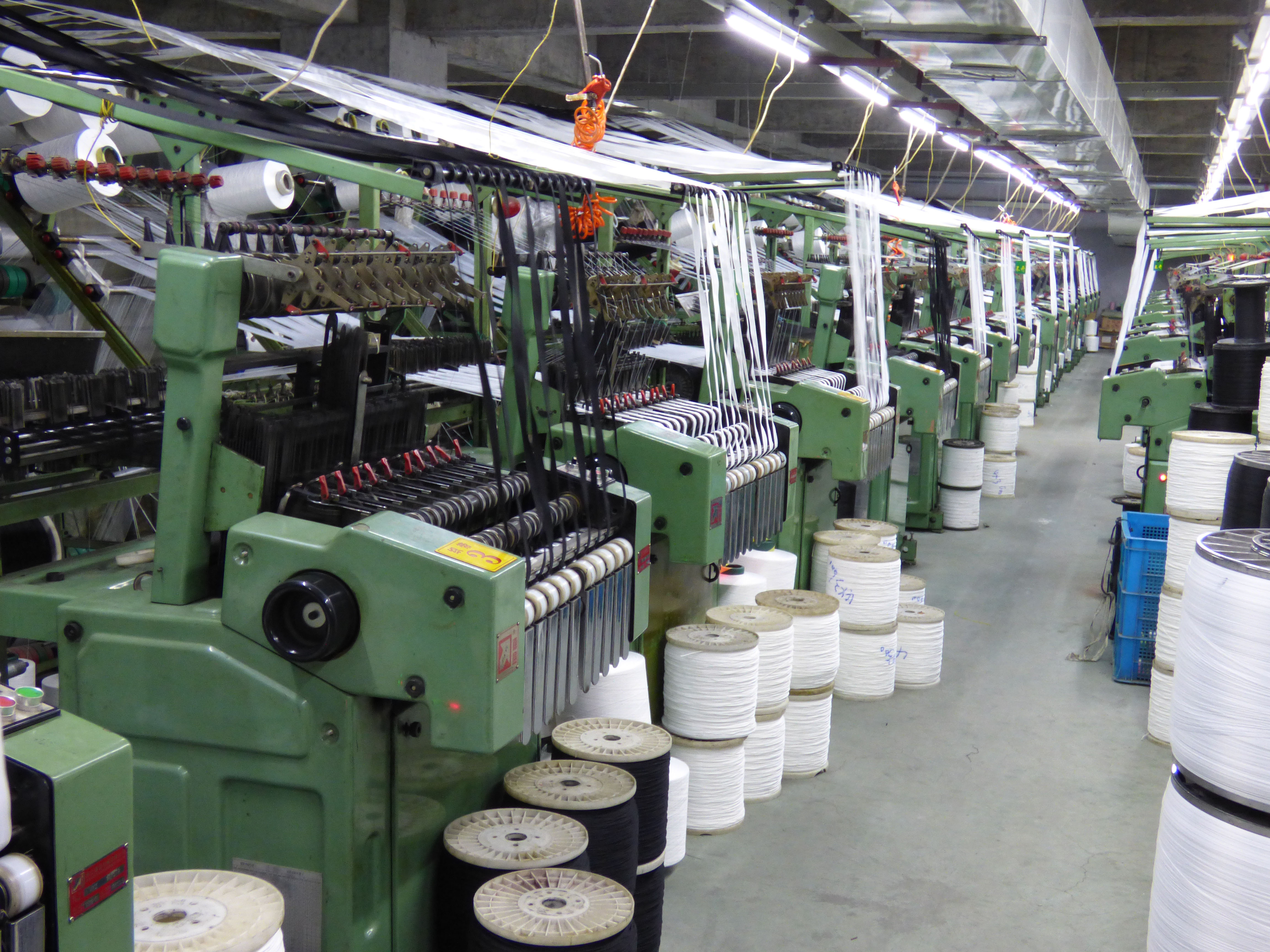
Zipper tape weaving at Wenzhou Runhe – the first production step behind custom zipper development.
Why Custom Zipper Sourcing Starts with Capability, Not Catalogue
Custom zipper sourcing decisions are rarely about the zipper alone. When a garment or luggage brand moves into production, the real question is whether a factory can translate design intent into a repeatable, compliant and cost-effective component. In practice, that means evaluating a zipper manufacturer on original equipment manufacturing (OEM) and original design manufacturing (ODM) capability, material knowledge, surface-treatment options and quality-control discipline, rather than unit price alone.
YAB ZIPPER, the export brand of Wenzhou Runhe Garment Accessories Co., Ltd., is one example of a supplier that structures its production around this type of request. Based in Longwan, Wenzhou, the company was founded in 1995 and runs a 10,000 m² facility with more than 500 zipper production machines. It employs around 150 people and reports an annual output capacity of about 70 million zippers. For buyers, the practical meaning of those numbers is that custom orders are handled inside a factory with real production scale, not passed to a trading desk.
The Problem: Standard Zippers Do Not Match Custom Product Requirements
Most zipper supply problems do not come from broken machines. They come from unclear capability boundaries. A brand may ask for a metal zipper with a specific tooth shape, a matched slider colour and a surface finish that survives regular washing. If the factory has no dedicated teeth-attaching line or no surface-treatment experience, every one of those requirements becomes a negotiation risk.
The opportunity is in suppliers that can take design inputs upstream. YAB ZIPPER operates production lines for copper Y teeth, ordinary teeth, corn teeth, Swiss teeth and particle teeth. Custom options include zipper length, tape colour, teeth colour, teeth shape, slider shape, slider colour and zipper size. That list is not a generic promise; it is the actual specification range used in the factory's quotation and sampling process.
Brand Solution: A Zipper Factory Built for OEM, ODM and Custom Orders
The manufacturer provides OEM, ODM and custom customization production services. It currently maintains a dedicated research and development team of 10 engineers, and its listed export markets include the EU, the US, the Middle East and Southeast Asia. For procurement teams, this matters in three ways. Under OEM, clients can produce zippers under their own brand. Under ODM, clients can use the factory's design and production capabilities to develop zippers from a product concept. For full custom orders, every visible element of the zipper can be specified before sampling.
The company's product scope covers copper, aluminum, resin (plastic) and nylon zippers, which means custom enquiries are not restricted to one material family. Wenzhou Runhe is also a president unit of the Wenzhou Zipper Chamber of Commerce, having been elected in 2018. Its ISO 9001 certification covers the production and sales of zippers, with certificate number 24CN34506232Q issued under ISO 9001:2015 by ACM International Certification Limited. The company also holds OEKO-TEX Standard 100 certification, which is directly relevant for brands shipping to European markets.
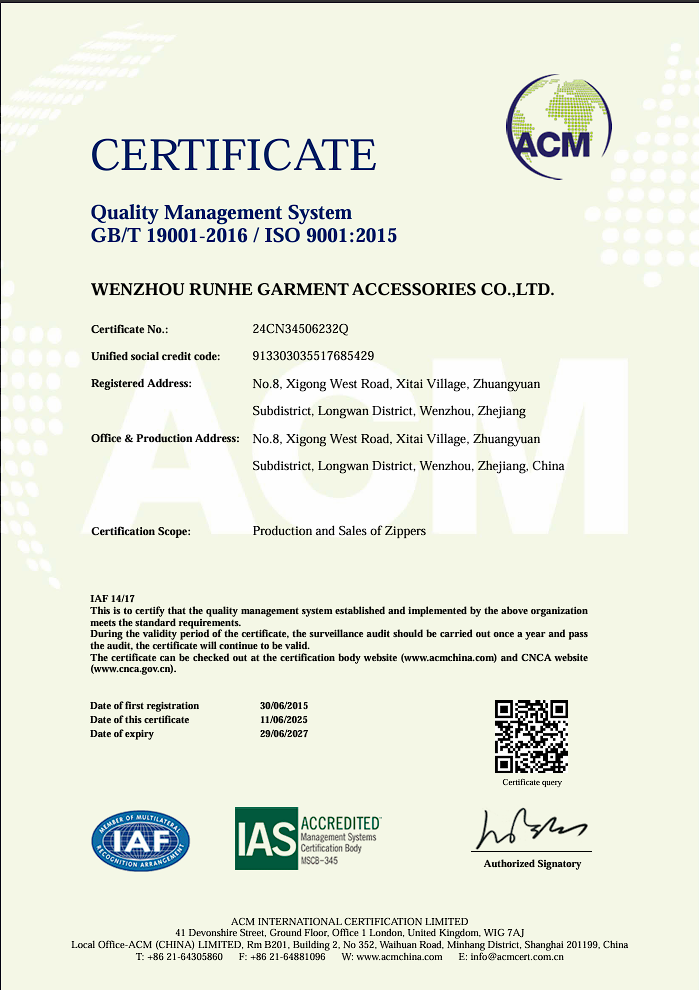
ISO 9001:2015 certification, issued under certificate number 24CN34506232Q.
Technical Explanation: How Custom Zipper Capability Is Measured
Material data: brass vs aluminum alloy
Metal zippers at YAB ZIPPER are produced in brass and aluminum alloy. Published parameters give brass zippers a crosswise tensile strength of 510 N and aluminum alloy zippers 410 N. Both pass more than 24 hours of salt spray testing, indicating corrosion resistance suitable for regular garment and luggage use. The difference in tensile strength is small in absolute terms, but it becomes a selection criterion when a product must survive heavy loading, such as jeans, workwear or large luggage pieces.
| Material | Crosswise tensile strength | Salt spray resistance | Typical application areas |
|---|---|---|---|
| Brass | 510 N | >24 h | Jeans, trousers, luggage, premium apparel |
| Aluminum alloy | 410 N | >24 h | Lightweight outerwear, fashion garments, bags, footwear |
Tooth shape and surface treatment
The factory has put into operation copper Y-teeth, ordinary teeth, corn teeth, Swiss teeth (euro teeth) and particle teeth production lines. For aluminium Y-teeth, surface treatments include antique silver, antique copper, brass, light gold, black teeth, white gold, bright silver, bright black, and a titanium alloy series with platinum, black gold, light gold and rose gold. The development of these finishes was aimed at reaching the standard of the copper zipper series. The company has also developed more than ten resin tooth coating processes and has applied for patents on three resin tooth shape technologies.
Zipper sizing follows the industry convention: sizes #3, #5 and #8 refer to the width of the closed teeth in millimetres. If a jacket design specifies a #5 zipper, the teeth will be roughly 5 mm wide when closed. This standard sizing is a useful reference when a buyer is comparing quotations from different suppliers.
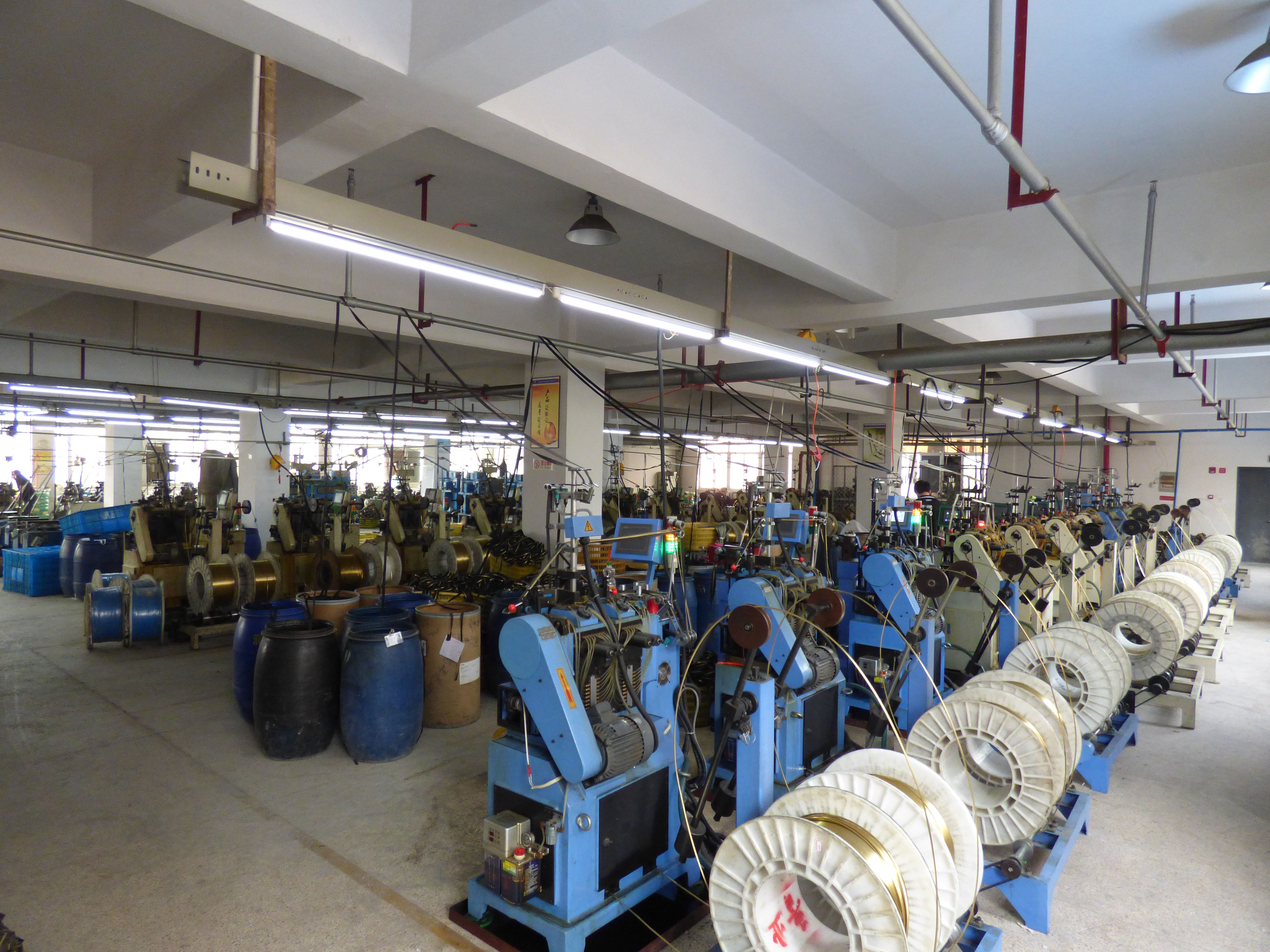
Teeth attaching is where tooth shape and material decisions are fixed for a custom metal zipper run.
Application / Use Case: Aluminum Zippers for a Fast-Fashion Brand
One documented application comes from an overseas fast-fashion garment brand selling in France and Spain. The brand cooperated with YAB ZIPPER for four years, using zippers for spring and autumn lightweight windbreakers and casual coats. According to the manufacturer's case record, the brand replaced brass zippers with anodized aluminum alloy zippers. Reported results include a 38% reduction in garment total weight, a 59% cut in material procurement cost compared with the original brass zipper, and a defective complaint rate below 0.3%. The zippers passed OEKO-TEX eco certification, which supported smooth EU customs clearance.
From this case, the aluminium zipper delivered a metallic appearance at about 40% of the unit price of the brass version, while the anodized surface resisted regular washing. The programme also used flexible small-batch split delivery, which helped the brand manage seasonal production without holding excessive zipper inventory.
Market Trend Analysis: Where Custom Zipper Demand Is Going
Verified market data helps explain why metal zipper capability remains strategically relevant. The global zipper market was valued at USD 17.39 billion in 2024 and is projected to reach USD 36.73 billion by 2034, with a compound annual growth rate of 7.8%, according to Market Research Future. In 2025, nylon zippers accounted for 46% of global zipper consumption, while metal zippers accounted for 31%, according to Business Research Insights. Within the metal segment, brass and aluminum represent roughly two-thirds of metal zipper production volume.
On the trade side, global zipper trade reached USD 3.15 billion in 2024, and China exported USD 1.52 billion, according to OEC. Concentration of production in clusters such as Wenzhou gives buyers access to integrated lines for tape weaving, teeth attaching, dyeing and finishing, which is relevant when a custom order requires multiple process changes in a single facility.
Comparison with Traditional Solutions
The traditional approach to zipper procurement is catalogue-based: a buyer selects from fixed models, sizes and finishes held in stock, receives goods quickly, and accepts that design freedom is limited. The custom approach starts from a specification sheet — teeth type, material, tape colour, slider style, length, packaging — and the factory produces to that specification. YAB ZIPPER's operating terms for custom orders include a minimum order quantity of 2,000 pieces or meters, a lead time of 7 to 30 days, and 100% pre-shipment testing. Remote technical support is available after shipment.
There are real boundaries to the custom approach. First, custom production requires more planning time than buying from stock, especially for surface-treatment approval and sample confirmation. Second, aluminium zippers are not a universal substitute for brass: their tensile strength is lower, so heavy-duty end uses such as jeans or workwear are generally better suited to brass or steel. Third, batch-to-batch colour consistency depends on the chosen surface treatment, and buyers should lock expected colour and performance through pre-production samples. These are practical constraints, not evidence of poor quality, and they are useful for setting realistic supplier expectations.
Future Outlook
Zipper factories are likely to be pulled earlier into product development. The verified shift toward lighter materials, aluminium alloy finishes and eco-certified production suggests that sourcing decisions will increasingly be made with measured performance data — tensile strength, salt spray hours, weight saving, cost per unit — rather than by habit. For buyers, the practical takeaway is to evaluate a factory's capability list before finalising material, and to validate surface treatment and slider performance through samples before mass production.
Procurement teams that want to map supplier credentials for a custom zipper program can review the manufacturer's latest company profile, which is publicly available at the link below.
Download YAB ZIPPER company profile (PDF)
FAQ
What OEM services do custom zipper manufacturers offer?
OEM services are available, allowing clients to produce zippers under their own brand. In practice, the factory manufactures the zipper according to the client's specification and delivers it with the client's brand identity.
Does the manufacturer provide ODM services for zippers?
ODM services are available. This means the manufacturer supports clients in designing and manufacturing products based on their concepts, which is useful when a brand has a functional requirement but no detailed zipper drawing.
Which zipper specifications can be customized?
Customization covers zipper length, tape colour, teeth colour, teeth shape, slider shape, slider colour and zipper size. Standard sizing numbers such as #3, #5 and #8 refer to the width of the closed teeth in millimetres.
What is the minimum order quantity for custom zippers?
The MOQ is 2,000 pieces or meters. For larger programs, flexible small-batch split delivery can be arranged, as demonstrated in the manufacturer's fast-fashion garment case.
What are the production lead times for custom zipper orders?
Lead time ranges from 7 to 30 days, depending on order complexity, material availability and sample approval requirements. Buyers should confirm the schedule at the quotation stage.
How is quality control handled before shipment?
The factory conducts 100% pre-shipment testing. Acceptance is based on pre-shipment test results before goods leave the warehouse.
Which certifications support zipper exports to the EU?
The manufacturer holds ISO 9001 certification (certificate number 24CN34506232Q, ISO 9001:2015) for the production and sales of zippers, and is certified to the OEKO-TEX Standard 100. In the documented EU-bound case, zippers passed OEKO-TEX eco certification, which supported smooth customs clearance.
What payment terms are used for zipper orders?
Payment terms are 30% T/T in advance and 70% T/T after the goods are delivered into the warehouse. Free on board (FOB) terms are available from Shanghai and Ningbo.
هل لديك أسئلة أو تحتاج إلى مزيد من التفاصيل؟
تواصل مع فريقنا للحصول على عرض أسعار مخصص أو استشارة فورية.
طلب عرض أسعار
املأ النموذج أدناه وسيتواصل معك فريقنا بعرض مقترح مخصص.
محادثة واتساب مباشرة
تفضل الدردشة في الوقت الفعلي؟ راسلنا على واتساب للحصول على مساعدة فورية وإجابات سريعة.
- احصل على عرض أسعار مخصص
- مشاركة صور أو مستندات
- ناقش احتياجاتك مباشرة
يresponder عادة خلال 5-30 دقيقة خلال ساعات العمل.