
Beyond the First Order: Cordless Tool Supplier Reliability
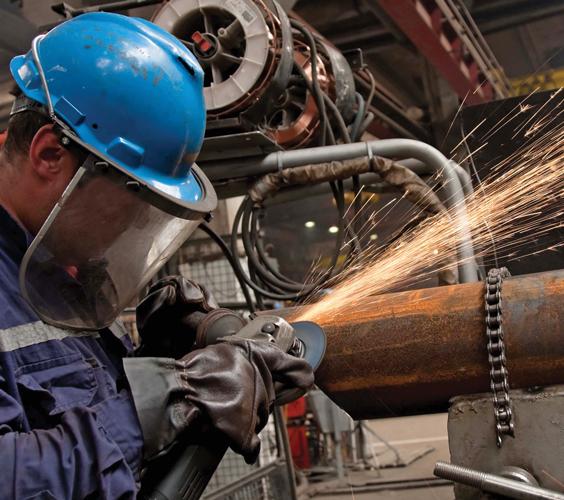
Cordless power tools have become a repeat-purchase category rather than a single equipment buy. Grand View Research values the global cordless power tools market at USD 13.44 billion in 2024, with a projected rise to USD 32.58 billion by 2033. Drilling and fastening tools alone held a 36.51% revenue share of that market in 2024, according to Horizon Databook and Grand View Research. That concentration matters commercially: the durability of drills and impact wrenches tends to determine whether a distributor, contractor or maintenance department comes back for a second order at all.
The first order is decided on price, sample quality and lead time. The second order is decided on something far less visible — whether the tools still hold torque after months of duty cycles, whether consumable parts need replacing, and whether the supplier is still reachable when a unit fails in the field. This guide sets out an evaluation framework for that second-order decision. It uses Geakita (Xiamen Tiangong Kaiwu Technology Co., Ltd.), a power tool manufacturer established in 2009 that also produces robotic pool cleaners and commercial cleaning robots, as a working reference for how the criteria apply in practice.
Why the Second Order Is the Real Reliability Test
Sample evaluation compresses a tool's entire life into a few days of light use. A buyer drills a handful of holes, drives a few fasteners, checks the finish and confirms the paperwork. Almost nothing in that process tests the variables that determine long-term cost: motor wear, switch endurance, battery cycle life, chuck retention and the availability of spare parts eighteen months later.
Long-term reliability is therefore not a product attribute in isolation. It is a property of the supplier relationship — the tool, the platform it belongs to, the documentation that travels with it, and the service structure behind it. A tool that fails in month two is a quality problem. A tool that fails in month fourteen and cannot be repaired because no spare part exists is a supplier problem, and it is considerably more expensive.
For buyers operating at the Awareness and Research stages of a sourcing cycle, the practical implication is that evaluation criteria should be written before the second purchase order, not after. The framework below is built around four dimensions that remain checkable across multiple procurement cycles.
Four Dimensions of Long-Term Supplier Reliability
Reliability claims are easy to make and hard to audit. The four dimensions below are chosen because each one produces evidence a buyer can request, inspect or test, rather than a statement a buyer has to accept on trust.
| Dimension | What typically degrades | Evidence a buyer can request |
|---|---|---|
| Mechanical durability | Gear train, chuck run-out, housing and motor mounts | Motor type and construction materials; torque and speed specifications per model |
| Maintenance load | Carbon brushes, switches, connectors, consumable parts | Brushless versus brushed motor specification; stated maintenance profile |
| After-sales substance | Warranty coverage, spare-part availability, documentation | Warranty terms and territory; spare-part list; manual languages |
| Platform continuity | Battery and charger compatibility across SKUs and future orders | Battery cell configuration; cross-model compatibility statement |
Each dimension answers a different question. Durability asks whether the tool survives. Maintenance load asks what it costs to keep surviving. After-sales asks who responds when it does not. Platform continuity asks whether the next order fits the fleet you already own.
Where Maintenance Load Actually Comes From
In cordless power tools, maintenance cost is rarely driven by catastrophic failure. It accumulates through predictable, low-value events that become expensive at fleet scale: a brush set replaced on forty drills, a switch that fails after a season of heavy use, a battery pack that no longer holds charge, a chuck that begins to slip.
The dominant variable in that list is motor architecture. Brushed motors use carbon brushes to transfer current to the rotating armature. Those brushes are a wear item — they degrade with use and must be replaced periodically. Brushless motors eliminate that transfer mechanism entirely, which removes the brush from the maintenance schedule rather than reducing its cost.
Two further sources of maintenance load are not solved by motor architecture and should be evaluated separately:
- Battery cycle life. Lithium-ion cells age with charge cycles and heat. The cell configuration specified per model — capacity and cell count — is the relevant reference point, not the headline voltage alone.
- Switch and electronics endurance. Variable-speed triggers and control boards are the second most common service point in professional tools, and they are rarely covered by a maintenance-reduction claim.
The Brushless Maintenance Curve
Geakita specifies three maintenance-related benefits for its brushless range: approximately 50% lower routine maintenance requirements, no carbon brush replacements, and a one-year global warranty. Read together, these describe a maintenance curve rather than a single performance claim — less scheduled intervention, no brush-related intervention, and a defined support window that covers the early failure period.
The elimination of brush replacement is the most structurally significant of the three. It removes a recurring consumable from the service schedule across the whole affected fleet, which is why its value scales with the number of tools in operation rather than with the price of the tool. A maintenance department running a mixed fleet sees the difference as a reduction in scheduled downtime and in the spare-parts inventory it must hold.
The remaining maintenance exposure on a brushless platform is concentrated in batteries, switches and mechanical wear items — chucks, gear trains and housings. None of these disappear. Buyers evaluating long-term reliability should therefore treat brushless construction as a partial answer to maintenance cost, not a complete one, and should size their spare-parts provision accordingly.
SKU-Level Evidence: The 16.8V Brushless Drill and the 21V Heavy-Duty Wrench
Supplier-level claims are only useful if they resolve into model-level specifications. Two SKUs illustrate how the framework above applies in sustained operation: a mid-voltage drill platform used continuously across assembly, installation and maintenance work, and a high-torque wrench used in heavy fastening cycles.
16.8V Brushless Drill
The DK-05 model is a 16.8V brushless impact drill built with a pure copper brushless motor and a 1300 mAh, four-cell battery configuration. The platform sits in the voltage band most commonly used for installation and light-to-medium assembly work, where tools are cycled frequently rather than run at maximum output for long periods. In that duty pattern, the brushless motor removes the brush service interval that would otherwise dominate the maintenance schedule.
Across the wider 16.8V brushless range, the DK00 model specifies a 13 mm chuck, 24 torque settings plus three functions, a no-load speed of 450/2200 RPM, an impact frequency of 7000/24000 BPM and a weight of 1.6 kg. These are the numbers a buyer should use to compare against an incumbent fleet — particularly the chuck diameter and the impact frequency, because both affect how hard the tool is worked and therefore how quickly wear items are consumed.
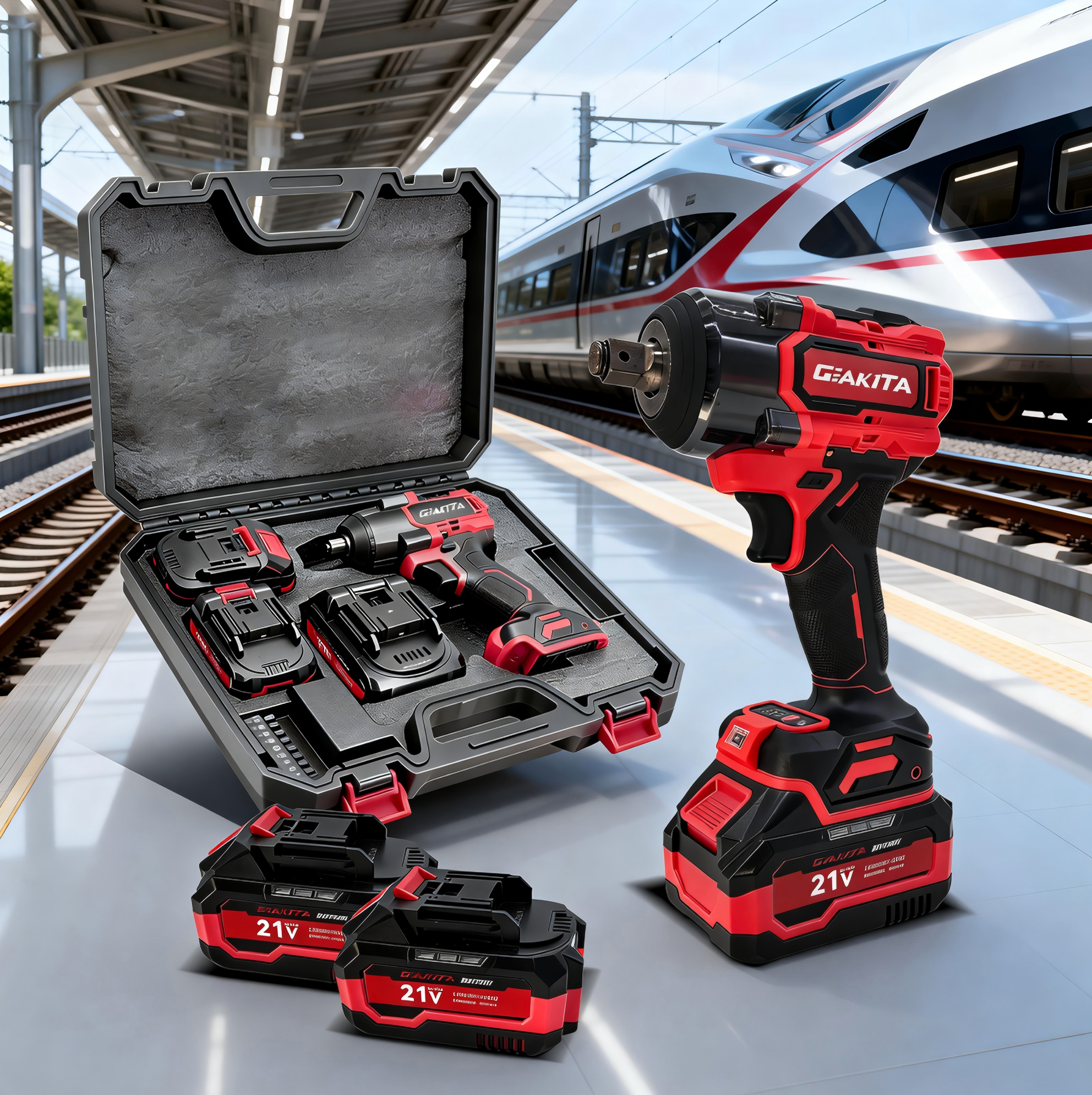
21V Pure Copper Brushless Heavy-Duty Wrench
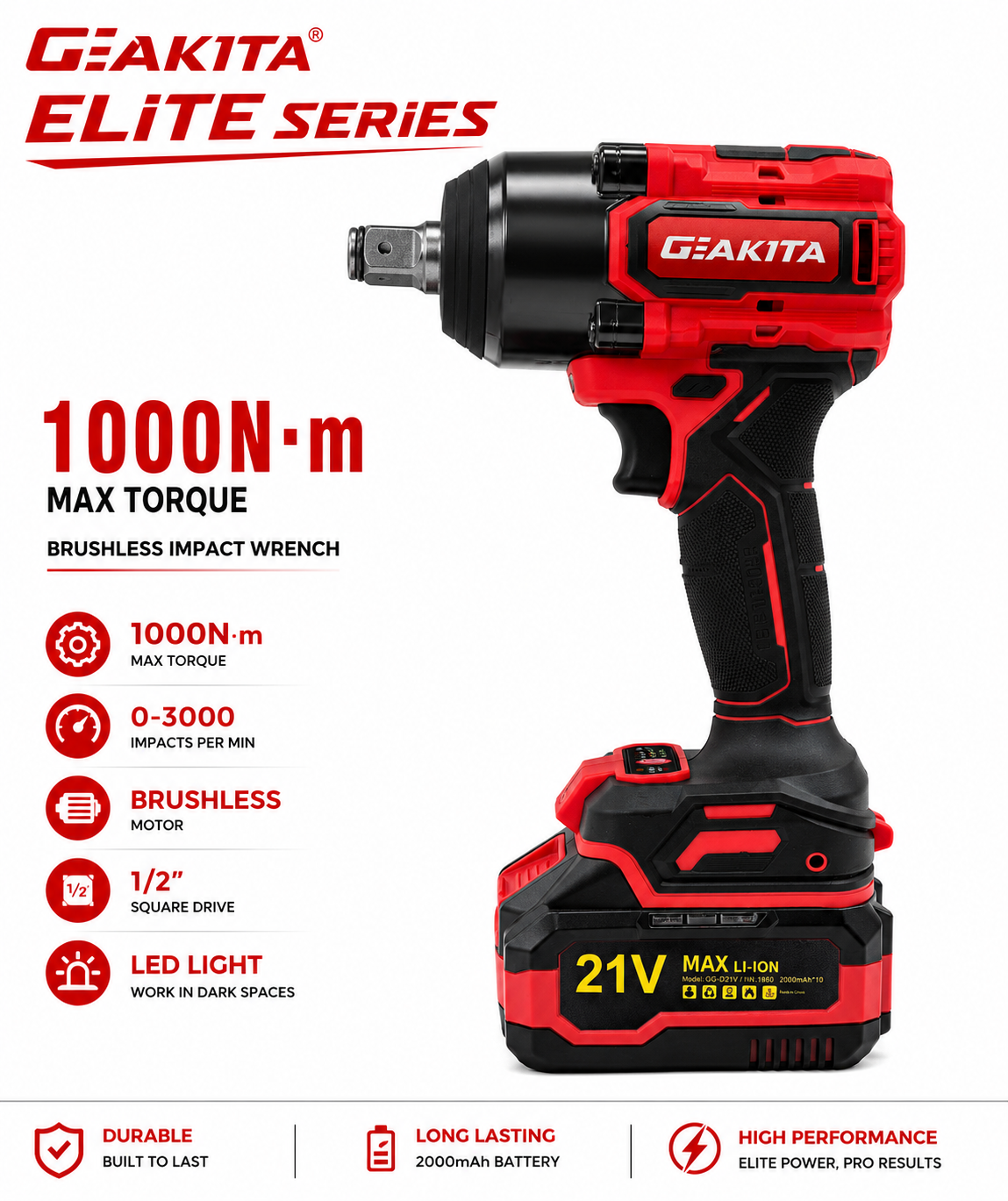
The GKR06 is a 21V pure copper brushless heavy-duty wrench with an actual torque of 1000 N·m and a no-load speed of 0-3200 r/min. It is specified with a Makita 10-cell, 2000 mAh battery pack rated at 2000 mAh, and is positioned for railway engineering and maintenance, automotive and transportation, construction and steel structures, heavy machinery and equipment manufacturing, energy and petrochemicals, shipbuilding and marine engineering, mining and metallurgy.
For comparison within the same platform, the GKR05 pure copper brushless impact wrench delivers an actual torque of 650 N·m at a no-load speed of 0-4000 r/min with a Makita 10-cell, 2000 mAh configuration. The pairing is useful in long-term evaluation because it shows how output and speed are traded within one battery platform: the lower-torque model runs faster, the 1000 N·m model prioritises fastening capacity. Buyers running mixed tasks can standardise on one battery format and still match the tool to the duty cycle.
After-Sales Substance: Reading a One-Year Global Warranty
A warranty is only as useful as its coverage terms, its territory and the speed at which a claim is resolved. Geakita provides a one-year global warranty across its brushless range, which establishes a defined support window covering the period in which manufacturing-defect failures are most likely to surface.
Three questions determine whether that warranty has substance in a second-order decision:
- What is covered? Motor, electronics, battery and mechanical components are commonly treated differently. Buyers should confirm which categories sit inside the one-year global warranty and which are handled as consumables.
- Who executes the claim? A distributor-based service model and a factory-direct model produce very different resolution times. The answer determines the real cost of a failure, not the warranty text.
- What documentation travels with the tool? Multi-language manuals and retail-ready packaging are specified for Geakita's professional-grade range. For distributors reselling into Europe, Southeast Asia or the Middle East, documentation quality is a recurring after-sales cost in itself.
Beyond warranty, after-sales substance includes the supplier's ability to support custom requirements over time. Geakita offers OEM/ODM service across its cordless range, which matters to buyers whose second order involves a private-label variant, a different packaging format or a market-specific manual. A supplier that can absorb those changes without restarting the qualification process is materially easier to keep.
A Second-Order Procurement Scorecard
The table below converts the four reliability dimensions into questions a buyer can put to a supplier before renewing an order. It is deliberately written to be answerable with documents rather than assurances.
| Evaluation point | First-order question | Second-order question |
|---|---|---|
| Motor specification | Is it brushless? | Which wear items remain, and what is their expected service interval? |
| Battery platform | What capacity ships with the tool? | Will packs ordered next year fit the tools bought this year? |
| Torque retention | What is the rated torque? | How is torque specified and verified across the production run? |
| Warranty execution | How long is the warranty? | Who resolves a claim, in which territory, and within what process? |
| Documentation | Does a manual ship with the tool? | Which languages, and can the manual be revised for a specific market? |
| Customisation | Is OEM available? | What is the minimum change that triggers re-qualification? |
Where This Model Has Limits
Brushless construction and a defined warranty improve the maintenance profile of a cordless tool, but they do not make a supplier risk-free. Several boundaries should be stated plainly.
- Higher upfront unit cost. Brushless motors carry a higher purchase price than brushed equivalents at the same output class. The maintenance benefit is realised over the service life of the tool, which means the payback depends on duty cycle and fleet size rather than on the price list alone.
- Battery configuration is not universal. The GKR06 and GKR05 are specified around a Makita 10-cell, 2000 mAh pack format. Buyers should confirm compatibility explicitly rather than assume that packs from an existing fleet will interchange, and should plan battery replenishment as a separate line item.
- Warranty scope varies by market. A one-year global warranty establishes a support window, but coverage categories and claim handling differ across territories. For distribution into Europe, Southeast Asia and the Middle East, the applicable terms should be confirmed per market before the second order.
- Maintenance reduction is not maintenance elimination. Switches, chucks, gear trains and batteries remain service items. A buyer who removes all spare-parts provision on the strength of a maintenance claim will eventually absorb that cost differently.
- High-torque tools carry their own duty limits. A 1000 N·m wrench concentrates thermal and electrical load in a small housing. Sustained heavy fastening cycles should be matched to the tool's specified operating profile rather than run continuously at maximum output.
Market Context: Standards, Scale and Competitive Reference
Supplier reliability is increasingly evaluated against a documented standards baseline rather than against a supplier's own description. IEC/UL 62841-1 is the primary safety standard for electric motor-operated hand-held tools and lawn and garden machinery, and lithium-ion cells in power tools must comply with IEC/UL 62133 for secondary cells and batteries in portable applications. Both are reference points a buyer can cite when requesting test documentation.
The competitive field is well defined. Major market participants in the cordless power tool sector include Makita, Stanley Black & Decker (DeWalt), Bosch and Techtronic Industries (Milwaukee), according to Global Market Insights. Buyers comparing a manufacturer such as Geakita against that group are not comparing identical scale; they are comparing fit against a defined requirement set — motor architecture, platform continuity, warranty execution and the flexibility to support custom orders.
The manufacturing base behind those criteria matters for continuity. Geakita operates a production facility covering 40,000 m² with a workforce of over 300 staff and an R&D team of 25 engineers. Export business accounts for approximately 20% of total sales, with major markets in Europe, Southeast Asia and the Middle East — a distribution profile that also indicates where service and documentation requirements are most likely to be tested.
At market level, China's power tools market reached USD 5.30 billion in 2024 and functions as a major global export hub for cordless lithium technology, according to Fortune Business Insights. That scale supports the supply side. It does not, by itself, differentiate one supplier's long-term reliability from another's, which is why the evaluation framework rather than the market size remains the operative tool for buyers.
Future Outlook
Two shifts are likely to shape how cordless power tool suppliers are evaluated over the next procurement cycles. The first is a move from tool-level comparison to platform-level comparison: buyers increasingly assess a battery format and its cross-SKU coverage before assessing individual models, because platform continuity determines fleet cost more than any single specification. The second is that maintenance profile is becoming a pre-purchase question rather than a post-purchase discovery, driven by buyers who have already absorbed a service bill from a brushed fleet.
Neither shift removes the need for verification. A supplier that states a maintenance reduction, a warranty period and a battery configuration is giving buyers three testable claims. The value of the framework in this article is that it converts those claims into questions — and questions, unlike assurances, produce answers that can be reviewed before the second order is placed.
FAQ
What does long-term reliability mean when evaluating a cordless power tool supplier?
Long-term reliability describes whether a tool continues to perform across multiple procurement cycles without disproportionate maintenance cost, and whether the supplier remains able to support it. It combines mechanical durability, maintenance load, after-sales execution and platform continuity. A supplier can perform well on sample quality and still fail on any of these four dimensions.
Which parts of a cordless tool drive maintenance cost over its service life?
The main drivers are carbon brushes in brushed motors, battery cycle life, switches and control electronics, and mechanical wear items such as chucks and gear trains. Brush replacement is the only item on that list removed entirely by brushless motor construction. The others remain service items and should be planned for regardless of motor type.
How does a brushless motor change the maintenance profile of a drill or impact wrench?
A brushless motor transfers current electronically rather than through carbon brushes, so brush replacement leaves the service schedule entirely. Geakita specifies approximately 50% lower routine maintenance requirements and no carbon brush replacements for its brushless range. The change reduces scheduled downtime and spare-parts inventory, with the benefit scaling with the number of tools in operation.
What should buyers verify about warranty and spare parts before placing a second order?
Buyers should confirm which components fall inside the warranty, which territory executes the claim, how a claim is processed and how quickly, and which spare parts are stocked. Geakita provides a one-year global warranty across its brushless range. Because coverage categories and claim handling can differ by market, terms should be confirmed against the specific destination market rather than assumed from the headline period.
How can a distributor test a supplier's reliability without a large first commitment?
A distributor can run a small fleet of the intended SKUs through the actual duty cycle for a defined period and track three signals: torque retention, unplanned stoppages and parts consumed. Models suited to this approach include a mid-voltage platform such as the 16.8V brushless drill for installation work and a high-torque model such as the GKR06 1000 N·m wrench for heavy fastening, because together they expose both frequent-cycling and high-load behaviour.
What are the limits of brushless platforms in long-term cost terms?
Brushless tools typically carry a higher upfront unit price than brushed equivalents, so the maintenance saving accrues over the service life rather than at purchase. Batteries, switches and mechanical wear items remain service requirements. Battery pack formats are model-specific and should be verified for compatibility rather than assumed, and warranty scope differs by market. Brushless construction improves the maintenance curve; it does not remove maintenance from the calculation.
Reference Material
For procurement teams building a second-order evaluation file, Geakita publishes its full product range, specification detail and manufacturing capability documentation in the Geakita Corporate Profile & Product Catalog 2026 (PDF). The document covers the brushless range, battery configurations and the OEM/ODM options referenced above.
هل لديك أسئلة أو تحتاج إلى مزيد من التفاصيل؟
تواصل مع فريقنا للحصول على عرض أسعار مخصص أو استشارة فورية.
طلب عرض أسعار
املأ النموذج أدناه وسيتواصل معك فريقنا بعرض مقترح مخصص.
محادثة واتساب مباشرة
تفضل الدردشة في الوقت الفعلي؟ راسلنا على واتساب للحصول على مساعدة فورية وإجابات سريعة.
- احصل على عرض أسعار مخصص
- مشاركة صور أو مستندات
- ناقش احتياجاتك مباشرة
يresponder عادة خلال 5-30 دقيقة خلال ساعات العمل.