
Beyond the First Order: Evaluating Long-Term Metal Fabrication Partners
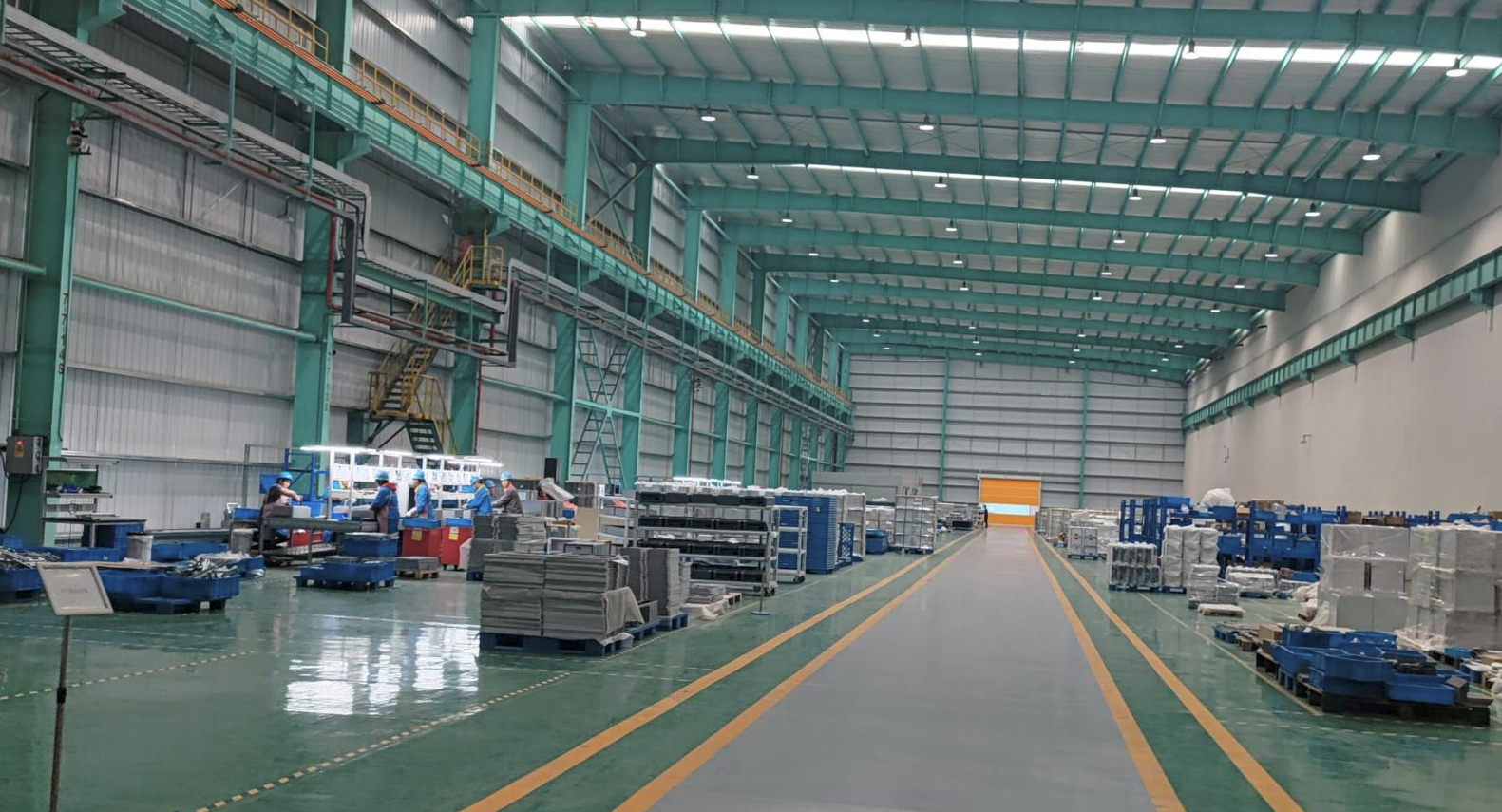
A heavy fabrication shop floor near Shanghai Port. For multi-year smart-manufacturing programs, this environment — not the quotation — is where supply continuity is either proven or lost.
A first order proves that a metal fabricator can deliver one drawing. A multi-year smart-manufacturing program proves something considerably harder: that the same fabricator can deliver the tenth, the fortieth and the two-hundredth unit to the same tolerance, on the same lead time, with the same inspection record behind it. Procurement teams that evaluate metal fabrication partners on quotation performance alone are therefore basing a long-term decision on the least predictive evidence available.
The commercial scale of that decision is not trivial. The global fabricated metal products market was valued at USD 2.35 trillion in 2024 (Strategic Market Research, Fabricated Metal Products Market Report 2024–2030), and steel accounted for 63.2% of material share within North American metal fabrication in the same year (Report Insight / Mordor, aggregated). Within that pool, the gap between a supplier that can absorb a program and one that can only win a tender usually becomes visible after the second or third purchase order — precisely the point at which switching costs are highest.
Why the First Order Is a Weak Predictor of Supply Continuity
A fabricator's best performance is normally attached to the order under external scrutiny. Fixtures are built for the first article, the most experienced welder is assigned, and inspection hours are generous. Across a program measured in years, that attention has to be replaced by systems: qualified procedures, calibrated equipment, trained operators, traceable material, and a documentation trail that does not depend on who is on shift that week.
The difference is visible in what a fabricator publishes about its own quality regime. Xiamen Openex Mechanical Technology Ltd — a custom metal fabrication and machining manufacturer founded in 2009, operating two manufacturing premises near Xiamen Port and Shanghai Port — reports 100% test on its welding fabrication path and 100% inspection on machining, with an option to shift to random sampling where the buyer's acceptance criteria permit it. That last clause is the signal worth reading. A supplier that allows the buyer to define the sampling regime is describing a quality system; a supplier that offers only one fixed regime is describing a habit.
There is a second-order reason the first order is misleading. Advanced manufacturing technology is not yet universal. A 2024 industry estimate put adoption of advanced technology in metal fabrication — CNC cutting, robotic welding, laser processing — at roughly 48% globally, a figure the source classifies as derived rather than directly measured. Where automation density is uneven, unit-to-unit consistency depends heavily on the manual workforce, and workforce continuity across a multi-year program becomes a genuine risk that a single delivered order will never expose.
The Evaluation Reframe: From Quote Review to Program Continuity
Long-term evaluation replaces one question — "can you make this?" — with a sequence of questions that can each be answered with evidence:
- Envelope fit: can the component be produced within the fabricator's machine and handling envelope, or does it have to be split and re-joined?
- Post-weld tolerance strategy: is the specified flatness or straightness achieved by welding control, by post-weld machining, or by a datum scheme that must be agreed before fabrication starts?
- Process re-qualification: if the material group changes or the wall thickness steps up, can the procedure be re-qualified under the buyer's own WPS?
- Certificate lifecycle: can the certificate set be kept current for the full duration of the program, and who is accountable for renewal?
- Commercial fit: do minimum order quantities and lead times match the program's demand pattern, or do they force stockpiling?
A useful discipline during evaluation is to treat every published reference configuration as an engineering starting point rather than a guaranteed specification. Openex's large welded press frame reference, for example, is stated at a 10,000–20,000 kN reference press force, with an approximate 2,500 × 1,800 mm clear opening, a 60–120 mm main plate, an envelope of roughly 6,000 × 4,000 × 8,000 mm and an estimated mass of 80–140 t in ASTM A572 Grade 50, EN S355J2+N or Q355B — and the company notes explicitly that press force and frame dimensions require FEA and fatigue assessment. A buyer who reads the reference number as a delivered promise will eventually be disappointed. A buyer who reads it as the opening of an engineering conversation is evaluating correctly.
Repeatability Checks by Component Class
Different component families fail in different ways over a long program. The table below maps each family to the repeatability question that actually determines whether the supply holds.
| Component class | Published reference configuration | Repeatability question that decides continuity |
|---|---|---|
| Large welded press frame (Custom-L-3) | 10,000–20,000 kN reference press force; clear opening approx. 2,500 × 1,800 mm; main plate 60–120 mm; envelope approx. 6,000 × 4,000 × 8,000 mm; estimated mass 80–140 t | Can the fabricator repeat distortion control and post-weld machining on a structure whose mass alone limits rework options? |
| Heavy machine base (B-300) | Base 24 × 24 in to 72 × 96 in; top plate 1, 1.5 or 2 in; welded, stress-relieved and shot-blasted; ground-top flatness ±0.001 in cumulative | Is stress relief and shot blasting a scheduled production step or an optional add-on order by order? |
| Turbine ring for hydropower (Customised-C-11) | 30 t fabricated and machined for a hydropower station in Uruguay; stable operation reported over 20 years | Can rough machining be separated and the pieces recombined for final precision machining on a repeatable basis? That sequence was the documented approach on this project. |
| AGV steel chassis (PSA-1) | 15 × 2.7 × 3 m; 10.5 t; 30 t loading capacity; S355JR or A572 Grade 50 at 25 mm plus NM400 abrasion-resistant plate at 20 mm | Does the fabricator control mixed-material welding consistently across batches, given the hardness difference between structural and wear plate? |
| Vacuum chambers (Custom-L-8 / Custom-L-9) | Thermal chamber approx. 108 in (2,743 mm) OD in 304 stainless at 1 × 10⁻⁶ to 1 × 10⁻⁷ Torr; box chamber 2,000 × 1,500 × 1,500 mm internal, 12 mm wall with external stiffeners, ≤1 × 10⁻⁵ mbar design, helium leak rate ≤1 × 10⁻⁸ mbar·L/s after final testing | Is leak testing performed to an acceptance figure the buyer has agreed, and is the wall and stiffener design reviewed by vacuum engineering rather than assumed from a reference drawing? |
| Tube sheets (Customized-J-01) | Diameter up to 10,000 mm; thickness up to 600 mm; drilling depth up to 1,000 mm; drilling precision ±0.05 mm; CMM, UT, PT, MT and PMI inspection | Can hole position and hole quality be held across the full plate field, not just at the edge nearest the machine datum? |
| Heat exchanger cores and condensers | Large carbon steel condensers up to 70 t; regenerative air heaters at 8.5 m diameter, 17.5 m length and up to 95 t | Is tube-to-tubesheet welding qualified automatically and does the fabricator own the qualification, or does it depend on the buyer's procedure each time? |
Flatness and straightness are not the same specification
Across the heavy component families, the tolerances that matter most are rarely overall dimensions. They are functional geometry: pad coplanarity at ≤0.20 mm per 1,000 mm on a welded automation frame, datum-pad flatness at ≤0.15 mm per 1,000 mm on a large precision-machined weldment, mounting-pad flatness at ≤0.20 mm per 1,000 mm on a compressor or turbine skid, guide straightness at ≤0.10 mm per 1,000 mm on a 6,000–10,000 mm welded crossbeam, and machined-face flatness at ≤0.10 mm per 1,000 mm on a press platen. These are the numbers a program buyer should track across batches, because they are the ones that quietly drift when a fabricator's attention reverts to normal after the first article.
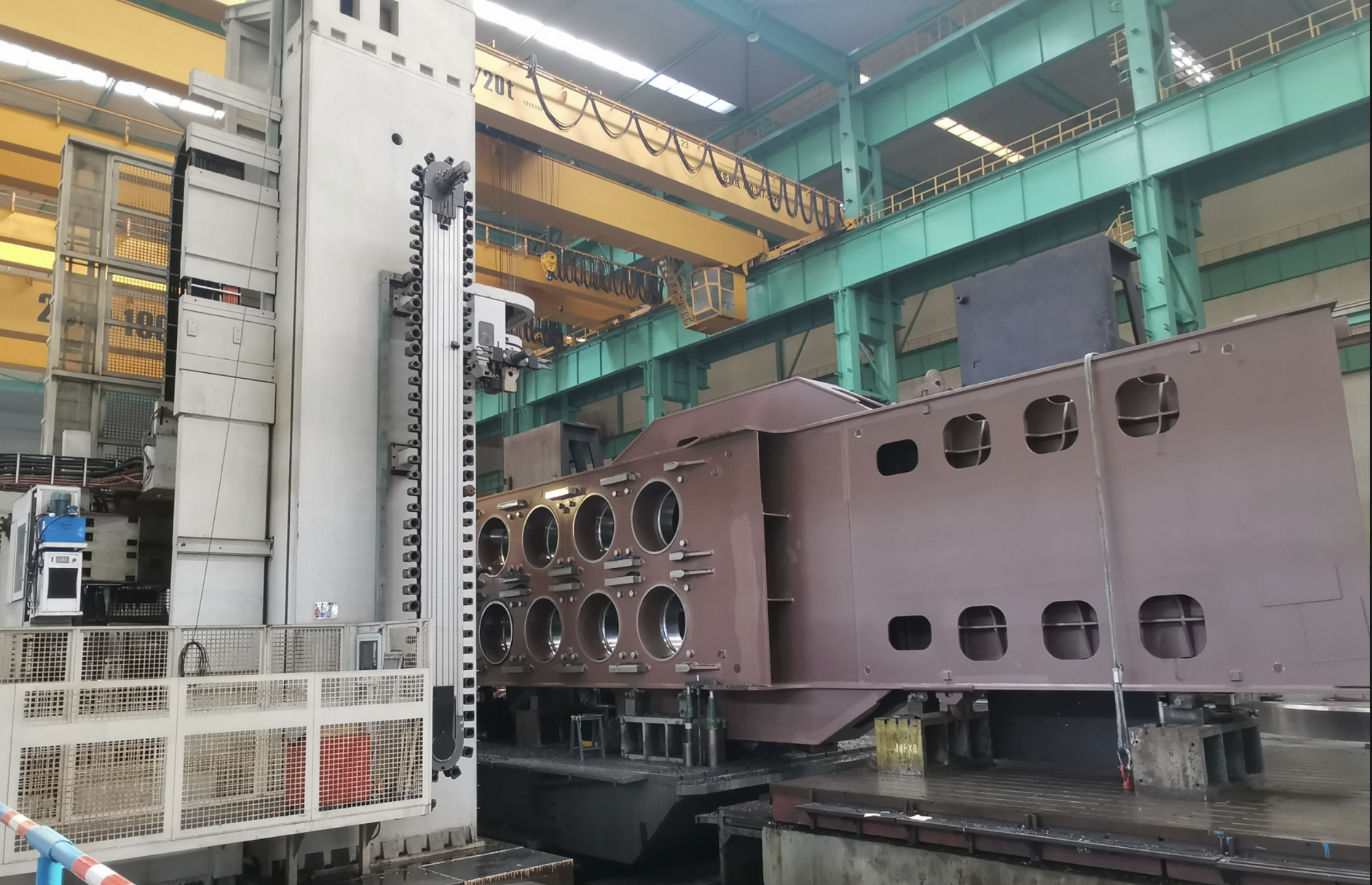
Large CNC milling and drilling capacity applied after welding fabrication. Post-weld machining is what converts a welded assembly into a dimensionally repeatable component.
The Evidence Stack: What Shop-Floor Proof Actually Looks Like
Long-term supplier evaluation is an exercise in matching claims to artefacts. The artefacts that carry the most weight are the ones that cannot be produced retroactively.
1. Named production premises and process inventory
A manufacturer states where it manufactures. Openex operates two manufacturing premises, near Xiamen Port and Shanghai Port, covering a reported 30,000 m² of factory space with around 200 employees, an annual output of 20,000 tons and a 35-engineer technical team, with roughly 80% of output exported. Its stated process range spans laser cutting, bending, punching and stamping, welding, machining, assembly, roll forming, casting, forging, galvanizing and powder coating. Each of those verbs should be verifiable against equipment photography or workshop footage, not only against a capability list.
2. Machine envelope — the constraint that shapes every other decision
Envelope is the single most under-weighted evaluation criterion. Openex publishes an overhead crane capacity above 250 tons, bending machine capability beyond 18 metres in length, and a maximum CNC machine tool travel of up to 50 m × 8 m × 7 m. Those numbers determine whether a large welded press frame, a machine base or a turbine ring can be produced in one piece or must be separated, rough-machined, recombined and finish-machined. The turbine ring supplied to a hydropower station in Uruguay followed exactly that sequence — separated pieces, re-assembly, then final precision machining — which is a legitimate engineering answer, but it is also a cost and schedule commitment the buyer should understand before award rather than after.
3. Inspection capability, not inspection promises
Inspection claims should be tied to named methods and named equipment. Openex's published non-destructive testing range includes RT, UT, MT, PT, VT and LT, with TOFD and phased array available in the welding scope, alongside hardness testing, hydrostatic and pneumatic testing and corrosion testing. Destructive capability covers chemical analysis on element composition, mechanical testing (tensile UTS, yield and elongation; impact including low-temperature; bend; hardness) and salt spray corrosion testing. Dimensional and visual inspection covers length, diameter, angle, roundness, straightness and position, plus surface roughness in Ra and Rz. Residual stress analysis, coating and plating inspection, and customised NDT systems are also listed.
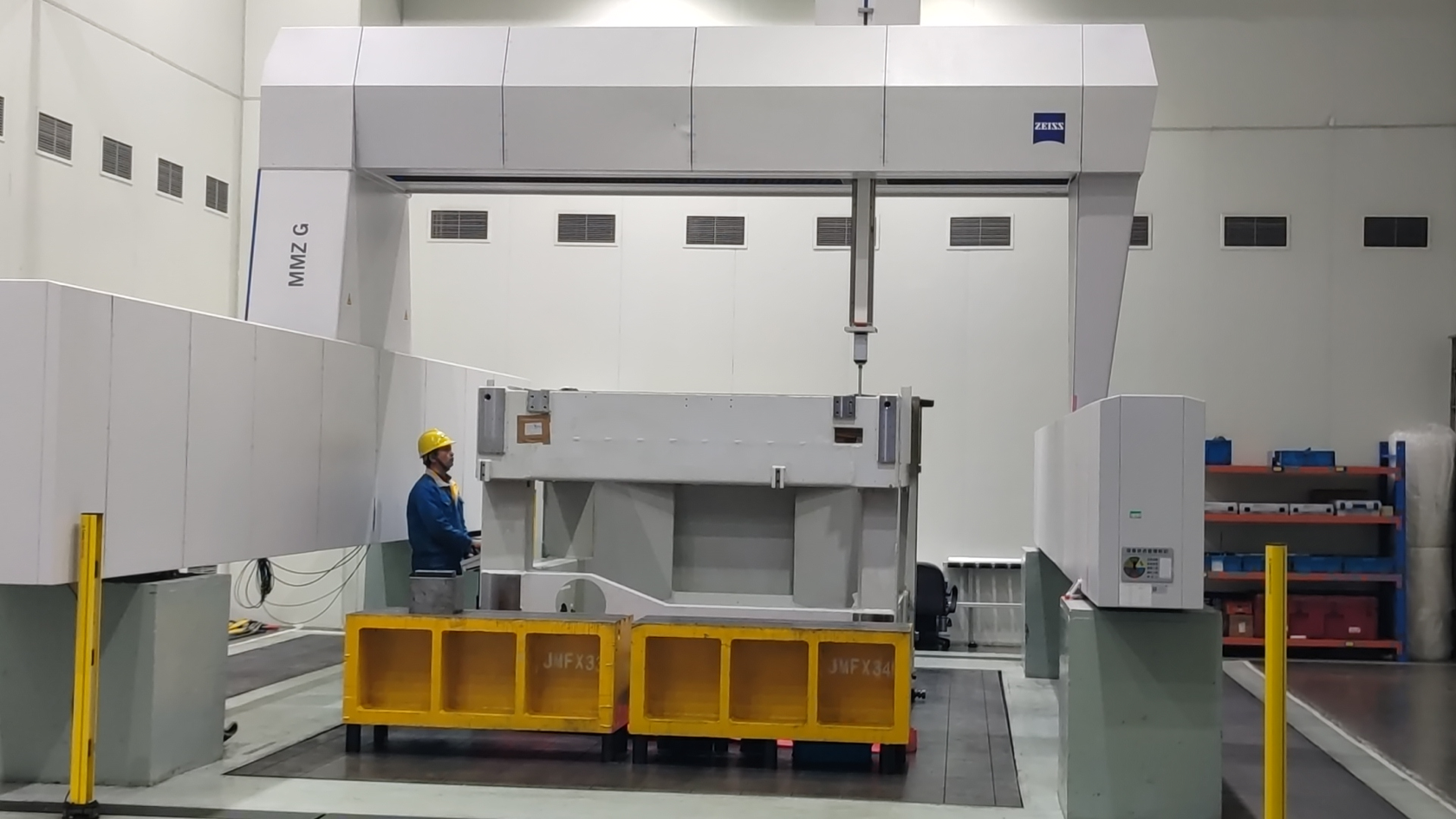
A Zeiss large CMM with 7 × 4 × 3 m capacity and micron-level precision. Metrology capacity of this size is what allows heavy weldments to be verified rather than assumed.
4. Automation as a repeatability instrument
Automation matters to long-term evaluation for one reason: it is the only mechanism that reliably removes shift-to-shift variation. The equipment Openex documents includes a six-axis industrial welding robot with ±0.05 mm repeat positioning accuracy and 24-hour continuous operation behind safety fencing; a Yaskawa six-axis robotic arc welding unit with ±0.2–0.5 mm trajectory accuracy, 5–50 mm/s welding speed, built-in seam tracking and 24/7 operation; an automatic welding machine for revolving hollow shafts up to 6,000 mm long with 600/800 mm ID/OD and 100–120 mm thickness at 10 rpm; an automatic welding unit that tilts ±90° for parts under 6 metres; and a French-made SAF PL130 plasma welding machine for 1–10 mm thickness on tubes up to 12.5 m. A buyer comparing two fabricators on the same drawing should compare these figures, not the adjectives.
5. Qualified procedures and the buyer's own WPS
The most consequential question in welding-heavy programs is whether the fabricator can qualify to the buyer's specification rather than to its own convenience. Openex lists WPS, PQR, welder qualification and PWHT procedures within its welding scope, and states that weld procedure qualification is fully customisable per the buyer's WPS. It documents SMAW, GMAW/MIG, GTAW/TIG, SAW, automatic tube-to-tubesheet welding, deep penetration welding and robotic welding, with joint design and preparation covering butt, fillet, corner, lap and edge joints, bevel angle, root gap and land thickness, and distortion-control planning offered as a value-added step.
Manufacturer or Supplier? The Certificate Scope Text Is the Tell
Certificates list the scope they were issued against, and that wording is more informative than the certificate's logo. Openex holds ISO 9001 (certificate 11426Q01049R001), ISO 14001 (11426E00739R001) and ISO 45001 (11426S00656R001), all issued on 16 April 2026 and valid to 15 April 2029 by Beijing East Allreach Certification Center Co., Ltd. The scope on all three reads: Manufacture of Machined Parts, Metal Structures and Sheet Metal Components (except where a license is required).
Two things follow from that sentence. First, the word "manufacture" indicates an audited production entity rather than a sourcing intermediary, which is the basic question a long-term buyer needs answered. Second, the carve-out — "except where a license is required" — is a real boundary, not a formality. Where a component falls into a licensed category, the management-system certificate does not cover it, and a separate qualification route must be agreed.
Welding certification deserves the same close reading. Openex's welding certification was issued by SGS against EN ISO 3834-2 and covers fusion welding of metallic materials under welding processes 135 and 135-automated for material groups 1.1 and 1.2. That scope statement tells a buyer which processes and material groups sit inside the audit boundary — and by omission, which sit outside it. Certificate validity windows also matter: certificates are issued with defined expiry dates, and buyers running multi-year programs should confirm current status at the point of award rather than at the point of first enquiry.
Purchasing Terms That Predict Multi-Year Continuity
Commercial parameters are the fastest way to test whether a fabricator's operating model fits a program. Openex publishes the following figures across its process families.
| Process family | Monthly capacity | Lead time | MOQ | Quality regime |
|---|---|---|---|---|
| Welding fabrication | 5,000 tons | 30–45 days | 25 tons | 100% test |
| CNC machining | 3,000 tons | 30–45 days | 15 tons | 100% inspection |
| Surface finishing | 3,000 units | 45 days | 15 tons | 100% or random check as required |
| Customisation and inspection-led builds | 1,000 pcs | 3 days | 1 unit | 100% or random test as required |
The asymmetry in that table is the interesting part. A 25-ton minimum on the welding path and a 15-ton minimum on machining do not suit trial or low-volume work, while the customisation path operates at a one-unit minimum with a three-day lead time and a different support model — remote after-sales support rather than the remote or on-site support offered on the welding and machining paths. A buyer running a multi-year program with mixed volumes should decide in advance which path each release will travel, and confirm that the associated support model matches the criticality of the component.
Market Trend Analysis: Why Program-Level Evaluation Is Becoming Standard
Several published signals explain why procurement teams are shifting from order-level to program-level supplier assessment in this category.
The first is scale. The fabricated metal products market reached USD 2.35 trillion in 2024, according to Strategic Market Research, which means the supplier base is large enough that shortlisting decisions carry real opportunity cost. The second is workforce constraint. U.S. fabricated metal product manufacturing employment stood at 1,460.8 thousand seasonally adjusted persons in August 2024, per the Bureau of Labor Statistics (NAICS 332), and in a labour-constrained environment the ability to automate consistency is a differentiator rather than a luxury.
Growth forecasts themselves are worth handling carefully. Market Research Future projects a 3.3% CAGR for the steel fabrication market across 2025–2035, while Mordor Intelligence reports a materially higher figure over a shorter window. The variance is best explained as a scope difference — whether primary steel output is included alongside the fabrication service layer — rather than as a disagreement about demand. The practical implication for buyers is that no single growth figure should drive a capacity commitment; the supplier's own capacity, lead time and MOQ data should.
Two further signals shape the technical side of evaluation. Structural steel components accounted for 39.3% of application share in 2024 (Market Data Forecast), confirming that structural work remains the dominant demand centre that any broad fabricator must be organised around. And for pressure-retaining equipment, ASME BPVC Section IX governs welding and brazing qualifications — a standard buyers in oil, gas and power supply chains will expect to see reflected in a fabricator's procedure documentation.
Comparison with Traditional Solutions — and Where the Limits Sit
Traditional single-order sourcing optimises for unit price and delivery on one drawing. Program sourcing optimises for the cost of the fourth and fifth year — rework rates, engineering change absorption, documentation continuity and the risk that a supplier's attention decays once the account is won. Moving from the first model to the second usually produces a higher apparent unit price against a lower total program cost, which is why the shift is resisted internally until a quality escape forces it.
The limits of an integrated fabrication-and-machining model are equally real and should be stated plainly, because a supplier profile without boundaries is not an evaluation input.
- Reference configurations are starting points, not guarantees. Openex's own documentation flags that its press frame reference requires FEA and fatigue assessment, that vacuum chamber wall and stiffener design requires vacuum engineering, that welded crossbeam section and weld design require load analysis, that skid load rating and lifting points require structural review, and that actual weldment envelope and tolerance depend on the datum scheme.
- Machine envelope constrains geometry strategy. Very large components may need to be split, rough-machined, recombined and finish-machined, and the turbine ring delivered to a hydropower station in Uruguay followed that route. It is a workable solution, but it changes tolerance planning and adds a handling cycle.
- Minimum order quantities do not suit every buyer. A 25-ton MOQ on the welding path and 15 tons on machining are program-scale thresholds. Buyers with small or irregular release patterns may not fit that model.
- Lead times require demand planning. At 30–45 days for welding and machining and 45 days for surface finishing, buyers must plan at program level rather than ordering reactively.
- Certification scopes carry carve-outs. The ISO scope excludes categories where a licence is required, and certificate validity must be confirmed at the point of award.
- Support models differ by path. Remote-or-on-site support applies to the welding and machining paths, while the customisation path is listed as remote support only.
Future Outlook
Three shifts are likely to shape how long-term metal fabrication partners are evaluated over the next several years.
First, metrology capacity will move from a quality-department detail to a headline procurement criterion. As components such as vacuum chambers, tube sheets and heavy machine bases carry acceptance figures that are stated in microns or in leak rates rather than in overall dimensions, the ability to verify rather than assume becomes the binding constraint. In Openex's case, the published metrology assets include a Zeiss large CMM with 7 × 4 × 3 m capacity at micron-level precision alongside smaller CMMs, plus CMM, UT, PT, MT and PMI inspection on tube sheet work.
Second, certificate lifecycle management will become a standard clause in multi-year agreements. As management-system certificates and welding certifications carry defined validity windows, program buyers will increasingly require a named owner for renewal, because an expiring certificate inside a program is an avoidable stoppage.
Third, the combination of fabrication and machining inside one supplier will keep gaining weight. Welding without post-weld machining caps the achievable tolerance; machining without fabrication control caps the achievable scale. Suppliers documented as holding both — with an overhead crane above 250 tons, bending capability beyond 18 metres, CNC travel up to 50 m × 8 m × 7 m, and 5,000 tons monthly welding capacity alongside 3,000 tons monthly machining capacity — are structurally better positioned to absorb a multi-year smart-manufacturing program than suppliers holding only one half of the chain.
FAQ
How can a buyer tell whether a metal fabricator is an actual manufacturer rather than a trading supplier?
The clearest signal is the scope wording on the management-system certificates rather than the marketing description. Xiamen Openex Mechanical Technology Ltd holds ISO 9001 (certificate 11426Q01049R001), ISO 14001 (11426E00739R001) and ISO 45001 (11426S00656R001), issued 16 April 2026 and valid to 15 April 2029, with a scope reading "Manufacture of Machined Parts, Metal Structures and Sheet Metal Components (except where a license is required)." A scope that names manufacture points to an audited production entity. Supporting artefacts include named manufacturing premises — Openex operates two, near Xiamen Port and Shanghai Port — together with equipment inventories and factory or workshop imagery showing the claimed processes in operation.
Which metal and material groups should a heavy fabrication partner be able to process?
For heavy and large components the usable material range is wider than carbon steel alone. Openex's welding scope lists carbon steels, stainless steels, duplex and super duplex grades, clad and composite plates, and low-alloy steels, while its tube sheet work covers carbon steel, stainless steel, duplex stainless steel, titanium, stainless steel clad steel and high-strength alloy steel. Welding certification scope is narrower and more precise: the SGS-issued EN ISO 3834-2 certification covers fusion welding of metallic materials under welding processes 135 and 135-automated for material groups 1.1 and 1.2. Buyers should map their component list against both the process capability statement and the certified scope, because the two are not identical.
What shop-floor and certification evidence should be verified before shortlisting a fabricator?
Evidence should be specific and non-retrofittable. On the shop floor, that means named premises, crane and machine envelope figures, and inspection equipment that matches the acceptance criteria — for example an overhead crane above 250 tons, bending capability beyond 18 metres, CNC travel up to 50 m × 8 m × 7 m, and CMM capacity of 7 × 4 × 3 m at micron-level precision. On documentation, it means WPS, PQR, welder qualification and PWHT procedures, plus NDT methods such as RT, UT, MT, PT, VT, LT, TOFD and phased array. On certification, it means reading the scope text and the validity window on each certificate rather than counting certificates.
How is repeatability tested on large welded structures such as press frames and machine bases?
Repeatability is tested against functional geometry across successive batches, not against overall dimensions. Relevant acceptance figures include ground-top flatness of ±0.001 in cumulative on the B-300 machine base, pad coplanarity of ≤0.20 mm per 1,000 mm on a welded automation frame, datum-pad flatness of ≤0.15 mm per 1,000 mm on a large precision-machined weldment, and machined-face flatness of ≤0.10 mm per 1,000 mm on a press platen. Where welding alone cannot hold the figure, the sequence matters: the B-300 base is welded, stress-relieved and shot-blasted before grinding, and heavy components are commonly machined after welding. Buyers should also confirm whether stress relief is a scheduled step or an order-by-order option.
What purchasing terms indicate a fabricator can support a multi-year program?
Capacity, lead time, minimum order quantity and sampling regime together indicate whether the operating model fits program demand. Openex publishes 5,000 tons monthly welding capacity with 30–45 day lead time and a 25-ton MOQ under a 100% test regime, 3,000 tons monthly machining capacity with 30–45 day lead time and a 15-ton MOQ under 100% inspection, and 3,000 units monthly surface finishing with a 45-day lead time. A separate customisation path operates at 1,000 pcs monthly capacity, a 3-day lead time and a one-unit MOQ with 100% or random testing as required. Buyers should confirm which path each release travels, because MOQ, lead time and after-sales model all change between them.
Which component types fit this supplier profile, and where do the limits sit?
Documented scope spans large welded press frames, heavy machine bases, turbine rings for hydropower stations, AGV steel chassis, thermal and box vacuum chambers, tube sheets, heat exchanger cores, pressure vessels, large welded crossbeams, equipment skids, platens, energy storage steel frames and enclosures. Documented limits matter equally. Reference configurations are engineering starting points requiring FEA, fatigue assessment, load analysis, datum scheme definition or vacuum engineering review; some very large components must be split and recombined, as on the 30-ton turbine ring project in Uruguay; welding and machining MOQs of 25 tons and 15 tons do not suit small or irregular releases; and the ISO scope excludes categories where a licence is required.
For procurement teams building a long-term supplier file, the most useful starting point is not a capability claim but a document trail: certificate scopes and validity windows, machine envelope figures, inspection methods matched to acceptance criteria, and commercial thresholds that fit the program's release pattern. Openex's manufacturing profile, process range and capability portfolio are consolidated in its downloadable manufacturing brochure, which can be used as a reference document when mapping a fabricator's stated evidence against a specific program requirement.