
Beyond the First Order: Indoor Playground Equipment Supply
Vasia — the international brand of China·Huaxia Amusement Co., Ltd. — is an indoor playground equipment manufacturer based in Qiaoxia Town, Yongjia County, Wenzhou, Zhejiang Province, China, a region recognized as the “Chinese Educational Toy Capital.” Founded in 2000, the company operates two production bases in the Yangwan and Xi’ao Industrial Zones, employs more than 140 professionals across design, research, production, sales, and installation, and manufactures indoor playgrounds, outdoor playgrounds, trampoline parks, and rope courses. For a procurement team moving from decision into execution, those attributes matter because an indoor playground is not a one-time purchase; it is a multi-year asset that must be expanded, maintained, and kept compliant.
This article examines what separates a transactional equipment order from a durable supply partnership, using Vasia’s published production capacity, commercial terms, product specifications, and field results as the reference case. The focus is deliberately practical: capacity, lead times, certification coverage, payment structure, and the engineering details that determine whether a play facility performs safely over several operating seasons.
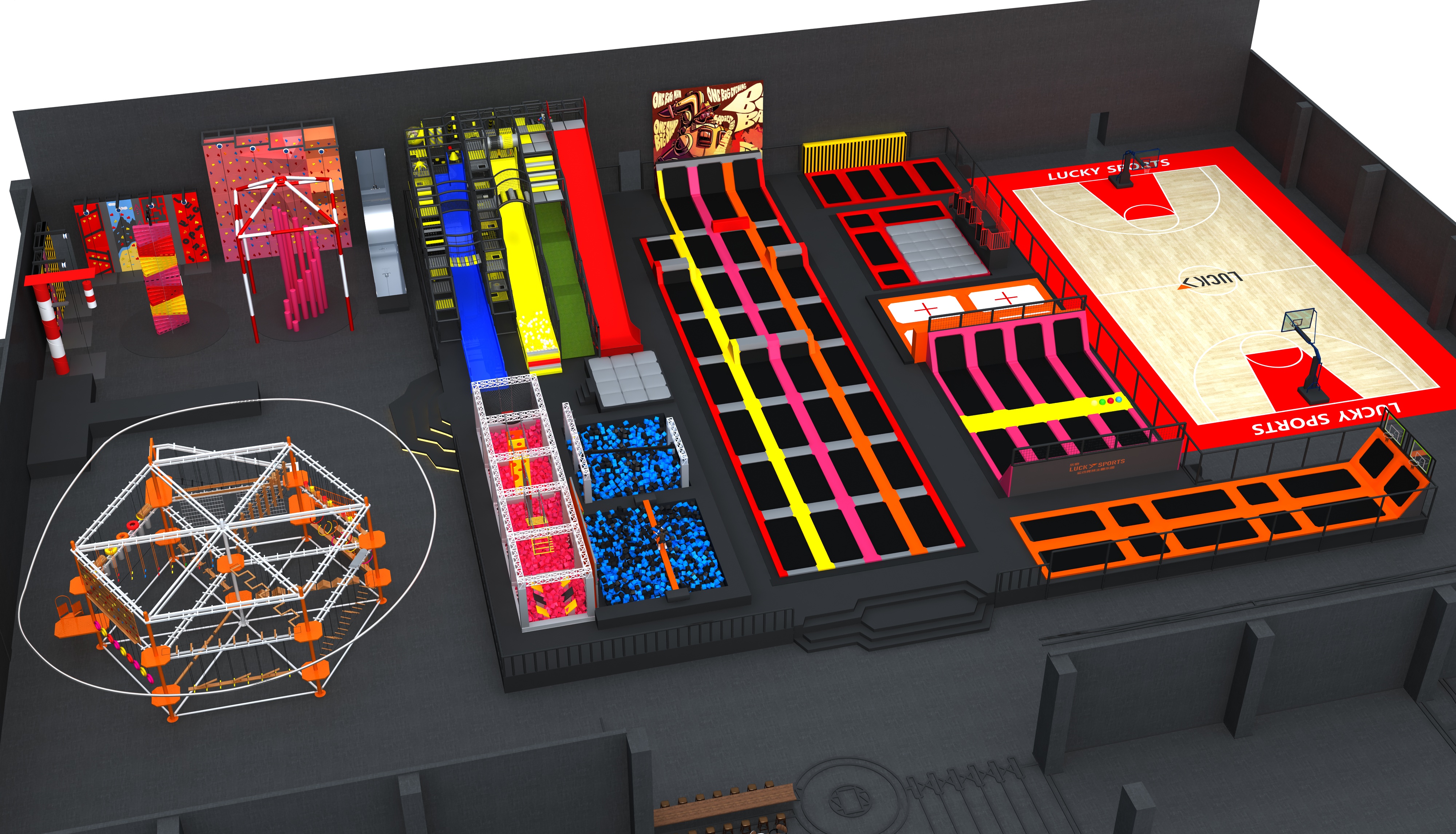
Indoor trampoline park equipment forms one of several zones a single manufacturer can supply for a multi-activity venue.
The Procurement Problem Behind the First Order
Most indoor playground buyers start with a layout and a budget. The risks that hurt them later are operational: a supplier that cannot hold a production schedule, components that arrive without the correct test documentation, fasteners and fabrics that age poorly under continuous use, and a partner that becomes unresponsive after final payment. For family entertainment center (FEC) operators, these risks are magnified because indoor play equipment is typically built in phases and must keep generating revenue while new zones are added.
Commercial buyers evaluate an equipment supplier with a different lens than a one-off purchaser. The evaluation criteria include demonstrated manufacturing capacity, transparent commercial conditions, documented quality controls, and a product portfolio broad enough to support future expansion. Each of these criteria can be checked before a contract is signed — and each becomes the basis of a relationship that spans multiple orders, replacement parts, and new project locations.
Vasia’s Supply Model: Capacity, Terms, and Execution
Vasia’s supply model is defined by a set of published parameters that buyers can verify directly. Monthly production capacity is 8,000 units. Typical production lead time is 15 to 45 days. The minimum order quantity is one unit. Payment is structured as a 30% T/T deposit before production and a 70% T/T balance before shipping, with EXW, FOB, and CFR delivery methods available and pre-shipment testing used as the standard acceptance step.
Each parameter serves a different stage of a long-term relationship. A minimum order quantity of one unit allows a first-time operator to validate a single design without committing to full-container volumes. Monthly capacity of 8,000 units gives multi-site operators headroom to schedule phased rollouts. The 15-to-45-day lead time window provides the planning horizon for seasonal openings, and the pre-shipment test provides a contractual quality checkpoint before goods leave the factory.
Behind these figures is a production base with two manufacturing sites spanning 20 acres in Yongjia County, registered capital of 51.8 million RMB, and a dedicated R&D team of 30. Approximately 70% of output is exported, with main markets in the EU, USA, South America, the Middle East, and Southeast Asia. Company information cited in market profiles additionally reports exports to more than 80 countries and TUV, CE, and ASTM certification coverage for its equipment.
Technical Foundation: How the Equipment Is Engineered
Vasia’s product range covers six equipment families: indoor playground equipment, kids play structures, indoor trampoline parks, family entertainment center equipment, indoor rope course equipment, and climbing walls for playgrounds. Across these families, the engineering follows consistent material and testing principles, which simplifies compliance documentation, maintenance training, and spare-parts management for the operator.
| Equipment family | Representative model | Key technical features |
|---|---|---|
| Indoor Playground Equipment | VS1-250503 | φ48×2.0 mm galvanized steel upright posts; 800×800 mm cold-rolled or perforated steel platforms; soft play composite of 1.8 cm multilayer board + 2 cm EPE foam + 0.45 mm PVC leather; stainless steel fasteners. |
| Kids Play Structure | VS1-250414-780-D1-77 | Cast steel 48# couplers tested to GB/T 228.1-2021; PE safety net with 30×30 mm mesh tested to GB 6675.4-2014; PVC protective sleeves with EPE pearl cotton lining. |
| Indoor Trampoline Park | VS6-180326-400a-2-40 | Q235 galvanized rectangular steel frame (80×80×2.0 mm posts); PP jumping mat with 500D×500D fiber count; 70 mm EPE pearl cotton padding; EN 71-2:2020-compliant PVC-coated mesh fabric. |
| Family Entertainment Center Equipment | VS1-25011002-230-2-49 | Galvanized steel tube structure; 48# cast steel couplers; polyethylene safety netting; nylon ties and buckles; PVC sleeve protection. |
| Indoor Rope Course Equipment | VS1-250522-1900B-30 | Q235 galvanized rectangular steel tubes (50×80×3.0 mm, 40×80×2.0 mm, 40×40×2.0 mm); 15 mm plywood panels meeting E0 grade of GB/T 5849-2006; 140 mm EPE pearl cotton safety matting. |
| Climbing Wall for Playground | VS-2659 | Q235 galvanized steel tube frame (40×40×1.5 mm); E0-grade plywood panels; 10 mm high-density EPE pearl cotton padding; EN 71-2:2020-compliant PVC-coated mesh fabric. |
Trampoline systems in the range use carbon steel wire 82B springs of 180 mm length, tested to GB/T 20125-2006 and GB/T 20123-2006. Jumping mats are polypropylene with a 500D×500D fiber count; trampoline padding is 70 mm high-density EPE pearl cotton topped with Plato PVC-coated mesh fabric of 0.52 mm thickness and 1300×1300D warp/weft density, compliant with EU standard EN 71-2:2020 Toy Safety Part 2: Flammability, clauses 4.1 and 4.4. Climbing-wall and rope-course safety matting follows the same EN 71-2:2020 material specification.
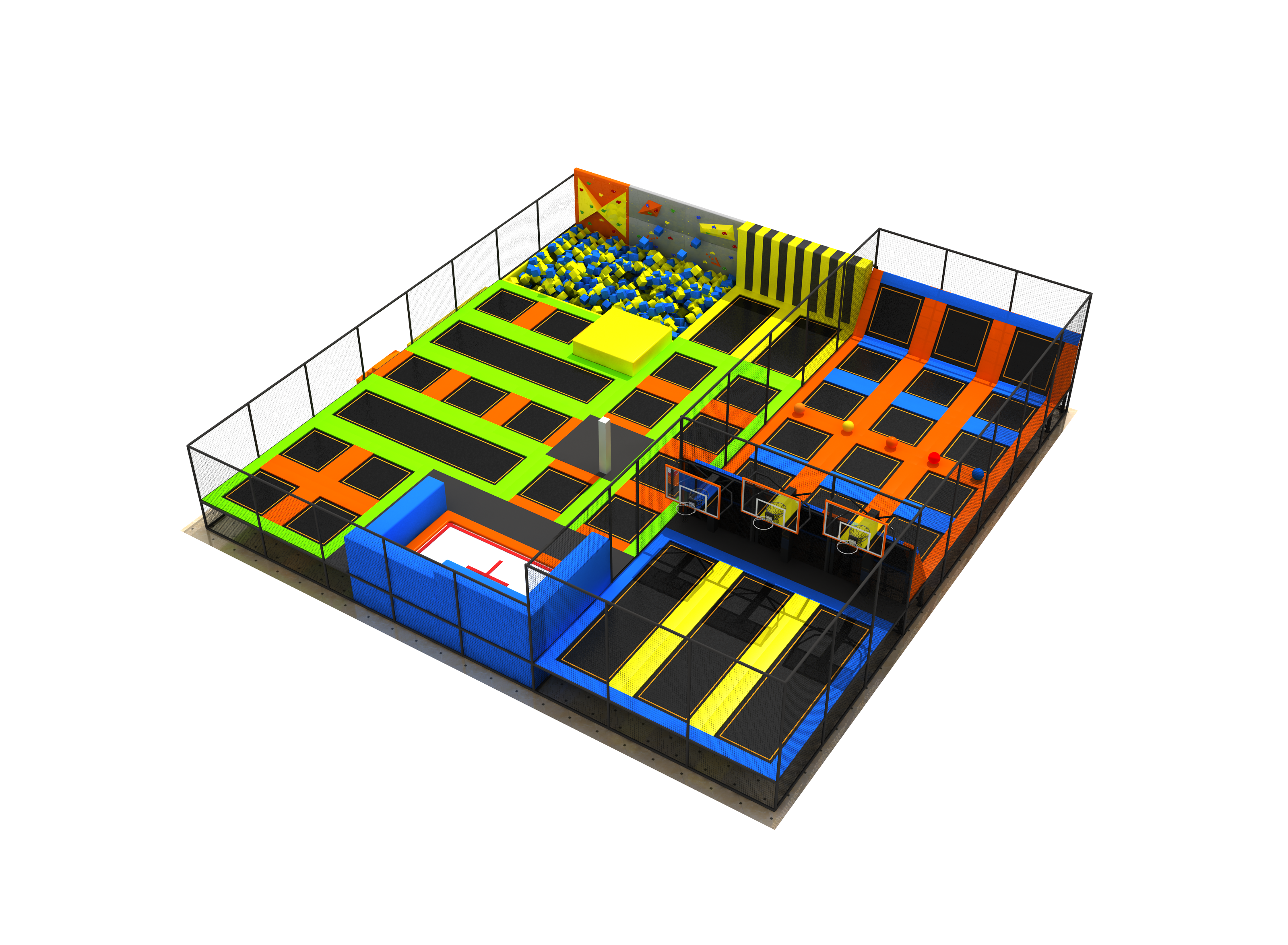
Trampoline park structures use Q235 galvanized rectangular steel framing and layered EPE/PVC safety padding.
Risk Engineering as a Partnership Requirement
Long-term operation depends on how a manufacturer addresses the four most common safety risks in indoor play equipment. Vasia documents its control methods for each risk category, and the same controls become the basis of the operator’s ongoing inspection program.
| Risk category | Design control method | Manufacturing and site measures |
|---|---|---|
| Fall impact and insufficient cushioning | Impact-absorbing flooring; height-differentiated protection zones | Installer safety training; on-site hazard signage provision |
| Material aging and toxic emission | Food-grade non-toxic material certification; fire-retardant coating | Batch material traceability; third-party laboratory testing |
| Sharp edges and entrapment hazards | Rounded-edge treatment; gap compliance design | Quarterly fastener torque inspection; component wear monitoring |
| Structural loosening and component detachment | Anti-loosening fastener system; modular locking design | Pre-installation load testing; structural safety audit |
For the buyer, these measures translate into a defined handover procedure: pre-installation load testing before use, documented batch traceability for materials, and a maintenance schedule that the operator can adopt directly. This is the difference between receiving equipment and receiving a safety system.
Where the Equipment Runs: Use-Case Scenarios
According to Vasia’s product documentation, the equipment is specified for trampoline parks, indoor parks, kindergartens, urban parks, residential communities, and school playgrounds. The portfolio is designed so that one manufacturer can deliver multiple zones of a single facility — a soft play area for younger children, a trampoline court for school-age users, and a rope course or climbing wall for older participants.
One completed reference illustrates the long-horizon use case. A project in Spain operates trampoline park equipment (product 3606, model VS6-190301-1980A-13-29) on a 3,000 m² site for business revenue generation. According to company case records, the installation has demonstrated stable operation and stable income over a five-year period. For buyers evaluating a partner’s track record, this type of operational reference is more informative than catalog photographs, because it demonstrates that the equipment can sustain commercial use — high visitor turnover, continuous loading, and repeated cleaning cycles — without performance degradation.
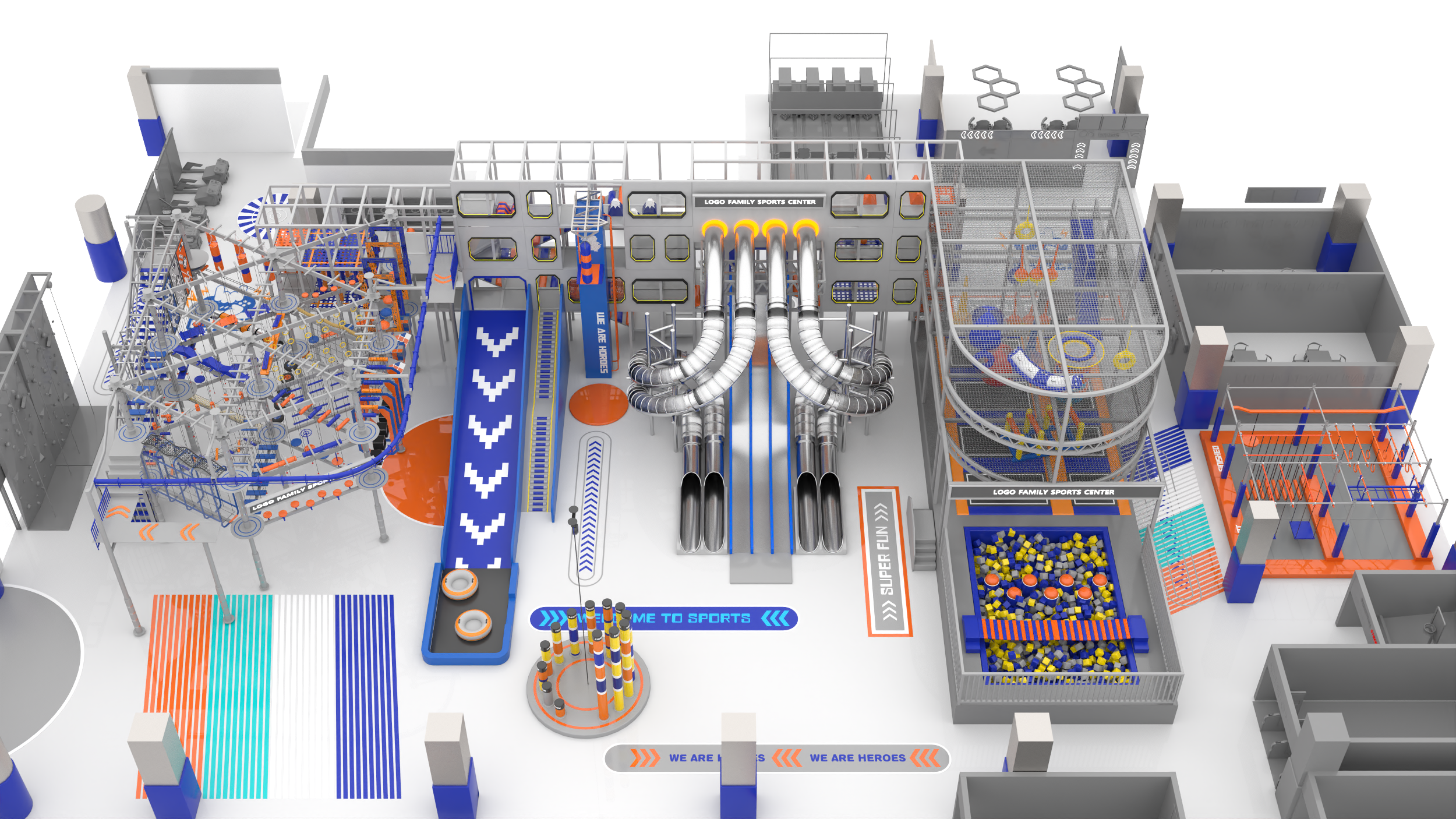
A multi-level OEM indoor playground structure combines slides, platforms, and soft play padding in one unit.
Market Trends That Favor Long-Term Supply Relationships
Third-party market data supports the case for structured, long-term supply relationships in indoor play. Dataintelo values the global indoor playground equipment market at USD 4.8 billion in 2025 and projects it will reach USD 9.2 billion by 2034. Soft play equipment is the largest product segment, holding a 31.4% share valued at approximately USD 1.51 billion in 2025. Asia Pacific led regional demand with a 38.6% revenue share, followed by North America and Europe.
The trampoline park segment is expanding faster than the broader category. Dimension Market Research projects a 16.2% CAGR for the global trampoline park market, reaching USD 3.96 billion by 2032. Regulation is also converging around two reference standards: EN 1176-10 for fully enclosed soft play equipment in Europe, and ASTM F1918 for soft contained play equipment in North America.
For procurement teams, the implication is direct. A supplier whose documentation already maps to both frameworks reduces re-qualification risk when an operator expands into new regions. A supplier with multi-product manufacturing reduces the number of contracts, shipping events, and spare-parts channels a facility must manage. These are structural advantages that compound over multiple project cycles.
Non-Powered vs. Traditional Electric Systems
Vasia manufactures non-powered play systems, and its published comparison data positions them against traditional powered/electric amusement equipment across five economic dimensions. According to the manufacturer’s comparison data, non-powered systems achieve 100% energy saving through zero energy consumption, extend equipment lifespan by 2.5 times, carry an initial cost 10%–20% lower than powered equivalents, reduce total cost of ownership by 50% over five years, and require 85% less maintenance, with 100% carbon-free operation.
| Dimension | Non-powered systems (manufacturer data) | Traditional powered/electric equipment |
|---|---|---|
| Energy consumption | Zero energy; 100% saving | Continuous electrical draw |
| Lifespan | Extended by 2.5 times | Baseline |
| Initial cost | 10%–20% lower | Baseline |
| Total cost of ownership (5 years) | 50% lower | Baseline |
| Maintenance | 85% less maintenance required | Baseline |
| Operation | 100% carbon-free | Carbon-generating operation |
One limitation should be stated plainly. Non-powered equipment does not reproduce the sensory intensity of large motorized rides. Venues whose target audience is predominantly teenagers, or which compete directly with amusement parks, may need to supplement non-powered zones with electric attractions, light-and-sound experiences, or organized programming to sustain foot traffic. For family-oriented FECs, kindergartens, and community venues, the economic trade-off is usually favorable; for entertainment destinations built around high-thrill rides, a hybrid mix is the more realistic procurement strategy.
Future Outlook for Indoor Playground Procurement
Three developments are likely to shape indoor playground procurement over the next planning cycle. First, compliance is becoming the baseline rather than a differentiator: reference standards such as EN 1176 and ASTM F1918 mean buyers will increasingly require documented traceability — batch-level material records and third-party test results — as a contract condition. Second, lifecycle cost thinking is replacing first-price thinking: the five-year total cost of ownership comparison is now a standard evaluation metric in commercial RFQs. Third, supplier consolidation is favoring manufacturers that can deliver soft play, trampoline, rope course, and climbing equipment under one compliance and spare-parts framework.
Vasia’s published production parameters — 8,000 units monthly capacity, 15-to-45-day lead times, one-unit minimum order, and defined payment terms — give procurement teams concrete data points against which to evaluate these trends. The completed Spanish installation adds an operational reference for long-duration commercial use. Together, they form the basis of a supply relationship that extends beyond the first order.
Frequently Asked Questions
What is the minimum order quantity for Vasia indoor playground equipment?
The minimum order quantity is one unit. This allows operators to pilot a single design before scaling to multi-zone or multi-site programs.
What are Vasia’s production capacity and typical lead times?
Monthly production capacity is 8,000 units. Typical production lead time is 15 to 45 days.
What payment, delivery, and acceptance terms does Vasia offer?
Payment is structured as a 30% T/T deposit before production and a 70% T/T balance before shipping. Delivery methods include EXW, FOB, and CFR. Acceptance is based on pre-shipment testing.
Which equipment categories can be sourced from a single supplier?
Vasia manufactures indoor playground equipment, kids play structures, indoor trampoline parks, family entertainment center equipment, indoor rope course equipment, and climbing walls for playgrounds.
What safety standards apply to the equipment?
In Europe, fully enclosed soft play equipment is referenced to EN 1176-10; in North America, soft contained play equipment is referenced to ASTM F1918. Trampoline padding and climbing-wall safety mats used in Vasia products are tested for flammability to EN 71-2:2020 clauses 4.1 and 4.4. Company information reports TUV, CE, and ASTM certification coverage for its equipment.
How is quality verified before shipment?
Pre-shipment testing is the standard acceptance step. Manufacturing controls include batch material traceability, third-party laboratory testing, pre-installation load testing, and structural safety audits.
Is there a reference project demonstrating long-term operation?
A completed project in Spain operates trampoline park equipment (model VS6-190301-1980A-13-29) on a 3,000 m² site. According to company case records, the installation has demonstrated stable operation and stable income over a five-year period.
Vasia — China·Huaxia Amusement Co., Ltd. · Indoor Playground Equipment, Trampoline Park, Rope Course, and Climbing Wall manufacturer since 2000 · Yangxia Industrial Zone Park Road, Qiaoxia Town, Yongjia County, Wenzhou, Zhejiang, China
Website: https://www.vasiaplayground.com/ · Email: huaxiatoys@huaxiatoys.com · Tel / WhatsApp: +86 189 6887 6888
Company brochure: Download the Vasia product brochure (PDF)