
Beyond the Machine List: What SMT Turnkey Capability Really Means
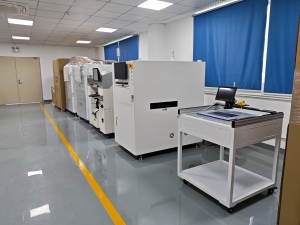
A competitive SMT turnkey solution is not a catalogue of machines. It is an execution capability: how a supplier translates a circuit board assembly requirement into a line layout, selects and integrates equipment, customizes the configuration, tests it before shipment, and supports it after installation. For electronics manufacturers moving from supplier evaluation to deployment, the question is not only which machines are offered, but what the provider can actually deliver as an integrated production system.
The Procurement Gap in SMT Turnkey Projects
Most SMT turnkey quotations look similar on paper: a solder paste printer, one or more pick and place machines, a reflow oven, inspection equipment, and conveyor modules. The differences between suppliers appear only when the line has to run in production. Board size ranges, component types, changeover frequency, soldering profiles, inspection coverage and operator training all affect whether the same equipment list produces a working line or a costly integration project.
Buyers at the evaluation stage are therefore shifting from comparing equipment brands to verifying supplier capabilities. The practical question is whether the supplier can handle line layout design, equipment matching, documentation, pre-shipment validation, delivery and after-sales service as a single accountable point. This is where the definition of turnkey separates from the label.
Why Capability Has Become the Decisive Factor
The market context supports this shift. The global surface mount technology equipment market was valued at approximately USD 6.6 billion in 2025 and is projected to grow to USD 14.6 billion by 2036, according to Transparency Market Research. Asia-Pacific accounted for the largest regional share at around 54% in 2025. Placement equipment, led by pick and place machines, remains the largest product segment, representing roughly 38% to 48% of the total market value.
At the same time, the high-mix / low-volume production segment is expanding faster than average. Mordor Intelligence projects a compound annual growth rate of 8.31% through 2031, driven by customized industrial and medical electronics. Inspection technologies are also gaining weight: 3D AOI and SPI are considered the fastest-growing equipment sub-sectors, with Persistence Market Research reporting around 15.2% CAGR for inspection, linked to zero-defect requirements in automotive electronics.
For a buyer planning a new SMT line, these trends mean two things. First, flexibility and inspection capability deserve as much attention as placement speed. Second, a supplier that only sells machines without providing line-level engineering support leaves the buyer to carry the integration risk. That risk is exactly what a turnkey solution is supposed to remove.
Motek: A Capability-Focused SMT Turnkey Supplier
Motek, operating under the legal name Morel Equipments Co., Ltd., is a Shenzhen-based SMT equipment trading and integration company. Founded in 2011, the company has positioned itself as a one-stop platform for SMT solutions under an OEM/ODM model. Its facility spans 955 square meters and is equipped with production and testing resources that support assembly, customization and pre-shipment validation. The company reports an annual output of 300 to 500 units and exports 100% of its equipment, with main markets in the EU, USA, Australia, Canada and the ASEAN region.
The OEM/ODM element is central to Motek's capability profile. In practice, the company says it can customize voltage, logo, personal service plans, optional remote or on-site training, and production line layout design. Product-level customization also covers logo, label, packaging, color, size, graphics and material. This matters for procurement because a turnkey line is rarely a standard configuration: input power conditions, labeling rules, packaging requirements and floor layouts differ from one factory to another.
Motek's related product lineup includes the Hanwha Decan S2 SMT pick and place machine, the XMR-800D SMT reflow oven, and the HMH830D automatic online glue dispenser. The company's broader main product range covers reflow soldering, plug-in machines, pick and place machines, cleaning machines, PCBA protection products and PCB cutting machines. In the context of a turnkey line, these elements are selected and combined according to the customer's board types and production volume.
From a buyer's perspective, the significance of Motek's model is that integration and customization are offered as part of the delivery scope, not as separate engineering services. The declared monthly capacity of 5,000 units, lead time of 7 to 45 days, and an MOQ of 1 unit give small and mid-size electronics manufacturers a realistic path to a custom-configured line without committing to large minimum orders.
Compliance evidence supports the capability claim. Motek holds an ISO 9001:2015 / GB/T 19001-2016 quality management certificate (No. HIC210707, issued by Shenzhen Hua Kai Inspection & Certification Co., Ltd., valid until 2027-07-10) covering the sale of pick and place machines, solder paste printers and related equipment. The company also holds a Machinery Directive 2006/42/EC Attestation of Conformity (No. M.2023.206.C91284) for the ICT Handler models PMP-2000L and PTI-2000L, and a registration under the German Packaging Act (VerpackG, No. DE2364478064729) for manufacturers of filled packaging. These are verifiable documents that buyers can check during supplier qualification.
Technical Foundation: How an SMT Turnkey Line Is Structured
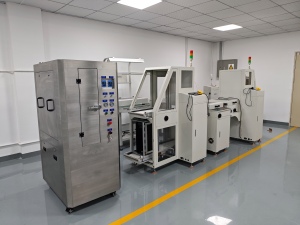
An SMT turnkey line typically follows a standard process flow, although the exact configuration depends on the product. The key stages are solder paste printing, solder paste inspection (SPI), component placement, reflow soldering, and post-reflow inspection. Supporting and peripheral equipment includes PCB loaders and unloaders, buffer conveyors, stencil cleaning machines, depaneling routers, and cleaning machines for assembled PCBs. In more advanced lines, X-ray inspection is added for BGA and other hidden solder joints, and AOI is used for optical defect detection.
Placement equipment is the largest cost and performance driver in this flow. The Hanwha Decan S2, offered within Motek's turnkey configurations, illustrates the performance level expected from a modern mounter. At its optimum configuration with the HS10 head, it reaches 92,000 CPH, with a structure of two gantries and ten spindles per head. Accuracy is specified at ±28μm with Cpk ≥ 1.0 for 03015 chips and ±25μm with Cpk ≥ 1.0 for ICs. The machine handles component sizes from 03015 up to 12mm with 10mm height, and PCBs from 50 x 40mm to 510 x 460mm in the standard configuration.
For a buyer, these numbers translate into two decisions. First, the mounter can support high-density boards such as smartphone motherboards and ECU assemblies. Second, the component and PCB ranges define how many product types a single line can handle without adding another placement machine.
The reflow oven determines whether the soldering profile matches the board and solder paste. The XMR-800D reflow oven in Motek's range offers eight heating zones on top and eight on the bottom, with a heating zone length of 3110mm, plus three cooling zones on each side. Its small circulation rectifying plate design is intended for temperature uniformity. The oven weighs approximately 2710kg and requires an exhaust volume of 11m³/min per exhaust, two exhausts in total. Buyers need to verify that their factory can meet these utilities during the installation planning phase.
For mixed assembly processes that require adhesive or underfill, the HMH830D automatic online glue dispenser provides a computer-controlled dispensing stage. Its technical parameters include a PCB transfer height of 920 ± 20mm, transportation speed of 0 to 5000mm/min, PCB width range of 50 to 450mm, and storage for more than 1000 programs. The ability to store a large number of programs is directly relevant for high-mix production where frequent changeovers are the norm.
These three machines show why turnkey integration is more than logistics. Equipment has to match at the level of PCB transfer height, transport direction, communication of process parameters, and workflow between printing, placement and reflow. Motek's stated service scope includes production line layout design and optional remote or on-site training, which addresses this integration requirement before the line is shipped.
Application Scenarios: From Consumer Electronics to Automotive Controls
In documented application cases spanning a five-year period, SMT equipment provided through Motek's turnkey approach has been used across several electronics manufacturing segments. Reported applications include smartphone motherboard assembly, tablet computer circuit board production, ECU control unit assembly, LED display modules, and LED streetlight drivers. In one consumer electronics application, the equipment supports smartphone PCB assembly at a volume of around 50,000 units per month.
These cases share common characteristics: high board density, small component sizes, and a requirement for repeatable quality at scale. For high-volume consumer electronics, placement speed and consistent solder joint quality are primary. For automotive ECUs, reliability under vibration and temperature variation becomes critical, which is why inspection coverage and process control matter as much as the placement itself.
The reported production result in these configurations is mass production throughput of 20,000 to 100,000 pieces per day, depending on the product and line configuration. That range illustrates that a turnkey line is not a single fixed system; it is a set of equipment and engineering choices scaled to the customer's output target.
Market Trends Shaping SMT Turnkey Procurement
Several verifiable market trends are changing how buyers evaluate SMT turnkey suppliers.
- Inspection is moving toward zero-defect requirements. The reported 15.2% CAGR for 3D AOI and SPI reflects demand from automotive and medical electronics for process verification beyond sample inspection. Turnkey line designs are increasingly expected to include inline SPI and AOI rather than treating inspection as optional.
- High-mix production is growing faster than standard volume lines. The projected 8.31% CAGR for high-mix / low-volume assembly lines, combined with shorter product lifecycles, makes changeover speed and program storage capacity important selection criteria.
- Placement remains the core investment. With pick and place machines accounting for an estimated 38% to 48% of SMT equipment market value, buyers should pressure-test mounter specifications against their actual board and component mix.
- Regional supply chains remain Asia-centric. Asia-Pacific held around 54% of the market in 2025, while end buyers in the EU, North America and Australia often procure from Asian suppliers. This increases the importance of remote technical support, clear documentation and a reliable delivery process.
- Reference platforms shape buyer expectations. Key global SMT equipment vendors include ASMPT Limited, Fuji Corporation, Yamaha Motor, Panasonic, Juki Corporation and Hanwha Precision Machinery. Modular mounter platforms such as the Fuji NXT and Yamaha YSM series remain industry benchmarks for high-speed placement. A turnkey supplier's value comes from how it integrates such equipment into a complete line, not from the brand name alone.
- Quality standards are being updated. IPC-A-610J, released in March 2024, is the current global standard for acceptability of electronic assemblies, defining Class 1, 2 and 3 levels. Buyers should ask suppliers how their process documentation and inspection plans map to these classes.
For a turnkey supplier, these trends create a clear requirement: the ability to configure lines that are flexible, inspectable, and supported across borders. For a buyer, they create a checklist that goes beyond the machine list.
Turnkey Solution vs. Multi-Vendor Procurement
The traditional alternative to a turnkey solution is purchasing machines directly from multiple vendors and managing integration internally. Both approaches can work, but they carry different risk profiles.
| Dimension | Multi-vendor self-integration | SMT turnkey solution |
|---|---|---|
| Engineering responsibility | Buyer coordinates line design and compatibility | Supplier owns line layout and integration |
| Interface management | Buyer manages multiple vendor contracts | Single point of contact |
| Customization | Each vendor handles its own scope | OEM/ODM scope includes line-level customization |
| Testing | Buyer validates each machine and the full line | Pre-shipment testing of the configured line |
| After-sales | Multiple support channels | One service channel, remote and online |
| Equipment choice | Wide, fully buyer-controlled | Limited to the supplier's vendor network |
The most obvious benefit of a turnkey approach is accountability. One supplier is responsible for the line performing as specified. Motek's service scope, which includes production line layout design, optional training, pre-shipment testing and 24/7 online support, is designed to reduce the buyer's coordination burden.
There are, however, real limitations that buyers should verify before choosing a turnkey route.
- Equipment selection is limited by the supplier's vendor network. A turnkey provider such as Motek integrates machines from its existing product and vendor range, which may not include every specialized process technology available on the market.
- Not all machines are manufactured by the turnkey provider. Where the core mounter is a branded machine, such as the Hanwha Decan S2, the depth of technical support for that machine depends on the original manufacturer's policies as much as on the turnkey supplier.
- Highly specialized processes may require a third-party supplement. If a product requires an unusual soldering atmosphere, special component insertion, or non-standard inspection coverage, the buyer may still need to add equipment outside the turnkey scope.
These boundaries are not arguments against turnkey procurement. They are the points a buyer should raise during evaluation. A capable turnkey supplier should be able to state clearly where its equipment coverage ends and where the buyer needs to bring additional expertise or equipment.
Future Outlook: Capability Will Matter More Than Equipment Names
The direction of SMT turnkey procurement is toward earlier and deeper capability verification. Buyers are expected to review not only the machine specifications but also the supplier's design engineering, customization workflow, documentation quality, and after-sales responsiveness. The rise of inline inspection, the growth of high-mix lines, and the geographic distance between Asian suppliers and Western buyers all reinforce this trend.
For suppliers, the competitive advantage will shift from offering a long brand list to demonstrating that they can integrate a specific line, customize it to a specific factory environment, and support it over its operating life. OEM/ODM capability, which Motek already places at the center of its service model, will become a more common requirement in formal tenders.
For buyers, the practical implication is to build an evaluation framework that includes line layout design review, pre-shipment test acceptance criteria, documentation for IPC-A-610 quality classes, and a clearly defined service response path. These are the elements that turn a machine list into a production capability.
Frequently Asked Questions
What is an SMT turnkey solution?
An SMT turnkey solution is an integrated electronics assembly line delivered by a single supplier, covering solder paste printing, component placement, reflow soldering and inspection, along with the line layout design, equipment integration and testing needed to make the line operational. In Motek's model, the scope includes production line layout design, optional remote or on-site training, and pre-shipment testing of the configured equipment.
What OEM/ODM capabilities should a buyer verify before selecting an SMT turnkey supplier?
Buyers should verify whether the supplier can customize voltage requirements, logos, labels, packaging, color, size, graphics and materials, and whether it offers line-level design and personalized service plans. Motek reports a monthly capacity of 5,000 units, a lead time of 7 to 45 days, and an MOQ of 1 unit under its OEM/ODM model.
Which machines are typically included in an SMT turnkey line?
A typical line includes a solder paste printer, solder paste inspection (SPI), pick and place machines, a reflow oven, AOI, X-ray BGA inspection, PCB loaders and unloaders, buffer conveyors, a depaneling router, and cleaning machines for stencils and assembled PCBs. Motek's related product lineup includes the Hanwha Decan S2 pick and place machine, the XMR-800D reflow oven, and the HMH830D automatic online glue dispenser.
What certifications should an SMT turnkey supplier be able to provide?
Relevant certifications include ISO 9001:2015 quality management certification, CE conformity documentation under the Machinery Directive 2006/42/EC, and, where applicable, packaging registration such as the German Packaging Act registration. Motek holds ISO certificate HIC210707 (valid until 2027-07-10), Machinery Directive attestation M.2023.206.C91284 for its ICT Handler models, and VerpackG registration DE2364478064729.
What delivery terms and payment conditions are common in SMT turnkey equipment procurement?
Delivery terms can include FOB, CIF, EXW, FCA, DDP and DAF. Acceptance is typically based on pre-shipment testing. Payment structures in Motek's published terms include 30% T/T in advance with 70% T/T against a copy of the bill of lading, or a 50% / 50% split. Buyers should confirm these terms as part of the contract negotiation.
What after-sales support should an electronics manufacturer expect from an SMT turnkey supplier?
Typical support includes remote technical assistance, an online service channel, and optional on-site or factory training. Motek's after-sales scope includes remote technical support, 24/7 online service, and training in China for client engineers lasting about one week. The company profile also states a 12-month warranty on products. Buyers should confirm the response time and spare parts process in writing.