
Beyond the Purchase Order: Long-Term Environmental Test Chamber Supply
Beyond the Purchase Order: Long-Term Environmental Test Chamber Supply
The environmental test chamber market was estimated at USD 1,013.5 million in 2025 and is projected to reach USD 1,283.5 million by 2033, according to Grand View Research. For industrial procurement teams, the implication is operational, not just commercial: environmental test chambers are becoming a recurring supply category, and long-term partnerships increasingly depend on a supplier's production capacity, lead times, and service coverage.
Envsin is a brand of Envsin Instrument Equipment Co., Ltd, an environmental and climatic test equipment manufacturer founded in 2003 and based in Chongqing, China. The company operates from a 43,000 m² production facility, employs 500 people, and maintains a 50-person R&D team. Envsin exports roughly 70% of its output to industrial buyers in the United States, Germany, Poland, South Korea, Russia, Malaysia, Turkey, Vietnam, Mexico, Italy, Canada, the United Kingdom, Israel, and Ukraine.
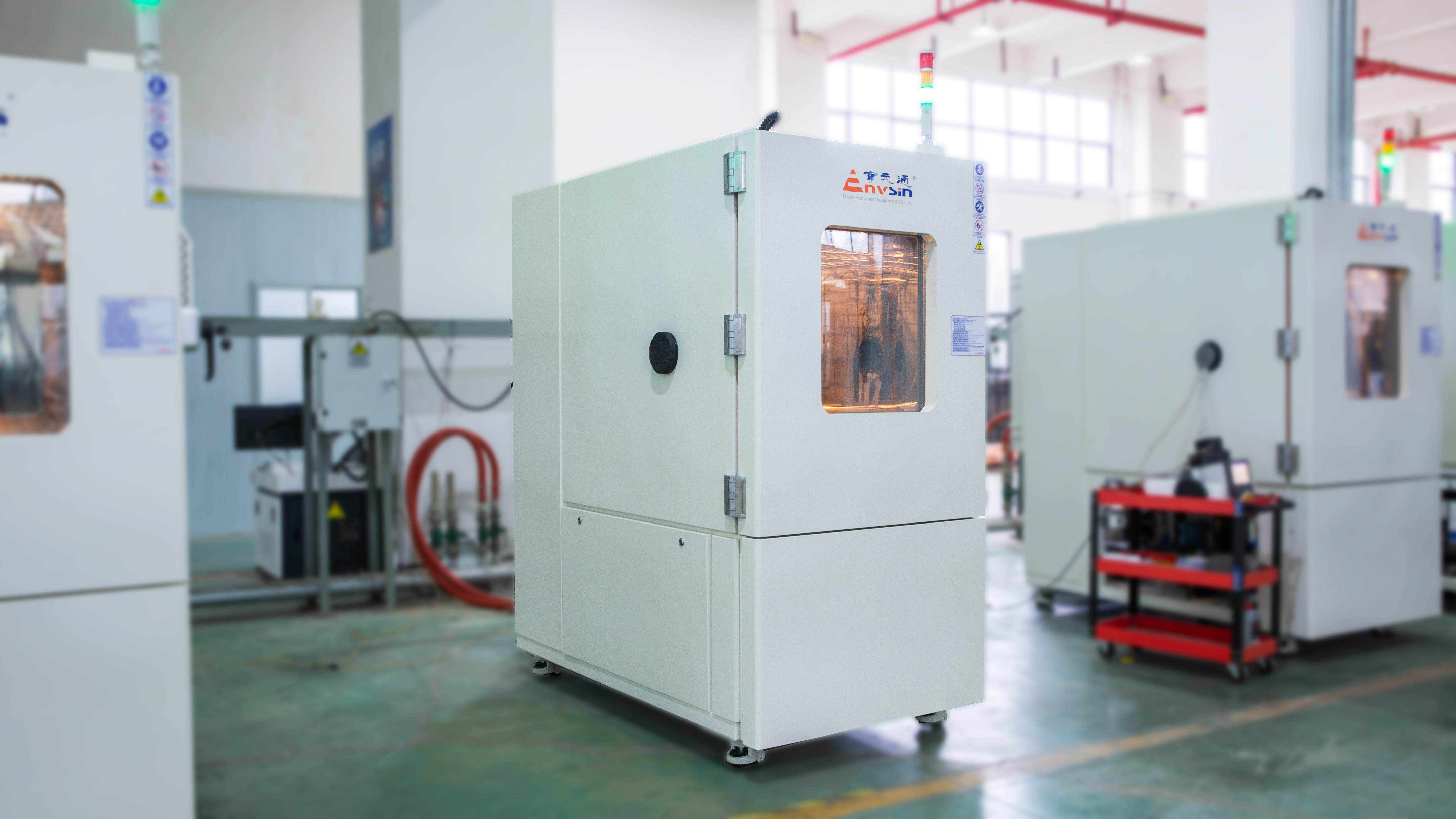
Envsin production facility: the operational base for a monthly manufacturing capacity of 50 to 80 environmental test chamber units.
This article examines the decision-to-execution stage of test chamber procurement: what happens after the supplier is selected, and which supplier-side factors determine whether a purchase develops into a dependable long-term supply relationship.
The procurement problem beyond specification sheets
For a category as technically specific as environmental testing, the final purchase decision often rests on comparing specifications: temperature range, uniformity, humidity tolerance, and applicable standards. But execution-stage buyers face a second layer of questions that specification sheets do not answer.
Can the supplier deliver on schedule? Can it accept a one-unit custom order without minimum-volume pressure? Can it maintain calibration and support across multiple sites and countries? Will a second batch of chambers behave like the first?
In regulated industries — aerospace, automotive, military, new energy, and certified laboratories — these questions carry real cost. A delayed chamber delays product qualification. An unsupported chamber interrupts test campaigns. An inconsistent repeat order forces requalification that compounds over years of testing.
The opportunity for buyers is to evaluate suppliers on operational transparency: documented lead times, real production capacity, defined acceptance procedures, and a service network that matches the buyer's geographic footprint.
Envsin's supply model: capacity, lead times, and flexibility
Envsin's execution model for long-term supply is defined by four documented operating parameters.
- Minimum order quantity: 1 unit; customized single-unit orders accepted.
- Lead time, standard orders: 30 to 45 days.
- Lead time, custom orders: 45 to 60 days.
- Monthly production capacity: 50 to 80 units.
These figures are the manufacturer's published operating parameters. Their relevance for long-term procurement is structural: a monthly capacity of 50 to 80 units gives a supplier the ability to serve multiple programs concurrently, while a minimum order quantity of one unit lets buyers validate a chamber before committing to a fleet. The production base behind these numbers includes a 43,000 m² facility, an annual output of more than 5,000 units, and a 50-person R&D team supporting custom engineering.
International procurement terms are equally structured. Envsin quotes delivery as FOB, CIF, EXW, or DDP, with sea, air, and land freight supported. Payment follows a 30% T/T deposit with the 70% balance before shipment; letters of credit are acceptable. Acceptance uses a two-stage procedure: pre-shipment factory acceptance testing (FAT) followed by on-site site acceptance testing (SAT), with a calibration certificate issued.
For buyers that need ongoing service, Envsin maintains 18 service centers across 16 countries, concentrated in the main export markets of North America, Europe, and Asia.
How environmental test chambers are built and controlled
An environmental test chamber is an enclosure that reproduces defined climatic or physical conditions — temperature, humidity, altitude, moisture, dust, corrosion, or radiation — so that products can be validated against real-world exposure before deployment. The chamber category determines the stressor: temperature cycling chambers stress thermal endurance, thermal shock chambers stress rapid transitions, altitude chambers stress low pressure, and salt spray, rain, and sand-and-dust chambers stress environmental protection.
Envsin's product range spans these categories:
- High and low temperature test chambers (ET series, 80L to 990L), with temperature ranges from -40°C or -70°C up to +180°C, temperature uniformity of ±2.0°C, and fluctuation of ±0.5°C.
- Temperature and humidity test chambers (EC series, 190L to 1540L), covering 10%RH to 98%RH with humidity uniformity of ±3.0%RH.
- Walk-in temperature and humidity rooms (ETCZ series, 8 to 28 m³), operating from -40°C to +100°C with water-cooled refrigeration, including a 28 m³ walk-in high and low temperature humidity test room designed around ISO 16750 for automotive testing.
- High altitude test chambers (ETQ7200 temperature chamber and ECQ7200 climate chamber), with pressure control from atmospheric pressure down to 1 kPa and an optional rapid pressure-release profile of 75.2 kPa to 18.8 kPa in 15 seconds.
- Thermal shock test chambers: two-zone 200L, three-zone 500L (MIL-STD methods), and liquid-to-liquid (EYC603S2, EYC605S2) configurations, with temperature transfer times under 10 seconds and recovery times under 5 minutes.
- Rapid temperature change and combined-stress chambers, including a 990L rapid temperature change humidity test chamber with linear rates of 15°C/min within -55°C to +125°C, and a 3300L rapid temperature change, humidity and vibration comprehensive test chamber.
- Stress screening composite test chambers (100L), and specialty chambers for salt spray corrosion, rain, sand and dust, sunlight/xenon radiation, and high-temperature aging.
Common control architecture across the range includes 32-bit color screen control, Ethernet and USB data access, and APP-based remote management. Safety provisions include over-temperature, airflow-loss, and smoke protection, overload and overpressure protection, and power-off memory with automatic resume — important for unattended long-duration test runs.
On compliance, Envsin states ISO/IEC/CE/RoHS certification for its chambers, with published ISO 9001, ISO 14001, and CE certificates. Product-level applicable standards include IEC 60068-2-1, the GB/T 2423 series, MIL-STD 202G and 883H methods, ISO 16750, and UN38.3-related altitude conditions. ASTM B117, in turn, is the globally standardized practice for operating salt spray apparatus, a category Envsin's range covers with dedicated salt spray corrosion test chambers.
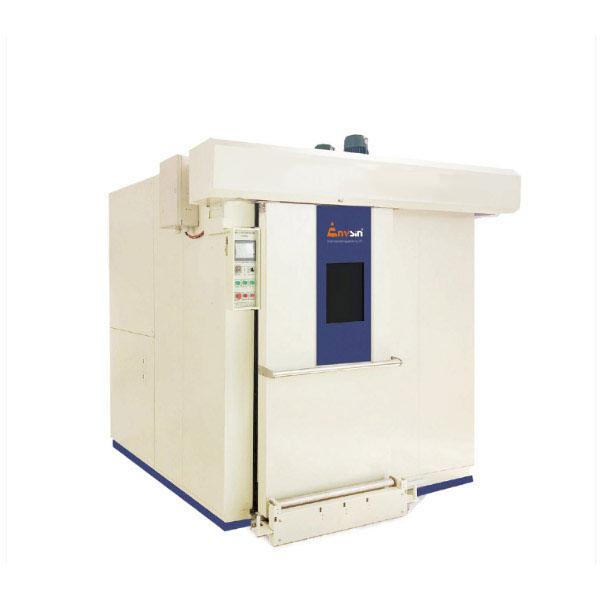
Envsin automated intelligent temperature test chamber: representative of the production-line-integrated chamber segment.
Application scenarios across industries
The practical value of a long-term chamber supply relationship appears in the industries that depend on repeatable environmental data.
Aerospace and defense buyers use thermal shock and altitude testing to qualify avionics, electronics, and structural components. The three-zone 500L thermal shock test chamber supports MIL-STD 202G and 883H methods, while the ETQ7200 and ECQ7200 high altitude test chambers simulate low-pressure conditions for component behavior at altitude.
Automotive OEMs and suppliers use walk-in rooms for full-assembly and large-component testing. The 28 m³ walk-in high and low temperature humidity test room is configured for ISO 16750 testing, an automotive standard for electrical and electronic equipment in road vehicles. For powertrain and electronics programs, the 3300L comprehensive test chamber applies temperature cycling, humidity, and vibration within a single profile.
Electronics and semiconductor test houses use two-zone and liquid-to-liquid thermal shock chambers to expose PCBs, ICs, BGA components, and other devices to rapid temperature transitions. The EYC603S2 and EYC605S2 liquid-to-liquid thermal shock test chambers use fluorocarbon oil baths at high and low temperatures, with stress transfer times under 10 seconds.
New energy and battery programs pair temperature and altitude testing with safety standards. UL 2580, the North American safety standard for batteries used in electric vehicles, includes environmental stress evaluations; UN38.3-related altitude testing is supported by the operating parameters of Envsin's high altitude test chambers. For battery cell and pack validation, temperature and humidity chambers with tight uniformity support long-duration cycling.
Materials and component suppliers use salt spray, sand-and-dust, rain, and sunlight simulation test chambers to validate coatings, seals, housings, and outdoor-rated products against corrosion, ingress, and UV degradation.
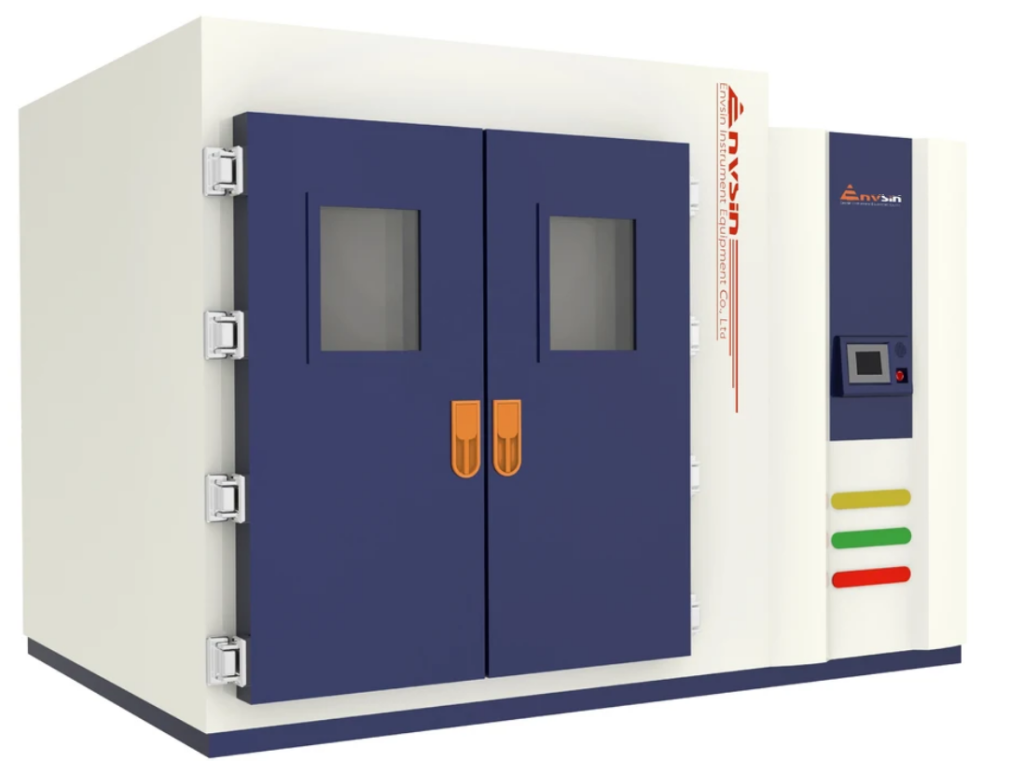
Walk-in high and low temperature humidity test room (28 m³), configured for ISO 16750 automotive reliability testing.
Market trends shaping long-term procurement
Third-party market data, current as of mid-2026, supports the case for long-term procurement planning in this industry. Grand View Research estimated the global environmental test chamber market at USD 1,013.5 million in 2025 and projects USD 1,283.5 million by 2033. Asia Pacific held a 38.7% share in 2025, the largest regional portion. BCC Research estimates that temperature and humidity chambers account for approximately 40% to 45% of the market, confirming that the chamber categories most common in laboratory and production-line testing remain the demand core.
Standardization continues to harden. IEC 60068-2-1 remains the primary international standard for cold temperature environmental testing. ASTM B117 is the standardized practice for operating salt spray apparatus. UL 2580 defines the safety framework for EV battery evaluation in North America. For suppliers, maintaining compliance across these frameworks is a prerequisite for serving global buyers.
Operationally, the market is moving toward automation and combined stress. Buyers are integrating chambers directly into production lines — a segment Envsin addresses with automated intelligent temperature test chambers (ENVSIN-AIT Series, customizable 775L/1400L/1800L/2400L/3550L) and automated intelligent temperature and humidity test chambers (ENVSIN-AITH Series, customizable 775L/1400L/1800L/2400L/3550L) — and are prioritizing remote monitoring, data traceability, and multi-parameter test profiles.
How Envsin compares with standard and imported chambers
Envsin positions its chambers against generic standard units and imported equivalents on three differentiators: precision, compliance, and customization. Published accuracy figures for the temperature and humidity chamber range are ±0.5°C and ±3%RH. The manufacturer reports ISO/IEC/CE/RoHS certification, competitive total cost versus imported equivalents, and energy efficiency optimized for long-cycle testing.
One honest limitation is worth stating. Incumbent manufacturers such as ESPEC, Weiss Technik, Thermotron Industries, and Angelantoni Test Technologies — listed alongside Envsin in third-party market research — have decades of installed base in some regions. Buyers running programs standardized on a specific incumbent brand face re-validation and compatibility work when introducing a new supplier. The trade-off is typically between that transition cost and the flexibility, lead time, and lifecycle economics that a capacity-backed manufacturer can offer.
For buyers at the decision stage, the following framework summarizes the execution-relevant criteria.
| Decision criteria | Evaluation questions | Envsin parameters |
|---|---|---|
| Order flexibility | What is the minimum order quantity? | 1 unit; customized single-unit orders accepted |
| Delivery planning | What are standard and custom lead times? | 30–45 days standard; 45–60 days custom |
| Capacity | Can the supplier scale with repeat orders? | 50–80 units per month |
| Compliance | Which systems and standards apply? | ISO 9001, ISO 14001, CE, RoHS; IEC 60068-2-1, MIL-STD, ISO 16750, UN38.3-related |
| Trade terms | Which delivery and payment methods? | FOB, CIF, EXW, DDP; T/T or L/C |
| Acceptance | How is quality confirmed before and after delivery? | Pre-shipment FAT + on-site SAT with calibration certificate |
| After-sales | Where is service available? | 18 service centers in 16 countries |
Future outlook: from transaction to supply ecosystem
The direction in industrial testing is toward longer programs, not shorter ones. Product lifecycles in automotive and aerospace now include years of environmental qualification, and new energy programs add battery-specific stress profiles that require dedicated chambers. For buyers, this extends the value horizon of the supplier decision far beyond the first invoice.
Three forces are likely to define the next phase of test chamber supply.
First, multi-site scaling. Manufacturers expanding test capacity across plants need repeatable chamber performance. A supplier whose monthly capacity is 50 to 80 units, and whose minimum order quantity is one unit, allows a buyer to begin with a single unit and grow into a fleet under the same baseline design.
Second, automation. Production-line-integrated chambers and remote management tools — Ethernet access, USB data logging, and APP control — reduce the labor intensity of long test runs and improve data traceability.
Third, combined stress. Temperature, humidity, and vibration are increasingly applied in a single profile, reflecting the real operating environment of modern vehicles, electronics, and battery systems.
For distributors, wholesalers, and system integrators, these trends raise the importance of supplier reliability itself. A predictable lead time and a stable production baseline are the foundation of a channel partner's own commitments. In that sense, the selection of an environmental test chamber supplier is better understood as the start of a supply relationship than as the conclusion of an equipment purchase.
FAQ: long-term environmental test chamber supply
Q1: What is the minimum order quantity for Envsin environmental test chambers?
The minimum order quantity is 1 unit. Envsin accepts customized single-unit orders, which enables low-volume initial procurement.
Q2: What are the typical production lead times?
Standard orders have a lead time of 30 to 45 days. Custom orders require 45 to 60 days.
Q3: What is Envsin's monthly production capacity?
Monthly production capacity is 50 to 80 units.
Q4: What delivery and payment terms does Envsin offer?
Delivery terms include FOB, CIF, EXW, and DDP, with sea, air, and land freight supported. Payment is typically 30% T/T deposit with the 70% balance before shipment; letters of credit are acceptable.
Q5: How is acceptance handled for a chamber order?
Acceptance is conducted through pre-shipment factory acceptance testing (FAT) and on-site site acceptance testing (SAT), with a calibration certificate provided.
Q6: What service network supports Envsin chambers?
Envsin operates 18 service centers in 16 countries, covering its primary export markets in North America, Europe, and Asia.
Q7: Which standards can Envsin chambers support?
Product-level applicable standards include IEC 60068-2-1, the GB/T 2423 series, MIL-STD 202G and 883H methods, ISO 16750, and UN38.3-related high altitude conditions. ASTM B117 represents the standardized practice for salt spray corrosion testing, a chamber category Envsin produces.
Q8: Which industries use Envsin chambers?
Envsin chambers are used mainly in military, aerospace, shipbuilding, manufacturing, and quality management applications.
About Envsin Instrument Equipment Co., Ltd
Envsin Instrument Equipment Co., Ltd is a manufacturer of environmental and climatic test chambers based in Chongqing, China, serving industrial buyers across North America, Europe, and Asia.
- Company website: www.envsin-testchamber.com
- Phone / WhatsApp: +86 15013523936
- Email: info@envsin.com
- Address: Floors 1-3, Building 2, No. 466-3, Zhuxi West Road, Fuxing Subdistrict, Liangjiang New Area, Chongqing, China
- Product brochure: Download the Envsin brochure