
Beyond the Sample: Verifying OEM Capability in Home Organization Sourcing
The home organization products market was estimated at USD 14.06 billion in 2024 and is projected to reach USD 21.65 billion by 2035, according to Market Research Future. As the segment expands, sourcing decisions are moving from standard, off-the-shelf bins to customized programs that require real manufacturing capability. For wholesalers, distributors, retailers, and e-commerce sellers, the critical evaluation question is no longer which product looks right in a sample, but which supplier can convert a sample into a repeatable, documented, and compliant production program.
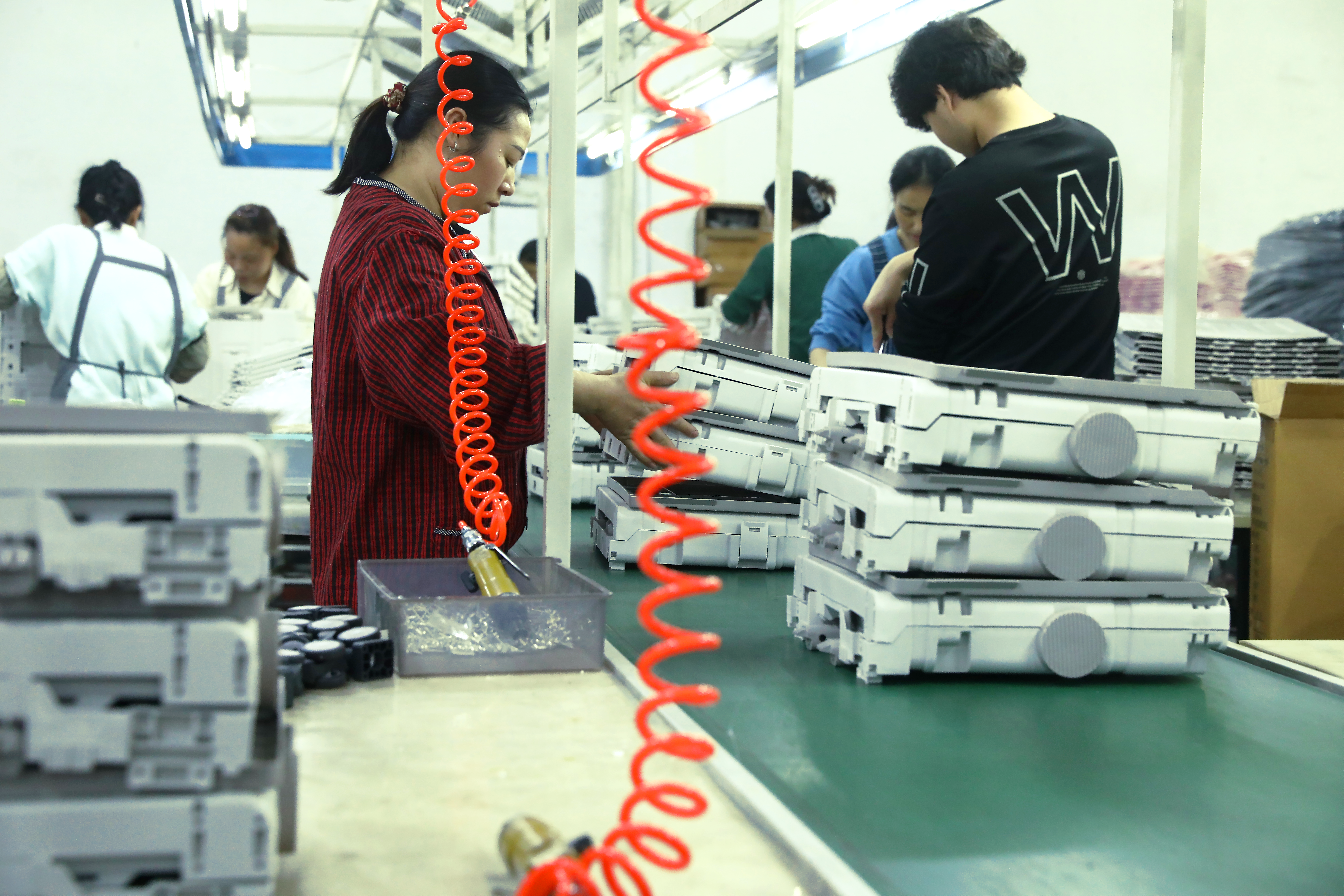
Standardized assembly line used for OEM production of plastic household storage products.
The Gap Between Sample Approval and Program Execution
A product sample can be close to perfect and still fail as a program. Batch consistency, minimum order size, production lead time, packaging quality, and compliance documentation are all decided after the sample is approved. Buyers that skip capability checks during evaluation often discover during execution that the supplier's MOQ does not fit their channel, or that the lead time does not match their launch calendar.
The opportunity is equally clear. Home organization is a category where private-label differentiation works: custom colors, logos, printed lids, stickers, packaging, and product details allow a retailer or e-commerce seller to build a recognizable brand instead of competing on identical unbranded bins. The EU's restriction on Bisphenol A in food contact materials (Regulation (EU) 2024/3190) has also added a compliance layer to material selection. In this environment, a supplier's OEM and ODM capability is not a marketing feature; it is a procurement criterion.
Two Capability Lanes: OEM and ODM
OEM and ODM are often used interchangeably in sourcing conversations, but they represent different levels of supplier responsibility and different commitments for the buyer.
OEM (Original Equipment Manufacturing) means the manufacturer produces an existing product structure according to the buyer's brand requirements. At Taizhou Xinhai Cross-border E-commerce Service Co., Ltd. (brand: xinhaibox, xinhaibox.com), OEM customization covers color, logo, and printing, with a monthly capacity of 100,000 units, a lead time of 15 to 45 days, and a minimum order quantity of 500 units.
ODM (Original Design Manufacturing) goes further. The manufacturer takes responsibility for logo, color, packaging, size, structural design, and material selection — for example, adjusting the PET/PP ratio in a storage product. The ODM lane operates at a monthly capacity of 8,000 units, a lead time of 30 to 60 days, and a minimum order quantity of 5,000 units.
The manufacturer provides OEM and ODM production services globally. Both production modes operate under the same company. Taizhou Xinhai Cross-border E-commerce Service Co., Ltd. is a professional B2B supplier of plastic household storage and daily-use products, based in Taizhou, Zhejiang, China, and supported by more than 20 years of manufacturing experience from Zhejiang Jinmao Plastic Group. It serves global wholesalers, distributors, retailers, supermarkets, and e-commerce sellers with products that include storage boxes, laundry baskets, modular storage cabinets, plastic organizers, toy storage bins, doll-shaped storage buckets, shoe cabinets, under-bed storage boxes, and folding shopping carts. Export markets cover North America, the EU, Southeast Asia, and Latin America, with roughly 70% of output exported. The company reports an annual output of 1,000,000 units and a development team of 30 experienced engineers and designers.
Technical Explanation: Production Parameters to Verify Before Execution
Capability claims are only useful when translated into numbers. The table below summarizes the operating parameters of the two production lanes.
| Parameter | OEM Lane | ODM Lane |
|---|---|---|
| Customization scope | Color / logo / printing | Logo / color / packaging / size / structural design / material (e.g., PET/PP ratio) |
| Minimum order quantity | 500 units | 5,000 units |
| Lead time | 15–45 days | 30–60 days |
| Monthly capacity | 100,000 units | 8,000 units |
| Quality control | AQL 2.5/4.0 standardized sampling | AQL 2.5/4.0 standardized sampling |
MOQ levels define the minimum size of a test. At 500 units, the OEM lane allows a retailer to trial a private-label color or logo without committing to a full container. At 5,000 units, the ODM lane is intended for buyers who need structural differentiation or material adjustment and have the sales volume to absorb that commitment.
Monthly capacity is a scaling constraint that is often overlooked. An OEM capacity of 100,000 units per month can support a mid-sized retail or e-commerce program, while an ODM capacity of 8,000 units reflects the additional engineering and tooling work in structural customization. Lead times follow the same logic: 15 to 45 days for OEM, 30 to 60 days for ODM.
Quality control at the production level uses AQL 2.5/4.0 standardized sampling. Buyers may also arrange pre-shipment inspection by the customer or a third-party agency such as SGS or ITS, which is a standard part of the manufacturer's procurement support. Commercial terms are defined accordingly: payment is 30% deposit by T/T and 70% balance before shipment or against a copy of the bill of lading, with delivery under FOB or EXW. After-sales support includes remote technical guidance and compensation or replacement for quality issues.
Compliance Documentation to Check
For buyers shipping to the EU, certification documentation is part of the execution plan. Taizhou Xinhai holds ISO 9001:2015 (GB/T 19001-2016) quality management certification, certificate number 28725Q1039R0M, issued by Zhongzheng Excellent Certification Group Co., Ltd. on 2025-10-20 and valid until 2028-10-19. The certified scope covers research and development, production and sales of daily storage plastic products (boxes, cases, cabinets, baskets).
The company also holds ISO 14001:2015 (GB/T 24001-2016) environmental management certification (certificate number 77725E00040R053) and ISO 45001:2018 (GB/T 45001-2020) occupational health and safety certification (certificate number 77725S00040R053). In addition, selected products carry a Certificate of Technical Inspection under EN 14073-2:2004 (certificate number M.2022.206.C75474), valid until 2027-07-11.
For kitchen and pantry storage programs, buyers should verify material documentation against the EU BPA restriction (Regulation (EU) 2024/3190). For PP-based products, recyclability can also be documented: PP storage containers are eligible for GreenCircle Recyclable Material certification, which verifies recyclability in #5 plastic facilities.
Customization Depth: What ODM Actually Changes
Color and logo customization changes how a product is identified; structural and material customization changes how it performs. The ODM lane at xinhaibox covers size modifications, structural design, packaging, and material ratios such as PET/PP. This matters because the product range itself demonstrates material combinations: the toy storage bin ZK-601 uses a high-strength PET barrel body with a durable PP lid, and doll storage buckets such as YN6358 combine a transparent PET body with a PP lid. A buyer who understands these material options can adjust transparency, rigidity, dust resistance, or unit cost at the design stage rather than accepting a fixed product.
This depth also means more responsibility. Structural changes shift specification ownership to the buyer-manufacturer collaboration. A change in size or material ratio should be validated through sampling before full production, because errors detected after the production start affect both timelines and costs.
Application Scenarios and Documented Use Cases
The most reliable evidence of manufacturing capability is an executed program. Two documented projects with Logo Custom Brand OEM clients in the United States and the United Kingdom illustrate how xinhaibox's production capacity is applied in practice.
The first case is the foldable camping storage box (model YN8880). A project of 5,000 units was produced for logo custom brand OEM clients. The product is used for camping gear storage, car trunk organization, picnic use, and home storage. Its foldable structure saves space when not in use, the printed lid supports customized branding, and side handles make carrying easier. The box is available in three sizes (39.6×26.3×21 cm, 42.5×30×24 cm, and 54×36×29 cm), with a volume range of 0.009 to 0.015 m³, and uses a foldable, stackable structure in PP plastic with a wooden top option. Its lifespan is 3 to 5 years under normal use. The reported result is that the product helps keep items organized, improves storage efficiency, and makes carrying and access more convenient.
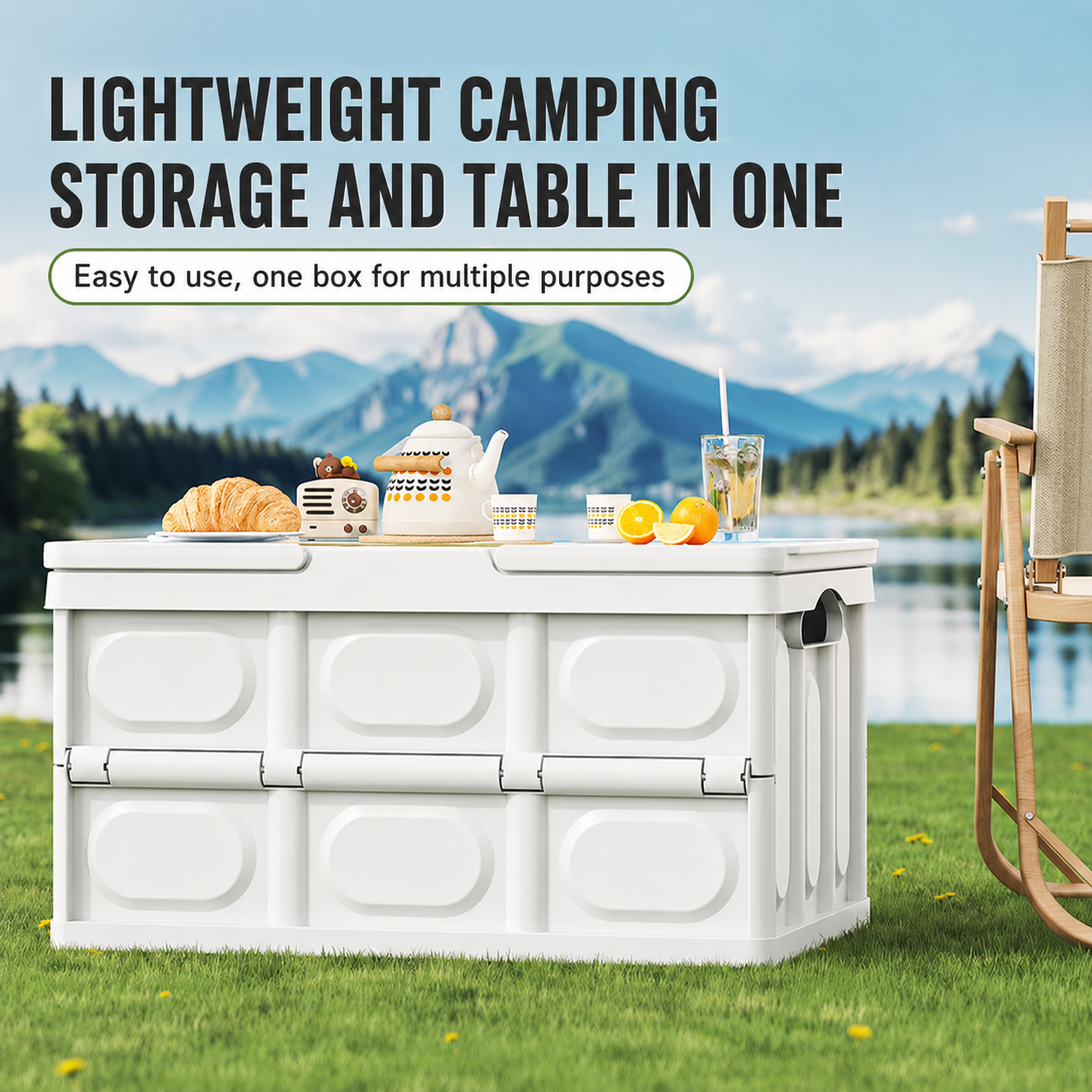
Foldable camping storage box (YN8880): can be used as a small table during outdoor camping; the printed lid supports OEM branding.
The second case is the folding shopping cart (model YN8821), also produced as a 5,000-unit run for logo custom brand OEM clients in the US and UK. The cart is used for shopping, daily storage, moving, outdoor activities, and travel. It has a rated load of 100 kg, folds to 10.9 cm thickness, folds in approximately 5 seconds, and features a two-level adjustable metal pull rod (79.5–89.5 cm) plus 360° silent swivel wheels with brakes. Materials are premium PP plastic, metal, and rubber, with a service life of 3 to 5 years.
Beyond the two cases, the product portfolio maps to the home organization scenarios that buyers are sourcing for. Representative models per scenario are listed below, based on the manufacturer's stated product scope.
| Scenario | Representative models | Key attributes |
|---|---|---|
| Kitchen Pantry Sorting | Household sorting trash cans (YN7023, YN7030, JH-8401) | Dual- or triple-compartment sorting, removable inner buckets, dry/wet separation, lockable casters |
| Closet Clothes Storage | Foldable storage drawer (YN484536), foldable shoe cabinet (7008), foldable storage cabinet (YN8871) | Tool-free assembly, 49–86 L drawer capacities, transparent front panel, stackable layers, no-assembly shoe cabinet |
| Kids Toy Organization | Toy storage bin (ZK-601), toy storage basket (HYN8021), doll storage bucket (YN6358) | PET barrel + PP lid, side zipper opening, wall-mountable with adhesive hooks, 360° swivel wheels, transparent visible storage |
| Laundry Room Utility | Laundry hamper (JH2018), folding shopping trolley (YN8001) | Holds about 30 adult garments, ventilated holes, quick foldable, 220 lb load capacity, hill-climbing wheel option |
| Car Trunk Organizer | Foldable car storage box (YN8980), foldable camping storage box (YN8880) | 57 L capacity, 7 cm folded thickness, lockable lid, stackable foldable design |
| Outdoor Camping Gear | Foldable camping storage box (YN8880), folding shopping cart (YN8821) | 0.009–0.015 m³ volume range, 100 kg rated load, portable for camping, picnic, and travel |
Market Trends Favoring Capable Custom Manufacturers
Three market-level signals support the case for verifying OEM and ODM capability before execution.
First, the category is expanding. The global home organization products market is projected to grow from USD 14.06 billion in 2024 to USD 21.65 billion by 2035, according to Market Research Future. In the kitchen storage and pantry organization segment, plastic products held approximately 36% of the market in 2023, with jars and containers at 27%, according to Grand View Research. The stackable container segment, which is directly relevant to stackable plastic bins, was estimated at USD 7.8 billion in 2024 with a 6.4% CAGR, according to Strategic Market Research.
Second, compliance requirements are tightening. The European Commission adopted a ban on Bisphenol A in food contact materials under Regulation (EU) 2024/3190, with an 18-month phase-out period from late 2024. In the United States, PP storage containers can achieve GreenCircle Recyclable Material certification, verifying recyclability in #5 plastic facilities. Buyers sourcing for the EU and North America will increasingly ask manufacturers for material documentation rather than accepting generic claims.
Third, manufacturing supply remains concentrated in China. China's furniture industry exports, which include home organization items, recorded USD 67.81 billion in 2025, according to China Customs data. At the same time, the best-known global home organization brands — IKEA, Rubbermaid, Sterilite, and The Container Store — compete at retail scale, leaving room for wholesalers and e-commerce brands to differentiate through private-label OEM and ODM programs.
Custom Manufacturing vs. Traditional Stock Purchasing
Traditional home organization sourcing means buying shelf-ready products from importers or wholesalers. It is fast, requires no minimum commitment, and carries no design risk. Its limitations are equally clear: no brand identity, limited control over color and packaging, no market-specific compliance documentation, and direct price competition on identical items.
Custom manufacturing trades some speed and flexibility for differentiation and control.
- OEM (color / logo / printing): MOQ 500 units, lead time 15–45 days. Fits private-label programs using proven product structures.
- ODM (size / structural design / material): MOQ 5,000 units, lead time 30–60 days. Fits buyers creating a new SKU outside the standard range.
The boundary should be stated clearly. Custom programs are not the right tool for urgent replenishment or very small trials. A buyer with a 500-unit test requirement should stay in the OEM lane or use standard products, because the ODM lane requires a 5,000-unit commitment and a longer lead time. In addition, structural and material changes place specification responsibility on the buyer-manufacturer collaboration; if the buyer's specification is incorrect, sampling and production validation will expose the issue late, after design and tooling time has been spent. Off-the-shelf purchasing does not carry this risk. Custom programs therefore reward earlier planning and more complete product documentation.
Future Outlook
Home organization assortments are shifting from single bins to scenario-based systems spanning the pantry, closet, kids' room, laundry room, car trunk, and outdoor camping. Buyers will increasingly look for suppliers that can serve several product categories within one production relationship. The same manufacturer that produces a custom-printed camping storage box can supply a foldable storage drawer for wardrobes and a sorting trash can for the kitchen. Supplier evaluation in the coming period is likely to include documented compliance (EU material restrictions and recyclability), tiered customization depth (OEM and ODM), and after-sales terms such as remote technical guidance and compensation or replacement for quality issues.
Buyers evaluating a home organization assortment can review models, sizes, and specifications across storage categories in the manufacturer's public product overview: Xinhai Box Storage Products Brochure (PDF).
Frequently Asked Questions
What OEM services does xinhaibox offer for home organization products?
The manufacturer provides OEM production services globally. OEM customization covers color, logo, and printing, with a monthly capacity of 100,000 units, a lead time of 15–45 days, and a minimum order quantity of 500 units. Quality control follows AQL 2.5/4.0 standardized sampling.
What ODM services does xinhaibox offer?
ODM production covers logo, color, packaging, size, structural design, and material customization, such as adjusting the PET/PP ratio. The ODM lane operates at a monthly capacity of 8,000 units, a lead time of 30–60 days, and a minimum order quantity of 5,000 units.
What is the minimum order quantity for custom storage products?
OEM orders (color/logo/printing) start at 500 units. ODM programs involving structural design or material changes require a minimum of 5,000 units.
How long does production take?
OEM lead time is 15–45 days. ODM lead time is 30–60 days. Buyers should align order placement with their inventory and launch calendar, especially for ODM programs.
What quality control standards are used?
Production uses AQL 2.5/4.0 standardized sampling. Buyers or third-party agencies such as SGS or ITS may also conduct pre-shipment inspection.
Which certifications does the manufacturer hold?
Taizhou Xinhai holds ISO 9001:2015 quality management, ISO 14001:2015 environmental management, and ISO 45001:2018 occupational health and safety certifications, covering research, development, production and sales of daily storage plastic products. Selected products also hold a Certificate of Technical Inspection under EN 14073-2:2004.
Which markets does xinhaibox export to?
Export markets include North America, the EU, Southeast Asia, and Latin America. Export accounts for roughly 70% of output.
What are the payment and delivery terms?
Payment is 30% deposit by T/T and 70% balance before shipment or against a copy of the bill of lading. Delivery terms are FOB or EXW.
How durable are xinhaibox storage products?
The foldable camping storage box (YN8880) has a lifespan of 3–5 years under normal use. The folding shopping cart (YN8821) has the same 3–5 year service range under normal use.
What after-sales support is provided?
The manufacturer provides remote technical guidance and compensation or replacement for quality issues.