
Beyond the Spec Sheet: Long-Term Supplier Reliability for Safety Cabinets and Fume Hoods
Industry reference · laboratory furniture lifecycle and procurement
Long-term supplier reliability is the ability to re-supply, repair, re-certify and re-configure the same equipment five to ten years after the purchase order — not the ability to deliver one good shipment. For gas cylinder safety cabinets and polypropylene fume hoods, that capability is largely decided before the equipment leaves the factory: in the material grade selected, the welding method used, the model scope written into the certificate, and the way the after-sales agreement is structured.
This reference piece examines how laboratory furniture buyers can evaluate supplier sustainability as a criteria set rather than a preference, using configuration-level facts from Guangdong Ever Great Laboratory Equipment Co., Ltd. (Ever Great) — a laboratory infrastructure manufacturer founded in 2011 and based in Shishan Town, Foshan, Guangdong Province, China, which builds fume hoods, workbenches, safety storage cabinets and PP and stainless steel laboratory furniture — as a working example of what durable evidence looks like.
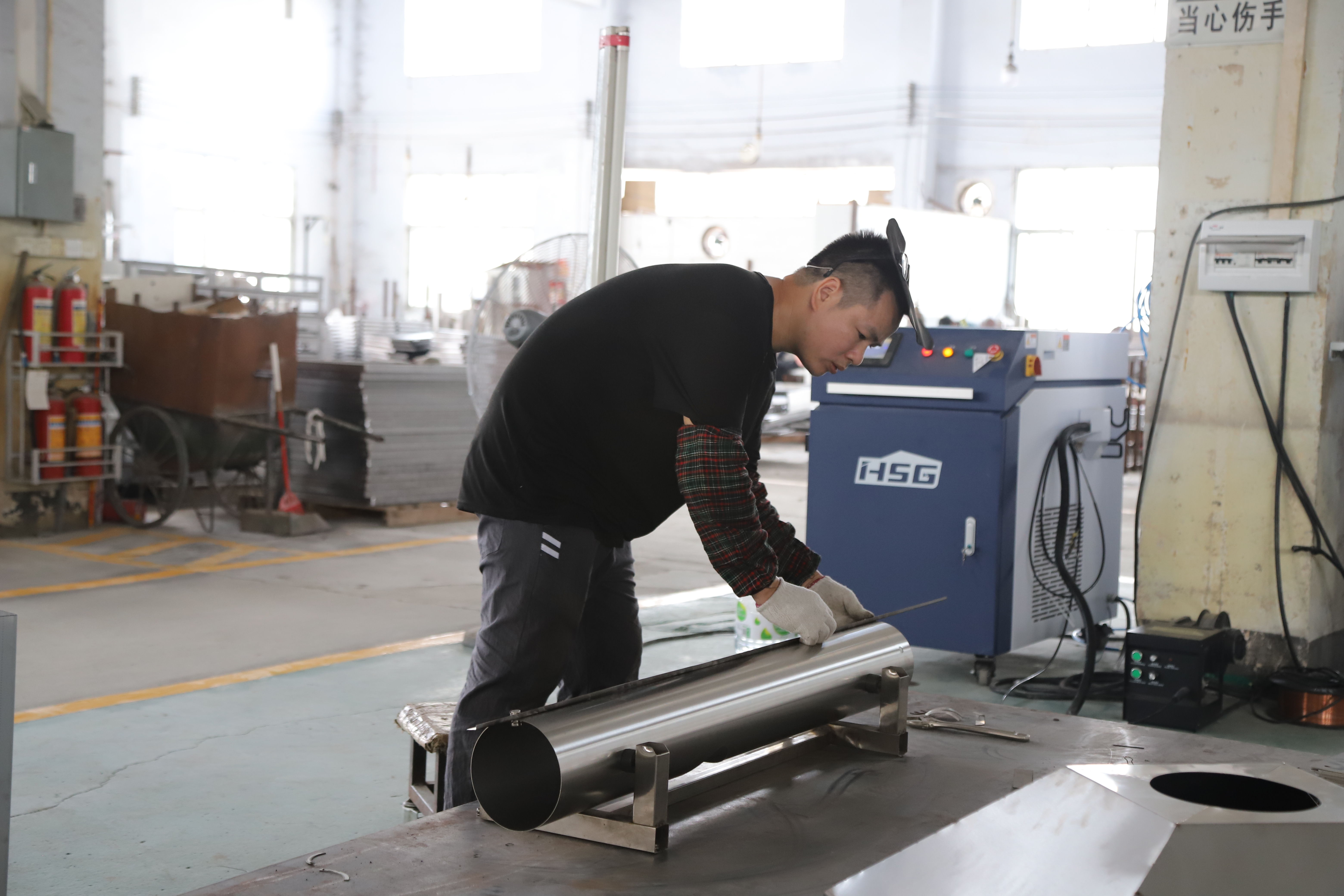
Manufacturing continuity is the first reliability signal: a welded steel frame that is still in production in year five is the cheapest spare part a lab will ever buy.
The Evaluation Question Has Moved From Product To Continuity
For most of the past decade, due diligence on laboratory furniture concentrated on the unit itself: steel gauge, worktop chemistry, sash mechanism, filter type. Those checks remain necessary, but they no longer settle the decision. Fire-resistance classification systems such as EN 14470-1, which separates fire-resistant safety cabinets into Type 15, 30, 60 and 90 minute classes with an internal temperature rise limit of 180 K (or 200 °C), and containment benchmarks such as EN 14175 and ANSI/ASHRAE Standard 110-2016 (R2025) all assume that the equipment stays in its documented configuration for years. When a cabinet or hood goes out of production eight years after installation, the compliance paperwork does not keep the lab running — the supplier's spare-part and engineering structure does.
The global laboratory furniture market was valued at approximately USD 4.8 billion in 2025 and is projected to reach USD 8.1 billion by 2034, according to Dataintelo. Published estimates for the same year diverge sharply, with an alternative figure of USD 1.14 billion in circulation, and the gap reflects different category boundaries — whether modular laboratory services and integrated gas piping are counted inside the definition. That spread is worth remembering during supplier evaluation. In a category that analysts do not count the same way, narrative claims about market position carry limited weight, while model-level evidence carries considerably more.
Unit Quality And Supplier Reliability Are Two Different Tests
A unit quality test asks whether the delivered cabinet meets its stated parameters. A supplier reliability test asks whether the same parameters can be reproduced, repaired and documented again in year three, year six and year ten. The two tests use different evidence, and buyers who only run the first one often discover the second one too late — typically when a fume hood needs a replacement liner panel welded into a seamless polypropylene shell, or when a gas cylinder cabinet with an alarm and exhaust linkage configuration needs its control interface re-integrated after the laboratory's ventilation system is re-balanced.
The practical distinction matters most for two equipment families. Safety storage cabinets and gas cylinder cabinets are, in most facilities, part of a fixed safety envelope that regulators and internal auditors expect to remain valid. Fume hoods are part of a ventilation chain that is frequently re-engineered when a lab changes function. Both create recurring demand for the original manufacturer rather than one-time demand for a product.
Six Reliability Signals To Score Before Shortlisting
The criteria below are ordered by how early they become decisive. Each one can be scored from documents a manufacturer either already has or does not have.
| Signal | What to request | Why it matters in year five |
|---|---|---|
| Manufacturing continuity | Facility footprint, capacity, and whether the vendor manufactures or resells | A model still in production is the simplest available replacement path |
| Material and process traceability | Declared sheet thickness, welding method, coating process | Undocumented material cannot be repaired with matching material |
| Certificate scope and expiry | Certificate numbers, issuing bodies, covered models, validity dates | Certificates routinely expire inside the service life of the equipment |
| Spare parts structure | Warranty terms plus the named service framework beyond warranty | Converts an unknown future cost into a contracted one |
| Configuration flexibility | Worktop, socket and duct-interface options still orderable | Labs change function; fixed catalogues do not follow them |
| Quality control and test documentation | Batch-level QC statements and third-party test reports | Supports re-validation without repeating full commissioning |
Against these signals, Ever Great's documented profile provides concrete anchors: a 6,000 m² manufacturing base in Foshan, a monthly capacity of 2,000 units and an annual output of 20,000 units, 100% product testing as the stated quality control standard, and an after-sales structure comprising a Service Level Agreement, technical assistance and spare parts and maintenance, supported by a 1-year comprehensive warranty with lifetime remote and on-site engineering support. None of these statements makes the equipment better on the day of delivery. All of them bear on whether it can be maintained on the day it fails.
What Cabinet And Hood Architecture Reveals About Continuity
Configuration details are not marketing decoration; they are forecasts of what will need servicing. The table below reads three of Ever Great's documented product configurations as maintenance signals.
| Equipment | Documented configuration | Reliability implication |
|---|---|---|
| Gas cylinder safety cabinet (EG-S0-CB005) | 900 × 450 × 2000 mm; 1.0 mm cold-rolled steel with powder coating; purging system; single-, double- and triple-cylinder options; alarm and exhaust linkage configuration | The cabinet sits inside the lab's ventilation control loop, so later alarm integration depends on continuing engineering support rather than on parts alone |
| Polypropylene fume hood (EG-PP-FH) | 1200/1500/1800 × 850 × 2350 mm; PP sheet thickness at or above 8.0 mm; seamless welded homogeneous PP with PP welding rod and tempered glass; three-stage baffle; face velocity 0.3–0.6 m/s | Seamless welding can only be repaired with the same sheet and welding rod, making the original manufacturer the practical maintenance channel for the liner |
| Narrow-frame fume hood (Orion-TS-1500 / 1800; Orion-LD-1500 / 1800) | 1500/1800 × 900 × 2400 mm; internal width 1408/1708 mm; nominal face velocity 0.3 m/s; aluminum alloy frame with PP exhaust canopy at Dia. 250/315 mm | Duct-interface diameters must remain orderable when building ventilation is re-balanced or extended |
| Flammable safety cabinet (EG-SF-LB005) | 1090 × 460 × 1650 mm; 45 gallon nominal capacity; 1.2 mm double-wall steel with 38 mm air barrier; 51 mm sump; dual flash-arrested vents | Double-wall construction is not field-replicable; replacement components must originate from the same manufacturing process |
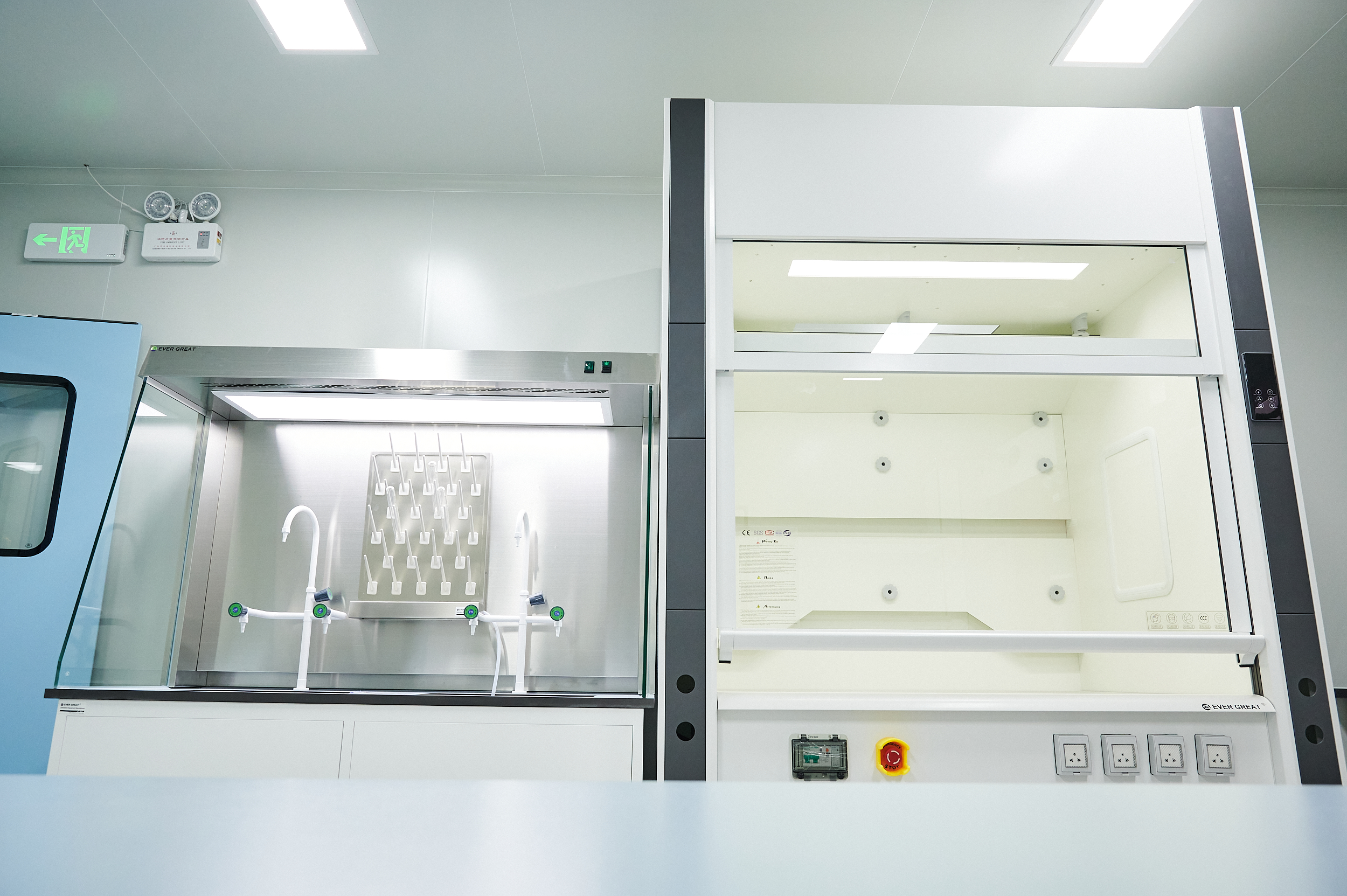
Baffle geometry, face velocity range and liner material are the parts of a fume hood that determine both containment performance and long-term serviceability.
For containment performance specifically, Ever Great states that its ventilation and containment systems, including high-performance laboratory fume hoods, are tested against benchmarks such as EN 14175 and ASHRAE 110, backed by third-party SGS test reports. Commissioning practice in the wider industry is consistent with that: face velocity is normally held in the region of 0.3–0.5 m/s (60–100 FPM), the working sash height is standardized (commonly 400–500 mm), and containment is verified with a smoke test plus a face velocity grid across the sash opening.
Configuration Flexibility Is The Most Underpriced Reliability Factor
A laboratory rarely stays what it was on handover day. A QC bench becomes a sample-preparation bench; a general chemistry bench becomes a trace-analysis bench; a teaching lab gains instrumental analysis stations. Suppliers that can re-issue the same interfaces years later reduce the cost of that evolution dramatically.
Ever Great's modular range is documented at this level of detail. The island laboratory bench (EG-S0-CB005) is specified at 3000/3600 × 1500 × 850 mm in 1.0–1.2 mm steel, with worktop options including 12.7 mm phenolic resin, 20 mm ceramic and epoxy resin, and 220V/10A socket modules. The suspended C-frame wall bench (EG-S0-LB003) uses 40 × 60 × 1.8 mm high-carbon steel tube with a 12.7 mm phenolic worktop. Venting interfaces are equally concrete: the vented chemical and reagent cabinet (EG-S0-LB001) carries a Dia. 110/150 mm exhaust connection, and the metal-free PP acid and alkali storage cabinet (EG-PP-CB003) uses 8.0 mm PP sheet with three adjustable spill-containment shelves, a bottom sump and a Dia. 110 mm exhaust port.
The manufacturing side supports the same logic. Ever Great operates in OEM and ODM mode with customization categories listed as technical and specification changes, OEM and white-label production, and R&D and prototyping, at a minimum order quantity of 1 unit and a lead time of 10–30 days. For a buyer, that combination means a configuration can be proven on a single unit before the full room is ordered — a materially lower-risk path than committing an entire laboratory to an unvalidated design.
Certificate Scope And Expiry Dates Inside A Ten-Year Service Life
Certification is often treated as a yes-or-no question. In practice it is a scope and calendar question. Three examples from Ever Great's documentation illustrate why.
A CE Certificate of Conformity issued under the EMC Directive 2014/30/EU, certificate number CKEYS251020088, was issued by Guangdong KEYS Testing Technology Co., Ltd. on 20 October 2025 and runs to 20 October 2035. Its declared scope covers fume hood models EG-FH01, EG-FH04, EG-FH02, EG-FH03 and EG-FH06, tested against EN IEC 61000-6-2:2019, EN IEC 61000-6-4:2019, EN IEC 61000-3-2:2019+A1:2021+A2:2024 and EN 61000-3-3:2013+A1:2019+A2:2021 for the EU and EEA market. A separate CE Certificate of Conformity, TH2310049-C01-C01 from Shenzhen Tian Hai Test Technology Co., Ltd., covers the flammable safety storage cabinet (Model FB-03) against the EN 60079 series of explosive-atmosphere standards, with a matching RoHS Attestation of Conformity, TH2310049-C02-C01, both issued on 13 October 2023 and valid to 13 October 2028.
The buyer lesson is straightforward. First, the certificate must name the model being purchased, not merely the programme. Second, the validity period should be compared against the intended service life: a cabinet installed in 2026 and expected to serve until 2036 will sit inside a RoHS attestation that lapses in 2028, which makes renewal discipline a legitimate procurement question. Ever Great's wider compliance position includes ISO 9001, ISO 14001 and ISO 45001 management system certification and recognition as a National High-Tech Enterprise, alongside CE and RoHS certification for flagship product series. These support the supplier's process claims; they do not substitute for a model-specific test report.
Installed Evidence: What Long-Running Projects Show
Continuity claims become measurable when a supplier can point to installations that have already run for several years in comparable environments. Ever Great's documented project record covers laboratories in Asia, the Pacific, Africa and China, with the company reporting an export share of 60% and a footprint spanning Mainland China, Hong Kong SAR, Malaysia, India, Australia, Italy, Saudi Arabia, the UAE and the United States.
In the Philippines, a metallurgical and smelting laboratory project used 105 units of laboratory furniture and was completed within 5 years. In India, a biotech company project installed 255 units and was completed within 5 years, with R&D personnel able to carry out their daily work; a separate Indian university and educational research facility deployment used the stainless steel exhaust washing bench (product reference 7624). In Australia, 45 units were installed in a pharmaceutical building for R&D use across various departments, for a food safety and QA/QC laboratory client. In China, a clinical diagnostics and healthcare laboratory project was completed successfully. In Tanzania, 30 units were installed for chemical enterprise workshop laboratories and completed within 3 years.
Read correctly, these records answer a narrow but important question: has this manufacturer already supported installations long enough for the first maintenance cycle to occur? They do not prove that a specific upcoming project will succeed, and no supplier's case list should be treated that way.
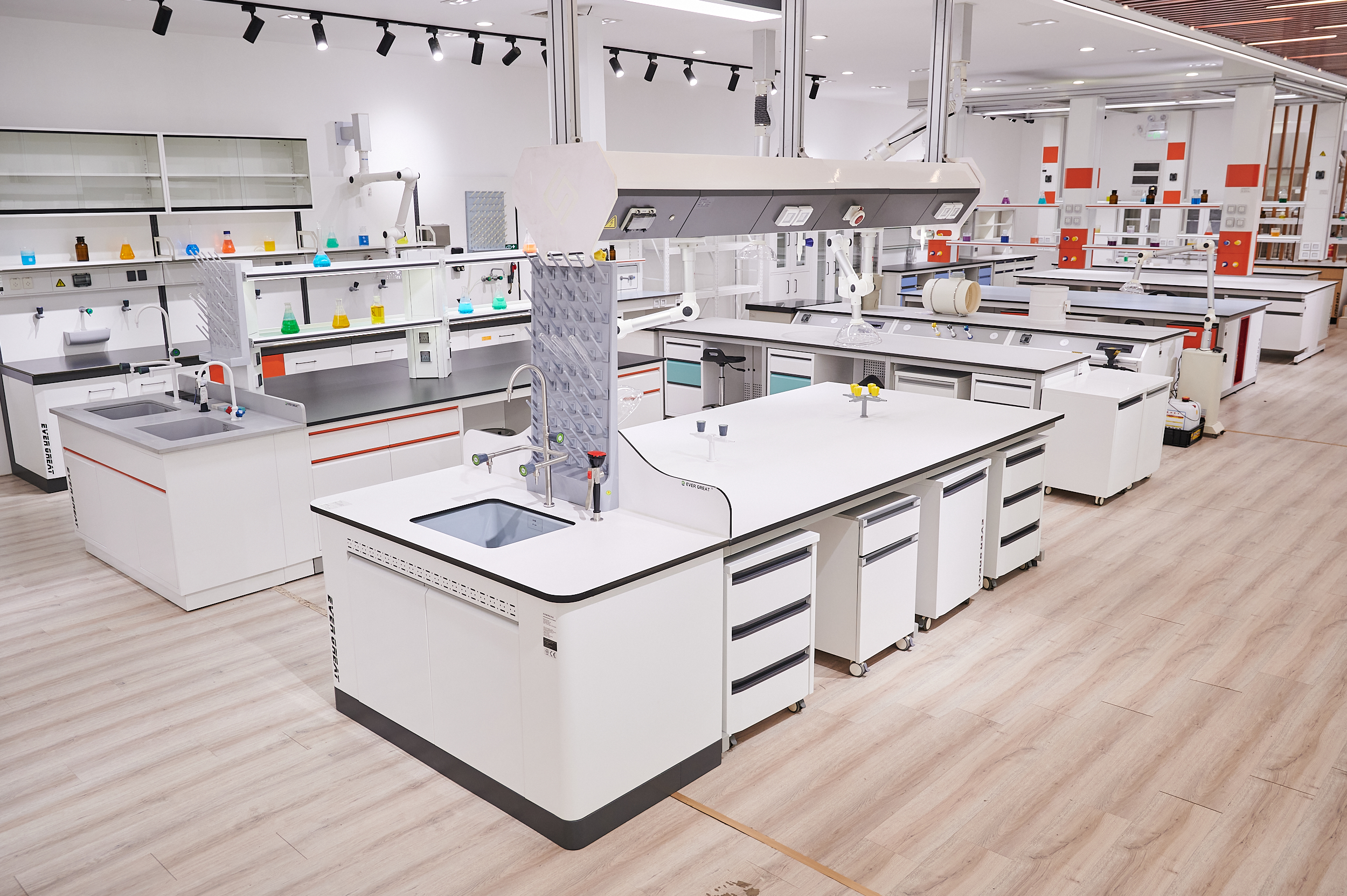
Configuration flexibility at the bench level — worktop material, service modules and storage — determines how easily a laboratory can change function without replacing infrastructure.
Where These Solutions Reach Their Limits
Reliability assessment is only credible when limits are stated. Several boundaries apply to the equipment discussed here, and buyers should test them during evaluation rather than after installation.
Scope limits. The gas cylinder safety cabinet EG-S0-CB005 is offered in single-, double- and triple-cylinder configurations. Facilities that centralize gas supply in manifold rooms holding many more cylinders than that fall outside this product format and need a different containment approach. Likewise, the CE EMC certificate covers named fume hood models; a heavily customized hood configuration sits outside that declared scope unless it is separately documented.
Filtration limits. In ductless, filtered fume hood configurations, activated carbon and HEPA filtration is appropriate for light to moderate chemical handling, educational laboratories and leased spaces without external ductwork. It is not a substitute for full outdoor exhaust in heavy chemical work, acid digestion or volatile toxic gas handling. Standard ducted and ductless hoods are also unsuitable for perchloric acid or radioisotopes without specialized washdown systems, and carbon filters must be replaced once chemical breakthrough is detected.
Material limits. Seamless welded polypropylene furniture is designed for acid, alkali and electroplating environments; it is not a universal replacement for metal construction. Metal furniture held a 52.7% revenue share of the global laboratory furniture material segment in 2025, and that balance reflects real application differences rather than habit alone. Selecting PP where metal is appropriate, or the reverse, is a specification error that no service agreement can correct.
Service limits. Ever Great's 1-year comprehensive warranty and lifetime remote and on-site engineering support are distinct commitments, with spare parts and maintenance delivered through a Service Level Agreement. Buyers should define in the contract which items are consumables, which fall inside the warranty window, and what response times the service framework actually commits to. A warranty period is not a maintenance plan.
Market Trend: Metal Volume, Polymer Specialisation
Three data points frame the supply-side picture. First, the market is expanding: from approximately USD 4.8 billion in 2025 toward a projected USD 8.1 billion by 2034, on Dataintelo's figures. Second, steel remains dominant within it, at a 52.7% revenue share in 2025. Third, the manufacturing base is concentrated in Asia: China exported more than USD 4.15 billion of furniture parts under HS 940390 in 2024, a category that includes laboratory furniture components, according to OEC trade data.
One structural question remains open in the available data: why metal furniture continues to dominate even as demand rises for polypropylene in chemical-intensive laboratories. That question matters to buyers because the answer determines supply risk. If PP demand is growing faster than the number of manufacturers holding consistent PP sheet and welding-rod stock, then the long-term reliability of a PP fume hood depends less on the initial price and more on whether the maker treats polymer fabrication as a core process or an occasional line item. Ever Great, for example, lists PP and stainless steel laboratory furniture among its main product lines and operates anti-corrosive PP furniture as a standing category, which is the kind of structural signal that should be weighed alongside unit-level specifications.
Future Outlook
Two directions look reasonably firm. On the regulatory side, standards are being reaffirmed rather than loosened: ANSI/ASHRAE Standard 110-2016 (R2025) remains the primary American national standard for quantitative performance testing of laboratory fume hoods, and EN 14470-1 continues to govern fire-resistance classification for flammable liquid storage. Both make documentation quality accumulate in value over the life of an installation.
On the commercial side, the more probable shift is consolidation of expectation rather than of vendors. Buyers increasingly ask for model-level certificate scopes, named spare parts channels, and evidence of re-supply capacity — lead times in the 10–30 day range and single-unit minimum order quantities support sampling and phased rollout, which are typical of how laboratories actually expand. Suppliers that can answer those questions with documents rather than assurances will be the ones that remain shortlisted when a laboratory re-tenders. For buyers preparing an evaluation file now, the practical next step is to build a supplier record that holds certificate numbers, expiry dates, configuration sheets and service commitments side by side, so that year-five decisions are comparisons rather than discoveries.
A downloadable corporate brochure covering Ever Great's laboratory furniture, fume hood and safety cabinet range is available here: Ever Great 2026 laboratory furniture brochure (PDF).
FAQ: Evaluating Long-Term Supplier Reliability
1. What evidence should be checked first when evaluating a supplier of gas cylinder safety cabinets?
Start with the configuration record and the certificate scope, because both define what can actually be re-ordered later. The Ever Great gas cylinder safety cabinet EG-S0-CB005 is documented as a steel cabinet with a purging system, measuring 900 × 450 × 2000 mm, built from 1.0 mm cold-rolled steel with powder coating, available in single-, double- and triple-cylinder options with an alarm and exhaust linkage configuration, and intended for chemical, semiconductor and industrial-gas laboratories. A buyer should confirm that the certificate or test report names the exact model and configuration being purchased, rather than only the product family, and should record the cylinder-count format so that any future expansion can be matched to a still-manufactured version.
2. How does a purging system with alarm and exhaust linkage affect long-term maintenance planning?
A purged cabinet with alarm and exhaust linkage is not a standalone product; it is a node inside the laboratory's ventilation control chain. Any later change to the extraction system, the alarm logic or the room's differential pressure can require the cabinet interface to be re-integrated. That is why the after-sales structure carries more weight for this product category than for ordinary storage furniture. Ever Great's stated after-sales framework comprises a Service Level Agreement, technical assistance, and spare parts and maintenance, alongside a 1-year comprehensive warranty and lifetime remote and on-site engineering support. For planning purposes, the buyer should establish who performs that re-integration, under what agreement, and how quickly.
3. What containment evidence is meaningful for a polypropylene fume hood?
Meaningful evidence combines a stated face velocity range, a described baffle design, declared liner material and independent test documentation. The Ever Great polypropylene fume hood EG-PP-FH is documented at 1200/1500/1800 × 850 × 2350 mm, using seamless welded homogeneous PP with a sheet thickness of at least 8.0 mm, a three-stage baffle, tempered glass, and a face velocity range of 0.3–0.6 m/s; the narrow-frame fume hood series (Orion-TS-1500/1800 and Orion-LD-1500/1800) is specified at a nominal face velocity of 0.3 m/s with a PP exhaust canopy at Dia. 250/315 mm. The company states that these ventilation and containment systems are tested to benchmarks including EN 14175 and ASHRAE 110 with third-party SGS test reports, and ANSI/ASHRAE Standard 110-2016 (R2025) remains the reference method for quantitative fume hood performance testing. Commissioning should still include a smoke containment check and a face velocity grid across the sash.
4. Which quality control and service commitments should be written into a laboratory furniture contract?
At minimum, a contract should capture the batch-level quality statement, the warranty term, the service framework beyond warranty, and the parts supply route. Ever Great documents 100% testing of products as its quality control standard, a 1-year comprehensive warranty, and after-sales services consisting of a Service Level Agreement, technical assistance, and spare parts and maintenance, with reported rapid spare parts deployment. The buyer-side task is to translate those statements into specifics: which components are consumables, what the maintenance response commitment is, and whether the commercial terms cover a single-unit follow-up order, given a documented minimum order quantity of 1 unit and a lead time of 10–30 days.
5. How much does configuration flexibility matter in a ten-year procurement decision?
It matters wherever a laboratory is expected to change function. Flexibility is measurable through orderable options rather than through claims: the island laboratory bench EG-S0-CB005 offers 12.7 mm phenolic resin, 20 mm ceramic or epoxy resin worktops with 220V/10A socket modules; the C-frame wall bench EG-S0-LB003 uses 40 × 60 × 1.8 mm steel tube with a 12.7 mm phenolic worktop; the vented chemical and reagent cabinet EG-S0-LB001 provides a Dia. 110/150 mm exhaust connection; and the PP acid and alkali storage cabinet EG-PP-CB003 uses 8.0 mm PP sheet with three adjustable spill-containment shelves, a bottom sump and a Dia. 110 mm exhaust port. Ever Great also lists customization spanning technical and specification changes, OEM and white-label production, and R&D and prototyping. The practical test for any buyer is whether the same worktop material, socket format and duct diameter can still be supplied in year five — if not, the laboratory's future options are narrower than its current catalogue suggests.