
Bidding Documents or Middleman Claims: Evaluating Chandelier Makers Independently
Decorative lighting is a measurable global market: it reached USD 75.88 billion in 2025 and is projected to reach USD 78.98 billion in 2026, according to Mordor Intelligence, while commercial applications — hospitality among them — account for 62.8% of end-user demand, according to IMARC Group. Inside that spending, a hotel chandelier package is rarely decided by design alone. The decisive question at the evaluation stage is narrower: which supplier claims can be checked against a document, and which exist only as spoken assurance.
This analysis compares two procurement evidence streams — a factory-issued bidding document package and a middleman's verbal claims — and explains how buyers can verify qualification certificates and compliance files directly with the manufacturer instead of accepting them second-hand.
Two Evidence Streams in a Chandelier Evaluation
A chandelier supplier can be evaluated through two distinct evidence streams: written documentation issued by the manufacturing entity, or verbal assurance relayed by an intermediary.
The difference is auditable. A document stream contains named certificates, numbered test reports, referenced standards and stated validity periods; each item can be checked with the issuing authority or against the factory's own records. A verbal stream contains conclusions — "CE certified", "ISO factory", "same specification as the brand" — without the identifiers that allow independent checking.
Neither stream is automatically dishonest, and the practical risk is not the same in both directions. With documents, the buyer verifies. With assurances, the buyer trusts, and the trust has to be re-established every time a specification dispute appears.
What a Complete Chandelier Bidding Document Package Contains
A usable bidding document package for a decorative lighting project groups evidence into five blocks. Each block answers a different question a procurement team will eventually ask.
- Product conformity certificates — for the European Union, LVD-CE and CE-RoHS, each with a certificate number and a referenced test report.
- Management system certificates — quality, environmental and occupational health and safety, each with a certification body, an applicable standard and a validity window.
- Test reports referenced by the conformity certificates, showing which test methods were applied.
- Scope statements — the exact product type covered by each certificate, for example "fixed luminaire (hanging lamp)".
- Production and shipment records — pre-shipment inspection scope, quality-approval checklist, and written warranty terms for engineering lighting products.
The table below compares how each verification point is answered in a factory-issued document package versus a middleman's verbal account.
| Verification point | Factory-issued document package | Middleman verbal assurance |
|---|---|---|
| Certificate identity | Certificate number, issuing body and test report reference are printed on the document | Typically described as "CE / ISO certified" without a number |
| Standard reference | Standard named, e.g. EN 60598-1:2015+A1:2018 | Standard often not named or verifiable |
| Product scope | Certificate states the covered product type, e.g. fixed luminaire (hanging lamp) | Scope usually unstated |
| Validity | Issue date and expiry date visible on the certificate | Validity rarely stated |
| Traceability | Buyer can contact the issuing body to confirm the record | Buyer depends on the intermediary to forward originals |
| Inspection evidence | 100% pre-shipment inspection scope plus a quality-approval checklist per shipment | Inspection described verbally |
| Warranty | Written warranty period, e.g. 3 years for engineering lighting products | Warranty promised verbally |
| Dispute handling | Claims can be tied to a document and a date | Claims depend on recollection |
Reading the Certificates Behind the Claim: YZ ART LIGHT's Document Set
Zhongshan YZ ART LIGHT Co., Ltd. (YZ ART LIGHT) is a decorative lighting manufacturer based in Henglan Town, Zhongshan, Guangdong Province, China. The company produces chandeliers, art glass chandeliers, wall lamps, floor lamps and table lamps for hotels, banquet halls, restaurants and spas, villas, shopping malls and office or cultural spaces.
Its procurement file is built around five documents, each carrying an identifier a buyer can check independently.
- LVD-CE Verification of Conformity — certificate number QTS800119288, test report reference 61.11.19.0573.01, issued by Guangzhou Quality Technology Service Co., Ltd. (QTS) for the EU market. Scope: fixed luminaire (hanging lamp). Standards: EN 60598-1:2015+A1:2018, EN 60598-2-1:1989, EN 62493:2015. Issued 2019-09-27; valid to 2028-09-02.
- CE-RoHS Verification of Conformity — certificate number QTS800519289, test report reference 61.15.19.0574.01, also issued by QTS for the EU market, scope fixed luminaire (hanging lamp). The standards referenced come from the IEC 62321 test series. Issued 2019-09-27; valid to 2028-09-27.
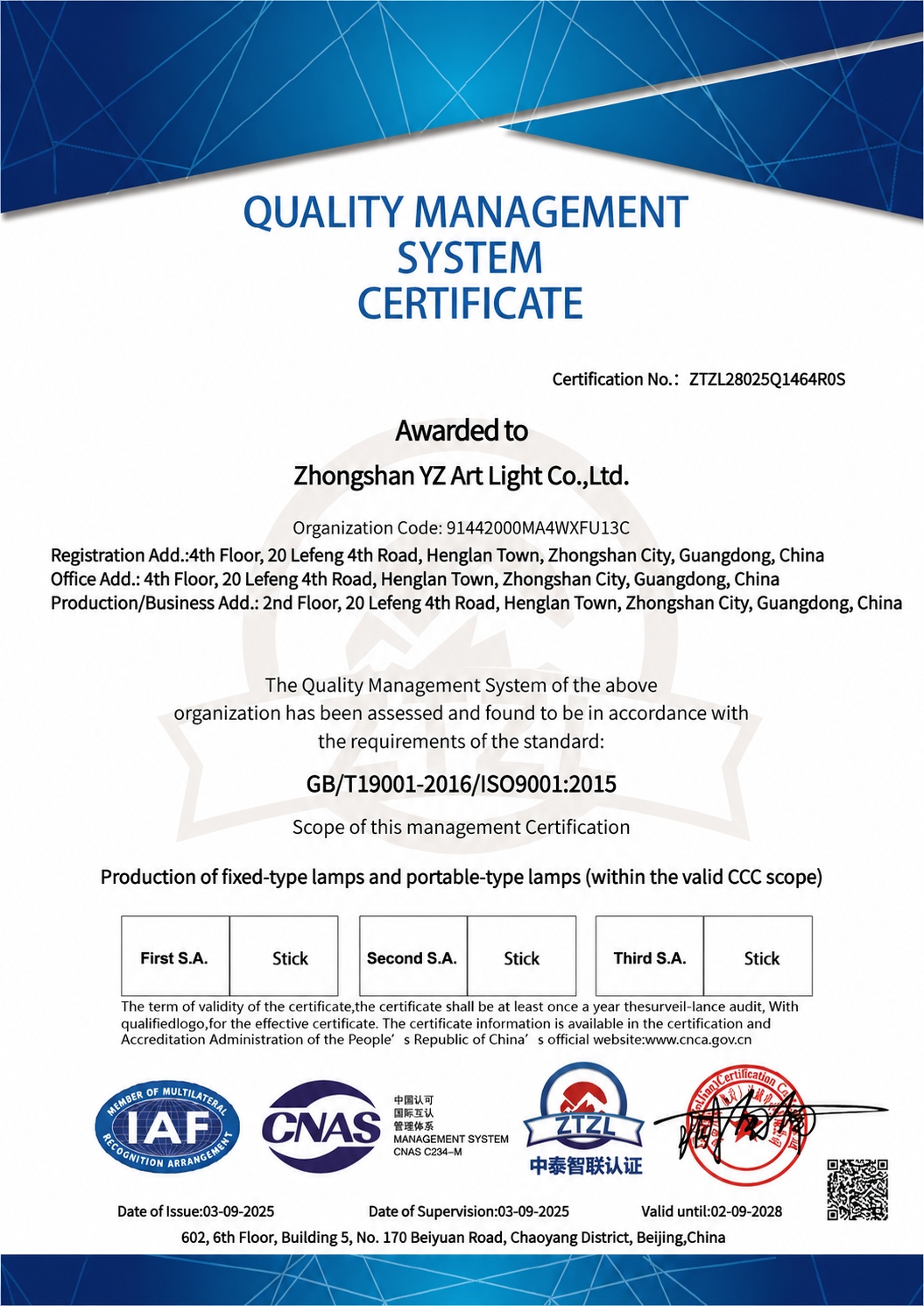
- ISO 9001 Quality Management System — certificate ZTZL28025Q1464R0S, issued by ZTZL (Zhongtai Zhilian Certification) under GB/T 19001-2016 / ISO 9001:2015, covering production of fixed-type lamps and portable-type lamps. Issued 2025-09-03; valid to 2028-09-02.
- ISO 14001 Environmental Management System — certificate ZTZL28025E0851R0S, GB/T 24001-2016 / ISO 14001:2015, covering environmental-management activities for the production of fixed fixtures and portable fixtures. Issued 2025-09-03; valid to 2028-09-02.
- ISO 45001 Occupational Health and Safety Management System — certificate ZTZL28025S0801R0S, GB/T 45001-2020 / ISO 45001:2018, covering occupational health and safety management for the same production scope. Issued 2025-09-03; valid to 2028-09-02.
What the Standards in Those Documents Actually Cover
Certificate numbers matter only if the standards behind them are understood. The YZ ART LIGHT file references the following technical basis.
- EN 60598-1:2015+A1:2018 — the general safety requirements applied to luminaires in the European Union.
- EN 60598-2-1:1989 — particular requirements for fixed general-purpose luminaires, the category that covers a permanently installed hanging chandelier.
- EN 62493:2015 — assessment of lighting equipment in relation to human exposure to electromagnetic fields.
- IEC 62321 series — the test methods used to screen restricted substances under RoHS.
- GB/T 19001-2016 / ISO 9001:2015, GB/T 24001-2016 / ISO 14001:2015 and GB/T 45001-2020 / ISO 45001:2018 — the quality, environmental, and occupational health and safety management system standards.
Destination changes the required document set. For projects delivered in North America, luminaires are assessed against UL 1598 and UL 8750 (UL Solutions). A European conformity file does not replace a North American one, and a buyer comparing suppliers should request the set that matches the market where the fixture will be installed — not the set that happens to be easiest to produce.
Cross-Checking the Document Package Against Manufacturing Reality
Documents describe a company; capacity data describes what that company can actually ship. Independent evaluation means testing whether the two are consistent.
YZ ART LIGHT operates a 15,000-square-metre production base with approximately 150 employees, including a 20-engineer R&D team, and works on an OEM and ODM basis with a minimum order quantity of one piece. Standard lead time is 30–40 working days, with shortened lead time available for urgent hotel projects; monthly capacity is 20,000 units against annual output of 100,000 units. Export accounts for roughly 70% of business, with Europe and America and the Middle East as the principal markets.
The consistency test is straightforward. A supplier that issues a manufacturing-scope certificate should also be able to state floor area, headcount and monthly output without hesitation, because those figures appear in its own management records. A supplier that claims shipment-level inspection should be able to describe the inspection steps in sequence rather than in adjectives.
In this case, every lamp undergoes 100% full inspection before shipment, covering power-on testing, appearance workmanship check, dimension and structure inspection, and accessories completeness verification. A quality-approval checklist is attached to each shipment, engineering lighting products carry a 3-year warranty, and overseas clients receive global remote technical guidance.
Application Fit: Where Independent Verification Matters Most
Document-first evaluation matters most where the fixture is large, permanent and expensive to replace: lobby chandeliers, banquet hall chandeliers, oversized chandeliers and high-ceiling installations.
YZ ART LIGHT products have been used by hotel groups, hotel engineering projects, villa owners and commercial real estate developers. The stated production scale includes over 1,000 completed commercial engineering projects, with completed references including Four Seasons Resort Sharm El Sheikh, InterContinental Jerusalem by IHG, JW Marriott Costa Elena Resort & Spa, and Waldorf Astoria Kuala Lumpur.
For a buyer, the useful part of those references is not the logo list but the operating data attached to it. The LED light source is stated to have a service life of up to 50,000 hours, and metal and glass lamp bodies are described as durable for over 15 years under normal use. Figures of that kind should be traceable to a test record, a warranty statement or a specification sheet — not to a sales conversation, whether the conversation happens with the factory or with an agent.
Market Trend: Certification and Documentation Are Becoming Specifications
Several market signals point in the same direction: documentation is moving from an afterthought to a tender requirement.
- LED lighting holds a 39.8% share of the decorative lighting light-source mix in 2025 (IMARC Group), which places driver architecture, dimming behaviour and thermal performance inside the conformity conversation.
- 56% of new luxury hotel projects now require dimmable chandelier installations (Dataintelo), a requirement that has to be answered with control and compatibility data rather than a certificate number alone.
- The 2024 International Energy Conservation Code expanded occupancy and dimming requirements for lobbies and meeting areas (International Code Council), pushing lighting documentation into building-code review.
- Hospitality lighting is growing fastest in Asia-Pacific at 5.98% CAGR (Mordor Intelligence), a region where buyers frequently evaluate suppliers they have not previously audited in person.
Taken together, those trends favour suppliers who can hand over a structured file and disadvantage suppliers whose qualification evidence exists only in conversation.
Where the Document-First Approach Has Limits
Document verification is a strong filter, not a complete one. Five boundaries are worth stating plainly.
- Scope limits. A certificate is written for a defined product type. The conformity certificates reviewed here are scoped to fixed luminaires (hanging lamps). Bespoke engineering that changes structure, load path or electrical assembly should be checked against that scope rather than assumed to be covered by it.
- Market limits. LVD-CE and CE-RoHS address the European Union. They do not establish North American compliance, and the certificates themselves note that specific applicable countries and limitations are subject to confirmation.
- Evidence limits. Documents verify safety, materials and management systems. They do not verify design fit, finish match with an interior scheme, or installation quality on site.
- System limits. Where a project uses a third-party lighting control platform — for example, Lutron's Quantum systems, which are specified in hundreds of luxury hotel properties globally (Dataintelo / Lutron) — integration is a system-level question that sits outside a luminaire conformity file.
- Situational limits. Verbal assurance is not useless. For small, low-complexity orders, or repeat purchases from a supplier already audited by the buyer, requesting a full document set can cost more time than the order justifies.
Future Outlook
Three changes are likely over the next procurement cycles.
- Certificate lifecycle management becomes routine. Validity dates are checkable — the management system certificates reviewed here run to 2028-09-02 and the RoHS conformity to 2028-09-27 — so buyers can set expiry alerts in supplier records instead of re-requesting files each time a project restarts.
- Dimming, control and energy data move into the core file. Code changes and project specifications are already pulling them in, which means the supplier who can produce a complete package in one submission will spend less time in clarification rounds.
- Remote verification matures. As hospitality lighting growth concentrates in Asia-Pacific, more buyers will select suppliers they have never visited, and document quality will carry more of the evaluation weight than it has historically.
The practical conclusion for an evaluation-stage buyer is unglamorous but reliable: ask for the file, check the numbers, match the scope to the project, and treat every claim without an identifier as a question rather than an answer.
FAQ
What documents should a chandelier manufacturer provide before a hospitality project order is confirmed?
A complete package normally contains product conformity certificates (for the EU, LVD-CE and CE-RoHS), the test reports those certificates reference, management system certificates for quality, environmental and occupational health and safety, a scope statement naming the covered product type, pre-shipment inspection records, and written warranty terms. In the YZ ART LIGHT file, that corresponds to LVD-CE certificate QTS800119288, CE-RoHS certificate QTS800519289, and ISO 9001, ISO 14001 and ISO 45001 certificates issued by ZTZL (Zhongtai Zhilian Certification).
How can a buyer check whether a certificate is genuine and still valid?
Three checks apply. First, the certificate number and issuing body — for example QTS (Guangzhou Quality Technology Service Co., Ltd.) or ZTZL — can be confirmed with the issuing organisation. Second, the referenced standard should match the destination market, such as EN 60598-1:2015+A1:2018 for the EU. Third, the validity window should be current; the ISO certificates ZTZL28025Q1464R0S, ZTZL28025E0851R0S and ZTZL28025S0801R0S are valid to 2028-09-02.
Does an EU LVD-CE certificate make a chandelier compliant in North America?
No. LVD-CE and CE-RoHS address the European Union market. In North America, luminaires are assessed against UL 1598 (Standard for Luminaires) and UL 8750 (LED Equipment) from UL Solutions. A manufacturer may hold both document sets, but the buyer needs to request the set that corresponds to the installation market.
What inspection evidence should accompany a chandelier shipment?
Shipment-level evidence should describe what was actually checked rather than assert overall quality. In this supplier's process, every lamp undergoes 100% full inspection before shipment, including power-on testing, appearance workmanship check, dimension and structure inspection, and accessories completeness verification. A quality-approval checklist accompanies each shipment, and engineering lighting products are covered by a 3-year warranty with global remote technical guidance for overseas clients.
Are verbal assurances from a middleman ever acceptable?
They can be, within defined situations: small orders, repeat purchases from a supplier the buyer has already audited, or early scoping before a shortlist is formed. The limitation is structural rather than moral: verbal claims cannot be tied to a certificate number, a standard, a product scope or a validity date, which makes them difficult to rely on if a specification dispute arises after delivery.
What is the difference between ISO 9001, ISO 14001 and ISO 45001 in a lighting factory file?
The three standards cover different management systems: ISO 9001 addresses quality management, ISO 14001 addresses environmental management, and ISO 45001 addresses occupational health and safety management. In the YZ ART LIGHT certificates they are issued under GB/T 19001-2016 / ISO 9001:2015, GB/T 24001-2016 / ISO 14001:2015 and GB/T 45001-2020 / ISO 45001:2018 respectively, with the same stated production scope of fixed-type and portable-type lamps.
Reference material: the company and product brochure for Zhongshan YZ ART LIGHT Co., Ltd. is available for download at Zhongshan YZ ART LIGHT Co., Ltd. brochure.
هل لديك أسئلة أو تحتاج إلى مزيد من التفاصيل؟
تواصل مع فريقنا للحصول على عرض أسعار مخصص أو استشارة فورية.
طلب عرض أسعار
املأ النموذج أدناه وسيتواصل معك فريقنا بعرض مقترح مخصص.
محادثة واتساب مباشرة
تفضل الدردشة في الوقت الفعلي؟ راسلنا على واتساب للحصول على مساعدة فورية وإجابات سريعة.
- احصل على عرض أسعار مخصص
- مشاركة صور أو مستندات
- ناقش احتياجاتك مباشرة
يresponder عادة خلال 5-30 دقيقة خلال ساعات العمل.