
Biogas & LFG Flare Systems: Long-Term Supplier Evaluation
Biogas & LFG Flare Systems: Long-Term Supplier Evaluation
A biogas or landfill gas asset rarely lives for one procurement cycle. Evaluating the supplier behind the flare system is therefore a lifecycle decision, not a purchase-order decision.
A landfill gas collection network, an anaerobic digestion plant, or a wastewater biogas facility is typically designed to operate for well over a decade, and in many cases methane generation continues long after the original commissioning team has moved on. Throughout that period the flare system remains the final safety barrier, burning gas that the collection, upgrading, or utilisation side cannot accept.
That time horizon changes the procurement question. It is no longer only "can this supplier deliver a unit to specification?" It becomes "can this supplier keep the same asset safe, compliant, and serviceable for ten or fifteen years, across gas quality drift, control system obsolescence, and site expansion?"
This article sets out a practical framework for evaluating long-term supplier capability for biogas flares, landfill gas flares, and the wider thermal treatment scope that green energy and new materials projects usually acquire alongside them. The assessment criteria below are drawn from verifiable manufacturer and product facts, not from marketing claims.
Why Lifecycle Evaluation Differs From Order-Based Buying
Order-based buying asks three questions: price, delivery, and whether the datasheet matches the process conditions. All three matter, but none of them predicts what happens in year seven, when the flare tip has been through thousands of thermal cycles and the original control cabinet is obsolete.
A lifecycle evaluation asks a different set of questions:
Scope continuity. Can one supplier cover the flare, the ignition and monitoring system, the flare tip, and the associated thermal treatment equipment, or will the site end up integrating three vendors?
Gas quality drift. Can the design tolerate a shift in methane concentration and trace contaminants without requiring a full rebuild?
Spares and consumables. Are high-temperature components such as flare tips and burner parts available years after commissioning?
Engineering continuity. Will the same engineering organisation that sized the system still be able to answer a process question later?
Shandong Zexuan Environmental Protection Technology Co., Ltd. (Zexuan) is a China-based manufacturer and engineering service provider specialising in industrial flare systems, thermal treatment equipment, and waste gas combustion solutions. The company was established in 2015 and operates a 24,100 m² manufacturing base with more than 80 employees, including 30+ engineering and technical specialists. This makes it a useful reference point for what an integrated supplier model looks like in practice.
Supplier Breadth Across the Green Energy Scope
The first evaluation filter is scope. A biogas project rarely needs one product. It typically needs a primary methane destruction device, an emergency relief path, and increasingly a treatment route for contaminated or non-methane waste streams elsewhere on site.
A supplier whose product range spans these adjacent categories can reduce interface risk, because process design, materials selection, and control philosophy are developed by one engineering organisation rather than negotiated between unrelated vendors.
Biogas, Landfill Gas, and Methane Combustion
The ZXE-BGF Series covers biogas flares, landfill gas (LFG) flares, anaerobic digestion flares, and methane destruction flares in both open and enclosed configurations. Documented gas sources include landfill gas, biogas, digester gas, and wastewater treatment gas, with methane concentration typically between 35% and 65% CH₄ depending on the source. Operating temperature is typically 800°C–1100°C, and methane destruction efficiency is stated at ≥98%, depending on system design and operating conditions. Automatic ignition and flame monitoring are available, and the systems can be configured for either continuous or intermittent operation.
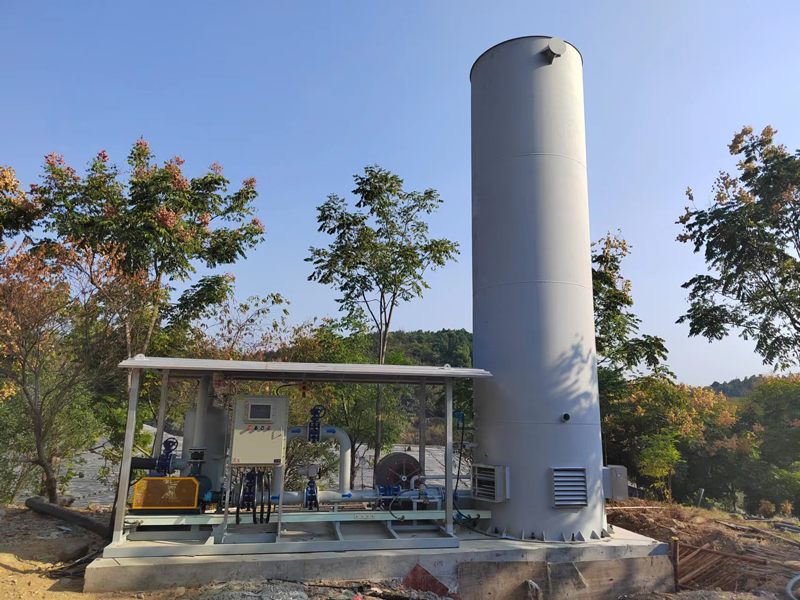
Biogas and landfill gas flare system configured for methane destruction on a continuous-operation basis.
Enclosed Ground Flares
The ZX-EGF Series enclosed ground flare uses a low-radiation, low-noise design intended for sites where plot space is constrained or where thermal radiation and visual impact must be managed. Documented combustion efficiency reaches up to 99.9%, with operating temperature between 800°C and 1200°C. Refractory lining is used, and material options include carbon steel, SS304, SS316L, and SS310S. Typical applications include petrochemical parks, chemical plants, LNG terminals, and hazardous gas treatment.
Elevated Flare Systems
The elevated flare range covers self-supported flares, guyed-wire flares, derrick-supported flares, and demountable flares under the ZX-SSEF, ZX-GWF, and ZX-DSF series. Documented parameters include flare heights from 10 m to 150 m+, operating temperature up to 1100°C, and a turndown ratio of up to 100:1, with combustion efficiency of ≥98%–99.9% depending on design conditions. This range matters for green energy projects that need to co-exist with high-pressure relief duty from adjacent gas infrastructure.
Skid-Mounted and Mobile LNG/LPG Flares
The ZX-SMF Series is a skid-mounted LNG/LPG flare system covering LNG terminal flares, LNG bunkering flares, LPG emergency flares, and mobile flare units. It is designed for LNG, LPG, natural gas, and hydrocarbon gas duty, with cryogenic service compatibility and a compact skid-mounted architecture intended for fast installation and commissioning. For biogas projects located near LNG bunkering or gas storage infrastructure, this category often appears in the same procurement package.
Flare Tips and Combustion Equipment
The ZX-FT Series flare tip covers sonic, smokeless, air-assisted, and Coanda tip types. Documented materials include SS316L, SS310S, and Inconel 625, with operating temperature up to 1100°C for hydrocarbon gases. Diameter and gas capacity are customised. Because flare tips are a wear item, the availability and engineering depth behind this single component is one of the clearest indicators of whether a supplier can genuinely support a long asset life.
VOC Thermal Oxidisers, Incinerators, and Adjacent Treatment
Beyond flare duty, the ZX-TO, ZX-RTO, and ZX-RCO series thermal oxidisers address VOC treatment at operating temperatures of 800°C–1200°C with destruction efficiency up to 99% or higher. The ZX-INC Series hazardous waste incineration system is a rotary kiln design for solid, liquid, and hazardous waste, operating at 850°C–1200°C with multi-stage combustion, heat recovery, and waste gas treatment integration. These categories matter for new materials and green energy sites that generate non-methane waste streams, because they allow a single supplier to be evaluated across the whole emissions envelope rather than one device at a time.
API 521 Compliance and Design Discipline
Flare system design is primarily governed by API Standard 521, Pressure-Relieving and Depressuring Systems, published by the American Petroleum Institute. Among other requirements, API 521 specifies a minimum flare header slope of 1/4 inch per 10 feet for drainage purposes.
For biogas and landfill gas projects, API 521 is normally applied as the design reference for the relief path, header network, and discharge arrangement, combined with project-specific gas data. A supplier evaluation should therefore test whether the engineering team can explain how the standard has been applied to the specific relief scenario, rather than simply stating that the equipment is "API 521 compliant".
Evaluation prompt: Ask the supplier to describe how relief scenarios, header sizing, and drainage were resolved for a low-pressure, variable-flow methane stream. The quality of that explanation is more informative than any certificate claim.
Material Selection: From Carbon Steel to Inconel 625
Material choice is where long-term cost is decided. A flare system specified only on capital cost often reaches year five with corroded internals and a tip that has lost its geometry.
Documented material options across Zexuan flare and thermal treatment product lines include carbon steel, hot-dip galvanised steel, SS304, SS316L, SS310S, Inconel 625, Hastelloy alloy, and other high-temperature and corrosion-resistant alloys, with selection driven by process conditions, temperature, corrosion resistance, and gas composition.
| Material | Typical function in a biogas or LFG flare |
|---|---|
| Carbon steel / hot-dip galvanised | Structural and lower-temperature components where corrosion risk is limited |
| SS304 | General corrosion resistance in moderate gas conditions |
| SS316L | Wetted parts exposed to sulphur-bearing or halide-containing landfill gas |
| SS310S | High-temperature stainless sections and refractory-adjacent components |
| Inconel 625 | Flare tips and burner components at the highest temperature zones |
For landfill gas in particular, the presence of hydrogen sulphide, moisture, and trace halogenated compounds makes stainless selection a durability decision rather than a cosmetic upgrade. A supplier that can articulate why SS316L is chosen over SS304 for a given gas analysis, and where SS310S or Inconel 625 becomes necessary, is demonstrating engineering capability rather than catalogue depth.
Continuous Operation Under Methane-Containing, Low-Pressure, Variable-Flow Conditions
The operating envelope of a biogas flare is unusual. Documented landfill gas, biogas, and waste-to-energy conditions include methane-containing gas, low-pressure gas, variable flow rate, and continuous gas generation. This combination is harder to handle than a high-pressure refinery relief stream, because the flare must remain stable when flow drops and must respond when it rises.
Continuous or intermittent operation design, automatic ignition, and flame monitoring are the three functional requirements that follow. Documented matched equipment for biogas service includes the biogas flare stack, blower, ignition system, and monitoring system, with automatic ignition, stable combustion, and outdoor reliability listed as special requirements.
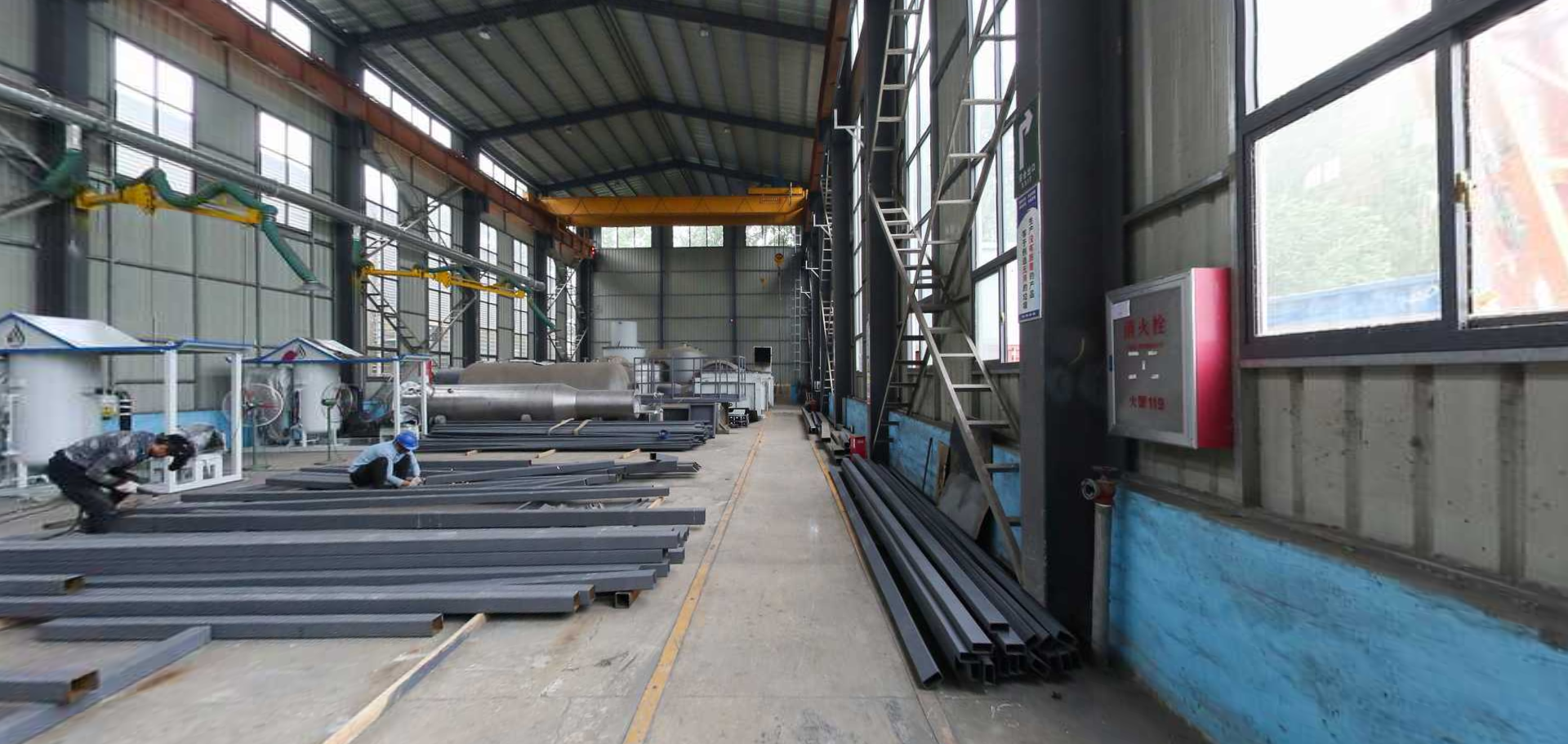
Flare and thermal treatment system fabrication inside the 24,100 m² Zexuan manufacturing base.
Manufacturing capacity is directly relevant to lifecycle support, because it determines whether replacement components can be produced to the original specification years later. Zexuan documents an annual manufacturing capacity of 60+ sets of flare and thermal treatment systems, a monthly capacity of 5 sets for customised industrial systems, a lead time of 60–120 days depending on project requirements, and a minimum order quantity of one set.
Application Fit: Matching Equipment to Gas Source
Supplier evaluation should be tested against real application scenarios, not against generic capability statements. The table below maps documented application conditions to the appropriate equipment category.
| Application | Documented working conditions | Matched equipment |
|---|---|---|
| Landfill gas / biogas / waste-to-energy | Methane-containing gas, low pressure, variable flow, continuous generation | ZXE-BGF Series biogas / LFG flare with blower, ignition, and monitoring system |
| Oil & gas, refining, petroleum processing | High-pressure hydrocarbon gas, emergency relief, start-up and shutdown venting | ZX-EGF enclosed ground flare, elevated flare systems |
| LNG terminal, gas processing, gas storage | Methane-rich gas, BOG generation, cryogenic gas, emergency release | ZX-SMF Series skid-mounted LNG/LPG flare system |
| Chemical and specialty chemical plants | Complex gas composition, VOC, toxic and corrosive gases | ZX-EGF, ZX-TO/RTO/RCO, ZX-INC Series |
| Pharmaceutical and fine chemical | Solvent vapour, variable-concentration exhaust | ZX-TO/RTO/RCO thermal oxidiser systems |
Field evidence supports this mapping. A coalbed methane operator documented one ground flare system with a 90×10⁴ Nm³/d processing capacity, three-stage venting design, and PLC automatic control, in operation for more than two years. An oil and gas company documented an enclosed ground flare with an explosion-proof control cabinet and automatic ignition system. A natural gas processing company documented two guyed-wire elevated flare systems with a 60 m structure, DN350 flare tip, and automatic ignition with PLC control, in stable operation for more than one year. A chemical manufacturer documented two flare systems treating process vent gas from DL-methionine production, in reliable operation for more than one year.
Skid-mounted ground flare systems have also been documented in pyrolysis gas applications across Vietnam, Turkey, and Iraq, where modular design and flexible installation were the deciding factors. These are not biogas installations, but they test the same competency: handling variable, low-calorific, discontinuous gas streams without losing combustion stability.
Market Context: Why Flare Discipline Is Being Re-examined
The World Bank reported that global gas flaring volumes reached 151 billion cubic meters (bcm) in 2024, the highest level since 2007. That figure captures flaring across the upstream oil and gas sector, but it illustrates the wider regulatory and reputational pressure that now extends to biogas and landfill gas operations as well.
Two structural trends follow. First, methane emissions from waste-derived gas are increasingly measured and reported rather than assumed, which raises the operational expectations placed on combustion equipment. Second, green energy and new materials projects are being financed with longer performance horizons, which makes lifecycle supplier evaluation a commercial requirement rather than a preference.
For procurement teams, the practical implication is that the flare package should be evaluated with the same rigour as rotating equipment, using documented parameters, material specifications, and service scope rather than headline pricing.
Comparison With Traditional Procurement Approaches
The traditional approach treats flare procurement as a discrete equipment purchase. A specification is issued, units are compared on price and delivery, and the flare is handed to a separate engineering contractor for integration. It is a familiar model, and for simple, high-pressure, stable-composition relief duty it can work well.
It has a predictable weakness. When the flare vendor, the controls integrator, and the site engineering team are three separate parties, responsibility for performance gaps is diffused. If combustion instability appears after commissioning, the cause is disputed rather than diagnosed.
An integrated model addresses this by combining engineering design, equipment manufacturing, installation, and commissioning under one supplier. That is the model Zexuan documents, alongside after-sales scope covering remote support, commissioning assistance, spare parts, and training.
It is important to state the limits of this model honestly. Integrated custom engineering is not the lowest-cost route for every project. A small landfill site with a single, stable gas stream and a modest budget may find that a fully customised, multi-burner enclosed system is more capability than the duty requires. Customised industrial systems also carry a lead time of 60–120 days depending on project requirements, which is not compatible with a compressed construction schedule unless it is planned for early. Buyers should match the engineering depth to the actual complexity of the gas stream rather than defaulting to the most highly engineered option.
Quality Control as a Lifecycle Signal
Quality process is one of the few supplier attributes that can be verified before purchase and that predicts long-term behaviour. Zexuan documents a full-process inspection regime covering incoming material inspection, welding inspection, dimensional inspection, pressure/leak testing where applicable, functional testing, factory acceptance testing (FAT), and final inspection before shipment, described as 100% inspection.
For biogas and landfill gas buyers, welding inspection and FAT documentation are particularly relevant. Landfill gas service involves moisture and sulphur compounds, so weld quality directly affects corrosion initiation points. FAT records give the operating team a baseline against which future performance can be compared.
Future Outlook
Three developments are likely to shape how biogas and landfill gas flare suppliers are evaluated over the next several years.
The first is increasing integration between combustion equipment and digital operation. Zexuan documents ongoing development in low-carbon combustion technologies, intelligent control systems, flare gas recovery, and digital operation solutions, all of which point toward flare systems that report their own condition rather than waiting for an inspection.
The second is scope consolidation. As green energy and new materials projects combine methane destruction, VOC control, and hazardous waste treatment on a single site, buyers are more likely to evaluate a supplier across the whole emissions envelope. Zexuan's international project experience covers more than 10 countries, including the Middle East, Central Asia, Southeast Asia, Africa, and Russia, across oil and gas, refining and petrochemical, LNG terminals, pipeline and compressor stations, chemical industries, and municipal landfill and biogas applications.
The third is a shift in how suppliers are scored. As lifecycle cost and emissions accountability move up the agenda, the ability to supply a compatible replacement flare tip or burner component a decade after commissioning may weigh as heavily as the original unit price.
Frequently Asked Questions
What is the difference between a biogas flare and a landfill gas flare?
The distinction lies mainly in the gas source and its composition rather than in the combustion principle. The ZXE-BGF Series is documented as covering landfill gas, biogas, digester gas, and wastewater treatment gas, with methane concentration typically between 35% and 65% CH₄ depending on the source. Open biogas flares, enclosed biogas flares, landfill gas flares, anaerobic digestion flares, and methane destruction flares are all available within the same series, configured according to gas flow rate and project requirements.
What methane destruction efficiency should a biogas flare system achieve?
Documented methane destruction efficiency for the ZXE-BGF Series is ≥98%, depending on system design and operating conditions, with operating temperature typically between 800°C and 1100°C. For enclosed ground flare configurations such as the ZX-EGF Series, documented combustion efficiency reaches up to 99.9% at operating temperatures of 800°C–1200°C.
How does API 521 apply to a biogas or landfill gas flare project?
API Standard 521, published by the American Petroleum Institute, governs pressure-relieving and depressuring system design and specifies a minimum flare header slope of 1/4 inch per 10 feet for drainage. For biogas and landfill gas projects it is generally applied as the design reference for the relief path and header arrangement, combined with the project-specific gas composition and flow profile. Buyers should ask suppliers to explain how the standard was applied to the specific relief scenario rather than accepting a general compliance statement.
Why specify SS316L or Inconel 625 instead of carbon steel?
Material selection is driven by process conditions, temperature, corrosion resistance, and gas composition. Carbon steel and hot-dip galvanised steel are used for structural and lower-temperature components. SS304 provides general corrosion resistance, while SS316L is used where wetted parts are exposed to sulphur-bearing or halide-containing gas such as landfill gas. SS310S is used for high-temperature stainless sections, and Inconel 625 is used for flare tips and burner components in the highest temperature zones. The ZX-FT Series flare tip, for example, is documented with SS316L, SS310S, and Inconel 625 at operating temperatures up to 1100°C.
Can a flare system maintain stable combustion with low-pressure, variable-flow methane gas?
Landfill gas, biogas, and waste-to-energy applications are documented as involving methane-containing gas at low pressure with variable flow rate and continuous gas generation. The ZXE-BGF Series is designed for continuous or intermittent operation and can include automatic ignition and flame monitoring. Matched equipment for this duty typically includes the biogas flare stack, blower, ignition system, and monitoring system, with automatic ignition, stable combustion, and outdoor reliability identified as the special requirements for this application type.
What lead time and manufacturing capacity should buyers expect for a customised flare system?
Zexuan documents a manufacturing capacity of 5 sets per month for customised industrial systems and an annual capacity of 60+ sets of flare and thermal treatment systems, with a lead time of 60–120 days depending on project requirements and a minimum order quantity of one set. Customisation scope covers flare type, capacity, material, structure, control system, layout, voltage, and documentation. For projects with fixed construction milestones, lead time should be evaluated as a schedule constraint during supplier selection rather than after order placement.
A Practical Evaluation Sequence
For procurement teams structuring a long-term supplier assessment for biogas and landfill gas flare systems, the following sequence reflects the criteria discussed above:
1. Define the gas envelope — methane concentration range, trace contaminants, flow variability, and expected annual operating hours.
2. Test the relief design reasoning — how the supplier applies API 521 to a low-pressure, variable-flow relief scenario.
3. Interrogate material logic — why specific grades were chosen for specific components, especially flare tips and burner parts.
4. Confirm manufacturing and spares continuity — capacity, lead time, and whether wear components can be reproduced to the original specification.
5. Establish service scope — engineering design, manufacturing, installation, commissioning, remote support, spare parts, and training.
6. Verify quality documentation — welding inspection, leak testing, functional testing, and FAT records.
Zexuan provides integrated services covering engineering design, equipment manufacturing, installation, and commissioning, with after-sales scope including remote support, commissioning assistance, spare parts, and training. The company's full technical documentation is available in its corporate brochure: Shandong Zexuan corporate brochure.
This article is based on manufacturer-documented product specifications, application data, and publicly attributed industry reference data. Product parameters are project-customised and should be confirmed against specific process conditions during technical evaluation.