
Bird Feeder with Camera: FCC, IP66 and 4K Buyer Checks
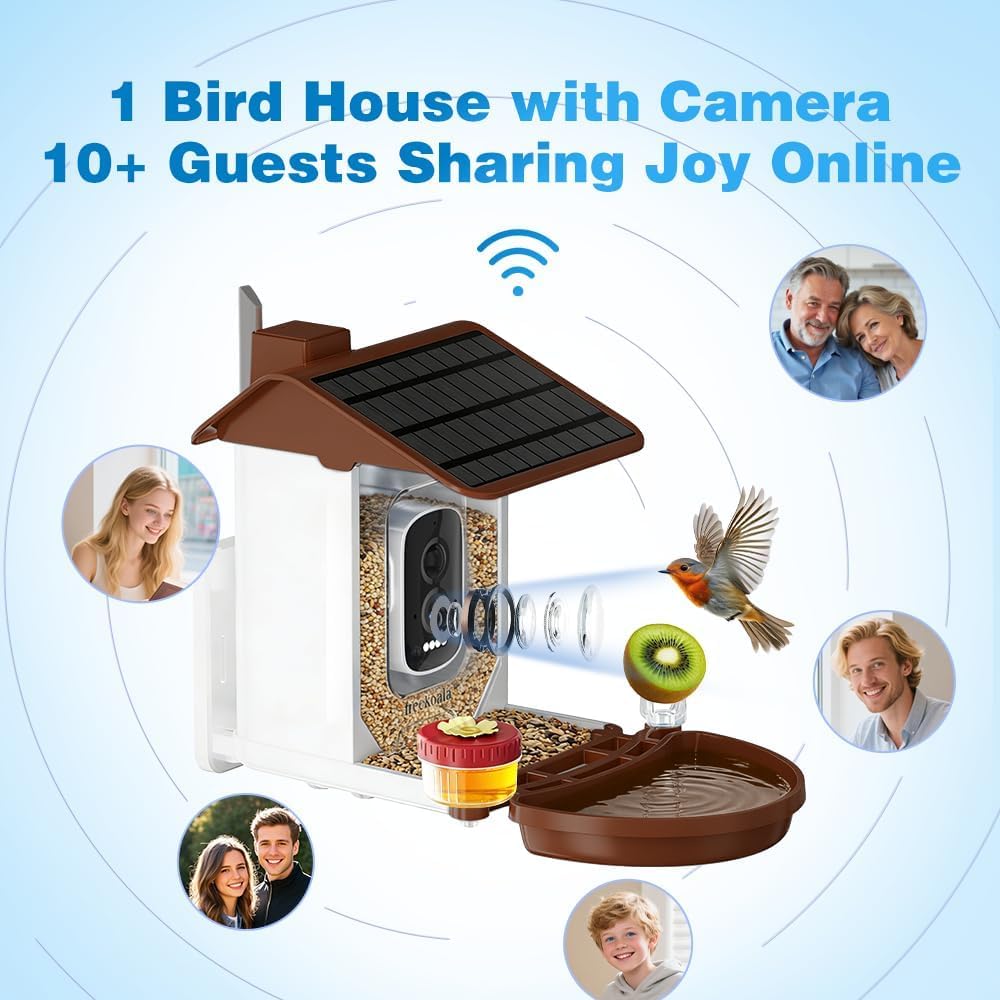
A camera-equipped bird feeder is an outdoor connected device. Buyers should evaluate wireless compatibility, weather protection, power, storage, and certification before comparing features.
Industry-led introduction: A bird feeder with camera is no longer just a feeding accessory; it is an outdoor Wi-Fi camera with a food container, a power system, and a mobile app. For research and evaluation-stage buyers, the useful question is not whether a bird camera can stream video, but which specifications and compliance documents determine whether it will work reliably in a yard, garden, or balcony and whether the manufacturer can support it after purchase.
FreeKoala Bird Feeder with Camera is a product line from Shenzhen Yangyangda Innovation Technology Co., Ltd., a manufacturer that specializes in smart pet devices, home security, and baby monitoring products, with bird feeder with camera among its main products. The company states that it exports 90% of its products, mainly to the USA, from a 5,109 m2 facility with 140 employees and annual output of 2,400,000 units. For buyers evaluating this category, those details matter less as promotional claims than as context for supply, documentation, and customization questions.
Why Bird Camera Buyers Need Constraint-First Evaluation
Most smart bird feeder pages lead with image quality or bird identification. In practice, the first constraints appear after installation: Wi-Fi band, weather rating, battery and solar behavior, local storage, subscription boundaries, and certification for the target market. A feeder that streams 4K video in a demo but cannot hold a stable 2.4GHz connection at the installation point will produce poor live viewing. A camera rated IP66 for rain may still fail if the user pressure-washes it or submerges it. A local recording feature may remove a monthly fee but still require a microSD card that is not included.
This is where the bird feeder camera category separates into two buyer paths. The first path is a casual gift purchase where visual appeal and easy app use dominate. The second path is a research or evaluation purchase where the buyer compares specifications, reads manuals, checks compliance, and asks whether the product can operate across seasons. The second path is the focus here.
Key Specifications That Define a Smart Bird Feeder
For the Smart Bird Feeder with Camera, model NU-T6SR-JC9L, the stated core specifications include a 4K camera, 2.4GHz Wi-Fi, card and cloud storage up to 256GB, 1.5L seed capacity, IP66 waterproof rating, 160-degree wide angle, 5200mAh battery, and an operating temperature range of -4F to 122F. The material is ABS, and the product is intended for outdoor gardening and patio supplies. These are the facts a buyer can use to screen the device against a home network, climate, and maintenance routine.
| Specification | Stated value | Buyer implication |
|---|---|---|
| Camera resolution | 4K | More detail for feather markings and digital cropping; default app setting may be SD, so UHD must be selected for maximum detail. |
| Field of view | 160 degrees | Wider scene coverage around the feeding tray and perch; useful when birds move quickly. |
| Wi-Fi | 2.4GHz | Longer range and better wall penetration than 5GHz for outdoor placement, but 5GHz-only networks are not supported. |
| Weather rating | IP66 | Dust-tight and protected against powerful water jets; not intended for submersion or pressure washing. |
| Battery and solar | 5200mAh battery; 3W solar panel | Solar assists charging in daylight; runtime depends on activity, live view, Wi-Fi strength, temperature, and sunlight. |
| Storage | microSD up to 256GB; optional cloud | Local recording can work without a monthly storage fee; card is not included. Premium AI and cloud services require a subscription after trial. |
| Seed capacity | 1.5L dual compartment | Fewer refills; two compatible seed types can be offered at once. |
| Operating temperature | -4F to 122F | Wide outdoor range, but extreme weather and direct sun still affect battery and charging. |
Specification summary based on the provided product data for the Smart Bird Feeder with Camera, model NU-T6SR-JC9L.
Certification and Compliance: What FCC Part 15C Means for a Bird Camera
For the US market, the Smart Bird Feeder with Camera, model NU-T6SR-JC9L, is certified to FCC Part 15C standards. The FCC ID certification number is 2ATUJ-TV-XM-Q20-4MP, issued by Eurofins Product Service GmbH. The applicable standards are FCC Part 15C, FCC 15.247, FCC 1.1310, and FCC 2.1091. The certification was issued on November 28, 2023, and does not have an expiration date. The covered scope is a digital transmission system using 2.4GHz Wi-Fi.
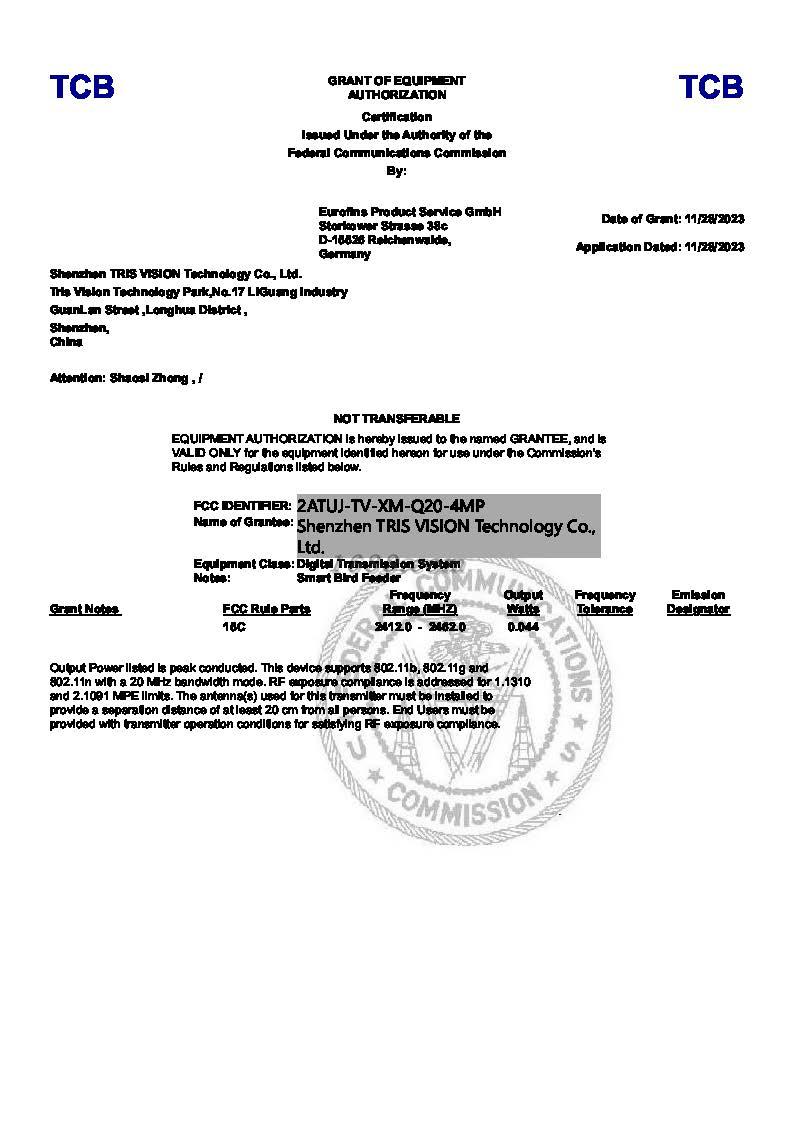
FCC certification documentation provided for the Smart Bird Feeder with Camera, model NU-T6SR-JC9L.
FCC Part 15C is relevant to intentional radiators and digital devices. For a buyer, the important interpretation is not the document number alone but the model coverage and scope. A certification tied to a specific model and a 2.4GHz Wi-Fi module tells the buyer that the radio and digital transmission system have been assessed for the US market. It does not replace an evaluation of the app, cloud service, or data privacy practices, and it does not automatically apply to every variant or future hardware revision.
Outside the US, the verified data notes that smart bird feeders with Wi-Fi or Bluetooth modules may fall under the EU Radio Equipment Directive (RED) 2014/53/EU. That directive is a market-access requirement for radio equipment in the European Union. Buyers sourcing for Europe should ask for model-specific EU documentation rather than assuming a US FCC grant is sufficient. The same logic applies to battery transport documentation and local environmental rules.
Weather, Power, and Placement Constraints
The most common mismatch in this category is weather rating versus real installation conditions. IP66 means the housing is dust-tight and protected against powerful water jets. It is suitable for rain, snow, dust, and normal bird splashing. It does not mean the camera can be submerged or cleaned with a pressure washer. Buyers should treat IP66 as an outdoor exposure rating, not a waterproof guarantee for every possible installation.
Power is the second constraint. The model uses a 5200mAh rechargeable battery and a 3W solar panel. Solar charging performance is lower in cloudy or shaded conditions. Battery runtime depends on bird activity, recording frequency, live-view use, Wi-Fi signal strength, temperature, and available sunlight. USB-C charging is available when solar charging is insufficient. A buyer in a low-sun region or a shaded yard should plan for periodic USB-C charging rather than assuming solar alone will eliminate maintenance.
Placement also affects Wi-Fi. The camera supports 2.4GHz Wi-Fi only. That band generally provides longer range and better wall penetration than 5GHz, which is useful for an outdoor feeder away from the router. However, if the Wi-Fi network is 5GHz-only, or if the 2.4GHz signal is weak at the installation point, live view and notifications may become unreliable. A practical evaluation step is to test 2.4GHz signal strength at the intended mounting location before final installation.
How the Camera Captures and Stores Bird Activity
The camera uses motion and bird-activity detection rather than recording continuously 24/7. When activity is detected around the feeder, it can capture the visit and send an alert to the app. This event-based approach reduces unnecessary recording, battery use, and storage consumption. It also means the system is not a continuous surveillance camera; a buyer who expects nonstop recording should look at that limitation directly.
Storage choices affect cost and control. Local storage saves recordings to a microSD card inside the feeder, while cloud storage saves recordings to remote online servers. FreeKoala supports microSD cards up to 256GB, allowing local recording without a monthly storage fee; the card is sold separately. Optional cloud storage is also available. Premium AI and cloud services require a subscription after the trial if users choose to continue them. Basic functions remain usable without a subscription, according to the provided product information.
If Wi-Fi goes down, videos can continue recording to the local microSD card and automatically sync to the phone after the connection is restored. Wi-Fi is still required for remote live view, push notifications, and real-time app access. That distinction matters for buyers who want local backup but also expect remote monitoring. Local storage reduces dependence on cloud services; it does not make the device fully offline-capable for live viewing.
AI Bird Recognition: Useful Aid, Not a Guarantee
AI bird identification automatically analyzes captured bird images and displays a likely species identification in the app. FreeKoala premium AI service is designed to identify more than 11,000 bird species. The feature can help users learn which birds are visiting without manually comparing every image with a field guide. However, AI identification should be treated as an aid rather than a guaranteed result for every image.
Accuracy can vary when birds have similar markings or when the image is affected by low light, motion blur, distance, dirty lenses, or partial obstruction. For better results, keep the lens clean, position the feeder where birds receive good natural light, avoid strong backlighting, and keep the camera stable. The current public product information does not specify whether all AI inference is performed on the camera or in the cloud, so buyers should avoid assuming on-device processing unless technical documentation confirms it.
Application Scenarios: Where a Bird Camera Fits
The provided application data describes a birdwatching program for outdoor, high-humidity, dusty, wide-temperature conditions from -4F to 122F, with IP66 waterproofing and all-weather automatic solar operation. The special requirement is connecting to the mobile app to watch. Matched equipment includes a Smart Bird Feeder Mounting Pole. This points to backyards, gardens, patios, and balcony installations where the feeder can receive a stable 2.4GHz Wi-Fi signal and enough sunlight for solar assist.
For apartment balconies, the wide-angle 4K camera can be useful at close range, but the buyer should avoid aiming the lens directly at reflective glass and should consider whether falling seed will affect neighbors or the property below. For family sharing, live video can be shared with up to 20 family members, which makes the feeder useful for households that want to watch backyard birds from different locations. For older users, setup requires a smartphone and 2.4GHz Wi-Fi, but everyday use can be simple once the camera is connected and alerts are enabled.
FreeKoala Smart Bird Feeder with Camera shown in brown. The product combines a feeder, camera, and solar charging in an outdoor-ready housing.
Market Trend: Camera Integration Is Moving from Niche to Standard
Commercial research estimates give a directional view of the category. Growth Market Reports estimates the global smart bird-feeder camera market at USD 225 million in 2025 and projects USD 566.3 million by 2034. The same source estimates that integrated smart feeder cameras account for 78% of market value in 2025. Another commercial source, DataIntelo, reports a broader smart bird feeder market of USD 420.5 million in 2025 with a CAGR of 11.2% for 2026-2034, and camera bird feeders as 42.3% of that defined market in 2025.
These estimates conflict because their market boundaries and methodologies are not transparent, so buyers should treat them as industry hypotheses rather than audited figures. The consistent directional signal is that camera integration is no longer an experimental add-on. It is becoming a defining product type within smart bird feeders. For buyers, that means supplier evaluation should focus on the parts that are difficult to retrofit: radio certification, weather sealing, power management, local storage, and app support.
In 2024, approximately 20% of premium bird feeders incorporated smart features including cameras and AI, according to one commercial estimate. If that direction continues, the competitive difference will shift from does it have a camera to does it have reliable connectivity, clear power expectations, and verifiable compliance. That shift favors buyers who use a constraint-first checklist instead of comparing resolution alone.
Comparison with Traditional Bird Feeders and Camera Kits
A traditional bird feeder requires no Wi-Fi, no battery, no app, and no subscription. It can be the better choice for a buyer who simply wants to feed birds with minimal maintenance. It does not provide live video, species identification, arrival alerts, or recorded clips. A separate camera aimed at a traditional feeder can add video, but it often requires its own mounting, power, and network planning, and it may not align with the feeding tray.
An integrated bird feeder with camera solves some of that alignment problem because the camera, feeder, and power system are designed as one product. It also introduces constraints: 2.4GHz Wi-Fi compatibility, solar dependence, event-based recording, local storage card requirements, and optional subscriptions for premium AI or cloud features. The trade-off is not smart versus simple but which constraints can the buyer manage. A buyer who cannot provide stable 2.4GHz Wi-Fi at the feeder location or who expects continuous 24/7 recording may find a traditional feeder or a different camera setup more appropriate.
FreeKoala model is designed for users who value integrated 4K video, subscription-free local recording, a 1.5L dual hopper, bird bath, hummingbird port, solar power, and family sharing in one system. Premium AI and cloud services remain optional paid features after the trial. That structure gives buyers a clear decision: use the basic local-recording mode, or add premium services if AI identification and cloud backup are worth the recurring cost.
Buyer Evaluation Checklist for a Bird Feeder with Camera
- Network: Confirm 2.4GHz Wi-Fi coverage at the mounting point; 5GHz-only networks are not supported.
- Power: Check solar exposure, seasonal sunlight, and whether USB-C backup charging is acceptable during low-sun periods.
- Weather: Match IP66 to the installation environment; avoid submersion and pressure washing.
- Storage: Decide whether local microSD recording is sufficient and budget for a card up to 256GB, which is not included.
- Subscription: Separate basic functions from premium AI and cloud services; premium services require a subscription after the trial.
- Certification: Request model-specific FCC documentation for the US and RED-related documentation for the EU where applicable.
- Use case: Confirm whether the buyer needs event-based clips, live viewing, or continuous recording; the product records events rather than 24/7 continuous video.
- Maintenance: Plan for lens cleaning, seed replacement, feeder cleaning, and solar panel clearing.
- Support: Confirm warranty terms and after-sales support channels; the product information includes a 1-year warranty.
Future Outlook
The next phase of the smart bird feeder category will likely be shaped by three pressures. First, buyers will ask for clearer proof of connectivity and compliance, not just resolution. Second, subscription fatigue will make local storage and transparent feature boundaries a stronger selling point. Third, AI identification will be judged by real-world accuracy, not species-count claims alone. Manufacturers that can document model-specific certification, explain power limitations honestly, and support local recording without forcing cloud dependence will be better positioned for research and evaluation-stage buyers.
For FreeKoala, the manufacturer context includes a stated product defect rate below 0.3%, over 100 R&D professionals, and more than 100 domestic and international patents, awards, and industry recognitions. These claims are company-reported and should be verified through factory audits, certificates, and sample testing during procurement. The presence of OEM capability, with customization for logo, appearance, and functions, monthly capacity of 200,000 units, lead time of 30-45 days, MOQ of 500 units, 100% testing, US export market, and remote after-sales support, gives buyers specific questions to ask rather than generic assurances.
FAQ
Does this bird feeder require a monthly subscription?
No subscription is required for basic use or local microSD recording. A microSD card up to 256GB can be used for free recording, but the card is not included. Premium AI and cloud storage are available during a trial and require a subscription if the user wants to continue those services afterward. All basic functions remain usable without a subscription.
Can I save bird videos without paying a monthly fee?
Yes. The camera supports local microSD card storage up to 256GB, so recordings can be saved locally without cloud storage. The microSD card is not included. Optional cloud backup is available for users who prefer cloud storage, but local recording can be used without a monthly cloud-storage fee.
Why does the product say 2.4GHz Wi-Fi only? Is that related to internet speed?
No. 2.4GHz describes the Wi-Fi radio frequency, not the speed of the internet plan. The feeder uses 2.4GHz Wi-Fi because this band generally provides longer range and better wall penetration than 5GHz, which is useful for an outdoor bird feeder away from the router. The product requires a 2.4GHz connection and does not support 5GHz-only networks.
What does IP66 waterproof actually mean for outdoor use?
IP66 means the camera housing is dust-tight and protected against powerful water jets. In practical use, the feeder camera is designed for outdoor exposure such as rain, snow, dust, and normal bird splashing. IP66 does not mean the camera can be submerged in water, and it should not be cleaned with a pressure washer.
Does the camera record 24/7, or only when birds arrive?
The camera uses motion and bird-activity detection instead of recording continuously 24/7. When activity is detected around the feeder, it can capture the visit and send an alert to the app. This event-based approach helps reduce unnecessary recording, battery use, and storage consumption. Detection and notification settings can be adjusted in the app.
What happens to bird videos if the Wi-Fi connection goes down?
Videos can continue recording to the local microSD card even if the Wi-Fi connection is interrupted, and they will automatically sync to the phone after the connection is restored. Wi-Fi is still required for remote live view, push notifications, and real-time app access while the network is offline.
Is 4K video useful, or is 2K enough for a bird feeder camera?
2K is sufficient for casual bird watching, while 4K provides more detail and more room for digital cropping. Higher resolution is useful when zooming in on feathers, markings, beaks, or small birds, or saving clearer clips for sharing. The current default setting is SD, so UHD mode must be selected in the app for maximum detail.
Resource: For company and product background, the FreeKoala corporate brochure is available for download: Corporate Brochure (PDF).
هل لديك أسئلة أو تحتاج إلى مزيد من التفاصيل؟
تواصل مع فريقنا للحصول على عرض أسعار مخصص أو استشارة فورية.
طلب عرض أسعار
املأ النموذج أدناه وسيتواصل معك فريقنا بعرض مقترح مخصص.
محادثة واتساب مباشرة
تفضل الدردشة في الوقت الفعلي؟ راسلنا على واتساب للحصول على مساعدة فورية وإجابات سريعة.
- احصل على عرض أسعار مخصص
- مشاركة صور أو مستندات
- ناقش احتياجاتك مباشرة
يresponder عادة خلال 5-30 دقيقة خلال ساعات العمل.