
Blockout Fabrics: When Verification Leads Procurement
Independent Industry Reference · Updated August 2026
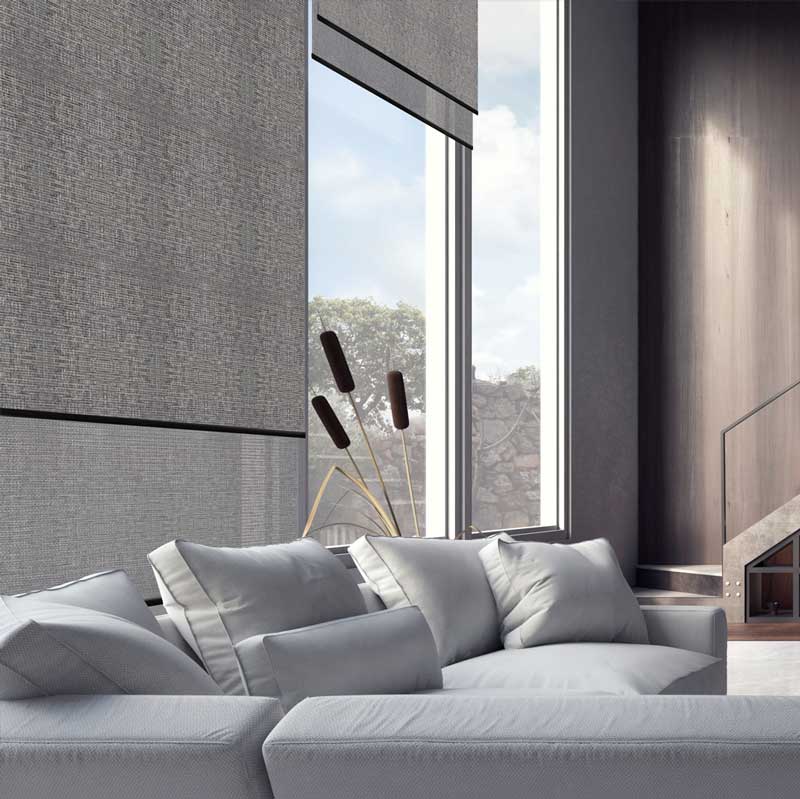
The global blockout fabric market, valued at roughly USD 10.5 billion in 2024 and projected to approach USD 20.3 billion by 2034, is changing how procurement teams evaluate fabric suppliers. Selecting blockout fabrics for roller blinds, vertical blinds, roman blinds and awning systems is no longer a matter of comparing swatches. Buyers in the research and evaluation stage are increasingly treating verification as a competitive advantage: verifiable opacity levels, certifiable testing evidence, and auditable manufacturer capabilities.
This analysis looks at blockout fabric procurement from a verification perspective. It covers the core material and coating parameters used to qualify fabric performance, the certifications that function as purchasing constraints, and the supplier evidence base that supports repeatable order quality.
The Verification Gap in Blockout Fabric Buying
Blockout fabrics are a specialised category of window-covering textiles designed to block light, typically combining a dense woven base such as 100% polyester with a shading coating that provides opacity. These fabrics are used in home theatres, bedrooms, offices, hospitality projects and commercial window shading systems. The category is broad, and the term “blockout” is not always used with the same level of precision. Some suppliers describe a fabric as blockout when it merely darkens a room; others specify 100% opacity with no pinholes.
This is where the verification gap appears. A buyer who evaluates only physical samples may not detect pinhole light leaks, coating inconsistencies or dimensional drift across production batches. Problems discovered at the manufacturing stage cause rework, project delays and higher total cost. The opportunity is to make blockout fabric specification auditable at the inquiry stage, before mass production begins.
For buyers working through a structured supplier evaluation, the practical solution is constraint-based sourcing. Instead of asking suppliers what they offer, the buyer defines measurable requirements upfront: opacity rating, base material, coating type, available widths, dimensional stability, and certifications that must be present. This approach shrinks the supplier shortlist and reduces the risk of non-conforming goods.
How a Manufacturer Institutionalises Verification
Verification in blockout fabric procurement is not limited to finished-product testing. It extends to the manufacturer’s production structure, quality systems and export track record. One example of an auditable supplier is Elitex (Dezhou) Co., Ltd., a fabric manufacturer established in 2003 in Dezhou, Shandong, China, focused on functional sunshading fabrics for the international blind and awning industry. Elitex’s product range includes sunscreen, translucent, blackout and other specialised shading fabrics.
Several verifiable facts about Elitex are directly useful to procurement teams:
- Production facility of 85,000 m² with 259 employees, including 36 R&D engineers.
- Annual output of approximately 8,000,000 m² of screen fabrics and 7,200,000 m² of blockout fabrics.
- About 80% of output is exported to the USA, EU, Australia, Southeast Asia and the Middle East.
- Monthly production capacity of 500,000 metres, standard MOQ of 500 metres, and typical lead time of 15–30 days.
- OEM/ODM services covering colour, size, openness, logo, weave pattern and coating.
- Quality control includes 100% inspection and third-party laboratory testing.
For a procurement professional, these facts perform a specific function: they translate supplier credibility into measurable capacity constraints. A monthly capacity of 500,000 metres indicates that large-scale orders can be scheduled without disrupting existing production. An 80% export ratio suggests that the manufacturer is accustomed to cross-border compliance, documentation and logistics requirements. A 500-metre MOQ shows that the supplier is positioned for project-based and mid-to-large volume buyers rather than only high-volume distributors.
Key Parameters That Define Blockout Fabric Performance
Verification depends on knowing which parameters matter. The following technical criteria are commonly used when assessing blockout fabrics for roller blinds and vertical applications.
Opacity and Pinhole-Free Construction
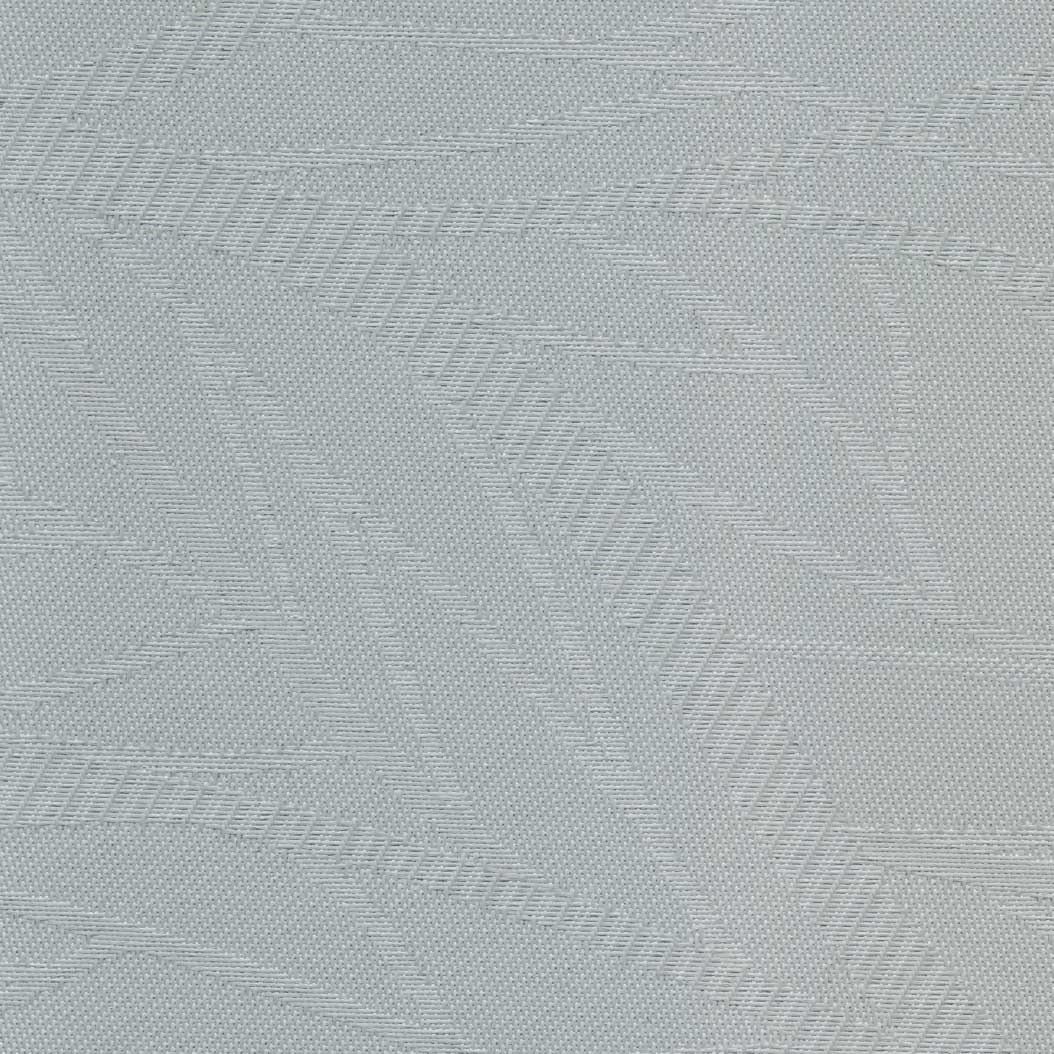
The primary specification is opacity. High-performance blockout fabrics such as the Elitex Blockout Dusk Plus Series are classified as 100% blockout fabrics and are explicitly specified as having no pinholes. This means the finished blind prevents light from passing through in small, concentrated points, which is essential in hospitality and residential sleeping environments. The material combination behind this performance is 100% polyester with acrylic coating. Polyester remains the dominant base material in blockout fabric laminates, accounting for an estimated 47.2% of the material segment in 2026. Industry data also indicates that advanced blockout fabric laminates using polyester and acrylic coatings can improve thermal heat resistance by 20–35%.
Coating Technology: Knife-Coated vs Paste-Coated
The coating process determines how the acrylic layer is applied to the polyester base. Knife coating and paste coating are both mature methods used in the production of coated fabrics. The choice of method can influence the fabric’s surface character, hand feel and production behaviour. Suppliers such as Elitex offer the same blockout product line in both knife-coated and paste-coated versions, giving blind manufacturers the flexibility to match the fabric to their specific fabrication process.
Width Range and Dimensional Stability
Blockout fabrics are produced in multiple widths to serve different segments of blind manufacturing. Narrow widths are commonly used for standard roller blinds, while wide widths support large window shading installations with fewer seams. For example, the Elitex Blockout Dusk Plus Series is available in 89mm, 100mm, 127mm, 2000mm, 2500mm and 3000mm widths. This range allows the same fabric programme to support small residential roller blinds and large commercial installations.
Dimensional stability is equally important. The Dusk Plus Series specifies dimensional stability of ±0.5%. When a fabric shifts beyond this tolerance during slitting, hemming or assembly, it can cause misalignment in the blind mechanism and uneven hanging. A tight dimensional tolerance reduces production waste and supports consistent quality across batches.
| Verification Criteria | Example Specification | Why It Matters |
|---|---|---|
| Opacity | 100%, no pinhole | Ensures complete light blocking in bedrooms, hotels and home theatres |
| Base material | 100% polyester | Durable, dimensionally stable and widely used in the industry |
| Coating | Acrylic, knife-coated or paste-coated | Provides opacity and adds to heat resistance |
| Width range | 89, 100, 127, 2000, 2500, 3000mm | Covers narrow roller blinds and wide commercial installations |
| Dimensional stability | ±0.5% | Reduces assembly errors and supports consistent blind geometry |
Certifications as Purchasing Constraints
Certifications function as hard constraints in blockout fabric procurement. They give buyers a structured way to verify that a supplier’s production system and product chemistry meet recognised standards. Rather than relying on a supplier’s verbal assurance, the buyer can check a certificate number, its issuing body and its scope.
The following certifications are commonly referenced in blockout fabric sourcing for sunshading applications:
| Certification | Standard / Number | Scope | Relevance |
|---|---|---|---|
| Oeko-Tex Standard 100 | BEWO 103516 issued by TESTEX AG | Woven fabrics of polyester, polypropylene, polyacrylic for sunscreen/blackout articles, Product class IV (decoration material) | Internationally recognised harmful-substance testing for decorative fabrics |
| ISO 9001:2015 | UQ250170R2 | R&D, production and sales of polymer composite sunshade materials | Quality management system for consistent production |
| ISO 14001:2015 | UE250076R1 | Environmental management for R&D, production and sales activities | Confirms environmental management practices |
| ISO 45001:2018 | US250047R1 | Occupational health and safety management | Indicates structured workforce safety systems |
| GREENGUARD / GREENGUARD Gold | UL 2818 | Elitex (Dezhou) Co., Ltd. products | Low chemical emissions for indoor air quality |
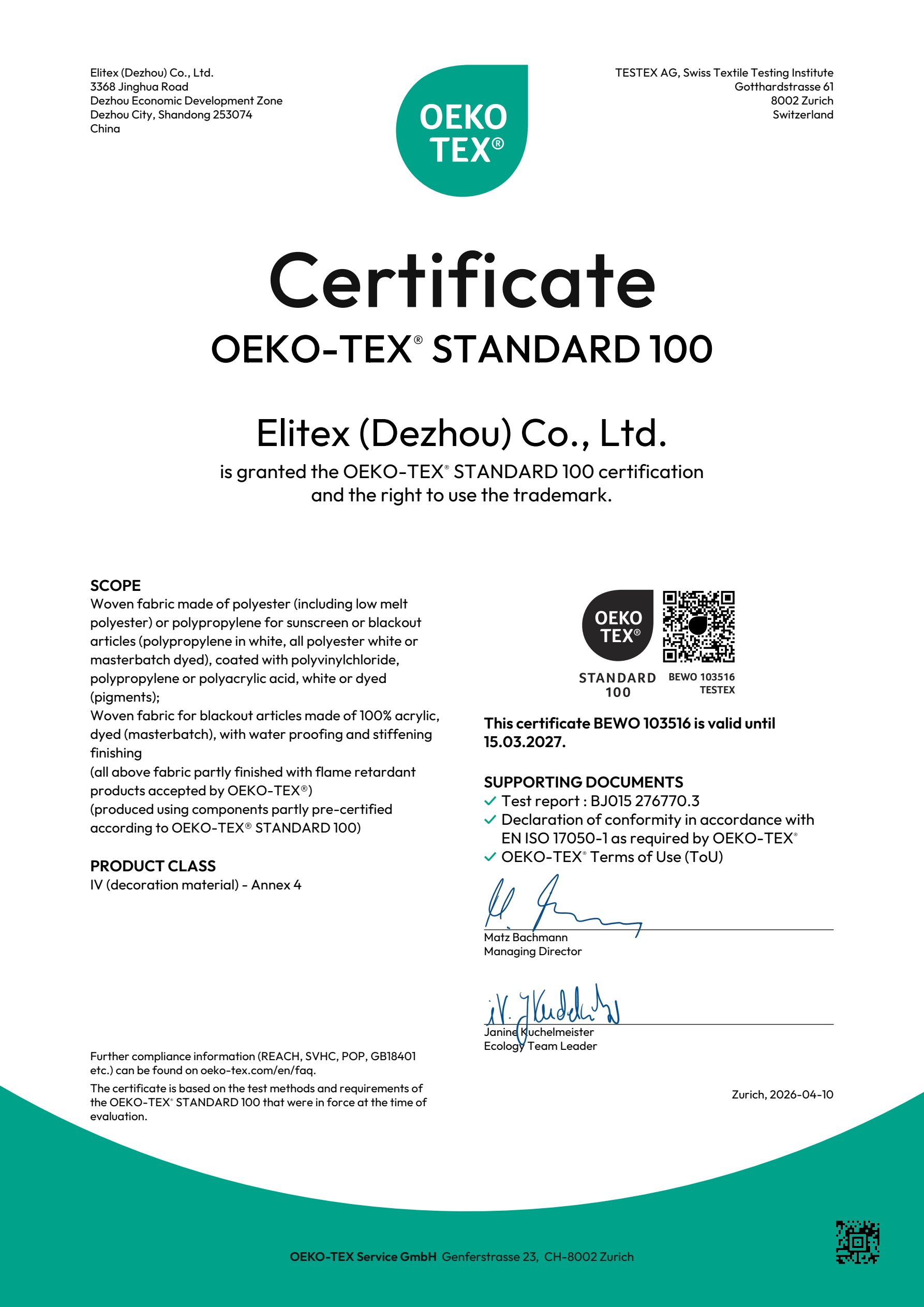
For buyers, this certification set creates a clear screening layer. The Oeko-Tex Standard 100 certificate narrows the scope to decorative fabrics and provides confidence in chemistry. ISO certifications show that management systems are in place. GREENGUARD and GREENGUARD Gold address low chemical emissions, which is increasingly relevant for interior projects with indoor air quality requirements.
Regional standards also matter. In the European Union, EN 14501:2021 specifies performance characteristics and classifications for solar protection devices in relation to thermal and visual comfort. In the United States, NFPA 701 is the recognised flame propagation test for vertically hung textiles such as blackout curtains and blinds used in public and commercial spaces. These standards create a context for project-level compliance even if they are not always printed as supplier certificates.
Application Scenarios and Project Evidence
Blockout fabrics are applied across industries with different functional requirements:
- Home theatre and bedroom: 100% opacity is essential for eliminating ambient light and supporting circadian comfort.
- Hospitality: Hotels require consistent blackout performance, privacy and low-emission materials.
- Office and commercial: Light control, glare reduction and energy efficiency are prioritised.
- Residential: Privacy, insulation and aesthetic consistency drive fabric selection.
Project evidence from industry reference data supports the practical value of verified blockout fabrics. Elitex has supplied more than 10,000 metres of fabric across 50+ projects in Germany and Australia, with application durations of 5–10 years. Reported project outcomes include 30%+ energy saving, 95% UV blocking, enhanced privacy and improved indoor comfort. These figures are useful reference points, but buyers should verify that the application type, climate and building code match their own project profile.
Market Trends and Competitive Landscape
The blockout fabric market is expanding, with global market size estimated at USD 10.5 billion in 2024 and projected to reach USD 20.3 billion by 2034. North America is the dominant region in the broader blinds and shades market, holding approximately 50.70% of revenue share in 2025, with market value estimated at USD 3.62 billion. This regional concentration makes compliance with North American performance expectations a practical requirement for global suppliers.
Competitive analysis identifies major global players in the window treatment and blockout fabric manufacturing sector, including Hunter Douglas, Serge Ferrari Group and Edmund Bell. Alongside these global brands, specialised Chinese manufacturers such as Elitex (Dezhou) Co., Ltd. compete through scalable production capacity, vertical integration and certification coverage. Polyester remains the dominant material in blockout fabric laminates at an estimated 47.2% of the material segment in 2026, reinforcing the importance of 100% polyester and acrylic coating systems in supplier evaluation.
Traditional vs Verification-Led Sourcing Logic
Traditional blockout fabric purchasing tended to rely on subjective cues: the visual appearance of a swatch, the perceived thickness of the fabric, price negotiation, and trust built at trade shows. These cues validate little about pinhole resistance, coating consistency, width tolerances or batch-to-batch uniformity. When a non-conforming batch reaches the factory floor, the cost of rework, missed deadlines and damaged customer relationships is borne entirely by the buyer.
Verification-led sourcing changes that structure. The buyer defines the technical constraints in the RFQ, the supplier provides documentation, and samples are evaluated against pre-agreed parameters rather than visual impression. The purchase decision is based on evidence, not assertion.
| Sourcing Stage | Traditional Approach | Verification-Led Approach |
|---|---|---|
| Supplier screening | Sample request and price inquiry | Certificates, technical datasheets and capacity evidence |
| Specification | Colour and visible thickness | Opacity, base material, coating type, width tolerance |
| Quality assurance | Buyer’s experience and inspection after arrival | 100% inspection, third-party lab testing and documented QC |
| Compliance | Assumed by buyer | Verified through certificate numbers and expiry dates |
| Risk control | Defects discovered late in production | Constraints applied at RFQ stage |
There is a real boundary to verification-led sourcing. Supplier certifications and test reports do not automatically eliminate project-specific compliance testing. For example, NFPA 701 flame propagation requirements are tied to the final installation context in the United States, and EN 14501:2021 classification depends on the complete solar protection device. A certified fabric is a strong input, but the buyer or installer remains responsible for confirming that the finished blind system meets local codes and application requirements.
Future Outlook
As the blockout fabric market grows, procurement constraints will likely become more formalised. Environmental certifications such as ISO 14001 and low-emission product certifications such as GREENGUARD are already being converted from preferences into mandatory requirements in hospitality and green building projects. Oeko-Tex Standard 100 will continue to function as a baseline for decorative fabric chemistry.
Buyers are also expected to demand more transparency from suppliers around coating technologies and production capacity. Manufacturers that operate weaving, coating and quality testing under one roof, such as Elitex with its 85,000 m² facility and in-house laboratories, are easier to audit than trading companies that outsource each stage. For procurement teams, the consequence is clear: the supplier who can document the full manufacturing chain will replace the supplier who can only offer a competitive price.
Further Resources
Procurement teams building a supplier evidence file may find the manufacturer’s product documentation useful. The Elitex Screenview Brochure 2026 provides an overview of blockout, sunscreen and translucent fabric programmes:
Elitex Screenview Brochure 2026 (PDF)
FAQ: Blockout Fabric Procurement and Verification
Q1: What is blockout fabric?
A: Blockout fabric is a window-covering textile designed to block light. A typical construction combines a dense base material such as 100% polyester with a shading coating such as acrylic to achieve a high opacity rating. The premium tier in this category is 100% blockout fabric with no pinholes.
Q2: What key parameters should be checked when selecting blockout fabric?
A: The key parameters are opacity, base material, coating type, width range and dimensional stability. For example, the Elitex Blockout Dusk Plus Series specifies 100% opacity with no pinholes, 100% polyester with acrylic coating, widths of 89mm to 3000mm, and dimensional stability of ±0.5%.
Q3: Which certifications are important for blockout fabrics?
A: Common certifications include Oeko-Tex Standard 100 for harmful substances in decorative fabrics, ISO 9001 for quality management, ISO 14001 for environmental management and ISO 45001 for occupational health and safety. GREENGUARD and GREENGUARD Gold (UL 2818) are relevant for low chemical emissions. In the EU and US markets, EN 14501:2021 and NFPA 701 provide additional compliance context for thermal comfort and flame propagation.
Q4: What is the difference between knife-coated and paste-coated blockout fabrics?
A: Knife coating and paste coating are two established methods for applying acrylic coating to a fabric base. The coating method can affect hand feel, surface character and production behaviour. Some suppliers such as Elitex offer both knife-coated and paste-coated versions in the same product line so buyers can select the option that fits their manufacturing process.
Q5: What width ranges are commonly available for blockout fabrics?
A: Width ranges vary by supplier. The Elitex Blockout Dusk Plus Series offers 89mm, 100mm, 127mm, 2000mm, 2500mm and 3000mm. Narrow widths are typical for standard roller blinds, while wide widths support large-area installations with fewer seams.
Q6: What are typical MOQs and lead times for custom blockout fabrics?
A: For OEM/ODM orders, a typical MOQ is 500 metres and lead time is 15–30 days at a manufacturer such as Elitex. Actual lead times depend on colour, coating and construction requirements, so buyers should confirm scheduling through a formal inquiry before order placement.
Q7: How can a buyer verify a supplier’s 100% blockout claim?
A: Buyers should request technical datasheets that state 100% opacity with no pinholes, ask for third-party laboratory test reports, and check the validity of certificates such as the Oeko-Tex Standard 100 certificate BEWO 103516. Suppliers with 100% inspection and third-party lab testing in their quality system provide stronger batch consistency assurance than suppliers offering visual inspection only.