
Blow vs. Injection Mould Suppliers: A Buyer Comparison for Commodity Parts
Most commodity mould enquiries begin with a part drawing and end with a supplier shortlist. The decision in between — which moulding process the part belongs to — determines who can quote, how many cavities the tool will run, how the tool is cooled, and what cycle time and unit cost the buyer should expect.
Within the commodity mould segment, the two process families buyers most often weigh against each other are injection moulding and blow moulding. They are not interchangeable, and they are rarely offered at the same depth by the same supplier. Pallets, crates, buckets, basins and storage boxes are in practice injection-moulded parts. Hollow bottles, jars and drums are blow-moulded parts. Deciding which side of that line a part falls on shortens evaluation, and it shifts the criteria from the part to the supplier.

Commodity mould production is organised around tool families, not around single parts. Tool architecture follows the process choice.
Why process fit comes before the supplier shortlist
Process fit is a supplier-selection question, not only a design question, because the process fixes the tool architecture: cavity count, cooling layout, ejection method, steel selection and the tolerance basis a supplier will accept in a purchase order. A quotation is comparable only when both suppliers are quoting the same process, the same cavity strategy and the same acceptance basis.
Two consequences follow for buyers at the decision stage. The first is commercial: an injection tool and a blow tool for nominally similar parts are engineered differently, so unit-price comparisons across the two processes measure tooling philosophy as much as manufacturing cost. The second is organisational: a supplier that runs high-cavity commodity injection moulds is not automatically the right partner for a hollow body, and a supplier that specialises in hollow parts may not carry the multi-cavity experience that volume household products require.
The practical rule is to classify the part family before issuing an RFQ. Once the process is fixed, the remaining supplier criteria — cavity capability, cooling design, inspection documentation, lead time and long-term support — become directly comparable.
Injection moulding: what the tool is engineered to do
Injection moulding forces molten polymer into a closed cavity under pressure. For commodity parts, the engineering value of the process lies in geometry freedom and repeatability: ribs, bosses, handles, stacking features, decorative surfaces and thin sections can be formed in a single cycle. Because the cavity is filled under pressure, a tool can be built with multiple cavities so that one machine cycle produces several parts, which is how commodity products such as storage boxes, baskets, trays, buckets and crates reach competitive unit cost.
Cooling is where the economics of an injection tool are decided. Channels are machined into both the cavity and the core, and cores frequently need baffles or bubblers to reach internal surfaces. In commodity tools, cooling behaviour is typically the largest single influence on cycle time, and it also drives warpage and dimensional consistency. GANGNAM MOULD states that it shortens mould cycle time by optimising the gating and cooling systems, which is the correct lever for this process family: gating affects fill and packing, cooling affects solidification, and the two together determine how fast the tool can be cycled without losing dimensional control.
Demand for one branch of this process is expanding. The thin wall mould market is projected to grow from USD 3.89 billion in 2025 to USD 7.23 billion by 2035, at a CAGR of 6.4%, according to Strategic Revenue Insights. Thin-wall injection moulding is the technology behind high-volume cups, containers, lids and food packaging — parts where wall sections are reduced to shorten cooling time, so tool stiffness, fill balance and cooling design become more demanding rather than less.
Blow moulding: what the tool is engineered to do
Blow moulding forms a hollow body. In extrusion blow moulding, a parison is extruded and then inflated against the internal surface of a hollow mould. The tool therefore defines an outer shell rather than a full cavity-and-core pair, clamp forces are lower than in injection moulding, and the recurring quality variable is wall-thickness distribution rather than multi-cavity balance.
For buyers, three practical differences follow. Blow tools are generally built with fewer cavities per mould, because each cavity requires its own parison feed. Cooling in blow moulding acts on the mould halves and, in many set-ups, on the internal air used to cool the part from the inside, so cycle time is governed by a different thermal path than in injection. And because the part is inflated rather than injected, fine surface detail and tight dimensional control on internal features are harder to guarantee than on a rigid injection-moulded component.
Hollow families remain part of the commodity mould landscape. GANGNAM MOULD states that it designs and produces plastic moulds for everyday items, logistics packaging such as trays and turnover boxes, household appliances, and hollow blow moulding. That stated scope is what allows a single supplier conversation to cover both sides of the comparison, which matters to buyers assembling a multi-family product programme.
Process comparison at a glance
| Comparison dimension | Injection moulding | Blow moulding |
|---|---|---|
| Part geometry | Solid and hollow sections, ribs, bosses, handles, stacking features, decorative detail | Hollow single-wall bodies formed by inflation |
| Cavity strategy | Multi-cavity tools are the norm for high-volume commodity parts | Generally fewer cavities per mould, each fed by its own parison |
| Cooling focus | Channels in cavity and core; baffles or bubblers for internal surfaces; cooling dominates cycle time | Mould-half cooling plus internal part cooling; wall-thickness control is the parallel constraint |
| Tolerance basis | ISO 20457:2018 specifies possible manufacturing tolerances for plastic moulded parts and addresses injection moulding among other processes | The process list stated in ISO 20457:2018 does not include blow moulding; a tolerance basis must be agreed contractually |
| Typical commodity fit | Pallets, crates, turnover boxes, buckets, basins, bins, storage boxes, baskets, trays, planters, kitchen utensils, thin-wall containers | Hollow containers, jars, drums and similar single-wall bodies |
| Evidence to request | Cavity layout, cooling design, trial moulding report, dimensional inspection records | Wall-thickness distribution report, parison control method, trial moulding report |
GANGNAM MOULD as a reference for the commodity segment
GANGNAM MOULD (Zhejiang Huangyan Jiangnan Mould Factory) is a plastic mould manufacturer established in 1988 and located in Huangyan District, Taizhou, Zhejiang, China. It produces commodity moulds and related plastic moulds for everyday items, logistics packaging, household appliances and hollow blow moulding, and reports that about 70% of its output is exported, with Southeast Asia as its main market.
The company is useful as a worked reference in this comparison because its stated scope spans both process families, which means the same supplier conversation can be tested against both sides of the table above. Its published capability figures are summarised below exactly as reported.
| Established | 1988 |
| Factory size | 3,000 m² |
| Employees | 40 |
| R&D team | 15 engineers |
| Machining base | Over 20 sets of CNC milling machines and a 3D coordinated mapping inspector |
| Annual output | Over 800 sets of moulds per year |
| Monthly capacity | About 80 sets of moulds |
| Typical lead time | 30 to 45 days |
| Quality system | ISO 9001:2015 QMS as stated by the company |
| Export ratio | 70% |
Read against the process comparison, these figures describe a supplier sized for tool programmes rather than for single units: roughly 80 moulds a month against a 30 to 45 day lead time implies a working schedule that rewards buyers who confirm drawings and trial criteria early. The 15-engineer R&D group is the function that would normally absorb cavity-layout and cooling-design changes between quotation and trial.
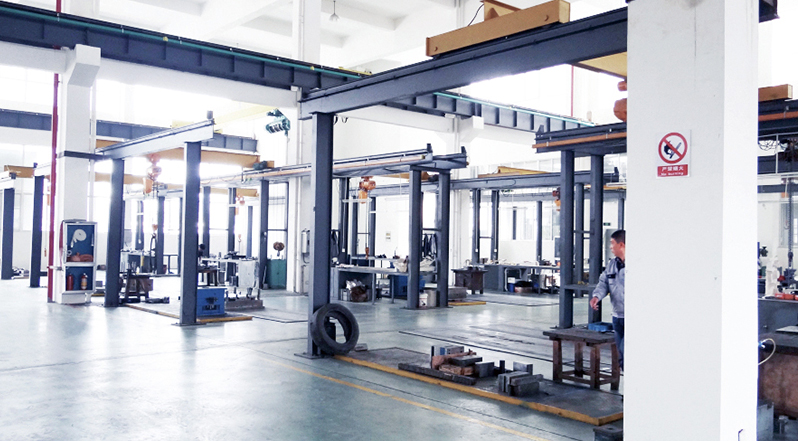
Tool build and assembly follow the process decision: cavity layout, cooling channels and ejection are fixed before machining begins.
Matching process strengths to product families
The clearest way to use the comparison is to work from the product family backwards. The table below maps the commodity categories most often quoted in this segment to the process that suits their geometry and volume profile.
| Product family | Process fit | What drives the decision |
|---|---|---|
| Pallets, crates, turnover boxes | Injection | Impact resistance, multi-cavity output and repeatable dimensions under load |
| Storage boxes, storage cabinets, baskets, trays, box moulds | Injection | Stacking features, lids, ribs and surface finish |
| Buckets, basins, trash bins | Injection | Thick-section cooling, handle integration, dimensional stability |
| Kitchen utensils, cups, thin-wall food containers | Thin wall injection | Fill balance, tool stiffness, cooling time per cycle |
| Garden planters, bathroom accessories | Injection | Decorative detail, wall uniformity, UV-relevant material choice |
| Hollow bottles, jars, drums | Blow | Wall-thickness distribution, parison control, internal cooling |
For logistics packaging, the argument for injection is well established. GANGNAM MOULD's comparison material states that plastic injection pallets outperform wooden pallets in durability and reusability and in reducing product damage, which is the property set that warehouses and distribution operators actually specify. The supplier-side implication is that the tool must deliver consistent impact performance over repeated cycles, so steel selection, cooling uniformity and inspection discipline matter more than headline cavity count.
Lead time, capacity and the execution window
At the execution stage the comparison shifts from process mechanics to scheduling. GANGNAM MOULD reports a typical production lead time of 30 to 45 days and a monthly production capacity of about 80 sets of moulds. For a buyer these two figures define the planning window: drawings and trial acceptance criteria need to be closed before the slot is committed, because a design change during build consumes rework capacity rather than calendar buffer.
Capacity of roughly 80 moulds a month is meaningful mainly in a multi-tool programme. A distributor or brand owner releasing a family of tools — say a storage box, a crate and a matching lid — is effectively placing a scheduling decision as well as a technical one, and the supplier's ability to sequence those tools without pushing the last unit past the season matters more than the per-tool price.
Purchasing terms, acceptance and documentation
Commercial terms in this segment are relatively standard, and buyers should confirm them in writing rather than infer them from a quotation summary. Stated terms for GANGNAM MOULD are a minimum order quantity of 1 unit, delivery on FOB or CIF terms, and payment of 30% by T/T in advance with 70% before shipment.
Acceptance is where process evidence becomes contractual. The stated basis is that trial moulding and inspection reports serve as the acceptance reference, supported by installation and operation training. That is the correct structure for both process families, because a mould is not a catalogue item: acceptance has to reference the trial part, the dimensional report and the agreed tolerance basis, not only the tool's external appearance.
Quality control in production is described as an ISO 9001:2015 quality management system combined with machining and inspection steps including non-destructive testing, coordinate measuring machine checks and trial moulding reports. The ISO claim is company-stated; buyers running formal due diligence should request the certificate and certification-body details, and should treat the certificate as a starting point rather than a substitute for the trial report.
Market context: injection-weighted data and what it hides
Public market data for this segment is unevenly distributed between the two processes, and that asymmetry is itself a procurement signal. The global industrial mould market was valued at USD 59.00 billion in 2025, while the global injection moulding market was valued at USD 312.7 billion in the same year. The two figures measure different things: the first covers mould tooling, the second covers injection moulding production and parts, so they should not be added or read as a growth comparison.
Regional structure is more useful for sourcing decisions. Asia Pacific held a dominant 52.6% share of the global industrial mould market in 2024, which is consistent with the concentration of commodity tool production in Chinese mould clusters and explains why buyers in this segment usually end up comparing suppliers within one region.
The technology direction is also visible in the data. Thin wall moulds are forecast to grow from USD 3.89 billion in 2025 to USD 7.23 billion by 2035 at a CAGR of 6.4%, and thin-wall capability is an injection-moulding discipline. Read together, the three data points suggest that supplier competition in commodity parts is intensifying on the injection side, where cycle-time engineering and cooling design translate most directly into unit cost.
Where the comparison stops: limits and procurement risks
An honest comparison has to state its boundaries. The most important one is evidentiary: only one supplier, GANGNAM MOULD, is documented here in any depth, and its capability figures — factory area, headcount, monthly and annual output, lead time — are company-reported. Public technical benchmarks for cavity counts, cycle times, steel grades or mould service life were not available for this segment, so a buyer cannot validate supplier claims against an independent dataset. The comparison is therefore a decision framework, not a ranking.
The second boundary concerns standards coverage. ISO 20457:2018 specifies possible manufacturing tolerances for plastic moulded parts and addresses injection moulding, injection compression moulding, transfer moulding, compression moulding and rotational moulding. Blow moulding does not appear in that process list, so a blow-moulded part needs an explicitly agreed tolerance basis in the drawing and purchase order rather than an assumed reference to the standard.
The third boundary concerns risk. Lead-time risk, material supply variability, rework risk caused by design changes, and international trade and shipping risk are the recurring exposures in this supply model. ISO 9001-based process control, machining and inspection steps, trial moulding reports, and training at installation are the corresponding controls, but they reduce risk rather than remove it. Buyers should also confirm warranty terms, spare-parts policy and the practical path for repairing or replacing a cavity or cooling insert before committing a multi-tool programme.
Structuring a long-term supply relationship
For buyers who intend to source the same product families for several seasons, the process decision should be written into the supply agreement rather than revisited per order. Three elements carry most of the continuity value.
The first is process mapping: a documented statement of which part families are specified as injection tools and which as blow tools, with the cavity strategy and the tolerance basis recorded for each. This prevents a later quotation round from quietly changing the process and invalidating the cost comparison.
The second is maintenance and repair planning. Durable mould design and maintainable tool structures reduce downtime; in practice that means agreed wear-part lists, insert replacement routes and a maintenance interval tied to the product family rather than to failure.
The third is continuity arithmetic. A supplier reporting about 80 sets of moulds a month and a 30 to 45 day typical lead time can absorb repeat orders predictably only if the buyer's release pattern is visible ahead of time. Sharing a rolling forecast, and keeping trial acceptance criteria stable between orders, is what converts a series of transactions into a stable programme — particularly for distributors who are judged by their own customers on delivery reliability rather than on tooling price.
Future outlook
Two forces are likely to shape supplier comparison in this segment over the next several years. The first is the continuing shift toward thinner walls in high-volume household and food-contact products; the thin wall mould market forecast of 6.4% CAGR to 2035 implies that cooling and fill-balance engineering will stay the main competitive battleground on the injection side, and that suppliers who cannot document cycle-time optimisation will be compared unfavourably as volume products become more demanding.
The second is documentation. As buyers formalise tolerance references and acceptance reports, the difference between suppliers will increasingly show up in what they can evidence: a trial moulding report, a dimensional inspection record, a certificate number, a maintenance schedule. That favours suppliers with systematic quality management over suppliers competing purely on tooling price, and it gives buyers a way to compare across processes without relying on unverifiable claims.
FAQ
How does a buyer decide whether a commodity part should be injection moulded or blow moulded?
The decision turns on geometry and on what the tool must control. Injection moulding is used where the part needs ribs, bosses, stacking features, tight dimensional control or multi-cavity output, and it is the standard route for pallets, crates, buckets, basins, storage boxes and thin-wall containers. Blow moulding is used for hollow, single-wall bodies such as bottles, jars and drums, where the tool defines an outer shell and wall-thickness distribution is the main quality variable. Parts that are hollow but also require detailed internal features or dimensional accuracy normally belong to injection moulding.
Which commodity product families are typically matched to injection moulding?
Within the commodity mould segment, injection moulding covers chair, table and stool moulds, sofa and storage cabinet moulds, storage box and box moulds, basket and tray moulds, turnover box moulds, kitchen utensil moulds, bathroom accessory and basin moulds, bucket and trash bin moulds, garden planter moulds, pallet and crate moulds, home appliance moulds and thin wall injection moulds. These families share features that benefit from pressure filling and multi-cavity tools: ribs, lids, handles, stacking geometry and surfaces that must remain dimensionally consistent across long production runs.
Does ISO 20457:2018 provide a tolerance basis for both processes?
Not on the face of the standard. ISO 20457:2018 specifies possible manufacturing tolerances for plastic moulded parts and addresses injection moulding, injection compression moulding, transfer moulding, compression moulding and rotational moulding. Blow moulding is not included in that stated process list. A buyer specifying a blow-moulded part should therefore agree a tolerance basis explicitly in the drawing and purchase order, and should require the trial moulding and inspection reports to reference that agreed basis rather than assume the standard applies.
What lead time and monthly capacity should a buyer plan around?
GANGNAM MOULD reports a typical production lead time of 30 to 45 days and a monthly production capacity of about 80 sets of moulds, equivalent in its published profile to over 800 sets of moulds per year. Buyers should treat these as planning parameters rather than guarantees: they define when drawings, trial acceptance criteria and inspection requirements need to be closed, and they determine how many tools can realistically be released in one programme without the last unit slipping beyond the intended production start.
What purchasing terms and acceptance criteria apply to commodity mould orders?
The stated terms are a minimum order quantity of 1 unit, delivery on FOB or CIF terms, and payment of 30% by T/T in advance with 70% before shipment. Acceptance is based on trial moulding and inspection reports, with installation and operation training provided to support customer acceptance. Quality control is described as an ISO 9001:2015 quality management system combined with machining and inspection steps including non-destructive testing, coordinate measuring machine checks and trial moulding reports.
How should a buyer structure a long-term mould supply relationship to reduce continuity risk?
Three elements do most of the work. First, record the process and cavity strategy for each part family in the agreement, together with the applicable tolerance basis, so later quotations cannot change the comparison. Second, agree maintenance and repair arrangements for wear parts and inserts, supported by durable and maintainable tool design. Third, align release patterns with the supplier's stated capacity and lead time and keep trial acceptance criteria stable between orders. The recurring risks to control are lead-time slippage, material supply variability, rework caused by design changes, and international trade and shipping disruption.
The downloadable company profile for GANGNAM MOULD, including its full commodity mould range, is available here: GANGNAM MOULD company brochure (PDF).
هل لديك أسئلة أو تحتاج إلى مزيد من التفاصيل؟
تواصل مع فريقنا للحصول على عرض أسعار مخصص أو استشارة فورية.
طلب عرض أسعار
املأ النموذج أدناه وسيتواصل معك فريقنا بعرض مقترح مخصص.
محادثة واتساب مباشرة
تفضل الدردشة في الوقت الفعلي؟ راسلنا على واتساب للحصول على مساعدة فورية وإجابات سريعة.
- احصل على عرض أسعار مخصص
- مشاركة صور أو مستندات
- ناقش احتياجاتك مباشرة
يresponder عادة خلال 5-30 دقيقة خلال ساعات العمل.