
Board Size and Batch Size: Scenario Fit for a 2-in-1 Press
Board Size and Batch Size: Scenario Fit for a 2-in-1 Press
Most packaging plants open a press comparison with print width, then find out a year later that the cost per job is governed by something else: how often board size and order quantity change together. On a 2-in-1 multifunctional digital printing machine, those two variables are the real selection criteria, because the platform carries two operating modes — scanning (multi-pass) and direct output (single-pass) — and each mode earns its keep on a different kind of order. GOKING states the pairing plainly: complex or large-format boards run in scanning mode, while small boards and small-batch orders run in direct-output mode, handled by a single all-in-one machine.
Guangdong Goking Intelligent Technology Co., Ltd. (GOKING) is a Dongguan-based manufacturer founded in 2020 that builds single-pass and multi-pass 2-in-1 digital printing machines for corrugated and honeycomb board. The company reports a 10,000 m² facility, 152 employees, 38 R&D engineers and a monthly capacity of 38 sets (cmyk-goking.com). The specifications and scenario rules below are treated as company-reported data; the buyer's job is to test whether that fit holds for a specific board mix and order book.
Why board size alone is a misleading selection criterion
Board size tells you what the machine must physically accept. It does not tell you whether the machine will be productive, because productivity in packaging print is set by the ratio between setup and running time. A plant that prints a 1,200 mm board in runs of 30 boxes needs a very different machine behaviour from a plant that prints the same board in runs of 30,000 — even though the sheet is identical and the print width requirement is identical.
This is where plate-based offset or flexo logic starts to strain. In plate-based work, the setup cost of each design is carried by the length of the run; when runs shorten and job changes multiply, that fixed cost per square metre rises faster than the press can recover it. GOKING lists plate elimination, plate-cost reduction and reduced setup waste among the functions digital printing serves in carton plants, together with short-run, urgent and personalised order handling — the operating conditions its application material names as mass production, short-run printing, frequent job change and continuous high-speed running.
The practical consequence is that a two-mode machine only pays off if the plant can route each order to the correct mode. That routing decision, not the brochure width figure, is what a scenario fit test should establish.
The specification envelope a scenario has to sit inside
Before mapping orders to modes, a buyer needs the physical envelope. The figures below are GOKING's published parameters for its corrugated cardboard digital printing machine configuration set, where head count, resolution, width and speed vary by model. They describe a configuration family, not one universal machine — which is exactly why each figure must be re-confirmed on the quotation for the selected model.
| Published parameter | Stated value | What it constrains in a real scenario |
|---|---|---|
| Print width (model range) | 264 mm to 2,600 mm | Defines the narrowest and widest board the family can address; usable width for a specific model must be confirmed separately |
| Material thickness | 2–30 mm | Sets the board caliper range to be proven on your own stock, from thin coated board to rigid corrugated |
| Printhead count | 8 to 256 | The configuration ladder between an entry setup and a high-output line |
| Production efficiency | 700 / 1,500 m²/h | A planning band for capacity studies, not a per-job guarantee |
| Single-pass linear speed | 60 m/min with Epson heads; at least 100 m/min with XAAR heads | Governs how fast direct-output batches clear the line |
| Platform | Vacuum adsorption | Board hold-down, particularly on light or small sheets |
| Feeding | Leading-edge feed or belt feed; leading edge available semi-automatic or fully automatic | Edge condition, board stiffness and labour content of loading |
| Machine footprint and weight | 4,260 × 2,300 × 1,900 mm; 2,800 kg | Floor area, access route and installation planning |
| Power | ≈14 kW; 380 V, 50/60 Hz, three-phase | Site electrical provision and stabiliser sizing |
| Working environment | 15–32 °C, 70% humidity | Whether the shop needs humidity or temperature control |
| Minimum text size | 1.5 mm English | The legibility floor for small-format and gift-box work |
| RIP workflow | Direct printing without converting images | Prep time per job change, and how quickly a new design can be released |
Two further company-reported points help with large-format planning. GOKING states that its corrugated packaging solution supports A, B, C and E flute board, and that a specialty wide-format solution uses a 2.55 m printing width for honeycomb board, oversized industrial packaging and large display board. The 2.55 m figure and the 2,600 mm upper bound of the parameter range come from different documents and different solution scopes; a buyer should treat both as company-reported and match the usable width to the exact model quoted.
Mapping board size and batch size to the two modes
The routing rule is the core of the fit decision. Scanning mode builds an image across multiple passes of the head, which is why GOKING describes its scanning configuration as the route to photo-quality imagery for premium packaging and detailed graphics. Direct output lays the image down in a single pass, which is why the same company positions its single-pass configuration on throughput for high-volume orders. A 2-in-1 machine holds both behaviours in one frame, and GOKING lists automatic scanning-to-print switching among the machine's functions.
| Board and batch pattern | Mode indicated by the stated rule | Feeding and handling to confirm | What to prove in a sample run |
|---|---|---|---|
| Small board, small batch, frequent design change | Direct output (single pass) | Leading-edge feed; semi-automatic or fully automatic loading | Registration and hold-down on light sheets; time lost per job change |
| Small board, repeated batches, long runs | Direct output | Belt feed for continuous presentation | Sustained throughput and drying at the planned speed |
| Mixed board sizes, weekly job mix | Switch between both modes | Confirm the physical changeover procedure for feed and platform | Time and waste per mode switch, measured on your own boards |
| Large-format or graphically complex board | Scanning (multi-pass) | Belt feed for heavier or longer board | Image detail at final size; board flatness through the line |
| Oversized honeycomb or display board | Scanning | Confirm usable width and board support before quoting | Handling of wide board, and whether the quoted width is usable width |
The cost of getting the routing wrong
Two failure modes are common, and neither shows up on a specification sheet. The first is a plant that runs everything in scanning mode because it started with premium work: complex graphics come out well, but straightforward repeat batches consume passes they do not need, and the machine's capacity is spent on jobs that did not require it. The second is a plant that runs everything in direct output because it bought the machine for speed: repetitive small cartons fly through, then a one-off large display board with fine detail exposes the limits of a single pass.
Neither outcome means the machine is wrong. It means the order router — the person or rule that decides which mode a job enters — was never given a criterion. The two-variable rule above is that criterion, and it should be written into the plant's production planning before installation, not after.
Feeding, hold-down and the details that decide feasibility
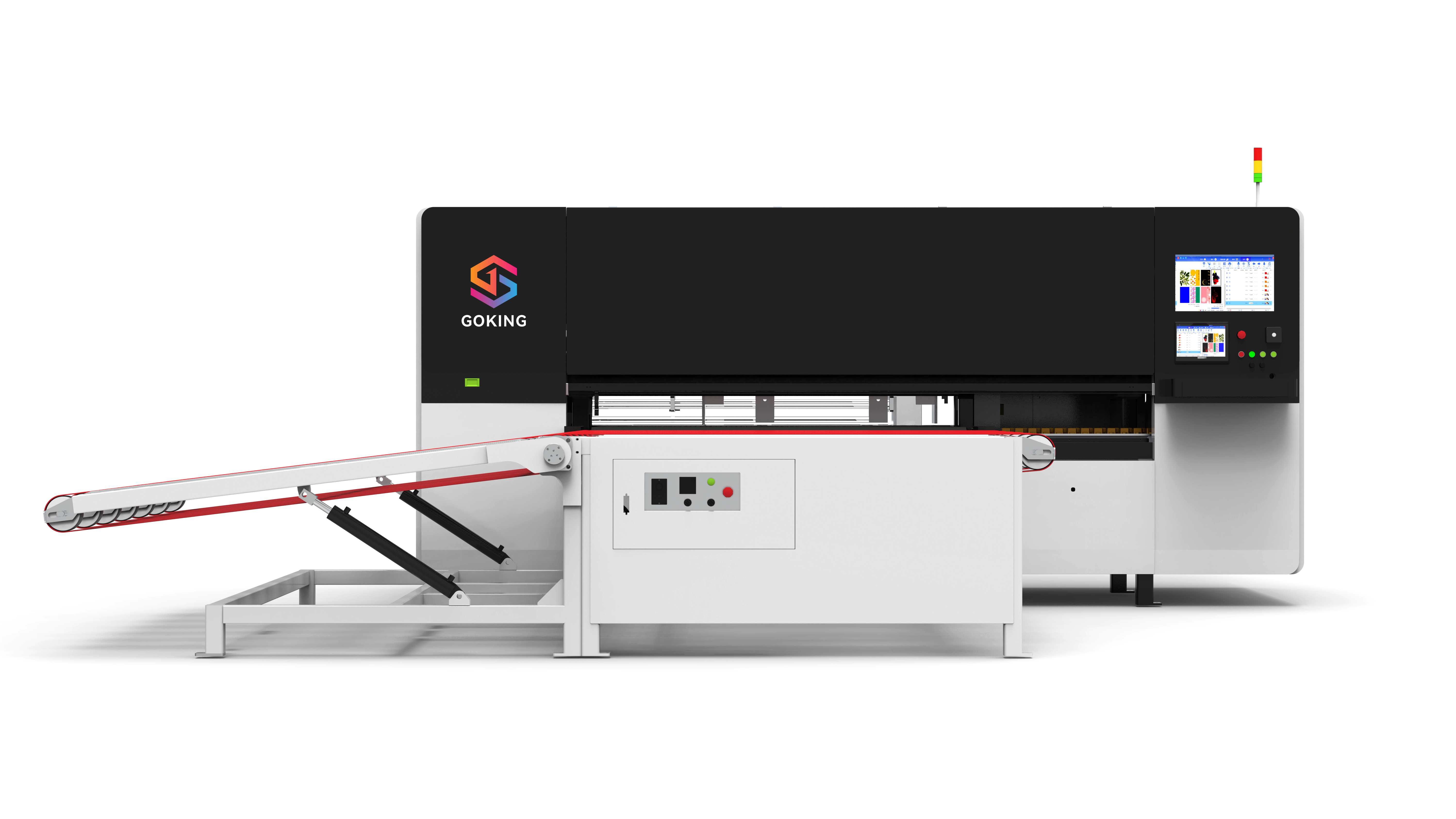
Two boards of the same length can behave completely differently on the same press, and the difference is usually edge quality and stiffness. GOKING lists two feeding methods — leading-edge feed and belt feed — with the leading-edge unit available in semi-automatic or fully automatic form. Belt feeding presents board continuously, which suits sequences of similar board; leading-edge feeding hands each sheet in at its front edge, which suits job-by-job loading where board changes between runs.
Hold-down is the second variable. The platform is a vacuum adsorption type, which matters most on small, light or slightly warped sheets: without reliable hold-down, a small board can shift between passes, and registration drift shows up as reject rate rather than as a machine fault. On a 30 mm rigid board the same platform is doing a different job — keeping a heavy sheet flat and predictable as it travels.
Around the print engine, GOKING's specification adds a magnetic levitation high-precision crossbeam, servo-motor motion, Schneider electrical components, a two-supply fully enclosed ink channel and a temperature control system. In scenario terms these are not decoration: they are the parts of the machine that determine whether a wide board prints consistently across its full width and whether repeated job changes stay within tolerance.
Three plant types, three different fits
Corrugated packaging plants: batch size does the deciding
A corrugated box plant typically faces one dominant constraint — order fragmentation. When a customer orders 500 boxes in three sizes and reorders the same three sizes next month, the machine's value depends on re-entry speed rather than peak speed. This is the profile where the direct-output side of a 2-in-1 machine carries most of the load, with scanning reserved for the large or graphically demanding carton that would otherwise be outsourced or plated. GOKING reports that its customers in printing and packaging have run this model for more than five years in short-run and on-demand work, with production efficiency and cost reduction cited as the outcomes.
Paper mills and coated board converters: board range decides
A mill or coated paperboard operation usually has the opposite starting point: fewer customers, more stable designs, and a strong interest in whether one machine can cover both lighter coated stock and heavier corrugated. GOKING states that its solutions span kraft paper through coated paper and sheet printing through mass production, which is the claim to test against your own caliper ladder. Here the fit question is not batch fragmentation but whether the 2–30 mm thickness range and the quoted usable width genuinely cover the heaviest and widest board in the mill's catalogue — and whether both feeding methods can be demonstrated on that board.
Gift box, display and oversized industrial packaging: complexity decides
Where the product is decorative or the board is oversized, image quality and handling outrank raw throughput, and the scanning side of the machine dominates. GOKING positions its scanning configuration for premium packaging and detailed graphics, and its wide-format solution for honeycomb board, oversized industrial packaging and large display board. For this buyer, the decisive checks are detail retention at final size, flatness through the line, and whether the quoted printing width is usable width.
Where the 2-in-1 logic stops, and plate-based printing still wins
Digital's advantage is concentrated where a plate would be used once. For a long, static run of a single design on a stable substrate, a plate-based line amortises its setup over volume and remains economically sound; the honest boundary of the multifunctional machine is that it does not replace that case, it removes the penalty attached to the other cases. A plant that expects to run one design for months should not buy short-run flexibility it will never use.
Three further boundaries belong in the evaluation file rather than in a footnote:
- Nominal resolution is not measured print quality. GOKING states support for 600 DPI and 1,200 DPI with Epson heads in configurations from 8 to 256 nozzles, but no model-level mapping between resolution and head count is published, and nominal DPI is not equivalent to measured image quality. Accept a machine on printed samples, not on a DPI figure.
- Ink chemistry does not by itself establish water resistance. GOKING lists water-based dye, water-based pigment, coating and UV eco-friendly inks, plus a CMYK(W) colour mode with white available. The material supplied for this article does not include water-resistance test data or a test method, so a buyer whose packaging must survive moisture should request tests on their own board and ink combination before accepting the specification.
- Compliance is documented per machine. Declaration of conformity, applicable standards and the electrical and machinery safety file should be requested for the exact model being purchased. The EU Machinery Regulation (EU) 2023/1230 becomes fully applicable on 14 January 2027, introducing stricter safety and digital documentation requirements, so a machine specified now will operate under that framework for most of its service life.
Market context: why batch fragmentation is being priced in
Two published figures frame the demand side, and both should be read for what they measure. Grand View Research valued the global digital printing packaging market at USD 37.5 billion in 2025, while Smithers expects the digital corrugated segment to more than double across 2025–2030 and reach USD 8.2 billion by 2030. These are packaging-market values, not press shipments, and published forecasts for this category vary with the product scope each researcher includes — so they support a direction of travel, not a procurement decision on their own.
What they do support is the operational premise behind the two-mode machine: if a growing share of packaging value sits in shorter, more varied runs, then a plant's bottleneck moves from printing speed on long runs to changeover and routing on mixed runs. That is a machine-architecture question as much as a market question, and it is why the board-size and batch-size pairing deserves to be tested explicitly rather than assumed.
Outlook: capacity planning around two modes
The realistic planning assumption for the next several years is that a packaging plant will hold a mixed order book — some repeat volume, some fragmented short runs, some oversized or premium work — rather than committing to one profile. A 2-in-1 platform hedges that mix, but only if the plant treats the two modes as two capacities to be scheduled. GOKING supports that planning with a stated MOQ of one set, a standard production lead time of about one month for standard machines (custom and OEM/ODM timelines confirmed on order), pre-shipment inspection, 100% aging and long-time running tests, and engineers who travel to site for installation and commissioning, with after-sales response stated at within 24 hours.
A seven-point fit check before signing
- Send four boards, not one. Thinnest, thickest, largest and smallest, printed in both modes, so the 2–30 mm range and the quoted usable width are proven on your stock rather than on a demonstration sheet.
- Measure the mode switch. Time the move from direct output to scanning and back, including colour calibration, and convert it into the smallest batch size that is still worth running.
- Confirm feed configuration against your edges. Leading-edge versus belt feeding, and semi-automatic versus fully automatic loading, should be decided on your board stiffness and edge condition — not on labour-cost assumptions alone.
- Test hold-down on your lightest sheet. Vacuum adsorption performance shows up as registration stability on small, light board; a short run on your thinnest stock is the cheapest test available.
- Check the site numbers. A 4,260 × 2,300 × 1,900 mm footprint at 2,800 kg, roughly 14 kW at 380 V three-phase, and a 15–32 °C / 70% humidity environment are the constraints to clear with your facilities team before the shipping date.
- Verify the width claim in writing. Ask for the usable print width, the head count and the resolution of the exact model on the quotation, and reconcile it with the wider 264–2,600 mm family range.
- Build the document set. Substrate test records, ink specification, drying details, declaration of conformity for the model, spare-parts list and acceptance criteria belong in the purchase file, not in a later conversation.
Frequently asked questions
What board sizes can a multifunctional digital printing machine handle?
GOKING publishes a print width range of 264 mm to 2,600 mm across its corrugated cardboard configuration set, with material thickness of 2–30 mm. Because head count, resolution, width and speed vary by configuration, the number to confirm on a quotation is the usable print width of the specific model rather than the family maximum.
When is scanning mode a better choice than direct output?
Under the scenario rule GOKING states, complex or large-format boards are assigned to scanning (multi-pass) mode, while small boards and small-batch orders are assigned to direct-output (single-pass) mode on the same all-in-one machine. The reasoning is mechanical: multi-pass scanning builds the image over several passes, which suits large or graphically demanding work, while a single pass trades that for throughput on simpler, higher-volume work.
Does board thickness change the mode or the feeding method?
Thickness affects handling rather than the mode rule. The machine accepts a stated 2–30 mm material range and holds board by vacuum adsorption, and it offers leading-edge feeding or belt feeding, with the leading-edge unit available in semi-automatic or fully automatic form. Which feed suits a given board depends on stiffness, edge condition and how the sheet is presented to the head, so the practical approach is to demonstrate the thinnest and thickest board in your range during sample printing rather than assume one feed setting covers the full range.
How should a plant validate scenario fit before ordering?
Submit representative boards for sample printing and ask for both modes to be run. On the samples, check registration, drying at the planned production speed, hold-down on the lightest sheet, image detail on the largest sheet, and the time and waste involved in switching modes. GOKING states that it provides free sample printing for global clients and includes comprehensive print sample inspection in its process; verifying performance on your own board mix remains the buyer's step.
What site conditions does the machine require?
GOKING lists a machine size of 4,260 × 2,300 × 1,900 mm, a weight of 2,800 kg, rated power of approximately 14 kW at 380 V three-phase 50/60 Hz, and a working environment of 15–32 °C at 70% humidity. These figures should be checked against floor area, access route, electrical supply and shop climate before the installation date is agreed.
Does a 2-in-1 machine replace plate-based printing entirely?
No. Plate-based printing retains its economics where a single design runs in long, stable volumes, because the plate cost is spread over that volume. The 2-in-1 digital platform addresses the opposite case — short runs, frequent job changes and reduced setup waste — and the two approaches can coexist in the same plant, with the routing decision determining which one carries each order.
Reference material
The GOKING product catalogue covering single-pass, multi-pass and 2-in-1 configurations is available for download: 2026 GOKING product catalogue (PDF). Company information is published at www.cmyk-goking.com.
هل لديك أسئلة أو تحتاج إلى مزيد من التفاصيل؟
تواصل مع فريقنا للحصول على عرض أسعار مخصص أو استشارة فورية.
طلب عرض أسعار
املأ النموذج أدناه وسيتواصل معك فريقنا بعرض مقترح مخصص.
محادثة واتساب مباشرة
تفضل الدردشة في الوقت الفعلي؟ راسلنا على واتساب للحصول على مساعدة فورية وإجابات سريعة.
- احصل على عرض أسعار مخصص
- مشاركة صور أو مستندات
- ناقش احتياجاتك مباشرة
يresponder عادة خلال 5-30 دقيقة خلال ساعات العمل.