
Box Type Substation for Solar Power Plants: Buyer's Guide
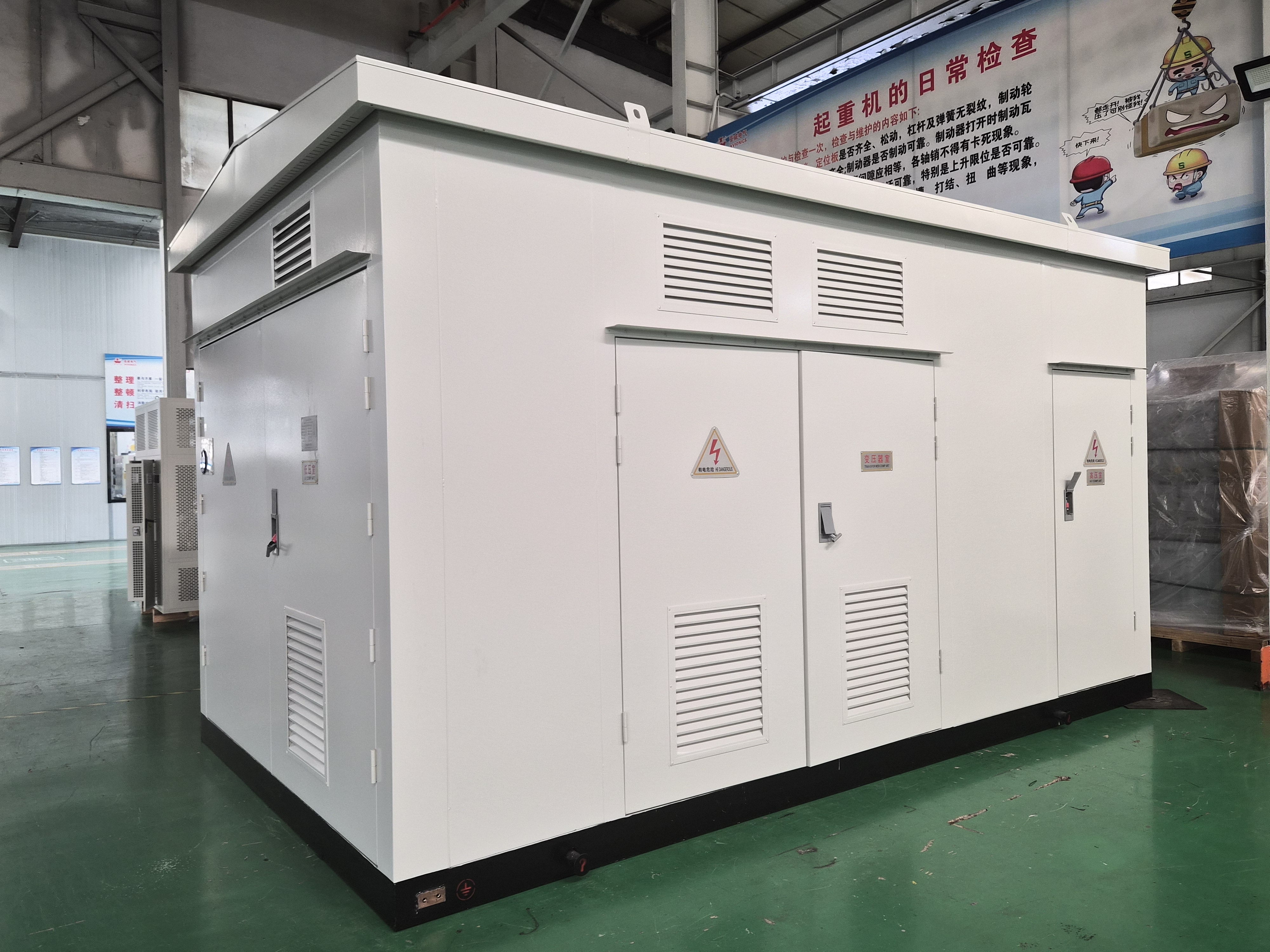
A box type substation for a solar power plant is a factory-assembled medium-voltage substation that combines a step-up transformer, high-voltage switchgear, low-voltage switchgear, protection and auxiliary systems inside one enclosure, and connects a PV block to the plant's medium-voltage collection network. Its function is to raise inverter output voltage to the 10 kV or 35 kV level at which a solar plant moves power toward the point of grid connection.
That definition is short; the specification behind it is not. Photovoltaic plants are built in high-irradiance locations where transport routes, site labour and weather windows all vary, and the collection substation is one of the last items to be energised before a plant can export power. The package therefore has to be evaluated as project infrastructure rather than as a transformer in a steel box.
This reference sets out what the product covers, what sits inside the enclosure, how the transformer is matched to inverter output, which standards a buyer should expect to see, and where the prefabricated approach stops being the appropriate answer. Product and capability facts are drawn from Apex Power Systems (Nanjing) Co., Ltd., an international trading and supply-partner company based in Nanjing, China, that supplies power transformers, box-type substations and prefabricated substations through audited manufacturing partners and is not itself a manufacturer.
Why the collection substation sits on the energisation critical path
In a conventional approach the substation building, foundations, cable trenches and equipment erection are completed on site, in sequence, and each stage is exposed to weather and to the availability of qualified labour. On a remote PV site that sequence becomes the schedule risk: civil works cannot start before design freeze, equipment cannot be energised before the enclosure is weathertight and any oil-filled equipment has been processed and tested, and every one of those steps competes with the same site crew that is installing mounting structures and modules.
Prefabrication moves that work upstream. In a prefabricated cabin substation the high-voltage switchgear, transformer, low-voltage switchgear, compensation equipment, automation system, AC and DC auxiliary supply and environmental control are installed, tested and commissioned at the factory, and the module is then transported and connected on site. The buyer's remaining site work reduces to foundation, positioning, cable or busbar connection and commissioning checks.
The engineering consequence is that the transformer inside the enclosure is no longer a stand-alone purchase. Its low-voltage range, impedance, cooling class, vector group and monitoring interfaces are fixed against the inverter and against the network protection study before the cabin is built, so changing them later is a cabin redesign rather than a transformer swap.
What the package contains: the configuration envelope
Taking the YBM/ZGS11/ZGS13 prefabricated cabin modular substation as a reference configuration, the integrated scope is wider than most first-time buyers expect. The table below summarises the envelope as published in the product data.
| Parameter | Published value |
|---|---|
| Voltage class | 10 kV / 35 kV |
| Transformer capacity | 500–50,000 kVA |
| Integrated equipment | HV switchgear, transformer, LV switchgear, compensation equipment, automation system, AC/DC power supply, environmental control |
| Cabin dimensions | Standard container dimensions, customizable |
| Enclosure protection | IP54 / IP55 |
| Ambient temperature | -40 °C to +50 °C |
| Installation | Transport as a complete unit, crane lifting, on-site connection |
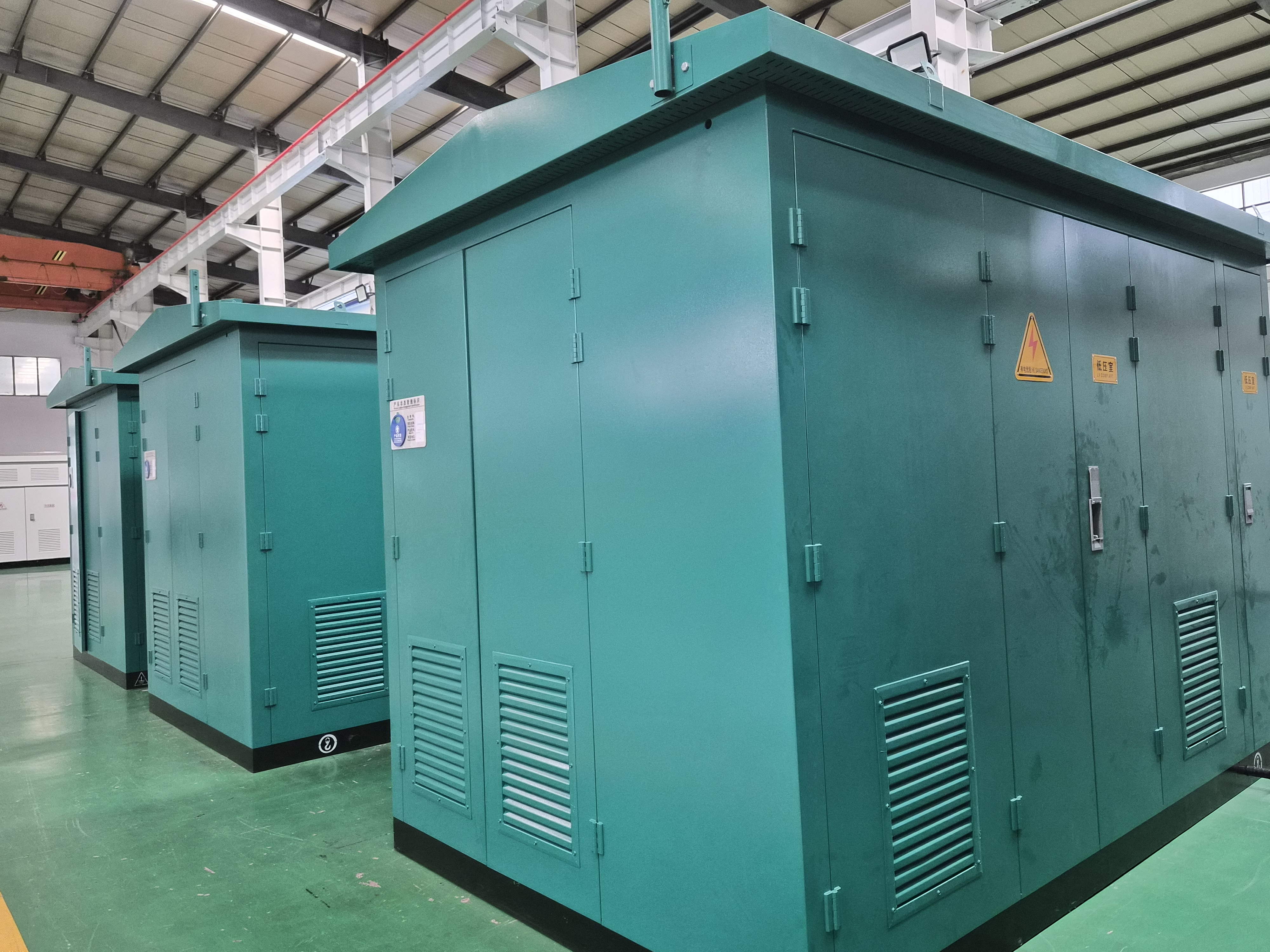
| Cabin construction | Containerized steel structure with rock-wool sandwich-panel insulation and anti-corrosion coating; welded structural-steel base with anti-corrosion treatment |
| Monitoring | Integrated automation system covering temperature, humidity, smoke, water ingress and access |
| HVAC and fire protection | Industrial air conditioner, forced ventilation and heater; gas extinguishing or ultra-fine dry powder, optional |
Two rows deserve emphasis at the research stage. The first is capacity: 500 to 50,000 kVA at 10 kV or 35 kV covers a single PV block through to a substantial collection station, but capacity is not the same thing as voltage class, and this enclosure family does not extend into transmission voltages. The second is the declared ambient range of -40 °C to +50 °C. That is an operating envelope, not an unlimited one; the product data also states suitability for high-altitude, high-humidity, dusty and salt-spray environments, and those conditions should be confirmed in writing against the actual site rather than inferred from a general catalogue statement.
Matching the transformer to inverter output
Photovoltaic generation is inverter-based, and that shapes the substation specification more than the plant nameplate capacity does. Inverter output voltages differ between manufacturers, which is why renewable-energy transformers are commonly specified with a wide-range low-voltage winding. In the SC10, SZ18 and SZ20 new energy transformer range, the published envelope is 500–12,500 kVA at the 10 kV class and 1,000–12,500 kVA at the 35 kV class, with a low-voltage winding covering 0.4–1.14 kV and impedance voltage options from 6.0% to 14.0% for different system short-circuit capacities. Off-circuit tapping is normally +/-2 x 2.5% or +/-5%, and cooling is ONAN or ONAF depending on the load profile.
Oil-immersed distribution transformers are also supplied in the same ecosystem: the S13, S14 and S15 series cover 30–3,150 kVA at the 10 kV class and 3,150–31,500 kVA at the 35 kV class, with off-circuit or on-load tap changing. Where an oil-free installation is required, the SCB12–SCB18 epoxy resin cast dry-type range is the alternative, and it is the conventional choice for fire-sensitive or indoor locations.
Inverter-based sources also present harmonic content and DC bias that a transformer serving a passive load does not see. Harmonic and DC-bias withstand is therefore a legitimate specification item for a PV step-up unit, not a marketing phrase, and it belongs in the technical schedule next to impedance and tap range.
Cooling class determines the permissible load
The four-letter cooling code on the nameplate tells the buyer how the unit is cooled and therefore how much load it may carry. O stands for oil and A for air, N for natural circulation and F for forced circulation. An ONAN transformer relies on natural oil circulation and natural air circulation, while adding fans - ONAF - raises the permissible loading, which is why the same transformer often carries two ratings on its nameplate, one for each cooling stage. The cooling class must be checked against site ambient temperature and altitude, because a rating established at one set of conditions does not automatically transfer to another.
Vector group and parallel operation
The vector group, for example Dyn11 or Yyn0, defines how the high-voltage and low-voltage windings are connected and what phase displacement exists between them. It matters for two practical reasons: two transformers can only be operated in parallel if their vector groups are compatible, and the phase displacement affects protection settings and the connection of downstream equipment. Because it appears on the rating plate, the enquiry and the drawings, an incorrect vector group is one of the more common reasons a transformer arrives unable to parallel with units already on site.
Enclosure engineering and site conditions
In a solar plant the enclosure is exposed for decades, so the cabin specification carries as much weight as the transformer. The reference construction is a containerised steel structure with rock-wool sandwich-panel insulation and an anti-corrosion coating, mounted on a welded structural-steel base that is itself anti-corrosion treated. Internal environmental control combines an industrial air conditioner, forced ventilation and a heater, which is what allows the same family to operate across a declared -40 °C to +50 °C range. Fire protection is optional and can be specified as gas extinguishing or ultra-fine dry powder.
Monitoring is integrated rather than added later: the automation system covers temperature, humidity, smoke, water ingress and access, and the product supports remote monitoring and unattended operation. For a plant that may be staffed only during maintenance visits, this is a practical requirement rather than a feature, because it converts the substation from a passive asset into an observable one.
Modularity is the other structural point. The configuration is expandable, and additional capacity is added by adding cabins rather than by rebuilding the station. That matters on PV sites that are built in phases, where the collection network has to grow with the installed DC capacity.
Standards and conformity: what to verify, not assume
The international reference for this product family is IEC 62271-202:2022, which specifies the service conditions, rated characteristics, general structural requirements and test methods of enclosed high-voltage prefabricated substations. A supplier should be able to state the edition applied and show type-test evidence for the product family being offered, not only for a similar product.
Beyond the assembly standard, the transformer and switchgear content carries its own conformity. The manufacturing base behind Apex holds IEC conformity for 10 kV and 35 kV power transformers and box-type substations, CQC product certification for box-type substations and switchgear product lines, and type-test reports covering dry-type, oil-immersed and box-type substation families. Independent verification of large-transformer capability is documented separately: a KEMA Labs Type I Inspection Report for a 250 MVA / 345 kV three-phase power transformer, tested in accordance with the IEC 60076 series and IEEE standards.
For equipment placed on the EU market, three parallel regimes apply and they are often collapsed into a single claim that a buyer cannot audit. The Low Voltage Directive 2014/35/EU applies to electrical equipment rated between 50 V and 1,000 V AC; the EMC Directive 2014/30/EU governs electromagnetic compatibility, which is directly relevant to protection, control and monitoring electronics; and RoHS 2 (Directive 2011/65/EU) restricts specified hazardous substances in electrical and electronic equipment. CE marking is the visible outcome, but the auditable evidence is a declaration of conformity plus the supporting test documentation. In an integrated substation the low-voltage compartment and auxiliary circuits fall inside the Low Voltage Directive voltage range while the medium-voltage side is governed by the relevant high-voltage switchgear standards, so a single blanket certification claim has to be decomposed before it means anything.
For North American projects, certification is specific to product category and rating and must be held in the manufacturer's legal entity name; utility projects may additionally require the purchasing utility's own specification and the applicable IEEE test requirements for routine, type and special tests.
Where Apex Power Systems fits in the supply chain
Apex Power Systems (Nanjing) Co., Ltd. operates as a trading and supply partner rather than a factory: manufacturing, certification and test evidence belong to its audited manufacturing partners, and Apex manages factory selection, capability and quality-system auditing, design review, production supervision, witnessed factory acceptance testing, documentation, freight and site commissioning coordination on the buyer's behalf. The company reports an export ratio of 70% with main markets in the EU, the USA and the Middle East.
For a solar plant buyer, that positioning has one clear benefit and one clear condition. The benefit is that supplier selection is not constrained to a single plant's product plan, so the specification can be compared across more than one factory before commitment. The condition is that the buyer must read the documentation chain correctly: quality-management certification (ISO 9001:2015, ISO 14001:2015 and ISO 45001:2018 are held at partner level), product certification and type-test reports belong to the manufacturing partner, and they should be presented with the certificate number and legal entity name intact.
The relevant reference record includes a delivered 40,000 kVA energy-storage project in Bulgaria, a 15 MVA pad-mounted transformer project in the United States, a 345 kV project in Georgia, United States, and 110 kV and 115 kV substation work in Azerbaijan and Tajikistan. These are coordinated deliveries rather than solar-specific installations, but they indicate the voltage and capacity classes in which the supply chain has documented experience.
Prefabricated versus conventional site-built substations
The honest comparison is not prefabricated versus obsolete; it is prefabricated versus site-built, and each suits a different project profile.
| Criterion | Prefabricated box type substation | Conventional site-built substation |
|---|---|---|
| Assembly location | Factory, under controlled conditions | On site, under weather and labour constraints |
| Testing before shipment | Routine and functional tests completed at the factory | Largely completed during site commissioning |
| Site duration | Reduced to foundation, positioning and connection; product information cites site construction time reductions of up to 60%, a figure a buyer should verify against its own schedule assumptions | Civil works, erection, oil processing and testing are sequential on site |
| Footprint | Compact; no separate relay or LV building required in the reference configuration | Larger; separate buildings and cable trenches |
| Relocation | Possible if the network configuration changes | Effectively fixed once built |
| Voltage and capacity envelope | 10 kV / 35 kV, 500–50,000 kVA in the reference configuration | Extends to transmission voltages and to much larger single-unit capacities |
| Transport sensitivity | High: cabin dimensions follow standard container dimensions and are customizable, but route and crane capacity are project constraints | Lower for individual components, higher for total site logistics |
The limits are real and should be stated plainly. A prefabricated box type substation is a distribution and sub-transmission package: it covers the 10 kV and 35 kV classes with transformer capacity from 500 to 50,000 kVA, and it does not replace a transmission-level substation - the 250 MVA / 345 kV class unit referenced earlier is a different product with a different test regime. Transport is a genuine constraint, because although cabin dimensions are customizable, the road route, the crane available at site and the foundation design remain project works that prefabrication does not remove. The declared ambient range of -40 °C to +50 °C is an envelope, and a site outside it requires a different specification rather than an assumption. Finally, and most often overlooked, factory prefabrication reduces site work but does not remove grid-connection approvals, protection coordination studies or energisation tests.
Procurement checklist for a solar plant substation
| Item to specify | What to state | Why it changes the offer |
|---|---|---|
| System voltage and earthing | 10 kV or 35 kV collection level, earthing arrangement, short-circuit level | Fixes switchgear rating, insulation level and transformer impedance window |
| Transformer duty | Capacity in kVA, inverter output voltage, impedance 6.0–14.0% | Aligns the LV winding with the inverter and the protection study |
| Cooling and site conditions | ONAN or ONAF, ambient temperature, altitude, humidity, dust, salt spray | Determines the permissible rating and the HVAC and coating specification |
| Vector group | Required connection symbol and any parallel-operation constraint | Prevents a unit that cannot be paralleled with existing transformers |
| Enclosure and protection | IP54 or IP55, fire suppression option, access control | Sets the cabin construction and the safety case for unattended operation |
| Monitoring scope | Temperature, humidity, smoke, water ingress, access, remote communication interface | Defines the automation content and the interface to the plant SCADA |
| Conformity evidence | IEC 62271-202 edition applied, IEC conformity, CQC, type-test reports, EU directives where relevant | Makes the certificate auditable against the exact product family and rating |
| Logistics | Transport route, module dimensions, crane capacity, foundation design | Confirms the prefabricated advantage survives the actual site access |
Market trend analysis
Three trends are visible in the evidence rather than inferred from it. The first is standard consolidation. With IEC 62271-202:2022 in force, buyers have a defined reference for service conditions, rated characteristics, structural requirements and test methods, and that shifts the conversation from enclosure appearance to documented type-test scope. Suppliers that cannot map their product family to the standard will find it harder to enter utility and EPC specifications.
The second is documentation depth in regulated markets. The EU conformity chain - low-voltage safety, electromagnetic compatibility and substance restriction - runs in parallel, and each element produces its own paperwork. Substations with remote monitoring electronics are affected by EMC in a way that a passive enclosure is not, so the compliance workload grows with the smart content of the product.
The third is competing demand for the same manufacturing capacity. The global data centre substation market is estimated at USD 11.31 billion in 2026, USD 13.27 billion in 2027 and USD 19.78 billion by 2032, according to Mordor Intelligence, and data centres were reported by IDCA as consuming about 2% of the world's electricity in 2026. Solar buyers and data centre buyers draw on overlapping transformer and switchgear capacity, which is an argument for fixing the substation specification and the delivery slot early in the project rather than after module procurement is complete.
Future outlook
For solar applications, the direction of travel is toward a more complete factory package and a thinner site scope. Modular expansion - adding cabins rather than rebuilding a station - is already part of the reference configuration, and remote monitoring with unattended operation is presented as standard rather than optional. As PV plants are built in phases, that expandability is likely to matter more than any single rating.
Two buyer behaviours follow. First, procurement will increasingly be judged on the documentation package: type-test scope, certificate numbers, legal entity names and the edition of the standard applied. Second, the transformer inside the enclosure will be specified against the inverter and the protection study rather than against a generic distribution catalogue, because the cost of a late change sits in the cabin, not only in the transformer.
Frequently asked questions
What is a box type substation in a solar power plant?
It is a prefabricated substation supplied as a factory-assembled unit - typically a steel or containerised enclosure containing the transformer, high-voltage and low-voltage switchgear, protection and auxiliary systems - installed where a PV block connects to the plant's medium-voltage collection network. Its duty in a solar plant is step-up: it raises inverter output voltage to the 10 kV or 35 kV collection level. IEC 62271-202:2022 is the international standard that specifies service conditions, rated characteristics, general structural requirements and test methods for enclosed high-voltage prefabricated substations.
What voltage class and transformer capacity does a box type substation cover?
The reference prefabricated cabin modular substation covers 10 kV and 35 kV, with transformer capacity from 500 to 50,000 kVA. Within that envelope, the renewable-energy transformer range is published as 500–12,500 kVA at the 10 kV class and 1,000–12,500 kVA at the 35 kV class. The capacity figure refers to the transformer inside the enclosure, and the number of cabins increases with the integrated scope rather than the transformer rating alone.
What equipment is inside a prefabricated cabin substation?
The integrated scope is high-voltage switchgear, the transformer, low-voltage switchgear, compensation equipment, an automation system, AC and DC auxiliary power supply and environmental control. The cabin itself is a containerised steel structure with rock-wool sandwich-panel insulation and anti-corrosion coating on a welded structural-steel base, with IP54 or IP55 protection. Optional content includes gas extinguishing or ultra-fine dry powder fire protection, and the automation system monitors temperature, humidity, smoke, water ingress and access.
Which transformer type is used inside the enclosure for PV applications?
Either oil-immersed or dry-type, depending on the site. For PV step-up, the SC10, SZ18 and SZ20 range is specified with a wide-range low-voltage winding of 0.4–1.14 kV, impedance voltage options of 6.0% to 14.0%, ONAN or ONAF cooling and off-circuit tapping of +/-2 x 2.5% or +/-5%. Where an oil-free installation is required, for example in fire-sensitive or indoor locations, the SCB12–SCB18 cast resin dry-type range is used instead. Selection should follow inverter output voltage, system short-circuit capacity, ambient temperature and altitude.
How is a box type substation installed and connected on site?
The module is transported as a complete unit, positioned by crane and connected on site. Foundation design, transport route, crane capacity and cable or busbar connection remain project works and are not absorbed by prefabrication. High-voltage and low-voltage connection, earthing, protection testing and energisation follow the manufacturer's procedure, and the completed test records should be handed over with the unit.
Which standards and certificates should a buyer verify?
Start with IEC 62271-202:2022 for the prefabricated assembly, then the transformer and switchgear conformity: IEC conformity for 10 kV and 35 kV power transformers and box-type substations, CQC product certification for box-type substations and switchgear product lines, and type-test reports covering the specific product family. For EU placement, the Low Voltage Directive 2014/35/EU applies in the 50–1,000 V AC range, the EMC Directive 2014/30/EU covers electromagnetic compatibility including monitoring electronics, and RoHS 2 (Directive 2011/65/EU) restricts specified substances; each requires a declaration of conformity and supporting test documentation. Certificates should be in the manufacturer's legal entity name and valid for the exact product family and rating.
What are the limits of a prefabricated box type substation?
Three boundaries are documented. The voltage and capacity envelope is 10 kV or 35 kV with 500–50,000 kVA, so the product does not substitute for a transmission-level substation. Transport and lifting are constrained by standard container dimensions, however customizable, and by crane availability at site. The declared ambient operating range is -40 °C to +50 °C. Beyond these, prefabrication reduces site work but does not remove grid-connection approvals, protection coordination studies or commissioning tests.
Reference material
Apex Power Systems publishes a catalogue covering its transformer and substation ranges, including prefabricated cabin substations; the document is available for download at Apex Power Systems catalogue (PDF).
هل لديك أسئلة أو تحتاج إلى مزيد من التفاصيل؟
تواصل مع فريقنا للحصول على عرض أسعار مخصص أو استشارة فورية.
طلب عرض أسعار
املأ النموذج أدناه وسيتواصل معك فريقنا بعرض مقترح مخصص.
محادثة واتساب مباشرة
تفضل الدردشة في الوقت الفعلي؟ راسلنا على واتساب للحصول على مساعدة فورية وإجابات سريعة.
- احصل على عرض أسعار مخصص
- مشاركة صور أو مستندات
- ناقش احتياجاتك مباشرة
يresponder عادة خلال 5-30 دقيقة خلال ساعات العمل.