
Box Type Substation for Wind Farms: What Buyers Specify
A box type substation is a prefabricated high-voltage and low-voltage assembly — transformer, switchgear, protection, metering and auxiliary systems — assembled and tested inside an enclosure at a factory and delivered to site for connection. On a wind farm it is the repeating unit of the electrical system: the point where turbine-level or feeder-level generation is stepped up into the medium-voltage collection network, or where that collection network is stepped up again for the grid connection.
That definition matters more on a wind site than on most other industrial sites, because a wind farm rarely buys one substation. It buys a repeatable design, delivered in modules, and commissioned across terrain where access roads, lifting positions and ambient conditions change from one location to the next. The questions a buyer therefore has to answer are not only about transformer capacity — they are about enclosure rating, transport and lifting, cooling, monitoring, and how the transformer behaves behind converter-based generation.
The short answer: a wind-farm box type substation combines a step-up transformer, HV and LV switchgear, protection, compensation, auxiliary power and environmental control in a single factory-built enclosure, specified in the 10 kV and 35 kV classes and typically rated from several hundred kVA up to tens of MVA depending on whether it serves a cluster of turbines or the whole plant.
In export markets the term spans two hardware families that buyers routinely compare: the pad-mounted (American-style) unit, installed at ground level in a tamper-resistant enclosure, and the walk-in prefabricated cabin, delivered as a complete containerised module.
Why Wind Farms Need a Different Substation Conversation
Wind generation is spread over distance and arrives at the grid through a small number of connection points. Between the turbines and that connection point sits a chain of transformation steps: turbine-level step-up, a medium-voltage collection network, and plant-level step-up. Each step is an opportunity to lose energy, to lose availability, or to lose weeks of programme time.
Three characteristics of wind sites change the equipment brief:
- Converter-based generation. Wind converters do not present a clean sinusoidal load. The renewable-energy application profile used by Apex Power Systems specifies harmonic and DC-bias resistance as a design requirement for transformers on this duty, alongside a low-loss design intended to protect overall plant yield.
- Distributed installation. Enclosures must arrive complete, because site labour in remote or high-wind areas is expensive and weather-dependent. Factory prefabrication moves assembly, wiring and routine testing into the workshop and leaves only connection work on site.
- Environment. Coastal humidity, salt spray, dust, altitude and temperature extremes are normal operating conditions rather than exceptions, and the enclosure specification has to say so explicitly.
Where those three conditions coincide, the prefabricated cabin has displaced the civil-built substation room in a growing share of renewable-energy EPC projects — particularly where infrastructure at the site is limited and the plant has to be energised on a fixed commissioning date.
What a Wind-Farm Box Type Substation Actually Contains
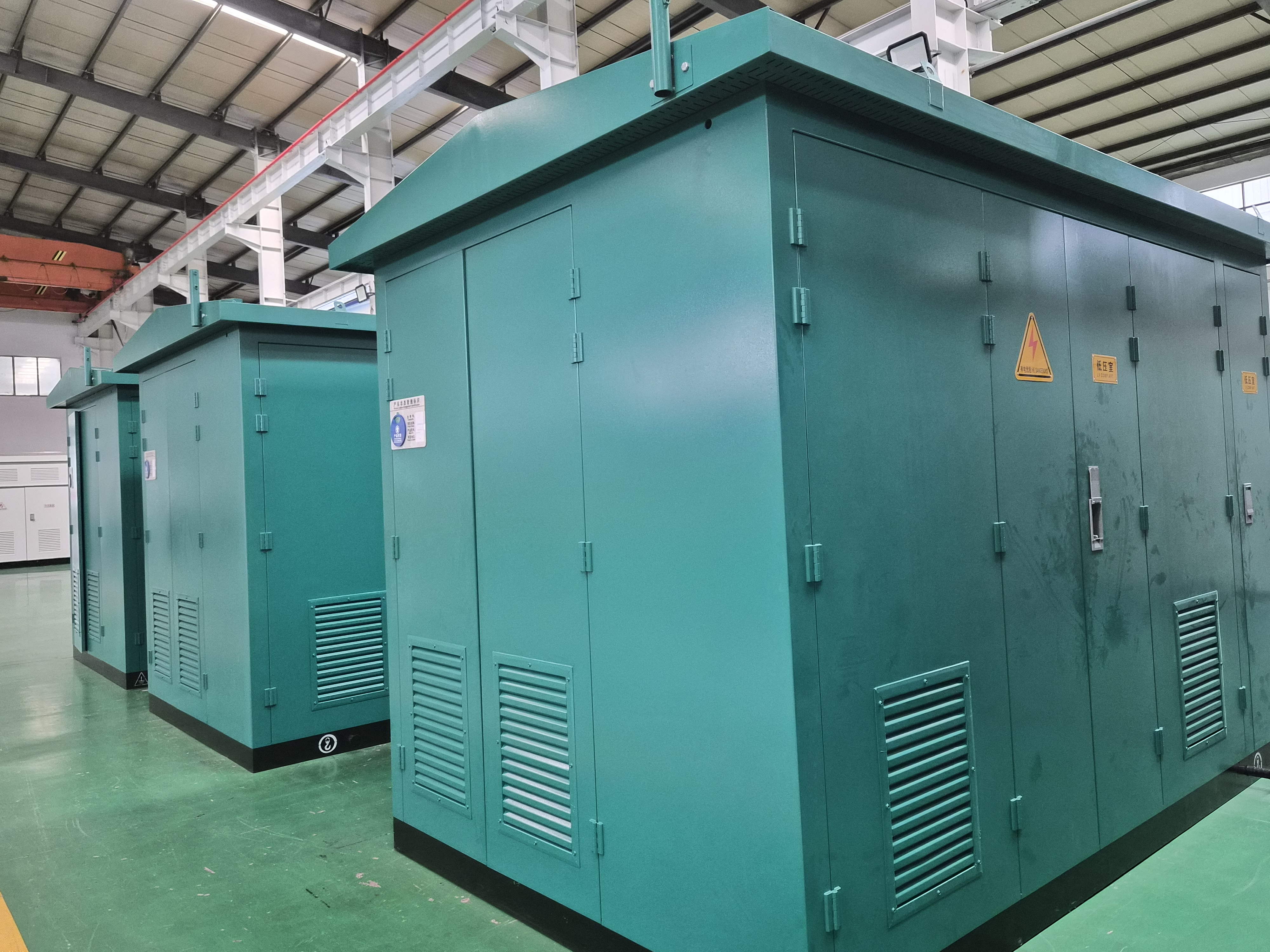
The clearest reference point in the Apex Power Systems range is the prefabricated cabin substation, model designation YBM/ZGS11/ZGS13. It is classified as a prefabricated cabin modular substation and is designed for step-up duty at PV, wind and energy-storage plants, as well as for data centres, industrial plant substations, temporary or permanent municipal power, and remote supply for mines and oil and gas fields.
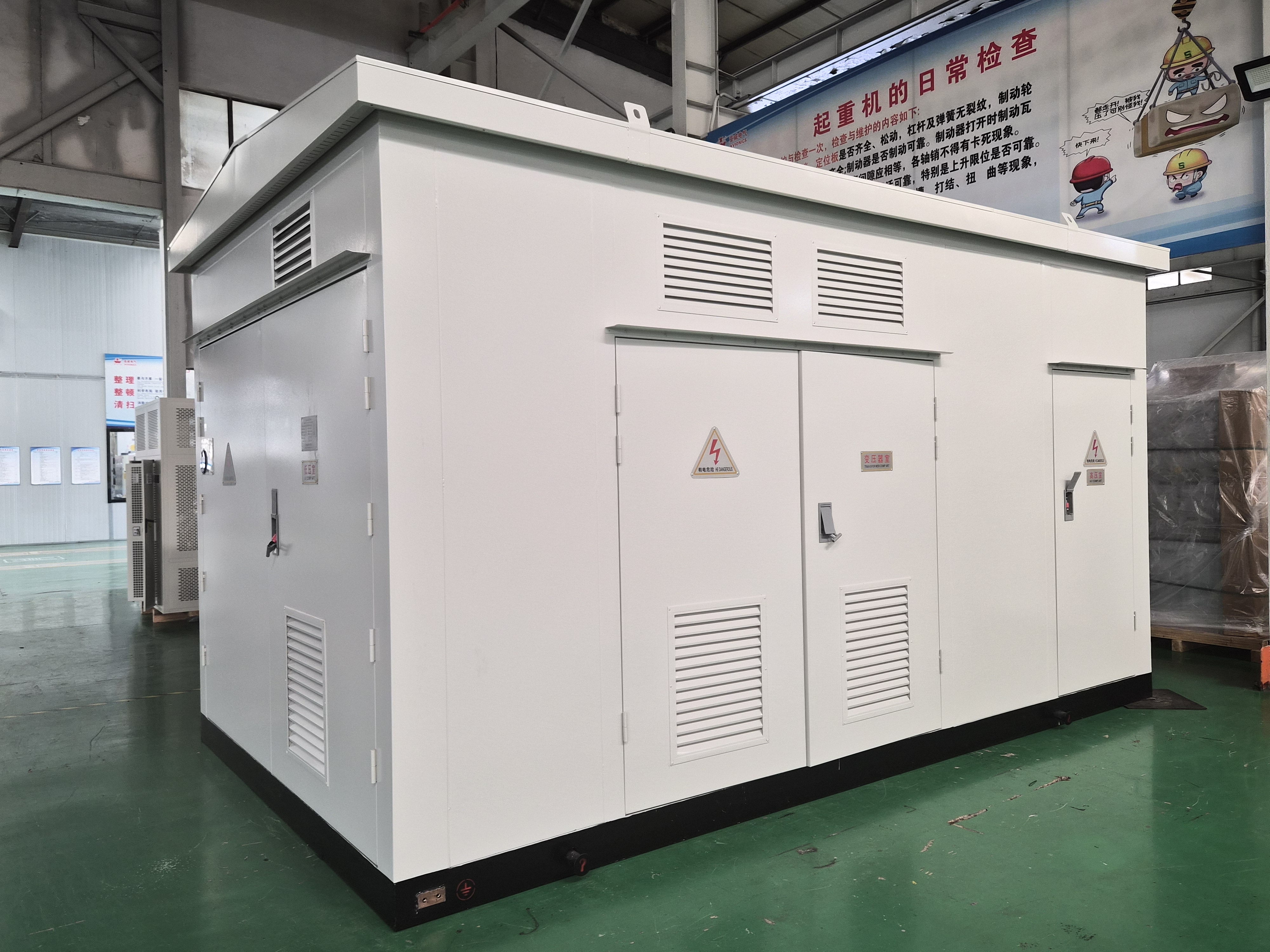
The cabin is not a transformer in a shed. It is an integrated substation in which the primary equipment, the secondary equipment and the building services are designed together:
| Element | What the specification covers | Why it matters on a wind site |
|---|---|---|
| Voltage and capacity | 10 kV or 35 kV class; transformer capacity 500–50,000 kVA | One product family covers turbine-cluster step-up through to plant-level step-up |
| Integrated equipment | HV switchgear, transformer, LV switchgear, compensation equipment, automation system, AC/DC auxiliary supply, environmental control | A single interface replaces several separate supplier packages |
| Enclosure | Containerised steel structure, rock-wool sandwich-panel insulation, anti-corrosion coating, welded structural-steel base; IP54 or IP55 | Weather protection and thermal performance are part of the delivered product, not site work |
| Ambient envelope | –40 °C to +50 °C | Covers cold-climate and hot-arid wind regions without re-engineering |
| Switchgear | Metal-clad withdrawable or fixed type with vacuum circuit breakers; copper busbar with heat-shrink insulation | Withdrawable construction shortens fault recovery at unmanned sites |
| Monitoring | Integrated automation system monitoring temperature, humidity, smoke, water ingress and access | Supports remote monitoring and unattended operation |
| HVAC and fire protection | Industrial air conditioner, forced ventilation and heater; gas extinguishing or ultra-fine dry powder, optional | A sealed IP54/IP55 cabin must reject heat deliberately, and fire protection must be designed in |
| Installation | Transported as a complete unit, crane-lifted, connected on site; standard container dimensions, customisable | Compresses the site programme and reduces weather exposure during construction |
The modular logic is the part buyers tend to undervalue at tender stage. Capacity upgrades are handled by adding cabins rather than by rebuilding an enclosure, and the platform supports secondary-equipment cabins, distribution cabins and main-transformer cabins as different combinations of the same building block.
The Transformer Inside the Enclosure: Three Routes
The enclosure is the visible product; the transformer is where the technical risk sits. Apex supplies three transformer families that can be specified inside a wind-farm substation, and the choice is driven by fire exposure, capacity and how the plant is operated.
| Transformer family | Capacity and voltage band | Characteristics relevant to wind duty |
|---|---|---|
| New energy transformer, SC10 / SZ18 / SZ20 | 500–12,500 kVA at 10 kV class; 1,000–12,500 kVA at 35 kV class; HV 10 / 10.5 / 11 / 35 / 38.5 kV; LV 0.4 / 0.69 / 0.4–1.14 kV | Purpose-designed for PV, wind and energy storage; wide-range LV winding accepts inverter output from different brands; impedance 6.0–14.0% selectable against system short-circuit capacity; ONAN or ONAF cooling; oil-immersed or dry-type; available as a prefabricated cabin integrated package |
| Dry-type transformer, SCB12–SCB18 | 30–2,500 kVA at 10 kV class; 800–25,000 kVA at 35 kV class; IP00 / IP20 / IP23 | No insulating oil, so it can be installed close to the load and in fire-sensitive locations; up to 150% of rated load under forced-air cooling; IEC 60076-11 compliance |
| Oil-immersed distribution transformer, S13 / S14 / S15 | 30–3,150 kVA at 10 kV class; 3,150–31,500 kVA at 35 kV class; impedance 4–10% | Conventional ONAN cooling and established efficiency grades; used for auxiliary and distribution duties within the plant |
Two specification points are worth flagging because they are frequently missed. First, the wide 0.4–1.14 kV low-voltage band on the new energy transformer exists so that a single transformer design can sit behind inverters from different manufacturers — useful when a plant is built in phases with equipment from more than one supplier. Second, the impedance range of 6.0–14.0% is not a comfort margin; it is chosen against the short-circuit capacity of the network the plant connects to, and it has to be fixed before the order is placed.
Where the buyer's priority is no-load loss rather than capital cost, the S(B)H15(21–25)-M amorphous-alloy transformer family is specified with no-load losses reported as 60–80% lower than conventional silicon-steel equivalents, in oil-immersed or dry-type versions. It is used in the Apex range for distribution-side renewable applications and for auxiliary supplies where a transformer sits energised but lightly loaded for long periods.
Where Apex Power Systems Fits in the Supply Chain
Apex Power Systems (Nanjing) Co., Ltd. is an international trading and supply-partner company for power transformers and substation equipment. It is not a factory: it selects, audits and manages manufacturers on the buyer's behalf and supplies box-type substations and prefabricated substations through audited manufacturing partners, coordinating design review, production, testing, documentation, freight and site commissioning as one contract.
For a wind project this model has a specific consequence that buyers should test rather than assume. The certifications and test evidence belong to the manufacturing partners, not to the trading entity, and they should be presented in the manufacturer's legal entity name for the product family being purchased. Apex presents ISO 9001:2015, ISO 14001:2015 and ISO 45001:2018 management-system certificates, IEC conformity for 10 kV / 35 kV power transformers and box-type substations, UL and CSA product certification, CQC product certification for box-type substations and switchgear lines, provincial metrology qualification and type-test reports covering dry-type, oil-immersed and box-type substation families. Independent verification includes a KEMA Labs Type I Inspection Report for a 250 MVA / 345 kV three-phase power transformer, tested to the IEC 60076 series and IEEE Std C57.12.00 / C57.12.90.
The manufacturing base behind that supply chain operates a site of more than 900 mu, employs over 1,700 people including more than 300 engineering and technical personnel, and runs a dedicated test laboratory with lightning-impulse, no-load and load-loss, ratio, winding-resistance, temperature-rise and insulation test benches. Documented reference projects relevant to renewable and substation work include a 40,000 kVA energy-storage project in Bulgaria and a 110 kV substation in Mongolia, alongside transmission projects in Azerbaijan, Tajikistan, the Philippines, Spain, the United States and Puerto Rico.
Specification Points That Decide Whether the Substation Works
Most wind-farm substation problems that surface after energisation were decided at specification stage rather than in the factory. The following are the points worth writing into the technical requirements.
Cooling class and load capability
The cooling code on the nameplate is not administrative detail. ONAN means oil-immersed with natural oil circulation and natural air circulation; ONAF adds fans that force air across the radiators and raises the permissible loading. The same transformer can therefore carry two ratings, one for each cooling stage, and the site ambient temperature and altitude must be checked against those ratings rather than against a single headline figure.
Losses as a revenue variable
On a wind farm the substation transformer is energised continuously while the plant output varies. No-load loss is therefore paid around the clock regardless of generation, which is why low-loss core material and an explicit loss evaluation in the tender are worth more here than on a plant running near full load.
Enclosure thermal design
An IP54 or IP55 cabin protects equipment from dust and water ingress, and also traps heat. Environmental control — industrial air conditioning, forced ventilation and heating — is part of the delivered scope for exactly that reason, and the heat balance should be demonstrated rather than assumed, especially where the enclosure also houses compensation equipment and batteries.
Monitoring and the unmanned-site assumption
The integrated automation system in the prefabricated cabin monitors temperature, humidity, smoke, water ingress and access, and the new energy transformer range supports temperature control and online oil dissolved-gas monitoring with remote communication interfaces. For a plant operated unmanned, this is the difference between a condition-based maintenance regime and a site visit after a failure.
Application Fit: Where This Configuration Earns Its Place
The prefabricated cabin substation is designed for step-up duty at wind plants, PV plants and energy-storage plants, and the same platform covers several adjacent duties that appear on a wind site.
- Onshore wind collection step-up. Cluster-level transformation spread across the site, where repeatability of the module and speed of commissioning drive the decision.
- Offshore and coastal wind. Specified through the new energy transformer range, which is designed for onshore and offshore wind farms and for high-humidity, dusty and salt-spray environments.
- Wind-plus-storage sites. Electrochemical storage using lithium, flow or sodium batteries is within the scope of the same transformer family, and hybrid and microgrid architectures are named applications.
- Remote EPC projects. Overseas projects where transport infrastructure is limited are a named application for the prefabricated cabin, because site work is reduced to lifting and connection.
- Plant auxiliary and station service supply. Served by the oil-immersed distribution range or by amorphous-alloy units where standby loss dominates the business case.
Market Context: Standards Convergence and Competing Demand
Two forces are shaping how wind-farm substations are specified in 2026, and neither is primarily about hardware.
Standards are converging on a single reference. IEC 62271-202:2022 specifies the service conditions, rated characteristics, general structural requirements and test methods for enclosed high-voltage prefabricated substations. A buyer can now write one international reference into the specification instead of reconciling national practices, and a supplier that cannot produce type-test evidence against it is easy to identify at tender stage. For projects inside the European Union, three further regimes apply in parallel: the Low Voltage Directive 2014/35/EU, which covers equipment rated between 50 V and 1,000 V AC or 75 V and 1,500 V DC and therefore reaches the LV compartment; the EMC Directive 2014/30/EU, which becomes more relevant as protection, control and communication electronics are added; and RoHS 2 under Directive 2011/65/EU for restricted substances. “CE certified” is not a single certificate — it is a declaration supported by the applicable conformity evidence, and buyers should ask for the documents rather than the phrase.
Demand from data centres is competing for the same manufacturing capacity. The global data centre substation market was reported at USD 11.31 billion in 2026, forecast at USD 13.27 billion in 2027 and USD 19.78 billion by 2032, while data centres were reported to consume 2% of the world's electricity in 2026, up from 1.7% in 2024. Those figures describe data centres, not wind farms — but they describe the same transformer and switchgear supply base. For a wind developer the practical reading is a procurement one: substation slots compete with data-centre orders for factory capacity, so the enquiry date, the type-test evidence and the factory acceptance test window deserve the same attention as the price.
Comparison With Traditional Solutions — and Where This Approach Stops
| Consideration | Civil-built substation building | Prefabricated cabin substation | Pad-mounted unit |
|---|---|---|---|
| Where assembly happens | On site, across multiple trades | In the factory, tested before shipment | In the factory |
| Site programme | Longest; weather-exposed | Reduced to lifting and connection | Short; concrete pad and connection |
| Footprint | Largest; needs a building and access | Compact, container dimensions | Smallest |
| Relocation | Not practical | Possible as a module | Possible |
| Typical capacity band | Project-specific | 500–50,000 kVA in the Apex range | 75–2,500 kVA for the three-phase pad-mounted range |
| Walk-in access for maintenance | Yes | Yes | No |
The honest boundary conditions matter as much as the advantages. A prefabricated cabin is transported as a complete unit and crane-lifted into position, so the site must have a route and a lifting plan that suit the module — a location without crane access is a poor fit. The standard ambient envelope is –40 °C to +50 °C, and sites outside that band need engineering rather than a catalogue selection. Capacity growth is achieved by adding cabins, not by enlarging the existing one, so the layout has to reserve space at the design stage. And the transformer choice sets a hard ceiling: the dry-type SCB12–SCB18 range reaches 2,500 kVA at the 10 kV class and 25,000 kVA at the 35 kV class, so larger plant-level step-up duties move to the oil-immersed or new energy transformer families, or to large power transformers outside this product scope.
Two further limits are worth stating plainly. An oil-immersed transformer inside an enclosure brings oil containment and fire protection into the enclosure design — the catalogue offers gas extinguishing or ultra-fine dry powder as options, which means the requirement must be specified, not assumed. And a sealed IP54/IP55 enclosure with integrated electronics depends on functioning environmental control; if the HVAC scope is descoped to cut cost, the reliability case for the whole cabin changes with it.
Future Outlook
Three developments are likely to shape wind-farm substation specification over the next procurement cycles.
First, co-location. As wind plants are paired with battery storage and operated as hybrid or microgrid assets, the substation stops being a one-directional step-up device and becomes an interface that must be specified for both directions of flow. The transformer families already cover wind, PV and storage duties, which makes the electrical design the easier half of that transition.
Second, documentation as a selection variable. With IEC 62271-202 providing a common structural and test reference and the EU conformity regimes adding parallel obligations, the supplier that can produce a complete, correctly named document set is increasingly preferred over the supplier with the lowest headline price.
Third, supply timing. Prefabricated substations sit in the same manufacturing queue as data-centre infrastructure, and the demand figures above suggest that queue will not shorten quickly. Developers who fix the electrical architecture early — including impedance, cooling class, enclosure rating and monitoring scope — protect their commissioning dates far more effectively than developers who negotiate those items after the order is placed.
Frequently Asked Questions
What is a box type substation?
A box type substation is a prefabricated substation supplied as a factory-assembled unit rather than built up on site. The transformer, high-voltage and low-voltage switchgear, protection and auxiliary systems are assembled and tested inside a steel or containerised enclosure, and the completed module is shipped ready for connection. The practical consequences are reduced civil works and installation time, quality control performed in the factory instead of at the site, and the option to relocate the unit if the network changes.
Why is a box type substation used at wind-farm level rather than only at the grid connection point?
Because wind generation is distributed across the site, transformation is needed at several points between the turbines and the grid connection. Placing prefabricated substations at cluster or feeder level keeps the step-up close to the generation, shortens the low-voltage cable runs, and allows each module to be factory-built and commissioned independently. The same product family, rated from 500 to 50,000 kVA, can serve cluster-level step-up and plant-level step-up, so a project can standardise on one enclosure platform across both duties.
What does a prefabricated cabin substation contain?
In the Apex Power Systems range, the YBM/ZGS11/ZGS13 prefabricated cabin integrates HV switchgear, transformer, LV switchgear, compensation equipment, an automation system, AC/DC power supply and environmental control in one enclosure. The cabin is a containerised steel structure with rock-wool sandwich-panel insulation and anti-corrosion coating, rated IP54 or IP55, with metal-clad withdrawable or fixed switchgear using vacuum circuit breakers, copper busbar with heat-shrink insulation, industrial air conditioning with forced ventilation and heating, optional gas extinguishing or ultra-fine dry powder fire protection, and monitoring of temperature, humidity, smoke, water ingress and access.
Which transformer types can be installed in a wind-farm box type substation?
Three families apply. The new energy transformer (SC10 / SZ18 / SZ20) is purpose-designed for PV, wind and energy-storage duty, with 500–12,500 kVA at the 10 kV class, 1,000–12,500 kVA at the 35 kV class, a wide 0.4–1.14 kV low-voltage winding compatible with inverter outputs, and 6.0–14.0% impedance options. The dry-type SCB12–SCB18 is used where oil-free construction is required, covering 30–2,500 kVA at the 10 kV class and 800–25,000 kVA at the 35 kV class. The oil-immersed S13 / S14 / S15 series covers distribution and auxiliary duties from 30 kVA to 31,500 kVA depending on voltage class.
What do the ONAN and ONAF cooling codes mean, and why do they matter on a wind site?
The cooling class is the code on the nameplate describing how the transformer is cooled, combining the internal cooling medium and its circulation with the external medium and its circulation: O for oil, A for air, N for natural circulation and F for forced circulation. ONAN therefore means oil-immersed with natural oil and natural air circulation, while ONAF adds fans that force air over the radiators and raises the permissible loading. The same transformer often carries a rating for each cooling stage, and those ratings must be checked against the ambient temperature and altitude of the installation site.
Which standard applies to a prefabricated substation?
IEC 62271-202:2022 specifies the service conditions, rated characteristics, general structural requirements and test methods of enclosed high-voltage prefabricated substations, and is the natural international reference for a wind-farm unit. For equipment placed on the European Union market, three further regimes apply alongside it: Directive 2014/35/EU (Low Voltage Directive) for equipment rated between 50 V and 1,000 V AC or 75 V and 1,500 V DC, which reaches the LV compartment; Directive 2014/30/EU (EMC Directive) for electromagnetic compatibility, relevant to protection, control and monitoring electronics; and Directive 2011/65/EU (RoHS 2) for restricted substances.
What are the practical limits of a wind-farm box type substation?
The enclosure is transported as a complete unit and crane-lifted, so the site needs a suitable access route and lifting plan. The standard ambient envelope is –40 °C to +50 °C; sites outside it require engineering rather than catalogue selection. Modular expansion is achieved by adding cabins rather than enlarging an existing one, so space must be reserved in the layout. Capacity is bounded by the transformer selected — the dry-type range reaches 2,500 kVA at the 10 kV class and 25,000 kVA at the 35 kV class — and larger plant-level duties move to oil-immersed or large power transformers. Where an oil-immersed transformer is installed inside the enclosure, oil containment and fire protection must be specified explicitly.
The full Apex Power Systems product catalogue — including prefabricated cabin substations, new energy transformers, dry-type and oil-immersed distribution transformers — is available as a downloadable reference document.
Note on scope: Apex Power Systems (Nanjing) Co., Ltd. is a trading and supply-partner company and is not itself a manufacturer. Manufacturing, certification and test references in this article relate to its audited manufacturing partners and are presented as evidence of the supply chain it manages on behalf of customers.
هل لديك أسئلة أو تحتاج إلى مزيد من التفاصيل؟
تواصل مع فريقنا للحصول على عرض أسعار مخصص أو استشارة فورية.
طلب عرض أسعار
املأ النموذج أدناه وسيتواصل معك فريقنا بعرض مقترح مخصص.
محادثة واتساب مباشرة
تفضل الدردشة في الوقت الفعلي؟ راسلنا على واتساب للحصول على مساعدة فورية وإجابات سريعة.
- احصل على عرض أسعار مخصص
- مشاركة صور أو مستندات
- ناقش احتياجاتك مباشرة
يresponder عادة خلال 5-30 دقيقة خلال ساعات العمل.