
Brass Angle Valve Comparison: Alloy, Thread and Approval Checks
Brass Angle Valve Comparison: Alloy, Thread and Approval Checks
Dezincification behaviour, thread standard and approval scope decide whether a brass angle valve survives a concealed installation. They are also the three items most often left out of the purchase order.
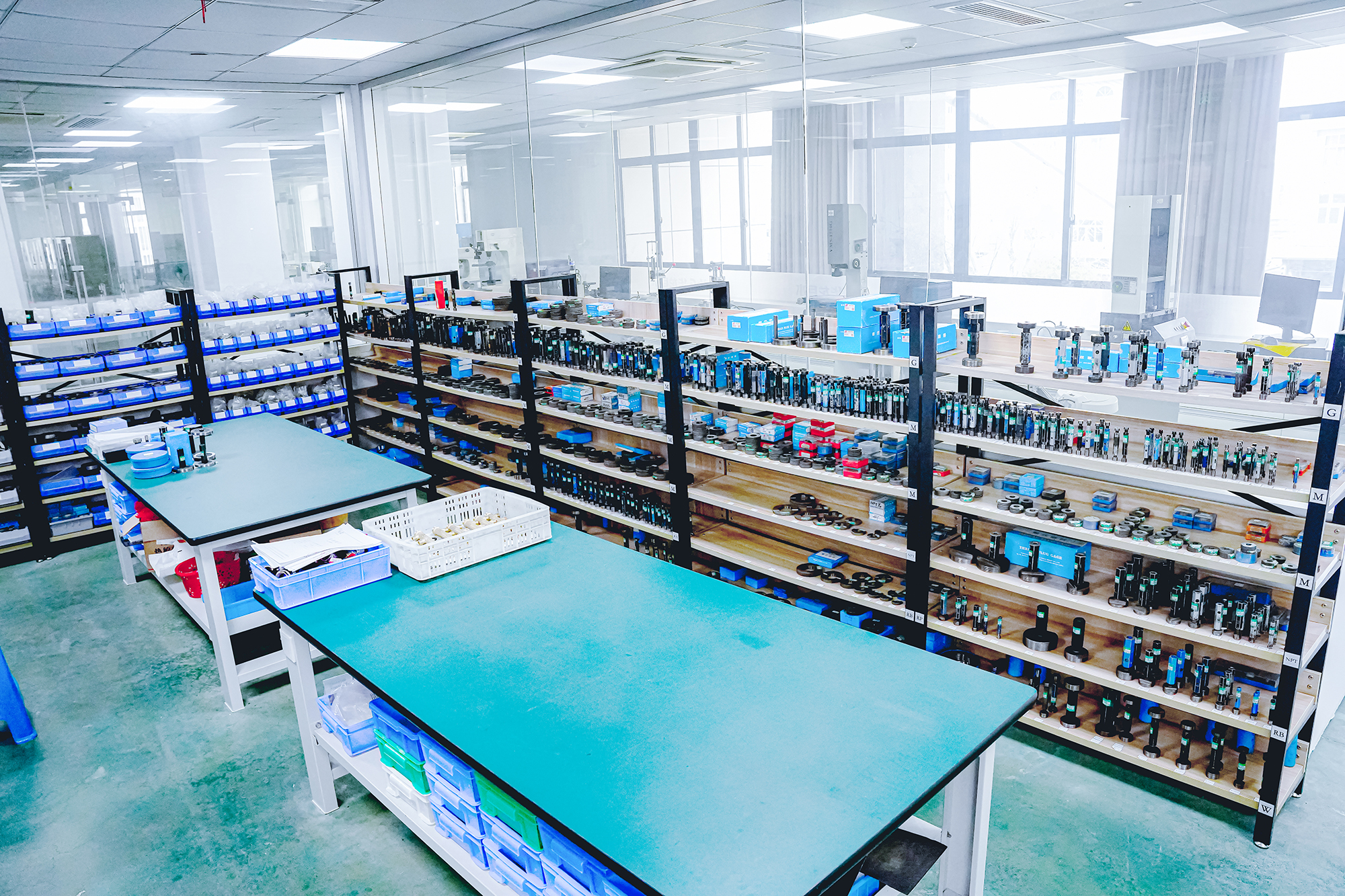
Thread gauge management inside the manufacturer laboratory. Thread conformance is a measurable, recordable property, not a catalogue claim.
Why the angle valve deserves more scrutiny than its unit price suggests
A brass angle valve occupies the highest-risk position in a building water system. It sits at the fixture connection, behind a cistern, beside a radiator or inside a service void, where access is poor and a weep is discovered late. The cost of remedying a failed joint in that position is many times the cost of the part itself.
Three properties determine whether the part performs there: the dezincification behaviour of the brass, the thread standard cut on the body, and the scope of the approvals that actually cover the specific model. These are verifiable procurement criteria rather than marketing attributes, and all three can be settled at quotation stage at no cost — provided the request for quotation asks for them.
This article sets out a buyer-side comparison framework for brass angle valves along those three axes. It does not rank suppliers and it does not assign scores. It describes what a buyer can verify before ordering, what evidence should be requested, and where specification gaps commonly sit, using the published characteristics of the Valogin VG14.90111 brass angle valve — a product of Zhejiang Valogin Technology Co., Ltd., a brass valve and fittings manufacturer based in Yuhuan, Zhejiang, China — and the approval records associated with it as a worked example.
Why angle valves escape specification review
Angle valves rarely arrive as a standalone purchase. They travel inside a mixed container of fittings, a project package or a distributor stock replenishment. Nobody negotiates the angle valve line, so the specification is usually inherited from an earlier order or copied from a catalogue description, and the inherited description is seldom re-checked against the duty it has to perform.
Three gaps account for most of the problems that surface later:
- Alloy described only as brass. Brass is a family of copper-zinc alloys with different zinc content and materially different behaviour in contact with water. A description that stops at brass does not tell a buyer whether the part suits a line that is never drained.
- Thread described only by size. Half inch identifies a nominal size, not a standard. ISO 228, ISO 7/1 and NPT are not interchangeable, and a valve threaded to the wrong standard will either fail to seal or fail to assemble.
- Approval assumed rather than scoped. A manufacturer holding a recognised approval does not mean any given model is covered by it. Approvals are granted for a product category, a defined standard and a listed set of models; the scope page of the certificate is the document that answers the question.
The opportunity is straightforward. All three can be resolved before the order is placed, and none of them requires a laboratory on the buyer side — only a written answer that can be filed and checked at goods-in.
The three comparison axes in one view
| Axis | Question put to the supplier | Acceptable evidence | Typical gap |
|---|---|---|---|
| Dezincification | Which alloy designation is used, and what dezincification resistance has been demonstrated for it? | Written alloy designation on the drawing or quotation, mill or batch material certificate, and a test report against a recognised dezincification method with the testing body named | The catalogue states brass or corrosion resistant without a grade or a test reference |
| Thread | Which thread standard is cut, and how is the joint sealed? | Dimensioned drawing carrying the thread callout, thread gauge inspection records, sealing method stated | Size quoted without a standard; sealing method left to the installer |
| Approvals | Which certificate covers this exact model, in this market, and is it current? | Certificate number, issuing body, scope page and expiry date | A company-level approval claimed for a model outside the listed scope |
The axes are not independent. Dezincification determines the material choice, the thread determines how the joint is made on site, and the approvals determine whether the part may legally be installed in the target market at all. A buyer who settles all three has effectively written the specification.
Dezincification: the evidence that has to be obtained in writing
Dezincification is a selective corrosion process in which zinc is preferentially leached from a brass, leaving a copper-rich, porous and mechanically weak residue. It progresses inward from the wetted surface, which is why a valve can look sound from the outside while the wall section has already lost strength. The mechanism is well established in the valve and fittings industry and is the reason dezincification resistance appears as an explicit requirement in drinking water and closed-loop heating specifications.
Angle valves are exposed for three structural reasons. They sit at the end of a branch where water can stagnate rather than flow. They are frequently installed in lines that are never fully drained, which is precisely the condition in which dezincification resistance is called out in building water supply specifications covering potable water at 1 to 10 bar with hot water up to 65 degrees Celsius. And they are usually the lowest-flow device on the circuit, so the surface stays wetted for long periods without the scouring effect of continuous flow.
A buyer can close this axis with four requests:
- The alloy designation in writing, on the quotation or the drawing, not only in a brochure or on a website.
- The specification of the brass blank used for the body, where the buyer quality system distinguishes between supply forms.
- A dezincification test report to a recognised method, naming the testing body and the date.
- Batch-linked material certificates, if traceability is a contractual requirement.
In the Valogin documentation, the published selling points state that products use high-quality brass blanks with corrosion resistance and stable sealing performance, and the company operates a laboratory of about 1,025 square metres built to ISO 17025 with more than 100 sets of equipment, including a salt spray chamber. Those are relevant capability facts. The published data for the VG14.90111 brass angle valve specifies a chrome-plated brass body and a chrome-plated zinc alloy handle, but does not state an alloy grade or a dezincification test result, so both have to be requested per order rather than assumed from the product page.
Threads: the standard matters, not the size
The Valogin VG14.90111 brass angle valve is offered in two size combinations, 1/2 inch by 3/8 inch and 1/2 inch by 1/2 inch, with ISO 228 threads specified as equivalent to DIN EN ISO 228 and BS EN ISO 228. That detail carries more procurement weight than the size designation that usually travels with it.
ISO 228, also written as G thread, is a parallel thread with no sealing function of its own. The joint is sealed by a washer, an O-ring or a defined sealing face, not by contact between the thread flanks. ISO 7/1, written Rp for the internal thread, is a parallel thread designed to mate with a tapered external thread and to seal on the threads. NPT is a fully tapered thread that also seals on the threads. The three systems are not interchangeable, and an ISO 228 valve installed against an ISO 7/1 connection will not seal correctly however much torque is applied.
The practical consequence is that the most common failure mode of an ISO 228 angle valve is an omitted or wrongly seated gasket, not a defective thread. Over-torquing to stop a weep compresses and splits the washer and leaves the joint no better sealed than before. Buyers specifying for a target market should therefore state the standard, not the size, and should confirm that the sealing component is supplied with the valve rather than sourced separately on site.
A useful cross-check inside a single supplier range: the Valogin brass gas ball valve VG10.61011 is documented with two female thread options, ISO 7/1 Rp parallel and ISO 228, whereas the angle valve record lists ISO 228 only. Thread coverage differs between product lines from the same manufacturer, which is a further argument for specifying at model level rather than at supplier level.
Approvals: scope, not reputation
Approval certificates are the most frequently misread documents in valve procurement, because the headline — the name of the scheme — is memorable while the scope line is not. The Valogin approval records set out the following entries, each with a number, an issuing body and a validity date:
| Approval | Number | Issuing body | Market | Scope as recorded | Valid to |
|---|---|---|---|---|---|
| WRAS | 260717304 | WRAS (Water Regulations Approval Scheme) | United Kingdom | Product type: valves, gate | 2031-07-31 |
| WaterMark | WM-022194 | IAPMO R&T Oceana | Australia | In-line valves for plumbing water supply systems, WMTS-012:2018 | 2027-03-07 |
| UPC listing | 7553 | IAPMO R&T | US and Canada | Ball valves, IAPMO/ANSI Z1157 and ASME A112.14.2022 / CSA B125.14:22 | Not stated |
| CSA | 2759792 | CSA Group | Canada and US | Gas valves, 1/2 psig and 5 psig ball valves, models 10.12352, 10.12362, 10.12372 and 10.12382 series | Not stated |
| DVGW type examination | DG-4312DQ0883 | DVGW CERT GmbH | EU | Gas fittings, shut-off valve (Kugelhahn), series 10., DIN EN 331 | 2030-12-22 |
| AGA | 8775 | The Australian Gas Association | Australia | Manual shut off valve, application 17131 | Not stated |
| ACS | 23 ACC NY 155 | Eurofins | France | Pressure reducer 18.07023.G20.CP, XP P41-280 | 2028-04-06 |
| ECM (CE) | 0B230606.ZVTDN65 | Ente Certificazione Macchine | EU | Check valve and Y strainer, EN 12266-1 and EN 12266-2 | 2028-06-05 |
| Lead Free | 7555 | IAPMO R&T | US | Lead Free Plumbing Products, NSF/ANSI/CAN 372-2024 | Not stated |
Read that table as a set of product-category statements rather than as a statement about any single valve. The WRAS entry is recorded against the gate valve category. The UPC listing is recorded against ball valves. The DVGW type examination names the gas shut-off valve in series 10. The ACS certificate names one pressure reducer model. The ECM certificate covers check valves and Y strainers. The gas ball valve series appear under CSA. The records are associated with a broader product list, but the scope line — not the association — is what determines whether a specific model may be sold into a specific market for a specific duty.
This is not a criticism of one supplier's documentation. It is the normal structure of product approvals across the industry, and it applies to every manufacturer on a shortlist. The buyer action is the same in each case: obtain the scope page, confirm that the target model appears within it, and confirm that the validity period extends past the shipment date and the project acceptance period. A certificate that expires before handover is a supply chain risk even when it is genuine.
For an angle valve buyer, that means separating two questions that are routinely merged: does the supplier hold approvals, and does an approval cover this angle valve in this market. The first is a supplier qualification question. The second is a purchase order condition.
Where the Valogin documented position sits on these axes
Zhejiang Valogin Technology Co., Ltd. was founded in 1985 and manufactures brass valves, fittings and distribution manifolds for plumbing, heating, fittings and gas systems from a factory of more than 28,000 square metres in Yuhuan, Zhejiang, with over 1,000 employees and an annual output of 80 million pieces. More than 90 percent of turnover comes from international markets, with Europe and North America as key markets and coverage extending to South America, the UAE and more than 100 countries. The R&D team includes more than 70 designers and engineers, of whom over 15 are full-time R&D engineers working across water, gas, oil and heating systems. Management systems are certified to ISO 9001, ISO 14001 and ISO 45001.
On the evidence axis that matters for a comparison framework, three capability facts are relevant. First, the laboratory is built to ISO 17025 with more than 100 sets of equipment, which bears on whether a supplier can produce the test reports a buyer requests rather than only stating a claim. Second, 70 percent of products are manufactured through automated workflows, with dedicated fully automatic production lines for ball valves and gate valves supported by industrial robots, which bears on batch-to-batch consistency. Third, quality control includes a 100 percent air-tight test, dimension sampling per batch and material certificates on request, which bears directly on the thread and material documentation a buyer needs.
None of these facts is a performance conclusion. They describe the process that generates evidence. The alloy grade and dezincification test result for the angle valve still have to be requested per order; the process capability is the reason such a request can reasonably be expected to be answered.
For the VG14.90111 brass angle valve specifically, the published specification sets the size range at 1/2 inch by 3/8 inch and 1/2 inch by 1/2 inch, the body material as chrome-plated brass, the handle as chrome-plated zinc alloy, the thread standard as ISO 228 in its DIN EN ISO 228 and BS EN ISO 228 equivalents, the working temperature range at 0 to 80 degrees Celsius and the maximum working pressure at PN10. Its stated applications are piping water systems and sanitary systems.
Application: where the angle valve actually earns its place
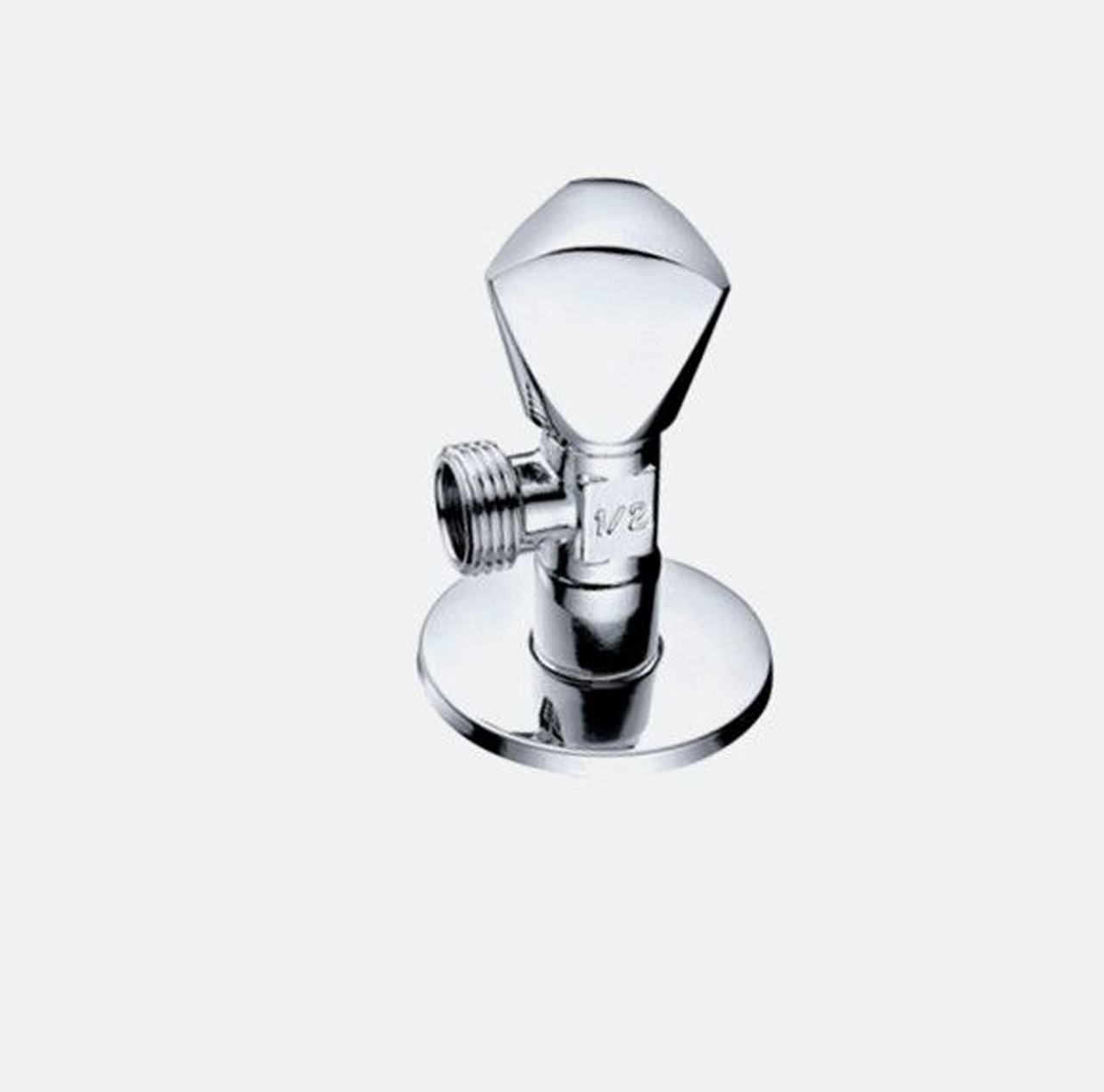
Brass angle valve VG14.90111. The published rating is PN10 across a 0 to 80 degrees Celsius working range.
Sanitary fixture connection in building water supply. In domestic, commercial and institutional water supply, a brass angle valve connects a sanitary fixture to the pipework so that a single fixture group can be isolated without shutting down a floor or a building. In that duty the valve sits permanently under mains pressure, typically in the 1 to 10 bar band with hot water up to 65 degrees Celsius, and is operated only for isolation and maintenance. The PN10 and 0 to 80 degrees Celsius rating of the VG14.90111 sits inside those conditions, and the fixture-level isolation role is exactly what the angle valve category is for.
Radiator connection in two-pipe hydronic circuits. Brass angle valves also appear as the radiator connection on two-pipe heating circuits, where they allow a radiator to be removed for service without draining the circuit. That duty is more demanding than the sanitary case: the scenario documentation for residential and commercial radiator circuits describes hot water up to 90 degrees Celsius with working pressure up to 10 bar and continuous circulation through the heating season. The angle valve category belongs in this application, but the specific model has to be selected against the circuit temperature rather than the product category, because the published rating of the VG14.90111 stops at 80 degrees Celsius.
Isolation hierarchy inside riser systems. In apartment blocks, hotels, hospitals and office buildings, angle valves are the last element in a hierarchy: gate valves provide the coarse shut-off on the main supply and each riser, ball valves give quarter-turn isolation at the fixture group, check valves prevent back-flow and cross-connection between circuits, and angle valves make the final fixture connection. Specifying each level against its own duty, rather than treating brass valves as one interchangeable group, is where most of the procurement value in this category actually sits.
Limits and boundaries a buyer should write into the specification
Every product has boundaries, and stating them is more useful than implying they do not exist. For the angle valve discussed here, five are material.
- Temperature ceiling. The published working range for the VG14.90111 is 0 to 80 degrees Celsius. Radiator circuits are described in the application documentation at up to 90 degrees Celsius. The model specified for radiator duty must therefore be confirmed against the circuit temperature; the category name alone does not establish suitability.
- Pressure class. The rating is PN10. Lines rated PN16 sit outside that envelope, and the pressure class should be checked against the maximum working pressure of the line, not against the pressure normally seen in service.
- Thread sealing is not inherent. ISO 228 is a parallel, non-sealing thread. Correct installation depends on a washer, O-ring or sealing face, and on torque applied within the washer specification. The valve cannot compensate for a missing gasket.
- Approval coverage is model-specific. As set out above, the approval records held by a manufacturer are recorded against product categories and model series. Coverage for a given angle valve in a given market must be confirmed on the scope page.
- Order economics. Valogin lists a minimum order quantity of 5,000 units and a lead time of 50 days against a monthly capacity of 15 million pieces. For a project buyer placing a small top-up order or working to a tight handover date, that is a planning constraint that belongs in the programme rather than in the complaint log.

Salt spray testing verifies surface corrosion resistance of the finished part. It is a different question from through-wall dezincification resistance.
Market trend: approvals are being read differently
Across the plumbing and heating supply chain, buyers are increasingly evaluating approvals at certificate-scope level rather than at brand level. The driver is not regulatory change alone; it is that distributors and contractors increasingly carry the consequences of a non-compliant installation, and a supplier statement is harder to defend than a certificate number and a scope page.
Three related movements are visible in how specifications are being written. Concealed and never-drained installations — underfloor manifolds, service voids, sealed riser systems — keep pushing dezincification resistance from a desirable property into an explicit line item, because the material cannot be inspected after the floor is closed. Potable water and gas regulation continues to diverge between markets, so a single approval rarely travels intact across a multi-country order. And the shift toward automated production and in-line testing moves the consistency question from incoming inspection to process control, which changes what a buyer should ask for: less sample checking, more batch records.
None of this makes the angle valve a strategic component. It makes it a documentation component, and the suppliers who answer documentation questions quickly and specifically are the ones who tend to stay on shortlists.
Future outlook
The most likely direction of travel is toward verifiable, model-level documentation as a standard part of the purchase order rather than an exception. Three developments support that expectation. Certificate numbers and validity periods are increasingly checkable against issuing-body registers, which makes the scope page a practical rather than an archival document. Batch-level material traceability is becoming a routine request in markets with mature drinking water regulation, which favours suppliers whose quality system already produces batch-linked records. And lead content and dezincification requirements continue to tighten in potable water applications, which favours suppliers who can respond with a material designation and a test report rather than a marketing description.
The practical implication for a buyer today is modest but concrete: put the alloy designation, the thread standard and the certificate scope in the request for quotation, and file the answers. The cost of asking is close to zero. The cost of discovering the gap after handover is not.
Frequently asked questions
Which approvals should a brass angle valve carry for potable water use?
There is no single global approval. The United Kingdom market works to the Water Supply (Water Fittings) Regulations, assessed through WRAS; Australia works through the WaterMark scheme against WMTS-012:2018; the United States and Canada work through UPC listing and NSF/ANSI/CAN 372 for lead content; France works through ACS against XP P41-280; the EU gas market works through DVGW type examination against DIN EN 331. What matters in each case is that the certificate names the model and the market, not that the manufacturer holds an approval of some kind.
Does an ISO 228 thread on a brass angle valve seal without a gasket?
No. ISO 228 is a parallel thread without a sealing function of its own, so the joint is sealed by a washer, an O-ring or a defined sealing face. ISO 7/1 (Rp) and NPT are different systems that seal on the threads and are not interchangeable with ISO 228. The Valogin VG14.90111 is specified with ISO 228 threads in the DIN EN ISO 228 and BS EN ISO 228 equivalents.
How can a buyer confirm that a brass angle valve is dezincification resistant?
Ask for the alloy designation in writing and for a test report against a recognised dezincification method, with the testing body and date named. A statement that the product uses high-quality brass or is corrosion resistant does not answer the question. Salt spray testing of the finished, plated part addresses surface corrosion resistance, not through-wall dezincification resistance.
What do PN10 and PN16 mean on a brass valve, and which applies to an angle valve?
PN denotes the nominal pressure class of the valve body. PN10 corresponds to a 10 bar nominal rating and PN16 to 16 bar. The Valogin VG14.90111 is rated PN10 across a working temperature range of 0 to 80 degrees Celsius. The rating should be checked against the actual maximum working pressure and temperature of the line rather than against the general category of the valve.
Can the same brass angle valve be used on a radiator circuit and on a sanitary fixture?
The angle valve category appears in both duties, but the operating conditions differ. The building water supply case runs at potable water pressures in the 1 to 10 bar band with hot water up to 65 degrees Celsius, which sits inside the VG14.90111 rating. The two-pipe radiator case is described with hot water up to 90 degrees Celsius, which is above the published 0 to 80 degrees Celsius range of that model, so the model selected for radiator duty has to be confirmed against the circuit temperature.
What are the ordering parameters for custom brass angle valves from this supplier?
Valogin lists a minimum order quantity of 5,000 units, a lead time of 50 days and a monthly capacity of 15 million pieces. Customisation covers structure, material, marking and logo. Quality control includes a 100 percent air-tight test, dimension sampling per batch and material certificates on request, with engineering and drawing support from quotation through to first article and sample approval before mass production.
For buyers who prefer the product range, material and approval reference in a single document, the Valogin brand brochure can be downloaded here: Valogin brand brochure (PDF).
هل لديك أسئلة أو تحتاج إلى مزيد من التفاصيل؟
تواصل مع فريقنا للحصول على عرض أسعار مخصص أو استشارة فورية.
طلب عرض أسعار
املأ النموذج أدناه وسيتواصل معك فريقنا بعرض مقترح مخصص.
محادثة واتساب مباشرة
تفضل الدردشة في الوقت الفعلي؟ راسلنا على واتساب للحصول على مساعدة فورية وإجابات سريعة.
- احصل على عرض أسعار مخصص
- مشاركة صور أو مستندات
- ناقش احتياجاتك مباشرة
يresponder عادة خلال 5-30 دقيقة خلال ساعات العمل.