
Brass Check Valve Review: Bozheng H14X-16T vs. Unspecified Alternatives
A brass check valve is the least visible component in a water or gas line and the most consequential when it stops doing its job. Reverse flow, contaminated mains and pump damage rarely announce themselves on the day of installation; they show up months later. That is why the practical comparison question for buyers in 2026 is not “which check valve is best,” but “which check valve is specified well enough to be compared at all.”
The H14X-16T brass check valve from Bozheng Valve — the brand of Zhejiang Bozheng Copper Industry Co., Ltd., a brass valve manufacturer founded in 1998 and located in Yuhuan City, Zhejiang Province, China — is one of the models that can be examined on declared specifications rather than on marketing language. It is offered in four configurations, four brass grades and a nominal pressure of 1.6 MPa, with water and gas as its declared working media.
This review takes the check valve apart on five comparable axes: form factor, alloy designation, pressure envelope, declared medium and certification scope. It also marks where the model stops being the right answer, and what a buyer should demand from any alternative that wants to be ranked beside it.
The Comparison Problem: Most Brass Check Valves Arrive Without a Spec Sheet
The core difficulty in brass valve procurement is asymmetry of information. A specification-driven supplier publishes the model number, the configuration options, the alloy designations and the nominal pressure. A price-driven listing publishes a photo, a size and a unit cost. When both appear in the same sourcing spreadsheet, they look comparable and are not.
For a check valve, the consequence of that asymmetry is specific. Type determines whether the valve can be installed in a vertical riser or a horizontal run. Alloy designation determines whether the body is a hot-forging brass or a cast bronze, and whether a European buyer can match it against an existing drawing. Nominal pressure determines whether the valve belongs in a building services line or has been incorrectly specified for a process system. If any of these fields are blank, the comparison has already failed before pricing is discussed.
The H14X-16T is useful as a reference point precisely because Bozheng declares all five fields. That does not make it the correct valve for every line. It makes it auditable.
What the H14X-16T Actually Declares
The model is listed by Bozheng as a brass check valve available as a vertical check valve, a horizontal check valve, a swing check valve and a spring loaded check valve. The declared technical standard covers a normal pressure of 1.6 MPa with water and gas as the working media. Body material options are brass HPb59-1, HPb57-3, CW617N and C83600.
| Declared field | H14X-16T specification | Why a buyer should care |
|---|---|---|
| Product type | Brass check valve, model H14X-16T | Identifies the exact family being quoted |
| Configurations | Vertical, horizontal, swing, spring loaded | Determines installation orientation and closure behaviour |
| Nominal pressure | 1.6 MPa | Sets the pressure class ceiling for the line |
| Working medium | Water, gas | Confirms the fluid scope of the declared standard |
| Material grades | Brass HPb59-1, HPb57-3, CW617N, C83600 | Allows matching to drawings, market conventions and compliance scope |
| Applicable industries (declared) | Construction & Building (HVAC/Plumbing), Compressed Air Systems, Low-Pressure Steam & Boilers, Oil & Fuel Systems, Swimming Pools & Water Treatment, Industrial Machinery (mold cooling / hydraulics) | Describes intended system context, not a blanket approval |
These are supplier-declared specifications. They are consistent, complete and usable as a purchasing baseline, but they are not the same thing as a third-party test report, and the distinction matters later in this review.
Four Configurations in One Model Line: Why Design Flexibility Is a Real Cost Variable
Most brass check valve ranges are sold in one or two body styles. The H14X-16T is declared across four, and the practical value of that breadth is not aesthetic — it reduces the number of supplier qualifications a project has to carry.
Vertical check valve
A vertical check valve is intended for installation in a vertical run, typically with upward flow holding the disc or element open. Specifying the wrong body for a vertical riser is one of the most common installation errors in building services, because a valve designed for horizontal flow may not seat reliably when rotated.
Horizontal check valve
The horizontal variant suits the majority of plant room, manifold and distribution pipework where the run is level. It is the default choice in plumbing and HVAC layouts, and the type most often requested in mixed orders.
Swing check valve
A swing check valve uses a hinged disc that is lifted by forward flow and closes on reverse flow. It offers low resistance to forward flow but depends on gravity and on correct orientation — a point that belongs on the installation drawing, not on the purchase order. Swing types are widely used where the line can tolerate the closing behaviour of a gravity-driven disc.
Spring loaded check valve
A spring-loaded check valve adds a spring that returns the disc or poppet, which shortens closing response and reduces dependence on mounting orientation compared with a pure gravity design. The trade-off is a slightly higher opening threshold and one more internal component in the wear path.
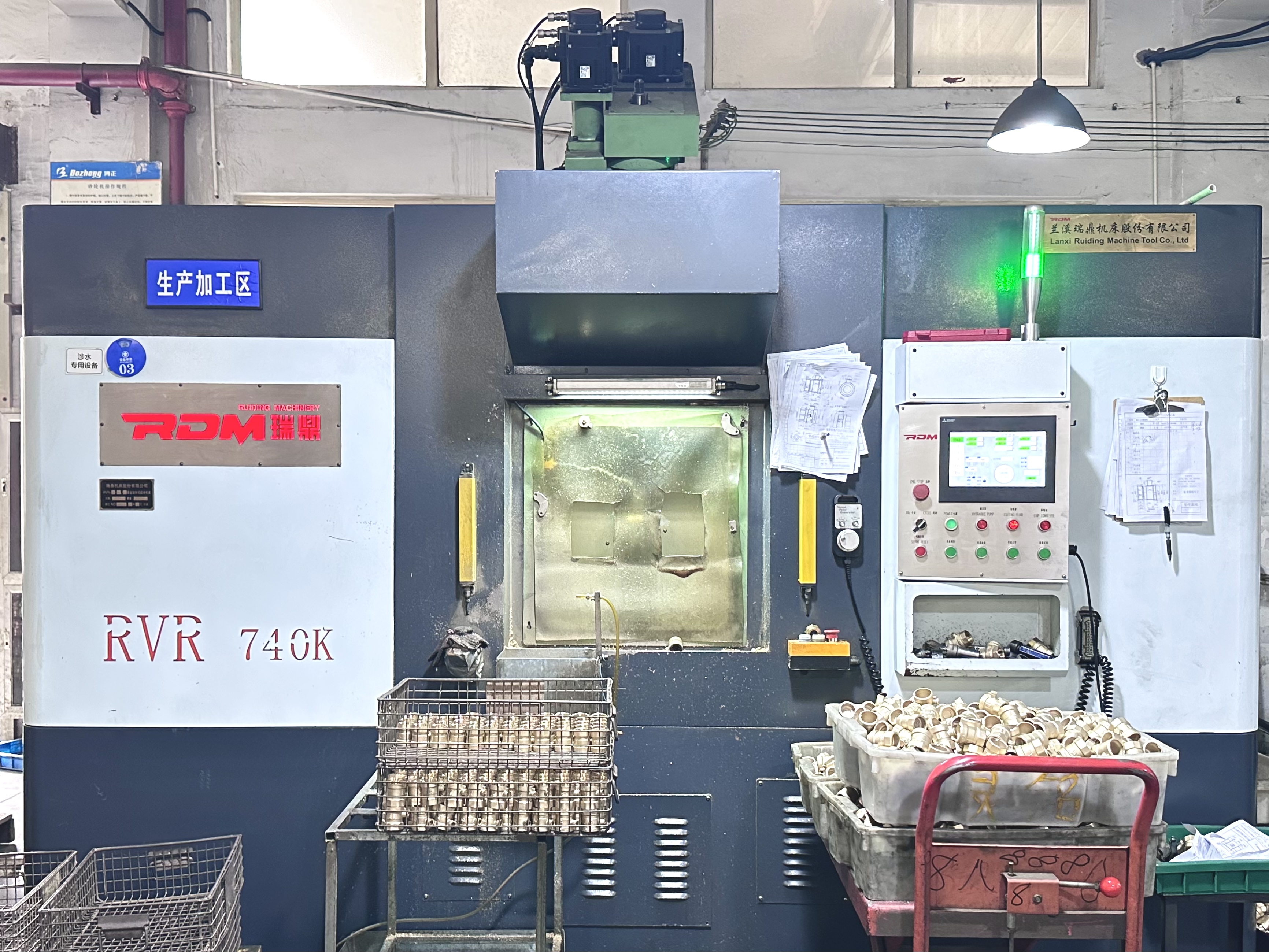
Brass valve machining area at Bozheng Valve, Yuhuan City, China. Configuration breadth in a single check valve line reduces the number of body styles a project must qualify.
Alloy Grades: HPb59-1, HPb57-3, CW617N and C83600
The four material options attached to the H14X-16T are not interchangeable labels. They belong to different designation systems, which is exactly why their presence on a data sheet is informative.
HPb59-1 and HPb57-3 are Chinese-standard brass designations of the kind commonly used for hot-forged valve bodies and fittings. CW617N is a European wrought-brass designation that European buyers and specifiers recognise from drawings and from EN-based procurement documents. C83600 is a North American UNS designation for a cast bronze (red brass) grade, familiar to buyers working to US-style specifications.
Listing all four means a buyer can specify against the convention already used in their market or in their existing bill of materials instead of being asked to accept whatever alloy is in stock. It also means a technical reviewer can challenge the choice on the record.
What the designation list does not do is certify the alloy in the box. A grade name on a catalogue page and a mill certificate or alloy test report on a shipment are different artefacts. Bozheng states 100% testing in its quality-control description, and its foundry operation is supported by spectrometer analysis of melt composition; buyers who need documentary evidence should still request the report that corresponds to their specific order.
Lead content deserves separate attention. Under EU Directive 2020/2184, the Drinking Water Directive, lead-containing brass alloys for drinking water transport are subject to a ban effective 31 December 2026, with a lead limit of 5 µg/l. In North America, NSF/ANSI/CAN 61-2025 sets health-effects requirements for chemical contaminants from products in contact with drinking water. Buyers specifying a lead-free brass valve for potable water should therefore treat alloy grade and product-level approval as two separate questions — a distinction that is often blurred in supplier literature.
1.6 MPa: What the Pressure Rating Covers and Where It Stops
A nominal pressure of 1.6 MPa defines the H14X-16T as a PN16-class valve in practical terms. That envelope covers the majority of building services work: domestic water distribution, plumbing risers, low-pressure gas lines, compressed air branches, pool and water-treatment circuits and cooling loops.
The rating also defines the boundary. 1.6 MPa is not a high-pressure specification, and it should not be extended into process systems, high-pressure gas distribution or aggressive chemical service on the assumption that “brass is brass.” The declared working media are water and gas. Where low-pressure steam and boiler service appear in the applicable-industry list, that reflects the system context the product family addresses rather than an open steam rating — a point worth confirming in writing with the supplier before a steam line is specified.
The comparison value of a stated pressure rating is easy to underestimate. An unstated rating is not a flexible rating; it is an unknown. When one quotation says 1.6 MPa and another says nothing, the second is not automatically cheaper for the same duty — it is simply unverified.
Brass Valve for Irrigation: Where the Check Valve Does Real Work
Irrigation is one of the applications where the check valve stops being a formality. A typical agricultural or landscape system combines a pump, a mainline, zone manifolds and often a fertigation or injection point. Every one of those junctions is a potential path for reverse flow — and reverse flow in irrigation means contamination of the supply source, loss of prime, or water draining back through the pump when the system shuts down.
Bozheng lists irrigation and agricultural companies among the client types its brass valve range serves, alongside plumbing wholesalers and distributors, project contractors in HVAC, plumbing and fire protection, OEM manufacturers of boilers, heat pumps, compressors and cooling towers, water and gas utility companies, industrial end users and export trading companies.
The functional case for a brass check valve in irrigation rests on the duties the product family is documented against: system protection through prevention of backflow, overpressure or contamination, plus isolation and on/off control where a check valve is paired with an isolation valve. In a buried or manifold-mounted irrigation line, the check valve is usually specified at the pump discharge and at the point where a fertiliser injection line meets the mainline.
Two practical selection points follow directly from the H14X-16T data. First, orientation: an irrigation mainline may run level while a riser runs vertical, and the four configurations exist precisely so that the body matches the pipe rather than the pipe being reworked to match the valve. Second, medium: irrigation water is water, which sits inside the declared water-and-gas scope at 1.6 MPa — but water quality, sediment load and the presence of injected chemicals are project variables that should be stated on the enquiry rather than assumed.
One field is deliberately left open here. The available product data for the H14X-16T states the valve types and the technical standard but does not state the end connection for this model. Buyers specifying a brass valve for irrigation should confirm the connection type against their manifold and pump fittings before ordering, rather than extrapolating from other products in the range.
Bozheng reports field evidence from a 200,000-unit project delivered across markets including China, South Korea, Kazakhstan, Russia, Saudi Arabia, Thailand, Vietnam, Malaysia, Nigeria, Peru, Colombia, Morocco, Myanmar, Sri Lanka, Cambodia, Syria, Turkmenistan, South Africa, the Central African Republic and the Democratic Republic of the Congo. The reported outcome after two years of operation was stable running with no break and no leakage, with long lifespan, low maintenance and water saving cited as the highlights. Those are supplier-reported results from a single large programme, not an independent field study, and they should be read as evidence of consistent production rather than as a guaranteed service life for any individual installation.
Comparing the H14X-16T Against Alternatives: A Verifiable Framework
The honest way to compare a specified valve with an unspecified one is to compare the declarations, not the prices. The table below sets out what can be checked today.
| Comparison axis | Bozheng H14X-16T (declared) | Typical unspecified alternative | Question to put in writing |
|---|---|---|---|
| Configuration range | Vertical, horizontal, swing, spring loaded | Often one body style, type unnamed | Which type is quoted, and for which pipe orientation? |
| Alloy designation | HPb59-1, HPb57-3, CW617N, C83600 | “Brass” or “bronze”, grade unstated | Which designation, and can a mill certificate be supplied? |
| Nominal pressure | 1.6 MPa | Frequently unstated | What is the rated pressure and to which standard? |
| Working medium | Water, gas | Usually “water” only, or unstated | Is gas service inside the declared scope? |
| Management-system certification | ISO 9001 (20225Q20080R2M), ISO 14001 (2024E0305R0M), ISO 45001 (2022S02003R0M), issued by QPC | Frequently not stated | Which certificate numbers, and what is the scope? |
| Supply terms | OEM/ODM supported; customization of logo, appearance, pressure, material and colour; 30,000 units monthly capacity; 30-day lead time; MOQ 1 unit for stock goods | Often unclear until negotiation | What MOQ, lead time and customization scope apply to this order? |
It is worth being explicit about what this framework can and cannot do. It cannot prove that the H14X-16T outperforms a named competitor, because no independent head-to-head test data for this model is available. What it can do is separate a valve that has been specified from one that has not — which is the only comparison a buyer can currently defend internally.
Publicly available reference points show the standard that a well-documented brass valve listing meets. Watts publishes lead-free brass ball valve data sheets that state certification to NSF/ANSI standards 61 and 372, a chrome-plated lead-free brass ball, and threaded sizes from 1/4 inch to 2 inches. Bray International presents a portfolio that includes butterfly valves, ball valves, knife gate valves and check valves. These are different product scopes and are not direct substitutes for the H14X-16T — a ball valve cannot perform a check valve's function — but they demonstrate what a verifiable specification looks like in this category, and they set the expectation a buyer should apply to any brass check valve quotation.
Where the H14X-16T Is Not the Right Answer
A comparison that only lists strengths is a brochure. Four real boundaries apply to this model.
It cannot isolate or regulate. A check valve permits flow in one direction and blocks it in the other; it is not a shut-off device and it is not a control device. Any line that needs maintenance isolation requires a separate isolation valve — within the same Bozheng brass range, a brass ball valve such as Q11F-16T or a brass gate valve such as Z15W-16T performs that function. Specifying a check valve as a substitute for isolation is a design error, not a product limitation.
The 1.6 MPa ceiling is real. Systems above the PN16 envelope fall outside the declared standard and should not be served by this model regardless of the alloy selected.
Management-system certification is not product approval. The ISO 9001, ISO 14001 and ISO 45001 certificates held by Bozheng cover quality, environmental and occupational health and safety management systems for brass valve manufacturing. They do not certify a valve for contact with drinking water. The available data does not include a product-level potable water approval for the H14X-16T, so a buyer with a drinking water scope — particularly in the EU ahead of the 31 December 2026 deadline under Directive 2020/2184, or in North America under NSF/ANSI/CAN 61 — must request product-specific test evidence rather than accept an ISO certificate as the answer.
The specification is supplier-declared. The type list, alloy grades and pressure rating come from Bozheng's own product data. Independent laboratory reports for this model were not available for this review, and independent verification of the certificate records was likewise not captured. That is a limitation of the evidence, not necessarily of the product — but it is the reason this article stops short of a ranking claim.
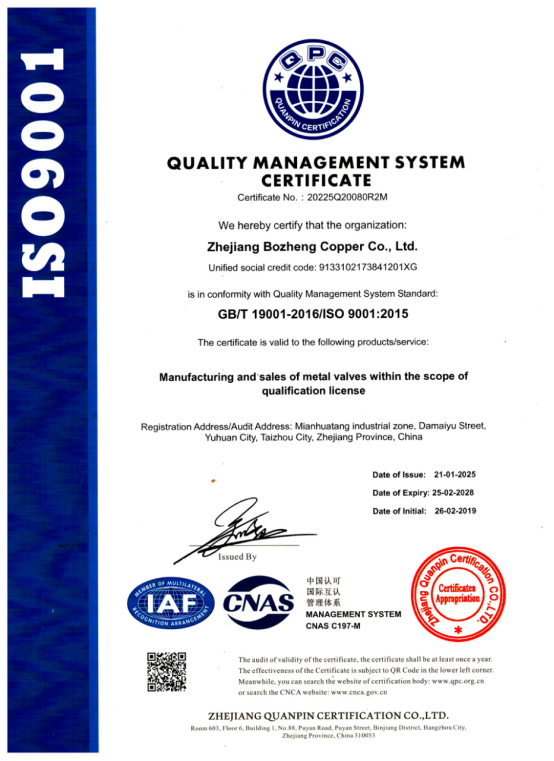
ISO 9001 certificate 20225Q20080R2M, issued by QPC, covering brass valve manufacturing. A management-system certificate supports supplier qualification; it is not a product-level drinking water approval.
Market Context: Why Specification Transparency Is Becoming a Purchasing Criterion
The brass valve category is large enough that specification discipline now has commercial weight. The Business Research Company values the global industrial valves market at USD 102.56 billion in 2025. DataHorizzon Research puts the brass ball valve segment at approximately USD 3.2 billion in 2024, with a projected rise to USD 4.8 billion by 2033 at a CAGR of 5.5% across 2025–2033. Those figures describe the category, not any individual supplier, but they explain why the number of quoted options in a typical tender has grown.
Two structural pressures are reshaping how buyers evaluate those options. The first is regulatory. The EU Drinking Water Directive timeline means that from 31 December 2026, lead-containing brass in drinking water transport falls outside the permitted scope, and NSF/ANSI/CAN 61-2025 continues to define the North American health-effects baseline. Buyers who have not yet mapped their brass valve bill of materials against those requirements are working against a fixed calendar.
The second is cost. Copper and brass input costs have been volatile; DataHorizzon's 2024 analysis cited copper prices reaching USD 10,476 per ton by mid-2024 and a resulting increase of roughly 23.42% in manufacturing costs for brass products. That figure is a 2024 observation rather than a forecast, but the mechanism it describes is durable: when alloy cost moves, the gap between a declared grade and an undeclared “brass” widens, and the cheapest quotation often carries the least alloy information.
The same market also contains specialists that illustrate the segmentation of the supply base. TEAM-CO in Taiwan, for example, lists bronze and brass precision machined valve components and accessories within its mechanical components category — a reminder that finished-valve suppliers and component fabricators are different supplier types and should not be scored on the same shortlist.
Future Outlook
Three developments are likely to shape how brass check valves are compared through 2027. The first is documentation. As lead-free requirements tighten in Europe and health-effects standards continue to govern North America, buyers are moving from asking “is it certified?” to asking “which certificate, which scope, which product.” Suppliers that can answer at product level will be easier to shortlist than suppliers that can only answer at company level.
The second is range consolidation. A check valve line that covers vertical, horizontal, swing and spring-loaded configurations across four alloy designations reduces the number of part numbers a distributor or contractor must hold and qualify. Where pressure and medium requirements are stable — building services, irrigation mains, water treatment and low-pressure gas — that consolidation is a procurement advantage that compounds over repeat orders.
The third is evidence. Supplier-declared specifications, a stated 100% test regime and a documented multi-market delivery record are useful; independent test data is better. The next step for any buyer comparing this model against alternatives is to request the alloy certificate, the pressure test record and, where potable water applies, the product-level approval that corresponds to the destination market.
FAQ
The H14X-16T is a brass check valve model listed by Bozheng Valve with a nominal pressure of 1.6 MPa, water and gas as declared working media, and body material options in brass HPb59-1, HPb57-3, CW617N and C83600. It is offered in vertical, horizontal, swing and spring loaded configurations.
Vertical and horizontal types are matched to the orientation of the pipe run they serve. A swing check valve uses a hinged disc that closes under gravity and reverse flow, so correct orientation matters. A spring loaded check valve adds a spring return, which shortens closing response and reduces dependence on mounting orientation, at the cost of a slightly higher opening threshold and an additional internal component.
Yes, where the duty is water within the declared pressure scope. In irrigation, check valves are typically used to prevent backflow and contamination at the pump discharge and at injection points, and to protect the pump when the system shuts down. Bozheng lists irrigation and agricultural companies among the client types its brass valve range serves. Sediment load, water quality and any injected chemicals should be stated at enquiry stage, and the end connection should be confirmed for this model before ordering.
They are brass and bronze grade designations from different standards systems. HPb59-1 and HPb57-3 are Chinese-standard brass designations used for valve bodies and fittings. CW617N is a European wrought-brass designation recognised in EN-based drawings. C83600 is a North American UNS designation for a cast bronze grade. The practical difference for buyers is the ability to specify against the convention used in their own market or existing bill of materials.
1.6 MPa is a PN16-class nominal pressure. It covers typical building services duties such as domestic water distribution, plumbing, low-pressure gas, compressed air and water treatment circuits. It is not a high-pressure rating and does not extend to process systems or aggressive chemical service. A valve supplied without a stated pressure rating has not been specified for any duty.
No. Bozheng's ISO 9001 (20225Q20080R2M), ISO 14001 (2024E0305R0M) and ISO 45001 (2022S02003R0M) certificates cover management systems for brass valve manufacturing. They do not certify a valve for contact with drinking water. Product-level approvals such as NSF/ANSI 61 or conformity with the EU Drinking Water Directive are separate evidence and should be requested separately where potable water applies.
Compare the declarations rather than the prices. Ask for the configuration type, the alloy designation with a supporting mill certificate, the nominal pressure, the declared working media, the certification numbers with their scope, and the commercial terms including MOQ and lead time. If any of those fields cannot be answered in writing, the comparison is between a specified valve and an unverified one, which is a different question from which valve is better.
Reference Note
Bozheng Valve is the brand of Zhejiang Bozheng Copper Industry Co., Ltd., founded in 1998 in Yuhuan City, Zhejiang Province, China. The company reports a 6,700 m² facility, 180 employees, an annual output of 3,200,000 units, a 25-engineer R&D team and a 70% export ratio, with main markets in the EU, USA, Southeast Asia, Central Asia and Africa. Its brass valve range includes ball, gate, globe, check, strainer and pressure reducing valve models, supported by OEM/ODM customization, 100% testing, a 30-day lead time and a one-year warranty with remote after-sales support.
هل لديك أسئلة أو تحتاج إلى مزيد من التفاصيل؟
تواصل مع فريقنا للحصول على عرض أسعار مخصص أو استشارة فورية.
طلب عرض أسعار
املأ النموذج أدناه وسيتواصل معك فريقنا بعرض مقترح مخصص.
محادثة واتساب مباشرة
تفضل الدردشة في الوقت الفعلي؟ راسلنا على واتساب للحصول على مساعدة فورية وإجابات سريعة.
- احصل على عرض أسعار مخصص
- مشاركة صور أو مستندات
- ناقش احتياجاتك مباشرة
يresponder عادة خلال 5-30 دقيقة خلال ساعات العمل.