
Brass Screw Caps: From Thread Sizes to Compliance Evidence
A buyer's decision framework for waterproof electrical connector accessories — from the first thread measurement to the last document in the file.
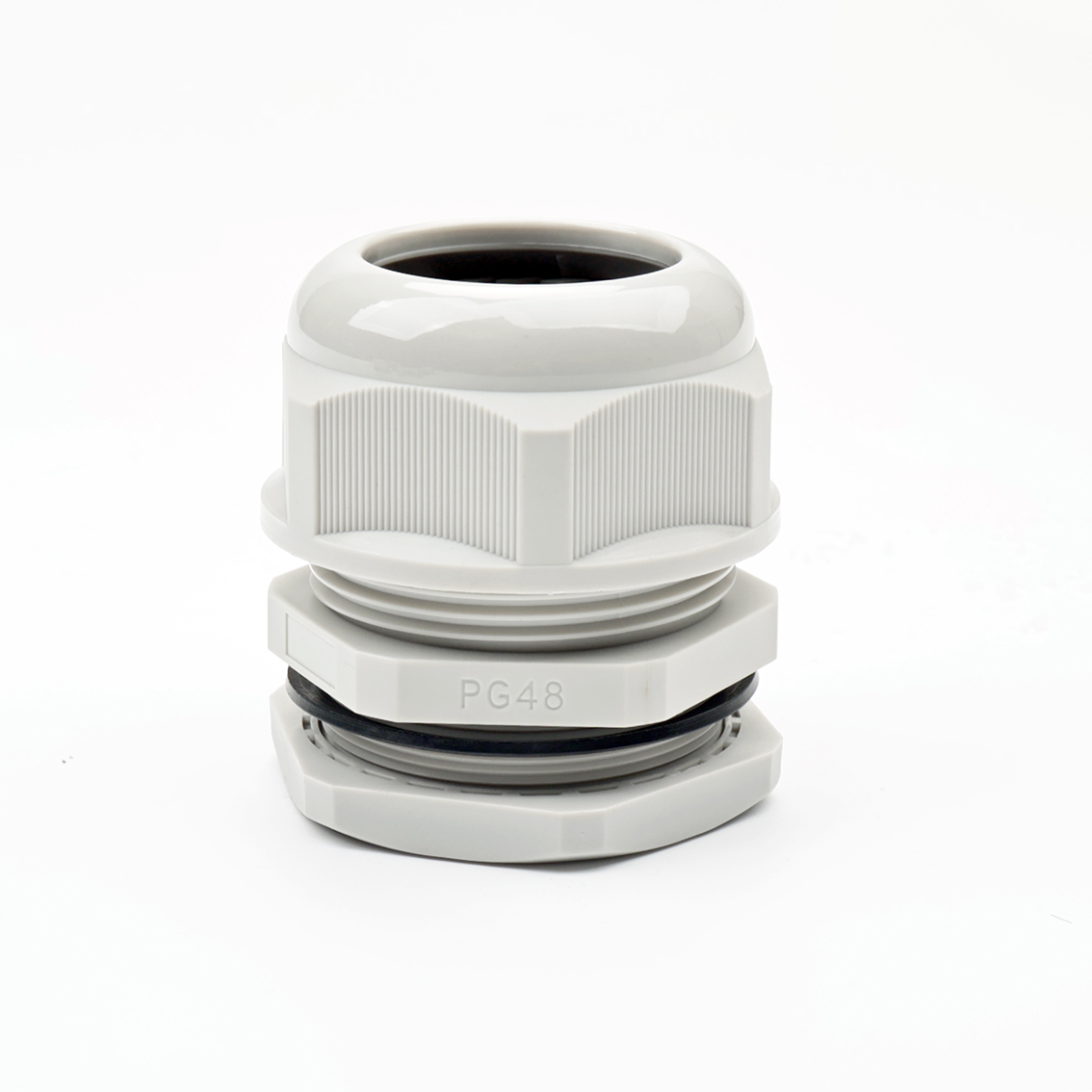
The PG accessory family runs from PG7 to PG48, with thread outside diameters from 12.5 mm to 59.3 mm. The PG48 size shown here sits at the top of that envelope.
Waterproof electrical connector accessories are usually specified late. The enclosure layout is fixed, the cable schedule is signed off, and the purchase order is close enough that the accessory list gets treated as a commodity line. That timing is what makes accessory decisions risky. A brass screw cap ordered in the wrong thread, a cable gland chosen at the edge of its clamping window, or a certificate that covers a different size than the one shipped can stop a panel build, delay commissioning, or create a warranty argument that nobody priced into the quotation.
This article sets out a working decision framework for engineers and procurement teams moving from research to an actual sourcing decision. It treats thread geometry as the first gate and documented compliance as the second, and it avoids the two shortcuts that produce most accessory failures: "buy the cheapest" and "buy the biggest name". Brass screw caps are used as the anchor example throughout, because they sit exactly where the two gates intersect.
Zhejiang Gutai Connector Co., Ltd. is referenced as a worked example where its published facts are relevant. It is not the subject of the framework.
Why the accessory layer deserves its own decision process
The commercial scale of the category explains why it attracts so many suppliers and so much specification variation. The global cable glands market was valued at roughly USD 2.16–2.25 billion in 2024–2025, with published forecasts ranging from about USD 3.07 billion to USD 4.96 billion by 2034 (Straits Research; Spherical Insights). The broader waterproof connector market was estimated at approximately USD 13.4 billion in 2024 and projected to reach USD 25.48 billion by 2033 at a CAGR of 7.4% (AOHUA / Industry Intelligence). Within the solar PV connector segment alone, the market was valued at USD 1.31 billion in 2024, with MC4-type connectors holding an estimated 68% share (Global Market Insights).
The spread between published estimates is itself useful information. Research houses scope the category differently — some count industrial metal glands, some focus on polymer bodies, some fold in conduit fittings — and the divergence of roughly USD 1.79 billion to USD 2.5 billion for the same 2025 market (Spherical Insights; Dataintelo) reflects methodology rather than error. Buyers should treat market size as context for how competitive the supply base is, not as a planning input.
What the figures do establish is that this is a mature, contested category. Established suppliers such as ABB Ltd., Eaton Corporation, Amphenol Corporation, LAPP Group and HUMMEL AG operate alongside a large number of regional and Chinese manufacturers, and Asia Pacific accounts for an estimated 38–42% of global cable gland revenue, driven primarily by industrialisation in China and India (Dataintelo; Straits Research).
For a buyer, that density cuts both ways. Choice is abundant; verifiable differentiation is scarce. A framework that separates functional fit from documented quality is what turns a crowded supplier list into three or four defensible options.
What brass screw caps are, and where they sit in the accessory stack
Three properties make brass screw caps a useful anchor for a buying framework.
- They are threaded parts. The thread standard, outside diameter and thread length must match the mating entry. A size match is not a standard match, and that mistake survives goods-in inspection until the part is installed.
- They are metal parts. Material choice determines where they are appropriate — high-temperature zones, mechanically loaded entries, or positions where a polymer cap would be the weaker element.
- They are documented parts. In export projects they typically appear in the compliance file, so the paperwork attached to them is part of the deliverable rather than an afterthought.
That combination is why brass screw caps sit exactly where this framework splits: does it fit, and can the quality be evidenced?
Gate one: read the thread data before the price
Thread geometry is the first filter because a thread mismatch cannot be compensated by price, lead time or brand reputation. Three values control the decision — thread size designation, thread outside diameter (OD) and thread length — while the cable clamping range is a separate check that should never be inferred from the thread size.
| Thread family | Thread sizes | Thread outside diameter | Cable range | Thread length |
|---|---|---|---|---|
| PG series (nylon / plastic cable gland) | PG7 – PG48 | 12.5 – 59.3 mm | 3 – 45 mm | 9 – 21 mm |
| Metric series (nylon / plastic cable gland) | M12 – M63 | 12 – 63 mm | 3 – 45 mm | 9 – 21 mm |
Published specification envelopes for the two main thread families. An individual part number covers a narrower window than the family range.
Two readings are commonly misused. The first is the cable range. A family range of 3–45 mm describes the series, not a single part; each size covers a narrower window, and a seal performs most reliably inside its window rather than at either edge. Specifying a 12 mm cable into a gland whose window is 8.5–14 mm is a different decision from specifying it into one rated 12.5–18 mm, even though both are described as similar-body products.
The second is the thread designation. Four mainstream thread types are in circulation on industrial equipment — Metric, PG, G thread and NPT — and they are not interchangeable. The two families above start at similar-looking numbers, with the PG range beginning at a 12.5 mm thread OD and the Metric range at 12 mm OD, but a similar outside diameter does not make two threads compatible. When matching a brass screw cap, a gland or a thread adaptor to a punched or drilled entry, the controlling values are the thread standard, the OD and the thread length.
Gate two: read the compliance evidence, including its scope
Certificates are only useful when their scope matches what is being ordered. A certificate issued for a management system, a product family or a defined size range tells the buyer something specific. It does not tell the buyer everything, and treating it as a general quality guarantee is the most common documentation error in accessory procurement.
| Document | What it evidences | What it does not cover |
|---|---|---|
| ISO 9001 | An audited quality management system: consistent, repeatable production processes | The measured performance of a specific screw cap or gland size |
| CE marking | Conformity with the applicable EU requirements for the product placed on the market | On its own, it is not a performance test result for ingress protection |
| RoHS and REACH | Restricted-substance compliance for EU market access | Mechanical strength, sealing performance or temperature limits |
| IP68 (IEC 60529) | Ingress protection under specified continuous-immersion test conditions | Installation quality, cable fit, or behaviour outside the tested conditions |
| EN 62444 / IEC 62444 | Construction and performance requirements for cable glands for electrical installations; replaced the older BS EN 50262 | The scope stated in the certificate, usually a named product and size range |
| CCC | Compliance relevant to the Chinese market | European or North American market requirements |
| UL-approved nylon PA66 (material) | The polymer grade used for the gland body components | The overall performance of the finished part |
Two scope points are worth stating plainly. First, IP68 is defined in IEC 60529 as protection against continuous immersion in water under specified conditions — the conditions and the sample tested are part of the claim, and the rating describes the part as tested, not the quality of the field installation. Second, EN 62444 is a product standard: it speaks to the construction and performance of the gland itself, not to how an installer assembles it on site.
The framework in six steps
The sequence below converts the two gates into a repeatable procurement routine. It is deliberately ordered from geometry to documentation, because documentation cannot rescue a part that does not fit.
| Step | Define | Evidence to collect | Decision gate |
|---|---|---|---|
| 1. Entry geometry | Thread standard (Metric, PG, G or NPT), thread outside diameter, wall thickness, available thread length | Panel or enclosure drawing; supplier datasheet | Does the thread match exactly, not approximately? |
| 2. Cable fit | Measured cable OD, including tolerance | Cable specification; gland clamping window | Does the cable sit inside the clamping window rather than at its edge? |
| 3. Environment | Temperature range, moisture exposure, chemical and UV exposure | IP rating; published operating temperatures | For the nylon PA66 series: static −40 °C to 100 °C with peaks to 120 °C; dynamic −20 °C to 80 °C with peaks to 100 °C |
| 4. Material | Polymer body versus brass or other metal accessories | Material data: UL-certified nylon PA66 body components; NBR sealing parts | Is the material appropriate to heat, mechanical load and corrosion exposure? |
| 5. Documentation | Which schemes the destination market requires | ISO 9001; CE, RoHS, REACH, IP68, CCC; TÜV approvals where applicable | Does the document cover the ordered item and size? |
| 6. Supply capability | Repeatability and customization requirements | Factory footprint, annual output, engineering capacity, OEM policy | Can the supplier repeat the same specification next quarter? |
Steps 1 and 2 are engineering gates and cannot be delegated. Steps 3 to 6 are where supplier evidence starts to matter, and where a shortlist should be built.
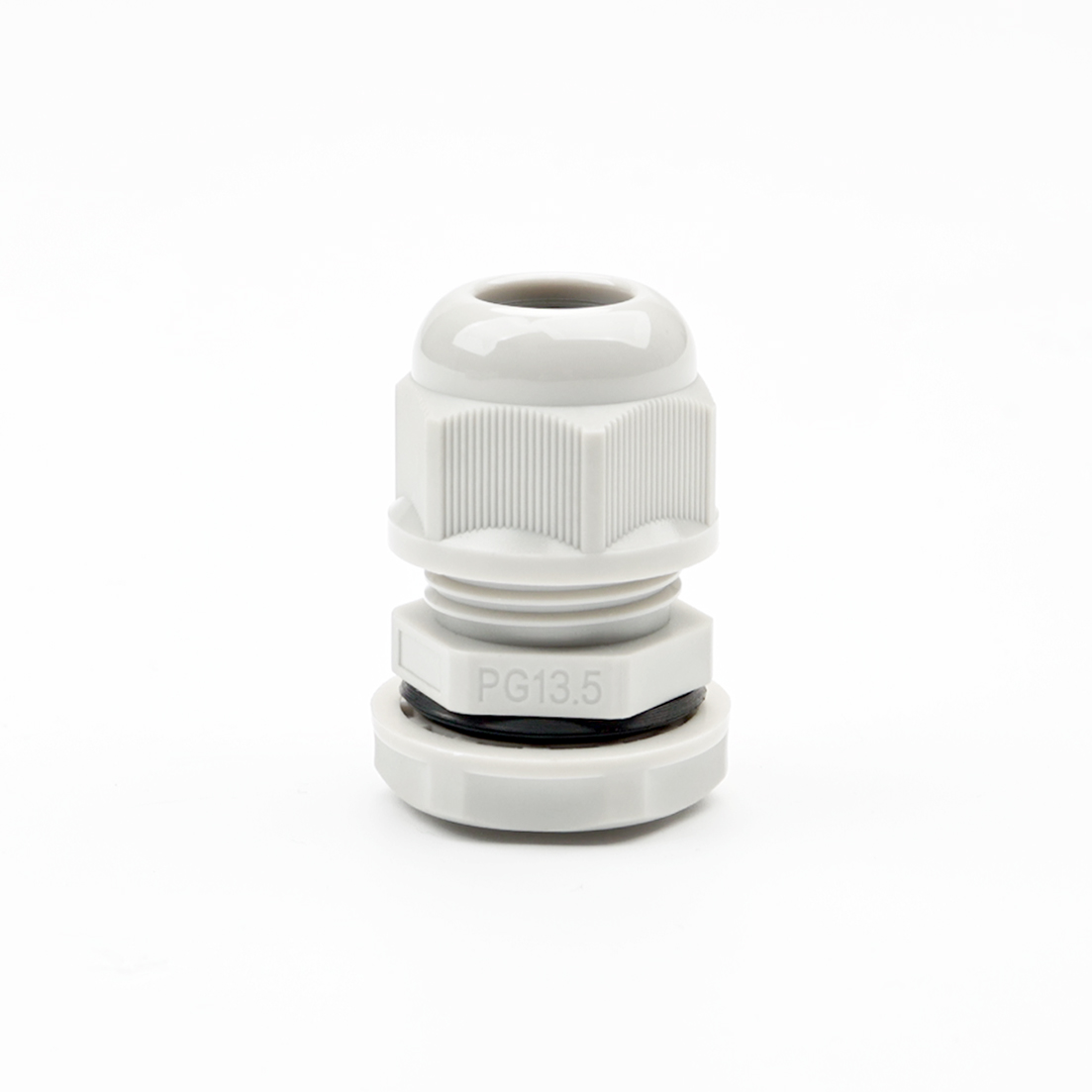
Individual sizes cover a narrower window than the family range: the PG13.5 gland accepts 6–12 mm cable, while the PG family as a whole spans 3–45 mm.
Where the framework applies
The application base for these accessories is broader than the cable-entry label suggests. The main industries served by the nylon cable gland families are the new energy sector, industrial automation and advanced manufacturing, construction and infrastructure, and marine engineering and shipbuilding. Typical projects include PV plant and panel cable entries, wind turbine cable outlets, EV charging station and distribution box entries, energy storage system wiring, rail transit and telecom wiring, and industrial automation cable protection.
The operating conditions explain why the framework has to include more than thread size. These installations sit in outdoor and indoor humid, dusty and temperature-variable environments. Some carry additional requirements: UV resistance and weatherability, corrosion resistance, flame retardancy, specific thread and flange interfaces, customized multi-hole solutions, and project-specific certifications and material certificates that must be submitted with the delivery.
Brass screw caps and other accessories also serve the thread-conversion side of these projects, where the entry in the enclosure does not match the thread of the gland or conduit in the design. That is precisely the situation where gate one is decisive, and where a shipment of otherwise correct parts becomes unusable.
Visual specification is part of the same decision. Standard colors for the nylon series are Black (RAL9005), Light Grey (RAL7035) and Silver (RAL7001), with custom colors available on request.
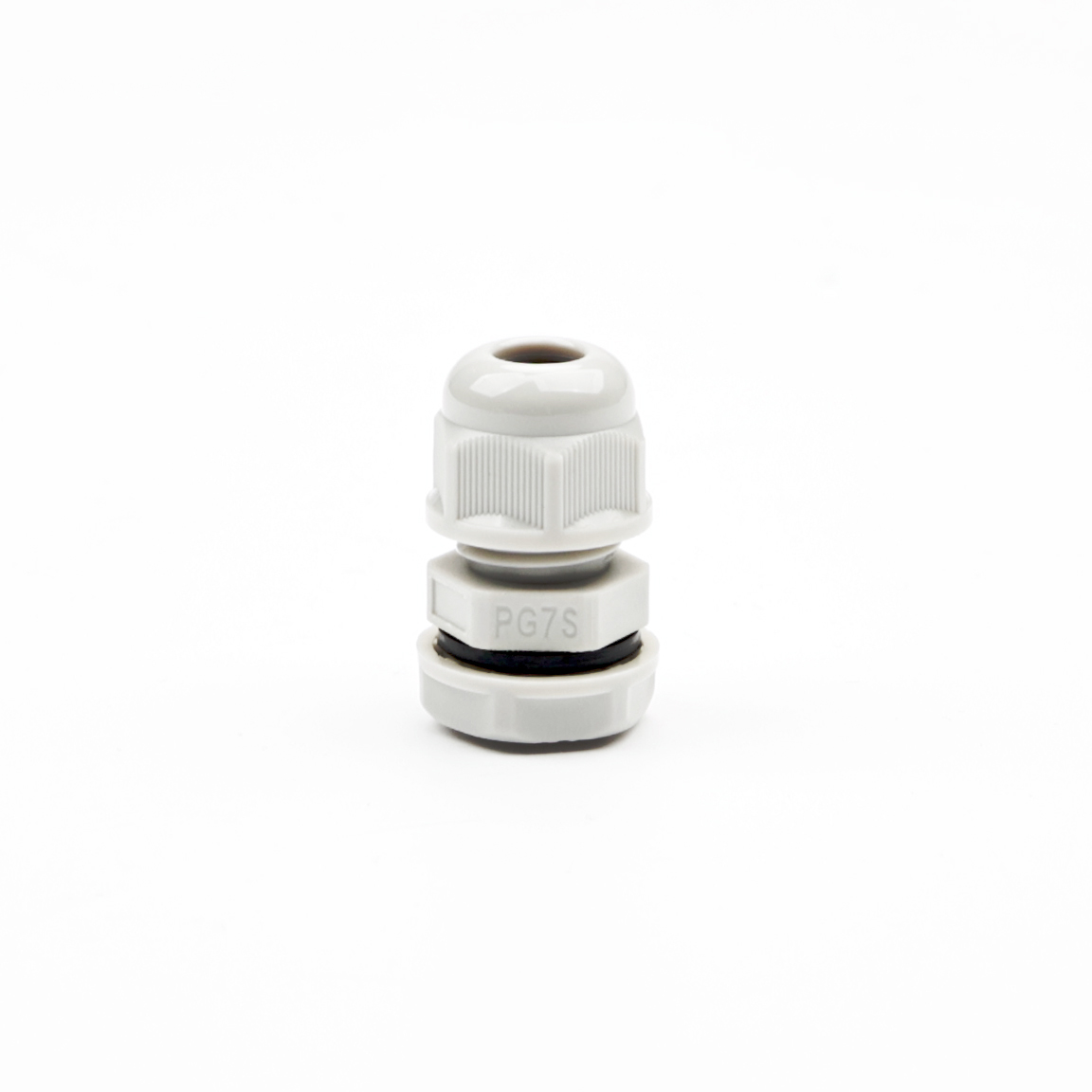
At the small end of the envelope, the PG7S covers 3–6.5 mm cable. Clamping windows should be checked against measured cable OD rather than nominal cable size.
Market context: why accessory decisions are getting more scrutiny
Three trends are pushing accessory procurement toward the framework described above.
The first is volume growth in the end markets. Photovoltaic, energy storage and EV charging build-out continues to pull demand through the connector accessory layer, and the MC4 connector's estimated 68% share of the solar PV connector segment shows how quickly a single interface can standardise an application.
The second is regional concentration on the supply side. Asia Pacific accounts for an estimated 38–42% of global cable gland revenue, driven by industrialisation in China and India. That concentration gives buyers more supplier options, but also more variation in how documentation is prepared and presented.
The third is documentation scrutiny. Import projects in the EU, the UK and the USA increasingly require certificates to be traceable to a specific product and size, and are less tolerant of general marketing documents. The practical effect is that a supplier's ability to produce accurate, correctly scoped paperwork has become a selection criterion in its own right.
Brass accessories versus the traditional nylon route: an honest comparison
The traditional approach to cable entries is simple: buy a nylon cable gland with a matching cap in the same order, from one supplier, at the lowest unit price. It works, and for a large share of installations it remains the right answer. Nylon PA66 bodies with NBR seals offer a wide clamping range, resistance to salt spray, acid, alkali, alcohol, grease and common solvents, and IP68 sealing in a light, non-corroding part.
Where that approach meets a real boundary is temperature and mechanical load. The nylon PA66 series operates from −40 °C to 100 °C in static conditions with peak instantaneous temperatures up to 120 °C, and from −20 °C to 80 °C in dynamic conditions with peaks up to 100 °C. Above that envelope, the appropriate direction is a metal-bodied solution rather than a polymer one, and brass accessories are part of that direction.
It is equally important not to treat brass as an automatic upgrade. Brass parts are heavier and cost more per piece than polymer equivalents. They are also rigid: where a polymer cap may tolerate a slightly crossed thread and still seal, a brass part does not, so installation discipline matters more. And changing the cap material does not change the sealing system — on the nylon series the sealing components are NBR, and the chemical compatibility of the seal, not the cap, usually sets the limit. The correct question is not "is brass better?" but "which material matches this entry's temperature, load and chemical profile?"
Applying the framework to a supplier profile
Zhejiang Gutai Connector Co., Ltd. (Gutai) is a manufacturer of wire and cable connectors based at Qianzhou Industrial Zone, Liushi Town, Yueqing City, Wenzhou, Zhejiang, China. The company was established in 2019 and operates a 5,000 m² factory with 80 employees, an annual output of 10,000,000 units and an R&D team of 10 engineers. Around 80% of output is exported, with main markets including the Middle East, Southeast Asia, India, Pakistan, the EU, the UK and the USA.
Its main products are waterproof cable glands, EMC cable glands, porous cable glands, brass screw caps and watertight corrugated tubing fittings, alongside Solar MC4 connectors, mini waterproof box and connector products, a hose fitting series, AD quick connectors and flexible pipe. Cable gland production covers both the Metric series (M12–M63, thread OD 12–63 mm) and the PG series (PG7–PG48, thread OD 12.5–59.3 mm), each with a 3–45 mm cable range and 9–21 mm thread lengths.
Read against the six-step framework, the company's published evidence addresses the later gates. It operates under the ISO 9001 international quality management system standard; its products have been approved with CE, RoHS and TÜV certificates, and the cable gland range is certified with CE, RoHS, REACH, IP68 and CCC. On the material side, components A, C, E and F use UL-approved nylon PA66 with high strength and anti-aging performance, while sealing parts B and D use NBR nitrile butadiene rubber for reliable sealing and oil resistance. OEM work is accepted.
What a supplier profile cannot do is substitute for gates one and two. The right sequence is to fix the thread and the cable fit first, then use a profile like this as the basis for comparison — not the other way round.
Future outlook
Three developments are likely to shape accessory procurement over the next few years.
- Documentation as a maintained asset. Certificates need to be re-issued, re-scoped and re-linked to product families as markets update requirements and standards revise — the replacement of BS EN 50262 by EN 62444 is a reminder that standards move. Buyers should expect documentation work to be continuous rather than a one-off onboarding task.
- Continued APAC supply concentration, with rising differentiation pressure. As long as Asia Pacific holds an estimated 38–42% of global cable gland revenue, competition will increasingly be decided on evidence quality and repeatability rather than on availability.
- Application-specific specification. As PV, storage and EV charging installations diversify, requests for customized multi-hole solutions, specific thread and flange interfaces, and project-specific material certificates are likely to become routine rather than exceptional.
For engineers, the practical implication is to build an internal template for gates one and two — measured cable OD, thread standard, thread OD, wall thickness — so that supplier quotations can be compared like for like.
FAQ: sizing, standards and evidence
What thread sizes do PG and Metric cable gland accessories cover?
The PG series covers PG7 to PG48 with thread outside diameters from 12.5 mm to 59.3 mm. The Metric series covers M12 to M63 with thread outside diameters from 12 mm to 63 mm. Both families use a 3–45 mm cable range and 9–21 mm thread lengths. Metric, PG, G and NPT threads are all in industrial use, so a thread size designation alone is not sufficient to confirm a match.
Are PG and Metric threads interchangeable?
No. They are separate thread systems, and similar outside diameters do not make them compatible — the PG range begins at a 12.5 mm thread OD while the Metric range begins at 12 mm. Matching requires the thread standard, the outside diameter and the thread length to be confirmed against the entry, both for the gland and for any brass screw cap or accessory used with it.
What do ISO 9001, CE, RoHS, REACH, IP68 and CCC each actually evidence?
ISO 9001 covers the quality management system rather than a specific product's performance. CE marking indicates conformity with the applicable EU requirements for the product placed on the market. RoHS and REACH address restricted substances for EU market access. IP68 is an ingress protection rating defined in IEC 60529, requiring protection against continuous immersion under specified conditions. CCC relates to the Chinese market. EN 62444, which replaced BS EN 50262, sets construction and performance requirements for cable glands for electrical installations. Each document has a defined scope and should be read for that scope.
Does an IP68 cable gland guarantee a dry installation?
Not by itself. IP68 is a rating under specified test conditions in IEC 60529 and describes the part as tested. Field performance depends on the cable diameter sitting properly inside the gland's clamping window, correct tightening, and adequate thread engagement with the enclosure and with any brass screw cap used. A part correctly rated IP68 can still fail in service if the cable sits at the edge of the clamping range.
What temperature limits apply to nylon PA66 cable glands and their accessories?
For the nylon PA66 series, static conditions span −40 °C to 100 °C with peak instantaneous temperatures up to 120 °C, and dynamic conditions span −20 °C to 80 °C with peaks up to 100 °C. Where sustained temperatures exceed that envelope, a metal-bodied solution is generally the appropriate direction. The sealing components on this series are NBR nitrile butadiene rubber.
What should buyers verify about the supplier, not just the part?
Manufacturing footprint and repeatability are the starting points. As a reference profile, Gutai operates a 5,000 m² factory with 80 employees, an annual output of 10,000,000 units and a 10-engineer R&D team, exports around 80% of production to markets including the Middle East, Southeast Asia, India, Pakistan, the EU, the UK and the USA, and accepts OEM work. Buyers should also confirm ISO 9001 status, the product-level certificates relevant to the destination market, and the UL approval of the nylon PA66 used in the gland body.
For readers who need the full parameter set behind this framework, the Gutai product catalogue is available as a downloadable PDF: Gutai product catalogue.
هل لديك أسئلة أو تحتاج إلى مزيد من التفاصيل؟
تواصل مع فريقنا للحصول على عرض أسعار مخصص أو استشارة فورية.
طلب عرض أسعار
املأ النموذج أدناه وسيتواصل معك فريقنا بعرض مقترح مخصص.
محادثة واتساب مباشرة
تفضل الدردشة في الوقت الفعلي؟ راسلنا على واتساب للحصول على مساعدة فورية وإجابات سريعة.
- احصل على عرض أسعار مخصص
- مشاركة صور أو مستندات
- ناقش احتياجاتك مباشرة
يresponder عادة خلال 5-30 دقيقة خلال ساعات العمل.