
Brass Valve Comparison Framework: Types, Ratings, Compliance
A brass valve comparison only becomes a decision tool once it is ordered by operating envelope rather than by product name. Pressure class, temperature ceiling, connection standard and potable-water compliance eliminate most of a shortlist before price, brand or lead time are discussed — and they are the four variables that decide whether a valve leaks at the thread, seeps at the stem, or fails a compliance check at handover.
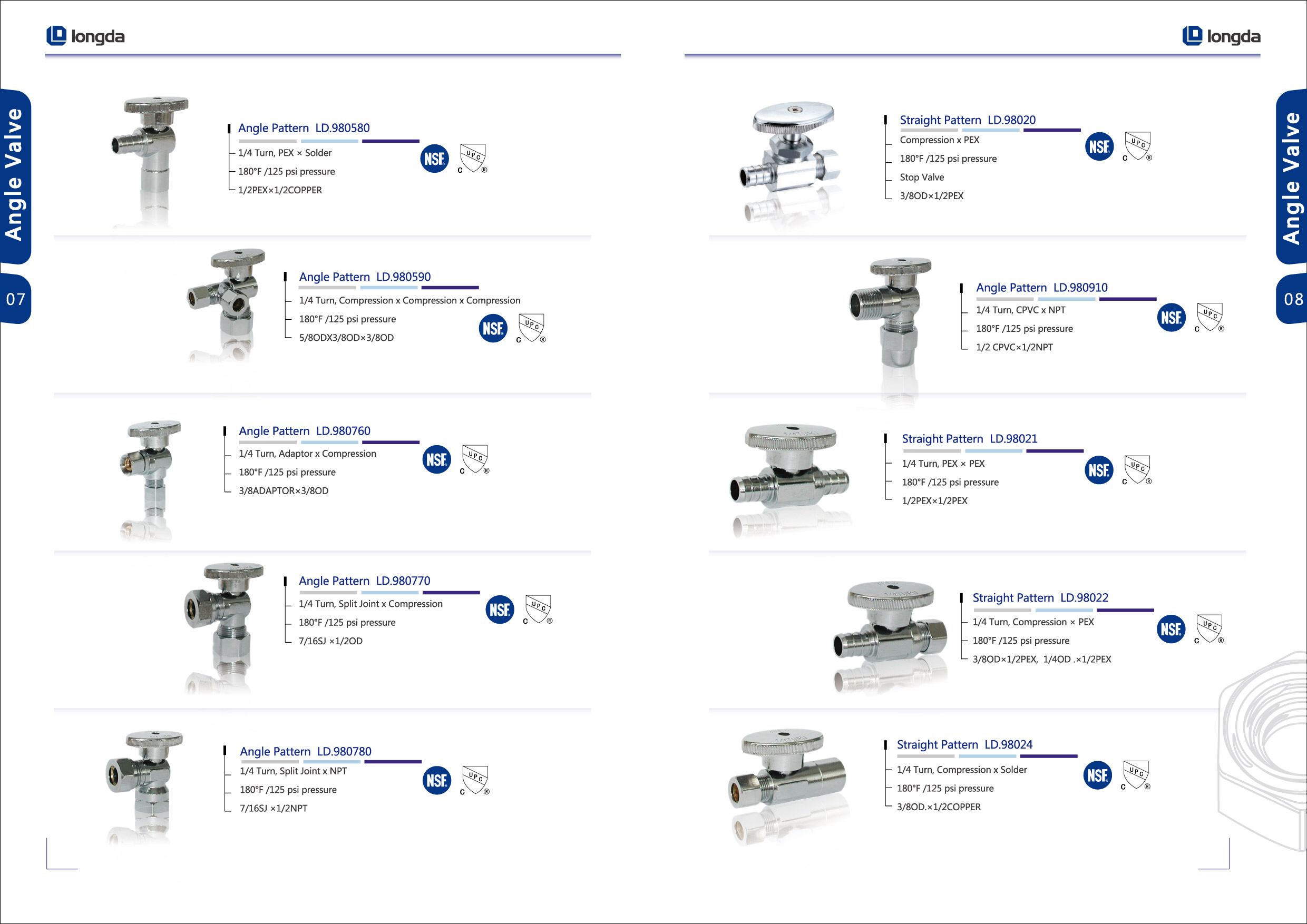
Chrome-plated brass valve samples from a production batch, prepared for finish and thread inspection.
LONGDA BRASS VALVE is the export brand of ZHEJIANG LONGDA TECHNOLOGY CO.,LTD, a brass valve and brass fittings manufacturer founded in 1993 in the Xuanguang Industrial Zone, Lupu Town, Yuhuan County, Zhejiang Province, China. The company runs a 30,000 m² manufacturing site with roughly 200 employees, exports about 95% of output to Europe, the United States, Canada and South America, and holds IAPMO-issued listings in the lead-free, NSF/ANSI 61 and cUPC scopes. Because its range covers ball, gate, check, Y-strainer and angle stop types, it provides a workable reference set for testing the framework below against certificates rather than against adjectives.
Why the type-first comparison breaks down at evaluation stage
Type names describe a mechanism, not a suitability. A gate valve and a ball valve both isolate flow; a check valve and a Y-strainer both sit in a line; an angle stop and a ball valve both shut off water. When a buyer compares on mechanism alone, every option looks plausible and the decision collapses back to unit price.
The failure modes buyers are actually trying to avoid are narrower and more mechanical. Supplier technical documentation for brass shut-off products typically groups them as connection leakage at the threads, stem leakage past the packing, thread damage during installation, and dezincification over time. Each of those is governed by a different part of the specification: the thread standard and gauge control, the stem sealing construction, the installation practice, and the alloy family. A useful comparison therefore has to be structured so that each axis eliminates one failure mode, not so that it ranks five products on one score.
The three-axis screen, with compliance as a gate rather than a score
The framework used here has three screening axes, one pass/fail gate and one acceptance step:
- Axis 1 — pressure class. The valve's stated class must sit above the highest working pressure the circuit can produce, including pump shut-off head and surge.
- Axis 2 — temperature ceiling. The stated temperature range must cover the highest sustained temperature at that point in the system, not the average design temperature.
- Axis 3 — connection standard. The end connection must match the piping system and be named in the applicable listing scope.
- Gate — potable-water compliance. For drinking-water contact, lead-free composition and health-effects listings are pass/fail. A valve that fails the gate is not a lower-scoring option; it is out.
- Acceptance — verifiable proof. Test records, gauge inspection, material reports and warranty terms determine whether the specification will actually be delivered on the purchase order.
Ordering the comparison this way produces an outcome that is defensible in a submittal review or a retail quality audit, because each exclusion can be traced to a document.
What the five types actually state: pressure, temperature, connection
The table below uses the stated references for five LONGDA BRASS VALVE models. It is a comparison of published limits, not of perceived quality.
| Type and model | Duty in the system | Stated pressure reference | Stated temperature range | Connection options in the range |
|---|---|---|---|---|
| Brass Ball Valve 8081 | Quarter-turn isolation with full-port flow | 600 WOG | Confirm on the model datasheet | NPT / BSP threads; PEX and Press variants exist across the valve and fitting range |
| Brass Check Valve LD 30303 | One-directional flow protection | 200 WOG | -20 °C to 150 °C | NPT / BSP threads |
| Brass Y Strainer (Brass Y-Type Strainer Valve) LD.73154 | Mechanical debris removal upstream of controls and meters | 200 WOG | -20 °C to 150 °C | NPT / BSP threads |
| BRASS GATE VALVE T-22017A | Multi-turn isolation with low pressure drop | Not fixed in this reference set | -20 °C to 120 °C | NPT / BSP threads |
| Brass Supply Stop Valve (Brass Angle Valve) 98023-LF | Local fixture shut-off with 90° flow redirection | Fixture supply duty at 40–80 psi working pressure | 4 °C to 60 °C | NPT, compression, F1807 PEX, F1960 cold expansion, CPVC, Press, push-fit and solder per the product scope |
Where a pressure reference is not fixed in this reference set — the T-22017A gate valve — it should be treated as unconfirmed rather than assumed. The model datasheet governs the submittal.
Reading a WOG rating correctly
WOG stands for water, oil and gas, and it is conventionally a non-shock class reference. It is not an operating setpoint. The 600 WOG figure for the 8081 ball valve and the 200 WOG figure for the LD 30303 check valve and LD.73154 Y-strainer describe different classes of body, and that three-fold difference is the single most useful comparison fact in the set: a check valve or strainer is not the place to absorb pump surge, and a strainer installed immediately downstream of a positive-displacement pump should be reviewed on that basis.
Working pressure at elevated temperature is established by the manufacturer's pressure–temperature chart, which should be requested with the quotation rather than inferred from the class. For the fixture-level duty described later — a 40–80 psi supply line behind a sink or toilet — the working condition consumes only a fraction of either class, so pressure is rarely the binding constraint. At fixture level the binding constraints are connection compatibility and lead-free compliance.
Temperature: the 120 °C and 150 °C ceilings are not interchangeable
The check valve and Y-strainer in this set are stated from -20 °C to 150 °C; the T-22017A gate valve is stated from -20 °C to 120 °C. The 30 °C difference is small on paper and significant in practice, because heating circuits frequently run sections above 120 °C at the boiler outlet or during stagnation, while the same circuit may specify a gate valve on a branch for its low pressure drop.
A practical rule follows from this: match the component ceiling to the highest sustained temperature at that specific point, and do not assume interchangeability because both components are brass and both are used for isolation. If a branch can exceed 120 °C, the gate valve is the wrong component at that location regardless of price, and a check valve or strainer rated to 150 °C is the safer reference — provided its pressure class and cracking behaviour are also acceptable.
Connections: where leakage and thread damage are decided
Threaded joints fail for predictable reasons: a standard mismatch, a damaged thread from over-torque, or a sealant applied to a thread form that is not designed to seal on the thread. NPT threads follow ASME B1.20.1 and seal by thread interference with a sealant; BSP threads follow ISO 228-1, where pressure-tightness is not made on the thread itself. Specifying 'brass valve, threaded' without naming the standard is how a mixed-standard assembly reaches a site.
Two controls reduce the risk. First, name the thread standard in the purchase order and inspect with a thread gauge on every lot rather than on the first article only. Second, confirm that the valve, not only the adjacent fitting, sits inside the listing scope for press and PEX connections.
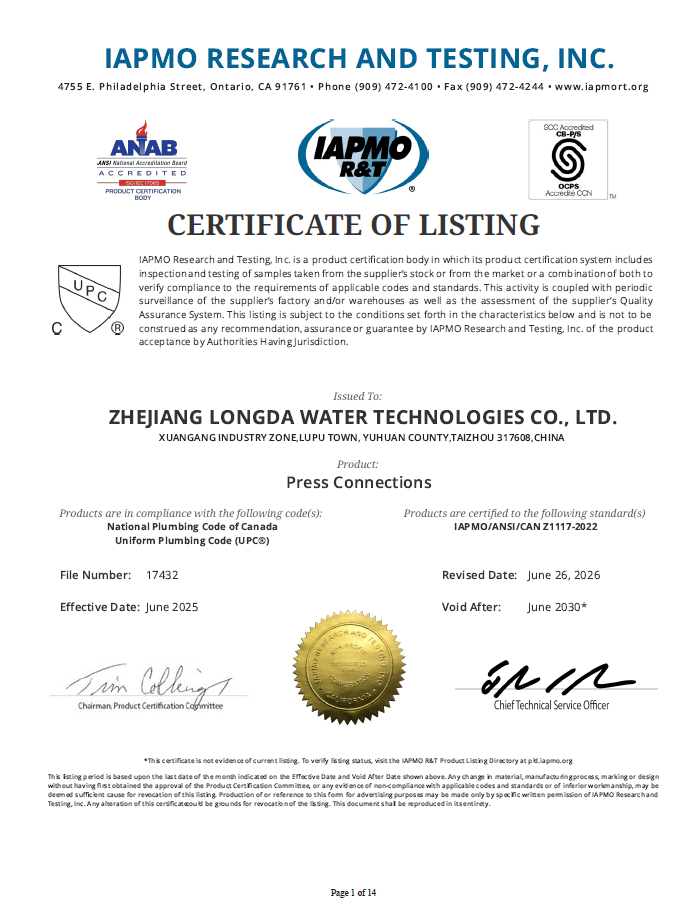
cUPC listing 17432 covers Press connections to IAPMO/ANSI/CAN Z1117-2022. Listings of this kind are issued to a defined scope, so buyers should confirm that the valve model itself is named, not only the connection family.
The documented connection scopes in the LONGDA range illustrate how granular this becomes. Press connections are listed under cUPC 17432 against IAPMO/ANSI/CAN Z1117-2022. Cold-expansion PEX connections are listed under cUPC 10232 against ASTM F1960-2024 and CSA B137.5-2023. Crimp PEX connections fall under UPC listing 8222 against ASTM F1807-2023 and CSA B137.5-2020. Push-fit connections are listed under cUPC 17433 against ASSE 1061-2025 and NSF/ANSI 14-2023. These are fitting listings; when a valve carries a press or PEX end, the buyer's question is whether the valve assembly is captured by the same scope. Asking that question before the order is cheaper than discovering the gap during commissioning.
The compliance gate for potable water
For drinking-water contact in the United States and Canada, lead-free is a defined threshold rather than a marketing term: the weighted average lead content of wetted surfaces must not exceed 0.25%, per NSF/ANSI/CAN 372 and Section 1417(d) of the Safe Drinking Water Act, with California Health & Safety Code Section 116875 applying the same limit in that state. Health effects of the materials in contact with drinking water are addressed separately under NSF/ANSI/CAN 61.
LONGDA holds IAPMO listings in both scopes. Certificate 6304 is a lead-free listing to NSF/ANSI/CAN 372-2024, issued 1 August 2024 and valid to 1 August 2028, and it names the ball valve 8081, gate valve T-22017A, check valve LD 30303, Y-strainer LD.73154, supply stop 98023-LF and fitting 15111. Certificate N-5775 is a drinking-water system components listing to NSF/ANSI/CAN 61-2023, issued 1 October 2024 and valid to 1 October 2029, covering the same core product set. Product-level plumbing listings sit alongside these: cUPC 5938 for ball valves against IAPMO/ANSI Z1157-2014e1(R2019), ASME A112.4.14-2022 and CSA B125.14-22, and cUPC 5775 for plumbing fixture fittings against ASME A112.18.1-2024 and CSA B125.1-24, which is the relevant listing for the 98023-LF supply stop.
A verification rule for buyers: read the certificate scope line, not the certificate title. A lead-free certificate and a health-effects certificate answer different questions, and neither substitutes for the cUPC product listing that names the model being purchased. Check issue and expiry dates at the time of order — the listings above run to 2028 and 2029 respectively, but a programme that lasts five years needs a document that will still be current at the end of it.
Purchasing acceptance criteria that can be checked at goods-in
Compliance documents establish what a product is allowed to be. Acceptance criteria establish what actually arrived. The two should be written into the purchase order together.
| Acceptance item | What it verifies | Reference in the LONGDA range |
|---|---|---|
| Unit-by-unit pressure test | Body and seat integrity before shipment | 100% air pressure tested under water |
| Thread gauge inspection | Thread form and damage control, lot by lot | Thread gauge inspection on every lot |
| Material test report | Alloy composition claimed for potable-water duty | Lead-free material test report available |
| Certificate scope check | That the purchased model is named in the listing | 6304, N-5775, 5938, 5775 |
| Packaging and retail readiness | Handling damage and shelf presentation | Blister, box or poly bag; private label available |
| Warranty terms | Recourse for defects after delivery | 12-month quality warranty, free replacement for quality defects |
Commercial parameters belong in the same document. The company's supply-stop line carries a minimum order of 1,000 pieces per size, a stated capacity of 500,000 pieces per month on that line and 300,000 pieces per month on the broader valve range, and quoted lead times that run from roughly 20 to 60 days depending on product line, with samples typically available in 5 to 7 days on the supply-stop range. Customisation covers sizes from 1/4 inch to 4 inches, lead-free or DZR brass bodies, lever, T-handle and butterfly handle options, NPT or BSP threads, chrome finish, logo and packaging.
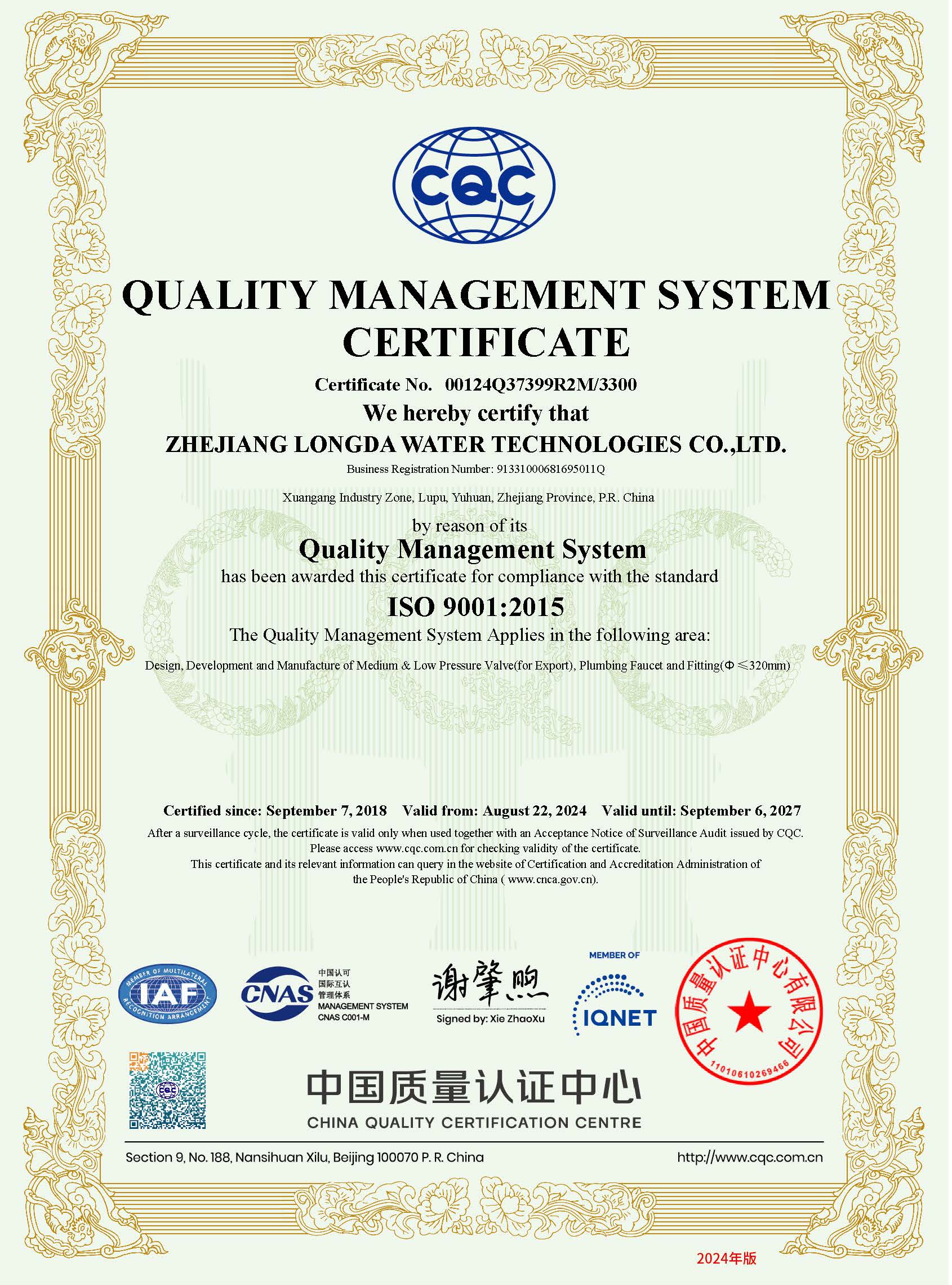
ISO 9001:2015 certificate CN00124Q37399R2M/3300, issued 22 August 2024 and valid to 6 September 2027; the scope covers design, development and manufacture of medium and low pressure valves for export.
Matching type to application: residential, renovation and hotel fit-out
Three application patterns account for most of the volume in this product set, and each places the decision at a different point in the framework.
New residential construction
Branch isolation, debris protection and backflow protection are separate duties. A ball valve at 600 WOG typically handles branch isolation; a Y-strainer ahead of meters, regulators or solenoid controls protects downstream components at a 200 WOG class and a -20 °C to 150 °C range; a check valve protects against reverse flow at the same class. The pressure axis separates these duties from the fixture-level duty described next.
Bathroom and kitchen renovation
Here the working condition is 40–80 psi at 4 °C to 60 °C, in a confined space behind a fixture. The relevant component is a supply stop — the 98023-LF brass angle valve for a 90° wall outlet, with quarter-turn operation and a lead-free body. In this application the pressure class is not the differentiator; the connection list, the chrome finish for humid service and the lead-free listing are.
Hotel and apartment fit-out
Fit-out projects multiply the same fixture-level decision across hundreds of rooms, which turns consistency into the specification. A documented case in this range involved a US manufacturer and a Canadian wholesale distributor using the supply stop for residential plumbing over three years in each market, with volumes of 8,000,000 pieces per year for the US manufacturer and 70,000,000 pieces for the Canadian distributor. The reported outcome was zero leakage complaints, a 100% pass rate in a retail quality audit and monthly repeat orders, on a cUPC and NSF 61 certified, chrome-plated, quarter-turn, lead-free product supplied in retail packaging. For a fit-out buyer the transferable lesson is not the volume; it is that the acceptance criteria were auditable at retail level.
A duty-based shortlist across the five types
Where a buyer needs a starting point rather than a full evaluation, the framework collapses into a short list ordered by duty:
- Frequent isolation on mains and branches: Brass Ball Valve 8081, 600 WOG, quarter-turn operation.
- Reverse-flow protection after a pump or ahead of a meter: Brass Check Valve LD 30303, 200 WOG, -20 °C to 150 °C.
- Debris protection ahead of regulators, meters or controls: Brass Y Strainer LD.73154, 200 WOG, -20 °C to 150 °C.
- Isolation where pressure drop matters and operation is infrequent: BRASS GATE VALVE T-22017A, -20 °C to 120 °C, pressure class to be confirmed on the datasheet.
- Fixture-level shut-off at 40–80 psi: Brass Supply Stop Valve 98023-LF, 4 °C to 60 °C, with the widest connection list in the set.
This is a shortlist by fit, not a ranking of quality. A gate valve at the wrong temperature and a ball valve used for throttling are both correctly manufactured and incorrectly applied.
Where this framework stops
Every comparison has a boundary, and stating it is part of being useful.
- The gate valve pressure class is not fixed in this reference set. Buyers should request the model datasheet before submittal rather than assume a class comparable to the ball valve.
- A supply stop is not a main-line isolator. The 98023-LF is specified for fixture supply duty at 40–80 psi and 4 °C to 60 °C; using it for branch isolation outside that envelope is an application error, not a product limitation to be argued around.
- Quarter-turn ball valves are not balancing devices. Where flow balancing is required, a brass manual balancing valve belongs in the specification instead.
- Y-strainers impose a pressure drop and need maintenance access. A strainer without a blow-down path is a future blockage.
- Check valve behaviour depends on cracking pressure. That value must be requested per model; it is not implied by the pressure class.
- Supplier-side limits are real. The stated range covers 1/4 inch to 4 inches in brass, with a 1,000-piece-per-size minimum on the supply-stop line and lead times of roughly 20 to 60 days. Larger sizes, non-brass bodies or emergency volumes fall outside that envelope and require a different sourcing plan.
Competitive context matters for calibration. Emerson Electric Co. is identified in third-party research as the global revenue leader in the broader industrial valve market at roughly USD 4 billion, while Mueller Industries, Watts Water Technologies and NIBCO are named as significant players in brass plumbing and heating valves in North America. Top-five suppliers are estimated to hold around 35% of global revenues, which means most of the market — and most of the certificate scope checking described above — sits with mid-sized manufacturers. The comparison framework is what makes that fragmented middle navigable.
Market direction: growth concentrated in isolation and compliant components
Third-party estimates place the global brass valves market at USD 14.8 billion in 2025, projected to reach USD 24.1 billion by 2034, a CAGR of 5.6% from 2026 to 2034 (Dataintelo). Within that total, ball valves held the largest product-type share at 38.4% in 2025, and the isolation function segment — gate, globe and check valves — accounted for USD 26.15 billion of the wider industrial valve market in 2024 (Cognitive Market Research). Industrial gate valves are projected as the fastest-growing type at a CAGR of 9.89% through 2032.
Regionally, Asia Pacific held 41.2% of brass valve revenue in 2025 and North America approximately 26.1%. The compliance direction is equally clear: lead-free brass alloys are becoming the mandatory standard for potable water applications in the United States under the Safe Drinking Water Act, a requirement that moves from documentation to enforcement at the point of inspection. Read together, these signals point to demand concentrating in two places — high-frequency isolation components and fully documented potable-water components — which is exactly where the four-variable screen applies.
What changes next for buyers
The practical shift over the next procurement cycles is that certificate scope becomes a line item rather than an attachment. Buyers who compare on type and price alone will keep discovering, at commissioning, that a lead-free listing did not name the model, that a press connection listing covered the fitting family but not the valve, or that a gate valve was specified at a temperature the datasheet does not support. Buyers who compare on pressure class, temperature ceiling, connection standard and compliance gate will find that the shortlist resolves quickly — and that the remaining conversation is about test records, packaging and lead time, which is where commercial negotiation belongs.
FAQ
Is a 600 WOG rating the same as a working pressure rating?
No. WOG (water, oil, gas) is conventionally a non-shock class reference, while working pressure at a given temperature is set by the manufacturer's pressure–temperature chart. In this reference set the 8081 ball valve is stated at 600 WOG, whereas the LD 30303 check valve and LD.73154 Y-strainer are stated at 200 WOG, so the two classes are not interchangeable in a surge-prone line.
Which brass valve type fits a 40–80 psi fixture supply line?
A supply stop, such as the 98023-LF brass angle valve, whose stated working condition is 40–80 psi at 4 °C to 60 °C for indoor installation behind sinks, toilets and washing machines. Its function is local shut-off and 90° redirection from a wall outlet, so that a fixture can be serviced without isolating the building supply.
What temperature ceilings apply to check valves, Y-strainers and gate valves in this reference set?
The Brass Check Valve LD 30303 and Brass Y Strainer LD.73154 are stated from -20 °C to 150 °C. The BRASS GATE VALVE T-22017A is stated from -20 °C to 120 °C. Selection should use the highest sustained temperature at the installation point rather than the average design temperature.
Which documents demonstrate lead-free compliance for a brass valve sold in the US and Canada?
Two separate listings plus a product listing. Certificate 6304 is a lead-free listing to NSF/ANSI/CAN 372-2024 for wetted-surface lead content of no more than 0.25%, referencing Safe Drinking Water Act Section 1417(d) and California Health & Safety Code Section 116875, issued 1 August 2024 and valid to 1 August 2028. Certificate N-5775 is a drinking-water system components listing to NSF/ANSI/CAN 61-2023, issued 1 October 2024 and valid to 1 October 2029. The cUPC product listing that names the specific model — 5938 for ball valves or 5775 for plumbing fixture fittings — completes the set.
How should thread type be specified to avoid leakage and thread damage?
Name the standard rather than the adjective: NPT threads to ASME B1.20.1, BSP threads to ISO 228-1. Require thread gauge inspection on every lot, keep one standard per assembly, and avoid over-torque during installation. Where pressure-tightness is not made on the thread, as with ISO 228-1, the sealing method must be specified separately.
What does 100% factory pressure testing actually cover?
It is a unit-by-unit integrity check, in this case an air pressure test under water before shipment, confirming body and seat tightness at test conditions. It does not by itself demonstrate alloy composition or long-term cycle life; those require the lead-free material test report and a design review of the sealing construction, such as the PTFE seat and O-ring arrangement used in the shut-off range.
The full LONGDA brass valve and fittings catalogue can be downloaded here: Longda Global Catalogue (PDF).
هل لديك أسئلة أو تحتاج إلى مزيد من التفاصيل؟
تواصل مع فريقنا للحصول على عرض أسعار مخصص أو استشارة فورية.
طلب عرض أسعار
املأ النموذج أدناه وسيتواصل معك فريقنا بعرض مقترح مخصص.
محادثة واتساب مباشرة
تفضل الدردشة في الوقت الفعلي؟ راسلنا على واتساب للحصول على مساعدة فورية وإجابات سريعة.
- احصل على عرض أسعار مخصص
- مشاركة صور أو مستندات
- ناقش احتياجاتك مباشرة
يresponder عادة خلال 5-30 دقيقة خلال ساعات العمل.