
Brass Valve Procurement FAQ: Threads, Leak Paths, Ratings
Brass Valve Procurement FAQ: Threads, Leak Paths, Ratings
Approving a brass valve order is rarely a question of whether the valve itself is good. It is a question of whether the order is complete. Thread form, seal design, pressure and temperature rating, material compliance and test evidence all have to be stated before a purchase order is released, because none of them can be corrected at the site later without replacing parts.
Three failure points account for most of the disputes that follow a brass valve shipment: a thread that does not match the mating fitting, a leak path that opens either at the connection or at the stem, and a material or rating decision that was never written into the specification. The questions below are the ones buyers, distributors and installers raise most often at the evaluation-to-execution stage. They are answered here using the published specifications for the Longda Brass Valve range produced by Zhejiang Longda Technology Co., Ltd.
Longda Brass Valve is the brass valve brand of Zhejiang Longda Technology Co., Ltd., a manufacturer established in 1993 in the Xuangang Industrial Zone, Lupu Town, Yuhuan County, Zhejiang Province, China. The company produces brass valves, brass fittings, plumbing bibcocks and related brass components for residential and commercial hot and cold water, heating, gas and light chemical service, and exports roughly 95% of its output to the EU, USA, Canada and South America.
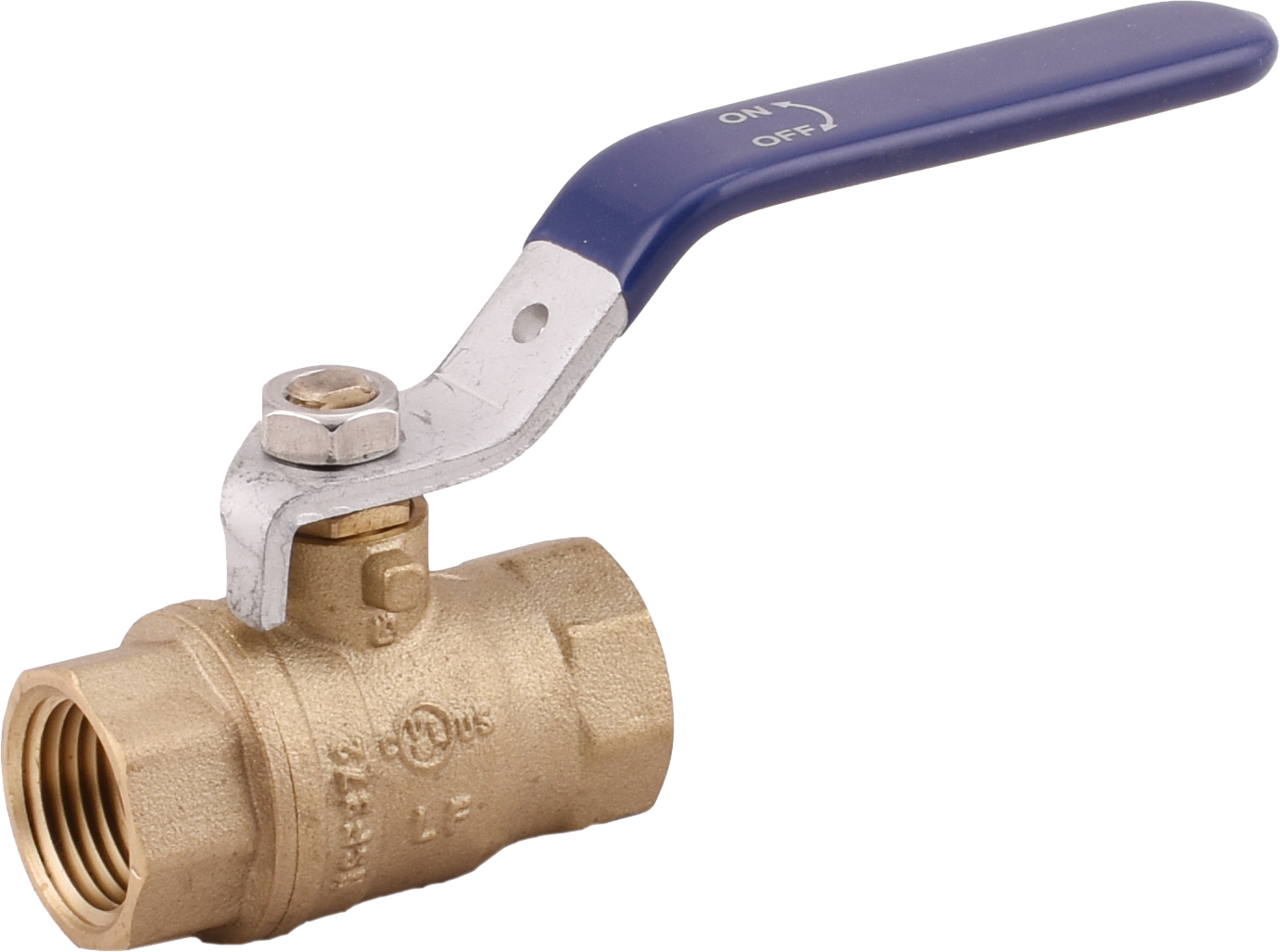
Model 8081 lead-free brass ball valve: 2-piece full port body, blow-out-proof stem design, PTFE seats and a 600 WOG (4.1 MPa) rating for potable water, heating, gas and HVAC service.
Thread standards: NPT, BSP and the first leak path
Threads are the single most common reason a brass valve order fails at the receiving dock or, worse, at commissioning. Two thread systems dominate international procurement, and they do not interchange.
NPT is a tapered pipe thread. North American potable-water specifications commonly require threads to conform to ASME B1.20.1, which is the reference standard the cUPC and NSF material requirements for brass valves cite for NPT conformance. Because the thread is tapered, the seal is created by interference between the mating threads, assisted by an approved thread sealant.
The BSP family is defined differently. ISO 228-1 regulates pipe threads where pressure-tight joints are not made on the threads. In other words, a parallel BSP joint is not designed to seal through thread interference at all; the sealing function has to be carried by a gasket, washer or elastomer face in the joint. A buyer who treats a parallel thread as if it were a taper thread will build a connection that weeps regardless of how much sealant is applied.
| Comparison point | NPT (ASME B1.20.1) | BSP parallel (ISO 228-1) |
|---|---|---|
| Thread form | Tapered; diameter changes along the thread | Parallel; diameter remains constant |
| Where the joint seals | On the threads, with an approved sealant | On a gasket or elastomer sealing face, not on the threads |
| Typical specification market | North America (US, Canada) and projects following ASME practice | Europe, the Middle East and other markets following ISO practice |
| Field failure pattern | Cross-threading, or a taper male forced into a parallel port | Leakage when assembled without the correct gasket |
| What belongs on the purchase order | Explicit NPT, gender and nominal size | Explicit BSP form, gender, nominal size and required gasket |
Longda Brass Valve supplies brass valves with female NPT or BSP threaded connections on models including the 8081 ball valve, the T-22017A gate valve, the LD.73154 Y strainer and the LD 30303 check valve. Thread type (NPT or BSP) is a documented customization option, alongside size range of 1/4 in to 4 in, body material (lead-free or DZR brass), handle type, handle colour, logo printing and packaging format. The practical consequence for procurement is that the thread standard must be stated as a distinct line item and matched to the fittings, hoses and equipment in the same bill of materials. A valve ordered with the correct thread but installed against a mismatched hose end is still a mismatch.
Connection leakage: three causes a purchase order can remove
Connection leakage is not a single defect. It has three predictable causes, and each one is addressed at a different point in the supply chain.
- Wrong thread form or wrong gender. The joint never had a chance to seal. This is a specification error, not a manufacturing error.
- Sealant applied incorrectly. Too little sealant on a taper thread leaves a path; sealant overrun into the valve bore can block a port or interfere with a seat. Sealant belongs on the male thread, applied so that the leading threads remain clean.
- Over-torque. Brass is ductile but not elastic. A tapered thread tightened far beyond seating can deform the female port or crack the valve body at the hex.
What a buyer can legitimately require before shipment is thread verification and pressure verification. Longda Brass Valve performs thread gauge inspection on every lot and 100% air pressure testing under water before shipment, with a lead-free material test report available as part of the documentation set. The company also issues a 12-month quality warranty covering free replacement for quality defects.
The limits of that evidence should be stated plainly. Factory testing verifies that the valve as delivered holds pressure and that its threads gauge correctly. It cannot verify the torque an installer applies on site, or whether the mating fitting was made to the same thread standard. Joint integrity remains partly a site variable, which is why thread gauging and incoming inspection matter on the buyer side as much as on the supplier side.
Installation practices that reduce connection leakage
The design of the valve removes only part of the risk. On site, the practical sequence for a threaded brass joint is: confirm that the male and female threads are the same standard; hand-start the joint so that the threads engage cleanly before a wrench is used; hold the valve body with one wrench and tighten the pipe with a second, so that the valve is never used as a lever; and stop tightening once the joint seats. A joint that has been backed off after seating should be disassembled, cleaned and re-made rather than re-tightened, because the sealant layer has already been disturbed.
Stem leakage and blow-out-proof stem design
Stem leakage follows a different path from connection leakage. It runs along the stem, between the stem and the body, and it is governed by the packing or O-ring arrangement rather than by the thread.
On the 8081 two-piece full port brass ball valve, the stem is specified with a blow-out-proof design. The stem is retained by the body construction so that internal pressure cannot eject it even if the handle and retaining parts are removed while the line is pressurised. The same valve uses a chrome-plated brass ball and PTFE seats, with O-rings available in NBR or FKM, and is operated by a quarter-turn lever or wing handle.
On quarter-turn supply stops such as the 98023-LF brass supply stop / angle valve, the sealing arrangement is specified as a PTFE seal combined with double O-ring sealing around a quarter-turn ball core, with a chrome-plated anti-corrosion finish on the visible surfaces. These valves are operated frequently over their service life, often in confined spaces behind fixtures, and the stem seal is the component whose quality determines whether the valve is still dry in year three. The 98023-LF is rated at 125 psi with a working temperature range of -20°C to 120°C and is available with compression, FIP, PEX (ASTM F1960), sweat and threaded connections.
Two selection points matter more than the marketing description of a stem seal. First, O-ring material should follow the medium and the temperature: NBR and EPDM are general water-service choices, while FKM is specified for higher-temperature duty in the ball valve range. Second, the stem seal should be considered a wear component in any valve that is cycled daily. Where cycle frequency is high, the specification should say so, because it changes which valve family is the right answer.
Thread damage during installation: what cannot be repaired
Thread damage is the one failure mode that is irreversible. Once brass threads are crossed, galling has started, or a taper thread has been deformed by over-torque, the component cannot be restored to a pressure-holding condition by adding sealant. The valve, the fitting or both must be replaced.
The damage is almost always created by one of four actions: starting the joint by hand incorrectly and then forcing it with a wrench; holding the valve body in a vice or pipe wrench and turning it onto a fixed pipe, which loads the body rather than the thread; using excessive leverage on a taper thread that has already seated; or pairing a taper male thread with a parallel female port and continuing to turn after the threads bind.
Supplier-side controls reduce the probability of a thread defect arriving at the site but do not remove the risk entirely. Longda Brass Valve gauges threads on every production lot and pressure-tests 100% of valves under water before shipment, and thread type (NPT or BSP) can be fixed as a customization parameter on the order. What remains outside supplier control is installation technique, which is why a short written installation note in the packaging documentation is worth more than an additional marketing sentence in a catalogue.
Seat leakage and the T-22017A rising-stem gate valve
Internal leakage, or leakage past a closed valve, is a seat question. It is also the question where the correct answer depends on how the valve will be used rather than on which valve is nominally better.
The T-22017A brass gate valve is a rising-stem, full-bore threaded gate valve with a brass-to-brass metal seat, operated by a 360° handwheel. It is rated at 200 WOG (1.4 MPa) with a working temperature range of -20°C to 120°C, is available with female NPT or BSP threaded connections in sizes from 1/2 in to 4 in (DN15 to DN100), and is tested at 1.5 times rated pressure on the shell and 1.1 times rated pressure on the seat. In its lead-free configuration it is certified to NSF/ANSI 61 and NSF/ANSI 372 by IAPMO.
A metal-to-metal seat between a forged brass disc and a brass body has one clear advantage in service: there is no polymer seat to take a compression set, and no elastomer whose performance falls away as water temperature rises. That is why metal-seated gate valves remain a common choice for continuous isolation duty in municipal supply, plumbing and HVAC systems.
The trade-off is equally clear. Metal-seated valves generally require more operating torque than a soft-seated valve, and at low differential pressure a metal seat may be less bubble-tight than a PTFE-seated ball valve. In practice, the decision rule is simple: if the valve is there to isolate a line and is expected to sit fully open or fully closed, a metal-seated gate valve is a reasonable specification; if the valve is expected to be operated frequently and to shut off tightly, a soft-seated quarter-turn ball valve such as the 8081 is the more appropriate choice.
Pressure and temperature expectations across the brass valve family
Pressure ratings on brass valves are expressed in WOG, meaning non-shock water, oil or gas service. The rating is a working pressure for steady, non-shock conditions; water hammer and surge are separate design considerations and should not be absorbed by the rating figure.
| Valve family (model) | Size range | Pressure rating | Working temperature | Typical duty |
|---|---|---|---|---|
| Brass supply stop / angle valve (98023-LF) | 1/2 in x 3/8 in; 1/2 in x 1/2 in | 125 psi | -20°C to 120°C | Fixture shut-off behind faucets, toilets, washing machines and water heater terminals |
| Brass angle valve (ART.98011) | 1/2 in x 1/2 in; 1/2 in x 3/8 in | 125 psi WSP / 600 WOG | 0°C to 90°C | Bathroom and kitchen fixture terminals |
| Brass ball valve (8081) | 1/2 in to 4 in (DN15–DN100) | 600 WOG (4.1 MPa) | -20°C to 150°C | Potable water, heating, gas and HVAC, including municipal and commercial systems |
| Brass gate valve (T-22017A) | 1/2 in to 4 in (DN15–DN100) | 200 WOG (1.4 MPa) | -20°C to 120°C | Municipal water supply, residential and commercial plumbing, HVAC, irrigation |
| Brass Y strainer (LD.73154) | 1/2 in to 2 in (DN15–DN50) | 200 WOG (1.4 MPa) | -20°C to 150°C | Water supply lines, HVAC and chilled water, gas piping, irrigation |
| Brass check valve (LD 30303) | 1/2 in to 2 in (DN15–DN50) | 200 WOG (1.4 MPa) | -20°C to 150°C | Pumping systems, water supply, heating and boiler systems |
| Brass ball valve (ART.60621) | As specified | 30 bar nominal | -20°C to 140°C | Drinking water, domestic hot water, heating, compressed air |
| Brass fittings (15111) | 1/4 in to 2 in (DN8–DN50) | Up to 600 WOG (4.1 MPa) | -20°C to 150°C | Potable water, gas piping, HVAC, fire protection, irrigation |
Two observations follow from the table. First, the pressure bands are wide. Fixture supply lines behind sinks, toilets and washing machines typically operate in the 40–80 psi (0.28–0.55 MPa) range in North American residential and commercial fit-outs, and supply-stop assemblies in other configurations are published for 40–150 psi (0.28–1.0 MPa). Against a 125 psi rated supply stop or a 600 WOG ball valve, that leaves substantial headroom. In these applications the binding constraints are usually thread compatibility, cycle life and lead-free compliance, not pressure.
Second, the temperature ranges are not identical across the range. The 8081 ball valve, the LD.73154 Y strainer and the LD 30303 check valve are published for -20°C to 150°C; the T-22017A gate valve and the 98023-LF supply stop for -20°C to 120°C; the ART.98011 angle valve for 0°C to 90°C. A single project may therefore include two or three different temperature ceilings, and the specification should reflect the valve, not the project average.
Failure over time: dezincification, zinc loss and material choice
Brass is a copper-zinc alloy, and in certain water conditions the zinc fraction can be selectively leached out of the material, a process known as dezincification. The result is a porous, weakened body that eventually leaks through the wall rather than at a joint. The conditions that make it more likely are well understood in the industry: aggressive water chemistry, elevated water temperature and long periods of stagnation.
The response at material selection level is a dezincification-resistant alloy. Longda Brass Valve offers a DZR CW602N option alongside Eco-Brass C69300, CW724R, lead-free brass C4650, CW511L, and low-lead CW509L and CW510L. For fittings, a dezincification-resistant option is also available. Specifying DZR is a material decision, and like any material decision it does not compensate for incorrect sizing or for water chemistry that the project has not analysed. Where aggressive water is known to be present, the alloy specification should follow the project water analysis rather than a default catalogue choice.
The second long-term material issue is lead. For potable water contact, the published requirement in the North American market is that the wetted surface lead content of lead-free brass is no more than 0.25%, consistent with NSF/ANSI 372 and with Section 1417(d) of the US Safe Drinking Water Act and California Health and Safety Code Section 116875 (AB1953). All materials in contact with potable water are expected to conform to NSF/ANSI 61 health-effects requirements. The US Environmental Protection Agency identifies lead-free brass alloys as the direction of travel for potable water applications under the Safe Drinking Water Act.
Compliance and test evidence to attach to a brass valve order
For a buyer at the execution stage, compliance is a documentation question. The following listings and tests are the ones relevant to the brass valve families discussed above.
- NSF/ANSI/CAN 61 drinking water system components. Certificate of listing N-5775 issued by IAPMO, valid from 1 October 2024 to 1 October 2029, covering drinking water system components. The listing relates to the T-22017A gate valve, the LD.73154 Y strainer, the LD 30303 check valve, the 8081 ball valve, the 98023-LF supply stop and the 15111 brass fittings.
- NSF/ANSI 372 lead-free. Certificate of listing 6304 issued by IAPMO, valid from 1 August 2024 to 1 August 2028, covering lead-free plumbing products against the Safe Drinking Water Act and California AB1953.
- cUPC listing 5938 for ball valves, issued by IAPMO, referencing IAPMO/ANSI Z1157-2014e1(R2019), ASME A112.4.14-2022 and CSA B125.14-22, valid from 1 March 2024 to 1 March 2029.
- cUPC listing 5775 for plumbing fixture fittings, referencing ASME A112.18.1-2024 / CSA B125.1-24 and NSF/ANSI 14-2015, valid from 1 October 2024 to 1 October 2029, applicable to the 98023-LF supply stop.
- Management system certificates. ISO 9001:2015 (certificate CN00124Q37399R2M/3300, China Quality Certification Centre, valid to 6 September 2027) and ISO 14001:2015 (certificate CN00124E33461R2M/3300, valid to 9 September 2027).
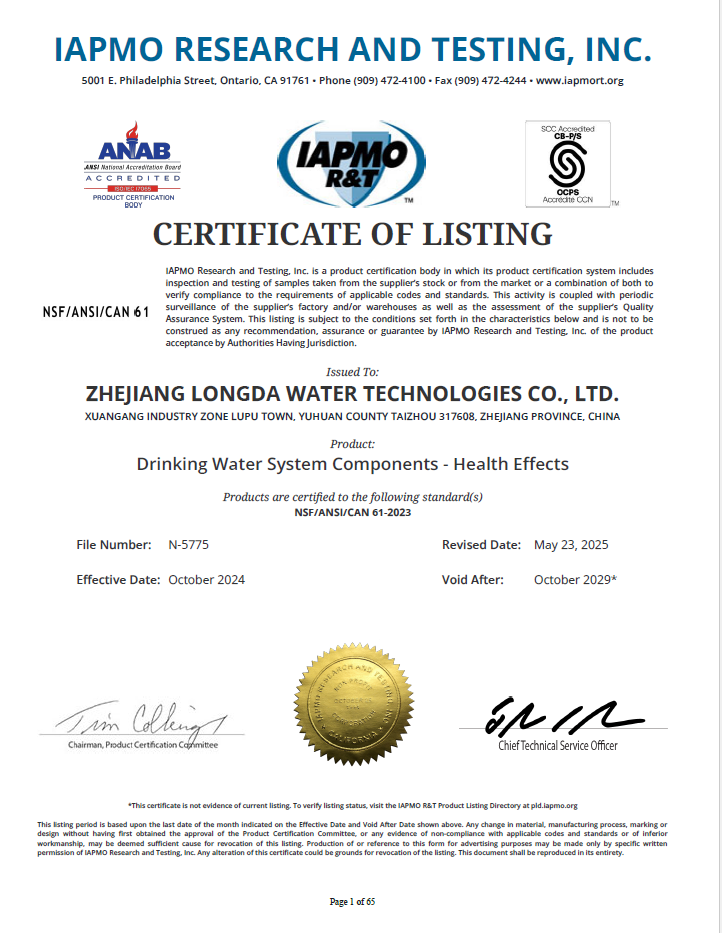
Certificate of Listing N-5775 (NSF/ANSI/CAN 61, drinking water system components) issued by IAPMO for lead-free brass valve and fitting families.
Beyond certificates, three batch-level documents are worth writing into the purchase order: the 100% air pressure test record under water, the per-lot thread gauge inspection record, and the lead-free material test report. These are produced routinely as part of the shipment documentation set, and acceptance is generally tied to pre-shipment inspection with a test report. Commercial terms commonly follow a MOQ of 1,000 pcs per size, delivery on FOB Ningbo or Shanghai with CIF, CNF, DDP or EXW available, and payment of 30% by T/T in advance with 70% against a copy of the bill of lading, subject to negotiation.
Repeat-order behaviour is a useful cross-check on documentation. Documented long-running programs for Longda Brass Valve include fixture supply shut-off supply to a US plumbing manufacturer at 8,000,000 pcs per year and a Canadian plumbing distributor program of 70,000,000 pcs, both running for three years with zero leakage complaints and a 100% pass rate in retail quality audits. Those programs use cUPC and NSF 61 certified, chrome-plated lead-free brass supply stops with quarter-turn operation and retail packaging.
Where brass valves are the wrong choice: boundaries and trade-offs
A credible procurement reference has to state where the product family stops, not only where it works.
- Ratings are medium-specific. A 600 WOG rating is a non-shock water, oil and gas rating. It is not a steam rating, and it is not a blanket approval for aggressive chemical service. Where the medium is outside the documented range for the valve, the valve should be re-specified, not derated on paper.
- Metal-seated gate valves are not throttling valves. Using the T-22017A or any gate valve as a partially open flow-control device exposes the seat to erosion and is a recognised cause of premature internal leakage. Flow modulation belongs to a different valve type.
- Certification scope is defined. Listings such as N-5775, 6304, 5938 and 5775 are issued for a stated scope and a stated set of products. A new size, a new connection type or a private-label configuration should be checked against the listing scope before it is presented as covered.
- Threaded joints carry an installation variable. No factory test can verify site torque or the accuracy of the mating fitting. Distributors that resell threaded brass valves inherit that variable.
- Lead-free and DZR alloys are not free. Both typically carry a different cost and machining profile than standard brass, which is why they should be specified where regulation or water chemistry requires them rather than applied as a blanket upgrade across a full catalogue.
Market signals behind brass valve procurement requirements
The commercial context supports the same conclusion: procurement attention is shifting from the valve itself towards documentation, material compliance and thread control.
The global brass valves market was valued at approximately USD 14.8 billion in 2025 and is projected to reach USD 24.1 billion by 2034, a forecast CAGR of 5.6% over 2026 to 2034 (Dataintelo). Within that market, ball valves held the largest product-type share at 38.4% in 2025 (Dataintelo), which is consistent with the fact that the quarter-turn ball valve is the reference product for isolation duty in potable water and heating systems.
Regionally, Asia Pacific accounted for 41.2% of brass valve revenue in 2025, while North America held approximately 26.1% (Dataintelo). China exported USD 22.6 billion of valves under HS 8481 in 2024, maintaining its position as the largest global exporter (OEC). At the same time, the top five global valve suppliers together account for roughly 35% of global revenues (Mordor Intelligence), which means the great majority of the market is served by regional and mid-sized manufacturers whose differentiation is documentation, consistency and compliance readiness rather than brand scale.
The regulatory trend runs in the same direction. Lead-free brass alloys are becoming the mandatory standard for potable water applications in the United States under the Safe Drinking Water Act (EPA), and industrial gate valves are projected to be the fastest-growing valve type with a CAGR of 9.89% through 2032 (Cognitive Market Research) — a growth figure that matters for buyers sourcing isolation valves for water and HVAC infrastructure.
What changes next in brass valve buying
Three shifts are worth planning for. First, lead-free compliance is moving from a differentiator to a baseline entry requirement in North American potable water projects, which means the compliance question becomes how quickly and completely a supplier can produce the listing and material test evidence for a given order, not whether the supplier has any lead-free capability at all. Second, dezincification-resistant alloys are likely to be specified more often as water chemistry data becomes a standard part of project documentation rather than an occasional engineering study. Third, larger fluid systems are moving towards instrumented monitoring and predictive maintenance, a structural trend identified in the industrial valve market, even as manual brass valves continue to carry the majority of residential, commercial and light industrial isolation duty.
For the buyer, none of these shifts changes the three core checks. A brass valve order is approved on the connection, on the sealing and seat design, and on the rating and compliance evidence. Everything else is execution detail.
FAQ: brass valve procurement questions
1. Which thread standard should a brass valve purchase order specify?
The standard should follow the mating system. North American potable water specifications commonly require NPT threads conforming to ASME B1.20.1, while BSP connections are used in Europe, the Middle East and other markets following ISO practice. ISO 228-1 covers parallel pipe threads where the pressure-tight joint is not made on the threads, so a parallel BSP joint depends on a gasket or elastomer face rather than on thread interference. The purchase order should state the standard, the gender and the nominal size for every threaded item in the bill of materials, since brass valves are supplied with either NPT or BSP connections depending on specification.
2. How can connection leakage and thread damage be prevented during installation?
At specification level, the controls are matched thread forms, gauged threads and factory pressure testing: Longda Brass Valve performs thread gauge inspection on every production lot and 100% air pressure testing under water before shipment. At installation level, the joint should be hand-started before a wrench is applied, sealant should be applied to the male thread only with the leading threads left clean, the valve body should be held with a second wrench so it is never used as a lever, and tightening should stop once the joint seats. A joint that has been backed off after seating should be disassembled and re-made, because the sealant layer has already been disturbed. Thread damage cannot be repaired; the affected component must be replaced.
3. How is stem leakage prevented on a brass valve?
Stem leakage is controlled by the stem retention and packing design rather than by the thread. The 8081 brass ball valve is specified with a blow-out-proof stem design, so internal pressure cannot eject the stem even if the handle and retaining parts are removed while the line is pressurised, and it uses PTFE seats with NBR or FKM O-rings. Quarter-turn supply stops such as the 98023-LF use a PTFE seal with double O-ring sealing around a quarter-turn ball core and a chrome-plated anti-corrosion finish. O-ring material should be selected against the medium and temperature, with NBR and EPDM typical for water service and FKM specified for higher-temperature duty. A 12-month quality warranty with free replacement for quality defects applies to the range.
4. What pressure and temperature ratings should be expected across a brass valve range?
Ratings differ by family. The 8081 brass ball valve is rated 600 WOG (4.1 MPa) over -20°C to 150°C. The T-22017A gate valve is rated 200 WOG (1.4 MPa) over -20°C to 120°C, tested at 1.5 times rated pressure on the shell and 1.1 times rated pressure on the seat. The LD.73154 Y strainer and the LD 30303 check valve are rated 200 WOG (1.4 MPa) over -20°C to 150°C. The 98023-LF supply stop is rated 125 psi over -20°C to 120°C, and the ART.98011 angle valve 125 psi WSP / 600 WOG over 0°C to 90°C. Fixture supply lines in residential and commercial fit-outs typically operate at 40–80 psi (0.28–0.55 MPa), so pressure is rarely the binding constraint in those applications. WOG ratings are non-shock water, oil and gas ratings and do not cover steam or surge conditions.
5. What causes brass valves to fail over time?
The most cited long-term material failure in brass is dezincification, in which zinc is selectively leached from the alloy and the body becomes porous. Aggressive water chemistry, elevated temperature and long stagnation increase the likelihood. The material-level response is a dezincification-resistant alloy such as the DZR CW602N option, alongside alloys including Eco-Brass C69300, CW724R, lead-free brass C4650, CW511L, CW509L and CW510L. For potable water contact, the parallel requirement is lead content: wetted surface lead of no more than 0.25%, consistent with NSF/ANSI 372, the US Safe Drinking Water Act and California AB1953, with materials in contact with potable water conforming to NSF/ANSI 61 health-effects requirements.
6. What compliance and test documents should accompany a brass valve shipment?
For the North American market, the relevant listings include NSF/ANSI/CAN 61 certificate of listing N-5775 issued by IAPMO (valid 1 October 2024 to 1 October 2029), NSF/ANSI 372 lead-free certificate 6304 issued by IAPMO (valid 1 August 2024 to 1 August 2028), cUPC listing 5938 for ball valves and cUPC listing 5775 for plumbing fixture fittings, together with ISO 9001:2015 and ISO 14001:2015 management system certificates. At batch level, the documents to request are the 100% air pressure test record, the per-lot thread gauge inspection record and the lead-free material test report, with acceptance generally tied to pre-shipment inspection with a test report.
7. What are typical purchasing and acceptance terms for a brass valve order?
Published terms for the Longda Brass Valve range use a MOQ of 1,000 pcs per size, delivery on FOB Ningbo or Shanghai with CIF, CNF, DDP or EXW available, acceptance against pre-shipment inspection with a test report, and payment of 30% by T/T in advance with 70% against a copy of the bill of lading, or other terms by negotiation. Lead time is generally 30 to 60 days depending on the product, with samples available in 5 to 7 days. Monthly capacity is published at 500,000 pcs for supply stop valve families and 300,000 pcs for the broader brass valve range.
Reference document
The full Longda Brass Valve product catalogue, covering the brass valve and brass fitting families referenced in this article, is available as a PDF: Longda Brass Valve global catalogue (PDF).