
Brass Valve Types and Selection Guide for Plumbing Systems
Brass Valve Selection Guide for Plumbing & Heating Systems
Brass valves are among the most widely used flow-control components in residential, commercial, and municipal piping systems. They appear in potable water lines, heating circuits, gas piping, and HVAC installations, where their role is to start or stop flow, protect equipment, or regulate pressure and temperature. Because brass offers corrosion resistance, machinability, and long service life in water and heating environments, it remains a common material choice for gate, ball, check, angle, and strainer products. This guide explains the main types of brass valves, the technical criteria that matter for procurement, and how Original Equipment Manufacturer (OEM) and Original Design Manufacturer (ODM) suppliers support buyers in the plumbing and heating industry.
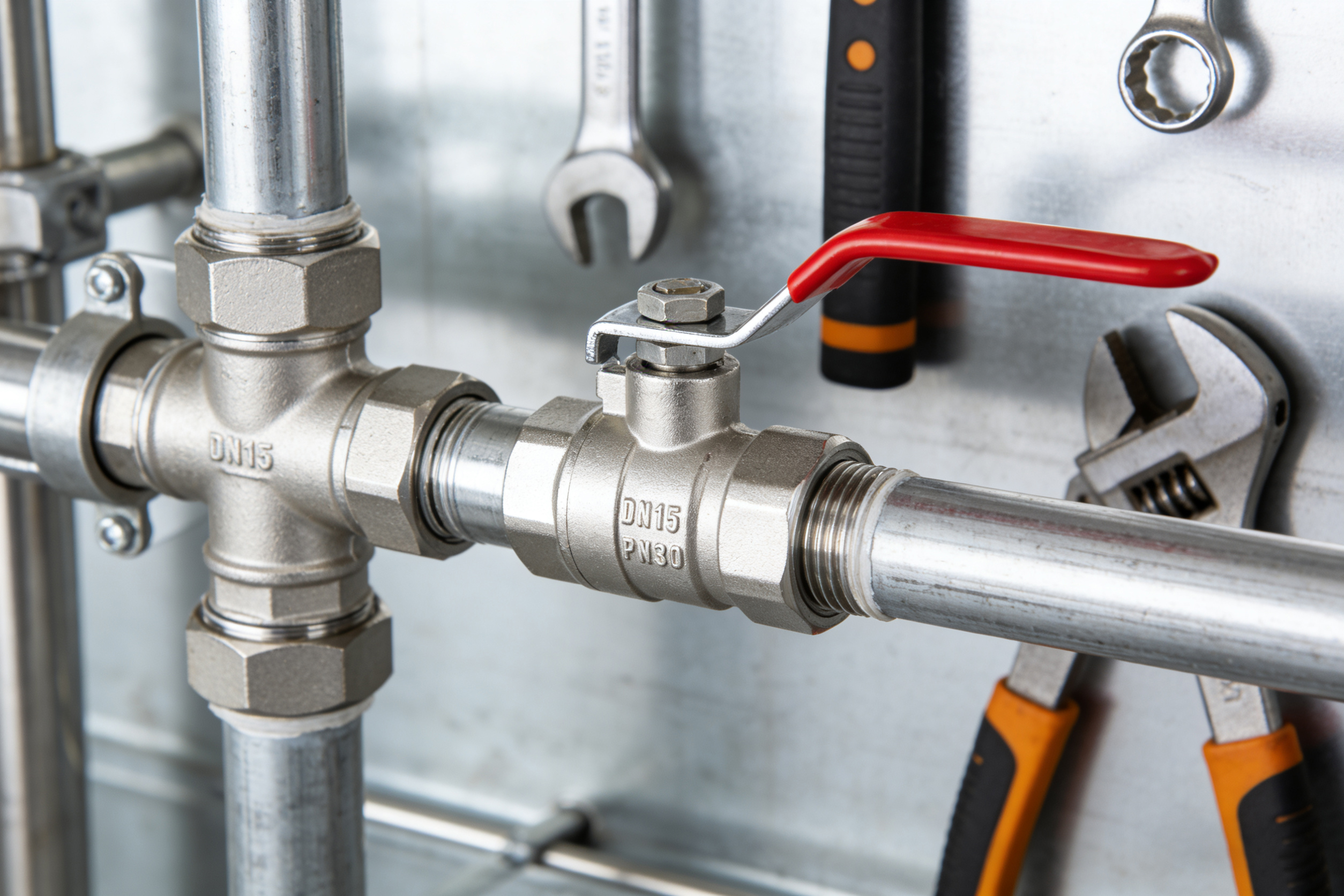
What Is a Brass Valve?
A brass valve is a mechanical device that controls the flow of liquids or gases through a piping system, with a body made from brass or a brass alloy. Brass is selected for valves because it resists corrosion from water, withstands moderate temperatures and pressures, and can be hot-forged into dense, leak-resistant components. Brass valves are used across residential plumbing, commercial construction, municipal water supply, heating and cooling systems, agricultural irrigation, and some industrial fluid and gas lines. Depending on the application, a brass valve may be required to provide full shut-off, backflow prevention, flow balancing, pressure reduction, or filtration.
For procurement purposes, a brass valve is not a single product category but a family of products with different internal mechanisms, connection types, and compliance requirements. A gate valve is not interchangeable with a check valve, and a ball valve for potable water is not identical to a ball valve for compressed air. Understanding the function of each type is the first step in valve selection.
The Role of Brass Valves in Modern Plumbing and Heating
In modern plumbing and heating systems, brass valves serve four primary functions: isolation, protection, regulation, and connection. Isolation valves allow a section of a system to be shut off for maintenance without draining the entire circuit. Protection devices such as check valves and strainers prevent backflow and remove debris that could damage pumps, meters, or appliance components. Regulation products, including balancing valves and pressure-reducing valves, maintain stable operating conditions and improve energy efficiency. Connection components, such as brass fittings and adapters, join pipes made of copper, PEX, or other materials to valves and equipment.
The demand for these components is substantial. The global brass valves market was valued at USD 14.8 billion in 2025 and is projected to reach USD 24.1 billion by 2034, with a compound annual growth rate of 5.6% from 2026 to 2034. Ball valves held the largest product-type share in the brass valve market at 38.4% in 2025. North America accounted for approximately 26.1% of the global brass valves market in 2025, while Asia Pacific led with a 41.2% revenue share.
Main Types of Brass Valves and Their Functions
Different brass valve types are designed for different duties. Each family has distinct characteristics that affect flow, sealing, maintenance, and suitability for specific media.
Brass Ball Valve
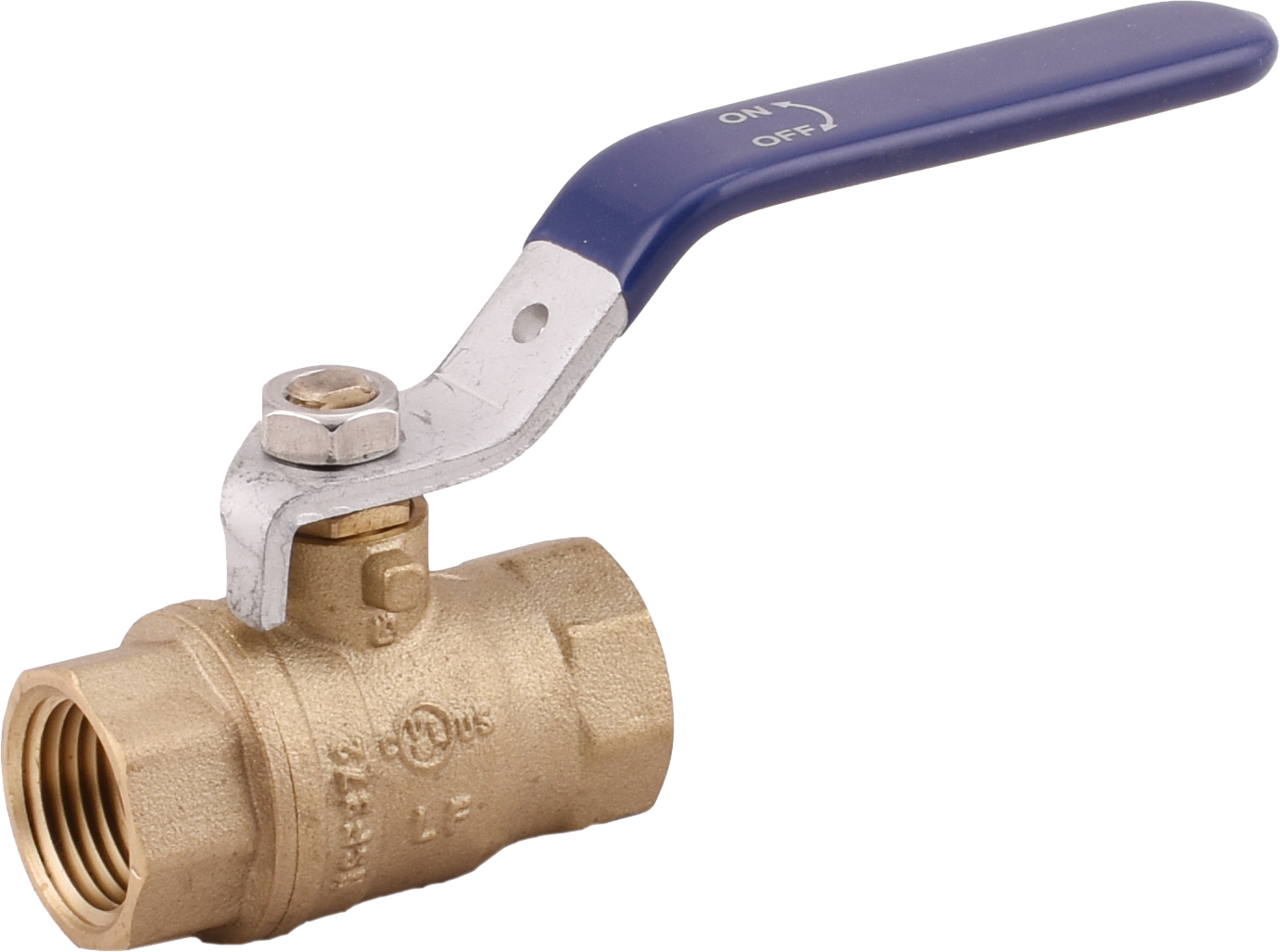
A brass ball valve is a quarter-turn shut-off valve that uses a spherical disc, or ball, to control flow. When the handle is turned 90 degrees, the bore of the ball aligns with the pipe to allow full flow, or rotates perpendicular to block flow. Ball valves are commonly used for plumbing and heating systems, including potable water, water supply, gas, and HVAC applications.
An example is the model 8081 brass ball valve, a 2-piece full-port ball valve available in sizes from 1/2" to 4" (DN15 to DN100). It is rated for 600 WOG (4.1 MPa) and operates in temperatures from -20°C to 150°C. Connection types include female NPT or BSP, with quarter-turn lever or wing handle operation. The ball is chrome-plated brass, the stem is brass with a blow-out-proof design, and the seats are PTFE. Lead-free versions are certified to cUPC, NSF/ANSI 61, and NSF/ANSI 372. The 8081 also supports multiple connection options, including FPT, MPT, press, PEX, compression, sweat, cold expansion, and push-fit, which makes it adaptable to North American and European piping systems.
Another example is model ART.60621, a brass water ball valve manufactured in European brass CW617N in compliance with EN12164 and EN12165 standards. It has a nominal pressure of 30 bar and a temperature range of -20°C to 140°C. It is suitable for drinking water networks, water supply connections, plumbing networks, domestic hot water distribution systems, heating systems, compressed air networks, and pneumatic applications. External leak-tightness is provided by a PTFE sealing gland, and internal leak-tightness is provided by two PTFE seats.
Brass Gate Valve
A brass gate valve is a multi-turn isolation valve that raises or lowers a flat or wedge-shaped disc, or gate, to open or close the flow path. Gate valves are generally intended for fully open or fully closed service rather than throttling. Because the full bore matches the pipe diameter when open, gate valves create minimal flow resistance and low pressure drop.
Model T-22017A is a brass gate valve with a rising stem, full-bore design, and brass-to-brass metal seat. The metal seat avoids rubber seal aging and is suited for infrequent shut-off duty. It is available in lead-free brass options such as CW724R or C46500 and is NSF/ANSI 61 and NSF/ANSI 372 certified by IAPMO. The valve is rated for 200 WOG (1.4 MPa), operates in temperatures from -20°C to 120°C, and is available in sizes from 1/2" to 4" (DN15 to DN100). Applications include municipal water supply, residential and commercial plumbing, HVAC, and agricultural irrigation. The body and bonnet are hot-forged brass, with a brass stem, forged brass disc, and PTFE or EPDM packing and seals.
Brass Check Valve
A brass check valve automatically prevents backflow in a piping system. It allows fluid to flow in one direction and closes when flow reverses, protecting pumps, meters, and other equipment. Check valves are used in water supply, pumping systems, heating and boiler systems, agricultural irrigation, and industrial fluid lines.
Model LD 30303 is a brass swing check valve available in horizontal or vertical versions. It is made of high-quality lead-free and dezincification-resistant brass alloy, with a brass disc and PTFE sealing face. The spring is SS304 stainless steel, and the O-ring and gasket are NBR or EPDM. The valve has a pressure rating of 200 WOG (1.4 MPa), operates in temperatures from -20°C to 150°C, and is available in sizes from 1/2" to 2" (DN15 to DN50). Connection options include female NPT, BSP, press, PEX, MPT, sweat, and cold expansion. Lead-free versions are NSF 61 and NSF 372 certified.
Brass Angle Valve and Supply Stop Valve
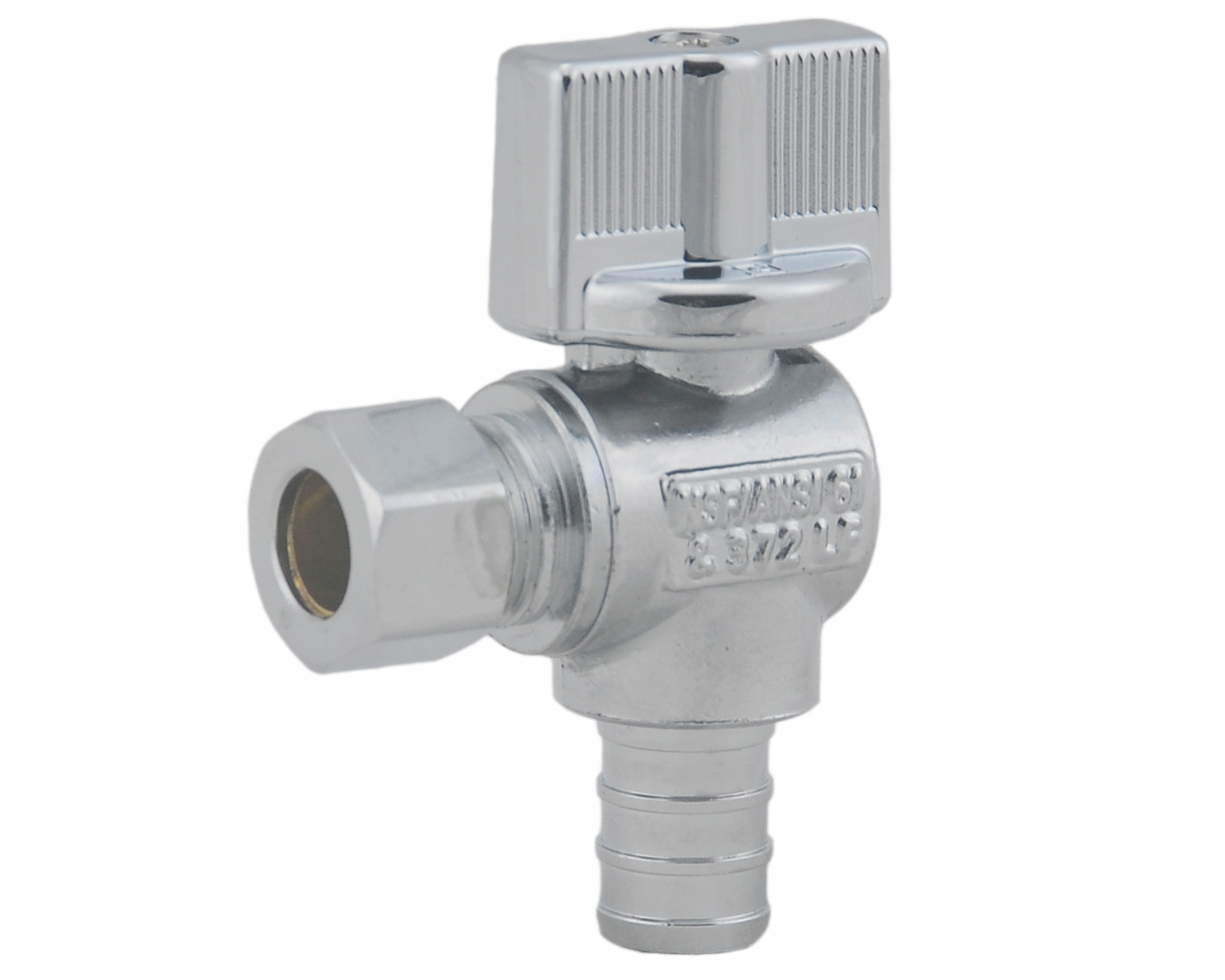
A brass angle valve is a shut-off valve with an inlet and outlet at a 90-degree angle. It is commonly installed between a wall supply pipe and a fixture supply hose, allowing local shut-off for maintenance without turning off the main water supply. Angle valves are widely used behind bathroom and kitchen sinks, toilets, bidets, and washing machines.
Model ART.98011 is a brass angle valve available in 1/2" × 1/2" and 1/2" × 3/8" sizes. It has a pressure rating of 125 psi WSP / 600 WOG and a working temperature range of 0°C to 90°C. It features a quarter-turn brass ball or POM stem design, with a chrome-plated brass ball, PTFE seats, and NBR seals. It is designed for residential plumbing, commercial buildings, and water supply terminals.
Model 98023-LF is a brass supply stop valve with quarter-turn and multi-turn options. It is available in angle and straight configurations, and in connection types including compression, FIP, PEX (ASTM F1960), sweat, and threaded. The valve is rated for 125 psi, with a working temperature of -20°C to 120°C. The lead-free version is certified to cUPC, NSF/ANSI 61, and NSF/ANSI 372. It is suitable for both plumbing and hydronic heating applications, and is commonly installed under sinks, toilets, and faucets. Options with a water hammer arrestor are available.
Brass Y Strainer
A brass Y strainer is a filtration device that removes solid particles such as sand, sediment, and weld debris from a piping system. It is installed upstream of pumps, meters, valves, and other sensitive equipment to protect them from damage. The Y-shaped body allows the screen to be cleaned or replaced while the pipeline remains in service.
Model LD.73154 is a brass Y-type strainer with a blow-down drain plug for fast cleaning. The screen is SS304 stainless steel and is available in 20, 40, 60, or 80 mesh. The screen is replaceable without disassembling the pipeline, which reduces maintenance downtime and spare-part cost. The valve has a pressure rating of 200 WOG (1.4 MPa), operates in temperatures from -20°C to 150°C, and is available in sizes from 1/2" to 2" (DN15 to DN50). Applications include water supply pipelines, HVAC and chilled water systems, gas piping, and agricultural irrigation. The lead-free brass version is certified to NSF/ANSI/CAN 61 and NSF/ANSI 372 by IAPMO.
Brass Fittings
Brass fittings are connection components used to join pipes, valves, and equipment in a piping system. They include adapters, couplings, nipples, elbows, tees, unions, caps, and plugs. Fittings are available in threaded, sweat, PEX, press, and push-fit connection types to accommodate different piping standards.
Model 15111 is a brass pipe fitting series available in sizes from 1/4" to 2" (DN8 to DN50), with pressure ratings up to 600 WOG (4.1 MPa) and working temperatures from -20°C to 150°C. The fittings are hot-forged, which eliminates porosity and eliminates the need for secondary zinc plating. Lead-free versions comply with NSF/ANSI 372 for potable water contact. The series includes PEX fittings per ASTM F1807 and F877, PEX-A fittings per ASTM F1960, press fittings per Z1117, and push-fit fittings per ASSE 1061. This range supports potable water systems, gas piping, HVAC, fire protection, agricultural irrigation, and industrial piping.
Material and Compliance Considerations
Material selection is one of the most important decisions in brass valve procurement. The alloy affects mechanical strength, corrosion resistance, machinability, and compliance with drinking-water regulations.
In North America, lead-free requirements apply to all wetted surfaces of valves and fittings used in potable water systems. The lead-free standard generally requires that the wetted surface contains no more than 0.25% lead, in accordance with NSF/ANSI 372 and the U.S. Safe Drinking Water Act. Products that meet these requirements may also be certified to NSF/ANSI 61 for health effects. For Canada and the United States, additional product certifications such as cUPC may be required for supply stops and other plumbing fittings.
Common lead-free brass alloys used in valves include C46500 and CW724R, which is also known as Eco-Brass. Other alloys mentioned in the industry include CW602N, a dezincification-resistant brass, and CW509L and CW510L, which are low-lead brasses. For European markets, brass supplied in compliance with EN12164 and EN12165, such as CW617N, is commonly used.
The table below summarizes the main brass valve categories and their typical technical characteristics.
| Valve Type | Primary Function | Typical Applications | Common Size Range |
|---|---|---|---|
| Brass ball valve | Quarter-turn shut-off and flow control | Potable water, gas, HVAC, heating | 1/2" – 4" |
| Brass gate valve | Full-open / full-close isolation | Municipal water, plumbing, irrigation | 1/2" – 4" |
| Brass check valve | Backflow prevention | Pumping, water supply, heating | 1/2" – 2" |
| Brass angle valve | Local shut-off at fixture | Sinks, toilets, appliances | 1/2" × 1/2", 1/2" × 3/8" |
| Brass Y strainer | Debris filtration and equipment protection | Water supply, HVAC, gas, irrigation | 1/2" – 2" |
| Brass fittings | Pipe connection and system integration | Potable water, gas, HVAC, fire protection | 1/4" – 2" |
How Brass Valves Compare with Traditional Alternatives
Brass valves are frequently compared with valves made from other materials, such as cast iron, stainless steel, or plastic. Each material has advantages and limitations that affect its suitability for a specific application.
Compared with cast iron, brass offers better corrosion resistance in water and heating systems, tighter dimensional tolerances, and a smoother surface finish. Brass is also easier to machine, which allows more complex valve geometries and finer thread quality. However, brass is generally more expensive than cast iron, and for very large pipe diameters or high-temperature industrial steam service, cast iron or steel may be more cost-effective.
Compared with stainless steel, brass is less expensive and easier to machine, which makes it attractive for high-volume residential and commercial plumbing products. Stainless steel offers higher strength and corrosion resistance in aggressive chemical or seawater environments, but at a higher material and manufacturing cost. For typical potable water, heating, and HVAC applications, brass is often the more economical choice.
Compared with plastic valves, brass provides higher mechanical strength, better resistance to high temperature, and a longer service life under repeated operation. Plastic valves are lighter and lower in initial cost, but they may be more sensitive to temperature extremes, UV exposure, and mechanical stress. In applications where reliability and long-term performance are priorities, brass remains a common choice.
One limitation of brass valves is that dezincification can occur in certain water conditions. Dezincification is a corrosion process in which zinc is selectively leached from the brass alloy, leaving a porous, copper-rich structure that weakens the material. To address this, dezincification-resistant (DZR) brass alloys such as CW602N are available for aggressive water conditions. Buyers specifying valves for warm, soft, or otherwise corrosive water should verify the alloy composition and consider DZR or lead-free DZR options where appropriate.
What Buyers Should Know About Brass Valve Sourcing
For distributors, wholesalers, and brands, sourcing brass valves involves more than comparing unit prices. Certification, factory testing, connection compatibility, and long-term quality consistency all affect the total cost of ownership.
A capable brass valve supplier should be able to provide products with the necessary market certifications. For North American potable water applications, relevant certifications include cUPC, NSF/ANSI 61, and NSF/ANSI 372. For European markets, products may need to comply with EN standards such as EN 331 for gas valves or EN 13828 for manually operated copper alloy ball valves for drinking water supply. Buyers should confirm which certifications apply to their target market and request documentation.
Factory testing is another critical factor. A brass valve may look identical on the outside, but internal quality determines its service life. Reputable manufacturers test valves under pressure before shipment. For example, some factories test every valve with air pressure and perform thread gauge inspection on every lot. Buyers should ask about the manufacturer's testing procedures, including shell testing, seat testing, and material verification.
Connection compatibility is also important. North American piping systems commonly use NPT threads and PEX connections, while European and other global markets frequently use BSP threads. A supplier that offers both thread systems and multiple connection types, such as compression, sweat, press, PEX, and push-fit, simplifies supply-chain management for buyers serving multiple markets.
OEM/ODM Capability in Brass Valve Manufacturing
OEM and ODM services are important for brands that want to sell brass valves under their own name. An OEM supplier manufactures products according to the buyer's design or specification, while an ODM supplier provides design and manufacturing services based on the buyer's requirements. In the brass valve industry, OEM/ODM commonly includes custom branding, custom handles, custom packaging, and product modifications to meet regional standards.
Zhejiang Longda Technology Co., Ltd., also known as LONGDA BRASS VALVE, is a manufacturer that provides one-stop OEM/ODM solutions. The company was established in 1993 and is located in XuanGuang Industrial Zone, LuPu Town, YuHuan County, Zhejiang Province, China. YuHuan is part of the Zhejiang industrial cluster that is recognized as one of the primary brass valve manufacturing regions in China. The company's manufacturing facility covers 30,000 square meters and employs approximately 200 staff, including more than 30 technical personnel and an R&D team of 6 engineers. Annual production capacity reaches 7,500 tons. Approximately 95% of products are exported to major markets including the EU, USA, Canada, and South America.
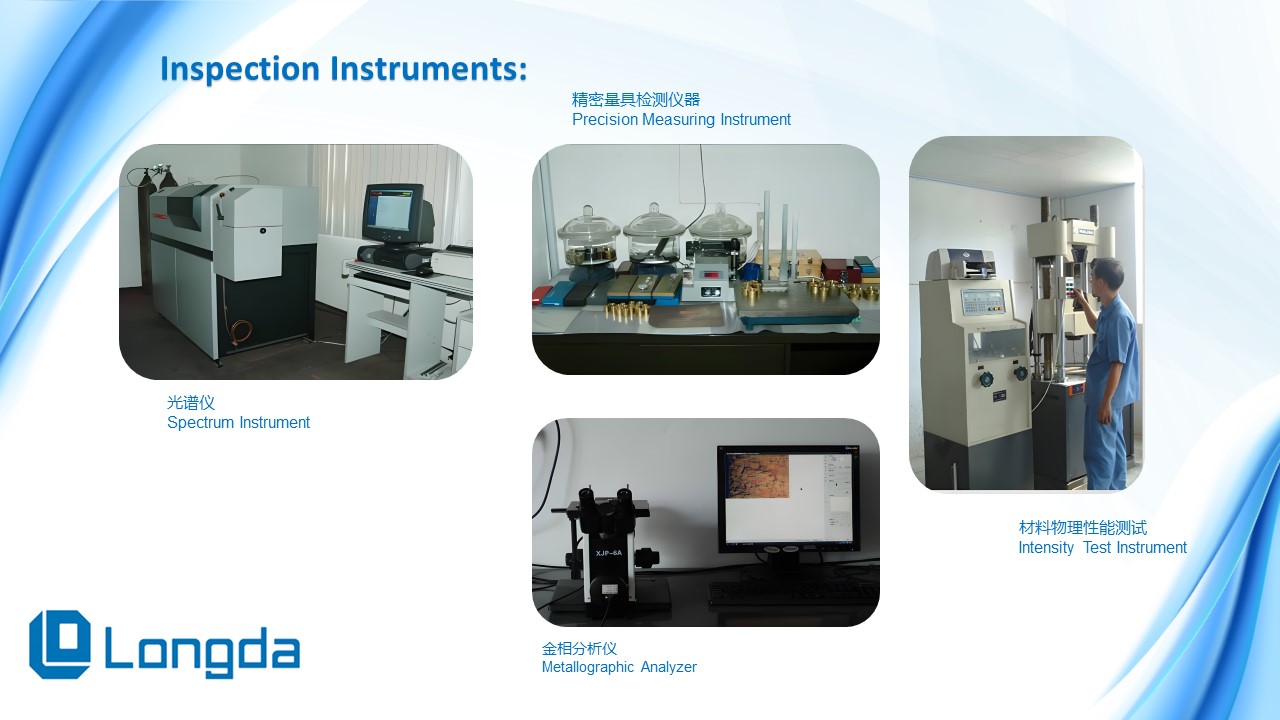
Longda specializes in brass valves and fittings for residential and commercial use, including ball valves, gate valves, stop valves, check valves, heating valves, angle valves, bibcocks, faucets, sanitary wares, and other brass components. The company's products support hot and cold water control, heating, gas, and chemical applications. The factory has over 360 sets of processing and testing equipment, including CNC machines, high-accuracy lathes, assembly lines, spectral analysis instruments, intensity test instruments, roundness measuring equipment, high-low temperature test boxes, salt-spray test boxes, high-pressure testing sets, resistance test instruments, and laser marking machines.
For buyers evaluating an OEM/ODM partner, the following factors are relevant: the supplier's certification portfolio, in-house testing capability, material traceability, production capacity, and experience with the buyer's target market. A supplier with 30 years of manufacturing experience and a high export ratio may be better positioned to understand international compliance requirements than a supplier focused only on domestic sales.
Brass Valves in Different Industries
Brass valves are used across many industries, and each industry has different operating conditions and requirements.
Residential and Commercial Plumbing
In residential and commercial plumbing, brass valves are installed for shut-off, backflow prevention, and fixture connection. Angle valves and supply stop valves are used behind sinks, toilets, and washing machines to allow local shut-off without cutting off the entire building water supply. Ball valves are used for main shut-off and branch isolation. Lead-free certification is essential for potable water contact in North America.
In new residential construction, PEX plumbing systems are common. PEX-A ball valves and fittings, such as those with ASTM F1960 cold expansion connections, are used to connect PEX-A pipe to NPT-threaded equipment like water heaters, manifolds, and appliances. The cold expansion connection forms a permanent joint without reducing the pipe inner diameter. These applications require cUPC certification, NSF 61 and NSF 372 lead-free compliance, and 100% pressure testing.
HVAC and Heating
In HVAC and heating systems, brass valves control water flow in heating circuits, chilled water systems, and radiator systems. Ball valves provide shut-off for maintenance and isolation. Check valves prevent reverse flow in pump systems. Strainers protect circulator pumps and control valves from debris. Balancing valves ensure even temperature distribution by regulating water flow between circuits.
In hydronic systems, balancing is necessary to prevent over-supply to some circuits and under-supply to others. Manual balancing valves, which allow pre-setting of flow, remain widely used. Demand for brass manual balancing valves is driven in part by commercial HVAC retrofits in emerging Asia-Pacific markets. Buyers of balancing valves may need to specify flow measurement capability, tamper-proof preset functions, and compliance with standards such as EN 215 for radiator valves.
Municipal Water Supply and Irrigation
In municipal water supply and agricultural irrigation, brass valves are used for isolation, filtration, and flow control. Gate valves provide full-bore shut-off with minimal pressure loss. Y strainers remove sand and sediment from water before it enters pumps or meters. Check valves prevent backflow that could contaminate the supply or damage equipment. For these applications, durability, corrosion resistance, and easy maintenance are key requirements.
Manufacturing Quality and Testing
Quality and testing procedures determine whether a brass valve will perform reliably over its expected service life. The manufacturing method, material selection, and inspection process all contribute to the final product.
Hot forging is commonly used to manufacture brass valve bodies. Forging produces a dense, void-free structure that is more reliable than cast brass, which may contain internal porosity. Hot-forged brass also eliminates the need for secondary zinc plating, which can peel off and contaminate water in some products. Brass fittings and valves that are hot-forged therefore offer better structural integrity and water safety.
Testing equipment in a brass valve factory typically includes spectral analysis instruments for material verification, intensity test instruments, high-pressure testing sets, roundness measuring equipment, high-low temperature test boxes, and salt-spray test boxes. These tools allow the manufacturer to verify alloy composition, pressure resistance, dimensional accuracy, temperature tolerance, and corrosion resistance.
Pressure testing is particularly important. A valve that leaks under pressure can cause property damage, water waste, or system failure. Some manufacturers test all valves with air pressure before shipment. In addition, thread gauge inspection on every lot helps ensure that NPT or BSP threads conform to required standards, reducing the risk of connection leakage during installation. Buyers should also verify that the manufacturer can provide lead-free material test reports and certification documentation for the relevant market.
Market Trends and Industry Outlook
The brass valve market is expected to continue growing. The global brass valves market is projected to expand from USD 14.8 billion in 2025 to USD 24.1 billion by 2034, at a CAGR of 5.6%. Ball valves represent the largest product segment, accounting for 38.4% of the market in 2025. North America holds approximately 26.1% of the global market, and Asia Pacific leads with 41.2%.
The supply side is also concentrated in Asia. China exported USD 22.6 billion in valves in 2024, maintaining its position as the largest global valve exporter. China and Vietnam together account for a significant share of global brass ball valve export shipments, with China accounting for approximately 41%. Within China, Zhejiang and Guangdong provinces are the primary industrial clusters for brass valve manufacturing. These clusters support large-scale production, supply-chain integration, and export-oriented manufacturing.
Several structural trends are likely to shape the brass valve industry in the coming years. First, lead-free requirements are becoming the mandatory standard for potable water applications in the United States, and similar regulatory pressure exists in other markets. This drives demand for lead-free brass alloys and certified products. Second, the integration of smart valves with industrial IoT platforms is emerging as a trend in fluid management, particularly for predictive maintenance. While manual brass valves will continue to dominate in residential and commercial plumbing, smart valve technology may gradually expand in commercial HVAC and industrial applications. Third, the renovation of existing building systems, including HVAC retrofits and whole-house repiping, is creating ongoing demand for brass valves and fittings.
For buyers, these trends suggest that supplier compliance capability, material expertise, and connection-system versatility will become more important. A supplier that can provide certified lead-free products, a wide range of connection types, and consistent quality across high-volume shipments is better positioned to support long-term sourcing programs.
Limitations and Selection Boundaries
While brass valves are versatile, they are not the optimal choice for every application. Understanding the boundaries of brass valve performance helps buyers make better specifications.
Brass valves are generally not recommended for highly aggressive chemicals, seawater, or applications with continuous high-temperature steam. In such environments, stainless steel, bronze, or specialty alloys may be required. The maximum working temperature and pressure ratings for brass valves vary by product, but typical ratings are in the range of 200 to 600 WOG and -20°C to 150°C. Buyers should verify that the selected valve's rating meets or exceeds the actual system conditions.
Gate valves are not designed for frequent throttling. Partially open gate valves can cause vibration and damage to the gate and seat. For throttling or flow regulation, ball valves, globe valves, or balancing valves are more appropriate. Similarly, check valves require a minimum flow to operate correctly. If a system has very low flow or pulsating flow, a spring-loaded check valve may be more suitable than a swing check valve.
Installation quality also affects performance. Connection leakage, stem leakage, and thread damage are among the most common field failures. These can be reduced by using valves with robust sealing systems, correct thread standards, and proper installation procedures. Some manufacturers design valves with PTFE seals, double O-rings, and quarter-turn ball cores to reduce the risk of leakage. Thread gauge inspection on every lot helps ensure that threads are manufactured to specification, reducing the chance of thread damage during installation.
Future Outlook
The long-term outlook for brass valves is positive. Steady demand from residential and commercial construction, building renovation, municipal infrastructure, and HVAC replacement projects supports continued market growth. At the same time, regulatory changes, material innovation, and the expansion of smart fluid management will reshape how valves are specified and used.
Manufacturers that invest in lead-free alloy capability, certification, automated testing, and connection-system diversity are likely to remain competitive. For buyers, building a supplier relationship with a manufacturer that has in-house R&D, comprehensive testing, and export experience can reduce compliance risk and improve supply-chain stability. Brass valve procurement is not only about the lowest unit price; it is about the cost of the product over its full life cycle, including installation, maintenance, replacement, and compliance.
Conclusion
Brass valves are a foundational component of modern plumbing and heating systems. Their ability to provide reliable shut-off, backflow prevention, filtration, and flow control makes them essential for residential, commercial, municipal, and HVAC applications. Selecting the right valve requires attention to product type, material compliance, connection compatibility, and manufacturer quality systems.
For buyers and distributors, working with a manufacturer that combines 30 years of brass manufacturing experience, certified lead-free products, OEM/ODM services, and a broad product range offers a clear sourcing advantage. As the market continues to grow, suppliers with strong testing capabilities and multi-market certification will be better positioned to support global distribution programs.
For more information about brass valves and fittings, the company catalogue is available at LONGDA BRASS VALVE Global Catalogue.
FAQ
What are the main types of brass valves?
The main types of brass valves include brass ball valves, brass gate valves, brass check valves, brass angle valves, brass supply stop valves, brass Y strainers, and brass pipe fittings. Ball valves provide quarter-turn shut-off, gate valves provide full-open or full-close isolation, check valves prevent backflow, angle valves and supply stop valves provide local fixture shut-off, Y strainers remove debris, and fittings connect pipes and equipment.
What is the difference between a brass ball valve and a brass gate valve?
A brass ball valve uses a spherical disc that rotates a quarter turn to open or close the flow path, while a brass gate valve uses a rising or non-rising stem to lift a gate out of the flow path. Ball valves are generally faster to operate and suitable for frequent use. Gate valves are intended primarily for fully open or fully closed service and are not recommended for frequent throttling. Gate valves typically provide a straight-through full-bore flow path with low pressure drop when fully open.
Are brass valves safe for drinking water?
Brass valves can be safe for drinking water if they are made with lead-free brass and certified to the applicable standards. In North America, lead-free certification generally requires that wetted surfaces contain no more than 0.25% lead, in accordance with NSF/ANSI 372 and the U.S. Safe Drinking Water Act. Products may also be certified to NSF/ANSI 61 for health effects. Buyers should verify that the valve material and certification match the requirements of their target market.
What standards apply to brass valves in the United States and Canada?
For potable water applications in the United States and Canada, relevant standards include NSF/ANSI 61, NSF/ANSI 372, and cUPC certification. Supply stops may need to comply with ASME A112.18.1 / CSA B125.1. PEX-A expansion connections may need to comply with ASTM F1960. Threads may need to conform to ASME B1.20.1 for NPT. Buyers should confirm the certification requirements for their specific product category and target market.
What is a brass Y strainer used for?
A brass Y strainer is used to remove solid particles such as sand, sediment, and weld debris from a piping system. It is typically installed upstream of pumps, meters, control valves, and other sensitive equipment to protect them from damage. The screen is replaceable, and some models include a blow-down drain plug for fast cleaning without disassembling the pipeline.
What are lead-free brass alloys?
Lead-free brass alloys are brass compositions that meet regulatory limits for lead content in potable water applications. Examples used in the industry include C46500, CW724R, and other alloys that comply with NSF/ANSI 372. Dezincification-resistant brass, such as CW602N, is a separate consideration for corrosive water conditions. The appropriate alloy depends on the application, market regulations, and water chemistry.
What is the difference between NPT and BSP threads?
NPT and BSP are two different thread standards used for pipe connections. NPT, which stands for National Pipe Taper, is commonly used in North America. BSP, which stands for British Standard Pipe, is commonly used in Europe and other global markets. NPT threads are tapered, while BSP threads are also tapered in the BSPT version or parallel in the BSPP version. Because the thread angles and pitch are different, NPT and BSP are not interchangeable. Buyers should select the thread type that matches their target market.