
Breathable Functional Knit Fabric: What Buyers Must Specify
Breathable Functional Knit Fabric: What Buyers Must Specify
Industry reference · knit fabric specification, certification and procurement
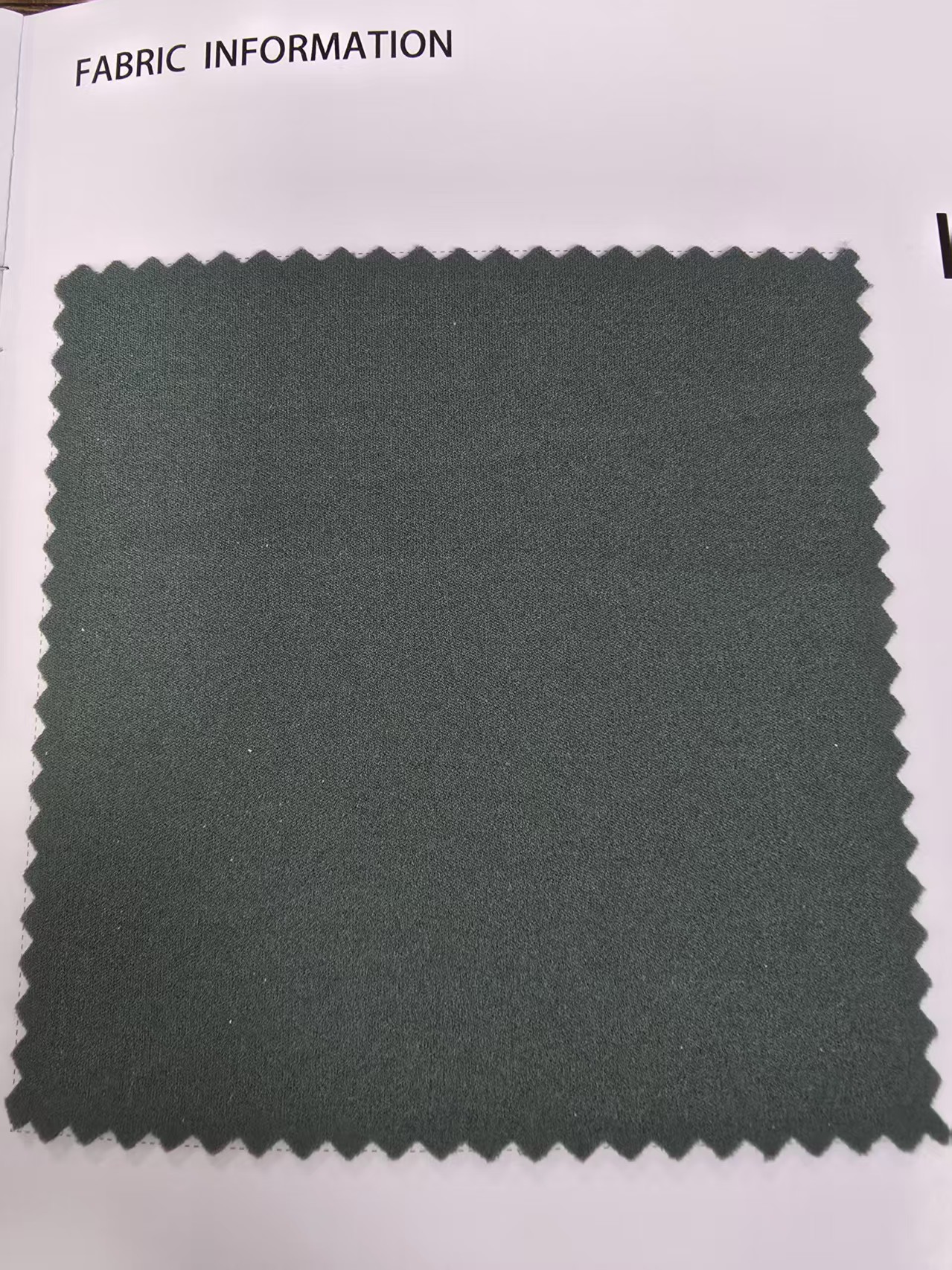
Breathability in a knit is configured per article. EKWP2270-D6 is a nylon/spandex functional knit fabric documented with moisture-wicking, breathable/quick-dry and 4-way stretch performance.
Breathable functional knit fabric is a specification outcome, not a catalogue adjective. The behaviour buyers describe as breathability comes from the interaction of three variables — yarn composition, knit structure and finishing — and the same finishing steps that deliver moisture management, water repellency or warmth can work against it. That is why two suppliers can both label a fabric “breathable” and still hand a garment team two different products.
Zhangjiagang E-king Textile Co., Ltd. is a knitted textile manufacturer established in 2011 in Zhangjiagang, Jiangsu Province, China, roughly 100 km from Shanghai, producing functional knit fabric — including the export-facing EKING fabric range — for markets that are mainly the EU and USA. Its documented approach places yarn composition and finishing treatment at the centre of performance rather than a single performance label.
This reference addresses the questions a research-stage buyer must close before an evaluation begins: how breathability is engineered into a knitted structure, which parameters have to be fixed before sampling, which certifications constrain EU and US sourcing, and where the limits of a breathable functional knit realistically sit. Documented EKING fabric models — EKWP2270-D6, EKWP1912-DSP and 20ETW1028-DSP — are used as concrete examples.
Why “Breathable” Is Difficult to Specify
The word is used loosely to cover several different physical behaviours. Air permeability describes how easily air passes through the fabric. Moisture vapour transmission describes how readily perspiration vapour escapes. Liquid moisture management describes how quickly liquid sweat is moved away from the skin and evaporated. A knit can perform well on one of these and poorly on another, and a specification that names only “breathable” cannot distinguish between them.
Breathability is also construction-dependent. Denser structures and heavier fabric weights, lamination, and some coating or water-repellent finishes generally reduce air and vapour movement, while more open knit structures support it. This is not a defect; it is a trade-off that has to be decided during development rather than discovered during bulk production.
The practical difficulty for sourcing teams is comparability. Unless the finished construction, the functional target, the test method and the acceptance threshold are agreed in writing at sample stage, quotations cannot be compared against each other. Where breathability sits alongside other claims — moisture-wicking, quick-dry, water repellency, warmth — the written specification, not the marketing word, decides which property takes priority.
How Breathability Is Built Into a Knitted Structure
In a knit, yarns are interlooped rather than woven, which produces a structure that can be engineered for openness, elasticity and air movement. The construction, the yarn blend and the finishing route are decided together. EKING fabric documentation states this relationship directly for its knit range: moisture-management performance is achieved through yarn composition and finishing treatments, and the structural configuration supports breathability and quick drying.
Yarn selection sets the starting point. The documented material options across the EKING fabric range include nylon/spandex and recycled nylon spandex for the stretch-driven sport and close-fit segments, and poly/spandex for lighter-weight programmes. Stretch is specified as 4-way stretch or high elasticity, which is designed to allow freedom of movement for the wearer — relevant to breathability in practice, because a knit that moves with the body maintains a stable air layer instead of restricting it.
Finishing then determines which performance claims the fabric actually carries. It is important not to conflate the claims, because each one is measured and purchased differently.
| Property | What it describes | Specification question to settle |
|---|---|---|
| Breathability | Movement of air and moisture vapour through the fabric | Which target applies at the specified weight and structure? |
| Moisture-wicking | Transport of liquid sweat away from the skin surface | Which wicking test is used, and on which sample stage? |
| Quick-dry | Rate at which the fabric sheds moisture after wetting | What drying performance is acceptable at garment level? |
| Water repellency | Resistance to surface wetting | Does the finish reduce breathability at the chosen weight? |
| Warmth / cool-touch | Thermal storage or heat-dissipating behaviour | Which thermal option matches the intended climate? |
How EKING Fabric Documents Breathability-Related Performance
Zhangjiagang E-king Textile Co., Ltd. operates a complete industrial chain from weaving to dyeing and finishing, and its own dyeing factory began production in March 2022. The company reports an annual output of 24 million yards of fabric, develops more than 100 new products each season, and works with a technical R&D team of 10 within an 8,600 m² facility of approximately 80 employees. Roughly 95% of output is exported, with the EU and USA as the main markets. Yarn and finishing technology cooperation is documented with Hengli Group, Shenghong Group, Invista, Creora Group, Huafeng Group and POLYGIENE.
That production base matters to a breathability discussion because the finishes that support it are handled in-house. Documented finishing capability includes mechanical processes such as peaching, brushing, fuzzing, transfer printing, dispersed printing, acid printing, digital printing, foil and emboss, together with chemical functions that include antibacterial and odour control, moisture wicking and quick drying, UV protection, anti-static treatment, waterproofing, stain and oil prevention, thermal storage and warmth preservation, and cooling treatment.
At article level, the functional sets are not identical across the range, and that difference is itself a specification signal:
- EKWP2270-D6 (nylon/spandex) — moisture-wicking; 4-way stretch and high elasticity; breathable/quick-dry; antibacterial and anti-odor; UV protection; water-repellent; easy-wash; recycled materials; wrinkle-resistant; optional cool-touch or warming treatments. Antibacterial, anti-odor and UV-protective treatments can be applied, and recycled polyester options support sustainable sourcing.
- EKWP1912-DSP (nylon spandex / recycled nylon spandex) — moisture-wicking, high elasticity, breathable/quick-dry, UV protection, water-repellent, easy-wash and recycled materials, with antibacterial, anti-odor and UV-protective finishes available to enhance wearer comfort.
- 20ETW1028-DSP (poly/spandex) — UV protection, water-repellent and easy-wash properties.
All three are classified as sports functional fabrics, outdoor functional fabrics and recycled functional fabrics. The procurement consequence is straightforward: breathability-related performance at this supplier is configured per article, so a buyer should specify against a model rather than against a generic range name.
The Specification Set to Lock Before Sampling
Sampling is where breathability stops being a discussion and becomes a document. The customization scope documented for EKING fabric covers yarn composition, GSM and weight, colour, stretch and knit structure, and finishing — including antibacterial, anti-odor, coating or water-repellent and UV treatment — as well as the use of recycled materials. Those are the levers a buyer should fix in writing before the first sample is cut.
| Parameter | Documented options | Why it must be fixed before sampling |
|---|---|---|
| Yarn composition | Nylon/spandex, recycled nylon spandex, poly/spandex | Determines baseline stretch, hand feel and moisture behaviour |
| Knit structure and stretch | Stretch and knit structure customizable; 4-way stretch / high elasticity | Controls openness, recovery and air movement |
| Weight / GSM | Specified per project | Heavier weights generally reduce air and vapour movement |
| Functional finishing | Moisture-wicking, quick-dry, antibacterial, anti-odor, UV, water-repellent, wrinkle-resistant, cool-touch or warming | Finishes interact; the priority order has to be agreed |
| Recycled content | Recycled materials, recycled polyester options | Affects documentation and certification route |
| Colour and print | Colour customization; dispersed, acid, digital and transfer printing | Dyeing route can influence final performance |
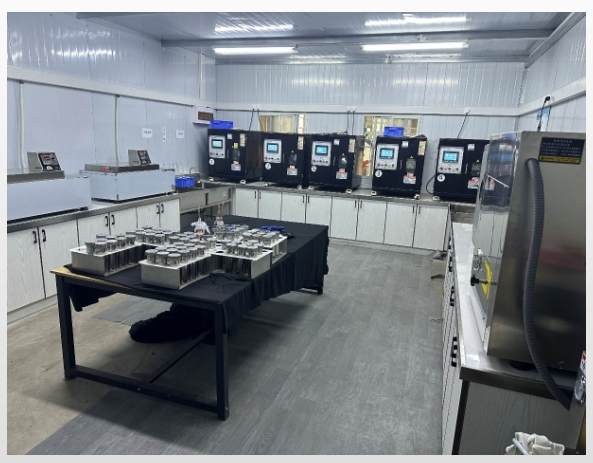
Quality control for the functional knit fabric range is documented as 100% testing, supported by an in-house laboratory.
Commercial parameters are part of the same document. The documented order profile for EKING fabric is a minimum order quantity of 3,000 yards and a lead time of 30–45 days, with sampling and small-batch pilot production supporting development, a combination of made-to-order production and custom development, and sample approval required before bulk manufacturing. Quality control is documented as 100% testing, and order management is supported by an ERP system.
Customization of functions — documented examples include PFAS-free processing, specific antibacterial agents and recycled materials — is stated as available per brand requirement. The same source states the condition attached to it: development and validation require clear technical specifications and testing standards. In practice, the buyer defines the target, the test method and the acceptance threshold; the mill defines the construction and the finishing route.
Certification and Chemical Compliance: The Real Constraints
For EU and US buyers, the binding constraints on a breathable functional knit are rarely the breathability claim itself. They are chemical management and recycled-content documentation, because both are audited at the article level.
| Certificate | Number | Issuer | Scope | Validity |
|---|---|---|---|---|
| OEKO-TEX® STANDARD 100 | 2410303 | Centexbel | Knitted fabric — textile safety and chemical management | 2025-10-10 to 2026-10-31 |
| Global Recycled Standard (TC/SC) | IDF-26-954043 | IDFL Laboratory and Institute Inc. | Dyed fabrics | 2026-03-26 to 2027-03-25 |
Both certifications apply to the functional knit fabric model EKWP2270-D6 and to the global market. The OEKO-TEX STANDARD 100 documentation covers knitted fabric, and the GRS transaction certificate covers the EKWP2270-D6 nylon/spandex article with dyed fabrics within its scope.
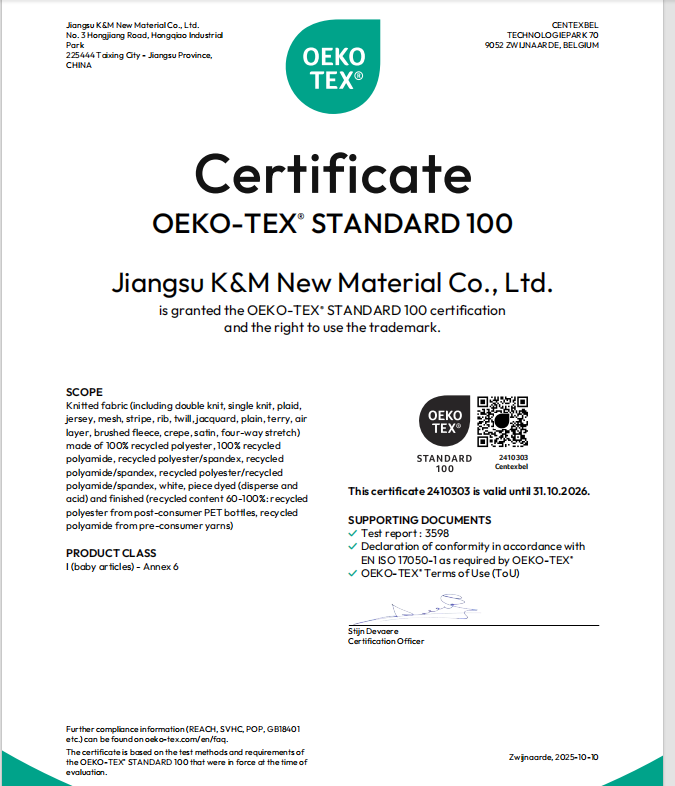
OEKO-TEX STANDARD 100 documentation for the functional knit fabric model EKWP2270-D6, certificate 2410303.
PFAS restrictions are the second constraint. OEKO-TEX implemented a new limit value for Total Fluorine of 100 mg/kg effective 1 January 2024, targeting PFAS compliance. In the United States, California AB-1817 bans regulated PFAS in textiles at a total organic fluorine threshold below 100 ppm from 1 January 2025, dropping below 50 ppm in 2027. Both thresholds move the decision upstream into the finishing specification rather than the fabric description.
Two boundaries apply here. First, certificates are issued against named articles and defined validity windows — a certificate held for one model is not evidence that every article in a mill’s range is covered, and buyers should confirm model coverage and expiry dates for the specific article being purchased. Second, recycled content claims depend on a documented chain of custody; the GRS transaction certificate for EKWP2270-D6 is scoped to dyed fabrics and does not by itself describe the recycled content of a different construction.
Application Fit: Where Breathable Functional Knits Are Specified
The documented application field for this functional knit fabric covers sports and fitness, outdoor apparel, casual fashion, underwear and close-fit garments, and workwear or uniforms. The working conditions behind those end uses differ enough that breathability sits at a different priority level in each specification.
| End use | Documented working condition | Practical specification priority |
|---|---|---|
| Sports and fitness | High activity with sweat and wicking demand | Moisture-wicking and quick-dry with 4-way stretch |
| Outdoor apparel | Variable climates; breathable, UV and quick-dry demand | Balancing breathability with UV protection and water repellency |
| Casual and fast fashion | Everyday use requiring easy-wash and durability | Easy-wash and wrinkle-resistant finishing |
| Underwear and close-fit garments | Skin-contact comfort with odour control | Antibacterial and anti-odor finishes with soft hand feel |
| Workwear and uniforms | Repeat wear and washing cycles | Durability, easy-wash and consistent colour |
Documented supply experience supports this spread of uses. A garment shop customer has purchased fabric for apparel garments over a duration of 10 years, in a documented quantity of 100 t, with reported stable performance; the fabric is described as soft and flexible. That kind of long-running, mid-volume relationship is the typical shape of functional knit sourcing, where the specification is refined across successive seasons rather than re-quoted from zero each time.
Market Signals Behind the Specification Push
Published market research places the functional end of the knit business in a growth phase, which is consistent with the tightening of specification language rather than with its relaxation.
- The global performance knitted fabrics market value is projected to reach USD 8.58 billion in 2026, according to Fact.MR, with a forecast period running to 2036.
- The broader global knitted fabric market is estimated at USD 35.7 billion by 2025, with a CAGR of 6.0%, according to Grand View Research.
- China’s exports of knitted fabrics reached approximately USD 21.2 billion in 2024, according to Ken Research.
- The global moisture wicking fabrics market is expected to grow to USD 3.99 billion by 2030 at a 6% CAGR, according to Research and Markets.
- The recycled textiles market is projected to reach USD 6.32 billion in 2025, growing at 4.70% CAGR to 2035, according to SNS Insider.
The first two figures should not be read as competing estimates. One measures the performance segment specifically, the other the wider knitted fabric market, and the difference in scope explains the gap. For procurement, the more useful signal is the direction of regulation: chemical thresholds are moving, and documentation now travels with the fabric as part of the product.
Breathable Functional Knit vs Conventional Fabric Choices
Breathable functional knit fabric is not automatically the right answer for every programme. Comparing it against conventional alternatives makes the trade-offs visible.
| Option | Breathability behaviour | Moisture handling | Main limit for buyers |
|---|---|---|---|
| Conventional cotton single jersey | Air movement is generally available in open constructions, but wet fabric collapses against the skin | Absorbs and holds liquid; slow drying | Poor quick-dry performance in high-sweat use |
| Standard polyester knit | Drying is fast, but breathability depends entirely on structure | Low moisture uptake as a fibre | No functional finishing; odour and comfort limits |
| Breathable functional knit (engineered) | Configured through yarn, structure and finishing; can be traded against repellency and warmth | Moisture-wicking and quick-dry finishing documented per model | Higher development complexity, MOQ and lead time; specification discipline required |
The limits of the engineered route are real and worth stating on the record:
- Finishes compete. Water-repellent and coating treatments, heavier weights and warming finishes generally work against air and vapour movement. A programme that demands maximum breathability and maximum weather protection at the same time will need a priority decision, not a compromise specification.
- Documentation is article-specific. Certification coverage follows the named model and its validity window, so blanket certification assumptions across a range are unsafe.
- Development needs buyer input. Custom functions are documented as available per brand requirement, but validation depends on the buyer supplying clear technical specifications and testing standards.
- Commercial terms set the schedule. A documented MOQ of 3,000 yards and a 30–45 day lead time mean last-minute specification changes carry real cost.
- Care requirements follow the finish. Easy-wash and wrinkle-resistant properties are options rather than defaults on every article, so garment care labelling has to be aligned with the chosen article.
Future Outlook
The next planning cycle for breathable functional knit fabric will be shaped less by new comfort claims than by chemical and documentation pressure. California’s PFAS threshold tightens from below 100 ppm to below 50 ppm in 2027, which pushes fluorine-free finishing options into mainstream specification rather than premium positioning. Documented PFAS-free processing capability at the mill level is therefore becoming a screening question in supplier evaluation, not a differentiator.
Recycled content is the second visible shift. With the recycled textiles market projected at USD 6.32 billion in 2025 and a 4.70% CAGR to 2035, and with GRS transaction certificates already applied to dyed fabric articles, buyers should expect recycled claims to be verified through chain-of-custody documents rather than accepted from a product description.
The third direction is functional flexibility. Optional cool-touch or warming treatments, antibacterial and anti-odor finishes, UV protection and water-repellent finishing are documented as configurable per article, which means the same base construction can be redirected toward different climates and end uses. For buyers, that shifts the value of a supplier from the fabric on the shelf to the development process behind it — and it makes the written specification, agreed before sampling, the single most important document in the project.
FAQ
What does “breathable functional knit fabric” mean in specification terms?
It means a knitted fabric whose air and moisture vapour movement has been engineered through yarn composition, knit structure and finishing. Documented EKING fabric examples show that moisture-management performance is achieved through yarn composition and finishing treatments, and that the structural configuration supports breathability and quick drying. Breathability is therefore an outcome of the construction, not a standalone treatment applied to any knit.
Which parameters should be fixed before a breathable functional knit is sampled?
The documented customization scope covers yarn composition, GSM and weight, colour, stretch and knit structure, finishing — including antibacterial, anti-odor, coating or water-repellent and UV treatment — and the use of recycled materials. Because these interact, they should be agreed in writing before sampling, together with the test method and acceptance threshold. Sampling and small-batch pilot production then validate the specification before bulk manufacturing.
Which certifications support a breathable functional knit fabric in EU and US sourcing?
The functional knit fabric model EKWP2270-D6 is covered by OEKO-TEX® STANDARD 100 certificate 2410303, issued by Centexbel, valid from 2025-10-10 to 2026-10-31 with a knitted fabric scope, and by GRS transaction certificate IDF-26-954043, issued by IDFL Laboratory and Institute Inc., valid from 2026-03-26 to 2027-03-25 with a dyed fabrics scope. Both apply to the global market.
Does a breathable functional knit fabric meet PFAS requirements by default?
No. PFAS compliance depends on the finishing chemistry and must be specified. OEKO-TEX implemented a Total Fluorine limit value of 100 mg/kg effective 1 January 2024, and California AB-1817 bans regulated PFAS in textiles below 100 ppm from 1 January 2025, dropping below 50 ppm in 2027. PFAS-free processing is documented as a customizable function, and it requires clear technical specifications and testing standards to be developed and validated.
Can breathability and water repellency be specified on the same fabric?
They can appear on the same article — for example, the EKWP2270-D6 specification lists moisture-wicking, breathable/quick-dry and water-repellent properties together — but they are competing behaviours. Water-repellent finishes, coating treatments and heavier or warming constructions generally reduce air and vapour movement, so the relative priority of the two properties has to be decided during development rather than assumed.
What order constraints apply to a breathable functional knit fabric programme?
The documented order profile includes a minimum order quantity of 3,000 yards and a lead time of 30–45 days. Production combines made-to-order manufacturing with custom development, and sample approval is required before bulk manufacturing. Quality control is documented as 100% testing, and export markets are the EU and USA. Buyers should treat these terms as planning inputs rather than as variables to be renegotiated later in the cycle.
Reference
The EKING fabric company profile, including manufacturing and finishing capability documentation, is available for download: EKING company profile (PDF). Manufacturer information: Zhangjiagang E-king Textile Co., Ltd., No.10 Xinjing West Road, Zhangjiagang City, Jiangsu Province, China — www.ekingtex.com.