
Bridge Guardrail Specification: Safety Barrier Constraints
Bridge Guardrail Specification: Safety Barrier Constraints
A bridge guardrail is the edge-protection assembly installed along bridge decks, viaducts, overpasses and elevated walkways. In most projects it is procured inside a broader safety barrier package, yet it behaves like a made-to-order steel product: dimensions, materials, post spacing and connection details are defined by the project rather than by a catalogue number. That combination is the central constraint for buyers in the research and evaluation stages, because a bridge railing cannot be compared across suppliers until the buyer has confirmed which parameters must be specified, which standards actually apply, and what evidence the supplier must provide.
The distinction has commercial weight. Bridge edges and elevated walkways are exposed to wind, rain, sunlight, traffic vibration and moisture, and salt exposure depends on the location. Two structures with similar spans can therefore require different materials, different anchoring and different protective mesh arrangements.
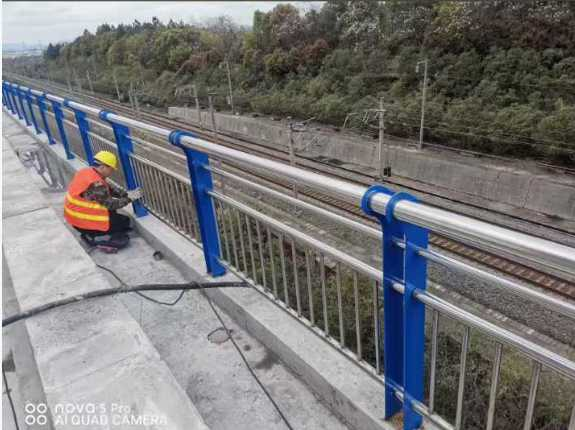
A stainless steel bridge railing in the recorded range: a grade 304 post-and-rail structure with an open design that preserves visibility along viaducts and overpasses.
Why Bridge Guardrails Cannot Be Compared as Catalogue Items
In the manufacturer's own product definition, bridge railing is a fully customized, bridge-specific design. Fabrication parameters and overall dimensions are produced according to project drawings, the railing design is adaptable to different bridge structures, and the load rating can be customized according to project requirements. Production follows the project's safety requirements rather than a fixed catalogue dimension.
The same logic extends to the components that sit beside or above the railing. Anti-throw mesh, for example, is supplied in custom mesh dimensions for project-specific installations. This means the purchase decision is rarely "which railing model" — it is "which parameter set has been confirmed against approved drawings".
The Compliance Boundary: EN 1317, MASH 2016, and What a Railing Is Not
Two standards define the compliance landscape most often encountered by bridge and roadside barrier buyers.
- EN 1317 is the mandatory European standard for vehicle restraint systems permanently installed on roads, with EN 1317-5 referenced in that framework and an effective date recorded as 1 January 2011 for the European Union.
- AASHTO MASH 2016 is the current evaluation standard for new permanent roadside hardware in the United States as of 31 December 2019.
Both instruments govern vehicle restraint systems — the complete installed assembly of rails, posts, connections and compatible end treatments. A bridge railing that provides edge guarding and separation is not automatically a crash-tested restraint system, and the difference is not a marketing nuance: it determines what testing documentation, if any, can be presented for the scope in question.
Two practical consequences follow. First, the specification should state explicitly whether the bridge railing scope includes vehicle restraint. Second, where a crash-rated system is required, component interchangeability cannot be assumed: performance depends on the verified system configuration, and rails, posts, connections and compatible end terminals must be selected as one assembly.
A third constraint is administrative rather than structural. Road guardrails are commonly classified under HS code 73089099 for trade purposes. That classification matters for customs documentation and landed-cost calculation, and it also explains why customs data aggregates guardrail sub-types, making sub-segment trade analysis difficult.
What Must Be Locked Before Fabrication
The parameters below are the ones that change the product, the fabrication schedule or the price. Each is project-defined, which is why a quotation that omits them is only an estimate.
| Constraint | What it controls | Evidence to confirm it |
|---|---|---|
| Application and structure type | Whether the scope is a road bridge, pedestrian bridge, viaduct or elevated walkway edge | Approved engineering drawings; intended bridge use |
| Overall dimensions and post spacing | Section and panel fabrication; alignment with the existing structure | Dimensional drawing set; site measurements |
| Material grade | Corrosion performance, appearance, maintenance expectations and cost | Material grade stated in the order specification |
| Surface treatment | Appearance, colour matching and protective life | Coating specification and colour reference |
| Load rating, where required | Structural sizing of the railing design | Project requirement statement |
| Environmental exposure | Whether coastal, humid or general outdoor exposure applies | Site location and exposure description |
| Installation method and interfaces | Connection to the bridge structure, drainage, lighting and expansion joints | Interface drawings; compatibility review |
| Applicable standards | Documentation, testing and acceptance criteria | Project specification referencing EN 1317, MASH 2016 or local equivalents |
| Quantity, delivery and packaging | Production scheduling and transport configuration | Bill of quantities; delivery destination |
How the Recorded Bridge Railing Range Handles Those Constraints
The range referenced throughout this article is produced by Guangzhou Santian Steel Structure Co., Ltd. (Santian), a China-based manufacturer of municipal traffic guardrails and construction site hoarding systems. The company operates a production facility of approximately 15,000 m² in Guangzhou and integrates research and development, product design, manufacturing and installation services; its industry experience dates back to 2011, with formal registration recorded on 16 May 2016. The company profile records around 200 employees, a 50-engineer R&D team, annual output of 1,500,500 m, and an export ratio of 50%, with main markets in Southeast Asia, Africa, South America and the Middle East.
Its product scope covers municipal road and bridge guardrails, decorative urban guardrails, riverside guardrails, balcony and stair railings, perimeter fence railings, construction site hoardings and standardized safety protection systems. The relevant point for a bridge scope is not the width of the range but how each model is defined: by type and material, with custom specification as the standard parameter set.
| Model | Type | Recorded material composition |
|---|---|---|
| T019 | Custom Bridge Railing | Steel |
| T020 | Stainless Steel Bridge Railing | Stainless steel; steel |
| T021 | Custom Bridge Railing | Stainless steel |
| T022 | Stainless Steel Bridge Railing | Stainless steel; steel |
| T023 | Stainless Steel Bridge Railing | Stainless steel; steel tube |
| T024 | Wood-Effect Handrail Stainless Steel Railing | Stainless steel; wood-effect components; wooden handrail |
Model T022 is recorded as a grade 304 stainless steel post-and-rail structure, fully welded for structural strength, with an open design that preserves visibility — a configuration the product documentation associates with viaducts and overpasses. Model T024 combines a wood-effect handrail with a stainless steel support structure; the handrail surface replicates a natural wood appearance through a wood-grain transfer finish, and the product functions as a safety barrier with custom dimensions available. Every model in the range carries the same base constraint: the specification is custom, and dimensions are defined by the project requirement.
Material Selection as a Constraint Decision
Manufacturer guidance on outdoor material selection is deliberately conditional rather than absolute.
- Hot-dip galvanized steel provides a practical balance of strength, corrosion resistance and cost, and is recommended for standard outdoor projects.
- Stainless steel offers better appearance and corrosion resistance. Grade 304 is suggested for humid environments, and Grade 316 or 316L for coastal and salt-spray conditions. Elsewhere in the railing range, Grade 316L stainless steel is recorded specifically for resistance to marine salt spray, and stainless steel riverside guardrails are documented as retaining their appearance without rusting under humid outdoor conditions and requiring no additional surface coating.
- Aluminium is lightweight and suited to decorative applications. In waterfront installations exposed to moisture, a recorded configuration pairs an aluminium handrail with hot-dip galvanized steel posts.
- Welded steel mesh serves protective rather than decorative functions, where mesh density and the post-and-mesh assembly — not surface finish — determine performance.
Coating is a separate decision from material. Surface finish across the railing range can be specified as electrostatic coating in multiple colours, and in facade-matched applications coating colours are coordinated with the building facade. For bridges carrying an architectural colour requirement, that precedent is worth confirming at specification stage rather than after fabrication.
Documentation and Evidence for a Custom Bridge Railing Order
Because the product is built to order, the documentary trail carries most of the quality risk. The recorded process for custom bridge railing production includes a design-for-manufacture (DFM) review before fabrication, dimensional tolerances validated against approved drawings before volume production, in-house cutting, bending and welding of stainless steel railing sections, material certificates and inspection records, and batch traceability records. A pre-production sample can be supplied for project approval, trial orders are accepted, and the product is available for third-party factory audit and supplier qualification.
Company-level quality control follows a comparable sequence: incoming material inspection, dimensional inspection, welding inspection, coating inspection, in-process quality control and final pre-shipment inspection. The customization model is OEM and ODM, covering dimensions, materials, colours, surface finishes, structural designs, decorative patterns, logos, packaging and project-specific configurations. Minimum order quantity is negotiable according to product type and project requirements, monthly capacity is flexible and project-based, and lead time is determined by order quantity, product specifications and customization requirements. After-sales scope is documented as remote technical support, installation guidance, maintenance recommendations, spare-parts coordination and after-sales response.
Where Bridge Guardrail Specification Changes: Applications and Use Cases
Bridge and elevated-road scopes do not use one product. In the recorded applications, the constraint set changes with the function being protected.
| Application | Recorded product evidence | Constraint to note |
|---|---|---|
| Viaducts, overpasses and urban bridges | T022 grade 304 stainless steel post-and-rail structure; fully welded; open design preserves visibility | Edge guarding and separation; vehicle restraint specified separately |
| Architectural and landscape bridges | T024 wood-effect handrail with stainless steel support structure; wood-grain transfer finish | Custom dimensions; appearance-driven finish selection |
| Elevated roads and bridge approaches with headlight glare | T038 expanded metal anti-glare screen; expanded steel mesh provides glare screening and ventilation to limit wind pressure | Function depends on the selected model; support compatibility must be confirmed |
| Bridge and elevated edges with falling-object risk | T037 anti-throw mesh; welded steel mesh with dense openings and a welded post-and-mesh assembly; mesh density designed to prevent objects falling from elevated roads | Custom mesh dimensions; suitable for bridge guardrail safety barrier projects |
| Waterfront approaches and riverside promenades | Riverside guardrail range with anti-corrosion treatment and weather-resistant materials, designed to consider prolonged exposure to water | Water resistance and corrosion resistance; these railings do not provide flood control |
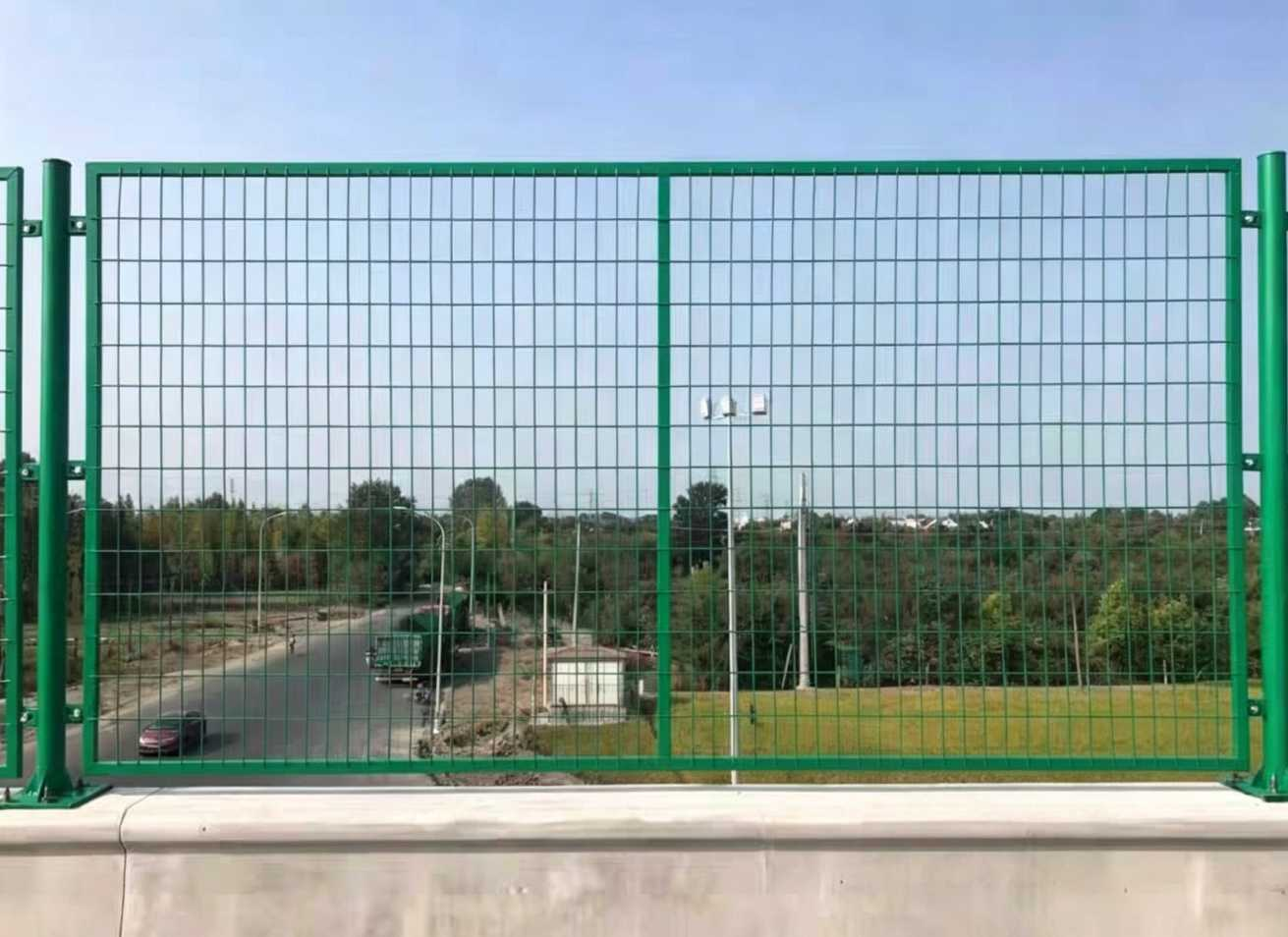
Anti-throw mesh in the recorded range: welded steel mesh with dense openings, supplied as a welded post-and-mesh assembly and fabricated in custom mesh dimensions.
One documented project illustrates the glare-screening case at scale. An expressway authority or road-safety contractor in China is recorded as using the T038 expanded metal anti-glare screen across 110 km of expressway, bridge or elevated-road alignment, with a recorded project duration of three years and expanded steel mesh cited for glare screening with ventilation to limit wind pressure.
Pedestrian-heavy structures follow a different route. Pedestrian guardrails guide movement, separate walking areas from traffic and channel crossing toward designated locations, but the product documentation states explicitly that they are not a substitute for a vehicle crash barrier.
Market Context: What the Published Figures Show
Independent market research frames the category as large, metal-dominant and gradually becoming more instrumented.
- The global barrier systems market was valued at USD 24.8 billion in 2025, according to Grand View Research's barrier systems market report.
- The same source records the metal segment at over 50.0% of material market share in 2025.
- The global temporary guardrail market was valued at USD 2.4 billion in 2024, also reported by Grand View Research.
- The smart road barrier market is projected at a 9.2% CAGR from 2025 to 2034, per Dataintelo.
- Hill & Smith PLC is identified as a major company in the global barrier systems market in commercial market research covering the sector.
Definitions should be read carefully. Metal share is not one number across the industry: one dataset records 58.7% for warehouse safety barriers, while another reports above 50.0% for barrier systems overall. That reflects different product scopes rather than a contradiction in the underlying material trend, and it is a reminder to check the scope behind any headline figure.
Manufacturer-side evidence supports the instrumented-barrier direction. The T007 lane separation guardrail with solar warning end is recorded as carrying a solar-powered LED warning end that charges during daylight and illuminates automatically at night, operating off-grid. That product sits in the lane separation category rather than the bridge railing category, but it shows that active warning elements are already being integrated into guardrail assemblies — the design direction the 9.2% smart barrier projection describes.
Comparison with Traditional Solutions — and Where a Railing Stops
Most bridge railing scopes are decided between a site-fabricated approach and a factory-prefabricated one. The prefabrication argument is documented elsewhere in the same railing range: the prefabricated stair railing model Y063 uses a factory-prefabricated bolted assembly, is installed on site by bolted assembly without welding, and is recorded as reducing construction time and pollution and as suitable for tight construction schedules.
Bridge railings specifically are fabricated in-house — cutting, bending and welding of stainless steel railing sections — supported by a DFM review and dimensional tolerance validation against approved drawings before volume production. That moves dimensional control upstream, into the factory, before sections reach the bridge deck. A buyer comparing a site-fabricated alternative should therefore confirm how tolerances will be verified, how welded joints will be inspected, and how coating damage will be repaired on site.
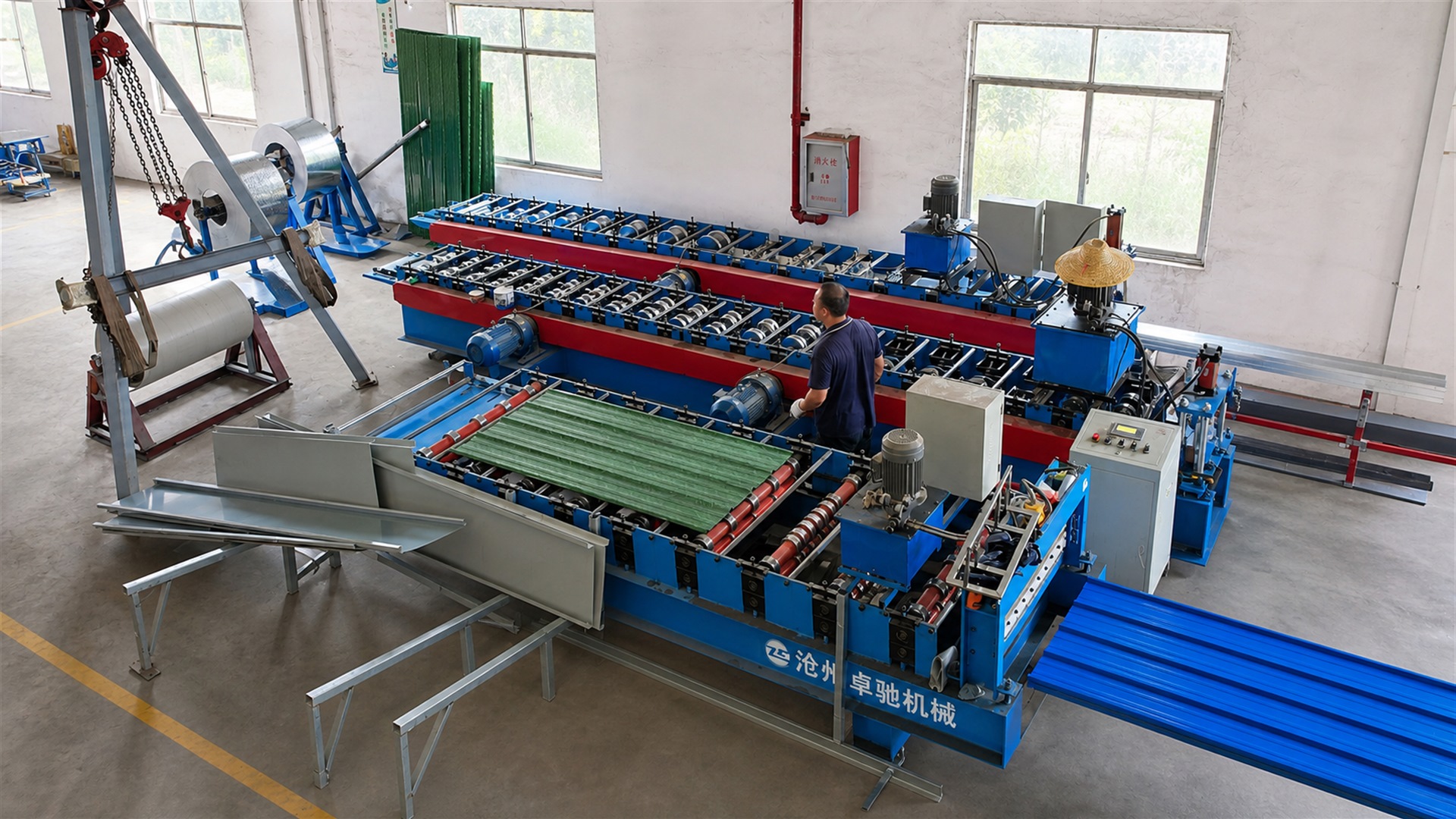
Prefabrication moves dimensional control upstream: roll forming and related in-house processes take place before sections are delivered to site.
Prefabrication does not remove the following limits, and any supplier implying otherwise is describing something the documented products do not claim.
- Edge guarding is not vehicle restraint. A bridge railing provides edge guarding and separation; vehicle impact containment requires a separately specified crash-rated system.
- Barrier components are not universally interchangeable. Rails, posts, connections and compatible end terminals function as one installed assembly, and performance depends on the verified system configuration.
- Protective mesh functions are model-dependent. Anti-throw and anti-glare performance depends on the selected model, and support compatibility with the bridge railing or median barrier must be confirmed.
- Service life is a specification outcome, not a fixed number. It depends on material, coating system, climate, installation quality and maintenance frequency; stainless and correctly galvanized steel generally provide reliable long-term outdoor performance when correctly specified and maintained.
- Custom specification has schedule consequences. Because panel dimensions are confirmed against project drawings before production, late dimensional changes propagate through the fabrication sequence.
- Waterfront railings do not control water. Riverside and reservoir railings guard accessible edges and guide pedestrian routes; they explicitly do not provide flood control.
Future Outlook
Three shifts are likely to shape bridge guardrail procurement over the next planning cycle.
Documentation becomes part of the product. With EN 1317 governing vehicle restraint systems in Europe and MASH 2016 governing new permanent roadside hardware in the United States, buyers operating across markets will increasingly treat evidence packs — material certificates, inspection records, tolerance validation and batch traceability — as a standard deliverable rather than an optional extra. Suppliers already maintaining traceability and offering third-party factory audit are structurally better positioned for that expectation.
Detection and warning elements migrate into the barrier. A projected 9.2% CAGR for the smart road barrier segment from 2025 to 2034 points to continuing integration of warning and monitoring functions. The solar warning end recorded on a lane separation guardrail is an early, off-grid example, and it introduces a new constraint class for buyers: power, maintenance access and replacement strategy for any active component sitting inside a passive safety scope.
Material selection tightens around exposure. With metal holding more than half of barrier material share, competition is unlikely to move away from steel. It is more likely to move toward specifying the correct grade — galvanized steel for standard outdoor conditions, stainless steel for humid environments, marine-grade stainless for coastal salt spray — and documenting that choice, because corrosion-related maintenance is where long-term cost is decided.
Trade classification will continue to limit visibility. Because guardrails are commonly classified under HS code 73089099, customs aggregates do not separate municipal, bridge and temporary guardrail flows. Buyers comparing regional supply should rely on project evidence and supplier documentation rather than on aggregate trade statistics.
Frequently Asked Questions
How do I choose the right guardrail for my project?
Select the guardrail according to the application, required safety level, installation environment, material, dimensions, surface treatment and local standards. Road, bridge, residential and industrial projects require different structural designs. Manufacturer guidance recommends galvanized steel guardrails for municipal roads, stainless steel railings for coastal or high-humidity environments, and welded mesh fencing for industrial perimeter protection, with custom specifications confirmed against project drawings.
Which material is suitable for outdoor guardrails?
Hot-dip galvanized steel provides a practical balance of strength, corrosion resistance and cost. Stainless steel offers better appearance and corrosion resistance, while aluminium is lightweight and suitable for decorative applications. The choice should balance service life, maintenance requirements, appearance and budget against climate, humidity, salt exposure, corrosion level and expected service life.
Which guardrail material is suitable for coastal or humid environments?
Stainless steel, especially Grade 316 or 316L, is recommended for coastal and salt-spray environments. Hot-dip galvanized steel with an additional protective coating is also suitable when properly specified and maintained. Within the product range, Grade 316L stainless steel is recorded specifically for resistance to marine salt spray, and stainless steel riverside guardrails are documented as resisting moisture without additional coating.
What information is required for a custom guardrail quotation?
An accurate quotation requires the guardrail type, height, length, post spacing, material grade, surface treatment, total quantity, drawings, dimensions, applicable standards and delivery destination. Site photographs are helpful when drawings are unavailable, and the application and site conditions should be provided so that a suitable configuration can be recommended.
Can guardrails be customized for different projects?
Yes. Dimensions, post spacing, rail configuration, materials, colours, surface finishes, decorative patterns, logos and installation methods can be customized according to project drawings and site requirements. For bridge railings, fabrication parameters and overall dimensions are produced according to project drawings, and the load rating can be customized according to project requirements.
How do you install a prefabricated steel guardrail?
Install according to approved engineering drawings, the manufacturer's instructions and local safety standards. The documented sequence is: review the drawings and confirm the installation location; inspect posts, rails, fasteners and accessories; mark post positions and verify the foundation or anchor points; install and temporarily secure the posts; connect rails and accessories in the specified sequence; adjust height, spacing, verticality and alignment; then tighten all fasteners to the specified torque and complete the final inspection. Trained installers and personal protective equipment are required, traffic control and an exclusion zone must be established, underground utilities must be checked before drilling, and damaged or incompatible components must not be installed.
How do you inspect and maintain galvanized steel guardrails?
Inspect regularly for loose fasteners, corrosion, damaged coatings, deformation, foundation movement and missing components. The documented procedure is: establish a safe inspection area; check posts, rails, welds, bolts and connection points; look for corrosion, cracks, deformation and coating damage; inspect foundations and anchor bolts for movement or loosening; clean dirt, salts and chemical deposits; tighten loose fasteners and repair minor coating damage; record defects and arrange replacement of severely damaged components. Roadside inspection requires proper traffic control, and severely deformed structural components should not be straightened for reuse without professional evaluation.
How can a damaged guardrail section be replaced?
A damaged modular guardrail section can usually be replaced independently when compatible posts, rails and fasteners are available, and the surrounding structure and foundation must be inspected before the new section is installed. The documented procedure is: isolate the work area and document the damage; inspect adjacent posts, rails, anchors and foundations; confirm the replacement component model, dimensions and material; support the damaged section before removing fasteners; remove the damaged components without affecting adjacent sections; install compatible replacements; then adjust alignment, tighten connections and conduct a final safety inspection. Approved traffic-control measures and lifting equipment are required, and the area should be reopened only after inspection and acceptance by qualified personnel.
A downloadable product brochure covering the guardrail, railing and construction hoarding range described in this article is available here: Santian product brochure (PDF). Company information is published at aotianguardrail.com.