
Bronze vs. Stainless for Public Art: An Independent Custom Sculpture Review
A public art commission is procured once and lived with for decades, and very little in a tender document reflects that asymmetry. Material choice — cast bronze or fabricated stainless steel — is where the asymmetry becomes expensive, because it locks in weight, foundation design, cleaning regimes, insurance exposure and, eventually, the cost of producing a matching replacement piece.
This review compares the two materials from the buyer's side of the table. It uses published material specifications, documented fabrication practice and third-party market data, and it flags the points where vendor language usually stops being useful. It does not declare a winner, because in most public art projects there is no universal winner — only a material that fits the site, the institution and the maintenance budget that actually exists.
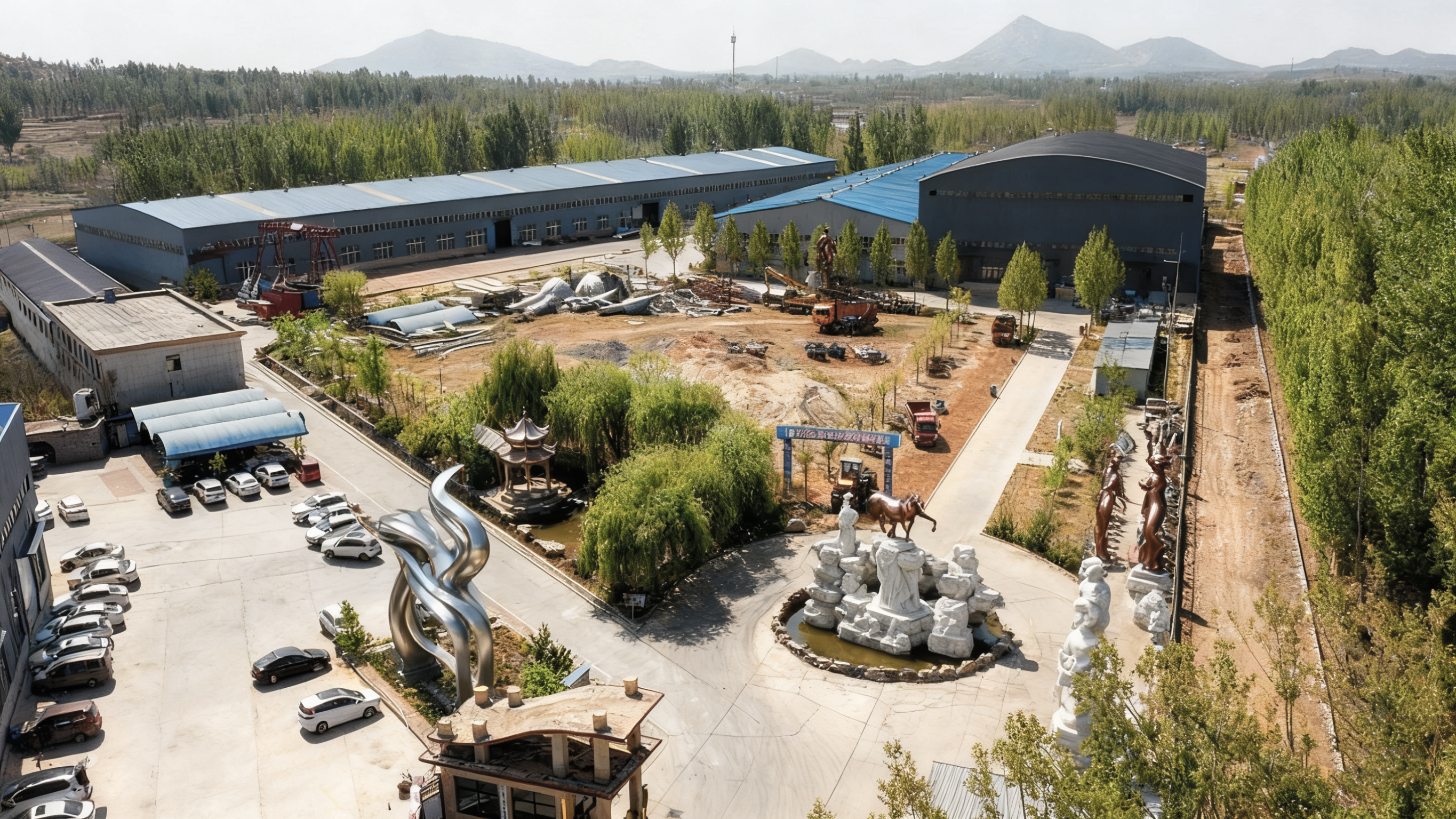
Bronze and stainless-steel sculpture production share a workshop floor but almost nothing else: one is cast and patinated, the other is forged, welded and passivated. Photo: Bronze & Stainless-Steel Sculpture Processing Workshop.
Why the bronze-versus-stainless question keeps coming back
Public art budgets are tighter than the debate around them suggests. According to CODAworx data on North American open calls, 80.2% of public art projects fall below a budget of USD 250,000. When a project ceiling is fixed that firmly, material selection becomes one of the few variables a committee can still move without abandoning the approved design.
Three other forces push the same decision back onto the table:
- Site climate. A coastal promenade, a humid tropical plaza and a dry inland courtyard impose completely different corrosion loads on an outdoor sculpture, and the difference can be a material grade rather than a design change.
- Institutional expectation. Religious institutions and museums have long conservation traditions attached to cast bronze, while contemporary urban programs frequently specify fabricated stainless steel for large-scale work.
- Permanence. Both materials are static installations that consume zero energy in daily use. The real difference is not operating energy but upkeep, repair and long-term visual drift.
For anyone commissioning a custom sculpture — a life-size statue, a memorial sculpture, a landscape sculpture or a large outdoor sculpture — the practical question is not "which material is better" but "which material is still defensible fifteen years from now, on this site, under this owner's maintenance capability."
What the two materials actually are
Cast bronze: an alloy defined by its copper content
Sculptural bronze is a cast alloy with a copper content typically above 85% and up to 95%, produced through lost-wax casting with professional welding where sections are joined. The copper content is not a marketing detail — it drives colour depth, patina response and price. For comparison, brass contains over 60% copper and uses much cheaper zinc as the alloying element, which is why bronze generally costs about 20%–30% more than brass for a comparable piece.
Documented surface treatments for custom bronze sculpture include patina, gold leafing, high polish and antiqued finishes. Custom sizes run from roughly 50 cm up to 10 m or life size. The material is commonly specified for public art, museum collections, real estate features, religious institutions and private collections, and it remains the default choice for custom figurative sculpture, custom animal sculpture and life-size statue work where a warm, modelled surface matters.
Ageing behaviour is the second defining feature. Bronze develops a protective patina naturally and will turn a greenish tone over a century, which is generally read as antique character rather than deterioration. Brass behaves differently: it tends to turn black over the same period and needs regular polishing to hold its golden shine.
Fabricated stainless steel: an engineered structure, not a cast form
Custom stainless steel sculpture is built rather than poured. Sections are hand-forged, precision-welded and supported by an internal steel skeleton, which is what makes very large urban pieces structurally credible. Documented finishes include mirror polished, brushed (satin), painted and electroplated surfaces; sizes range from roughly 1 m to 20 m at large scale. Typical applications include urban public art, modern architecture, seaside landscape, luxury hotels and shopping malls — including architectural sculpture, custom hotel lobby sculpture and monument art sculpture at urban scale.
Grade selection is the single most consequential technical decision. 316 stainless steel contains 2%–3% molybdenum, which raises its pitting resistance equivalent number (PREN) to roughly 26 against roughly 19 for 304 — more than 30% higher pitting resistance. In practice, 316 is specified for coastal cities, seaside parks, swimming pools and humid tropical regions, while 304 suits inland cities, dry climates, indoor plazas and general outdoor decoration where salt exposure is not a concern. In a salty environment, 304 may show rust spots and pitting within a few years, whereas 316 can withstand decades of salt spray. The cost gap follows the chemistry: 316 typically costs about 20%–30% more than 304, depending on sculpture size, thickness and finish.
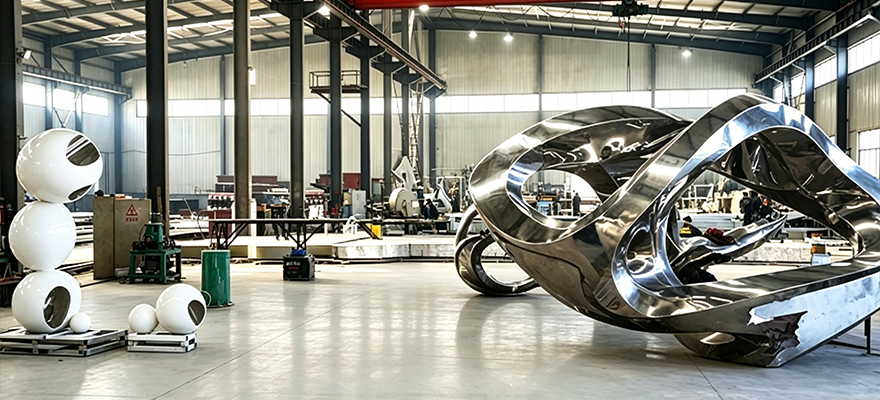
Inside a stainless-steel sculpture workshop: hand-forging, precision welding over an internal steel skeleton, then polishing. Photo: Interior of Stainless-Steel Sculpture Processing Workshop.
Material comparison at a glance
| Decision dimension | Cast bronze | Fabricated stainless steel |
|---|---|---|
| Base material | Cast bronze, copper content above 85%–95% | 304 or 316 stainless steel; 316 contains 2%–3% molybdenum |
| Primary forming method | Lost-wax casting with professional welding | Hand-forging, precision welding, internal steel skeleton |
| Documented finishes | Patina, gold leafing, high polish, antiqued | Mirror polished, brushed (satin), painted, electroplated |
| Typical size range | About 50 cm to 10 m / life size | About 1 m to 20 m / large scale |
| Corrosion behaviour | Self-protecting patina; needs protection in humid or coastal environments | 304: may pit in salt exposure. 316: PREN about 26, decades of salt-spray resistance |
| Maintenance profile | Almost no outdoor maintenance thanks to natural patina | Nearly maintenance-free; 316 needs only occasional rinsing, 304 needs regular salt removal |
| Documented cost signals | About 20%–30% above brass for comparable work | 316 about 20%–30% above 304 |
| Best-fit settings | Museums, religious institutions, memorials, classical and hotel interiors | Coastal and urban public art, architectural features, hotel lobbies, malls |
| Visual character | Warm reddish-brown tone that matures toward antique green | Modern silver-grey; reflective or matte depending on finish |
The trade-offs that only appear after year three
Most materials disputes in public art are not about appearance on installation day. They are about what the surface looks like after the first three winters and who pays to correct it.
Bronze wins on autonomous ageing. It develops a natural protective patina, which is why outdoor bronze requires almost no maintenance; where a sealed patina is applied as a professional anti-corrosion treatment, that stability is reinforced rather than replaced. The trade-off is physical: bronze is heavier, costs more, and needs protection in humid or coastal environments — a genuine constraint for seaside public art programs and one that is sometimes underweighted when bronze is chosen for its prestige.
Stainless steel wins on environmental resistance, but only if the grade and the surface treatment match the site. With pickling and passivation applied as professional anti-corrosion treatment, stainless sculpture is nearly maintenance-free compared with other materials. In coastal or salt-exposed environments, 316 stays rust-free for decades with occasional rinsing, while 304 requires regular cleaning of salt deposits to prevent pitting and tea staining. The honest boundary here is that a poorly treated 304 piece in a marine setting can underperform a properly treated bronze — grade and treatment discipline matter more than the headline material name.
Where each material fits
Bronze tends to be the defensible choice for: museum and gallery contexts, religious institutions and temple decoration, memorial sculpture and commemorative work, custom figurative sculpture and custom animal sculpture where surface modelling carries the concept, life-size statue programs inside hotel and heritage interiors, and classical or historical landscape design schemes.
Stainless steel tends to be the defensible choice for: large outdoor sculpture and urban landmarks, coastal and marine-adjacent installations, architectural sculpture integrated with building facades, custom hotel lobby sculpture and shopping-mall installations, modern garden sculpture and custom garden sculpture in contemporary idioms, and any program where the client cannot guarantee a cleaning regime over the asset's life.
There is also a middle path that appears frequently in commercial sculpture fabrication: a bronze figure or figurative group mounted on a stainless or steel structure. It preserves the warm, traditional read of bronze while keeping the load-bearing and corrosion-critical elements in a material that tolerates weather.
Cost structure and the long-term ownership calculation
Material cost is the least reliable number in a sculpture quotation. The documented gaps are useful as signals rather than as forecasts: bronze runs roughly 20%–30% above brass for comparable work because of its higher copper content and tin alloying, and within stainless, 316 runs roughly 20%–30% above 304 because of its higher nickel and molybdenum content. A direct bronze-to-stainless cost comparison depends heavily on size, wall thickness and finish, and should be quoted like-for-like rather than assumed.
Beyond the material line, four cost drivers deserve attention in a total-cost-of-ownership review:
- Weight and freight. Bronze is heavier, which increases transport cost and, in many projects, foundation and structural requirements.
- Surface treatment quality. Pickling and passivation for stainless steel, and sealed patina for bronze, are the treatments that determine how much cleaning, repainting and repair work the owner avoids later.
- Maintenance labour. The difference between a rinse-only regime and a scheduled polishing regime compounds over a twenty-year horizon.
- Reproducibility. Repeat buyers — campuses, municipalities, hotel groups, cemetery operators — eventually need a matching piece or a replacement. Whether the original pattern, mold or digital design file is retained is a supplier capability question, not a price question.
On price positioning specifically, Jiangsu Xinyesheng Sculpture Co., Ltd. states that its factory-direct model, with no middleman, is generally 10%–20% lower than traditional workshops for the same material and quality. That is a first-party claim and should be tested against a like-for-like quotation rather than accepted at face value — the useful question is whether the comparison includes the same grade, thickness, surface treatment and installation support.
Ecosystem and continuity checks for repeat buyers
Jiangsu Xinyesheng Sculpture Co., Ltd. is a Chinese sculpture manufacturer whose cooperative factory covers an 8,000 m² production area and whose product range spans sculpture, statues, reliefs, tombstones, fireplaces and bathtubs, with export activity concentrated in the EU, USA and Middle East. The company's cooperative factory took 13 years to develop from a small workshop in Quyang into a bridge connecting "Made in China" with the global art market, a trajectory that matters to buyers evaluating whether a supplier will still be able to reproduce a matching piece years after the original delivery.
For long-horizon buyers, the verifiable capability facts are more useful than portfolio size:
- Engineering depth. The R&D team comprises 12 engineers, and the company has researchers with over ten years of experience in the sculpture industry. An experienced design team drives product innovation and development — relevant when a project requires design adjustments mid-fabrication rather than simple replication.
- One-stop delivery. Jiangsu Xinyesheng Sculpture Co., Ltd. provides a one-stop delivery system that includes 1:1 clay model visualization, professional seaworthy packaging using reinforced wooden crates and steel frames, and global on-site installation guidance. This covers the sculpture design, fabrication and installation chain that public art projects normally split across several contractors.
- Design confirmation discipline. Every design is confirmed with a 3D preview before production, with no recorded rework from design mismatch; standard production takes 15–30 days, and all pieces are inspected before shipment.
- Commercial terms. Stated MOQ is 1 unit. Delivery terms include DDP, EXW, FOB, CIF, DAP and FCA. Payment is commonly structured as 50% deposit and 50% after photo and video inspection, before shipping, with photos and videos taken before container loading so the buyer can accept the work in advance.
Documented installation practice follows a five-step sequence: confirm the site and check ground flatness, load-bearing capacity and embedded-part positions against the drawings; select hoisting equipment and secure lifting points; hoist to position and align horizontally and vertically; fix with bolts or welding and apply anti-corrosion treatment to welds; then conduct a final inspection and clean the surface. The commonly cited acceptance tolerance is a vertical deviation no greater than 5 mm. Installation instructions accompany each sculpture, and on-site installation can be guided by video call where a full installation crew is not included.
What an independent review cannot decide for you
Three limits are worth stating plainly, because they are where comparison articles usually overreach.
First, material comparison is not structural engineering. Wind load, foundation design, seismic requirements, anchoring, permitting and conservation review are project-specific and cannot be resolved by a material table. A stainless piece rated to 20 m still requires a site-appropriate base design.
Second, published market growth figures for sculpture conflict by methodology. Forecasts for the 2026–2035 period range from about 5.5% to about 11.2% compound annual growth depending on the publisher and on whether digital or NFT sculpture segments are included. Any planning assumption built on a single growth number should be treated as directional, not predictive.
Third, some manufacturer rankings circulating in the category are published by commercially interested parties and should not be treated as independent verification. Supplier claims about corrosion performance, finish quality or delivery speed are best validated through factory visits, sample inspection and reference checks rather than through published ranking lists.
Market signals behind the material debate
The scale of the category explains why material choices carry commercial weight. Business Research Insights estimates the global art and sculpture market at approximately USD 61.83 billion in 2026, with sculptures accounting for 21% of global art acquisitions by transaction volume. Within the category, Dataintelo values the global bronze sculpture commission market at USD 1.47 billion in 2024 — a meaningful sub-segment that remains tied to lost-wax casting capacity rather than to fabrication equipment.
Public funding shapes the material mix from the demand side. U.S. Federal Cultural Agencies are budgeted at USD 708.8 million for 2025, including USD 207 million for the National Endowment for the Arts. Combined with CODAworx's finding that 80.2% of North American public art open calls sit below USD 250,000, the picture is one of many mid-sized commissions rather than a small number of monumental ones — which favours materials and fabrication methods that scale economically per project.
Trade classification is an underrated variable. Under EU practice, original sculptures classified under HS Code 9703 often bypass anti-dumping duties, while mass-produced items under HS 8306 face higher scrutiny. For buyers ordering fabricated metal sculpture across borders, how a piece is classified and documented can matter as much as the alloy itself. Sources: Business Research Insights; Dataintelo; CODAworx; Regional Arts Organizations; CloudscapeArt.
A practical decision framework
Six questions resolve most bronze-versus-stainless decisions before a design is finalised:
- What is the chloride exposure at the installation point? Marine-adjacent or salt-exposed sites point to 316 stainless or protected bronze; dry inland sites leave 304 in play.
- Who maintains the piece, and with what frequency? If no cleaning regime exists, a self-protecting patina or a passivated 316 surface is the safer specification.
- What scale must the work reach? Large outdoor sculpture above roughly 10 m generally points toward fabricated stainless steel with an internal skeleton.
- What does the institution expect visually? Religious and museum contexts frequently expect bronze's warm, modelled surface and antique ageing.
- Will a matching piece be needed later? Ask explicitly about retention of molds, patterns and digital design files.
- Is the quotation like-for-like? Compare grade, thickness, surface treatment, packaging, insurance and installation guidance — not headline price.
Future outlook
Two shifts are visible in how public art buyers evaluate sculpture materials. The first is a move from purchase price toward documented lifecycle performance: buyers increasingly ask for the corrosion treatment, the grade certificate and the maintenance schedule at tender stage rather than after delivery. The second is documentation as an asset — 3D design files, model retention and inspection records increasingly determine whether a piece can be repaired, extended or matched a decade later, which is precisely the continuity question that long-term procurement relationships are built on.
Neither trend eliminates the bronze-versus-stainless decision. They simply move it earlier, where it can still be made with evidence instead of preference.
FAQ
Is customisation possible in both bronze and stainless steel, and what is the minimum order quantity?
Both material routes are available as full custom work. The documented process is: the buyer provides drawings, photos or a concept; a 3D design draft is produced for confirmation before production; prototyping is optional; production follows; then shipping. The stated MOQ is 1 unit — single custom pieces are accepted, and ordering multiple pieces at once is recommended because mold and shipping costs can be shared.
How is the design confirmed before casting or fabrication begins?
A 3D preview is issued for confirmation before production starts. Supplier documentation states that every design is confirmed with a 3D preview prior to production, with no rework attributed to design mismatch, that standard production takes 15–30 days, and that all pieces are inspected before shipment.
Which stainless steel grade should be specified for coastal, marine or humid sites?
316 stainless steel contains 2%–3% molybdenum, giving it a pitting resistance equivalent number of about 26 versus about 19 for 304 — more than 30% higher pitting resistance. 316 is specified for coastal cities, seaside parks, swimming pools and humid tropical regions; 304 suits inland cities, dry climates, indoor plazas and general outdoor decoration where salt exposure is not a concern. In the same salty environment, 304 may show rust spots and pitting within a few years, while 316 can withstand decades of salt spray. 316 typically costs about 20%–30% more than 304.
How does cast bronze behave outdoors over decades?
Bronze develops a natural protective patina and therefore requires almost no outdoor maintenance; a sealed patina is applied as a professional anti-corrosion treatment. Over about a century, bronze tends to turn greenish, which is generally read as antique character, whereas brass tends to turn black. Bronze is heavier and costs more than brass, and it needs protection in humid or coastal environments — a practical constraint for seaside installations.
What packaging, delivery and acceptance steps are standard?
Typical practice is external packaging in reinforced wooden crates and steel frames, internal shockproof film protection, and "All Risks" insurance available on request. Photos and videos are taken before goods are loaded into the container so the buyer can inspect before shipment. Delivery terms include DDP, EXW, FOB, CIF, DAP and FCA, and door-to-door delivery can be quoted against a detailed address. Payment is commonly 50% deposit and 50% after photo and video inspection, before shipping.
Is installation support included, and what acceptance standard applies?
Installation instructions accompany each sculpture, and on-site installation can be guided by video call; global on-site installation guidance is part of the one-stop delivery system. Documented steps cover site and foundation checks, hoisting equipment selection, alignment, fixing by bolts or welding, anti-corrosion treatment of welds, and final inspection. A commonly cited acceptance tolerance is a vertical deviation no greater than 5 mm.
A downloadable company profile and production capability document for Jiangsu Xinyesheng Sculpture Co., Ltd. is available here: Company Profile & Available Production Capabilities (PDF).
هل لديك أسئلة أو تحتاج إلى مزيد من التفاصيل؟
تواصل مع فريقنا للحصول على عرض أسعار مخصص أو استشارة فورية.
طلب عرض أسعار
املأ النموذج أدناه وسيتواصل معك فريقنا بعرض مقترح مخصص.
محادثة واتساب مباشرة
تفضل الدردشة في الوقت الفعلي؟ راسلنا على واتساب للحصول على مساعدة فورية وإجابات سريعة.
- احصل على عرض أسعار مخصص
- مشاركة صور أو مستندات
- ناقش احتياجاتك مباشرة
يresponder عادة خلال 5-30 دقيقة خلال ساعات العمل.