
Brushless Gear Motor Shortlist: GMP36-TEC3650 and TWG3246-TEC2430
Brushless Gear Motor Shortlist: GMP36-TEC3650 and TWG3246-TEC2430
Precision motion projects rarely fail because a motor was too weak. They fail because the gear architecture, speed band, duty profile and available envelope were matched to the wrong load. The GMP36-TEC3650 brushless planetary gear motor and the TWG3246-TEC2430 brushless worm gear motor sit at opposite ends of that match: one is built for faster, higher-torque dynamic motion, the other for very slow, self-holding positioning.
Both models are manufactured by TT Motor (Shenzhen) Industrial Co., Limited, a miniature DC motor manufacturer founded in 2006 and headquartered in Bao'an District, Shenzhen, Guangdong Province, China. TT Motor operates a manufacturing area of approximately 9,000 square meters with more than 300 employees, three production plants and an annual output of 8,000,000 pieces. Its product range covers brushless motors, coreless motors, gear motors, stepper motors and DC motors, with roughly 70% of output exported to EU and US markets.
The two shortlisted models share exactly one headline specification: a rated voltage band of DC 12–24 V. Almost everything else about them differs.
Why a Precision Motion Shortlist Cannot Be Built on Torque Alone
The two shortlisted motors differ on every dimension that decides application fit: rated torque, usable speed range, output geometry and the way each design holds position when power is removed.
The GMP36-TEC3650 reaches a maximum rated torque of 30.0 kg.cm across a 4–1600 rpm speed range with 1 to 4 planetary gear stages. The TWG3246-TEC2430 reaches a maximum rated torque of 8.0 kg.cm across a 3–35 rpm speed range with 3 to 5 worm gear stages. Those two sentences already rule out interchangeable use in most machines.
A workable shortlist framework for this application class has five inputs, and torque is only the first:
- Load capacity. Rated torque is defined as the torque that can be continuously output under specified operating conditions. It is a continuous figure, not a peak figure, so starting torque, stall conditions and short-term overload must be confirmed separately against real application data.
- Speed band. A mechanism that must complete a move in under a second and a mechanism that must ease into position over several seconds require different motor families, not different settings on the same model.
- Duty cycle. Continuous running, intermittent positioning and high-frequency start/stop each stress a geared drive differently.
- Envelope and output geometry. Inline planetary output and right-angle worm output consume different space in the machine.
- Hold behaviour. Some axes must stay in position with power removed; others can rely on the controller.
Planetary and Worm: Two Different Routes to a Geared Brushless Drive
GMP36-TEC3650 — brushless planetary gear motor
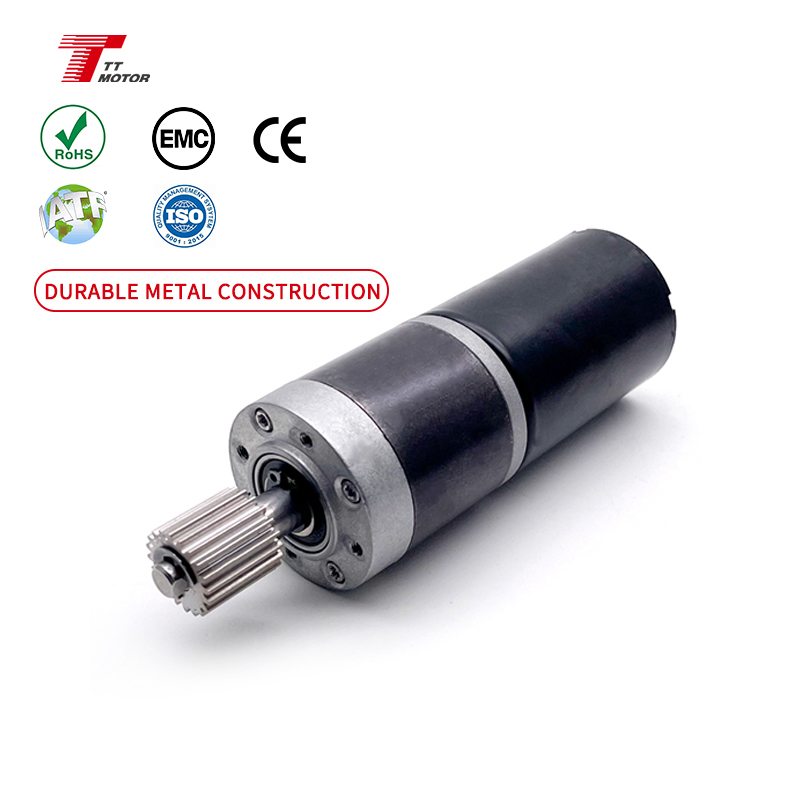
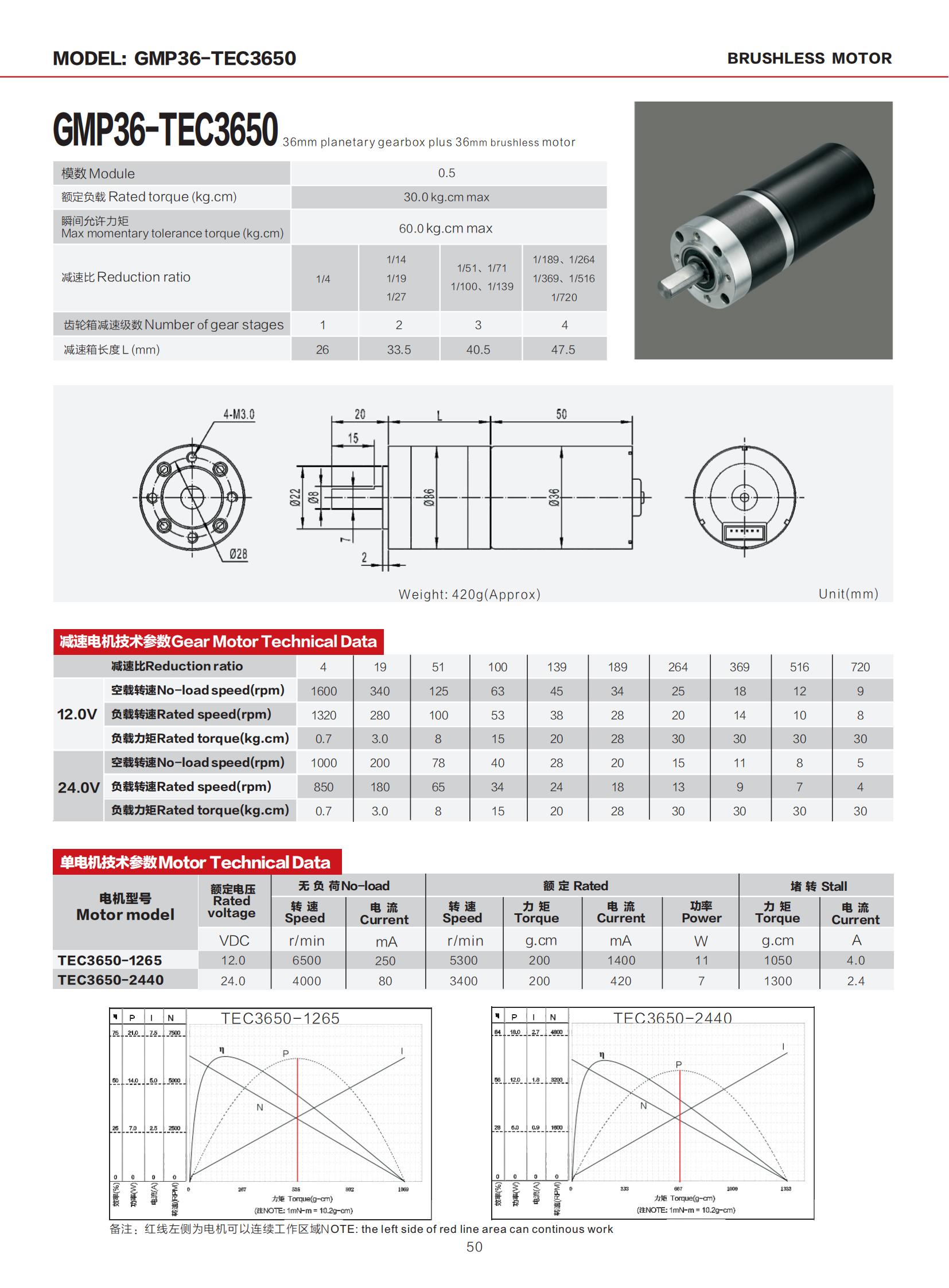
The GMP36-TEC3650 is a brushless planetary gear motor built on module 0.5 gearing with 1 to 4 gear stages and gearbox lengths of 26 / 33.5 / 40.5 / 47.5 mm. It is rated for DC 12–24 V, a speed range of 4–1600 rpm and a maximum rated torque of 30.0 kg.cm. The range offers ten reduction ratios from 1/4 to 1/720.
Its mechanical design targets space-constrained integration. The 36 mm motor body and the 36 mm gearbox share one diameter, so overall length grows only from 26 mm to 47.5 mm depending on stage count, at a stated weight of 420 g. The output is an 8 mm diameter solid shaft with 4-M3 flange mounting holes, combined with precision-machined planetary gears intended for low operating noise, minimal transmission backlash and high positioning accuracy.
Because the brushless structure removes brush contact, the manufacturer states a maintenance-free service life far exceeding that of brushed motors of the same size, typically tens of thousands of hours, with no regular brush replacement. Voltage is also customizable for specific programs.
TWG3246-TEC2430 — brushless worm gear motor
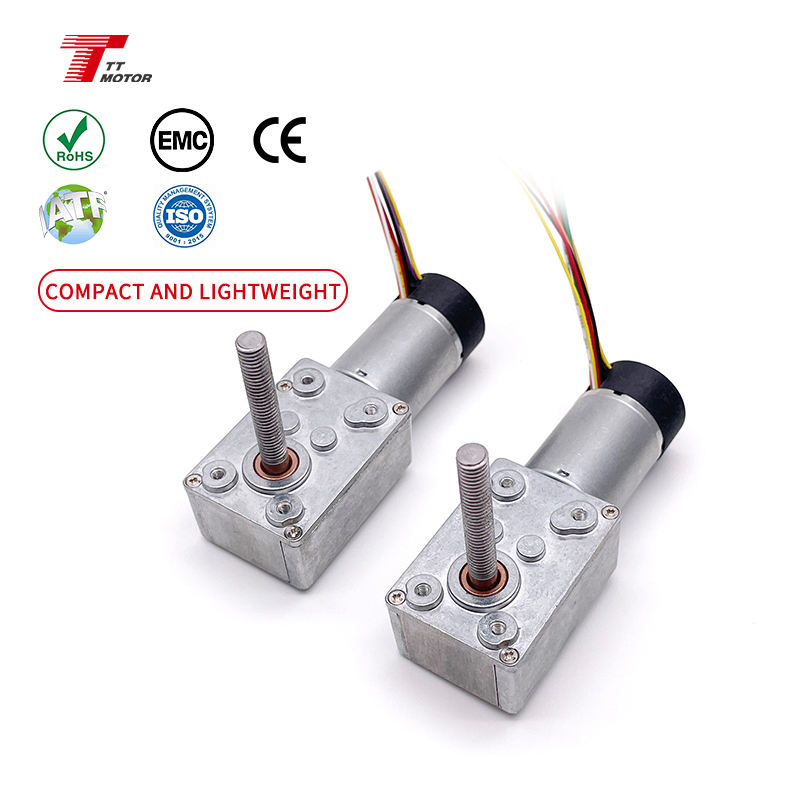
The TWG3246-TEC2430 is a brushless worm gear motor built on module 0.5/0.6 gearing with 3, 4 or 5 gear stages and a 46 mm gearbox. It is rated for DC 12–24 V, a speed range of 3–35 rpm and a maximum rated torque of 8.0 kg.cm, using stainless steel, iron and copper construction.
Its defining characteristic is right-angle output with a self-locking function. In many designs that removes the need for an additional braking device to hold position, because the worm stage resists back-driving. The same architecture delivers an extremely high reduction ratio and high torque inside a compact envelope, which is what makes extremely slow, smooth fine-tuning movement possible.
Additional stated characteristics include low power consumption and an ultra-long lifespan, a brushless structure that produces no spark and minimal electromagnetic interference, and a wear-resistant, impact-resistant mechanical design with very low operating noise.
Application Fit: Where GMP36-TEC3650 Belongs on the Shortlist
The GMP36-TEC3650 is applied in robots, medical devices, industrial automation equipment and intelligent logistics equipment. Its documented fit is in axes that combine moderate torque with repeated, fast movement.
Robot joints. In the robot industry the motor drives robot joints and operates in start/stop, forward/reverse and speed-change modes under high-frequency dynamic motion with rapid start and stop. The application requires high power density, fast response and low inertia, and the drive is integrated with robot joints, encoders and actuators. The scenario is common in North American markets such as the United States and Canada and is also common in Germany.
Medical equipment. In the United Kingdom, product 9125, which is the GMP36-TEC3650, is used for driving medical pumps, with a project scale of 500 to 2,000 units per year and a running duration of 3 years or more. The motor is also applied to long-term intermittent positioning duties in surgical stapler and rehabilitation robot equipment, where low noise and low vibration operation are required. In the medical pump case, the reported result was stable output under long-term operating conditions with reduced equipment maintenance frequency.
Industrial automation and intelligent logistics. A US logistics equipment case covering 1,000 units used the model to drive conveyor equipment and sorting mechanisms over a duration of 3 years or more, with the reported result of stable operation under frequent start-stop and load changes. Case highlights were fast start-stop response, high torque and good durability.
Application Fit: Where TWG3246-TEC2430 Belongs on the Shortlist
The TWG3246-TEC2430 is specified for miniature medical devices, precision automated instruments and electrically adjustable supports — equipment where the axis moves slowly, positions accurately and must often stay put.
The 3–35 rpm band is the point of the design, not a limitation of it. Analysis instruments, dosing mechanisms and adjustable support structures frequently need motion that is slow enough to be controlled precisely and smooth enough not to disturb the payload. The self-locking output then holds the position after the move, which simplifies the mechanism instead of adding a brake.
Smart home applications. Within TT Motor's smart home application profile — defined by low-speed, limited-space conditions and low-speed, intermittent, positioning operation with miniaturization, low noise and low power consumption as special requirements — the TWG3246-TEC2430 is listed among the applicable products, alongside a spur gear motor option. The listed smart home project types include smart curtains, smart camera pan-tilt units, smart height-adjustable desks, smart refrigerators and smart trash cans.
Smart lock mechanisms. In North America, product 9192, which is the TWG3246-TEC2430, has been associated with long-term supply stability of more than 5 years in a smart lock mechanism application, where the main issue addressed was meeting high-frequency unlocking and locking requirements. Reported results include small size, high torque and low noise, and stable batch operation for a customer volume band of 5,000 to 50,000 units per year.
Verified Specification Comparison for the Shortlist Decision
The table below places the two shortlisted brushless gear motors side by side, with three adjacent models from the same supplier range included for context on brushed and coreless alternatives. This is an application-fit shortlist, not a universal ranking: no single model in the table is the correct choice for every precision motion project.
| Model | Type | Rated voltage | Max rated torque | Speed range | Gear stages | Output and integration notes |
|---|---|---|---|---|---|---|
| GMP36-TEC3650 | Brushless planetary gear motor | DC 12–24 V | 30.0 kg.cm | 4–1600 rpm | 1 / 2 / 3 / 4 | Inline 36 mm diameter, gearbox 26–47.5 mm, 8 mm solid shaft, 4-M3 flange holes, 420 g |
| TWG3246-TEC2430 | Brushless worm gear motor | DC 12–24 V | 8.0 kg.cm | 3–35 rpm | 3 / 4 / 5 | Right-angle output with self-locking, 46 mm gearbox, no extra brake typically required |
| GM37-555PM | Brushed DC spur gear motor | DC 12–24 V | 8.0 kg.cm | 5–800 rpm | 2–6 | 37 mm outer diameter, 6-M2.5 flange holes, simple drive and low system cost |
| GMP12T-TDC1215 | Brushed coreless gear motor | DC 4.5–12 V | 2 kg.cm | 8–5000 rpm | 1 / 2 / 3 / 4 | Ultra-compact flange-mount design, very low rotor inertia, fast dynamic response |
| GM12-N20VA | Brushed DC spur gear motor | 2.4 V / 5 V | 0.5 kg.cm | 12–1450 rpm | 2 / 4 / 5 / 7 | Small envelope for smart home drive axes, metal precision gearbox |
Duty Cycle, Hold Position and the Question Buyers Often Skip
Duty cycle separates the two brushless shortlist entries more sharply than torque does.
The GMP36-TEC3650 is documented for high-frequency dynamic motion with rapid start and stop, and for start/stop, forward/reverse and speed-change operation. Its brushless construction removes brush wear, so the maintenance burden associated with repeated cycling falls away — the manufacturer describes the service life as far exceeding equivalent brushed motors, with no regular brush replacement. That makes it the more suitable entry for axes that cycle often and run long.
The TWG3246-TEC2430 is documented for low-speed, intermittent, positioning operation. Because the worm stage self-locks, the mechanism can hold a position without an additional braking device, and power consumption stays low because the motor is not required to hold torque continuously. For instruments that move occasionally but must remain stable in between, this behaviour is often more valuable than a higher torque ceiling.
Market Context: Why Small Brushless Drives Keep Expanding
Global demand for brushless drive technology continues to grow from a large base. Grand View Research and Precedence Research both place the global brushless DC motor market at approximately USD 22.2 to 22.33 billion for 2025, with a forecast period running from 2026 to 2033. At the component trade level, the OEC reports global export value of electric motors with an output below 37.5 watts at USD 16.3 billion in 2024 under HS code 850110 — the customs category that covers the miniature and sub-fractional motors used in the equipment discussed here.
Efficiency expectations are also moving, though largely at a different scale. The IEC added the IE5 ultra-premium efficiency class to IEC 60034-30-1:2025, effective 1 January 2025. That framework is a direction of travel for motor efficiency classification rather than a specification line that miniature gear motors are measured against today.
Within precision equipment, the practical driver is not regulation but maintenance economics. Machines that run continuously — analytical instruments, infusion systems, automated logistics lines — are increasingly specified with brushless drives because eliminating brush replacement removes a scheduled service event from the equipment lifecycle.
Brushless Versus Brushed Alternatives: What the Shortlist Gives Up
A brushless gear motor is not automatically the better answer, and the shortlist above includes real trade-offs.
Drive electronics are a design cost. A brushless motor cannot be run directly from a DC supply the way a simple brushed motor can. It requires commutation electronics — a driver or controller — which adds a board, a cost line and an integration step to the assembly. A brushed model such as the GM37-555PM is described in its own specification as offering simple drive and low system cost, with a 37 mm outer diameter and 6-M2.5 flange holes that make replacement and integration straightforward. Programs with tight electronics budgets or short development cycles may still find a brushed drive the pragmatic choice, accepting brush wear as the trade-off.
Envelope is fixed, not flexible. The GMP36-TEC3650 measures 36 mm in diameter and weighs 420 g at its stated figure, with gearbox length growing from 26 mm to 47.5 mm across the stage options. It is compact for its torque class, but it is not a miniature motor. Designs below that size class need a different entry in the range — the GMP12T-TDC1215 coreless gear motor reaches 2 kg.cm across 8–5000 rpm in a smaller envelope, and the GM12-N20VA spur gear motor covers 0.5 kg.cm at 2.4 V or 5 V — but neither matches the planetary model's torque ceiling.
Speed range is architecture-bound. The TWG3246-TEC2430 operates between 3 and 35 rpm. Any mechanism that must complete a move quickly cannot use it, regardless of how suitable the right-angle output and self-locking behaviour would otherwise be. Its 8.0 kg.cm rated torque ceiling is also roughly a quarter of the planetary model's 30.0 kg.cm, and its gearbox length is fixed at 46 mm.
Worm reduction trades efficiency for reduction. A worm stage achieves a very high reduction ratio in a single compact, right-angle step, and self-locking comes with that geometry. In general engineering terms, worm gearing achieves that in exchange for lower transmission efficiency than spur or planetary gearing, because the contact is largely sliding rather than rolling. For slow intermittent positioning that trade is usually the right one; for a continuously running axis, it is a factor worth calculating.
Efficiency regulation is not the compliance driver at this size. EU Ecodesign Regulation (EU) 2019/1781, effective 1 July 2021, sets IE3 as mandatory for motors from 0.75 kW to 1000 kW and IE2 for the 0.12 kW to 0.75 kW band. Those thresholds sit well above the power level of the miniature gear motors discussed here, so buyers should not assume that compliance with motor efficiency regulation is what governs acceptance. Project-specific documentation requirements should be defined by the buyer and confirmed during sampling.
Purchasing and Acceptance Questions for Either Shortlist Entry
Because both models come from the same manufacturer, the commercial framework is identical. TT Motor operates an OEM/ODM production model with customization available on shaft, encoder, gearbox, voltage, logo and speed. Quoted commercial parameters are a minimum order quantity of 2 pieces, sample lead time of 15–25 days and bulk lead time of 30–45 days, with a monthly capacity of 800,000 pieces and 100% testing. After-sales support is provided remotely.
On the technical side, an acceptance plan for a geared brushless drive should cover:
- Rated torque verified at the rated voltage, and speed verified both at no load and under the rated load.
- Noise and vibration measured at the operating point, which matters most in medical and instrument applications where low noise and low vibration are stated requirements.
- Backlash and positioning repeatability, particularly for the planetary model where minimal transmission backlash and high positioning accuracy are part of the stated design intent.
- Batch-to-batch consistency between the sample lot and the production lot — the sample is a validated design, not a guarantee of production spread.
- Documented test records from the supplier's own test system, since 100% testing is a process claim that should be evidenced for the delivered lots.
Supply continuity deserves the same attention as specifications for any product with a multi-year lifecycle. The smart lock mechanism application attached to the TWG3246-TEC2430 records more than 5 years of supply stability, and the UK medical pump application attached to the GMP36-TEC3650 records a running duration of 3 years or more — both relevant reference points when a buyer is assessing whether a motor will remain available across a product's production life.
Future Outlook
Two forces appear likely to shape this category over the forecast period through 2033. The first is the continued migration from brushed to brushless drives in equipment that runs for long periods, driven by the removal of brush replacement from the maintenance schedule rather than by any single regulatory requirement. The second is the maturing of the small-motor trade itself: with global exports of sub-37.5-watt motors already measured at USD 16.3 billion in 2024, the competitive differentiator at this size is less about raw capability and more about consistency, documentation and long-term supply reliability.
For precision motion projects, that shifts the shortlist question. The choice between a planetary and a worm architecture will still be decided by load, speed and hold behaviour. What is likely to change is how much weight buyers place on evidence — test records, batch consistency and multi-year supply history — when two technical options look equally plausible on paper.
FAQ
What is the difference between the GMP36-TEC3650 and the TWG3246-TEC2430?
They are different gear architectures built for different motion profiles. The GMP36-TEC3650 is a brushless planetary gear motor rated for DC 12–24 V, up to 30.0 kg.cm rated torque and 4–1600 rpm, with 1 to 4 gear stages. The TWG3246-TEC2430 is a brushless worm gear motor rated for DC 12–24 V, up to 8.0 kg.cm rated torque and 3–35 rpm, with 3 to 5 gear stages and a right-angle, self-locking output.
Which of the two suits a robot joint that requires fast start and stop?
The GMP36-TEC3650. It is used in the robot industry for driving robot joints, operating in start/stop, forward/reverse and speed-change modes under high-frequency dynamic motion with rapid start and stop, and it is applied with robot joints, encoders and actuators. That application requires high power density, fast response and low inertia. The TWG3246-TEC2430's 3–35 rpm speed range is not suited to that duty.
When does a self-locking worm gear motor make sense?
When an axis must hold its position without a separate braking device and when motion must be extremely slow and smooth. The TWG3246-TEC2430 uses a right-angle worm output with a self-locking function, and the manufacturer states that typically no additional braking device is required. This fits miniature medical devices, precision automated instruments and electrically adjustable supports, which are listed as its applicable industries.
How should duty cycle affect the shortlist decision?
Duty cycle determines whether brush wear and continuous holding torque matter. The GMP36-TEC3650 is documented for high-frequency dynamic motion and rapid start-stop cycles, with a brushless structure that the manufacturer describes as maintenance-free with a lifespan far exceeding same-size brushed motors. The TWG3246-TEC2430 is documented for low-speed, intermittent, positioning operation, where self-locking means the motor does not need to hold torque continuously and power consumption stays low.
Is the 30.0 kg.cm figure on the GMP36-TEC3650 the load I can work with?
It is a maximum rated torque, and rated torque is defined as the torque that can be continuously output under specified operating conditions. It is not a peak or stall figure. Buyers should confirm the actual continuous load, any short-term heavy-load margin and the required speed with the supplier against the real move profile, rather than treating the ceiling as an available working load.
Do EU motor efficiency regulations apply to these miniature gear motors?
Not in the way they apply to larger industrial motors. EU Ecodesign Regulation (EU) 2019/1781, effective 1 July 2021, requires IE3 for motors from 0.75 kW to 1000 kW and IE2 for the 0.12 kW to 0.75 kW band. Those power thresholds sit well above miniature DC gear motors. The IEC 60034-30-1:2025 addition of the IE5 ultra-premium efficiency class, effective 1 January 2025, is likewise a classification framework rather than a specification line applied at this size.
What should be checked before approving a sample for production?
At minimum: rated torque at the rated voltage, speed at no load and under rated load, noise and vibration at the operating point, backlash and positioning repeatability, and batch-to-batch consistency between the sample lot and the production lot. TT Motor's stated commercial parameters include a minimum order quantity of 2 pieces, sample lead time of 15–25 days, bulk lead time of 30–45 days and 100% testing, with OEM/ODM customization available on shaft, encoder, gearbox, voltage, logo and speed.
For further reference, TT Motor's published company brochure covering its miniature motor range is available here: TT Motor company brochure (PDF).